This week is Open Education Week and I am super excited to join in the fun, celebrating all things open in education. If you want to catch me live, I am joining a whole host of special guests on air hosted by the one and only Alan Levine on Wednesday:
P.S. It was a lot of fun to join Alan online, and here is a screenshot of a moment that made me smile: all of us talking about online, digital, AI and so forth, surrounded by books.
Open practice is central to all the work I do and for the past ten years my interest in and commitment to open has only increased. So it’s been a special pleasure to take part in a series of conversations in the run up to this week:
Building Community with guest Martin Hawksey!, Reclaim TV, 9th February 2024 was the first of these. I was lucky to join my Reclaim colleagues Amanda and Taylor and our special guest Martin Hawksey, who for me is both a friend and long-term collaborator. Community building is really at the heart of open practice for me, and we chatted about how to engage with people, how to reach new communities and networks, the impact of the pandemic and the changes in the social media landscape. Martin has more experience in this space than most, having built, curated and supported communities from the local to the global scale over the past fifteen years or more. There is little he isn’t expert in when it comes to making technology serve communities, and in this session he shares some of his reflections as well as tips 🙂
Building on that conversation, Reclaim & OER #4Ever, with Meredith Huffman, Reclaim TV, 16 February 2024 took the community building one step further as we previewed a talk we are planning for OER24. The theme of the talk is putting community together with capabilities and CPD, sharing approaches for gaining skills and expertise in open educational technology. Plus, we share a lot of fun memories of what we got up to at open education conferences over the years.. (friendly warning: shoe tweets are mentioned in this episode). I love how Meredith explains how building on hosting and infrastructure the community piece can help empower staff to have a better relationship with tools and technology which benefits not only the institution, but students as well. I can’t wait for OER24!
For me the conversation that brought all the elements together was Using Open Source tools as key infrastructure, with Anne-Marie Scott, Reclaim TV, 1 March 2024. This is the one where we talk big picture, global policy and institutional change. I love listening to Anne-Marie share her rich, reflective perspective and admire her ability to explain even the most complex dynamic in open source and open tech with such clarity, that you always leave inspired and empowered in equal measure.
And to add another piece of blogging goodness, I have shared a bit more over on the Reclaim blog.
Don’t want to miss what I am up to? Get a free, monthly summary to your inbox:
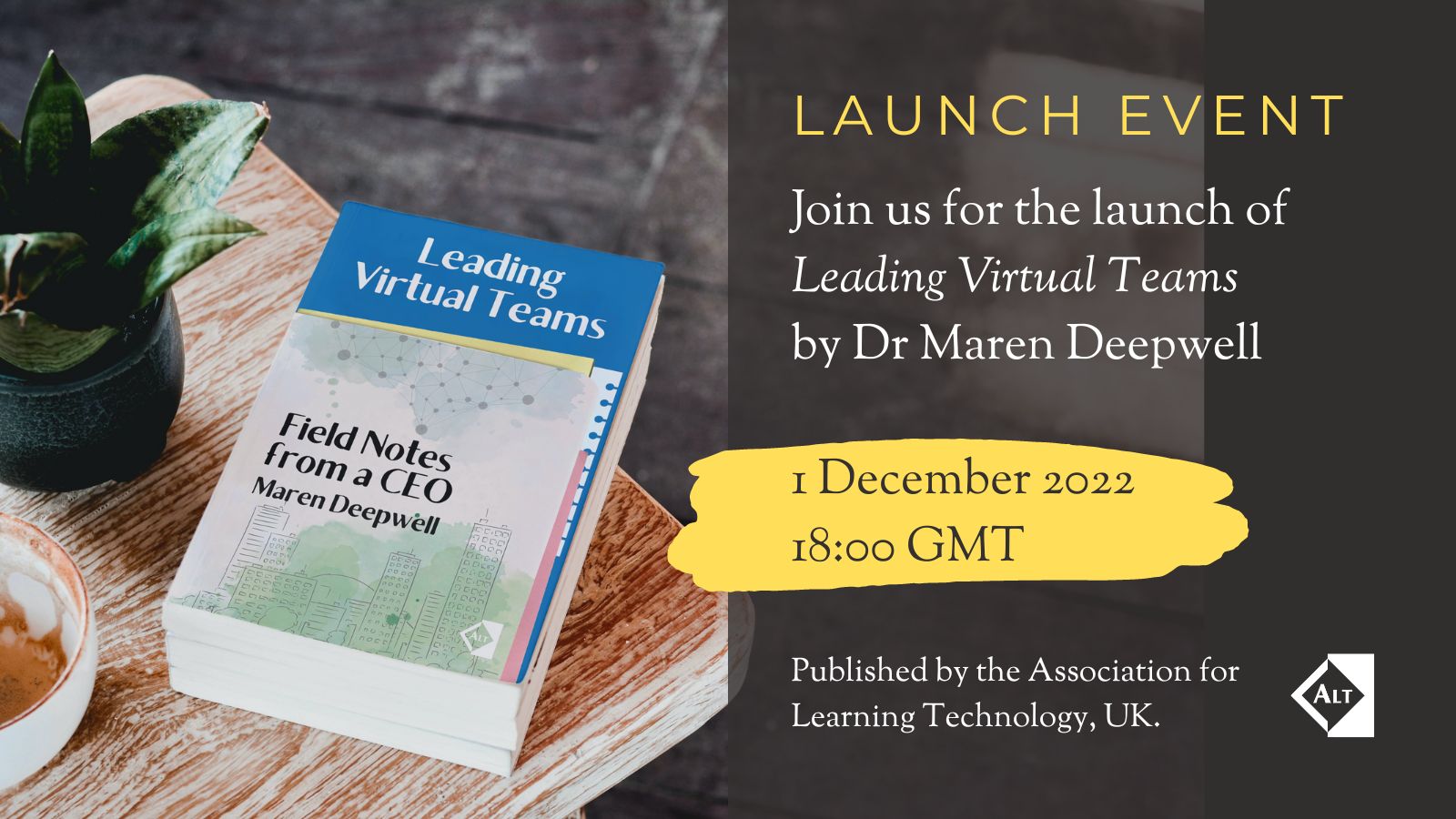
A year ago my book Leading Virtual Teams was published, and I can very clearly remember all the wonderful excitement that led up to the launch, and am still grateful for all the encouragement for this Open Access publication.
A year on, and the book, which was initially inspired by the work Martin Hawksey and I did at ALT, has turned into a whole host of resources, two free courses and a podcast which informs my wider work on hybrid working leadership development and coaching.
A year in Leading Virtual Teams
To celebrate the milestone, this post gives a quick overview over what’s happened in 2023 and if you are just discovering the book or my work, this is a great place to start:
Open Access publication – December 2022
Leading Virtual Teams – Field Notes from a CEO by Dr Maren Deepwell, was published in December 2022 as an open access publication by the Association for Learning Technology, UK. You can read and download a free digital edition, published as an Open Access publication by ALT in partnership with Open Academia.
I started the podcast in 2022, but in spring 2023 things really started happening. Each week, I share ideas and strategies for creative and fun approaches to help you succeed and lead in the hybrid workplace. Each episode includes tools, resources and strategies for different aspects of hybrid working, and links to blog posts and further reading.
Podcast | Blog post | Part 4: Fostering a shared team culture (12 May ’23)
Podcast | Blog post | Part 5: Leading team activities (19 May ’23)
Podcast season 3 with weekly episodes – September 2023
In September I was excited to have Season 3 of the Leading Virtual Teams Podcast finally underway. It’s a new season in every sense… and that is why I kicked off with ‘new pencil case’ moments in episode.
This episode celebrated the start of September, and the new season or start of term for many of us. I have recently tried out a new gratitude journal share ideas for how to find bright spots in a busy time of year. I also give you a preview of what’s in store for season 3 and the upcoming run of the Leading Virtual Teams course in October.
Free Hybrid Working Habits course launches – October 2023
I have experienced a lot of ups and downs working from home, managing remote workers and collaborating virtually, and I chronicled this in my book, Leading Virtual Teams (2022). One of the things I learnt along the way is that a good work/life balance and relationship with digital technology may look a little different for everyone but that the journey how we get there is similar. That’s why I designed this course: to share practical tips that you can use to find ways to make hybrid working really work for you (or you team or organisation) in the long term.
It’s been great to see the course attract lots of listens and interaction. Although I do encourage people to register for free, only about half of the people participating in the course do. Others prefer to simply subscribe to the podcast to listen along and explore at their own pace.
The topics for the course resonated well with participants, especially those designed to help manage digital overwhelm and setting life/work boundaries. Plus, I really enjoyed recording these as well, which is an added bonus!
The course resources and podcasts are now freely available and you can explore topics at your own pace. The easiest way to do that is to listen to the course podcast:
It’s been a wonderful year, and it’s also been a lot of hard work. Practically all my work in this area since the publication of the book has happened around the edges of my day job, and especially until the end of September that was a very full on commitment. Since focusing full time on my free-lance work I have had a little more scope to take on paid work in this space, and thus give this topic a bit more time in my day to day work.
Every now and then I get an email or a message or someone speaks to me at a conference about something valuable they found in the book, something that helped them in their work or opened up a new perspective and it always, always makes my day.
I have chosen not to publish the book commercially, instead going the Open Access route with the book and all the resources and courses I have published since, because I want as many people as possible to learn from the mistakes I made and the experiences I recount, and find a better way to manage blended, hybrid and virtual organisations. One downside is however that I have not much data about how many people engage with the work I do, and with an ever more fragmented social media landscape getting a feel for one’s reach is more challenging still. Which is why I value it so much when folk do share some feedback or send me a message.
All in all, it’s been a fun and rewarding year working towards putting the book into practice and making the ideas in it available to a larger audience.
Enjoyed this post? Get my free monthly newsletter directly to your inbox.
It’s a miserable day today in Cardiff. Grey, dark and rainy. Typical November weather. I am sitting at my desk with the light on although it’s only midday. Inside my head however, the sun is shining, at least figuratively, because my first OER24 submission is in!
the 15th annual conference for Open Education research, practice and policy will be organised by ALT, the Association for Learning Technology, in partnership with Munster Technological University (MTU).
MTU offers an excellent space for all members of the open education community to collaborate, learn and share in an inclusive environment. We are excited to welcome OER participants from the UK and across the world to the MTU Bishopstown Campus in Cork, Ireland.
Dates: Wednesday 27 and Thursday 28 March, with the GO-GN workshop on Tuesday 26
OER24 will bring together the strong Irish Open Education movement and international participants to leverage our shared expertise for change in policy and practice.
Now, I have blogged quite a lot about the OER Conference over the past few years, culminating in one very long post (love letter) to the event last year… as OER23 was my final event as CEO of ALT and an unforgettable conference.
The start of a new chapter
This year however, I get to return as a delegate for the first time, and hopefully as a presenter, too. Thanks to the great work of all involved, the Call for Proposals was out earlier than usual, giving me extra impetus to get my thoughts in order and draft my first ever ‘external’ submission to the event.
I love the themes the Chairs and Committee have picked this year:
The conference will put the spotlight on Open Education practices through five themes:
Open Education Landscape and Transformation: This theme explores Open Education and its transformative potential, with a particular emphasis on key initiatives and developments in the Irish education and training context.
Equity and Inclusion in OER: This theme delves into the role of Open Educational Resources (OER) in serving marginalised groups and in promoting inclusivity, diversity and equity in open education.
Open Source and Scholarly Engagement: This theme focuses on the connection between Open Education, Open Data, the Open-Source movement, and digital scholarship/librarianship, showcasing the collaboration of researchers across these areas.
Ethical Dimensions of Generative AI and OER Creation: This theme highlights the ethical considerations surrounding the use of generative AI for content creation and its potential in making educational content more accessible.
Innovative Pedagogies and Creative Education: This theme explores the intersection of Open Education with instructional design and learning design, examining creative practices and innovative pedagogies that enhance the learning experience.
And I picked the theme around innovative pedagogies and creative education for my submission. My hope is that if everything works out as planned, I’ll be there with my partner and his colleagues from the Open University as well as my colleagues from Reclaim Hosting, and of course I can’t wait for an opportunity to see at least some of my former team at ALT in person, too. Hugs will most certainly happen.
Get your proposals submitted!
If you are thinking of making a submission, I would really encourage you to put one in. You only need between 250 – 500 words and there are a lot of fun formats to choose from, ranging from workshops to presentations and, of course, the one and only GASTA format, which promises to be 5 minutes of unforgettable fun.
This is a conference where you will not only be welcome, but which will recharge those batteries of enthusiasm and hope for the whole year… (just look at the keynote line up!).
Fingers crossed, I’ll be seeing you in Cork in March!
Enjoyed this post? Get my free monthly newsletter directly to your inbox.
Yep, this is another post about houseplants… or rather things we can learn from plants. I’ve previously published leadership lessons from office plants and in the same spirit this post is all about houseplant inspired tips for managing a period of change or transition.
It’s inspired by my own experience of moving between jobs this month and my adventures in caring for a growing collecting of plants in my home and home office. It’s the first time in a long while that I am changing jobs, but the last few years have brought so much uncertainty with them that I feel I have quite a lot of practice of coping with the unexpected. What the last few years have also highlighted for me is how important it is for us to have strategies for periods of transition – and like many I found solace and inspiration in bringing a bit of green indoors.
So in the spirit of open practice, here are my personal reflections and practical tips. You can also listen related episode of my podcast on Apple Podcasts.
Allowing time to be less productive
One of the things I have struggled with a lot in recent months is just how much there is I don’t know or can’t control, both when it comes to changing jobs and also in relation to my plant collection. Although I am looking forward to the changes ahead, it’s still disconcerting not to know what the next day, week or month will bring, how it will feel, if what’s ahead is fun or frightening. While I have plenty of practice in dealing with uncertainty both professionally and personally, the emotional toll of not know is still there.
Hence there is a lot of need to get comfortable with accepting what I can’t control and to sit with my feelings, comfortable with being uncomfortable. Spending time with plants is one way of making that space and time to acknowledge to myself (and where appropriate to others) what I am feeling. I might go for a walk or sit quietly somewhere, or lie on the sofa cuddling my dog. The particulars don’t really matter. What does matter is that in that extra time I need I am not being as productive as usual. I am not achieving or working in the way I usually do. It’s a season of change, and just like my plants aren’t always growing new leaves or in bloom, I am adjusting and trying to enjoy this period for what it is.
Reflecting to gain perspective
Reflecting is a key part of my professional practice. I like reflecting in conversation, by writing in my journal, or just thinking about things. That said, at the moment I am finding it difficult to focus. I sit in front of a blank page and I can’t find the words to start. There seems to be too much to reflect on to know where to start, or indeed everything I can think of doesn’t seem worth mentioning.
Fortunately, I have a coach whom I get to lean on in times when my own capacity to gain perspective is low, but I also found some prompts to help me reflect. What I do is to start on a fresh page, and write down 3-5 questions that I then answer in turn. Here are some examples of the kind of questions I ask myself:
What was hard today?
How would you like tomorrow to be different?
What do you wish you had done or said differently?
Why are you feeling the way you do?
What has changed in the past week/month?
What are you looking forward to next?
What would you wish would go away?
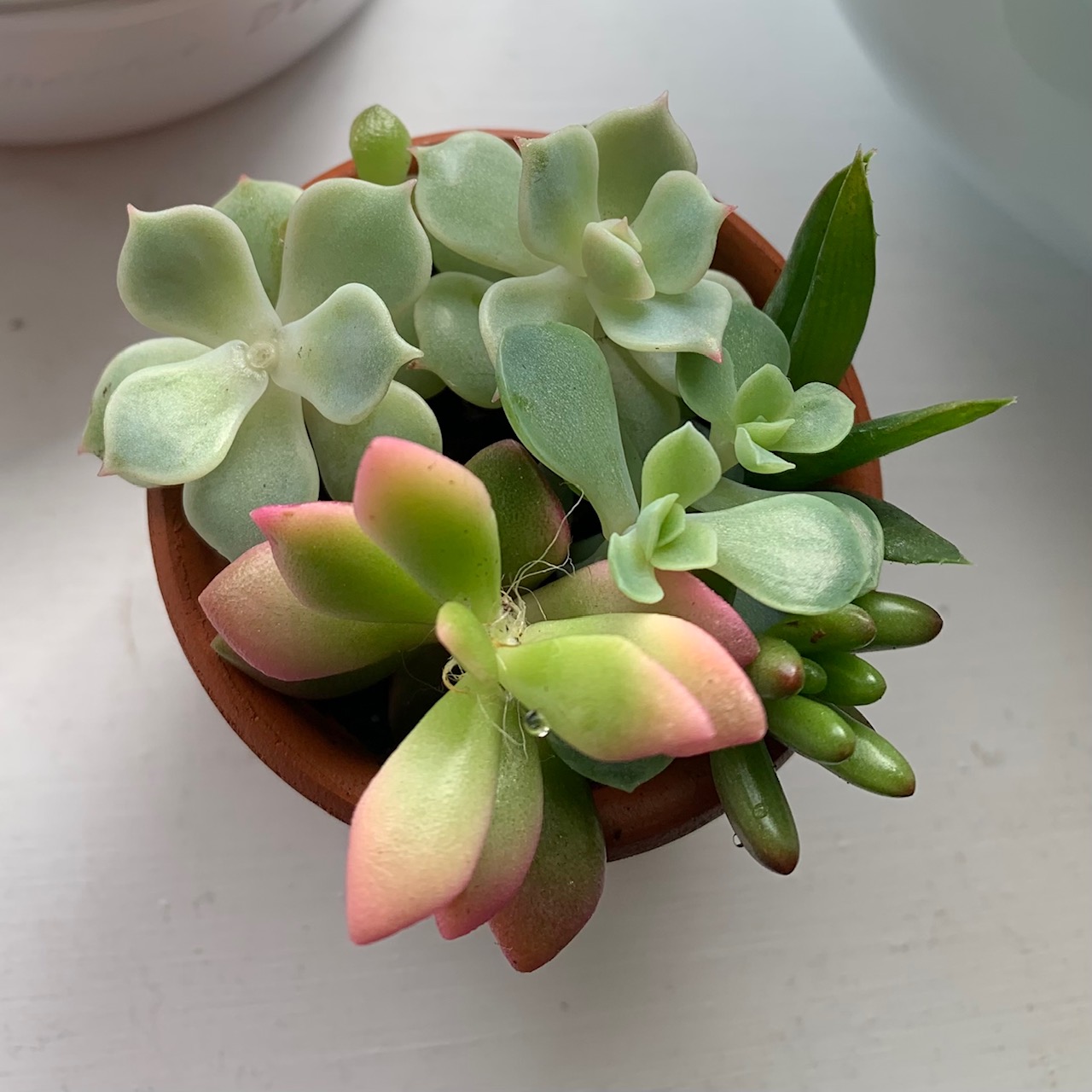
I have some very small succulents at the moment, and they are so interesting to watch. Day to day they don’t really change, and sometimes I give them to much water or too little, and some of them don’t like it, but with patience, they do change and grow and you can also really see those changes over a period of time. Similarly, in my journal, I can usually only spot the patterns when I look back at what I wrote 3 months or even a few years ago. It serves to remind me that my current perspective is always limited by the here and now.
Focus on what stays constant
Even in times of transition many things remain the same and it can help to focus on these. For me, it’s easiest to find constants in my home, my daily routine and my own skills and capacity. Here are some examples:
Home: I like finding my favourite comfy spots to read and have tea. Particularly during a stressful day, I enjoy looking out of the window and observing the outside world. I also have a great fondness for plants, and I have about 10-15 houseplants in my office. Plants change at a much slower rate, as they grow and develop. I enjoy observing them closely and soak up some of their patience and calm along the way.
Daily routine: tea in the morning, walking the dogs, even answering emails can be comforting routines. I really enjoy routines and habits, even though my week is not planned out in every respect. I like having flexibility to decide when I want to exercise or do chores, but doing familiar things is still comforting.
Skills and competencies: one of the things I find most comforting about change is that I can continue to rely on my own skills and competencies even when the context in which I apply them changes. For instance, I love planning and organising things. I enjoy being creative and producing content. My work rate is extremely high, and I get a lot done. All of these aspects remain the same, and I try to lean into those strengths.
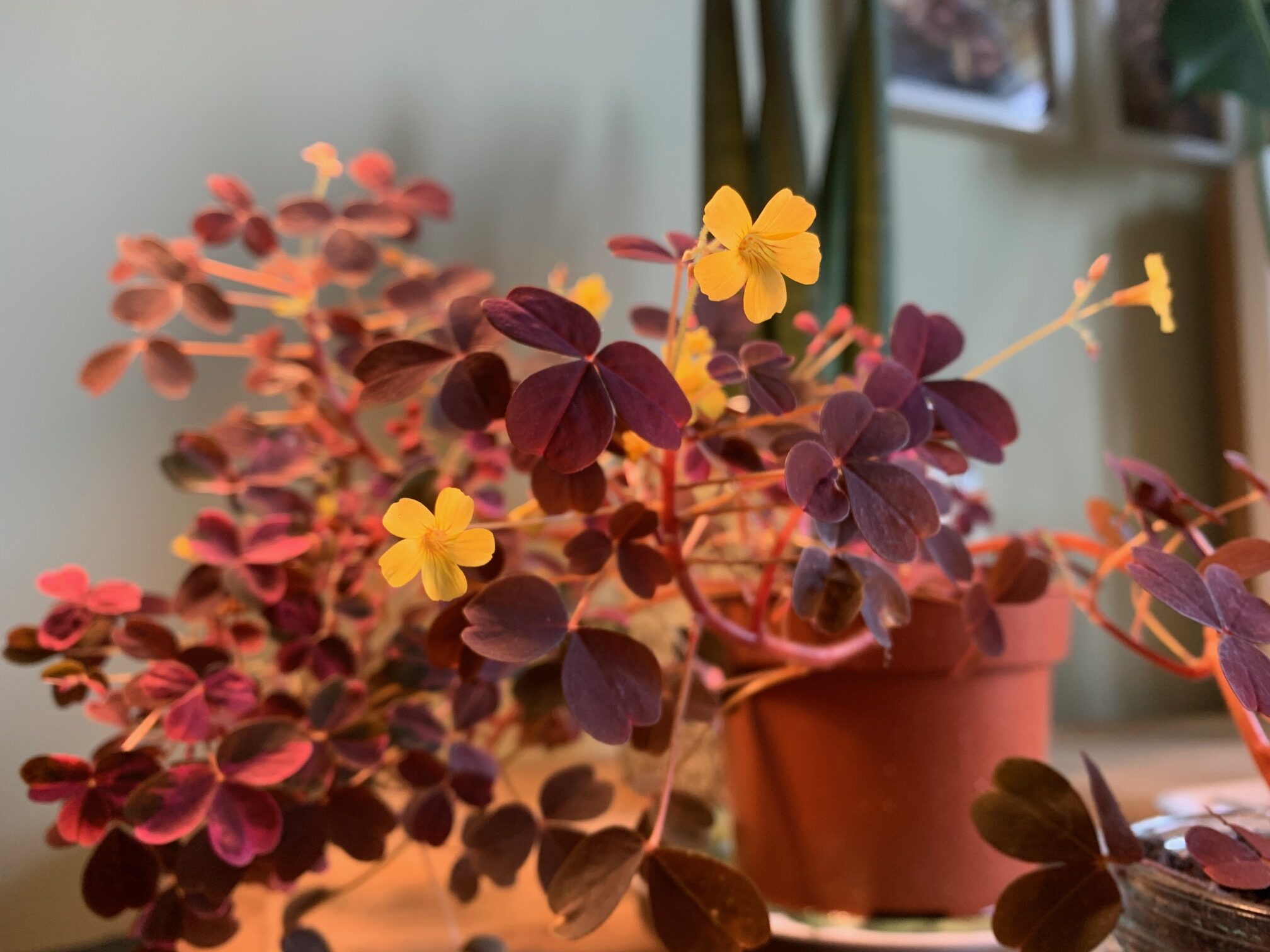
This plant, an Oxalis, arrived at my office from a local plant fair very recently. It usually grows near water, like a brook or stream, and is used to having some sun, but not too much, and to be kept moist and not dry out. So far, I am happy to say, I haven’t managed to kill it, but there’s always a high probability of failure with a new plant I am still learning about. I don’t know yet how the plant will adapt to my office, or what it might need. Context is everything, and with a change in environment there’s always a risk of failure. Like with plants, people, too, need conditions to thrive, and they provide a constant reminder of that.
There are other strategies that work for me at the moment, including making time to practice gratitude, taking breaks, planning for a holiday and re-inventing some of my weekly routines. In short, everything I do when moving at ‘plant pace’ (slow, intentional, balanced, looking after my needs) feel good and are helpful in this period of transition.
There are also some things that aren’t working for me:
Can’t rush settling in
One of the aspects about change that frustrates me is that you can’t rush it. Things take time to adjust, and other people and processes need time to catch up. Most importantly, I need time to adjust. And yet, my mind would like it to be sometime in the future when everything feels settled and the new routines have become familiar.
Feeling unsettled is hard and most of the time actually making a plan happen takes a lot longer than conceiving of it in the first place. Although I can comprehend that things simply take time to change, and that I need time to adjust and process everything I still find it frustrating at times.
Digital difficulties
The other part of transitions that I find difficult is in how many different places information needs to be updated. From social media sites to email footers, to life admin and address books, it feels like a mammoth task to even change my email address. That is one aspect of changing roles that I really don’t enjoy as it’s simply tedious to go through and unsubscribe, update or delete everything.
I am going to check back in on this in a few months, partly to report back on progress, and also to get a feel for how my perspective is shifting as the transition continues.
Enjoyed this post? Get my free monthly newsletter directly to your inbox.
As I am half way through the year, I am taking a look back at what I have blogged so far, and in the best tradition of the form, to blog about blogging once again. And, if you missed one of these, now is a good time to catch up and bookmark posts for future reading.
Blogging in numbers
So far I have published 43 blog posts this year. The average per month is 7 per month. January was the month with the most posts (10) and March and April were the month with the fewest posts (5).
At the moment, a lot of my work is focused on the upcoming OER23 Conference. OER23 is the 14th annual conference for Open Education research, practice and policy is organised by ALT, the Association for Learning Technology, in partnership with UHI, the University of the Highlands and Islands. OER23 will bring together the strong Scottish Open Education movement and international participants to leverage our shared expertise for change in policy and practice. The conference will be co-chaired in partnership with the GO-GN Global OER Graduate Network, connecting emerging researchers and a global perspective with local and national knowledge.
Suffice to say, I am super excited about this event which I have been fortunate enough to help organise since 2015 and which is always a great highlight of my year. This year, I am especially looking forward to heading up to the conference, partly because it’s in one of my favourite parts of the world, the Scottish Highlands, and partly because it will give me a chance to catch up with many friends and colleagues I haven’t seen in a while, including long-time collaborator, Lauren Hanks.
Lauren and I have been talking about hybrid working and leading virtual teams for the past few years, and at least year’s OER Conference we even ran a session together: As leaders of virtual teams, we critically examined what lessons we can learn from open approaches to learning and teaching and how we can use that knowledge in an increasingly virtual workplace. Since then, I have been thinking a lot about why open practice is so important for knowledge workers, and particularly managers and leaders who work in hybrid, distributed or fully virtual teams:
Sharing practice openly to improve practice
A few years now I was fortunate to interview a manager from Google together with my then colleague Martin Hawksey. We spent an interesting hour talking about leading a virtual team, and what struck me (and what’s stayed with me since) is how similar some of the challenges were and the solutions we had each come up with. Similar despite the fact that Google and a small, independent charity with less than 10 employees where clearly very different workplaces.
It struck how easily we forget to share how we work alongside what we do outside of formal training and development. Yes, there is a whole industry out there dedicated to workplace learning, but few of us who work in education or the third sector have a lot of scope to engage with that day to day. More often than not, a project deadline or the start of term looms large, and so we focus on the output of what we have achieved, rather than how.
In order to overcome that challenge, I build into my work routine a moment to reflect on WHY something went well or not, alongside what the outcome has been. For example, if I found a way to improve a workflow or manage my time for a project more efficiently, then I will share that with my colleagues as I go along. That is how “show & tell” time was brought into our weekly team meetings.
I am less interested in the amazing outcome of something than I am in how it was achieved and what made it work or fail. Crucially, I am most interested in sharing those insights to help us as a team and an organisation learn from that, and to help others avoid our mistakes and build on our work.
Hybrid and remote teams often focus on reporting outputs, rather than process, and so it is especially relevant for us working in virtual teams to create routine moments for reflecting and learning together casually.
Opening up space for sharing leadership practice
A really common issue for leaders in this space is worrying about “is it just me who is struggling with this?”. When everyone works from home and all you see is a carefully curated or blurred background with a professional, well-groomed headshot framed by a flattering camera angle, it can be hard to get a sense of how others are coping day to day and easy to feel that you are the only one who is struggling.
Complaining about workload or being busy is in my experience a lot more common than the kinds of problems you experience when you are leading a team or a large project. Performance management, HR trouble, lack of productivity, loss of communication… these are just a few of the issues that commonly challenge us and that can be difficult to talk about.
This is often compounded by working with colleagues who have a large online presence. When you see blog posts, podcasts or social media conversations all sharing exciting updates or personal successes, or when you see those group chats full of cheer and inside jokes rolling past you, then how do you join in? Where is the space for questions about things you are not sure of or worry you are doing wrong?
Open practice in a leadership position is different from sharing things like new publications, or blogging about exciting projects. It opens up a space to share the practice of leading, of managing people, not just the end results.
Modelling leadership with intentional communication
One of the most challenging aspects of leading people or projects in hybrid or remote teams is lack of comparison. In a traditional workplace you’d see more examples of how others lead, what their meetings or one-to-one catch ups might look like, how they deal with difficult situations or simply how they act day to day when at their desk or on campus.
Depending on how hierarchical or closed an organisation you worked for, you may see a lot of conversations happening behind closed doors, or at the pub after work, but even a lack of openness would set some kind of example.
Mediated by technology, tools and platforms, leadership can be a lot harder to observe. There is a lot of communication that you may never be aware of at all, happening in individual or group chats you are not part of, and during meetings certain ways of behaving may be the result of technical issues, lack of digital competency or simply a bad hair day. It’s much, much harder to observe how others lead effectively (or not), and to learn from that approach for yourself when everyone works remotely.
It’s also a lot harder for teams to follow the example of those who lead them, as there is so much that is not visible. You can’t really tell if your Line Manager is working hard or watching videos on YouTube when you never see them. What it comes down to is a much greater need to intentionally communicate to fill in the blanks created by hybrid working. Here are some examples from my own experience:
Tell colleagues what to expect from a meeting ahead of time, and be specific about what kind of engagement you are looking for from them;
Share when you are having a screen break or stepping away from work for a bit, to normalise taking breaks;
Set out a clear format for regular activities like 1-to-1 catch ups, and communicate what’s the same for everyone, so that others can learn from that example when organising their own meetings.