Tag: #Open

  • Working with greater kindness: how to take a break from being the worst critic of your own professional practice.

    Recently I’ve started to form a new habit, to give myself a break each day for something I’ve done or something I haven’t done. It was a kind of afterthought on a list of things, the sort of list you make at the start of the year, when the days are dark and you feel like turning over a new leaf.

    Yet, it’s been a surprisingly impactful exercise, prompting quite a few realisations about how I work:

    Being too self critical?! 

    The ease with which I find something each day made me realise that I’m more self critical than I’d thought. Having a regular reminder to give myself a break has made me take a kinder view.

    Perspective

    Often things that turn days from good to bad are quite small. Still, they can have a real impact on how I perceive things to have gone. Taking one thing out of the equation often makes things a lot better. In retrospect that is particularly helpful – focusing on good things, rather than small, but annoying niggles.

    Giving others a break

    Giving myself a break makes it much easier to do the same for others, I find. It stops me from getting distracted by minor issues, gives me more headspace to focus on what’s important. 

    Being my own mentor

    In the past, my mentor would have been the person who would remind me most often to give myself a break. It was liberating to hear and often cheered me up. Now I find reminding myself works, too. It still has the same effect. 

    Reflecting on failure

    It’s more difficult to reflect on failure than success, partly because of the emotional element. I may feel bad about a decision I made or a particular action I took and that makes me feel less comfortable, less able to think clearly about how I could have done better or what I would do differently next time. It also makes it harder to talk to others about it, because I may get defensive or focus on how I feel rather than listening. In this context giving myself a break, forgiving myself for mistakes I’ve made, is really important. It helps me to move on, to better learn from what I did or didn’t do. 

    How to… give yourself a break

    What works for me is to take a moment late in the day and think about how things have gone. Often one thing stands out as being annoying, something I wish I had done differently or something I wish I hadn’t said. It’s quite rare for nothing to come to mind. If they are too many things, I focus on whatever I feel most angry or annoyed about. Then, I take whatever it is, I acknowledge it, and give myself a break for whatever it may be. Sometimes that feels a bit like putting it in my own personal Room 101, sometimes it’s like putting it in the bin, sometimes it feels like letting go. 

    I know it’s happened, and I may have many more thoughts or feelings about my day but that one thing is now ok. Phew. 

    I found it’s much more effective than I’d expected. Maybe it’ll work for you, too.
  • Virtual teams: a special podcast edition

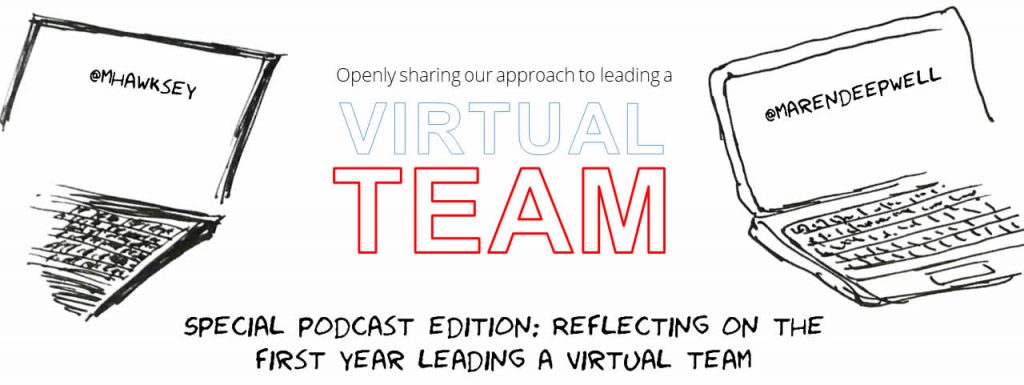
    Cover image: Special Podcast Edition: Reflecting on the first year leading a virtual team

    This post continues the series on openly sharing our approach to leading a virtual team – a joint project with Martin Hawksey (cross-posted here) for which we write a monthly blog post and this time recorded a podcast for you, too.

    What a year…

    With the transition to becoming a distributed organisation and one year of leading our virtual team under our belt, we reflect on the highs and lows, the good and the bad and most importantly on what’s ahead as we continue to develop this project in open practice.

    Maren: There’s so much I’d like to talk about that it’s hard to know where to start. First, I’m excited about how a transition plan on a spreadsheet has turned into reality, how the organisation we lead has changed over the past 18 months. Second, there’re 101 things I’ve learnt along the way, from how to set up a PO Box when you are a distributed organisation (harder than you think) to how to manage a virtual team and all that that entails. And then there are all the things I’ve discovered about being a home worker… during summer holidays, family emergencies and when things go wrong. It’s never been boring, that’s for sure!

    How about how? What’s been most surprising and rewarding this past year? What are you most keen to develop next? This time next year… will we be millionaires?

    Martin: Time has really flown by, it only seemed like yesterday that we started putting in place some of the operational changes for moving to a distributed organisation. It’s only the fact that I’ve started to receive renewal notifications for annual licences for things we didn’t require before in a host institution that I’m reminded of the realities of the changes we had to put in place. In some ways I have to say that the most rewarding thing in the past year has been the shared monthly posts we are doing. When we started I thought it would be useful to share with others the journey we as an organisation were on. I’ll let others decided whether it has been useful or not, but regardless I’ve personally greatly benefited from the opportunity to reflect on progress and consider where we go next. Reflecting on December something that stood out for me was in September’s post on the ‘serious upsides of working in pyjamas’, we discussed remote worker wellbeing. In December as the cold has set in it’s been noticeable how we’ve swapped pyjamas for thick jumpers and blankets. As a remote worker you’ve the benefit of having more control over your working environment. The downside I find, particularly if you are a skinflint like me, is you are reluctant to put the heating on if you are the only one in the property. As an employer our organisation is limited in what we can do. We all get a home working allowance but that is limited and it is up to us individually to decide how it is used. Seasonal variations in remote teams wasn’t something I had anticipated. Do you have any standout unanticipated moments?    

    Maren: It often feels to me like this whole year has been one long unanticipated moment. There’s definitely a lot we could talk about in that whole area of remote working and wellbeing. Writing these posts has helped us both become more aware of the complex issues involved and it’s interesting just how much there is to unpack here, both from the perspective of a small employer and ourselves as individuals.
    Another question you touch upon is whom this kind of open leadership practice is for. Our readers include our own team, the Board of Trustees whom we report to, Members of ALT and our professional networks. On Twitter, LinkedIn and our own blogs as well as at events we’ve been getting comments, questions & feedback – and many of them are about open practice rather than the virtual org transition. Senior staff don’t often adopt the approach we are taking, to discuss the inner workings of their organisation as they happen. Bringing our Learning Technology open practice into how we lead the team and managed the transition feels like an important step forward. It’s prompted me to think differently about innovating, about improving things even if they are new/in progress. No one gets to start new things on a blank slate or with everything in steady state very often. There’s usually legacy issues, deadlines, risks etc from the outset. By making time to focus on how we run the organisation we’ve been able to innovate much more in that area and that’s been exciting.

    Martin: You touched upon space in terms of time and locations such as various social networks. Something I’ve been thinking about more is mental space. This is an area we’ve talked about a couple of times, but a recent experience reminded me how important I find it to compartmentalize my workspace and personal space as part of being a remote worker and also how difficult it can be sometimes for others to understand this. Recently my parents were staying with us for the holidays. At home my ‘office’ is also the spare bedroom. Having a dedicated space for me to work is very important, not least it means I can just go to work each morning and not have to set up anything, I just switch on and go. This year my parents wanted to stay a little longer which meant they’d still need the spare room while I went back to work. As part of this they said they would make sure they would be out of the spare room/my office by 9am each day. Initially I didn’t say anything but in the end had to say to them it wasn’t going to work for me. The issue I had in my own mind is going to the office as a remote worker is more than just being at your desk at 9am. With suitcases and clothes lying around I was worried it was going to feel less like an office. Knowing my parents were in the house I was worried it was going to feel less like being at work. I appreciate for many these things sound trivial, but for me they are very important. If I worked in a traditional office in my own mind I knew it was going to feel like having my parents sitting in reception all day. I think this aspect of remote working can be hard for others to appreciate. Have you had any similar experiences?

    Maren: I’ve not worked from home for as long as you have and regular travel is a big part of my role, so I come to this from a different angle: I have created a mental work space that I can function in properly on a train, hotel room or at an event. I feel comfortable in that space. And it’s probably why I have a strong attachment to my chromebook, stickers and all. That said, creating that space in my head at my home has been tricky! Trickier than I had anticipated especially given how rarely I was desk based before working from home. And like you I prefer having physical space that’s ‘mine’ for that – but limited space, my cat, family etc really challenge that at times. I hated strongly disliked working in an office and I feel working from home is a hard won privilege. I love working from home and it suits me really well. Still, I have had to rearrange my set up at least 5 times in the first year, moving furniture, changing equipment, adjusting to how the sun comes in through the window and so forth. I have ended up with a yoga bolster as a footrest and using the windowsill as a temporary standing desk. I’m also a carer for my parents so my work/family lines are already blurry, but working from home has made that more… prominent in my mind. I may have also come to the conclusion that I would ideally need a bigger house! My work space is adjacent to the family bathroom and the main space to dry laundry as well as the notional spare room. Like you, I have to try and articulate my workspace not only in my own mind but to family, friends, guests & my cat. It reminds me of a Seinfeld episode in which George is talking to Jerry about his new girlfriend making friends with his other friends, how those two parts of his life are starting to mesh and he feels panic because he fears losing space to be ‘Independent George’ and end up being ‘Relationship George’ all of the time he shouts: ‘worlds are colliding, Jerry!’ I feel similarly about working from home – sometimes it seems like worlds are colliding.

  • Being grounded in itinerant professional practice

    Being grounded in itinerant professional practice

    Recently, I have started writing a series of blog posts with my colleague Martin Hawksey. It’s an interesting undertaking in which we take an open approach to leadership, to sharing our perspective on leading the organisation we work for through a period of change towards adopting a virtual mode of operating. And it’s got me thinking on parallel lines about my own professional practice and how it’s developed over the last 20 years, from being a practising artist making stuff, to being an anthropologist studying cemeteries, to being an academic and learning technologist and now to working in a leadership role.

    My work has been on the move constantly. I have changed countries, cities, institutions, offices, roles and colleagues. I like change, and having new challenges, but I also take things with me. Some things remain constant, part of my routine no matter where or how I work.

    That isn’t too say that my environment, technology or company doesn’t have a big impact. They do. But they don’t define my practice. What really matters, what makes me work well, what helps me achieve, that I take with me. A bit like the suitcases I used to create as a sculptor or draw in my sketchbooks, I think I have a carry-on of essentials that I don’t leave behind. They help ground me and my work when things change or I do. In my experience everyone has an equivalent of those types of things, but here are my top 5:

    Reflective writing
    Whether it’s in a journal, on loose paper, on my private blog or digital doc, at least once a week and often more frequently I sit down, reflect and write. It doesn’t matter where I am or how busy things get, reflective writing forms an essential part of my practice. It helps me gain perspective, empty my head and make time to enjoy what’s gone well or give myself a break for things that have gone awry. I write around 80,000 words a year, so cloud storage is a good thing. 

    Long term list
    No matter what shape my daily to list may take, I always keep a list of ideas, links and actions to consider in the long term. It’s a dump for anything important, but not urgent, as well as more creative ideas or plans. I review it periodically, maybe once a month or so, to mark things as completed, delete and re-order. Some items take years to complete… .

    Pictures
    A visual record of what I am working on, where I go or whom I meet is really important to me. It’s useful to be able to look back, revisit particular conferences or trips or lunch. That also includes images or artwork I (help) create – in particular if I have been working on something for a while.

    Making time to listen
    Harder to make the suitcase metaphor work with this kind of thing, but still an essential. It sounds very obvious that listening is important, but so few people actually do. Most of the time, it’s all about talking, transmitting, being heard. The busier things get the more difficult it becomes to find time to listen and make space for others to find their voice, share their thoughts. So from train journeys to coffee breaks, I make a point of putting my laptop or phone to one side and really focus on the people I am with.

    Complete something fun
    As often as I can, I dedicate some time to doing something fun. For example, I enjoy making a web page and publishing it. Or making an image for something. Or reading/writing something. It doesn’t really matter what it is, it’s about completing it and getting a sense of achievement from it. A quick win. A lot of what I work on is a) long term, b) invisible or c) collaborative and so in order to balance these with feeling that I have accomplished something I often do ‘something fun’ and see it completed. It reminds me of how good I am at making things happen and often helps me see bigger, more complex things through to completion with a greater sense of confidence.

  • Openness: a practical value #OER18

    Openness: a practical value #OER18

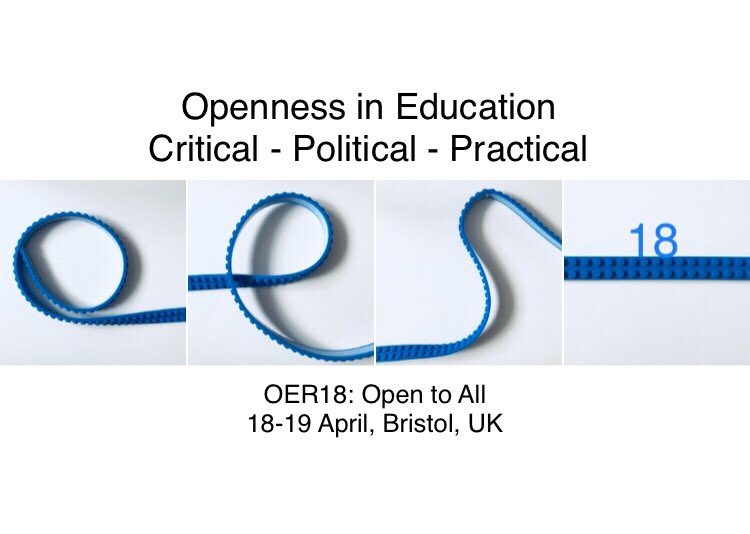
    In a few weeks, many colleagues from across the world will convene in Bristol for the OER18 Conference and from an active conference committee, and a inspiring line up of keynote speakers to a full programme of sessions about the politics and practice of openness in education there is so much to look forward to. I have been following the blog posts published on the conference site, thinking along with the debate about how open practice is being embedded in institutions, how advocates are winning over policy makers and funders and how our perspective on OER is changing. Inspiring stuff – and many difficult questions facing us, too.

    Yesterday I was talking to a group of UK policy makers and one of the things I spoke about is how openness is a practical value to me. It’s not a lofty concept or a hopeful, idealistic vision, it’s a practical measure to be implemented, a yardstick against which new proposals can be evaluated.

    From Open Access publishing to open licences, from shared content to open governance, it’s not a value that is easy to put into practice at any time. In her #OER18 post, Lorna Campbell reflects on this when she writes:

    To my mind, the success of the OER Conference has always been founded on its willingness to examine and renegotiate what “OER” means, and this is one of the themes I’ll be exploring in my keynote.  And by that, I don’t mean defining the specific attributes of what constitutes an Open Educational Resource, I mean critically reflecting on what openness means in relation to education at different points in time and from different perspectives, because as Catherine Cronin reminds us in Open Education, Open Questions, “openness is a constantly negotiated space”. Open education looks very different to each and every one of us, and our perspective will depend entirely on where we are standing and the privilege of our vantage point.  And of course it is inevitable that our perspective will change as our roles and careers develop over time.

    Outside of the OER community, most audiences that I speak to seem to think that openness means not generating revenue. It means taking a risk to give away something of one’s competitive advantage. It is for those who are privileged, those who can afford to spend time, to dedicate resources to something besides their core business. And so the work of advocates, individuals and organisations, is crucial to making business cases, to convincing governments and providers of the practical advantages, the bottom line, the success that can be achieved if a particular open model or platform is adopted. Open textbooks, for example.

    And yet despite the many signs of progress, there are many instances of what was once open, for example a repository, a course or a platform, turning into something else once it becomes valuable. That’s when economic imperatives take over openness as a value and turn it into a marketing strategy.

    For me, that is one of the reasons why it’s difficult to demonstrate that doing, being, leading ‘open’ is a practical value you can turn into success without betraying the principles involved. Openness has draw backs, just as every other approach, and sometimes these are difficult to negotiate. Which is why it is so powerful when you see people do just that. And that is what I am looking forward to learning about at OER18. How we can make openness work for all, warts and all.

    So if you are there in person, joining in on Twitter, watching the live stream or coming along to Virtually Connecting, blog, lurk or otherwise take part – as one of the organisers I hope you’ll find the welcome and the inspiration you are looking for.

  • CPD #cmalt as a springboard into openness and ownership

    CPD #cmalt as a springboard into openness and ownership

    Recently there have been a lot of interesting posts on Twitter #cmalt about how compiling a portfolio of your professional practice can be an open process (if you have not come across the #cmalt accreditation scheme, have a look at the ALT website or watch this).

    My own portfolio was accredited through CMALT in early 2016 and since then I’ve shared both posts about the process and the portfolio itself. But reading the recent posts made me think afresh about how undertaking CPD like compiling a CMALT portflio can be a springboard into openness and ownership – and some of the considerations I had when deciding on these issues.

    Considering others: in the context of a portfolio that describes and reflects on professional practice taking colleagues into consideration is key. Even though the CMALT process requires you to focus on writing in the first person, to reflect on your individual practice, anyone with management responsibilities or who works as part of a team, needs to consider how others are portrayed in what they share. In my case, I asked colleagues for permission if it was necessary to refer to them directly and I chose examples of practice specifically because they were suitable for sharing.

    Continuous reflection doesn’t have to be open: one of the key benefits of gaining CMALT for me is that it prompts me to continue my reflections on an ongoing basis as I collect evidence of practice for the update to my portfolio every 3 years. Some of this is work in progress or hastily written, so I don’t share it. I choose what I share, when and with whom and it’s valuable to have safe, closed spaces within my CMALT folders and documents that encourage critical reflection as well as recording achievements. The process of deciding what is open and what is less open in itself is a valuable experience.

    Contributing to our understanding of professional practice: as well as sharing my portfolio I have also added it to the sharing initiative run by ALT. It’s not openly accessible to everyone, but only to members or individuals registered for the cmalt scheme. I think this offers the advantage of being able to contribute to a wider picture of what professional practice in Learning Technology looks like as well as helping others find useful examples in their sector, job role or specialist area. It also provides an alternative way of sharing practice instead of putting your portfolio out on the public web.

    Taking ownership of what you share: I compiled my portfolio using Google Apps for Education (more info) and I use the same tools now to track my CPD and collect evidence as I go along. Loosing access to portfolios or evidence on institutional systems is a real risk for many and I wanted to keep my content for the long term. Recently, I have decided to take that a step further and started transferring my portfolio onto this site, my own domain (thanks to Reclaim Hosting!).

    Some of it is already available now at http://marendeepwell.com/cmalt/  and in the fullness of time it should enable me to take even more ownership of my professional practice and the recognition I gain.

  • #edtechReflection: getting started, reflecting on failure & other ideas

    In the previous post I talked about how the aspect of professional practice I have most conversations about is reflection. Whether it’s discussing how useful it can be, questioning how you can safely reflect openly with others or how to get started, it seems to be a key topic for many. For me it’s become clear how important a part of my professional development it really is and so I want to share my approach in the hope that it might prove useful or indeed prompt others to do likewise.

    I have included tips for getting started, reflecting on failure and reflecting in the first person as well as developing reflection as a professional habit:

    Have a look at the slide deck below and do send me your thoughts or feedback:

    You can also access the slide deck together with my CMALT portfolio at https://goo.gl/44I4Bd .