It’s been great fun this week to head up to Edinburgh to facilitate an away day for a senior leadership team at the university, and I wanted to share a few snippets of what made the day really memorable for me. The focus for the day was all about hybrid working and leading people and projects in a continually changing context, managing the enduring impact of lockdown working alongside emerging policies and priorities. Here are some reflections:
First of all, there’s the venue! The photo of this post shows the building where we spent our day with a beautiful view of Arthur’s Seat. It was great to have a venue which had such scenery on the doorstep, particularly as we could see the hill from the meeting room where we were based for the day. Lots of natural light and air always helps, I find. The venue was a good fit for some of the activities I had built into the day, designed to encourage everyone to step away from their screens and do some thinking together whilst getting some movement in.
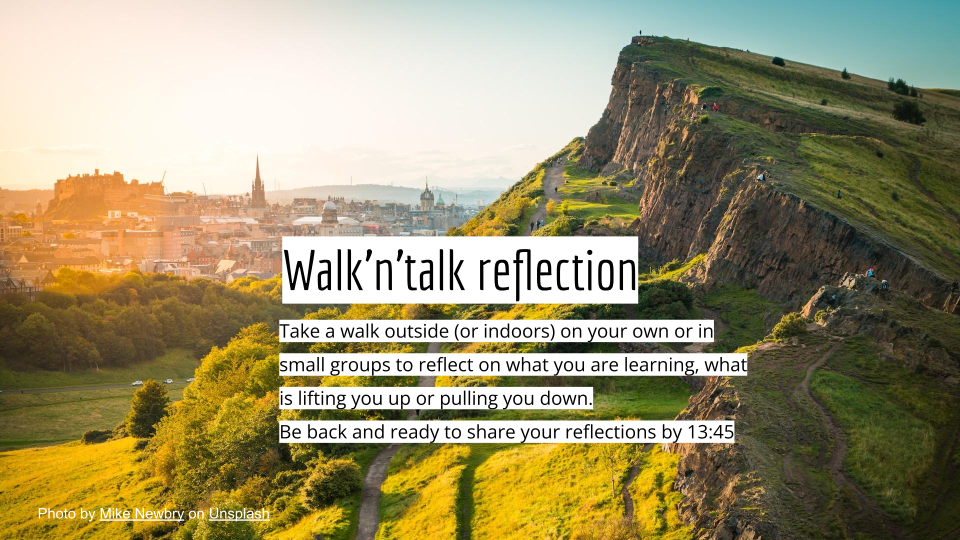
The walk and talk reflection after lunch was a really popular part of the day, giving everyone time and space to talk about things in a less formal setting than sitting around a meeting table. This activity also offered those who needed some quiet time to reflect on their own a way to do that between a busy morning of group working and the afternoon brainstorming session.
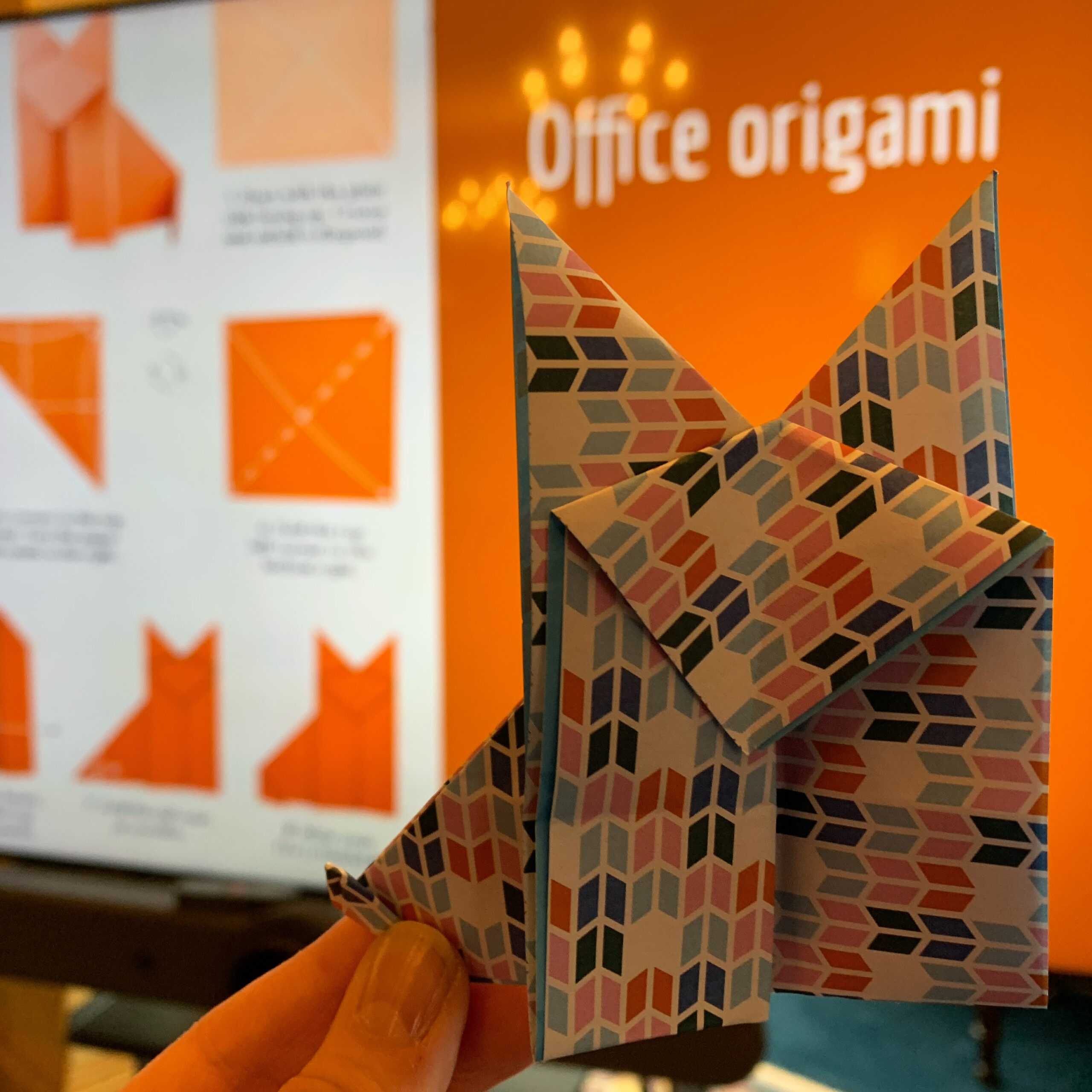
One of the sessions on the agenda explored fresh ideas for fostering a sense of community and encouraging engagement in hybrid workplaces. For example, we discussed how working radio or shared playlists could work, even scope to have a silent disco… 🙂 . I loved that idea in particular. We also tried out office origami as a communal activity.
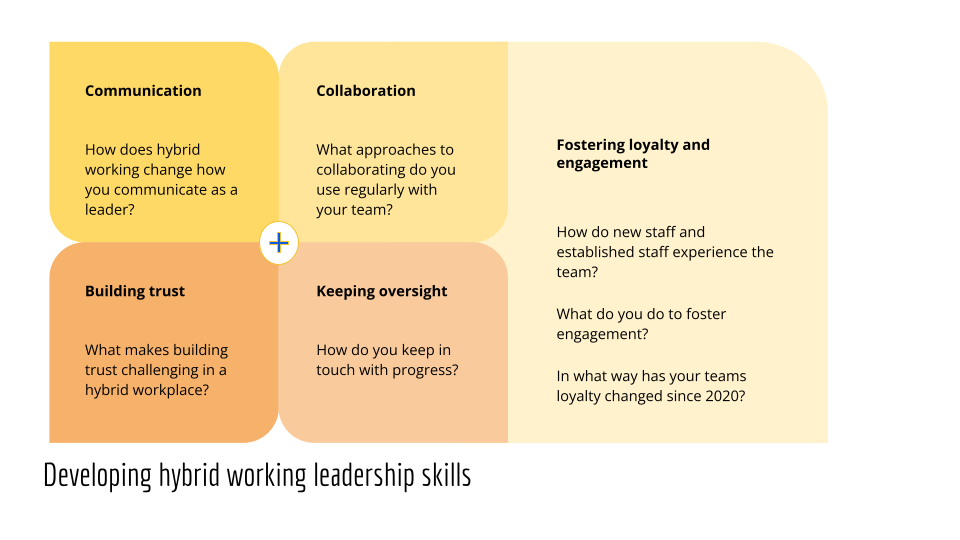
Now, for most of the day we worked on hybrid working leadership skills, exploring areas like communication and collaboration as well as building trust and keeping oversight of progress. Most importantly we talked about fostering loyalty and engagement, considering how the experiences of new and established staff could differ and how the role of leaders changes over time as hybrid working becomes more established.
What was really inspiring for me throughout the day was to see all the experience and expertise a team like this can bring to bear on the challenges of hybrid working. Working in learning technology builds a lot of capacity for the challenges ahead, especially as there are a lot of things we know about blended learning that can now be applied to hybrid working.
I had quite a few requests from folk elsewhere who are interested in hosting a day like this at their institution or take part in an online version. If you’d like to be added to the waiting list for that, get in touch.
Keep in touch with new events and the work I am doing by subscribing to my free monthly newsletter.
Over the past four weeks I have run a free and open course all about hybrid working. This week, we are wrapping up the course for 2023, and I’d like to take the opportunity to have a BIG thank you to everyone who took part, and contributed!
I love the format of the course, which is podcast cased with new topics released every week, as it allows folk to follow the course at their own pace, and offers the option to take part synchronously, too.
Inspiration for future courses
Quite a few people who registered for this run of the course expressed an interest in the weekly sessions to drop in. With between 30-50 participants taking part in the course each week, one of the challenges for me is to find a time that works across different time zones. For future runs of the course I’d probably come up with a better timetable to give more people the chance to connect and learn together.
Another element of the course that I am keen to develop is how new topics are released. Many people taking part have a lot of other commitments to juggle, and might find it easier if all the resources and topics were available from the start. I am going to have a think and see how that might work… 🙂
What worked well?
It’s been great to see the course attract lots of listens and interaction. Although I do encourage people to register for free, only about half of the people participating in the course do. Others prefer to simply subscribe to the podcast to listen along and explore at their own pace.
The topics for the course resonated well with participants, especially those designed to help manage digital overwhelm and setting life/work boundaries. Plus, I really enjoyed recording these as well, which is an added bonus!
Course catch up
The course resources and podcasts are now freely available and you can explore topics at your own pace. The easiest way to do that is to listen to the course podcast:
The course is podcast based and new episodes released weekly on Fridays. The podcast is called Leading Virtual Teams and you can find it on: Anchor, Apple Podcasts, Google Podcasts and Spotify.
If you’d rather see everything at a glance, the Course information page provides a handy guide to the course and links to all previous topics:
This past week all my networks about hybrid and virtual working have been dominated by attention grabbing headlines from this year’s KPMG CEO Outlook survey:
Most bosses think you’ll be back in the office 5 days a week within 3 years (Fortune)
Two-thirds of CEOs think staff will return to office five days a week (The Guardian)
Most executives expect a full return to the office by 2026 (The Times)
These headlines are usually accompanied by predictions around the disadvantages employees not willing to return might face:
87% of CEOs globally – 83% in the UK – told us it’s likely or very likely that employees who make an effort to come into the office will be rewarded with favourable assignments, raises or promotions.
There is some mention of the need to carefully handle a return to the office, to take into account what employees need and want, but overall, there is a strong sense of relief that established corporate power structures are flexing their muscles by demanding that workforces return to their rightful place in every sense of the word.
When I carried out the research for my book on virtual working, I found a distinct lack of evidence that the employment policy landscape in the UK or the US was changing. Other countries, especially around Europe, used the increase in home working during the pandemic to establish laws around employees’ rights to disconnect. But here in the UK there was no sense from government of urgency to create similar policies for the long term. Instead, UK policy flexed to accommodate emergency measures and short-term solutions.
So what do we really know about what the landscape looks like in the UK beyond the outlook of CEOs? Are workplaces really preparing for a return to the office, five days a week?
This is an interesting report, based on YouGov survey data, that explores flexible and hybrid working in the UK. The report focuses on employer and employees perspectives related to changes to flexible working law.
What I found most useful is that the report gives you a sense of what the current overall scale of flexible and hybrid working is in the UK, and also how many different practices this encompasses, with everything from working from home to having a four-day week and from zero-hour contracts to career breaks.
Hybrid working, in the context of this report, requires employees to still be in the workplace for a specific number of days per month or per week. The report states: “Over half (52%) require hybrid working employees to be in the workplace for a minimum number of days in the working week/month, while 46% do not. Private sector employers are more likely to say they have a minimum requirement, and voluntary sector employers are more likely to say they do not. Overall, employees are most likely to be required in the workplace for two (35%) or three (33%) days a week.
Is this a long-term trend? Or simply organisations operating more or less as before, but with more flexible and hybrid working added on top of existing practices? When it comes to long-term impact on resourcing office space, pay and equality, the report only includes brief mentions. It does highlight that employers perceive a positive impact on productivity, recruitment and retention as well as employee financial wellbeing.
When it comes to hybrid working specifically, the report states that “Eighty-three per cent of organisations have hybrid working in place. Forty-five per cent have a formal policy, 24% take an informal approach, and 13% are developing policies through learning/trialling. When CIPD last asked this in a similar survey in June 2022, fewer had hybrid working (77%) and fewer had formal policies in place (34%).”
This is really interesting, particularly when thinking about the managers leading teams in half the organisations that have hybrid working in place, but do not have formal policies. The need to develop skills for manage this scale of changes in the workplace is clearly becoming more urgent as the proportion of workplaces who offer flexible and hybrid working increases. The report reflects this as a negative impact of more flexible and hybrid working:
Specially, ability of managers to lead teams effectively (-18)
and identify as challenging for managers managing remote teams from a wellbeing and performance perspective (41%)
Developing your skills as a leader or manager in this context is particularly difficult because so few organisations have expertise to draw on and there is little formal training led by experts who actually have a track record beyond their personal experience of working from home.
Interested in evolving your approach to Hybrid Working? Registration for my next course starting 20th October is now open and it’s free for everyone. Sign up today.
Changes to workplace laws
One of the biggest changes in the UK this year is the Employment Relations (Flexible Working) Bill. This Bill has wide-reaching consequences for employers and employees, including granting employees the right to request flexible working from day 1 instead of after 26 weeks (background info) with the aim to make employment ‘flexible by default’.
As part of the work of the Flexible Working Taskforce, there now are a growing number of resources for employers and employees, including:
This follows on from last year’s UK consultation Making flexible working the default (December 2022) which included a focus on better understanding how informal flexible working operates in practice. It is very clear how far-reaching this particular issue is, even if the proposed changes to employment law don’t encompass all aspects:
Flexible working doesn’t just mean a combination of working from home and in the office – it can mean employees making use of job-sharing, flexitime, and working compressed, annualised, or staggered hours. … The ‘Making flexible working the default’ consultation recognised that flexible working is different for every employee, employer, and sector – it does not come in one size only. For an office worker, they may benefit from a job-share so they can better care for their children, or a factory worker may request different shift patterns that suit their balance between home and work. Because of this, the government will not instruct employers or employees on how to carry out their work, instead we encourage both parties have constructive and open-minded conversations about flexible working and find arrangements that work for each side.
However, the proposed changes do not go far enough in addressing the wider issues at stake here and this WIRED article provides a helpful insight into what’s not being tackled.
What does this tell us?
The change in the law around flexible working seems to be paying lip service to what employees demand, but is not going far enough in tacking the hybrid working issue that grab the headlines. This bill won’t protect the rights of employees if bosses increase demands to return to the office full time or ensure that those not returning won’t be disadvantaged. It doesn’t put onus on employers to up skill managers or upgrade infrastructure to exploit the full potential that hybrid working could offer. What it covers is too broad an area and not clearly enough defined to support hybrid working specifically.
There’s also something else at stake here, which comes out in the KPMG survey, a sense that work is all about people, “that business are about people, after all”. There is a lot of talk of nurturing wellbeing, supporting careers and offering the right sort of value proposition to employees with whom “hybrid working is extremely popular”.
Businesses are about making profits, and I am pretty such that the companies that take part in the KPMG survey and those quoted as ‘leading the return to the office’ such as Amazon and Google, are not seeing how giving employees more flexibility, continuously up-skilling managers to adapt to flexible workforces and making less use of extensive corporate campuses will benefit their bottom line.
Hybrid working is extremely popular not because some people can’t see that it’s more fun to have a coffee with colleagues than staring at endless video calls through a laptop screen. Hybrid working is popular because it enables people to cope with the competing demands of their lives, including family or caring responsibilities. It means spending less time and money on commuting, eating lunch alone and buying office appropriate clothes. Hybrid working has opened up a new perspective for many that work matters less, and being outside, spending time with family or simply taking a breath is more important than work.
Yes, hybrid working is complex and not without downsides, as I have explored at length elsewhere, but these headlines about mandating a return to the office seem to be much more about executives clinging onto old power structures than caring about people. Let’s not give into that and instead use the momentum created by the increase in hybrid working during the pandemic to shape the future of work for good.
Enjoyed this post? Get my free monthly newsletter directly to your inbox.
In this week’s podcast I share some of my personal history and how I came to be so interested in all things hybrid and virtual working. From Germany to London in my art school years, and from Athens to Oxford as my work moved from Art to Anthropology and then Education, this episode sets out what I think is interesting about hybrid and virtual working, why it’s important and why now is the time to really find ways of working that work for you.
Listen to the episode:
What are your hybrid working conundrums? Leave a comment or email me with you questions and problems when it comes to hybrid working, and I’ll pick these up in the upcoming episodes.
One of the consequences of the global pandemic in the workplace is an increased demand for flexible and hybrid working. In response, employers are offering staff to work from home more regularly, and come into the office or on campus for less time each week. Flexible working is intended to increase staff satisfaction, productivity, and retention at a time when we have moved from the great resignation of 2021 to an endemic of ‘quiet quitting’. At the same time, effectively working from home has become a sought after skill in the workplace, particularly as some of the negative impacts of long term home working on (mental) health, equality, diversity and inclusion and staff engagement have started to emerge.
Bridging the gap between the growing hybrid workforce of knowledge workers and the (lack) of organisational vision for the post-pandemic workplace, are the managers and leaders leading increasingly virtual teams. It is their job to translate the newfound flexibility into effective collaboration between colleagues. It is their challenge to establish communication channels that engage a hybrid workforce with diverse needs, balancing work with other commitments. A workforce for whom coming to the office or on campus may be a hated necessity or indeed a much sought after opportunity. Not everyone loves working from home, sharing a desk or meeting in a coffee shop.
If you are looking to move from overwhelm and burnout to finding balance, then this course is for you.
Develop the skills you need
This course is designed to help develop skills to:
Audit your hybrid working habits to find out how your current habits are impacting on you and what to change;
Set boundaries for a better life/work balance and stick to them even when things are busy;
Increase productivity away from the screen by using strategies for communicating and collaborating outside of meetings;
Communicate more effectively in the hybrid workplace in a way that works for you and reduces digital overwhelm.
Course activities
Listen to the podcast
The course has four parts and each part is introduced by a podcast episode that sets out the key ideas for the topic. I have chosen the podcast format to enable you to follow the course at your own pace, listening when it suits you and also to minimise screen time needed to take part in the course. Whether you listen to the course as you walk the dog, cook or sit in a comfy chair, this course is designed to take you away from your screen and constant stream of notifications. You just have to listen.
Reflect on your practice in weekly hangouts
Each topic is accompanied by prompts and questions to help you reflect on your professional practice. We will use these prompts in weekly course sessions to take a deeper dive into ways of working in the hybrid workplace and reflect on how your habits aligns with your goals and values. You can choose whether you write your reflections down, share them with others in the course or keep them private for yourself.
Explore new ways of working
Each topic comes resources and tools to explore. You can try out new idea for yourself or join one of the weekly drop-in sessions for personalised support.
Who is the course for?
This course is designed for emerging and established leaders and managers working in a hybrid or fully virtual setting in education and the not-for-profit sector. We will focus on how to develop effective home/hybrid working strategies. Whether you are collaborating online on a project, organising distributed volunteers or managing a whole hybrid working department, this course will support you to move from overwhelm and burnout to finding balance.
Register today
4 Week Course Listener – free
Listen via your favourite podcast app
Follow at your own pace
Explore resources via the show notes
Upgrade anytime!
4 Week Course Explorer – £29
Course content straight to your inbox
Weekly course hangout & drop-in support
End of course summary with resource pack
Certificate & badge upon completion
4 Week Course Explorer + Personal Coaching – £229 Course Explorer package PLUS:
With the holiday season coming up, our team has had a long overdue in person Team Day and we are also planning a virtual get together in a few weeks. These social activities are important to virtual teams, and I really value the opportunity to spend time with colleagues in a more relaxed way.
Blended approaches to working together can help shape the dynamic of the year, and punctuate long periods of remote working with new inspiration and energy connecting with colleagues in person can bring.
That said, this year it’s proving hard to make that actually happen. A mix of post-pandemic factors, cold + flu season, taking long overdue leave and simply bad luck have resulted in many of us missing one or more of these important moments.
Does it really matter, though, that we are not able to all meet together? Does it make a difference that I miss a Team Day or a get together?
Here are my thoughts on this:
Yes, it does…
In our team we set clear expectations that we meet in person 3-4 times a year. In 2022, thanks to train strikes and various other factors, our meet up got delayed and rescheduled several times, and it really had an impact. Relationships can change if you lack an expected amount if in person interaction.
Touch base: One of the aspects of being in an organisation in which everyone works from home that I find challenging is that I can easily forget how different an experience home-working is for each of us. What you see on a video call is only a small sliver of colleagues’ reality. Meeting in person really helps me touch base with colleagues and get a different perspective on how everyone is doing.
Joining in: We often have a social focus for meeting in person, and we have tried out a lot of different activities over the years. I enjoy joining in those activities, and being part of everyone interaction in a different way. The recent activity I missed out on was an escape room, and I am sorry I missed it!
Getting a sense of things being ‘normal’: This is a clumsy way of putting it, but I am not sure how else to express it. What I mean is that, our team met 3-4 times a year in person in 2019 and it matters to us that we are back to meeting in person in 2022. Things are not the same as in 2019, but we aim to have a blend of working from home and meeting in person, and it feels reassuring (and fun!) to get back to that schedule. Care
No, it doesn’t, if…
It’s a reality of any virtual team that someone is off or unavailable and thus misses out on a shared experience. The larger the group of people trying to get together, the higher the chances that people are missing out. There are plenty of ways to make up for the missed interaction, such as:
Share what happened: in the case of our Team Day, colleagues took photos and shared these with everyone afterwards, and also shared their stories at the next virtual meeting. We talked about what happened on the day and included everyone in the conversation.
Make it clear what others got out of it: we had planned to swap Secret Santa presents on the day, and these swaps largely moved online. We also went through some training for a new productivity took we are trying out, and that, too, continued virtually so that everyone could take part.
Encourage alternative forms of engagement: in the weeks after the event, we offered other ways to engage, and continue to conversation even though we were busy and had a lot of other things happening at the same time. That’s a crucial point for me: if it was important enough to spend time and energy to bring a group of people together, then there should also be an emphasis on afterwards including everyone who wasn’t able to get there.
Care goes both ways
During this year, I have been thinking a lot about the boundaries between work and personal space, about finding balance between the needs of the employer and the needs of the individual. In my context, working for a small employer with fewer than 10 employees, even a very small number of colleagues being unavailable as planned has a huge impact.
Today, for example, out of 6 employees: 33% are on holiday, 16.5% are off sick, 16.5% are not scheduled to work, and 33% of us, two people, are working.
When you are working in a team or organisation of a small size, balancing the need to work together on things and share experiences with the needs of each individual can be a difficult balancing act. Care goes both ways. We want to show care for each individual and their needs (take leave, be off sick, work flexibly) and also the needs we have as a team (collaborate in real time, meet to discuss new plans, spend time together).
Those missed moments can add up. In order to have good cohesion as a virtual team, you need to have enough of them with enough of your team to benefit long term. Which is why I am already looking forward to our next get together 🙂
We are currently recruiting for a Chief Operations Officer for ALT, and I couldn’t be more excited!
It’s always great when you get to grow your team, particularly when there are only seven of you and each individual makes a big impact.
Why this role, why now?
We are the leading professional body for Learning Technology in the UK – and we have been pretty busy in the past eighteen months! Learning Technology has never been more in demand and as a consequence the work we do to support our growing community has increased month on month.
After a year of supporting our Members through the global crisis, we have re-grouped and set out a strategic plan for the year ahead. 2020 was a tough year for us an independent charity as we traditionally generate half of our annual turnover from two face to face events. Thanks to our prudent financial strategy in past years, we had reserves to help us through times of crisis.
Now we are planning ahead for post-pandemic times. Whilst we have an excellent track record delivering online activities and a lot of expertise in virtual events, we don’t just want to follow our old ways. Instead, we are starting to innovate and that has helped us redistribute our income streams and ensured that we are back to generating the charitable income we need to achieve our mission. Next, we are looking to develop blended ways of doing things and improving what we are already good at.
In order to achieve that, we have created a new role and are looking to grow our staff team:
The Chief Operations Officer (COO) is responsible for day-to-day operation of ALT, including technical infrastructure and systems used to deliver ALT’s services to 3,500 Members. The COO acts as the Deputy for the Chief Executive and represents and advocates for ALT with our key stakeholders across sectors.
This is an opportunity to see projects through from conception to completion and play a part in shaping how we work and what we do. You will be reporting directly to and working closely with ALT’s CEO and have opportunities to develop your own skills in running an organisation in an innovative and human way.
https://www.alt.ac.uk/about-alt/work-us
If that sounds like the kind of work you would enjoy, read on.
For the past few months it’s been all ladies working in the team, and we are making a real effort to recruit the best candidates for each job whilst increasing the diversity of our team, which is a big priority for us (all recruitment and selection is undertaken in line with ALT’s aims and values and in accordance with ALT’s policy on equality and diversity).
As it stands, we are based in three of the four nations in the UK; three of our team, that is 42%, are currently completing a PhD (and one of us already has hers) and over 40% of the team are either Certified Members of ALT or currently working towards their accreditation.
As far as I know we have 5 cats and 5 dogs between us, and come Friday plenty of unicorns, too (Fridays we usually celebrate ‘unicorn’ day, a tradition even those of us who are not generally into things that are pink and fluffy have come to appreciate).
We have a real range of backgrounds and have a former chartered surveyor as well as an expert in Victorian cemeteries in the team. As many of us work part-time, mostly 3 and 4 days a week, it’s quite common for us to have other responsibilities to focus on, be that studies, kids or other interests.
If you’d like to find out what it is like for us working as a virtual team, read our blog post from earlier this year, celebrating three years as home-workers. Find out what our highlights and lowlights of pandemic working have been and how we thrive as a virtual team.
When I first started working for ALT, as an Assistant Administrator (Maternity Cover) in 2008, I was just finishing my PhD and I had no inkling that a career in Learning Technology was ahead of me. As it turns out, the field has proven so interesting and challenging that I find always something new to do and to learn.
The senior team of a small organisation is an exciting place to be. I love the freedom it gives me to make things happen, to be able to respond to the changing needs of our community without having a complicated hierarchy to negotiate. We believe in robust and transparent governance, and we get things done.
I am proud to be part of a journey that has seen the size of our membership double several times since 2008, and writing our Impact Report 2021 has reminded me of how much we achieve as an organisation and as a team. For me it’s an exciting place to be with a good dollop of life/work balance and a team culture we all benefit from.
Working for an independent charity with a staff team of fewer than ten people is a very different value proposition than working for a large institution such as a university or a commercial organisation with thousands of employees. For me, it’s a rewarding leadership position that allows me to practice what I preach 🙂
Not a working day… looking out over Cardiff countryside
Find out more
If you are interested to find out more, head over to the ALT website or contact me for an informal conversation.
Apply by sending us your covering letter and your CV by 17 September 2021.
All candidates will be notified after the initial short-listing by the end of September and short-listed candidates will be invited to online interviews in October.