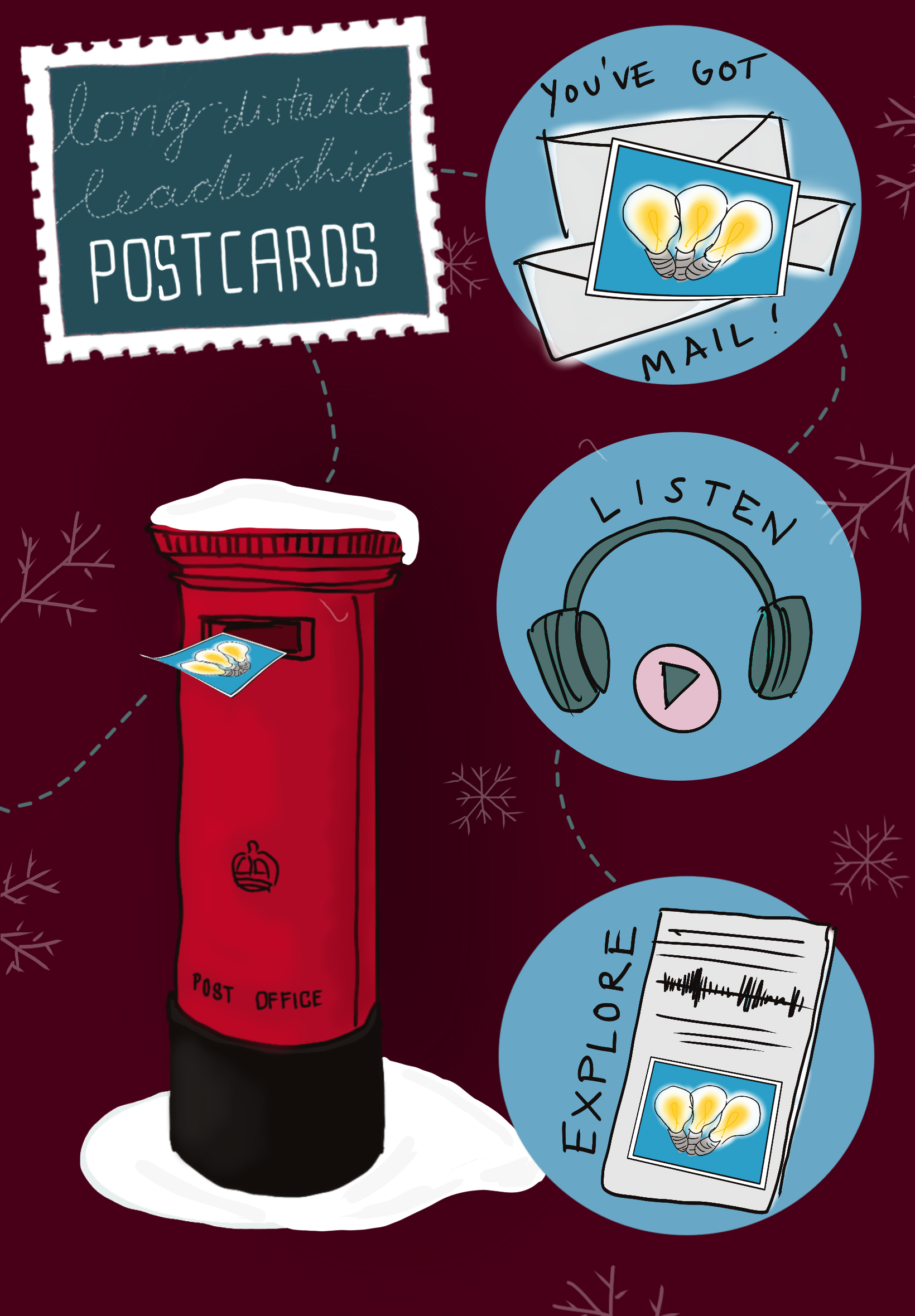
This month, as a little gift from me to you, you can join in with my leadership coaching subscription service, AKA Long Distance Leadership Postcards for free. I’ve made December free for all to access, and this month’s topic includes three free resources to explore.
Whether your 2025 has been busy and productive, or brought unexpected challenges, whether you are getting ready to rest or just about to set out in a new direction, I have designed this month’s coaching moment by mail to offer new inspiration and encouragement by focusing on your creativity, develop leadership capability or clear the decks with increased productivity.
Over the last 12 months we have explored 11 Long Distance Leadership Postcard topics around creativity, digital wellbeing, productivity and leadership development. To celebrate the end of the first run of Long Distance Leadership Postcards, you get to choose your own topic – or explore all three! Whatever you choose to do, enjoy and take care as we close out 2025.
Your guided tour
If you’d like to get a guided tour, tune in to the episode below in which I walk you through each resources and how they could be useful to you. Enjoy!
Coaching in 2026
I’ve loved coaching with you this year and I am already looking forward to the new year. If you are curious about coaching with me, get in touch. I have some space opening for spring and also new pro bono sessions available if you’d like to try and give coaching with me a go for free.
You can find out more about how I work and what my clients say about working with me on my coaching pages.
Sign up to my free monthly newsletter to get new resources straight to your inbox.
Over the summer I have updated my coaching course for leaders and managers, ready for the next academic year. I designed the course originally just over 18 months ago, and three cohorts later I have learnt a lot about what participants find most valuable. I’ve also had a lot of experiences working with coaching clients who are tasked with introducing AI in their teams, or supporting colleagues who are now using productivity suites such as MS Teams or Google Workspace with AI-powered tools, something I hadn’t specifically addressed when I designed the course.
I’m really looking forward to running the updated course, and to give you a sense of what’s in store, here’s a little preview of the updates I’ve made:
AI and Hybrid Working
Both AI and Hybrid Working change dynamics in the workplace. Colleagues see each other less, and communication is becoming more and more digital. Although many workplaces have seen at least a partial return to the office, often with 2-3 days on which everyone is on, the majority of meetings and activities is now blended, often supported by AI-powered tools.
The pace of digital productivity is increasing, or at least it feels like we need to speed up, making it even more important than before to focus on building trust, communicating clearly and creating engagement. The skills to use new technologies are changing and I have included a new section about AI literacy to the course to reflect that, but the skills needed to be a good leader and manager such as keeping oversight of progress, continue to be at the heart of professional practice.
Guided reflection
One of the things that jumped out at me when I read through feedback from participants is how much they value prompts and tools to help them effectively reflect on their practice.
Often, their day to day is so busy that even when they do make time to sit down and reflect, they find it hard to know where to start or how to make it useful. The course included a reflective exercise for each part, complete with prompts and practical tools, and I will include these in the live discussion session each week as well.
Open resources
The other piece of feedback that really stood out for me was how many participants wanted to take the resources we used in the course to work on with their teams. I had already openly licenced the resources, but this prompt made it easier for me to include even more of that in the updated version, enabling managers to translate what they work on in the course into their practice more easily.
Join the next course run starting 20 October
There’s also a group of participants signed up, but I have 10 places left for the next run of the course, starting 20th October 2025. The course will run over a period of 4 weeks, with an optional live session each week (which is also recorded to help everyone across the different timezones) and as before, all course content is available asynchronously to explore at your own pace.
Course registration costs £149 (or £79 if you are one of my coaching clients).
For many of us, hybrid working is here to stay. In my work with education professionals and entrepreneurs I support managers and leaders looking for new strategies for virtual and hybrid teams. This includes running effective hybrid team meetings, keeping oversight of progress, helping their teams be at their best and everything in-between.
If it’s part of your role to translate the newfound flexibility of the hybrid workplace into effective working practices then my course, Healthy Hybrid Habits for Leaders and Managers, might be for you. It will look at collaboration between colleagues, establishing communication channels that engage a hybrid team with diverse capabilities and preferences all whilst balancing work with other commitments.
Starts 7 October
Over four weeks we will take a deep dive into what it takes to manage happy hybrid teams, lead in ways that reflect your strengths and your values, and create healthy habits to balance the demands of a busy leadership role even when work/life boundaries become blurry.
Learn at your own pace with weekly course modules with podcasts and resources;
Stay on track and put your intentions into actions with a personal roadmap and regular check-ins;
Joinlive group sessions led by me and take a deeper dive into each topic as you reflect with peers;
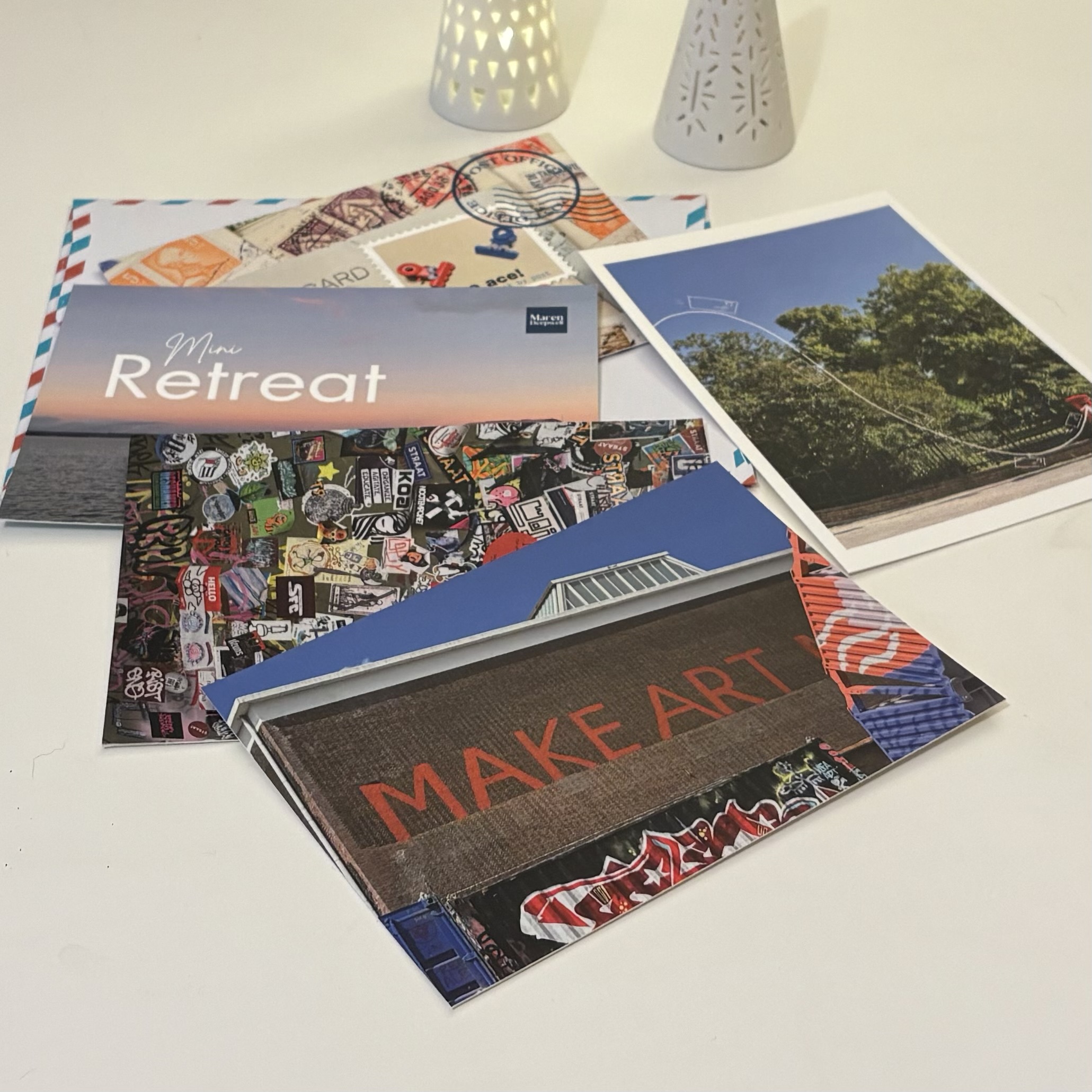
Get creative as you receive inspiration delivered by post;
Receive your digital course pack with everything you need in one place.
Registration is open
If you’d like to take part in this group coaching course, simply complete the registration form. Spaces are limited and will be allocated on a first come, first served basis.
10% of places are available on a pro bono basis, absolutely free. If you’d like to take up one of the free places, complete the form below and I’ll email you to confirm.
I regularly offer dedicated workshops and short courses for leaders and managers who manage people or projects in hybrid or fully remote settings. Over the past two years I have run several of these and each cohort has been a wonderful experience.
Although much of my work now is focused on helping other organisations design and build similar offerings for their own staff, I love the freedom that running my own courses offers – both in terms of the content and the design and delivery of the course. My own offerings give me a lot of scope to innovate and to try entirely new ways of engaging participants.
This time, there are a couple of things I want to try and add to the course design following feedback from previous cohorts: the course will offer more opportunities to get feedback and dialogue on a weekly basis so that we can discussed specific challenges and individual contexts in more depth.
I’d also like to experiment with adding some of the coaching resources and approaches that my individual coaching clients find most useful and offering more accountability and check-ins to help course participants stay on track and get the most out of the course.
As before, there’ll be a whole pack of practical tools and inspiring reading to take away as well as the course podcasts to support professional development beyond the end of the course and at your own pace.
I am really excited to get work underway on this new venture, and if you are curious to learn more, read the preview below and check out my previous courses, which are openly available.
NEW Autumn 2024
Healthy Hybrid Working for Managers and Leaders
When it comes to hybrid working, managers and leaders have a different experience to the wider workforce and different needs, too. From running effective hybrid team meetings, keeping oversight of progress and managing performance there are a whole range of challenges for hybrid people and project management.
If it’s part of your role to translate newfound hybrid flexibility into effective collaboration between colleagues, establish communication channels that engage a hybrid team with diverse capabilities and preferences and balancing work with other commitments, then this course is for you.
Over four weeks we will take a deep dive into what it takes to manage happy hybrid teams in a way that reflects your values, and create healthy habits to balance the demands of a leadership role even when work/life boundaries are blurred.
Start date: Monday, 7 October 2024 Duration: 4 weeks
This month I am running a short course on Digital Wellbeing and Hybrid Working. Working with the wonderful team at the University of Oxford IT Learning Centre is a rewarding experience, and with the support of Emma Procter-Legg, their Digital Skills Service Manager, the whole process has been seamless from start to finish 🙂
It’s been a welcome creative challenge to translate insights from leading virtual teams and hybrid working into the context of digital wellbeing, and in particular into a course format. Now that the course dates are coming closer, here is a bit of a preview of what the course is all about, and my hopes for what participants will get out of it.
About the course
Hybrid working offers a lot of advantages, enabling us to work more flexibly than before. When it comes to digital wellbeing however, hybrid working can pose challenges, too: for some, the increased use of digital technologies for communication and collaboration become oppressive, for others, physical and mental wellbeing suffer due to long hours spent staring at the screen. Over two sessions we will analyse and audit what works well and what you’d like to change about how you work and the impact this has on your digital, physical and mental wellbeing. Using practical tools and interactive activities the sessions will support you in reflecting on your current practice and identifying what actions to take next in your digital wellbeing journey.
Objectives
Reflect on how your current habits are impacting on your digital wellbeing
Identify your hybrid working skills strengths and areas for development
Understand the long term impact of hybrid working on digital wellbeing
Develop a sense of how to foster digital wellbeing
Digital wellbeing + hybrid working in a course format
One of the questions I considered when designing the course is where the biggest challenges lie when it comes to digital wellbeing and hybrid working. Digital wellbeing is a big term that encompasses much, and our relationship with technology becomes even more nuanced when you add hybrid working into the mix.
This is definitely not a ‘one size fits all’ teaching scenario, and an inquiry based approach seemed best suited to address the topic. Thus the course features a number of resources and tools to help participants analyse and reflect on what aspects of hybrid working most impact on their digital wellbeing and why.
Given that this is only one of the courses the IT Learning Centre offers and that many of the other courses are skills focused, I decided to reference rather than repeat digital skills training and to offer points within the course at which digital skills strengths and areas for development could be identified. This, I hope, will provide a jumping off point for future professional development.
In the meantime, the course also considers habits and behaviours, the broader context of one’s role and responsibilities as well as home-working context. Looking at each of these in the context of digital wellbeing will enable participants to gain a more holistic understanding of digital wellbeing.
Silent Disco anyone?
One of the things that is hard to convey in a webinar or a talk is the need to stop what you are doing and look at things with fresh eyes. It’s easy to say something like ‘take regular screen breaks’, but in my work I rarely meet anyone who actually takes breaks frequently enough and doesn’t end of staring at their phone, scrolling through social media or YouTube on their break.
The course design thus features an activity designed to disrupt the usual order of business of a course like this, an activity that invites participants to do something different: a silent disco one day and a bit of origami the next.
There’re good reasons for why I chose these activities, and there are alternative options for everyone based in a shared office, but ultimately it’s a question of whether the participants are prepared to step outside their comfort zone for a bit, and away from their desk or screen if they can. If it works as I hope, it’ll offer participants a chance to step outside of the usual rhythm of their day and that may open up more room for change.
I am really excited to run the course and very grateful for the opportunity to develop something new for students and staff who are interested in improving their digital wellbeing. Fingers crossed it’ll be a valuable experience for those involved 🙂
Enjoyed this post? Subscribe to my free monthly newsletter:
I made a fun discovery today: It’s now been over ten years since I started this list of things I have done. Wow! I had no idea it had been that long, and seeing those entries from 2013 made me pause and reflect on the habit of keeping the list, a decade in the making.
Why did I start tracking progress in this way?
My archive page is a lot like a personal vault. If you scroll all the way to the bottom of the page you’ll see that at the start I added some entries a bit like you would on a CV. I added dates of degrees I completed and images of things like my doctoral thesis from 2008:
Initially, I added these things as I was moving blogs, and I didn’t want to loose track of what I was up to. I was just in the finishing years of my graduate studies, and started working full-time and I had no real idea of what was going to happen next.
For a while, in the first few years of working at ALT, I didn’t really keep a record of anything until I started blogging publicly again in 2010 on WordPress, rather than my old Google Blogger sites. But then from 2013 onwards I started keeping a running list of projects I completed, conference papers, media stuff and so on.
Looking back to 2013, this entry makes me smile: June: Radio 4, Today Programme . Not particularly helpful for anyone other than myself, but it does bring back the morning I spent nervously sitting next to a very intimidating John Humphreys in the BBC radio studios in London. Similarly, in 2014 I went to the European Parliament in Brussels… noted in a similarly cryptic entry, but equally memorable for me. And although the 2015 link to an appearance on Parliament TV still works, many of the older links have rotted.
As we progress through the years the list of things I recorded each year becomes both longer and more comprehensive, particularly as I started to add links to blog posts on my own domain that contain a lot more information about a specific event or project. 2020’s entry is a bit shorter, but it looks remarkably ‘normal’ given everything that happened that year.
What do I use it for?
So, how is this useful?
Well, the practice of making the list and adding new entries to it is useful to me in itself. I could probably use a tool to compile this kind of information for me, but there’s great value for me in the act of processing what I have done and reflecting on it as I make the list.
For example, adding new items to the 2024 section of the list earlier today made me realise just how busy a year I have had so far, and we are only three weeks into it:
Workshop: Leading Hybrid Teams. Senior Leadership Team Away Day, University of Edinburgh, January 2024;
Article: Are you returning to the office, five days a week? Exploring the future of hybrid working. Learning Magazine, January 2024
So on a regular basis, as I publish something or a new project gets scheduled or completed, I will update the list, add links and date each entry. Wherever possible I try to capture what I am doing in a blog post as I add it to the list, so that I don’t have to rely on external websites to retain the information.
Then, on a monthly basis as I compile my newsletter, I refer back to the list, and cross-check what else I may want to mention. This is super helpful for me and makes compiling the newsletter pretty easy.
I also use the list as an archive in case someone asks me what talks I have recently given or what papers I have published on a particular topic and I make use of it for reviewing my progress or performance.
It’s a kind of super power when it comes to things like annual appraisals or planning career development. It doesn’t take me long to answer the questions like ‘What have you done in the past year ?’ or make a list of articles I have published. That is magnified if I want to write end of year reviews or reflections.
It’s important to me to keep learning and developing and over the years keeping this archive up to date has become a natural process of my workflow, just as blogging or journalling have become part of my practice.
Tips for starting your own archive
If you are keen to start your own list, get started with literally anything. You could add a workshop you have run or an event you attended, or even books you’ve read. You could add projects you have been involved with or led, or papers you have published.
The key is not to worry whether something is worthy of being included, and to simply include everything. I find once you start making a list of everything, things quickly amount to more than expected.
Over time, as you practice keeping the list, the satisfaction of adding to it will become a good motivator for keeping going but initially it can be difficult to find the courage to get started.
You might prefer to keep your list private, which is completely fine. The reason I have mine on my blog is that I am comfortable working here and I use my blog every few days. It’s a convenient place for me to refer back to or to send people to, but I don’t think the page that shows my archive gets a lot of visitors.
For me however it is priceless, and it reminds me when I have low days how much I have achieved over the years. Maybe your list will do the same for you.
One consideration for me is that I want to do what I can to keep the data safe. That is why I don’t rely on a platform like LinkedIn to keep this information. In an ideal world I might update the information somewhere like that, a network where folk who consider working with me might more easily get an idea of what I have accomplished. However, although that would be useful, I don’t trust that the information will still be there in 10 years or that it won’t suddenly get reformatted or repurposed as platforms change. Thus, I keep it here on my own domain first and foremost, and I update everywhere else when I feel it’s necessary.
So, good luck if you are just getting started and kudos to you if you are already on your way to keeping that precious list of everything you’ve done.