Category: staff development

  • Discussing (gender) equality in technology and education at the University of Sussex

    Recently I was invited to take part in a seminar on ‘Technology and Education: opportunities and challenges for equality’ organised by the Technology Enhanced Learning Team at the University of Sussex. Here is what the seminar was about:

    Technology has always played a significant role in education – whether it was the fountain pen and printing press of the past or today’s mobile devices, online study and immersive technologies. It cannot be assumed, however, that technologies will offer equal opportunities to all or that there is equality in all the spaces where technology and education meet and interact. As new technologies are increasingly adopted within educational contexts, now is a great time to think about the challenges and opportunities for equality.

    For this TEL seminar we are thrilled to welcome Dr. Maren Deepwell (Chief Executive Officer of the Association for Learning Technologiesand our own Mary Krell (Senior Lecturer in Media & Film Studies) to speak about the opportunities and challenges they see for equality in the ways that technology and education come together.

    Dr. Tamsin Hinton-Smith (Senior Lecturer In Higher Education) will chair the seminar and join Maren and Mary for a panel discussion of the ideas raised and audience questions.

    The day was really interesting and you can watch the videos from the seminar, access the slides and find out more about the speakers and chair on the university website.

    My contribution focused on gender equality but our conversation was much wider, focused more holistically on all types of inclusion and diversity, what progress we have made and how much there is still left to do.

    I was really inspired by the creative, thoughtful and visionary Mary Krell, whose thoughts on the limitations of technology as well as its potential resonated with me and my own thinking around how technology isn’t always the best way to engage, enable or empower learners.

    Similarly, Tamsin Hinton-Smith spoke eloquently and passionately about teaching training and development with a focus on equality and from a feminist perspective, providing insight into what the university is already doing and where further work may be done.

    The TEL Team also has a podcast (definitely recommended listening) and I enjoyed taking part in recording a session, in particular as some of their regular questions really made me think: what’s your favourite keyboard shortcut (my answer here was CTRL + F and also CTRL+/ CTRL- to zoom in/out) and what app can’t you live without (for me, sadly, that would be text messages).

    #femedtech skateboard visual
    Soup up my deck by @visualthinkery is licenced under CC-BY-SA.
  • Positive feedback by post: what happened next…

    Nice to CC you by Dr Maren Deepwell CC-BY-SA

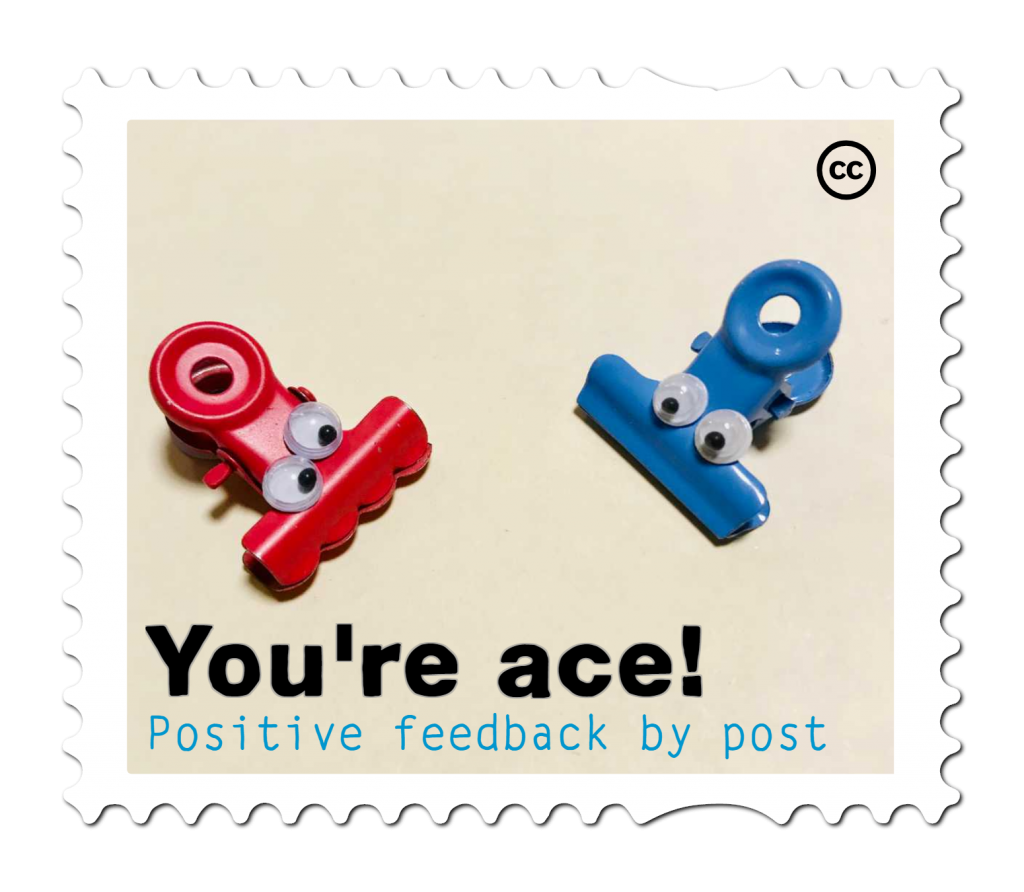
    In a recent post on positive feedback I talked about how to use positive feedback for personal & professional development. As I wrote the post I had an idea to try out a new approach to giving and receiving positive feedback in a virtual, distributed team: I made a template and sent an envelope to each of my colleagues in the post, enclosing a piece of positive feedback from me to them, as well as templates, envelopes & stamps for them to send each other positive feedback. That way, I hoped, we would each receive several pieces of positive post in the mail over the next week or so.
    If you’d like to have a look, here is the CC-BY template I created.

    So, what happened next?

    Writing and sending feedback

    I really enjoyed the process of printing, folding and making each envelope to send and in particular writing the feedback by hand. I hardly send or receive any personal letters and putting pen to actual paper made this feel special.

    Writing solely positive feedback, rather than including constructive criticism like I would for a performance review, felt liberating.

    I wasn’t sure what to say, at least initially. Or how much to write or what to focus on. But looking back at the original article that prompted me in this action, I tried to find something that I felt had made a big difference and why. Once I got started, there was a lot I wanted to say.

    Once I had written everyone’s feedback I put the envelopes in the post and I didn’t keep copies.

    You’ve got post!

    The following week I told my colleagues about the project, shared the blog post I’d written and everyone started to wait for their letters to arrive.

    As a distributed team we only rarely receive physical materials, mostly equipment or printed materials. My last letter from work was a tax certificate. Sending and receiving mail that we all knew would contain only good news made a difference.

    We send each other secret santa presents by post, and sometimes souvenirs from conferences or thank you presents, but it’s a rare occurrence to get those, so a special delivery like this is noteworthy.

    And it wasn’t just a single person, i.e. me, sending something to everyone one way. Instead, everyone sent a letter to everyone else (our team being small enough for that to be practical).

    You also never quite knew when a letter would be arriving and for remote workers post and parcel deliveries (mostly for other people) are a common feature of work days. But getting something just for yourself makes for a welcome change.

    Reflection

    Creating, distributing and receiving small moments of positive feedback was a very worthwhile exercise.

    Firstly, it made me focus on the positives more and once I did, there seem to be more of them!

    Secondly, it was useful to practice receiving positive feedback. It is true that it feels more powerful when not accompanied by negative feedback at the same time. Making space to absorb positive feedback meant that it stayed with me a lot more than it may have done otherwise.

    The reaction from colleagues to both the method and the focus of the exercise was also positive.

    A cpd task, which we as a team set every month, that focused not on learning new stuff or improving something, but on recognition for what is good, what we do well, proved a joyful experience and a relaxing one, too.

    As well as practising receiving positive feedback we all had the chance to articulate something positive to each other and that, too, felt worthwhile.

    P.S. Maybe it’s time for further thinking about postal projects for distributed teams… .

  • Positive feedback by post: on open practice and reflecting on your ‘best self’ in a virtual team

    I recently came across this article in the Harvard Business Review on how to use positive feedback for personal & professional development. The article points to a tool/service but in itself contains useful pointers and ideas explaining why positive feedback is important, how to give/receive it and reflecting on why this may be difficult:

    ‘Most people are well-attuned to critical feedback; it is jarring, threatening, and emotional, and as a result, quite memorable. In contrast, it is often easy to let positive reflections on our actions subtly slip us by. Lingering in the glow of praise can also feel uncomfortably immodest. It therefore takes practice to savour moments of positivity and to hold them in your memory.’

    In my experience that certainly rings true and I found the suggestions the authors make for practising helpful. They come up with five steps:

    • Noticing positive feedback, including creating a space where you can save it, like an email folder or pin board;
    • Asking questions, teasing out exactly what it is about what you did that made a positive impact;
    • Studying your success (personally I don’t like this phrase, but the idea is sound), reflecting on what you did and how/why you succeeded;
    • Practising enacting the most positive aspect of yourself, making space in your day to day work where you can see the positive impact you have on others, or on the organisation;
    • Share positive feedback with others, establishing giving and receiving positive feedback more firmly in your practice.

    One of the things that really stood out for me is the prompt to reflect on what I did well, what made a positive impact, rather than reflect in order to improve, focusing on what I could have done better or to gain a more critical perspective. I don’t think I habitually make time or space to focus exclusively on positive feedback although I receive quite a lot of it.

    That brings me to another point, which is how this sits within open practice. There are many upsides for me to being an Open Practitioner. It often brings with it a lot of valuable input from others, interesting ideas, suggestions for how to develop, sharing their perspective etc. But it doesn’t (for me) make for the most comfortable space in which to share praise or reflect on positive feedback. I can express a balanced perspective, i.e. including things that went well alongside things that could have gone better, but there’s always a sense of vulnerability when I write about a success because someone might well respond to point out flaws, mistakes or their own personal negative experience. In a leadership role especially it’s common to express positive achievements in such a way that there’s always room for contrasting views. And that doesn’t create the right kind of space for focusing on positive feedback alone.

    I’ve also come to realise that positive feedback means more to me when it’s given in private. Sometimes I receive heartfelt praise, sent to me personally rather than shared publicly and often the tone and content of feedback like is more meaningful for me. It matters that someone took the time to send positive feedback specifically, thought about it enough to feel the need to share it with me. I try and do this myself regularly and what I say and write to individuals personally differs from what I would say when praising them in public. Even within a small team, praising someone has meaning for all who are present, whilst personal positive feedback can be worded to be more relevant to the individual alone. It’s not an aspect of my practice that I feel can easily be translated into the open – but maybe that is something worth thinking about.

    Next: Positivity by post

    Given that I work in a virtual team, positive feedback generally comes in digital form. But I want to try and create something very tangible to test out some of the ideas I’ve discussed above and here is how: I’m going to send an envelope to each of my colleagues in the post, enclosing a piece of positive feedback from me to them, as well as three feedback slips from them to each of us and envelopes to send those to each other. That way, I hope, we will each receive some pieces of positive post over the next week or so. Positivity by post, if you like. I’ll report back on how it turns out.

  • Being grounded in itinerant professional practice

    Being grounded in itinerant professional practice

    Recently, I have started writing a series of blog posts with my colleague Martin Hawksey. It’s an interesting undertaking in which we take an open approach to leadership, to sharing our perspective on leading the organisation we work for through a period of change towards adopting a virtual mode of operating. And it’s got me thinking on parallel lines about my own professional practice and how it’s developed over the last 20 years, from being a practising artist making stuff, to being an anthropologist studying cemeteries, to being an academic and learning technologist and now to working in a leadership role.

    My work has been on the move constantly. I have changed countries, cities, institutions, offices, roles and colleagues. I like change, and having new challenges, but I also take things with me. Some things remain constant, part of my routine no matter where or how I work.

    That isn’t too say that my environment, technology or company doesn’t have a big impact. They do. But they don’t define my practice. What really matters, what makes me work well, what helps me achieve, that I take with me. A bit like the suitcases I used to create as a sculptor or draw in my sketchbooks, I think I have a carry-on of essentials that I don’t leave behind. They help ground me and my work when things change or I do. In my experience everyone has an equivalent of those types of things, but here are my top 5:

    Reflective writing
    Whether it’s in a journal, on loose paper, on my private blog or digital doc, at least once a week and often more frequently I sit down, reflect and write. It doesn’t matter where I am or how busy things get, reflective writing forms an essential part of my practice. It helps me gain perspective, empty my head and make time to enjoy what’s gone well or give myself a break for things that have gone awry. I write around 80,000 words a year, so cloud storage is a good thing. 

    Long term list
    No matter what shape my daily to list may take, I always keep a list of ideas, links and actions to consider in the long term. It’s a dump for anything important, but not urgent, as well as more creative ideas or plans. I review it periodically, maybe once a month or so, to mark things as completed, delete and re-order. Some items take years to complete… .

    Pictures
    A visual record of what I am working on, where I go or whom I meet is really important to me. It’s useful to be able to look back, revisit particular conferences or trips or lunch. That also includes images or artwork I (help) create – in particular if I have been working on something for a while.

    Making time to listen
    Harder to make the suitcase metaphor work with this kind of thing, but still an essential. It sounds very obvious that listening is important, but so few people actually do. Most of the time, it’s all about talking, transmitting, being heard. The busier things get the more difficult it becomes to find time to listen and make space for others to find their voice, share their thoughts. So from train journeys to coffee breaks, I make a point of putting my laptop or phone to one side and really focus on the people I am with.

    Complete something fun
    As often as I can, I dedicate some time to doing something fun. For example, I enjoy making a web page and publishing it. Or making an image for something. Or reading/writing something. It doesn’t really matter what it is, it’s about completing it and getting a sense of achievement from it. A quick win. A lot of what I work on is a) long term, b) invisible or c) collaborative and so in order to balance these with feeling that I have accomplished something I often do ‘something fun’ and see it completed. It reminds me of how good I am at making things happen and often helps me see bigger, more complex things through to completion with a greater sense of confidence.

  • “How to…” heroes – or how to do CPD at a micro scale.

    “How to…” heroes – or how to do CPD at a micro scale.

    In my organisation I lead on providing CPD for a small team and providing meaningful, cost-effective opportunities for learning and gaining know how at a micro scale can be challenging.  We’ve taken part in open online courses like Blended Learning Essentials and 23 things, we have a regular ‘show & tell’ slot at weekly team meetings, we take part in events and the networks we support and we sometimes have guests who share their work with us.

    Still, I am always on the look out for new ways to learn and resources that teach me and my colleagues “how to…” do anything from using technology to improving governance. Over the years I’ve assembled a whole list of places I go to and people I follow from whom I learn beyond searching for random tips on the internet. People or communities who are experts at sharing their thinking, their way of working and helping you learn for yourself.

    To me those tutorials, walk-throughs and case studies are invaluable resources. But even more importantly, I find that how someone shares their work and thus enables you to discover or do something yourself tells you much about their values. It can really inspire you and give you confidence for learning new things.  That’s an important part of cpd in general and particularly true in my context.

    With this in mind, I generally want to find more than instruction, and ideally I am looking for these three things from my “How to…” heroes.

    I want to:

    1. Find out why I should care/explore/spend time on something
    2. Examples that I can relate to and that are more generally applicable
    3. References and further reading, things I can share and that are accessible for people who aren’t experts

    So I’ve started making a list of whom we’ve learnt from a lot over the years to say thank you and acknowledge the power of openly sharing know-how:

    API Evangelist Kin Lane introduced me properly for the first time to the world of APIs, what they are and why they matter. His API 101 was my place to get started and Kin’s writing is both accessible and inspiring.

    Amy Burvall’s Graffikon site is really inspiring and opened my eyes to how visual thinking and expression can really become in a digital, black and pink kind of way. Education meets technology meets creativity in her recent book Intention: Critical Creativity in the Classroom.

    Bryan Mathers and his Visual Thinkery meanwhile represents for me a masterclass in thinking. Bryan not only shares his thoughts and what he captures from others, but also inspiring insights into his own creative process [the image heading this post Hey! How’d you do that? by @bryanMMathers is licenced under CC-BY-ND]

    Catherine Cronin starts her site with the motto ‘learning | reflecting | sharing” and is often a starting point for me when I am looking to reflect on or think about complex issues. Her examples remind me of how to critically examine my own perspective and the forces that shape it.

    David Hopkin’s meanwhile was one of the first blogs I discovered, and there is a wealth of “how to” posts (like this one) that are clearly written, useful for lots of professionals and easy to follow!

    Ewan McAndrew, Wikimedian in Residence at the University of Edinburgh, shares a huge amount of knowledge about how to use Wikipedia and I discovered that you can listen to Wikipedia being edited through him. Magic.

    FOS4L  is an open course on flexible, open & social learning for professionals in higher ed & others. I’ve taken part and audited the course and will do so again at the next iteration. It’s an excellent way to discover all the things you don’t know about (yet).

    Cable Green’s work and posts are one of the strongest examples of how to influence policy and make change happen in (open) education. In his posts, like this recent one on open licencing, he shares his reasoning and evidence for policy makers and educators alike with extensive references and materials licenced for re-use.

    Melissa Highton’s blog for me is less about how to do and more about how to think and lead. It’s especially valuable as only very few senior leaders share their thoughts in the way Melissa does and that makes it even more powerful.

    Joel Mill’s iLearning UK blog even comes with its own glossary and its this depth in the excellent resources he shares that I find particularly valuable. He showcases work from different educational contexts and connects all the dots. Always reminds me of what is possible.

    James Kieft produces and shares edtech resources including videos that I’ve often recommended to others and that link to many other resources and tools to explore.

    Alice Keeler is probably the one of my most frequently used sources for tips when it comes to using Google Apps for Education and her tips, while specifically aimed at teachers, are handy far beyond the classroom.

    LTHE twitter chat is the only chat I lurk in regularly, sometimes contribute to and always find interesting. It’s a practical demonstration of peer learning that leads me to discover a huge number of ideas and resources.  Thank you!

    Martin Hawksey could run a  masterclass on how to write easy to follow tutorials, but his blog showcases inspired innovation in practice far beyond technical “how to…” . A treasure trove for those looking to push the boundaries of edtech.

    OUseful Blog by Tony Hirst has become even more rewarding to follow since I learned more about open data and although quite a lot of it is beyond my technical knowledge, it’s a place where I never fail to find useful inspiration.

    Oliver Quinlan works at the intersection of learning, digital and education and was one of the first practitioners I discovered when he was still working in schools. He is now at the Raspberry Pi Foundation and shares everything from reading recommendations to practical tutorials. Prolific output.

    Rhizo… in the past one of the most usefully challenging and inspiring learning experiences and one I continue to revisit as the conversation continues even long after the course has finished.

    Chad Sansing’s work with Mozilla is a more recent discovery for me and I found his posts particularly helpful for gaining strategic “how to…” in the context of the web and education more generally. Posts like this one on successful facilitation I found very practical indeed.

    Amber Thomas’s blog is a must read for the bigger picture on Learning Technology and institutional change management, particularly as a lot of what I work on focuses on the relationship between technology and people and its wider impact.

    Santanu Vasant shares insightful thoughts and practice and I like the mix of thought pieces and practice approaches. I’ve discovered many new things through his consistent blogging and helpful tips.

    Audrey Watters‘ work is where I turn to when I need “how to…” think critically, question, analyse and examine. Consistently brilliant scholarship that poses difficult questions while examining the financial, political and social realities of the edtech industry.

    ALT’s #altc blog and in particular the case studies section I use frequently when I am looking to learn lessons from others or point someone else in the right direction. It helps me avoid trying to solve problems that other people have already mastered and keep up to date with current practice.

    Last, but not least, I often dip back into the open course I originally helped create, ocTEL. Many of the course materials, like this module on leadership and management, don’t loose their currency and it continues to be a valuable resource to build on.

    There are so many more entries to add to this list, or the next list on inspirational reading. But this one focuses first and foremost on things I find invaluable leading and sharing CPD and continuing my own learning.

  • Equality, empowerment, accreditation and beyond. My fantasy conference proposals… #altc

    Equality, empowerment, accreditation and beyond. My fantasy conference proposals… #altc

    Every year around this time when I encourage my peers to submit proposals to the ALT Annual Conference, I reflect on the fact that as one of the organisers I can’t submit a proposal myself. And given that as a Learning Technologist this is one of the key events in my diary each year, I have often thought about what I would submit if I wasn’t affiliated with ALT. So here are some of my fantasy proposals, ideas in the making, that I won’t be submitting (again) this year. If you have your own ideas then your chance to submit your 250/500 word proposal is still open until 20th (or soon to be 27th) March. Take your chance & make your voice heard.

    Poster, Theme: Wildcard: Poster showing how peer accreditation for Learning Technologist works based on the CMALT framework, which is mapped to a number of other accreditation pathways including the UKPSF, the Jisc Digital Capabilities Framework and Blended Learning Essentials. CC licenced so that the model can be adopted by participants in their own contexts.

    Lightening Talk, Theme: Empowerment in learning Technology: Empowered #edtech governance. A fast paced, visual take on how to work collaboratively with decision makers to build new strategies, using work with cross-sector stake holders as examples. Would include a 1 page “recipe” handout to take away and try out in your own organisation.

    Presentation, Theme: Learning Spaces: this presentation would be led by three apprentices/interns whom I have worked with in the past year and they would take participants on a tour of their learning spaces, both physical and virtual. The tour guides would explain how spaces are used and lived in, why and for what purpose. We would reflect on issues like privacy and agency in different spaces and importantly what happens in the spaces and time periods between things, i.e. between institutions, between life stages, between qualifications. We’d question how Learning Technology can provide continuity for life long learning both online and in person.

    Panel, Theme: Empowerment in Learning Technology: Working in Learning technology one of the things I am passionate about is equality. Particularly for those working as open practitioners there are so many ways in which inequality and discrimination can impact on our ability to achieve our aims. This panel would bring together 5 exceptional practitioners to share their own strategies for empowered practice in Learning Technology and to reflect critically on how their approaches are challenged. We’d invite participants to contribute their own tips and tools in advance and during the discussion, ending up in a series of posts providing practical information that would be useful to both learners and professionals.

    Workshop, Theme: Wildcard: Learning Technology: top 10 complete failures. This is one of the sessions I’d like to go to but somehow it doesn’t seem to make it onto any conference programme. Presumably because no institution pays for their staff to go and share the details of how they lost money or worse when Learning Technology failed. And indeed because no one wishes to have this particular reference added to their CV. Still, other conferences now include specific sessions where we explore what happens when things go wrong. What happens when projects don’t deliver, students don’t use the tools or academics simply don’t co-operate. The list of forgotten, crumbling Learning Technologies is long. This workshop then would include the brave colleagues I have known and worked with over the years who would be prepared to share their perspectives so that we don’t have to make the same mistakes over and over again. Participants would be contributing their own stories. Ideally one or two policy makers and industry experts would be contributing, too.

    You probably have your own ideas as to what sessions you’d like to go and see at the conference. Submit them… .