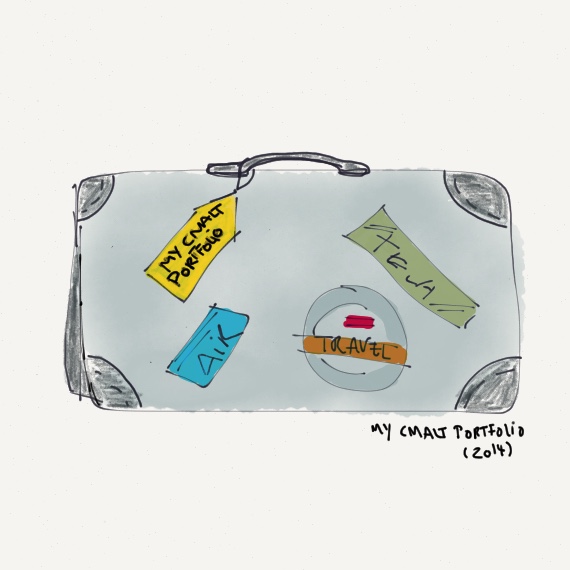
 Compiling my portfolio for submission for CMALT, ALT’s peer-based accreditation scheme, has been a long term project. Originally I started in 2011, but I didn’t complete it. Now I am close to finishing and planning to submit my portfolio (finally). As part of the process, I have made drawings for each section of the portfolio, usually one per section. The first few drawings I made close to a year ago, but I am still adding new ones. Some are illustrations based on CMALT criteria or headings, others are from my work and blog posts. Most of the drawings start life with pen and paper, but many end up being re-drawn on the paper app on an iPad and later edited again with more apps to add text, adjust colours and so forth. This kind of professional development definitely doesn’t require you to get your colour pencils out and start drawing things, so why? Here are my thoughts:
 First, drawing is something that’s been a key part of my practice, of the way I think, long before I started working in Learning Technology and I still find it an invaluable part of my work today. Whether it’s designing open badges or trying to figure out a complex network of use-cases, I often find drawing things down helps with problem solving and communication.
Second, drawings are a good way for me to express different parts of my vision, my personality. I like using them as part of my approach because they can be more eloquent than words and allow me to contribute something more. When I contributed #rhizo15 earlier this year, I found that drawings were a great tool for participating either together with text posts or as stand alone posts. There is something about using colour and images that really connects wit the way I think about things. In the case of my #cmalt portfolio, adding drawings helped to make it feel more like me, help me focus on what I wanted to communicate about my work.
 Finally, and importantly in this context, drawing takes time and focus. For me it is an excellent way to reflect and reflecting on your practice is a key part of the #cmalt framework. I often started a section with a drawing and by the time it was finished, I would be ready to start writing, having laid out the ideas in my head. The reflection is probably the most rewarding part of the process for me.
It’s not really about the drawing in itself, more about the process as a way of giving myself time and space to really think about things, figure out how I feel about something and sometimes, it ends up surprising me with unexpected ideas. That’s the best part for me.