Tag: #virtualteams

  • A year after publication: Leading Virtual Teams

    A year after publication: Leading Virtual Teams

    A year ago my book Leading Virtual Teams was published, and I can very clearly remember all the wonderful excitement that led up to the launch, and am still grateful for all the encouragement for this Open Access publication.

    A year on, and the book, which was initially inspired by the work Martin Hawksey and I did at ALT, has turned into a whole host of resources, two free courses and a podcast which informs my wider work on hybrid working leadership development and coaching.

    A year in Leading Virtual Teams

    To celebrate the milestone, this post gives a quick overview over what’s happened in 2023 and if you are just discovering the book or my work, this is a great place to start:

    Open Access publication – December 2022

    Leading Virtual Teams – Field Notes from a CEO by Dr Maren Deepwell, was published in December 2022 as an open access publication by the Association for Learning Technology, UK. You can read and download a free digital edition, published as an Open Access publication by ALT in partnership with Open Academia.
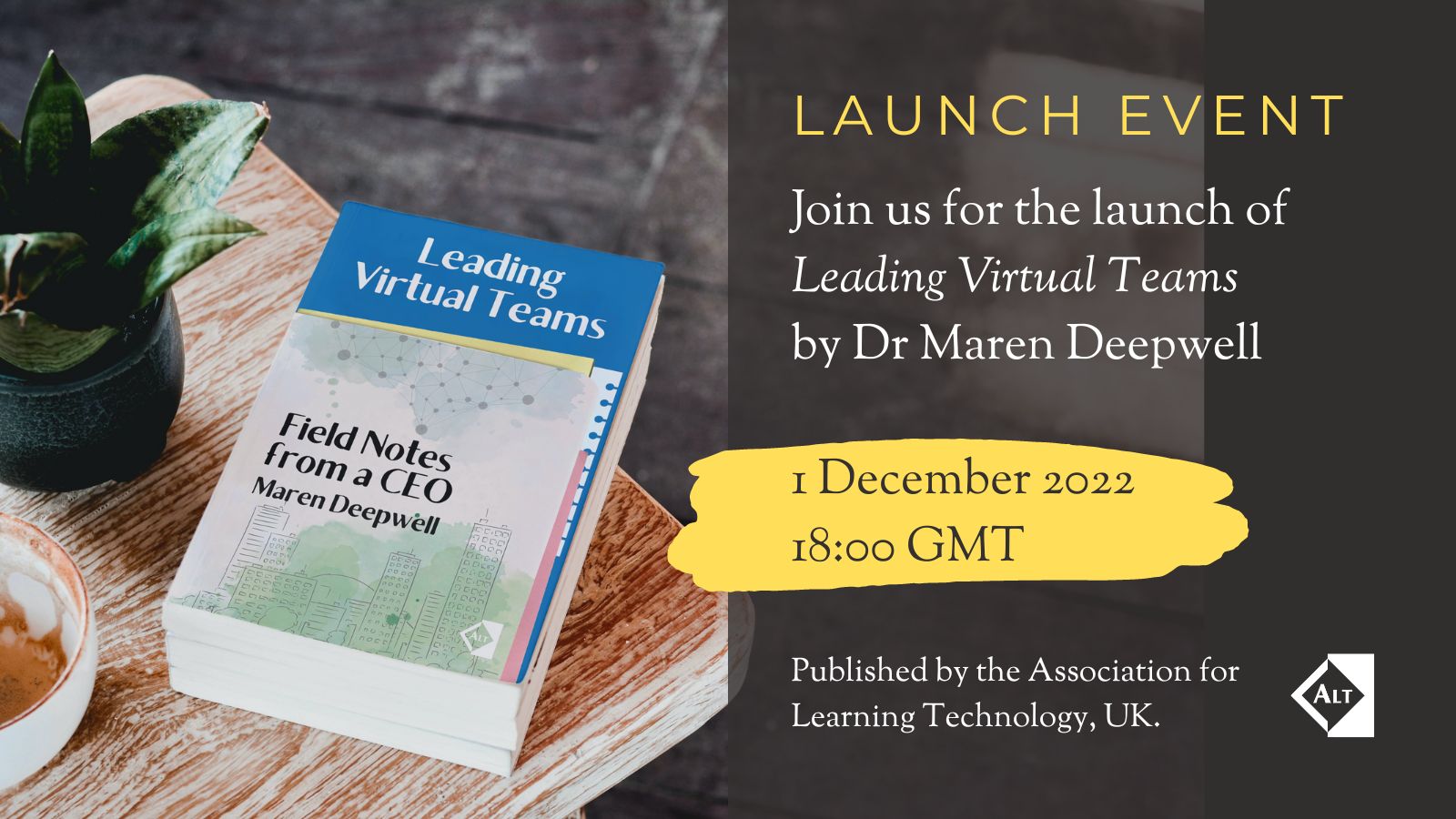
    Digital edition – out now

    I also recorded a preview of the book on the podcast:

    Print edition via Lulu Press – January 2023

    The Open Access print edition, published by Lulu.com, came out in January and you can order it via:
    Podcast season 2 – March 2023

    I started the podcast in 2022, but in spring 2023 things really started happening. Each week, I share ideas and strategies for creative and fun approaches to help you succeed and lead in the hybrid workplace. Each episode includes tools, resources and strategies for different aspects of hybrid working, and links to blog posts and further reading.

    The podcast is available on different podcast platforms and I hope you enjoy the show. You can find it on: AnchorApple PodcastsGoogle Podcasts and Spotify.

    Free Leading Virtual Teams course launches – April 2023

    This was my first venture of translating the book into a course, and I learnt a lot along the way.

    If you’d like to explore the course, all materials are freely available:

    Week by week

    Podcast season 3 with weekly episodes – September 2023

    In September I was excited to have Season 3 of the Leading Virtual Teams Podcast finally underway. It’s a new season in every sense… and that is why I kicked off with ‘new pencil case’ moments in episode.

    This episode celebrated the start of September, and the new season or start of term for many of us. I have recently tried out a ⁠new gratitude journal⁠ share ideas for how to find bright spots in a busy time of year. I also give you a preview of what’s in store for season 3 and the upcoming run of the ⁠Leading Virtual Teams course⁠ in October.

    Free Hybrid Working Habits course launches – October 2023

    I have experienced a lot of ups and downs working from home, managing remote workers and collaborating virtually, and I chronicled this in my book, Leading Virtual Teams (2022). One of the things I learnt along the way is that a good work/life balance and relationship with digital technology may look a little different for everyone but that the journey how we get there is similar. That’s why I designed this course: to share practical tips that you can use to find ways to make hybrid working really work for you (or you team or organisation) in the long term.

    It’s been great to see the course attract lots of listens and interaction. Although I do encourage people to register for free, only about half of the people participating in the course do. Others prefer to simply subscribe to the podcast to listen along and explore at their own pace.

    The topics for the course resonated well with participants, especially those designed to help manage digital overwhelm and setting life/work boundaries. Plus, I really enjoyed recording these as well, which is an added bonus!

    The course resources and podcasts are now freely available and you can explore topics at your own pace. The easiest way to do that is to listen to the course podcast:

    If you’d rather see everything at a glance, the Course information page provides a handy guide to the course and links to all previous topics:

    1: Audit your hybrid working habits to find out how your current habits are impacting on you and what to change;
    2: Set boundaries for a better life/work balance and stick to them even when things are busy;
    3: Increase productivity away from the screen by using strategies for communicating and collaborating outside of meetings;
    4: Communicate more effectively in the hybrid workplace in a way that works for you and reduces digital overwhelm.
    Special guest Martin Hawksey returns to the conversation – November 2023

    In November we went back to the origins of Leading Virtual Teams! I was delighted to co-write together with Martin Hawksey, and we created this joint blog post and special podcast episode:

    Working in the open

    It’s been a wonderful year, and it’s also been a lot of hard work. Practically all my work in this area since the publication of the book has happened around the edges of my day job, and especially until the end of September that was a very full on commitment. Since focusing full time on my free-lance work I have had a little more scope to take on paid work in this space, and thus give this topic a bit more time in my day to day work.

    Every now and then I get an email or a message or someone speaks to me at a conference about something valuable they found in the book, something that helped them in their work or opened up a new perspective and it always, always makes my day.

    I have chosen not to publish the book commercially, instead going the Open Access route with the book and all the resources and courses I have published since, because I want as many people as possible to learn from the mistakes I made and the experiences I recount, and find a better way to manage blended, hybrid and virtual organisations. One downside is however that I have not much data about how many people engage with the work I do, and with an ever more fragmented social media landscape getting a feel for one’s reach is more challenging still. Which is why I value it so much when folk do share some feedback or send me a message.

    All in all, it’s been a fun and rewarding year working towards putting the book into practice and making the ideas in it available to a larger audience.

    Enjoyed this post? Get my free monthly newsletter directly to your inbox.

    [newsletter_form type=”minimal”]
  • Leading Virtual Teams Revisited – with Martin Hawksey

    Leading Virtual Teams Revisited – with Martin Hawksey

    This week we are going back to the origins of Leading Virtual Teams! Join us, Maren Deepwell and Martin Hawksey, in this joint blog post and special podcast episode:

    Maren: Hi Martin! Been a while since we last blogged about leading virtual teams and hybrid working. So… I have lots of questions to get us started: tell us a bit about what your current work set up is like, and what you are particularly interested in when it comes to all things virtual/hybrid working. 

    Also, I am curious to hear how you think things have changed since the dark days of lockdown working. I have been doing some research into the data around home-working and evolving policies here in the UK (for example this 2023 report and the flexible working bill and this WIRED article provides a helpful insight into what’s not being tackled). What’s your take on the evolving picture of hybrid working?

    Martin: Hi Maren, thanks for having me back! For just over the last year I’ve been working for a UK based Google Partner. We have offices in Manchester, Edinburgh and Utrecht, but the focus is very much on remote working. Even in a post pandemic world I see many businesses still trying to find the right fit around hybrid culture. One of the key challenges I see is how to replicate the benefits of being co-located when employees are hundreds of miles apart. For now let’s put these benefits in the broad bucket of ‘watercooler moments’, ad-hoc opportunities for social interaction as well as work discussions. Seemingly effortless and tricky to measure the benefit. It’s something I remember us talking a lot about and I know you’ve shared a number of approaches and strategies which can help. Where I work a recent internal ‘pulse’ survey has highlighted a desire for increased opportunities to work collaboratively. The business is exploring various approaches, including one of the skeuomorphic virtual office spaces, Kumospace. This pilot highlighted there could be real benefits in restructuring the way teams work, a virtual focal point with awareness mechanisms like location, icons, and camera status making it easier to immediately speak to someone if they are available. The challenge was the price point. It was interesting to read the surveys you highlighted which include data on the overall economic benefit of hybrid working. Whilst we had many anecdotal examples of conversations that unblocked issues or identified business opportunities it is hard to put a value on them. The other challenge was there was low engagement across the business in the pilot space. So while we could see benefits for our team, but possible to justify for the business. Does this example resonate with what you’ve seen? Do you get a sense that organisations are still trying to work out how to make hybrid working work?

    Maren: It’s clear that businesses are still on a learning curve when it comes to hybrid working long-term. In the media, there is a lot of debate on whether or not there’ll be a big return to the office, but I think recruitment and retention without a flexible offering will be so challenging, that organisations won’t have a choice. There are a lot of parallels between the use of technology in education and training, and the use of technology in the workplace. Similar to how student expectations have shifted when it comes to digital, so have employee expectations, too. Organisations who don’t offer flexibility or effective hybrid working won’t be able to recruit or retain the diverse talent they need without entrenching structural inequalities further, for example disadvantage employees with care responsibilities. A few years ago we talked about the effort it takes to create and sustain employee engagement online, and your experience with the skeuomorphic virtual office space really chimes with me. Anecdotally it feels like ‘everyone’ wants more connection and collaboration, but at the same time they’d like that sense of connectedness to be maintained by others, so that they can dip in and out as they wish. Even something as simple as internal chat channels require a lot of effort to maintain. If you are using something like Slack or Mattermost to coordinate customer support tickets, then every support ticket becomes a reason to engage (and the value proposition is clear). However if you are in a water cooler or social space there is usually no external prompt to engage and someone usually has to take responsibility for kick-starting engagement by posting something. What are your thoughts on this?

    Martin: The term ‘effort’ resonates with me. Internally in our department we’ve switched to using an all day Google Meet with breakouts for individual teams. In a recent conversation with a colleague about using this space effectively we talked about how it takes effort to join the virtual office, similar to the effort it would take to get to a physical office. I would also agree it requires someone taking responsibility for the use of virtual spaces. I would go even further and say it requires leadership. Similar to having an office manager it needs someone to take responsibility for monitoring and supporting the online office. Something I remember us discussing previously was effort in terms of cognitive load. Part of this is the brain doing overtime trying to analyze micro movements in facial expressions. Looking towards the future I think this could get a lot easier with the next generation video conferencing hardware. I recently had the pleasure to have a short demonstration of Google’s Starline immersive conferencing solution. This combines technology that can scan a face in 3D, and present this to the viewer maintaining a depth of field without the need of special glasses or headsets. The result is incredibly impressive. It was only a brief experience so I can’t talk to the long term effects. Two things I did learn was that maintaining a realistic 1:1 scale was important, so it’s unlikely we’ll see this technology on smaller screens. The other detail was for this solution they are focusing on capturing and displaying detail in the face. For example, when the person on the call held up an apple there was a strong 3D effect, but I could see some fragmentation in the detail between the apple and the person’s fingers. Still lots of unknowns with this type of technology including whether it will ever be affordable for the masses, but interesting times!

    Maren: It’s really interesting to look out how technology might shape things in the future and what sort of skills and capabilities folk may need to develop to effectively deploy more advanced solutions. One thing I have been thinking about a lot recently, and also a topic I covered in the hybrid working course I ran recently, is increasing productivity whilst stepping away from the screen. There are a lot of reasons why we are glued to our screens, but the longer I work in a hybrid or fully remote setting the more I realise that I need to design my days to be a lot less desk based in order to be at my most productive. From getting more movement in and giving my eyes a break, to finding new ways to connect and communicate without staring at a screen I am interested in how we can mix things up a little more. 

    Listen to the full conversation in the podcast 🙂

    Enjoyed this post? Get my free monthly newsletter directly to your inbox.
  • Hybrid Working Habits – It’s a wrap

    Hybrid Working Habits – It’s a wrap

    Over the past four weeks I have run a free and open course all about hybrid working. This week, we are wrapping up the course for 2023, and I’d like to take the opportunity to have a BIG thank you to everyone who took part, and contributed!

    I love the format of the course, which is podcast cased with new topics released every week, as it allows folk to follow the course at their own pace, and offers the option to take part synchronously, too.

    Inspiration for future courses

    Quite a few people who registered for this run of the course expressed an interest in the weekly sessions to drop in. With between 30-50 participants taking part in the course each week, one of the challenges for me is to find a time that works across different time zones. For future runs of the course I’d probably come up with a better timetable to give more people the chance to connect and learn together.

    Another element of the course that I am keen to develop is how new topics are released. Many people taking part have a lot of other commitments to juggle, and might find it easier if all the resources and topics were available from the start. I am going to have a think and see how that might work… 🙂

    What worked well?

    It’s been great to see the course attract lots of listens and interaction. Although I do encourage people to register for free, only about half of the people participating in the course do. Others prefer to simply subscribe to the podcast to listen along and explore at their own pace.

    The topics for the course resonated well with participants, especially those designed to help manage digital overwhelm and setting life/work boundaries. Plus, I really enjoyed recording these as well, which is an added bonus!

    Course catch up

    The course resources and podcasts are now freely available and you can explore topics at your own pace. The easiest way to do that is to listen to the course podcast:

    The course is podcast based and new episodes released weekly on Fridays. The podcast is called Leading Virtual Teams and you can find it on: AnchorApple PodcastsGoogle Podcasts and Spotify.

    If you’d rather see everything at a glance, the Course information page provides a handy guide to the course and links to all previous topics:

    1: Audit your hybrid working habits to find out how your current habits are impacting on you and what to change;
    2: Set boundaries for a better life/work balance and stick to them even when things are busy;
    3: Increase productivity away from the screen by using strategies for communicating and collaborating outside of meetings;
    4: Communicate more effectively in the hybrid workplace in a way that works for you and reduces digital overwhelm.

    Enjoy!

    Enjoyed this post? Get my free monthly newsletter directly to your inbox.

  • Are you returning to the office, five days a week? The week in hybrid working click bait headlines…

    Are you returning to the office, five days a week? The week in hybrid working click bait headlines…

    This past week all my networks about hybrid and virtual working have been dominated by attention grabbing headlines from this year’s KPMG CEO Outlook survey:

    Most bosses think you’ll be back in the office 5 days a week within 3 years (Fortune)

    Two-thirds of CEOs think staff will return to office five days a week (The Guardian)

    Most executives expect a full return to the office by 2026 (The Times)

    These headlines are usually accompanied by predictions around the disadvantages employees not willing to return might face:

    87% of CEOs globally – 83% in the UK – told us it’s likely or very likely that employees who make an effort to come into the office will be rewarded with favourable assignments, raises or promotions.

    KPMG CEO Outlook

    There is some mention of the need to carefully handle a return to the office, to take into account what employees need and want, but overall, there is a strong sense of relief that established corporate power structures are flexing their muscles by demanding that workforces return to their rightful place in every sense of the word.

    When I carried out the research for my book on virtual working, I found a distinct lack of evidence that the employment policy landscape in the UK or the US was changing. Other countries, especially around Europe, used the increase in home working during the pandemic to establish laws around employees’ rights to disconnect. But here in the UK there was no sense from government of urgency to create similar policies for the long term. Instead, UK policy flexed to accommodate emergency measures and short-term solutions.

    So what do we really know about what the landscape looks like in the UK beyond the outlook of CEOs? Are workplaces really preparing for a return to the office, five days a week?

    Recent research

    Report: Flexible and hybrid working practices in 2023 (CIPD, 25 May, 2023)

    This is an interesting report, based on YouGov survey data, that explores flexible and hybrid working in the UK. The report focuses on employer and employees perspectives related to changes to flexible working law.

    What I found most useful is that the report gives you a sense of what the current overall scale of flexible and hybrid working is in the UK, and also how many different practices this encompasses, with everything from working from home to having a four-day week and from zero-hour contracts to career breaks.

    Hybrid working, in the context of this report, requires employees to still be in the workplace for a specific number of days per month or per week. The report states: “Over half (52%) require hybrid working employees to be in the workplace for a minimum number of days in the working week/month, while 46% do not. Private sector employers are more likely to say they have a minimum requirement, and voluntary sector employers are more likely to say they do not. Overall, employees are most likely to be required in the workplace for two (35%) or three (33%) days a week.

    Is this a long-term trend? Or simply organisations operating more or less as before, but with more flexible and hybrid working added on top of existing practices? When it comes to long-term impact on resourcing office space, pay and equality, the report only includes brief mentions. It does highlight that employers perceive a positive impact on productivity, recruitment and retention as well as employee financial wellbeing.

    When it comes to hybrid working specifically, the report states that “Eighty-three per cent of organisations have hybrid working in place. Forty-five per cent have a formal policy, 24% take an informal approach, and 13% are developing policies through learning/trialling. When CIPD last asked this in a similar survey in June 2022, fewer had hybrid
    working (77%) and fewer had formal policies in place (34%).”

    This is really interesting, particularly when thinking about the managers leading teams in half the organisations that have hybrid working in place, but do not have formal policies. The need to develop skills for manage this scale of changes in the workplace is clearly becoming more urgent as the proportion of workplaces who offer flexible and hybrid working increases. The report reflects this as a negative impact of more flexible and hybrid working:

    • Specially, ability of managers to lead teams effectively (-18)
    • and identify as challenging for managers managing remote teams from a wellbeing and performance perspective (41%)

    Developing your skills as a leader or manager in this context is particularly difficult because so few organisations have expertise to draw on and there is little formal training led by experts who actually have a track record beyond their personal experience of working from home.

    Interested in evolving your approach to Hybrid Working? Registration for my next course starting 20th October is now open and it’s free for everyone. Sign up today.

    Changes to workplace laws

    One of the biggest changes in the UK this year is the Employment Relations (Flexible Working) Bill. This Bill has wide-reaching consequences for employers and employees, including granting employees the right to request flexible working from day 1 instead of after 26 weeks (background info) with the aim to make employment ‘flexible by default’.

    As part of the work of the Flexible Working Taskforce, there now are a growing number of resources for employers and employees, including:

    This follows on from last year’s UK consultation Making flexible working the default (December 2022) which included a focus on better understanding how informal flexible working operates in practice. It is very clear how far-reaching this particular issue is, even if the proposed changes to employment law don’t encompass all aspects:

    Flexible working doesn’t just mean a combination of working from home and in the office – it can mean employees making use of job-sharing, flexitime, and working compressed, annualised, or staggered hours. … The ‘Making flexible working the default’ consultation recognised that flexible working is different for every employee, employer, and sector – it does not come in one size only. For an office worker, they may benefit from a job-share so they can better care for their children, or a factory worker may request different shift patterns that suit their balance between home and work. Because of this, the government will not instruct employers or employees on how to carry out their work, instead we encourage both parties have constructive and open-minded conversations about flexible working and find arrangements that work for each side.

    https://www.gov.uk/government/news/millions-of-britons-to-be-able-to-request-flexible-working-on-day-one-of-employment

    However, the proposed changes do not go far enough in addressing the wider issues at stake here and this WIRED article provides a helpful insight into what’s not being tackled.

    What does this tell us?

    The change in the law around flexible working seems to be paying lip service to what employees demand, but is not going far enough in tacking the hybrid working issue that grab the headlines. This bill won’t protect the rights of employees if bosses increase demands to return to the office full time or ensure that those not returning won’t be disadvantaged. It doesn’t put onus on employers to up skill managers or upgrade infrastructure to exploit the full potential that hybrid working could offer. What it covers is too broad an area and not clearly enough defined to support hybrid working specifically.

    There’s also something else at stake here, which comes out in the KPMG survey, a sense that work is all about people, “that business are about people, after all”. There is a lot of talk of nurturing wellbeing, supporting careers and offering the right sort of value proposition to employees with whom “hybrid working is extremely popular”.

    Businesses are about making profits, and I am pretty such that the companies that take part in the KPMG survey and those quoted as ‘leading the return to the office’ such as Amazon and Google, are not seeing how giving employees more flexibility, continuously up-skilling managers to adapt to flexible workforces and making less use of extensive corporate campuses will benefit their bottom line.

    Hybrid working is extremely popular not because some people can’t see that it’s more fun to have a coffee with colleagues than staring at endless video calls through a laptop screen. Hybrid working is popular because it enables people to cope with the competing demands of their lives, including family or caring responsibilities. It means spending less time and money on commuting, eating lunch alone and buying office appropriate clothes. Hybrid working has opened up a new perspective for many that work matters less, and being outside, spending time with family or simply taking a breath is more important than work.

    Yes, hybrid working is complex and not without downsides, as I have explored at length elsewhere, but these headlines about mandating a return to the office seem to be much more about executives clinging onto old power structures than caring about people. Let’s not give into that and instead use the momentum created by the increase in hybrid working during the pandemic to shape the future of work for good.

    Enjoyed this post? Get my free monthly newsletter directly to your inbox.

    Image credit: Photo by Adolfo Félix on Unsplash

  • The story behind… Hybrid Working Habits

    The story behind… Hybrid Working Habits

    In this week’s podcast I share some of my personal history and how I came to be so interested in all things hybrid and virtual working. From Germany to London in my art school years, and from Athens to Oxford as my work moved from Art to Anthropology and then Education, this episode sets out what I think is interesting about hybrid and virtual working, why it’s important and why now is the time to really find ways of working that work for you.

    Listen to the episode:

    What are your hybrid working conundrums? Leave a comment or email me with you questions and problems when it comes to hybrid working, and I’ll pick these up in the upcoming episodes.

    Learn more about the course

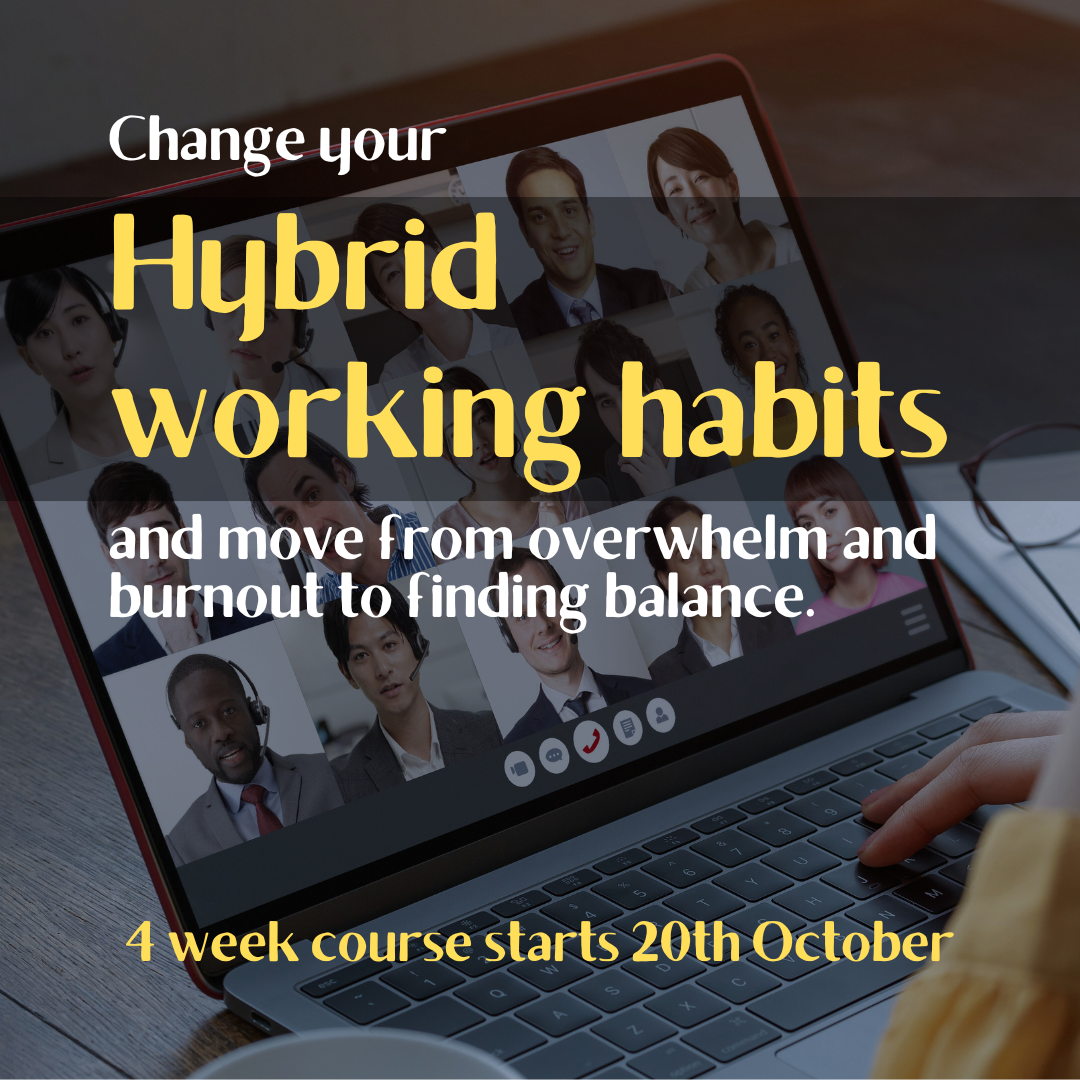
    Change your Hybrid Working Habits, my new 4 week course, starts 20th October 2023.

    One of the consequences of the global pandemic in the workplace is an increased demand for flexible and hybrid working. In response, employers are offering staff to work from home more regularly, and come into the office or on campus for less time each week. Flexible working is intended to increase staff satisfaction, productivity, and retention at a time when we have moved from the great resignation of 2021 to an endemic of ‘quiet quitting’. At the same time, effectively working from home has become a sought after skill in the workplace, particularly as some of the negative impacts of long term home working on (mental) health, equality, diversity and inclusion and staff engagement have started to emerge. 

    Bridging the gap between the growing hybrid workforce of knowledge workers and the (lack) of organisational vision for the post-pandemic workplace, are the managers and leaders leading increasingly virtual teams. It is their job to translate the newfound flexibility into effective collaboration between colleagues. It is their challenge to establish communication channels that engage a hybrid workforce with diverse needs, balancing work with other commitments. A workforce for whom coming to the office or on campus may be a hated necessity or indeed a much sought after opportunity. Not everyone loves working from home, sharing a desk or meeting in a coffee shop. 

    If you are looking to move from overwhelm and burnout to finding balance, then this course is for you. 

    Develop the skills you need

    This course is designed to help develop skills to:

    • Audit your hybrid working habits to find out how your current habits are impacting on you and what to change;
    • Set boundaries for a better life/work balance and stick to them even when things are busy;
    • Increase productivity away from the screen by using strategies for communicating and collaborating outside of meetings;
    • Communicate more effectively in the hybrid workplace in a way that works for you and reduces digital overwhelm.

    Course activities

    Listen to the podcast

    The course has four parts and each part is introduced by a podcast episode that sets out the key ideas for the topic. I have chosen the podcast format to enable you to follow the course at your own pace, listening when it suits you and also to minimise screen time needed to take part in the course. Whether you listen to the course as you walk the dog, cook or sit in a comfy chair, this course is designed to take you away from your screen and constant stream of notifications. You just have to listen.

    Reflect on your practice in weekly hangouts

    Each topic is accompanied by prompts and questions to help you reflect on your professional practice. We will use these prompts in weekly course sessions to take a deeper dive into ways of working in the hybrid workplace and reflect on how your habits aligns with your goals and values. You can choose whether you write your reflections down, share them with others in the course or keep them private for yourself.

    Explore new ways of working

    Each topic comes resources and tools to explore. You can try out new idea for yourself or join one of the weekly drop-in sessions for personalised support.

    Who is the course for?

    This course is designed for emerging and established leaders and managers working in a hybrid or fully virtual setting in education and the not-for-profit sector. We will focus on how to develop effective home/hybrid working strategies. Whether you are collaborating online on a project, organising distributed volunteers or managing a whole hybrid working department, this course will support you to move from overwhelm and burnout to finding balance.

    Register today

    4 Week Course Listener – free

    • Listen via your favourite podcast app
    • Follow at your own pace
    • Explore resources via the show notes
    • Upgrade anytime!

    4 Week Course Explorer – £29

    • Course content straight to your inbox
    • Weekly course hangout & drop-in support
    • End of course summary with resource pack
    • Certificate & badge upon completion

    4 Week Course Explorer + Personal Coaching – £229
    Course Explorer package PLUS:

    • 4 x 1-to-1 coaching sessions tailored to you
    • resources and tools
    • personal plan and accountability check-ins

    Register now

    Enjoyed this post? Get my free monthly newsletter directly to your inbox.
  • Fresh listens: Podcast Season 3

    Fresh listens: Podcast Season 3

    I’m really excited to have Season 3 of the Leading Virtual Teams Podcast finally underway. It’s a new season in every sense… and that is why I am kicking off with ‘new pencil case’ moments in episode 1:

    This episode celebrates the start of September, and the new season or start of term for many of us. I have recently tried out a ⁠new gratitude journal⁠ share ideas for how to find bright spots in a busy time of year. I also give you a preview of what’s in store for season 3 and the upcoming run of the ⁠Leading Virtual Teams course⁠ in October.

    Today the second episode of this season gets released and this one is all about coaching.

    The questions I get asked most often by new clients or those considering giving coaching a go, are… ‘What is a coaching session like?’, ‘What should I expect from the first session?’, ‘How should I prepare?’ and also ‘How can I make the most of it?’.

    In this episode, I bring together answers and examples to give you a sense of coaching with me, to explain what’s involved and what to expect.

    Listen to the podcast

    Each episode includes tools, resources and strategies for different aspects of hybrid working, and links to blog posts and further reading. On this page, you can find links to the all episodes and further resources in the show notes.

    The podcast is available on different podcast platforms and I hope you enjoy the show. As always, share your ideas and feedback in the comments, or on social media. If you have a specific questions or comment, contact me . I look forward to hearing from you.

    Enjoyed this post? Get my free monthly newsletter directly to your inbox.