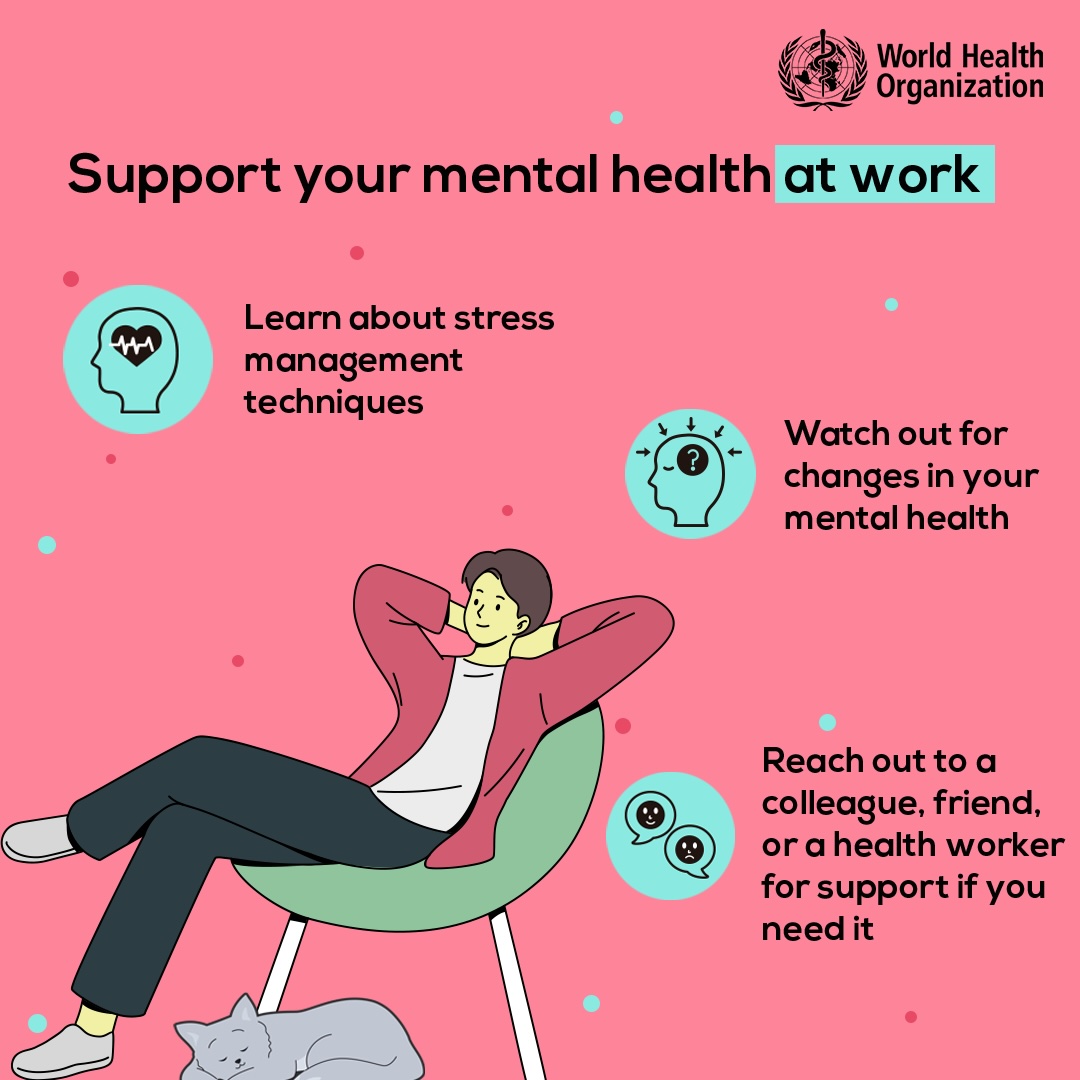
Tomorrow is World Mental Health Day and this year’s theme is “It is Time to Prioritise Mental Health in the Workplace” -World Mental Health Day is an annual awareness day observed every 10th October.
This is a cause I have long championed, and I am glad to see this year’s emphasis on mental health in the workplace supported by a whole range of resources. I’ve linked to some examples below and each of these point to further resources for help and advice:
Many of my coaching conversations are related to finding balance between wellbeing, both mental and physical, and the demands of a busy work life or a career transition so I doubly appreciate the emphasis on mental heath at work.
Hybrid and remote working has a big impact on our wellbeing. Much of the resources for leaders and managers features above identify the need to develop skills in supporting mental healthy in hybrid work places, but there’s a lot yet to do.
I’ve previously blogged about a whole range of approaches to supporting mental healthy in hybrid and virtual teams, from mediation and mindfulness to team building on the radio and celebrating small milestones.
This week I am going to take a moment to check in with myself, and those around me. So in that spirit, I’ll leave you with an invitation to reach out. How are you?
This past academic year I have worked on a number of different projects all connected by the theme digital wellbeing. This post brings these different strands of work together and offers some key take aways.
Now, before we jump in it’s worth being clear what we mean by the term ‘digital wellbeing’:
In the wider context of digital health it can mean using technology, applications, websites or online services to help us manage our health and wellbeing.
In the workplace, and specifically in an increasingly hybrid workplace, we often use the term digital wellbeing or digital wellness to describe how the use of digital technologies impacts our physical, mental or emotional health and wellbeing, for example screen fatigue or stress caused by digital overwhelm and constantly being connected.
It’s interesting that in one context technology is seen as a solution to managing health and wellbeing and in the other we have to manage technology to improve our health and wellbeing. In my work the second meaning of digital wellbeing is most relevant, as I work with individuals and organisations who are seeking to increase their awareness of and control over their relationship with digital technology in a work context.
What is the challenge?
The biggest challenge is having common ground to discuss what’s beneficial and what is having a negative impact when we think about technology and wellbeing in the workplace. It depends on a lot of different factors from the job you have, where and how you work, how you use technology outside of work, where and with whom you live and so on. An introverted researcher with a dedicated home office who lives alone is going to have a very different baseline from a member of support staff who is always on call and who has small children at home.
Professional development in digital wellbeing is thus not a ‘one size fits all’ teaching scenario. Although some advice will be helpful and relevant to most, it’s largely a case of cultivating a sense of awareness, of curiosity to begin with. In my experience an inquiry based approach seems best suited to address the topic and in many of the resources and course designs I feature resources and tools to help participants analyse and reflect on what aspects of hybrid working most impact on their digital wellbeing and why. The aim overall is to increase awareness and offer tools to start noticing what is working and what isn’t.
Common factors
Once you get to a point at which reflection is happening, some common factors emerge:
A desire to take more regular breaks or indeed an awareness that one should doesn’t easily translate into action. In very few workplaces is it seen as normalised to take regular screen breaks;
Senior managers are generally seen as unaware of the issues and hybrid working often makes people in power perceived as more distant, less accountable. The few exceptions I have worked with, i.e. senior leaders who do take an active interested, reap the rewards from and with their teams;
Desk/workspace set up are usually less than ideal. Space, equipment, improvements like a sit/stand desk, are often wished for, less often realised;
Everyone appreciates more time at home and/or with their family, but that doesn’t lead to less time working. Work/life balance feels more under pressure for homeworkers with a busy home life, especially with young children or care responsibilities;
The office, campus or HQ is perceived as problematic, either because it is too empty or because space has been reallocated and is now shared. Flexible/hot desking doesn’t seem to work for most;
Putting your phone away during screen breaks or lunch time is something most won’t attempt;
In every group I have worked with there are some who would return to the office tomorrow, and do not wish to ever use Teams or Zoom again. There are an equal number of folk who would never countenance the prospect of returning to the office, and most see working from home 2-3 days a week as the norm. Mondays and Fridays especially.
Teaching things like taking a break from sitting in front of your screen is hard to do in a format that requires yet more screen time, and I made an effort to experiment with different modalities including blended, audio only and asynchronous approaches. Making space to be silent, to pay attention to only one thing or only one window on the screen is key, and yet it’s very hard to achieve. Digital desktops are as unique as their users, and most have dozens or tabs, files or windows open whilst engaging with digital wellbeing activities online.
The wellbeing piece needs more expertise
In my work from coaching and teaching to leadership development the wellbeing part of digital wellbeing has always been an area I felt I need more expertise in. The literature on digital wellness and digital wellbeing, at least in the context I work on, is very often focused on the digital part of the equation, not the human being. Nearly all of the tips shared by participants in different context where related to technology and included wearing glasses that protect from blue light to using timer apps to remind you to take a break. Dedicated meditation mindfulness apps such as Calm, Headspace or Insight Timer have extensive and well produced content for wellbeing at work, but often such support doesn’t reach those harder to convince.
What’s needed is more practical expertise on how our bodies work (at work) and how we can increase digital wellbeing in practical ways. That’s the direction in which I am keen to develop my work next, and I am looking forward to sharing more details of an upcoming collaboration that will do precisely that in the coming months.
Listen to the podcast episode:
My projects in Digital Wellbeing, academic year 2023/24
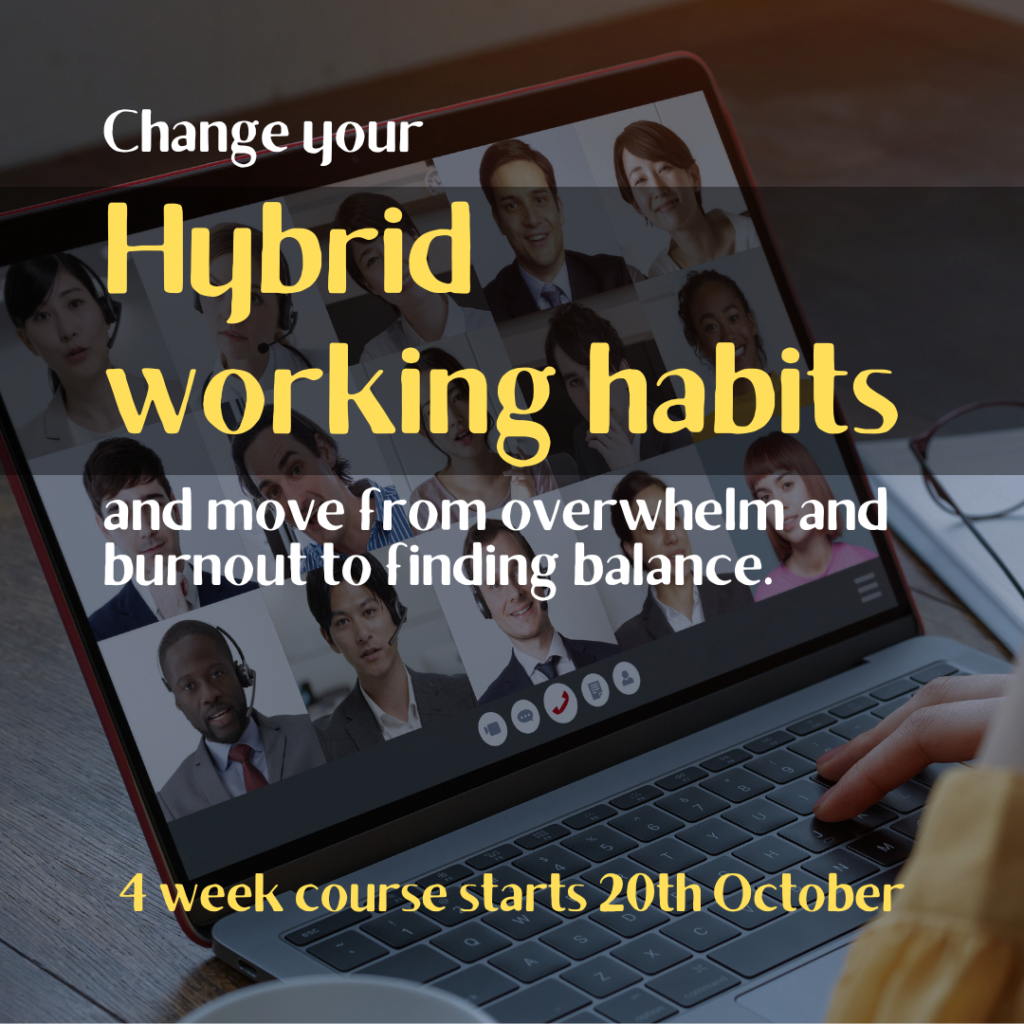
The first project was my free course Healthy Habits for Hybrid Working, which I ran in October and November last year. The course was designed to share practical tips that you can use to find ways to make hybrid working really work for you (or you team or organisation) in the long term and covered the following topics:
The work of the course then evolved into a series of resources, coaching tools and podcast episodes over a period of months, which included running dedicated workshops for teams and leaders.
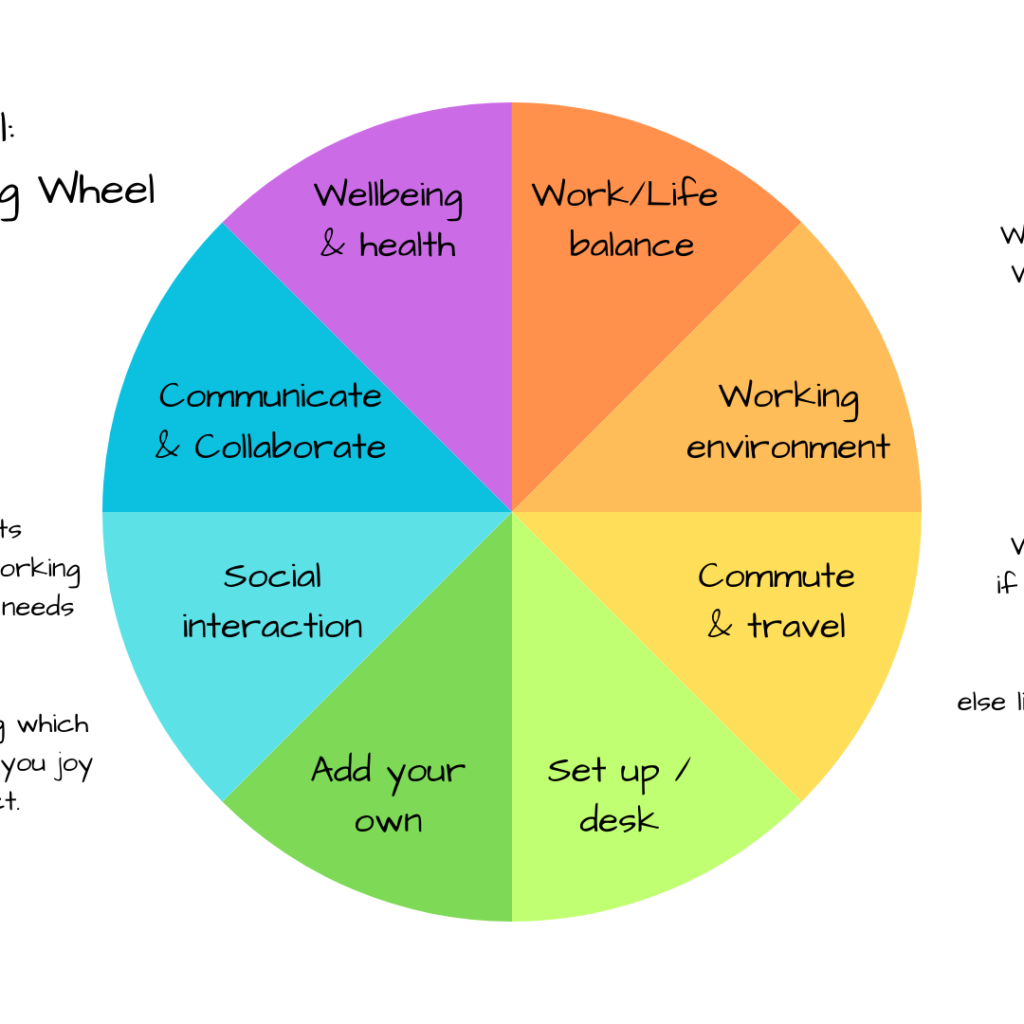
One of the most popular of these is an adapted coaching tool called the Hybrid Working Wheel, which many of my clients started using, and I organised a holiday ‘reflect-along’ session over the holidays which was a lot of fun!
Teaching digital wellbeing and hybrid working as a short-course at the University of Oxford’s IT Learning Centre was one of my favourite projects of the year, and I worked with a growing cohort of faculty and staff over two terms.
This course was specifically designed to enable participants to:
Reflect on how your current habits are impacting on your digital wellbeing
Identify your hybrid working skills strengths and areas for development
Understand the long term impact of hybrid working on digital wellbeing
Develop a sense of how to foster digital wellbeing
In this series I explore what happens to our senses when we work in a hybrid or fully remote setting for long periods. How does our embodied experience of work change as we spend more time in front of screens, alone in our studies or on kitchen chairs? And also, how does our perception of work shift as our senses of sight, smell, touch, taste and hearing adjust to hybrid working?
The short course in digital wellbeing I run for the University of Oxford explores some of these issues and it’s helped me appreciate even more how important these aspects of hybrid and remote working really are. In the course we only have limited time to dive into each of these, so this series of blog posts builds on some of my thinking from the course design, and expands these further. If you’re new to this series, you might find it helpful to first read Part 1 focused on our sense of sight, Zoom fatigue and healthy habits for stepping away from our screens.
There are also accompanying podcast episodes, starting with this episode:
In this post, part 2, I want to turn my attention to hybrid working, digital noise & overwhelm.
Our sense of hearing and hybrid working
Similar to our sense of sight, our sense of hearing works hard when we work online more often: from wearing headphones for long hours to listening to the radio or music in order to block out unwanted noise, quietude and silence are rare during a busy working day. There’s lot of medical research into the risks of wearing earphones or earbuds over prolonged periods, but I know too little about this to include specific studies here. From what I have read it seems clear that one should avoid prolonged use and take regular listening breaks, set limits on volume and monitor exposure to loud noise.
The prolonged use is specifically problematic when you are in video calls all day long, as we rely on our sense of hearing to fill in the gaps when video connectivity is poor, and we often use it to multitask during meetings, listening whilst checking emails or working on documents. In the first post in this series I talked about the impact of staring at screens without breaks and there is a parallel with our use of earbuds or headphones here, too. Most headphones and mobile devices now monitor routinely for noise and environmental sound levels and alert you when you are exposed to excessive noise. Wearing noise cancelling headphones or earplugs can help as can moving to a quieter area to work. However, I am not sure how much choice we have in our exposure to sound.
The auditory equivalent of Zoom Fatigue is called Listener fatigue (also known as listening fatigue or ear fatigue) and this is a phenomenon that occurs after prolonged exposure to an auditory stimulus. Symptoms include tiredness, discomfort, pain, and loss of sensitivity. Listener fatigue is not a clinically recognized state, but is a term used by many professionals.
Personally, I hadn’t come across the term before now, but I certainly have experienced the symptoms described above.
Even outside of meetings, audio notifications can be a source of distraction or stress. The constant pinging of chat messages, new alerts or reminders can feel relentless, and it takes some effort to adjust things so that the technology works for you, rather than against you. Personally, I go in for switching off all notifications and my mobile is always on silent, as I prefer to engage with things when I choose to, rather than to have things pull me in as new messages or mentions arrive, but whatever strategy you use to manage, check in to ensure that it serves you, rather than you changing your ways in order to accommodate the behaviour of the tools you use.
Healthy habit: daily quiet time
If you are looking to improve your digital wellness with daily quiet, here are some tips to get started:
Finding your quiet time: There is usually a time of day or a point in the week when you crave a quiet moment the most. For me, that’s usually Thursday afternoon. For many people a couple of back to back meetings or a busy day in contact with others prompts a desire for a quiet moment. Find a time and protect 10-15 minutes. Schedule a meeting or a break.
Finding quiet: Depending on where you are, this might involve going outside, going into a different room, or even using earplugs. Finding quiet places can be a challenge if you live or work in a busy environment. Wherever you go, make sure you are safe and undisturbed.
Support in silence: If you prefer, use a meditation app or sound recording at a low level to tune into quiet moments.
Notice the return of noise: When you return from your quiet time into a noisy environment, notice the impact that has on you.
Make it a habit: how about setting a reminder to schedule a moment of quietude each day? Or you might prefer to pair your daily quiet time with something you already do, such as walking the dog, doing the dishes or exercise. Add a short, intentional moment of silence and stillness to an existing habit makes it easier to stick to.
Share your habit: make this habit stick by sharing that you are having a quiet moment. If you use direct messages or chat at work, post a quick update like “Just stepping away for a quiet moment” or “Back online in 10 minutes. Taking a break”.
It’s been 18 months since I first launched my podcast, and this academic year I have stepped up the pace with a new episode every week. 65 episodes later… I still enjoy the process of making the podcast and it’s been very, very useful for my professional practice. It’s also a (for me still relatively) new way to sharing my work and I have tried to find the right tone in this medium, tried to find my podcast voice.
In this post, I bring together things I have learnt along the way, and also ideas for what I’d like to try out next:
Getting started: Looking back at the first year on the podcast, the pattern of putting out episodes is erratic. Sometimes I published 5 episodes a month, other times it was only one. They all come out on different days, and the format and duration vary, from below 10 minutes to above 40. Season 1, which doesn’t have episode numbers, has 10 episodes. Season 2 has 21 and currently Season 3 is at 30+. It’s a bit of a mess… However, what matters to me is that I did it. I continued to record and release episodes, trying out different topics and formats, with guests and without. I now feel that I have a podcast, and I have made it part of my professional practice.
Choosing what to talk about: Just looking at the titles of various episodes gives you a clear indication that there are a whole range of topics I talk about. Here are some examples from across the three seasons:
25 hacks to make hybrid work 1% more comfortable
A party without a cake is just a meeting…
Career transition reflection – 3 months in
Some episodes are focused on coaching, and include more factual/how-to content whilst others are about leadership in hybrid workplaces and others again are updates on my work, celebrating milestones, reflective practice, radio… . The list goes on. What’s useful for me is that the podcast has become a reflection of my practice and leadership. That’s what I am interested in exploring, and it’s been helpful to acknowledge that as I find my voice.
Listening to other people’s podcasts provided all sorts of inspiration and I tried out different things with various episodes to feel out what might work for me. Importantly, it needs to be a topic I am interested in, and it needs to be useful to me. My podcast is a passion project, not something I get paid to do. It’s an element of my open practice and as such it’s useful to others (I hope) but it’s primary user is me.
An audience of one? In the early days of the podcast, it certainly was (an audience of one). I remember how excited I got when someone who could not be family & friends listened! It still makes me happy to hear that someone found an episode interesting or useful and yet I haven’t put a lot of effort into promoting the podcast. The platforms on which the podcast is registered offer all sorts of tools and resources to help you build your marketing campaign and expand your audience, which I must admit I have largely ignored up to now.
It’s an intentional choice on my part to keep the podcast a space to play and experiment with. Just like my blog, I want the podcast to be part of my domain, a page in my sketchbook if you like. I don’t want to monetise it even if I could. I am not interested in it becoming the next big podcast on hybrid working even if that opportunity arose. I want it to sit in the margins. A working, thinking space instead of a polished production.
With an organically growing audience, episodes now attract 30-50 listens on average.
Experiments in podcasting: Since I started the podcast, I have experimented with various projects: I used the podcast to record audio versions of key sections of my book Leading Virtual Teams; I have run two CPD courses using my podcast as the main platform to deliver course content and I have used the podcast to share career transition updates as I started my free-lance venture. It’s certainly been a bit of a mixed bag of approaches and that has resulted in me learning a lot along the way.
I appreciate that it may be frustrating to folks who are looking for regular episodes week in week out on a similar range of topics, and with a similar take on the format and I am sorry if experimenting with various aspects of the show makes it less enjoyable or less useful at times. For me, these experiments have been incredibly useful and rewarding, giving me space to try out ideas and new approaches on the journey to finding my podcast voice.
Things I learnt along the way:
Getting comfortable with recording conversations and structuring content
Recording intros and outros
Writing show notes and providing links to resources
Transcripts and automatic transcription
Registering a podcast on different platforms
The power of replay: Whilst many people dislike listening to their own voice, and I am not a huge fan of mine either, I do listen back to my own podcast episodes. I find it incredibly useful to replay my thoughts to help me refine my reflections and also to review how my thinking has changed. Just as listening back to a recording of me coaching with my coach trainer helps me identify ways in which I can improve as a coach and also identify what I am doing well and why it works; listening back to podcast episodes is extremely helpful for my professional development.
It’s also a bit nostalgic, particularly in the more personal/reflective episodes. Here I am, celebrating milestones and sharing tips for this and that whilst around me domestic chaos or work problems reign. There are episodes when I clearly had a cold and episodes when I can hear my dog Posey in the background wagging her tail or chewing on something noisy.
A note on the technology: I don’t have much know-how to share when it comes to podcasting tools and platforms. I have a wonderful mic that I can’t connect to my current computer, I use a browser-based, free tool to record my episodes which is just about to go out of service… and I live in a noisy environment where proper recording quality is harder to achieve than I’d like. In short, my set up is makeshift. When I sit down at my desk in the morning between meetings to record an episode, I am afraid there are no ambitions to have a recording set up beyond headphones.
I am fortunate to know many people in the Open Education community with brilliant podcasts and radio shows, many of whom have professional experience in this industry, much better placed to advise on anything technical and I salute them. I learn much from their example, even if that is not always evident in the audio quality of what I produce… .
Where next? I am very excited about continuing my podcasting adventures and I have ideas I want to try out come summer, and a break in my ‘regular’ schedule. I also need to learn how to record my episodes on a new platform, and I am definitely working on getting the good mic connected. Most of all, and regardless of any practical considerations, I am determined not to loose this space for open practice that I have opened up for myself. It’s another experiment in open leadership that has become important to me, and that in itself is a huge reward.
It’s not all about podcasting… there’s a newsletter you can subscribe to as well… (that’s another blog post).
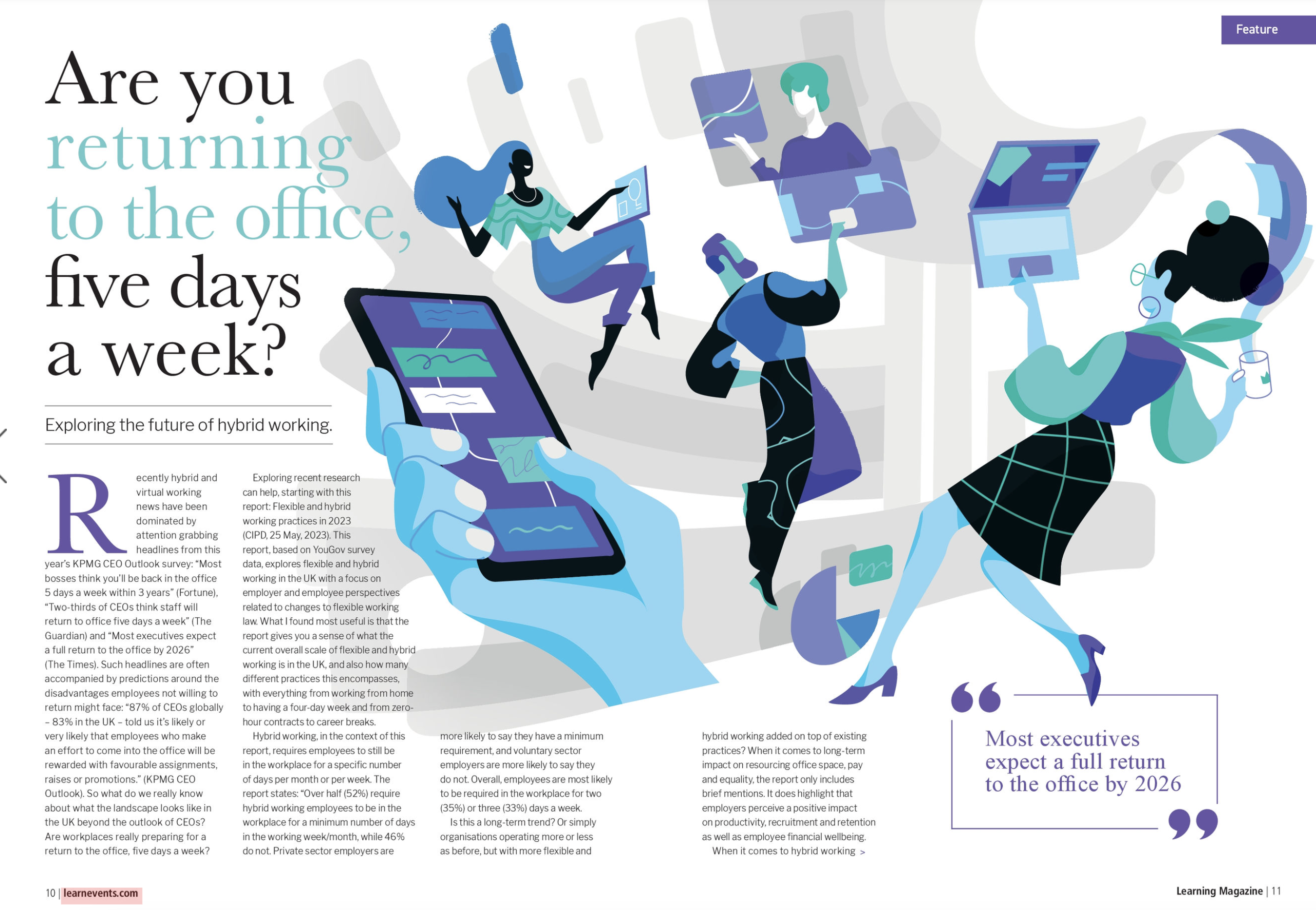
I am really looking forward to speaking an next week’s World of Learning Summit. In preparation for the session and to offer an insight into what my session will be about, I contributed an article to the Learning Magazine: you can read the article freely online.
Screenshot of the article with the caption: Are you returning to the office, five days a week?
My session at the summit is on Wednesday, and focused on offering an interactive discussion forum for leaders. We’ll explore hybrid working recruitment and retention, new trends in hybrid working and also challenges that arise over time from recruitment to long term retention.
Look out for the slides of the session, which I’ll be sharing via my linktree.
Don’t miss a post. Subscribe to my free newsletter and get a summary of everything once a month to your inbox.
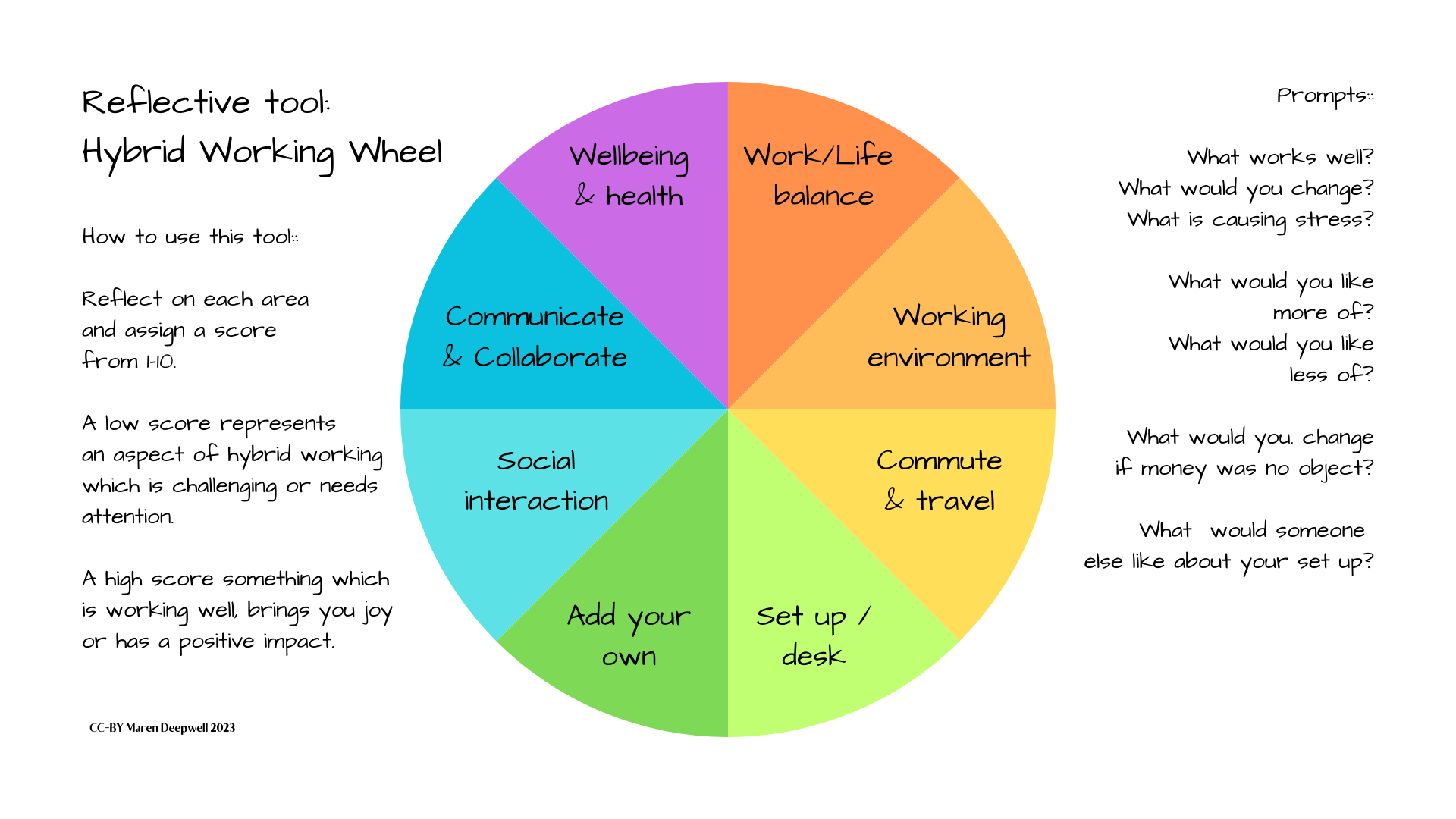
According to Spotify Wrapped, the most popular episode of my podcast for the year is this one, about the Hybrid Working Wheel. If you haven’t come across this before, have a quick look at this blog post from last yearn which provides a bit of background. Simply put, I adapted a popular coaching tool for reflection, the Wheel of Life, for hybrid working.
The purpose of the tool is to help you reflect on different aspects of how you work, including your working environment at home, at the office or on campus, communication & collaboration as well as social interaction and wellbeing.
Holiday ‘reflect-along’
One of the questions I get asked the most is how to reflect in practice. Many of us find it difficult to sit down with a blank piece of paper and jump straight into focused reflection.
Hence, in this podcast episode, I offer you the opportunity to see how the tool is used in practice and to reflect along with me as we progress through the episode. Let’s have a bit of fun at the end of the year, and try out something a little different. Use this episode to “reflect along” with me as part of your run up to the holidays (and hopefully a well deserved break!) or as you prepare to begin the new year.
How to take part
I have made an updated template especially for this reflect-along episode, and you are welcome to use this if you’d like to jot down your own scores and notes.
Find a cosy spot and get yourself a hot drink or take the episode outside and listen along as you walk. The important thing is to bring some curiosity to this exercise, and to be open to discovering something new.
Listen to the episode
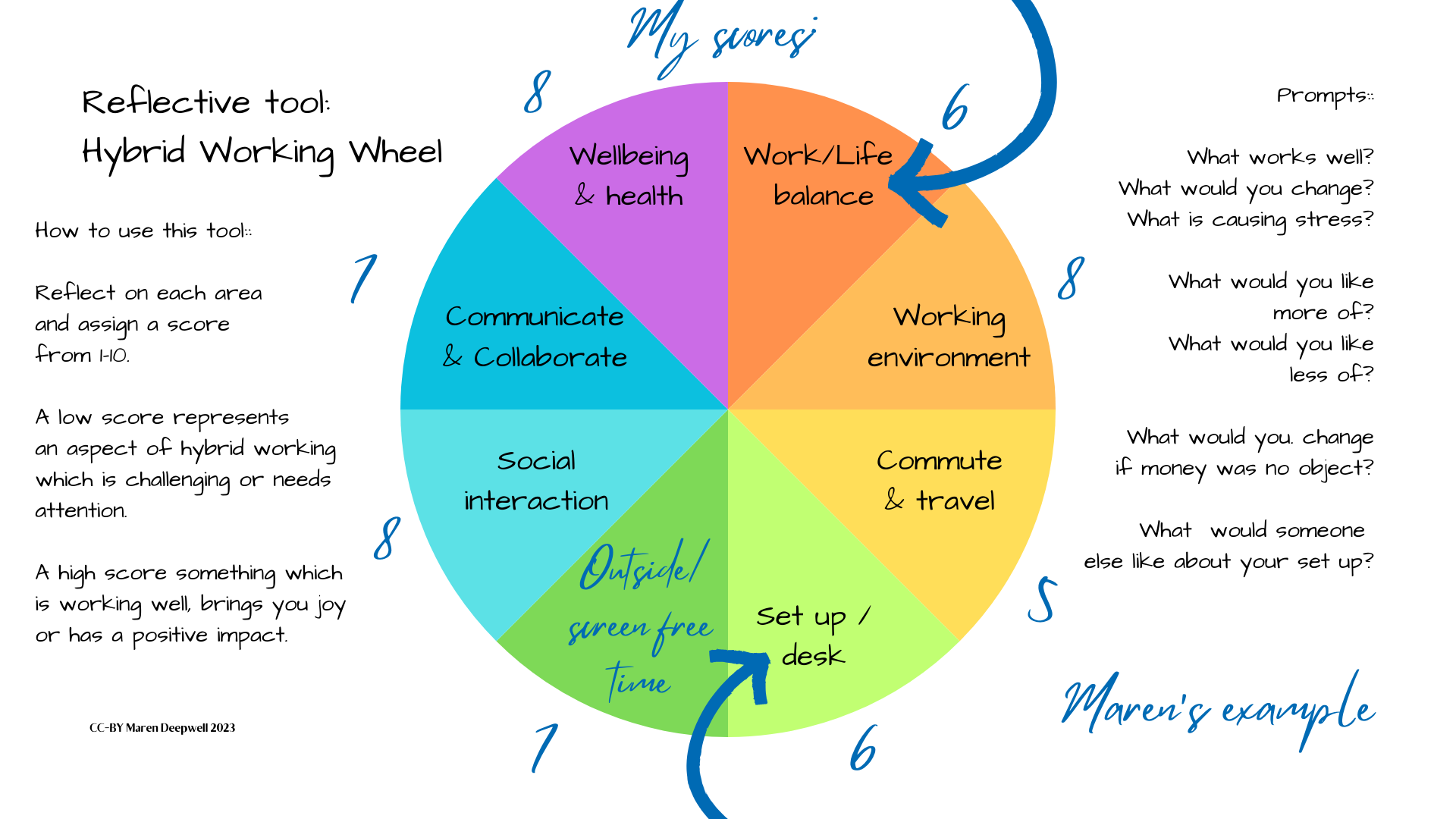
My completed wheel
If you’d like to take a look at the completed template that I used during the episode, here it is:
Enjoyed this blog post? Subscribe to my newsletter!