Category: open practice

  • Let’s Walk’n’Blog…

    Let’s Walk’n’Blog…

    Hi, welcome to this blog post which I am not typing but dictating.

    It is now mid-morning and I have plans to be getting on with before I have to be at my desk. So I wanted to try and write this blog post as I’m doing things… I’m making some coffee just now and I’ve just come back from walking the dogs. So it is a good time to blog but not a good time to sit at my desk. Hence the dictation.

    Recently I had a really interesting conversation with one of my coaching clients around the benefits of not always sitting down to reflect or to write, avoiding being faced with a blank piece of paper or a blinking cursor on an empty screen. Instead, we talked about ways to use technology like dictation software for example to try and give yourself some flexibility. Inspired by this conversation, I went back through a couple of blog posts I have written about how to reflect, and I came across one about using dictation for reflection. From there, it was a small jump to try and use it to write a blog post, too.

    Now, just as I was recording this, the doorbell rang, and it was a delivery. One of the joys of living and working in a community around many people who still work in an office, is that I get to be the local delivery depot for all deliveries in the neighbourhood. And it’s so practical to be able to just pause, walk to the door, deal with things and then being able to come back to this without having to run up and down, start typing again, start a new document and so on.

    Using voice recording also gives me a chance to write a different kind of blog post with a different kind of voice, one where I’m sipping coffee, thinking about things, having a bit more room to explore, which is lovely. Now, the joy of being able to record voice notes and turn them into blog posts is transcription software. Recently I’ve started to use a different software package, whisper transcription, which is easy to get and great, particularly when you’re a Mac user. And I’ve been using this for my podcasts, but also to make some of my audio resources more accessible. I’ve been finding it a real joy to be able to have a very easy and quick transcription that I get to keep rather than something that a platform that I use makes and then they keep it. It’s been fascinating to produce and then use transcripts of podcast episodes and interviews.

    The other thing I really like about using voice recording instead of typing on a keyboard is that I can take my blog activity on walks and get out more. At the moment for me it’s summer, although you wouldn’t know it by looking out of the window. It’s grey and dreary and it’s just about to start raining. But this morning, when I would normally spend time sitting at my desk, I really felt like going out with the dogs to have a nice walk to start the day.

    I’m going to spend plenty of time later sitting at my desk and staring at a screen. Being able to make a quick voice recording on my phone and then being able to have the transcription of that which I can turn into a blog post is a nice way of giving myself an opportunity to kind of reflect as I walk and talk. I felt inspired as I was walking and I often have my best thoughts in the morning. I had some ideas about the new course I’m working on, specifically the design of the course. And I thought, oh, I really need to write this down when I get back to my desk.This is a really good idea! I was thinking about the ] course design, which is a blended design in a number of different ways, it’s both online and a physical thing. It’s asynchronous and synchronous and so on. And as I was rehearsing in my mind what I was going to say to introduce the course in a short video, I thought, oh, great, I can just record myself now with my phone, make a quick voice memo and record the thoughts that are on my mind. I can note them down now. When I come home, I can just pop them into the transcription software and voila! I’ve got my notes from my inspired dog walk ready to go for when I want to sit down and get back to working on that video.

    For me, recording my ideas as I walk feels like a really lovely seasonal way to create more flexibility in my day, particularly as at the moment my meeting time is blissfully low. So now that I’ve got a bit of breathing room in the summer for the first time in many years, it’s just so joyful to be able to have 10 meetings a week rather than 80 meetings a week. And it’s also a relief not having to have every single meeting be a revenue generation must have rand instead have scope for exploratory conversations to see where things are going.

    So, yeah, I think his is probably all I want to cover in this post and I’m very curious to see how long this post turns out to be. Usually when I sit down to write a blog post, I know what I’m looking for in terms of length, and I very rarely write very long blog posts. Sometimes I get into the rhythm and I’ll write something longer, but most of my blog posts are fairly short. And so it’s interesting to see how that will differ in this format. I shall write a little post script to see how many words this blog post ended up being [this post is 996 words].

  • The year in blog posts… so far

    The year in blog posts… so far

    As I am half way through the year, I am taking a look back at what I have blogged so far, and in the best tradition of the form, to blog about blogging once again. And, if you missed one of these, now is a good time to catch up and bookmark posts for future reading.

    Blogging in numbers

    2024 has been a good year for blogging (it’s always a good year for blogging!). I published 35 blog posts in the first six months of the year, slightly fewer than last year (43), but still an average of six per month. March was the month with the most posts (thanks to lots of things to say about open education) and June was the month with the fewest (thanks to a deeply relaxing two weeks away and offline).

    Top 5 posts

    1. Post with the most comments: Twenty years of blogging… now on ReclaimPress
    2. Post that was shared most widely: A milestone moment on my coaching journey
    3. Post that was read most widely: What happens to our senses in the hybrid workplace?
    4. Post that had the most successful podcast companion episode: Six months of gold dust.
    5. Post that I enjoyed writing the most: The joy of not working.

    January (6)

    February (6)

    March (8)

    April (5)

    May (6)

    June (4)

    Never miss a post again. Get my monthly newsletter directly to your inbox!

    [newsletter_form type=”minimal”]
  • WiAL Webinar: My Leadership Journey

    WiAL Webinar: My Leadership Journey

    The ASCILITE’s Women in Academic Leadership Initiative aims to provide mentoring opportunities for academics and brings together its members via a community approach to support each other to progress in academia. Thanks to a recent invitation to speak at an upcoming WiAL webinar, I have started to think about my journey as a leader and what I could usefully share with this group of inspiring and aspiring academic leaders.

    My story, like so many of us who work at the intersection of education, technology and more, is not a straight line from degree to equally distributed career arc. My academic background in art and anthropology is not a natural stepping stone into non-profit leadership or project management even though to me it all makes sense (at least in retrospect). So when I share with people that I spent my PhD research in a cemetery and somehow less than ten years later I was the CEO of an edtech organisation there are definitely some curious glances.

    To bring some kind of order to the messy madness I have decided to present a couple of snapshots, rather than try to present a coherent narrative. From the beginnings of my undergraduate studies in the 90s, to my PhD years and even much of my early career a lot of my (paid) work involved bookshops, cafes, cinemas and market research. In short, any job that you could do as a young, foreign worker in the UK whilst still attending lectures sufficiently to pass my studies.

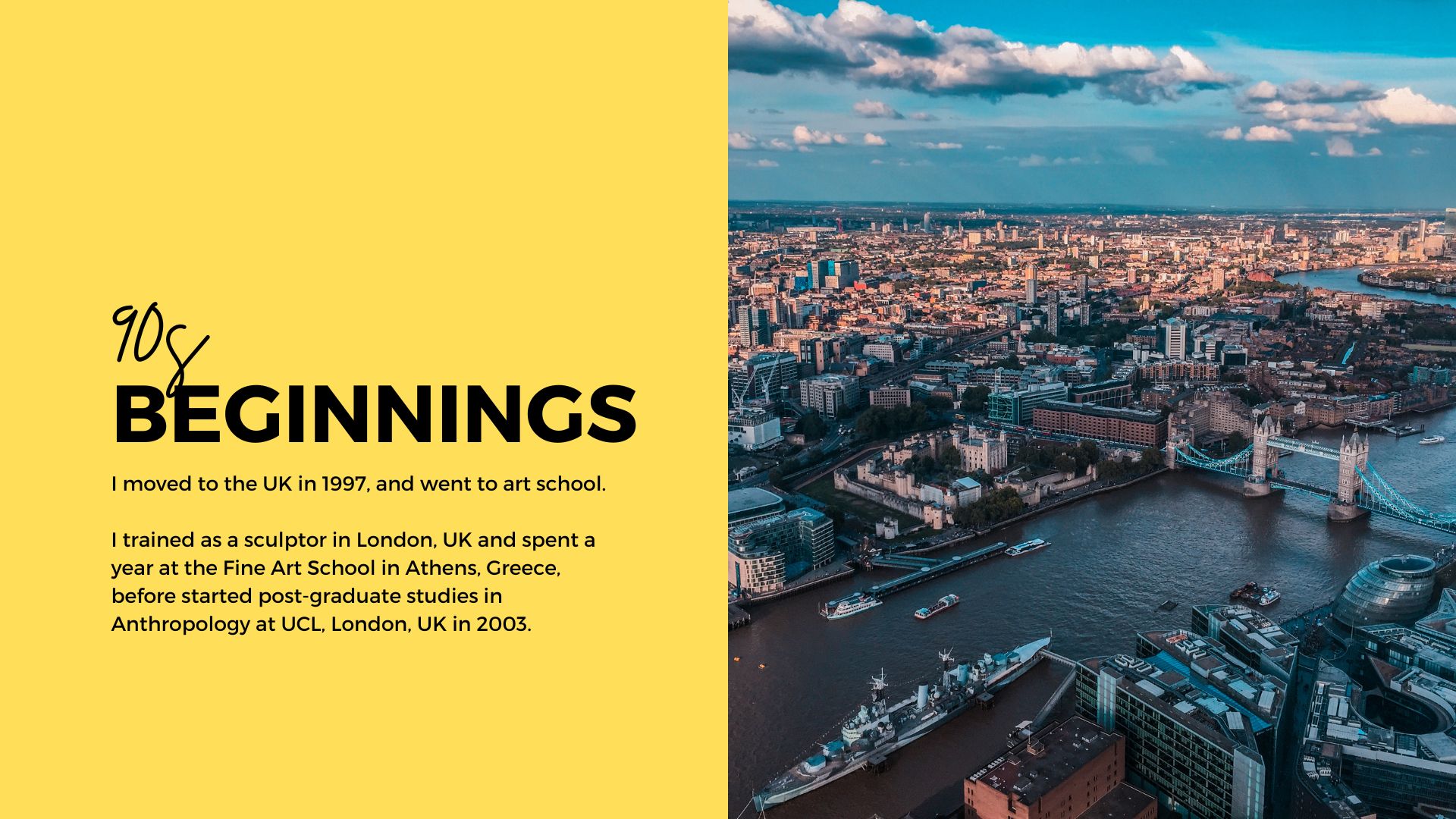
    Slide with the text: 90s Beginnings 
I moved to the UK in 1997, and went to art school. 

I trained as a sculptor in London, UK and spent a year at the Fine Art School in Athens, Greece, before started post-graduate studies in Anthropology at UCL, London, UK in 2003.

    When I think about what is important to me in my leadership practice, I think about my values and how what I do and the approach I use align with and reflect those values. Alongside my values, there is what motivates and drives me. Leadership roles can often feel quite lonely and isolated, and the more senior you are the more others look to you for encouragement and vision. Which brings me to the third aspect: developing my own voice.

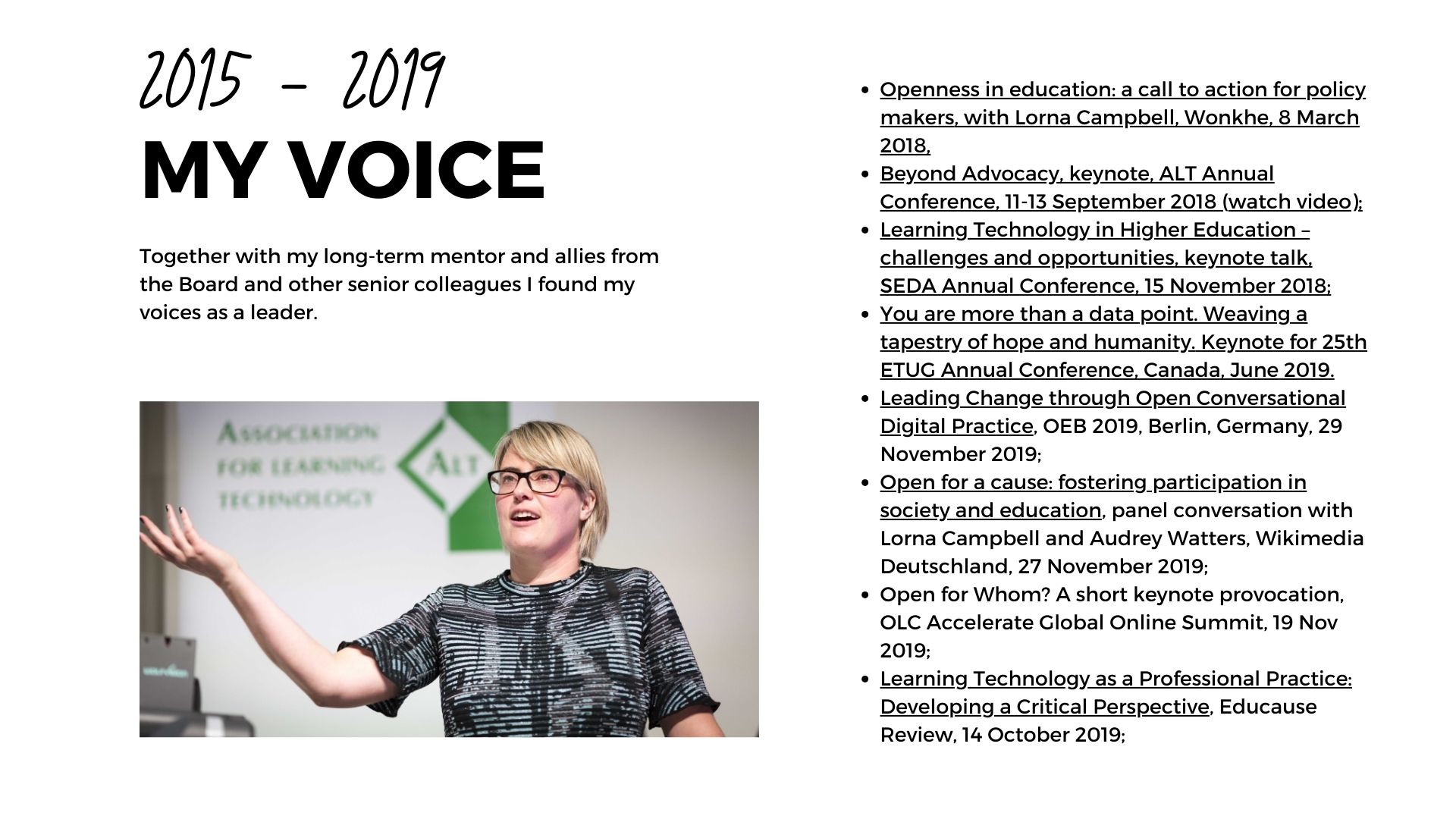
    For me, that process didn’t happen in isolation. I had invaluable support from my long-term mentor as well as allies from the Board I was working with and other senior colleagues external to the organisation. They helped me build confidence, not just capability, and encouraged me to find things I am passionate about. They also helped me step into larger stages, to develop my presence for giving keynotes and writing opinion pieces.

    Slide with the text: 2015 - 2019 My Voice. Together with my long term mentor and allies from the board and other senior colleagues I found my voice as a leader.

    Looking back at that list of keynotes and articles brings back a lot of good memories for me. In those years prior to the pandemic my perspective had begun to expand, and I started to enjoy being part of a wider dialogue. I had found a good balance between having experience and still being new enough in my sector to see opportunity for change. I was excited to be doing what I was doing, and I made connections with people who really opened up my mind to new (to me) ways of thinking, writing and working.

    These relationships provided a very valuable network of support and inspiration when the pandemic hit and I entered my first years of permanent crisis as a leader. All risk registers were RED, all of the time. Everyone I knew and worked with was constantly fire fighting. The world had been turned upside down, and education with it.

    My voice as a leader during those years of crisis had to become one of clarity and decision. We had to get through it, and eventually, we did. Relationships were both strong in solidarity and fraught by lack of sleep, energy, rest and hope. Like many, the pandemic prompted me to re-evaluate things and having reached a point of organisational recovery I was proud of, my energy was spent and I decided to embark on a period of transition to a new chapter in my career.

    2023 was focused on that process of transition, of letting go for a lot of relationships I had built over a period of 15 years, and starting to lay the foundation for my next chapter and a new way of working. What I discovered during that period is that being a leader is part of who I am rather than something I do, or a job title. It’s stayed with me, even though the only person I manage is myself and I run my own little enterprise rather than an organisation for thousands of members.

    At this stage in my career I feel I have less to prove and more power. Now I am looking to leverage my expertise and experience to achieve the kind of work life balance that works best for me, to be creative and have fun and to follow where my curiosity may lead me.

    Slide screenshot with the words: Next? What I've discovered this year is that being a leader is part of who I am rather than something I do, or a job title. At this stage in my career I feel I have less to prove and more power. Now I am looking to leverage my expertise and experience to achieve the kind of work life balance that works best for me, to be creative and have fun and to follow where my curiosity may lead me.
  • Reclaiming our socials: SUNY Digital Learning Conference 2024

    Reclaiming our socials: SUNY Digital Learning Conference 2024

    Last year’s experiment in the fediverse, Mission Mastodon, helped me onto a new path to reclaim my social media presence. At the time, I was contemplating what best to do in the face of the demise of Twitter and the fragmentation of my networks. Add a career transition into the mix, and a couple of new professional communities, too, and you will understand why I spent more time than before trying to find a way of connecting and sharing that works for me.

    This week I am joining my Reclaim colleagues Amanda Schmidt and Taylor Jadin for a workshop focused on precisely these issues at the 2024 SUNY Digital Learning Conference. The format of the session is very interactive, and should leave plenty of time for discussion with delegates. I am really curious to learn what approaches other’s find helpful when navigating the social media landscape of today.

    The theme of the conference this year is Educating for Digital Citizenship and I am super excited to be taking part and learn more about all the topics on the agenda. I am particularly looking forward to the featured speakers: Data, Discrimination, and Democracy: A Conversation with Chris Gilliard and Kathleen Fitzpatrick on Open Matters.

    Drawing of coloured screens with the words Reclaim Networks

    Our workshop at a glance

    • Title: Reclaiming our Socials… and how you can too!
    • Subtitle: Reclaim Hosting’s journey to demonstrate digital agency
    • Track: Digital Activism
    • Format: Presentation
    • Presenters: Amanda Schmidt, Maren Deepwell & Taylor Jadin, Reclaim Hosting

    Abstract: Given the fall from grace we’ve seen various social media platforms experience recently— from Twitter’s transition to X, to Substack’s implosion— now is the time to think critically about how to be informed, and autonomous, digital citizens.

    We’re seeing more and more social media users finding themselves immersed in platforms they’ve spent many hours cultivating community and content on, only to feel the rug pulled out from under them when that platform does or supports something that doesn’t align with those users’ values.

    At Reclaim Hosting, we’ve always been more comfortable working in spaces that are as open as possible so that we have as much control over our content and communications as possible. Our socials, however, were always stuck with the big-box providers. With the rise of the fediverse, we’re taking our autonomy back. Join us as we discuss the Reclaim Hosting team’s transition to Mastodon, a self-hostable, decentralized social networking platform, and Ghost, an open source blogging platform.

    We’ll discuss our perspectives on the current state of social media affairs, walk participants through our open setup, and demonstrate how to reclaim your socials!

  • OER24: The sound of Open Practice in social media wilderness

    OER24: The sound of Open Practice in social media wilderness

    I am REALLY looking forward to OER24 this year, not least of all because I get to share the stage with Martin as we present out (first ever) short talk on podcasts and radio. If you are curious what we’ll be talking about, you are in the right place:

    Read a short summary of our talk

    How do you share open practice and foster innovation in Open Education in the age of social media fragmentation? What supports and amplifies peer-learning and knowledge exchange between Open Education practitioners as social media platforms like X become increasingly hostile spaces?

    This presentation examines how the changes in social media impact open practice and highlights alternative media of radio and podcasts as a way to share practice and explore ideas. 

    Podcasts have grown in popularity over the past decade, with many easy to use tools for their production and consumption. In 2022 50 percent of respondents in the US aged 12 to 34 years old had listened to a podcast within the preceding month and 79 percent of U.S. consumers aged 12 years or above are aware of podcasting, up by more than 30 percent from a decade ago. Their use in education is expanding, with Shamburg (2021) reporting that educators have used them to discuss topics in a more informal way. 

    They thus provide an ideal medium for exploring open practice and experimenting with ideas, formats and topics. Internet radio is not a new medium in open and distance education, and during the pandemic saw a resurgence as educators took to the airwaves on grassroots stations such as DS106 Radio. In this session the speakers will explore their experience of using these two forms of media to develop their own professional practice and explore ways of connecting with audiences beyond spaces such as X and share lessons learnt. 

    Listen to the preview

    Join us as we discuss our presentation at OER24, a conference all about Open Education, 27-28 March 2024, Cork, Ireland. Listen to the preview podcast with Special guest: ⁠Martin Weller

    ⁠Presentation slides (incl. references)

    Enjoyed this post? Subscribe to my free monthly newsletter:

    [newsletter_form type=”minimal”]

    Image credit: Playing Card by @visualthinkery is licensed under CC-by-sa. Remix by Maren Deepwell.

  • Finding my podcast voice

    Finding my podcast voice

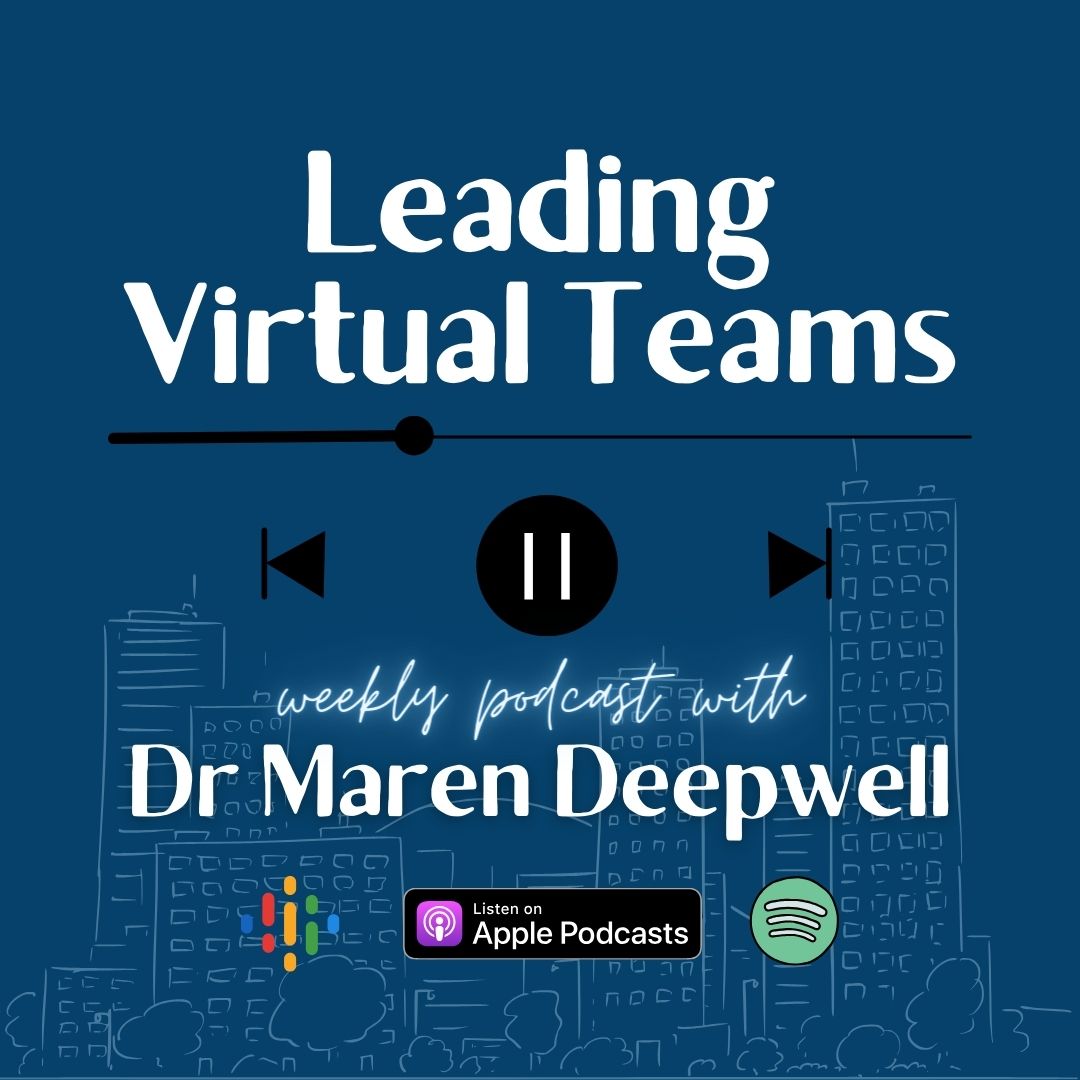
    It’s been 18 months since I first launched my podcast, and this academic year I have stepped up the pace with a new episode every week. 65 episodes later… I still enjoy the process of making the podcast and it’s been very, very useful for my professional practice. It’s also a (for me still relatively) new way to sharing my work and I have tried to find the right tone in this medium, tried to find my podcast voice.

    In this post, I bring together things I have learnt along the way, and also ideas for what I’d like to try out next:

    Getting started: Looking back at the first year on the podcast, the pattern of putting out episodes is erratic. Sometimes I published 5 episodes a month, other times it was only one. They all come out on different days, and the format and duration vary, from below 10 minutes to above 40. Season 1, which doesn’t have episode numbers, has 10 episodes. Season 2 has 21 and currently Season 3 is at 30+. It’s a bit of a mess… However, what matters to me is that I did it. I continued to record and release episodes, trying out different topics and formats, with guests and without. I now feel that I have a podcast, and I have made it part of my professional practice.

    Choosing what to talk about: Just looking at the titles of various episodes gives you a clear indication that there are a whole range of topics I talk about. Here are some examples from across the three seasons:

    • 25 hacks to make hybrid work 1% more comfortable
    • A party without a cake is just a meeting…
    • Career transition reflection – 3 months in

    Some episodes are focused on coaching, and include more factual/how-to content whilst others are about leadership in hybrid workplaces and others again are updates on my work, celebrating milestones, reflective practice, radio… . The list goes on. What’s useful for me is that the podcast has become a reflection of my practice and leadership. That’s what I am interested in exploring, and it’s been helpful to acknowledge that as I find my voice.

    Listening to other people’s podcasts provided all sorts of inspiration and I tried out different things with various episodes to feel out what might work for me. Importantly, it needs to be a topic I am interested in, and it needs to be useful to me. My podcast is a passion project, not something I get paid to do. It’s an element of my open practice and as such it’s useful to others (I hope) but it’s primary user is me.

    An audience of one? In the early days of the podcast, it certainly was (an audience of one). I remember how excited I got when someone who could not be family & friends listened! It still makes me happy to hear that someone found an episode interesting or useful and yet I haven’t put a lot of effort into promoting the podcast. The platforms on which the podcast is registered offer all sorts of tools and resources to help you build your marketing campaign and expand your audience, which I must admit I have largely ignored up to now.

    It’s an intentional choice on my part to keep the podcast a space to play and experiment with. Just like my blog, I want the podcast to be part of my domain, a page in my sketchbook if you like. I don’t want to monetise it even if I could. I am not interested in it becoming the next big podcast on hybrid working even if that opportunity arose. I want it to sit in the margins. A working, thinking space instead of a polished production.

    With an organically growing audience, episodes now attract 30-50 listens on average.

    Experiments in podcasting: Since I started the podcast, I have experimented with various projects: I used the podcast to record audio versions of key sections of my book Leading Virtual Teams; I have run two CPD courses using my podcast as the main platform to deliver course content and I have used the podcast to share career transition updates as I started my free-lance venture. It’s certainly been a bit of a mixed bag of approaches and that has resulted in me learning a lot along the way.

    I appreciate that it may be frustrating to folks who are looking for regular episodes week in week out on a similar range of topics, and with a similar take on the format and I am sorry if experimenting with various aspects of the show makes it less enjoyable or less useful at times. For me, these experiments have been incredibly useful and rewarding, giving me space to try out ideas and new approaches on the journey to finding my podcast voice.

    Things I learnt along the way:

    • Getting comfortable with recording conversations and structuring content
    • Recording intros and outros
    • Writing show notes and providing links to resources
    • Transcripts and automatic transcription
    • Registering a podcast on different platforms

    The power of replay: Whilst many people dislike listening to their own voice, and I am not a huge fan of mine either, I do listen back to my own podcast episodes. I find it incredibly useful to replay my thoughts to help me refine my reflections and also to review how my thinking has changed. Just as listening back to a recording of me coaching with my coach trainer helps me identify ways in which I can improve as a coach and also identify what I am doing well and why it works; listening back to podcast episodes is extremely helpful for my professional development.

    It’s also a bit nostalgic, particularly in the more personal/reflective episodes. Here I am, celebrating milestones and sharing tips for this and that whilst around me domestic chaos or work problems reign. There are episodes when I clearly had a cold and episodes when I can hear my dog Posey in the background wagging her tail or chewing on something noisy.

    A note on the technology: I don’t have much know-how to share when it comes to podcasting tools and platforms. I have a wonderful mic that I can’t connect to my current computer, I use a browser-based, free tool to record my episodes which is just about to go out of service… and I live in a noisy environment where proper recording quality is harder to achieve than I’d like. In short, my set up is makeshift. When I sit down at my desk in the morning between meetings to record an episode, I am afraid there are no ambitions to have a recording set up beyond headphones.

    I am fortunate to know many people in the Open Education community with brilliant podcasts and radio shows, many of whom have professional experience in this industry, much better placed to advise on anything technical and I salute them. I learn much from their example, even if that is not always evident in the audio quality of what I produce… .

    Where next? I am very excited about continuing my podcasting adventures and I have ideas I want to try out come summer, and a break in my ‘regular’ schedule. I also need to learn how to record my episodes on a new platform, and I am definitely working on getting the good mic connected. Most of all, and regardless of any practical considerations, I am determined not to loose this space for open practice that I have opened up for myself. It’s another experiment in open leadership that has become important to me, and that in itself is a huge reward.

    It’s not all about podcasting… there’s a newsletter you can subscribe to as well… (that’s another blog post).

    [newsletter_form type=”minimal”]