Wow. It’s really happening. This time, we are hitting not only the virtual but also the physical road again in order to journey to the OER Conference. OER22 here we come!
The last time the OER Conference took place as planned as in Galway in 2019, and since that time, three years ago, no edition of this very special event has gone to plan. In 2020, OER20 pivoted online with less than two weeks to go, and became very much a pandemic conference. In the crisis mood of those early days of the pandemic, OER20 became a free event with refunds winging their ways across the globe to participants who suddenly had a lot more to worry about than a cancelled conference.
Helloooer CC-BY Bryan Mathers
When I look back at the posts and reflections from that year, it really hits me how much the world changed for all of us, and for this event as well. Our small staff team worked wonders to make this one happen.
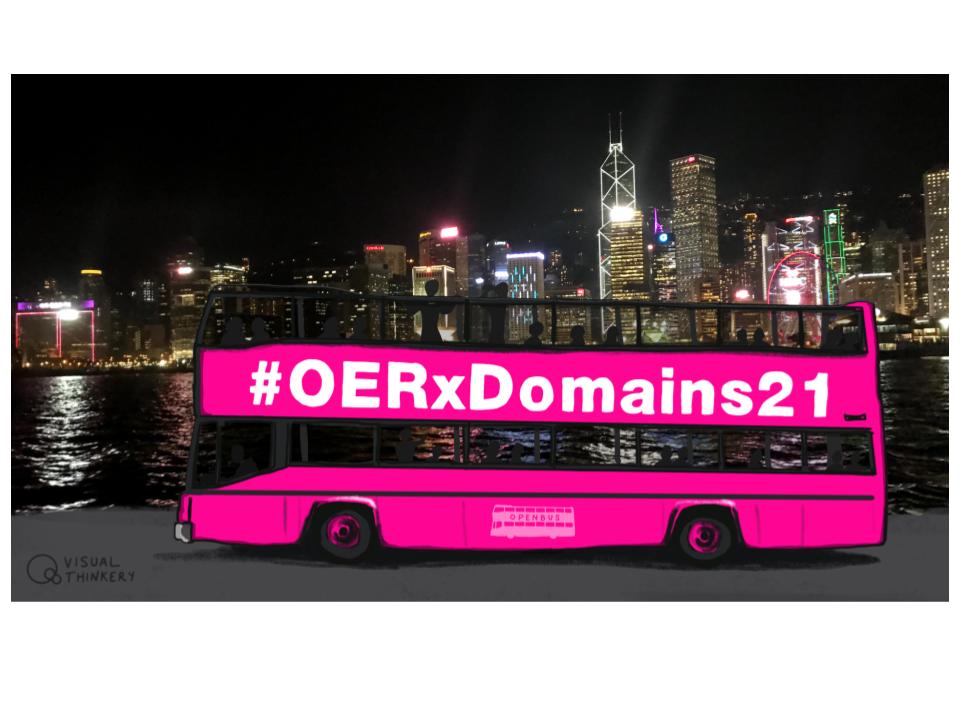
In 2021 we did plan to hold OER online, and then decided to join forces with the Domains Conference from Reclaim Hosting, bringing two communities together for what turned out to be… a journey into the wonderful unknown. OERxDomains21 was born.
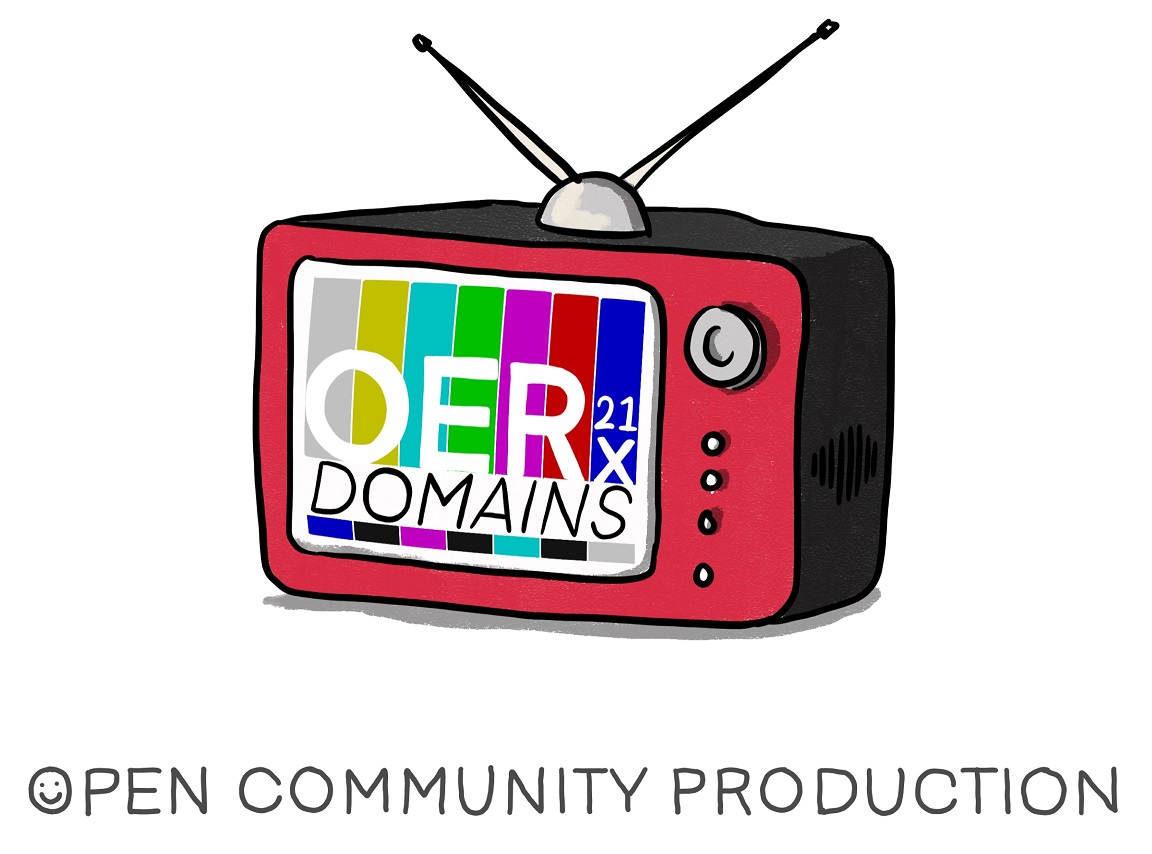
Title image from the OERxDomains21 programme
I organise, speak at and go to a lot of different conferences of all shapes and sizes. Each conference has its own way of working, and there are some big differences between them.
The OER Conference feels to me very much like a labour of love. It has its own voices, its own way of interpreting the criteria for peer review, its own priorities of what is important and what is not.
I have had the privilege of being involved in organising this event since 2015 and in that time I have learnt much about the generosity of the people who shape this event, their shared passion for open education and the values that connect them.
Inspired by the OER Conference I became an open practitioner and an open leader myself. I joined the community that this conference supports here in the UK and increasingly in other countries, too. Through the OER Conference I made connections with others who lead important work in this space, and I am grateful to be part of an expanding network, a community that is coming together again this week.
We are coming together in person and online to recharge and re-connect. To share, learn and discuss. I am so excited to see friends, colleagues and new acquaintances in person and online. For those who are unable to take part, there will be a lot of OER Conference goodness openly shared and disseminated after the event, adding to what is now a substantial collection of videos and resources.
Let there be penguins!
As you may have noticed by now, the GO-GN Penguins have taken over OER22 for this year, and they are truly everywhere, both online and in the physical world. I recently shared a True Story of how a Westminster meeting led to… penguins. I am deeply grateful to the creative, collaborative and collegiate minds at Visual Thinkery and at GO-GN for helping us bring this year’s event to life with these penguins centre stage. Usually I am more of a shoe(tweet) sort of conference goer, but I must admit that the penguin theme defeated my shoe selection… so I went a little overboard and decided to go fully ‘on brand’ in a different way for OER22.
A photo of my hand with painted nails, one of which is an image of a penguin
… and there is a session, too
In the last bit of the programme on Thursday, I am excited to actually get to lead a session in the programme! Long-time colleague and friend Lauren Hanks, Director of Operations at Reclaim Hosting and one of the Co-Chairs of last year’s edition of the OER Conference, and I, are getting together to reflect on the connections between open education and open approaches to online collaboration and work.
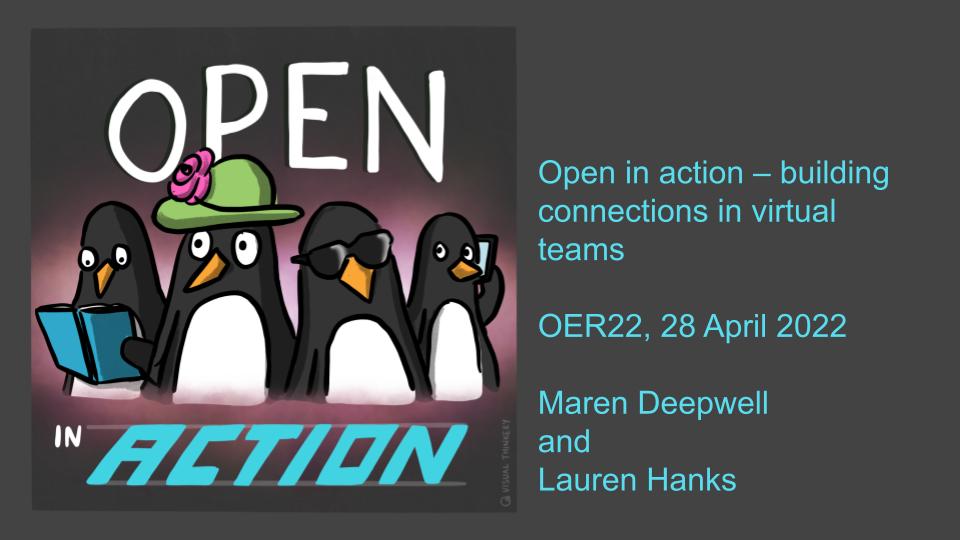
Title slide for our session: Open in action – building connections in virtual teams.
As leaders of virtual teams, we want to critically examine what lessons we can learn from open approaches to learning and teaching and how we can use that knowledge in an increasingly virtual workplace.
This session builds on a recent episode of the Remote Work Show on DS106 Radio, in which we started to unpack some of this (recording to follow).
We are currently recruiting for a Chief Operations Officer for ALT, and I couldn’t be more excited!
It’s always great when you get to grow your team, particularly when there are only seven of you and each individual makes a big impact.
Why this role, why now?
We are the leading professional body for Learning Technology in the UK – and we have been pretty busy in the past eighteen months! Learning Technology has never been more in demand and as a consequence the work we do to support our growing community has increased month on month.
After a year of supporting our Members through the global crisis, we have re-grouped and set out a strategic plan for the year ahead. 2020 was a tough year for us an independent charity as we traditionally generate half of our annual turnover from two face to face events. Thanks to our prudent financial strategy in past years, we had reserves to help us through times of crisis.
Now we are planning ahead for post-pandemic times. Whilst we have an excellent track record delivering online activities and a lot of expertise in virtual events, we don’t just want to follow our old ways. Instead, we are starting to innovate and that has helped us redistribute our income streams and ensured that we are back to generating the charitable income we need to achieve our mission. Next, we are looking to develop blended ways of doing things and improving what we are already good at.
In order to achieve that, we have created a new role and are looking to grow our staff team:
The Chief Operations Officer (COO) is responsible for day-to-day operation of ALT, including technical infrastructure and systems used to deliver ALT’s services to 3,500 Members. The COO acts as the Deputy for the Chief Executive and represents and advocates for ALT with our key stakeholders across sectors.
This is an opportunity to see projects through from conception to completion and play a part in shaping how we work and what we do. You will be reporting directly to and working closely with ALT’s CEO and have opportunities to develop your own skills in running an organisation in an innovative and human way.
https://www.alt.ac.uk/about-alt/work-us
If that sounds like the kind of work you would enjoy, read on.
For the past few months it’s been all ladies working in the team, and we are making a real effort to recruit the best candidates for each job whilst increasing the diversity of our team, which is a big priority for us (all recruitment and selection is undertaken in line with ALT’s aims and values and in accordance with ALT’s policy on equality and diversity).
As it stands, we are based in three of the four nations in the UK; three of our team, that is 42%, are currently completing a PhD (and one of us already has hers) and over 40% of the team are either Certified Members of ALT or currently working towards their accreditation.
As far as I know we have 5 cats and 5 dogs between us, and come Friday plenty of unicorns, too (Fridays we usually celebrate ‘unicorn’ day, a tradition even those of us who are not generally into things that are pink and fluffy have come to appreciate).
We have a real range of backgrounds and have a former chartered surveyor as well as an expert in Victorian cemeteries in the team. As many of us work part-time, mostly 3 and 4 days a week, it’s quite common for us to have other responsibilities to focus on, be that studies, kids or other interests.
If you’d like to find out what it is like for us working as a virtual team, read our blog post from earlier this year, celebrating three years as home-workers. Find out what our highlights and lowlights of pandemic working have been and how we thrive as a virtual team.
When I first started working for ALT, as an Assistant Administrator (Maternity Cover) in 2008, I was just finishing my PhD and I had no inkling that a career in Learning Technology was ahead of me. As it turns out, the field has proven so interesting and challenging that I find always something new to do and to learn.
The senior team of a small organisation is an exciting place to be. I love the freedom it gives me to make things happen, to be able to respond to the changing needs of our community without having a complicated hierarchy to negotiate. We believe in robust and transparent governance, and we get things done.
I am proud to be part of a journey that has seen the size of our membership double several times since 2008, and writing our Impact Report 2021 has reminded me of how much we achieve as an organisation and as a team. For me it’s an exciting place to be with a good dollop of life/work balance and a team culture we all benefit from.
Working for an independent charity with a staff team of fewer than ten people is a very different value proposition than working for a large institution such as a university or a commercial organisation with thousands of employees. For me, it’s a rewarding leadership position that allows me to practice what I preach 🙂
Not a working day… looking out over Cardiff countryside
Find out more
If you are interested to find out more, head over to the ALT website or contact me for an informal conversation.
Apply by sending us your covering letter and your CV by 17 September 2021.
All candidates will be notified after the initial short-listing by the end of September and short-listed candidates will be invited to online interviews in October.
OERxDomains21 is still going on as I am writing this and I am looking forward to some great post-conference workshops closing a week of extraordinary online open education conferencing. If you haven’t already done so, there are a couple of things you don’t want to miss:
All the sessions are now openly accessible to all, as part of our commitment to the Open COVID for Education pledge. Browse the keynotes, dig into research, learn about policy making… and get a flavour of the care that every presenter brought to the event.
Browse some of the goodness being shared on the #OERxDomains21 hashtag.
No conference is ever a perfect enterprise, and it’s always valuable and welcome to hear feedback of things that could have done better, things to do differently next time.. and how it went for you. If there’s anything you’d like to share with me, email ceo@alt.ac.uk 🙂
WE DID IT [not AGAIN].
For me, my team and the organisation I lead, OERxDomains21 was a conference of firsts…
… the first time we had FIVE Co-Chairs – who brought all their expertise, passion and ideas to bear.
… the first time participants remixed 159 conference badges.
… the first time we recorded 220 of 236 participants synchronously networking online on Discord, flooding the Hallway Chat, Introduction Channel and resource pool with contributions.
… the first time that these two organisations (ALT & Reclaim Hosting), and two conferences (OER and Domains), mashed up together to create this new, joint event bringing two communities together.
… the first time that we delivered a synchronous and asynchronous programme for participants from 18 countries and plenty of time zones for a total of 75 hours of programming.
… the first time that we found streaming platforms that made high quality recordings immediately available to participants and then to the public, enabling late arrivals to catch up and supporting delegates from across the globe.
… the first time we delivered an event with a staff team of 11 (up from the usual 5-6), many of whom had never met before.
… the first time that we delivered an online event without Martin Hawksey, who headed up ALT’s event delivery for the past seven years (waving to you, Mr Hawksey, I hope we did you proud :).
… the first time anyone had the most special TV programme design that went from emails to programme pages and beyond thanks to the work led by Reclaim Hosting, enabling our participants to quite literally step into their own Community TV Channel.
… the first time we managed staff handover between time zones seamlessly between sessions as one staff team ended their day and the other arrived.
There are also plenty of things we did again:
We funded 100% of all eligible scholarship applications, offering financial support to presenters and participants.
We supported nearly 50% of participants in delivering a session, a total of 100+ presenters over 2 days.
We welcomed ALL our volunteer session chairs on time and in the right virtual room – making it possible for our staff team to focus on technical support whilst putting our Conference Committee and speakers centre stage.
We organised the event with an open Committee meeting regularly and all of which notes and minutes are openly accessible in the months running up to the event (thank you!).
We carried out a double blind peer review process – for the first time since the pandemic started.
We supported student speakers to attend and speak at the conference.
My lists could go on… 🙂
The point I want to make, is that it’s not usual for an independent charity like ALT to take risks on this scale to create something that will help sustain the heartbeat of this community for another year. Last year’s OER Conference, which had to be refunded fully and lost tens of thousands of pounds, left the future of the event uncertain and various other factors only increased the risks we were facing.
But we took risks and they paid off. And to quote Jim Groom, it’s been a career highlight for me, to lead my team on a rollercoaster ride which ended in an event we are all proud of. WE WILL DO IT AGAIN.
Earlier this year, I blogged about that I feel I am starting a ‘new job’ as things have changed so much over the past year… so this week on Friday I am having a strategy away day, pandemic style.
CEOs often get asked what success will look like in 3, 12 and 36 months. Asking yourself that question is a useful way to get your own thoughts in order and prioritising short, medium and long term goals.
Often, the kind of success measures or KPIs you’d include range from internal to the organisation to external stakeholder groups, from local to national to international. That’s the kind of thing an Impact Report is made for and that is important – but not helpful for me just now.
I am looking to re-imagine, to re-assess and to start from a blank page. Cue a bit of drawing and colouring…
Putting pen (and brush) to paper
I find it helpful to start with a blank page and the first thing I drew was a little flag, planted at the start of the year. It marks the launch of ALT’s (then) new strategy for 2020-25 (…best laid plans etc).
From there, it was a story of firsts… the first pivot online… our first ever fully online OER conference… the first time that we ran an event with 1,000+ registered participants, and the first ever time that we had to fully refund hundreds of paying delegates AND the first time those participants donated nearly £10,000 to help cover the losses we were making.
The first time that we drew up an emergency budget and plan just two months after setting the first ones… the first time we made an emergency strategy and held an emergency Board meeting.
In June we held our first ever fully online AGM with in-house voting. And in July, ‘business as usual’ included open calls for volunteers, editors, committee members – all for activities which were changing continuously.
Our first ever online Summer Summit took place in August, the first ever fully online awards short-listing process in September and the start of term saw us provide a second wave of support webinars, resources and care for an increasingly exhausted membership, preparing for an academic year that would be like… no one knew.
In November we launched our first ever CMALT Accelerator workshops and in December the Winter Conference saw our first ever online Awards Ceremony and first ever Community Award to every Learning Technologist.
By the end of the year, we had also published 49 new research papers, double the average number and the first time that we reached such a high number of publications.
A year of firsts – pandemic style.
Doing this drawing, sitting and thinking, letting my pen guide my thoughts, is incredibly helpful. It allows me to see beyond the KPIs and budget columns – and these don’t feel terribly meaningful anyway in a global pandemic context.
What does feel meaningful to me is the picture I have in my head of the past year. A picture of an agile, learning organisation where everyone contributed to us achieving a lot of successful firsts.
I also see thousands of professionals whom we have supported through the ups and downs of 2020… from sharing open resources and offering full scholarships to running support webinars and providing much needed CPD.
I like the idea of last year being a year of firsts and as well as all the bad stuff, there are a lot of positives to take with us.
The next blank piece of paper is going to be for 2021. A year of… ?
Recently I contributed to a conversation around radical openness as part of the OLC’s Ideate online events, together with Robin DeRosa, Gerry Hanley, Leigh Graves Wolf and Rajiv Jhangiani. I was very glad to be invited and really enjoyed taking part.
The session, described as a ‘community salon’ was described in the programme as an “opportunity for a group of thought leaders to engage participants in rich discussions around a broad topic intersecting with their scholarship and outreach. This salon brings together champions of open education and pedagogy sharing perspectives and guiding activities around the topic of radical openness, with a special focus on the ways that we can open doors for learners that are often hidden or closed to their success. Come with your ideas, challenges, and questions on the topic of openness, and take part in building new knowledge around open practices that will sustain us through and past these challenging times.”
Leigh Graves Wolf set out a really helpful structure for the session, guiding us through a series of prompts and questions, including:
“in what ways are you open/radically open?”
“What are some Open Educational Practice behaviors that you promote/enact/admire?”
“What are some Open Educational practices that you promote/enact/admire?”
And it resulted in a rich discussion and engagement, collated into shared documents (I encourage you to visit the OLC website to explore more).
Eventually the conversation turned to current events, to how everyone is coping (or not) with the challenges of the pandemic, working from home, childcare, supporting students, teaching, Zoom… and so on. These topics, which have become so familiar to all in a short space of time.
The more casual part of the conversation brought to light a different side of openness, which makes us all more vulnerable than sharing a teaching resource or a textbook. But it also made me think of ways in which, over time, our ideas of what might be radical openness may change. Here are some of my reflections:
Radical… power structures
At this stage of the great pirouette online, much of what is being done is still determined by power structures within institutions and communities or even countries, that rely on the decision making power of face to face institutions and processes, such as university governing bodies, finance committees, audits, quality reviews and so forth. Most of what is happening is not what was planned, but it is too new still for a lot of annual processes or less regular process to have happened yet and many of those processes are not open in either behaviour or practice. It’ll be interesting to see if we can challenge the openness of such structures more radically or whether the opposite will be true.
Radical… change and culture
In the first year of moving everything and everyone online we can draw on what we built up in person. There is a certain amount of common experience, of organisational culture, of shared memories, that act a bit like glue when it comes to getting through a crisis. But over time, as new people join the venture who don’t have that shared background, you open your behaviours and practice up to more radical change and transformation and that can be hard for everyone involved. Hard for those who are joining and hard for those who are already there. It’s difficult to build a shared sense of identity, aims or values without in person interaction at any level. One’s instinct is to close down options to change, to potentially loose what is being held on.
Radical… uncertainty
In the absence of much that we can rely on, it is difficult to imagine beyond the radical uncertainty we face. What do you do, whom do you ask, what is your plan when no one knows what, when or how things will change.
Open behaviours and practice are hard to embrace when you are facing that kind of perspective. In that sense, any amount of openness we can put into practice is radical.
One of the things we discussed in the session was how to support learners, and we were mostly focusing on traditional learners in a higher ed context here. But it was clear from the conversation and the comments from the audience, that we were all feeling more like learners again in a sense, just without the study guide to refer to.
It’s International Women’s Day #IWD2020 and this year I am writing this post about washing.
What is this about? Women’s labour? Household chores? Automation of domestic labour? No. What I am thinking about is the concept of ‘openwashing’ and similar kinds of ‘washing’ and how to avoid drowning in that kind of dirty laundry.
I came across this first at the OER15 conference in Cardiff in a memorable keynote by Cable Green:
As an aside, OER15 was a vintage keynote year for the OER Conference in my view, featuring Josie Fraser, Martin Weller and Sheila MacNeill and the whole playlist is definitely worth another look. That said, I think you could safely say EVERY year of the OER Conference is a vintage keynote year (but you might expect me to say that as part of the organising team) and this year’s event, OER20, is promising to be a vintage programme year once again.
Back in 2015 meanwhile, Lorna Campbell wrote an often quoted blog post in which she wrote:
Cable also touched briefly on open washing, which Audrey Watters has defined as “having the appearance of open source and open licensing for marketing purposes while continuing proprietary practices.” And he called Udacity out for openwashing with their Open Education Alliance, which despite the name, does not appear to be open in any sense of the word.
From: OER15 – Better late than never!, Open World, by Lorna Campbell
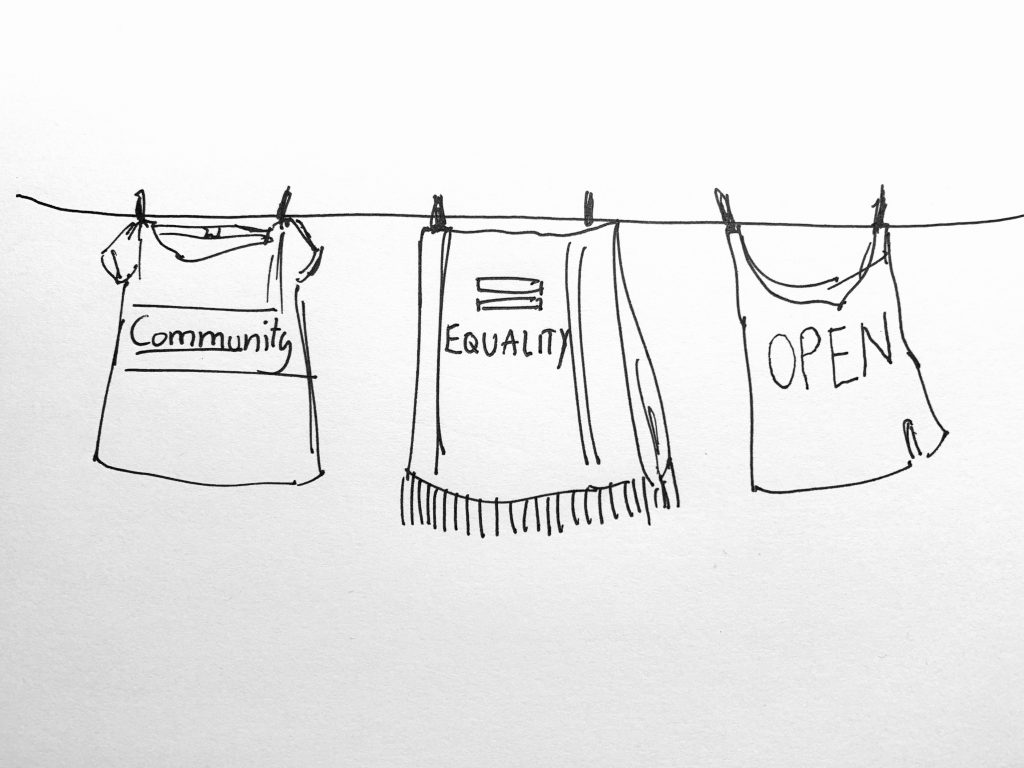
Since OER15 then I find it useful to use this concept of openwashing in other contexts as well, for example I come across of communitywashing and equalitywashing… and so forth.
I am in a position of privilege in many ways, in that I am a white European woman in a leadership position, I am well educated and I have the knowledge, skills and connections to navigate life to name some examples. Some of this privilege I was born into, some is due to luck and some I have worked hard to achieve. I also experience a lot of prejudice and discrimination and inequality as a woman working in a tech related field and in a myriad of other ways. Both have helped motivate me to actively try to see more of how others experience the world, and to do what is in my power to make a positive difference. Promoting gender equality is something I am passionate about, which is why I am an activist in networks that help this cause, such as the FemEdTech network.
Example of the work I do from 2019 (you can find the whole talk here)
This and other professional activities have attracted the attention of people who are keen to be perceived to care about things like openness, community and equality. People who organise events, publish content and generally broadcast messages that contain all the rights words and yet have no meaning because when we read them we know it’s nothing but washing. It’s reputation management at toxic levels. And so at this time of year, particularly around International Women’s Day, the invitations to contribute, to speak, to be interviewed and to participate increase in volume just as the desire to seem to be doing the ‘right’ thing becomes a more valuable commodity.
Every time I read yet another media release that starts with ‘by the community, for the community’ but which is actually written by the marketing or research department of a multi million pound business it makes me question what meaning community has in this context: do they actually mean customers, consumers, users, target audiences? It matters. It matters because of the intention behind the exercise differs and the outcome does as well. Like with openwashing proprietary practices usually continue to underlie all these ‘community activities’, they are just washed in words that imply engagement and shared ownership. Yet when the commercial interest or policy angle shifts, then those projects or networks are often shut down or dissolved into ‘self sustaining’ models that quickly end in the graveyard of moribund communities of practice which is full of ghosts of communities past.
Besides the obvious, this type of ‘washing’ has serious downsides in the long term: from the outside, to policy makers for example, sectors in which ‘community washing’ is prevalent appear to be functioning well, hence not in need of investment or intervention. Snap shots show only activity levels not their unsustainable and patchy nature. From the inside, particularly for newcomers, this kind of washing can be hard to detect and the alternatives harder to find. Again and again I come across new hubs or networks that duplicate what existing communities already do – but marketing ‘we are supporting something that is already there’ with its own identity and power, is far less effective at ‘washing’ those impact reports and social media channels, it can’t bathe them in a light of seemingly authentic engagement. Thus, I feel, much resources get wasted, wheels invented many times over in the name of communitywashing. It doesn’t help empower actual communities or build capacity or develop skills in ways that are sustainable and fit for purpose.
What all types of ‘washing’ have in common is that there is no real shift in the power base. Control remains with whoever has it rather than being distributed and shared. Gender equalitywashing provides some particularly infuriating examples, from equating balanced gender representation with having a token woman at a tech conference (‘there was A WOMAN on stage…’) to featuring appropriately photogenic stories front and centre without ever actually changing practice (…our organisation and its assets may be entirely dominated by men but we have stories about woman succeeding in the industry on the website).
From reports misrepresenting everyday sexism to glossing over structural pay and policy inequality, every single day brings examples of gender equalitywashing. There is so much evidence of inequality that is both persistent and pervasive that the kind of window dressing marketing that International Women’s Day seems to prompt each year seems laughable.
We know that we and YOU are not doing enough, not nearly enough, to redress the balance. Not anywhere. Not at any time. We are not closing gaps or nearly closing gaps. It may be more profitable to appear to address the issues in the workforce, company or industry, but only to a certain extent. Real change might disrupt profits and redistribute power.
This type of washing again gives the appearance of much positive activity or indeed activism without addressing the underlying inequalities effectively (and often without intending to do so at all). It creates a sense of futility, leads people to question why nothing is changing when we appear to do so much. And it does not support but often counteracts genuine efforts to affect change. Having a ‘women in X’ initiative does not equal ‘problem solved’.
I am well aware that there are many who don’t feel gender inequality continues to exist. Having won the right to vote and the existence of the Equal Pay Act has addressed any outstanding issues they argue. If this is your view, I am glad you are reading this blog post. You may wish to continue reading and books like Invisible Women or Inferior would make an excellent starting point.
I talk about inequality pretty much in every talk I give (there is a review of 2019 here) and there are always follow ups from people who don’t feel that in their lives, in their office, in their organisation this is an issue. Partly, I think, (wilful) ignorance is to blame (please refer to the reading suggestions above to become more informed).
But the kind of equalitywashing I am talking about is also to blame. It promotes a false sense of progress and change that does not prompt people to critically examine their own role and responsibility. In my view, we are all responsible both collectively and as individuals.
It is much harder, I find, to feel complacent when considering if there is anything more I could do to contribute, to make change happen – because there is always more to do. A lot more.
As the tide of misinformation gets whipped into a frenzy, the challenge to separate ‘washing’ from authentic voices can appear to become harder. But I find that most people do know. They can differentiate dishonesty from the real thing. What does become harder is to make your voice heard. Not to drown in other people’s dirty laundry.
And we do see those who engage in that kind of washing… those who use words like open and community and equality and try to divest them of their true meaning for their own convenience. The reality of open, the living of equality, the being part of a community is much more messy and nuanced, far less marketable than ‘washing’ requires it to be. It’s by no means all easy or good or uncontested. And yet, despite the messiness, the arguments and the disagreements, it is at least a reality beyond the imagination of corporations.
I want to note my thanks to all the people in my life who do what they can to make a difference. Who don’t engage in just applying a wash, a veneer of values but who live by them instead. Many of them identify as women, but many do not, and I am grateful for all of them, especially on International Women’s Day. I see you, I hear you, thank you.
Space for uncommon conversations
(Send your media enquiries and keynote panel invites via email to… 😉