… and we are off. The first, shiny new blog post of the year is here!
I hope you had a restful end to 2022 and are looking forward to what 2023 may bring. I am still on holiday, having taken some overdue leave and I am enjoying the extra rest. It’s giving me time to catch up with my thoughts, do some exercise and celebrate my partner’s birthday with a trip to the coast.
Back to blogging. Literally. I am kicking off my year of blogging by writing about blogging: for the first time in a few years, I have set up a new space for me to write in. A counterpart to this one, my primary domain, which offers me a private space for articulating my thoughts.
Two spaces?
It’s actually more than two spaces to write in, as I like to write a lot. I have paper based and digital journals, in which I write with blue and black ink and I like the speed of writing with a fountain pen as well as the sound it makes. A noise I had forgotten for a while.
I also have plenty of digital spaces to write in, mostly work-related, from social media, others’ platforms and this site, my own space.
It’s useful for me to have more than one space, as it helps me write about the different things I am interested in, and with different readers in mind.
Most people know me online through my day job, and they may not necessarily want to read about lots of unrelated things. I have tried in the past to bring everything I do together, but over time I have found that having separate spaces works better for me.
Why private?
This is a topic I have written about before, as I have always had different degrees of openness in my practice. It helps me to have a private space: it makes me feel safe to be completely honest, to write things down that I am still puzzling out, and to have a space to work through doubts or worries. It also gives me a space to revel in being me.
Most importantly, I find it fun to set up a new space for myself. It gives me a wonderful sense of turning over a new leaf. It’s the start of something.
As often as I can, I dedicate some time to doing something fun. For example, I enjoy making a web page and publishing it. Or making an image for something. Or reading/writing something. It doesn’t really matter what it is, it’s about completing it and getting a sense of achievement from it. A quick win. A lot of what I work on is a) long term, b) invisible or c) collaborative and so in order to balance these with feeling that I have accomplished something I often do ‘something fun’ and see it completed. It reminds me of how good I am at making things happen and often helps me see bigger, more complex things through to completion with a greater sense of confidence.
Setting up a new space to write ticks all those boxes. It’s a quick win. It’s fun. It gives me a sense to have achieved something and it’s only the 3rd January…
This blog post is a signpost.. one of many “I am leaving this platform… follow me on here” messages that folk are sharing at the moment in the wake of the continued [insert your own word here] on Twitter. So if you’d like to connect professionally, follow my updates or learn more about my work, here’s where to find me:
Read, listen, subscribe
Monthly newsletter I send out a monthly email newsletter with updates about my work, posts and resources. It’s a handy way to have everything on one place. It’s currently hosted on Mailchimp and you can subscribe/unsubscribe anytime.
Podcast: Leading Virtual Teams Available on a range of platforms and RSS feed, my weekly podcast about home/hybrid working, leading teams online and finding life/work balance with special guests and resources baked in for extra goodness.
LinkedIn: Maren Deepwell Look out for posts about the work we do in Learning Technology, projects, new reports and also recruitment. I also share news about upcoming talks, articles I have written and other #edtech news on here.
Mastodon: @marendeepwell@ds106.social.us I joined the ds106.social server and you can connect with me @marendeepwell[@]social.ds106.us. I do not post the same things across different platforms, so at the moment it’s a mix of reflections/comments on blog posts, pictures and re-sharing what I came across in the fediverse.
Instagram: @marendeepwell I take a lot of photos and enjoy sharing the visual aspects of my work. Expect posts about plants and snapshots about hybrid/home office life alongside work projects and coaching resources.
Twitter @marendeepwell For the time being, I’ll continue to share professional updates and posts #altc . Follow @A_L_T for news from the Association for Learning Technology.
Since the summer I have a deckchair in my office. And I love it.
It’s a space saving and relatively cheap piece of furniture that offers an alternative place to sit, relax and read. It’s strange that I never thought of having one before. Once I put it up in my office, I was immediately convinced.
Of course, not everyone has a home office and not everyone has the space for an additional piece of furniture, but if you do, then I could strongly recommend a deckchair. Even the dog has taken to sleeping in it (currently with it covered in warm woolly blankets of course) and I am a frequent user, particularly if I am fortunate enough to have a video-less meeting.
More importantly, it enables me to find much needed balance and cheer on days that are tough for whatever reason. Those days when you don’t want to get out of bed, much less go to work.
In my job being self-motivated enough to lead an organisation day in day out is essential. And of course, like every other CEO out there, I have days on which I find it easy and a pleasure, and days when the opposite is true. Enter the deckchair.
Whether in real or metaphorical terms, it really helps get me through those days with a little more fun, a bit more relaxed and a lot more convinced of making the rights calls.
Lastly, having a deckchair in my office is a daily reminder of the wonderful work of a person I much admire. If you haven’t come across her ‘Music for Deckchairs‘ then head over there now. Kate, you are an inspiration 🙂
It’s Monday and the temperature outside has plummeted to (for UK standards) freezing temperatures. Since the start of this month I have blogged more often again, aiming for a post on most weekdays. In the best tradition of the medium, I am going to blog about blogging today.
Why now?
During the recent [insert your own word here] on Twitter, and a subsequent re-activation of my Mastodon account, I was reading some really interesting reflections on what folk were hoping to leave behind (on Twitter), what they were hoping to find and contribute to (on Mastodon) and what they aim for overall with their digital presence.
It made me feel both sad and hopeful. Most of all, it made me consider what it is that I WANT from my time here on the internet.
Not the activities that are part of my day job for which I need to maintain profiles on particular platforms, but those parts that are shaped by what I want to do and who I want to interact with.
Which brought me back to my own domain, this space, that for many years has been my own platform, unchanged by the ebbs and flows of digital fortunes.
Thanks to Reclaim Hosting (#4life) I have long been able to administrate and safeguard my own space, giving me a channel for my own voice, my things, my creativity and projects.
What am I hoping for?
My blog has a regular readership in the hundreds, so not particularly huge, and I mostly blog for myself. Sometimes to curate resources to refer to, sometimes to share practical tips, but largely it’s a space for me to think about what I am interested in and share parts of that.
In 2020 I really struggled for what to say. Work kept going, but my professional practice was so dominated by the crisis response, that I found it hard to articulate anything.
Since then, I have published a lot on different platforms, but most of it is very much directed at the work I do, focused on projects like my book or specific events.
More recently, with the Twitter/Mastodon conversation in full swing, I came to the conclusion that I need to blog more. To hear my own voice represented here. I am not sure yet whether I really ‘need’ another social media platform, federated or otherwise, but I do want my own space to be alive and kicking. I started blogging more than 20 years ago (and I can’t believe that I am old enough for that to be true) and I am grateful that I can continue that practice here, on my own domain.
This month a few of the long standing volunteers of our network are getting together to try and re-energise some elements of our community activities. Whilst much has happened over the past few years, activities like the curation of our twitter account and amplifying the posts tagged with the #femEdTech hashtag have been difficult to sustain.
Since February then, each month for me started with #FemEdTech, first stepping back into the role of curator myself and also working together with other volunteers to set up a sustainable workflow that would enable others to get involved once again.
During the course of the year, we updated the information to get involved and the form to sign up, which, if you haven’t yet come across it, is available on the FemEdTech Open Space.
in April, our first official ‘guest’ curator took the the helm (thank you, Anne-Marie, for being our trailblazer this year) and from then on all months except for June, when I was back in the curator slot, were led by members of the community: Giulia, Clare, Sarah, Catherine, Leigh and Dani, handing over to Lorna just yesterday.
It was amazing to see individuals giving time and energy once more, to reinvigorate our corner of a social media platform which turned increasingly toxic as the year progressed. Maybe, in future our conversation may move elsewhere, but for this year, our network came back together around the #FemEdTech hashtag. And what a year we had.
It was a wonderful day which infused me with hope and gratitude and joy, and reminded me of the power of this community and the #femEdTech network and why I contribute.
Handing over lead curation
Since January, I have enjoyed acting as lead curator, and now I am grateful to hand over this role to Lorna, who will be at the helm of supporting guest curators for the next period. It’s fantastic to see that after the unavoidable hiatus in 2020/21, the conversation has been re-energised and continues to connect and amplify voices.
I am already looking forward to signing up for a curation slot in 2023, and to see where our conversations lead us next year, on Twitter #femEdTech and maybe elsewhere, too.
Preparations are in full swing for ALT’s Annual Conference this September, and we are working hard to design a hybrid conference programme that reflects our values and the needs of our Members.
In the past we have openly shared ALT’s expertise designing and delivering innovative online events, and during the early days of the pandemic we published resources about running events online. This blog post continues this practice, sharing our thinking for hybrid conferences.
Our approach to hybrid
The question we started with was what a ‘hybrid conference’ means for us. We have over a decade of experience running wholly online conferences as well as in person conferences with an online element, such as live streaming keynotes for example.
For our approach to hybrid conferences, we wanted to ensure that we make the most of a return to in person session formats, enabling participants to engage in discussion and collaboration without the constraints of being live streamed or having to interact with participants online in every session.
At the same time, we want to continue to offer Members the opportunity to participate and contribute online, and to connect with everyone who is at the event.
Whilst the majority of events we run are openly accessible as a membership service, our two large conferences a year have to cover their costs and contribute to our income as an independent charity. Fees for this year may be the lowest in five years for our Annual Conference, but we are well aware of the squeeze on budgets and inequalities in income. Alongside our scholarship programme, online participation offers a lower financial barrier to participate.
We work also within the operational constraints of what we can make possible in the venue we work with, with the limited financial resources we have and also what expertise we have to deliver the event.
It’s important to us that the way the event is run and organised reflects the Association and its values, and that makes us reluctant to give external organisations control over how the event is delivered or indeed who keynotes. Whilst we value the support from our sponsors and partners enormously, we have also set clear limits of what we offer in return for that support and that, too, shapes how we organise events.
Earlier this year, we had a fantastic opportunity to run our first hybrid conference, OER22, and learn from that experience. Building on the lesson learnt, we designed our conference programme to:
Start and finish online, bringing everyone participating together;
Deliver all keynote sessions online and in person, with in person speakers where possible;
Design the programme to accommodate most UK travel to and from the event on conference days;
Find a balance between online and in person programming that is reflected in the fee structure;
Account for staffing for simultaneous online and in person delivery.
An unknown quantity: Submissions and Peer Review
Our Conference Call for Proposals opened for submissions after we had to start designing the programme, and the largest unknown quantity was that we had no sense of how many submissions we would get, how many would be for online and how many for in person, and what percentage would make it through the Peer Review process.
With OER22 we started to ask participants to choose a format (including whether they wanted to present in person and online) at the time of submission, and this worked well, with only 1% of authors requested to change this subsequently.
We thus used the same approach for submissions for the Annual Conference, asking authors to choose what format they wanted to present in from the outset.
The Call for Proposals opened on 6 May and we sent out the initial decisions to authors on 23 June. Those weeks can feel like a long time in which to wait to see the shape of your conference programme. Here is what we hoped for an what happened:
No of submissions: We aimed for receiving 100 – 150 submissions. We received 132!
Online/in person split: We planned for 35% online / 65% in person. We received 29% submission for online, 71% for in person sessions.
Acceptance rate: the initial acceptance rate is ~70% after round 1 of the review process. Depending on how many authors submit revisions and how many of those are accepted, this may increase. Overall these rates are in line with previous years.
We won’t know all papers that will feature in the programme, until all accepted authors have registered and all outstanding revisions have been submitted later this month.
(Incidentally, if you are an author in need of help or you have questions, contact helpdesk@alt.ac.uk ).
Programme design
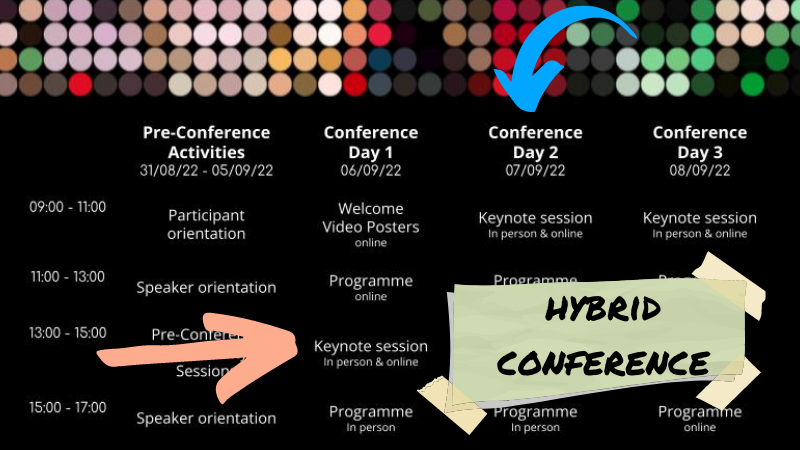
Work in progress: Screenshot of the draft programme for the conference.
Now that we have a better idea of the submissions for the conference, we can start to work on the actual programme, scheduling sessions and working out conflicts in scheduling.
Pre-Conference activities
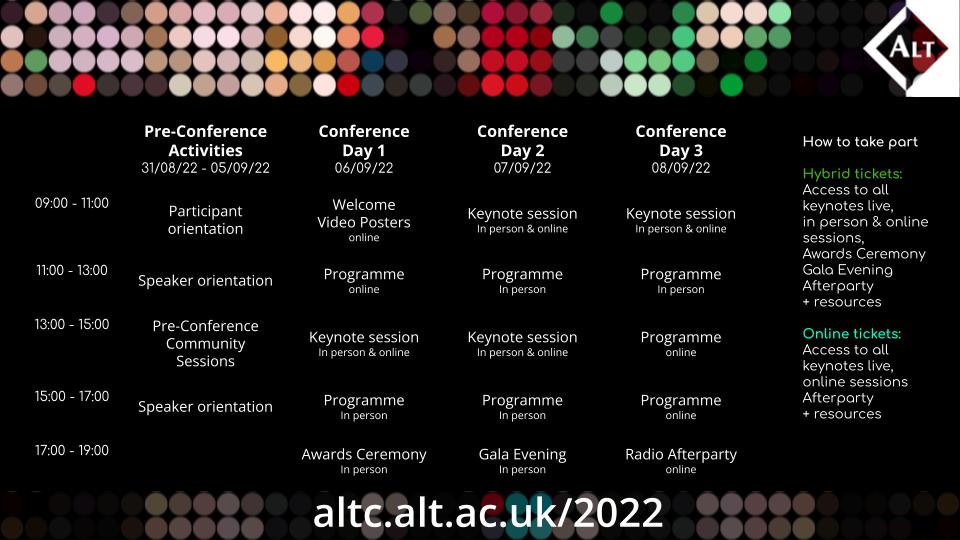
We will run pre-conference activities 31st August to 5th September and these will be open to all and free to attend. This is an important point, as these activities include sessions run by our Special Interest Groups and Members Groups. During this time we also run participant orientation sessions online, helping to onboard everyone on the conference platform and starting the conversation in our social space.
Twice daily speaker orientation sessions will help prepare speakers to present either online or in person and pick up logistical questions about session formats and session chairing.
6th September – Conference Day 1
The morning of day 1 will be online with an online welcome and live sessions including video posters. In the afternoon, the programme will be in-person. Keynotes will be live-streamed to online participants. In the evening, we will hold the 2022 Learning Technologist of the Year Awards.
7th September – Conference Day 2
Day 2 will be in-person and in parallel we will stream pre-recorded sessions with live online discussion. Keynotes will be live-streamed to online participants as well. In the evening, we will celebrate the launch of Digital Transformation, our collaboration with ITN Productions as part of our conference gala.
8th September – Conference Day 3
The morning of day 1 will be in-person, again with sessions online as well. In the afternoon, the programme will move to online only. Keynotes will be live-streamed to online participants. In the evening, the conference after party will be online and hopefully see the return of #altc radio on the airwaves.
What’s next…?
Designing the hybrid events programme is only one of many steps on the road to #altc22, and we’ll continue to share our practice as we go along. We hope you will join us in September!