Category: open practice

  • Looking for contributions: #femedtech slide deck for International Women’s Day 2019

    #femedtech #oer18
    #femedtech #oer18

    It’s not long before International Women’s Day on 8 March and whilst the work of the #femedtech network is not all about women, but about greater equality for everyone, the day is a great opportunity for us to share the work we do, spread the message and reach new supporters.

    Like many of you, I’m looking forward to sharing ideas, inspiration and some hard hitting facts when I talk about #femedtech and so I am looking for contributions to a shared slide deck – shared with everyone and free to use for you all.

    Please contribute something if you can, make a slide or more than one, adding images, quotes, references, figures or ideas that may help us better share the work we do and the things we care about. All contributions should be suitable for CC-BY sharing and include attribution.

    Thank you!

  • Working with greater kindness: how to take a break from being the worst critic of your own professional practice.

    Recently I’ve started to form a new habit, to give myself a break each day for something I’ve done or something I haven’t done. It was a kind of afterthought on a list of things, the sort of list you make at the start of the year, when the days are dark and you feel like turning over a new leaf.

    Yet, it’s been a surprisingly impactful exercise, prompting quite a few realisations about how I work:

    Being too self critical?! 

    The ease with which I find something each day made me realise that I’m more self critical than I’d thought. Having a regular reminder to give myself a break has made me take a kinder view.

    Perspective

    Often things that turn days from good to bad are quite small. Still, they can have a real impact on how I perceive things to have gone. Taking one thing out of the equation often makes things a lot better. In retrospect that is particularly helpful – focusing on good things, rather than small, but annoying niggles.

    Giving others a break

    Giving myself a break makes it much easier to do the same for others, I find. It stops me from getting distracted by minor issues, gives me more headspace to focus on what’s important. 

    Being my own mentor

    In the past, my mentor would have been the person who would remind me most often to give myself a break. It was liberating to hear and often cheered me up. Now I find reminding myself works, too. It still has the same effect. 

    Reflecting on failure

    It’s more difficult to reflect on failure than success, partly because of the emotional element. I may feel bad about a decision I made or a particular action I took and that makes me feel less comfortable, less able to think clearly about how I could have done better or what I would do differently next time. It also makes it harder to talk to others about it, because I may get defensive or focus on how I feel rather than listening. In this context giving myself a break, forgiving myself for mistakes I’ve made, is really important. It helps me to move on, to better learn from what I did or didn’t do. 

    How to… give yourself a break

    What works for me is to take a moment late in the day and think about how things have gone. Often one thing stands out as being annoying, something I wish I had done differently or something I wish I hadn’t said. It’s quite rare for nothing to come to mind. If they are too many things, I focus on whatever I feel most angry or annoyed about. Then, I take whatever it is, I acknowledge it, and give myself a break for whatever it may be. Sometimes that feels a bit like putting it in my own personal Room 101, sometimes it’s like putting it in the bin, sometimes it feels like letting go. 

    I know it’s happened, and I may have many more thoughts or feelings about my day but that one thing is now ok. Phew. 

    I found it’s much more effective than I’d expected. Maybe it’ll work for you, too.

  • 2018: my year in open practice and collaboration

    Snapshots of collaborations in 2018

    It’s been interesting to reflect on the year in Learning Technology (previous post) and that has brought about the realisation that much of what I have done this year has been in open practice and collaboration (and all the better for it!). It’s also brought about another blog post… 🙂

    Some of the work has been around governance and policy, for example in collaboration with Lorna Campbell, Martin Weller and Joe Wilson we produced a policy paper for ALT on openness in education. Since the paper was published I have been working to disseminate this call to action and one such effort was a recent post on Wonke, entitled Openness in education: a call to action for policy makers, with Lorna Campbell which was published on International Women’s Day. In the post, we examine the practical recommendations from the policy paper, how they could be implemented and discuss what policy makers could do to realise the benefits of openness in education in different sectors in the UK. 

    2017: What we have been up to [Image credit: Bryan Mathers]
    2017: What we have been up to [Image credit: Bryan Mathers]

    Or together with the Chair of ALT, Sheila MacNeill,  I wrote a Joint Report on strategic progress, 1 Feb 2018 – and we continue to publish minutes from Board meetings alongside all our governance information.  Open governance is one of the most interesting areas of work and I have been particularly enjoying talking to other membership bodies like UCISA, ILTA and ETUG about their approach or sharing expertise in groups like ALT’s strategic working group for our journal Research in Learning Technology (some of which I shared in this Gasta at EdTech2018). 

    Collaboration beyond my #altc colleagues led to this collaborative project, about how Learning Technology professionals and start-ups can work together. It started with a blog post call to action written jointly by Anders Krohn, CEO of Aula and myself, and led to a series of consultation sessions with academics, technologists and innovators, resulting in contributions to the first version of the Edtech start up guide, which was published early in 2018. Anders and I then followed up with a second blog post on the altc blog, including a contribution from Peter Bryant, LSE, to launch the guide, share some of the case studies and lessons learnt we collated and to look ahead at future work with start ups on the guide and in the community.

    My mentor, Margaret, and me, 2016

    And also, later this year, as part of my commitment to an open approach to leadership, I’ve asked my mentor Margaret to collaborate with me on a three part series to share our insights into being a mentor and what it’s like to have one. This project turned out to be much more intense than I had first anticipated and reminded me that even with experience sharing practice openly can be really challenging. We focused on different aspects of mentoring, reflecting on what it takes to get through tough times, how we built a blended approach to mentoring and the real benefits of having a mentor

    One of my favourite networks to collaborate with this year has been the growing #femedtech community and I have been advocating for the network at every opportunity at events  as well as volunteering as a guest curator of the @femedtech Twitter account. Promoting equality in all its forms in Learning Technology is one of the most rewarding aspects of my work and there is always SO MUCH more to do. 
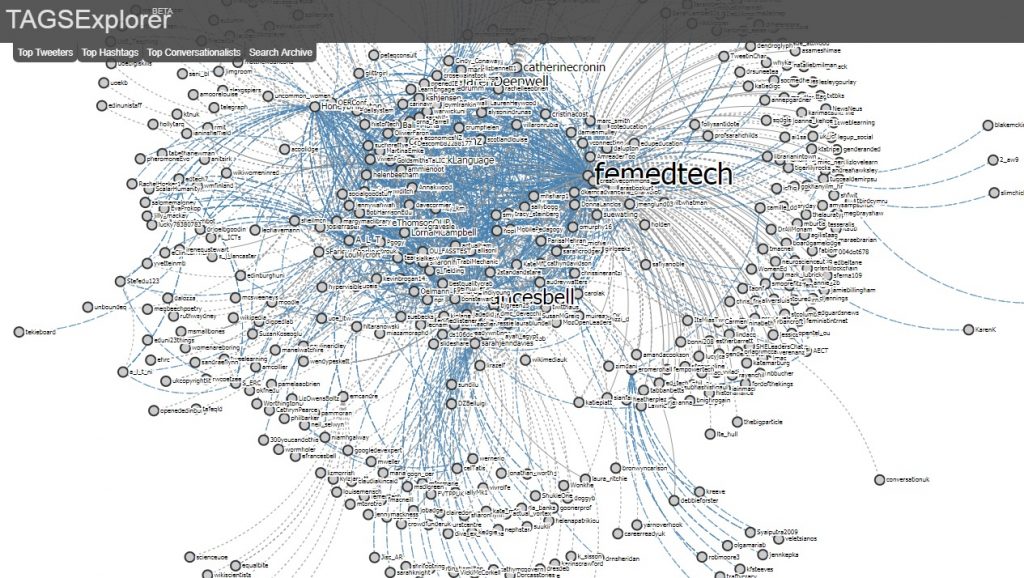
    I also set up a TAGS Twitter archive and TAGSExplorer for the #femedtech hashtag, to help chart and visualise the conversation as it evolves:

    TAGSExplorer #femedtech

    This year I have published 30 blog posts on my blog and about half of these this year have been chronicling how my colleague Martin Hawksey and I have led ALT through its transition to becoming a distributed organisation and establishing a new working culture as a virtual staff team. Our monthly series of posts has been at the heart of all my work this year, touching on everything from people management and well being at work to the technical challenges of remote working and the nuances of working in the open. Writing these posts whilst everything is actually happening, rather than sharing output from work that is in the past, felt far more scary than similar kinds of work I had done before. 

    There is much of what I do day to day that I hadn’t managed to make part of my open practice before this collaboration – leadership, management… these are not the most straight forward topics to share (especially when you are everyone’s ‘boss’). It feels easier to share ideas, innovations, practical things others can use or read up on. Sharing how we lead a team is a completely different proposition and I am glad that following Martin’s initial prompt I have taken up the challenge to create an open approach to share and reflect regularly. In previous years I have blogged about it… this year it feels like I am actually DOING it. 

    It’s also taught me much about the value of collaboration itself, about really leveraging what each person brings to the table and to create something that goes beyond anything that could have been created on an individual basis – and that, I am particularly grateful for. 

    On that note of gratitude to ALL of my collaborators this year, I am going to end this post and make plans for 2019… . 

  • Virtual Team outtakes: Smartwatch & homeworking

    In our most recent post on leading a virtual team Martin and I talked about the upsides of remote working and many of the comments we received highlighted ways in which people find balance between the demands of home and family life and work. That got me thinking about what makes a real difference to me day to day and took me back to contributing to David Hopkins’ Edtech Rations book, in which we shared what the most important things are, those you don’t leave home without. But when you don’t really leave home to work, what is it that makes the difference when you work from home?

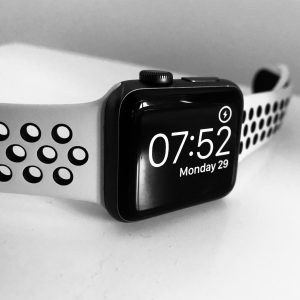
    Martin mentioned wearables in the post and that prompted me to think about how I use my smartwatch when I work from home. I do have concerns about the way the watch can track so much of my activity and I have switched off some more advanced/sharing functionality because of it, but there are certain things it can do that I find really helpful:

    Alarm clock: When charging and put on its side, the watch is a great alarm clock and I use it both at home and when I travel. It’s motion sensitive so the display only comes on when needed, which I like. It shows you the time your alarm is set for and it starts to get brighter as that time approaches, helping you to wake up. All of that could easily be accomplished with a regular alarm clock of course, but I like that I can make use of the watch when I am not wearing it and travel with it without having to carry along another bulky item of technology. It also means that I can leave my phone out of reach but I can still check the time. 

    Move reminder: another aspect of the watch I really like is that you can opt in to it reminding you to move if you have sat still 50 min of the hour. Whilst I have other reminders to move, like wanting a cup of tea, or the phone ringing or a delivery arriving, this function really helps me on days when I have a lot of work to get through. It reminds me to take a break from staring at the screens as well. On a long journey it’s not always possible to take a break, but I find long train journeys much more comfortable when I move about a little regularly. With enough awareness and self discipline there is no reason why one shouldn’t naturally take breaks regularly, but I don’t always have that when I get lost in a complicated piece of work.

    Phone system: our phone system puts calls through on my computer as well as my mobile phone during work hours (I have chosen for it to do that, it’s not required). However, I am not always at my desk and I don’t always want to carry around my mobile phone either. So glancing at my watch when the phone rings gives me the chance to check whether it’s a work call or a personal call. I can answer the call on the watch, but I rarely do.

    Planning time to go running: there is one other way in which I use the watch during the week, particularly in the colder months when it gets dark early and is cold in the mornings. I set the watch to display the temperature and the time the sun sets, helping me decide when to best find time to go for a run. I don’t run every day, but for my work life balance to work I want to be heading outside once or twice during the week, and I find it frustrating to forget, finish work and realise it’s nearly dark. So having a way to remind myself of what time the sun will set (provided that it is shining to begin with) is a useful way of planning the end of my working day and I have the flexibility to finish an hour early to catch the last bit of daylight.

  • Walking, talking, thinking. Conversational professional practice.

    My office this Thursday

    Recently I have experimented with different modes of thinking and developing ideas to see how I can expand my practice and work more productively in different contexts,  particularly whilst I travel.

    Everyone I work with is distributed all across the UK and many people I work with on specific projects or initiatives are similarly in different places and so increasingly over the past few years I have made conversations, usually on the move, a big part of my professional practice.

    What started as a necessity, i.e. taking urgent calls whilst I was walking from A to B or having confidential calls outside an open plan office became more intentional when I started working with my mentor and we adopted walking and talking as our preferred mode of working together.

    Having something else to see and focus on, being able to move, look somewhere else than the person I am talking to often helps make conversation more free-flowing, less confrontational than sitting across each other at a meeting table and more personal than trying to hear each other in a crowded coffee shop. 

    I find it much easier to think of new ideas or solve problems when I’m standing up in any case, so even if I am having a call with someone I might walk around my work space, talking and walking and thinking. 

    It reminds me a bit of Bryan Mather‘s approach to visual thinkery, drawing and talking and thinking together. 

    But whist having a walk is a great part of my professional practice, it isn’t possible or practical for me to physically meet up with everyone and so there are a number of other approaches to having a conversation that I have been finding really useful, including a recent experiment recording a podcast for a joint series on open leadership I am writing with Martin Hawksey.

    Another experiment has been to take part in a different kind of conversation for a fortnight as a guest curator of @femedtech

    Or the week co-hosting the #LTHEchat, which like the #femedtech week opened up a whole new conversation for me to take part in and deepen my understanding of how I can use different approaches to conversations as part of the work I do and the way I reflect on and explore new ideas.

    A conversational approach to thinking about things and developing my understanding is particularly helpful because it makes me aware of my own perspective, what I take for granted, what assumptions I might make. It prompts me to re-consider my starting point as well as my objective. It also gives others the opportunity to understand my perspective better, to ask me questions and to put their point across and that is something that I value in particular as I have a leadership role in which that kind of exchange can easily be sidelined. 

    I have also been writing my keynote for ALT’s Annual Conference, which I am really looking forward to, but it is in less than a month and the pressure to get my thoughts in order is palpable. When I am stuck or uncertain or lacking inspiration, that’s when having a conversation becomes even more important. Time to go for a walk this weekend.

  • Being grounded in itinerant professional practice

    Being grounded in itinerant professional practice

    Recently, I have started writing a series of blog posts with my colleague Martin Hawksey. It’s an interesting undertaking in which we take an open approach to leadership, to sharing our perspective on leading the organisation we work for through a period of change towards adopting a virtual mode of operating. And it’s got me thinking on parallel lines about my own professional practice and how it’s developed over the last 20 years, from being a practising artist making stuff, to being an anthropologist studying cemeteries, to being an academic and learning technologist and now to working in a leadership role.

    My work has been on the move constantly. I have changed countries, cities, institutions, offices, roles and colleagues. I like change, and having new challenges, but I also take things with me. Some things remain constant, part of my routine no matter where or how I work.

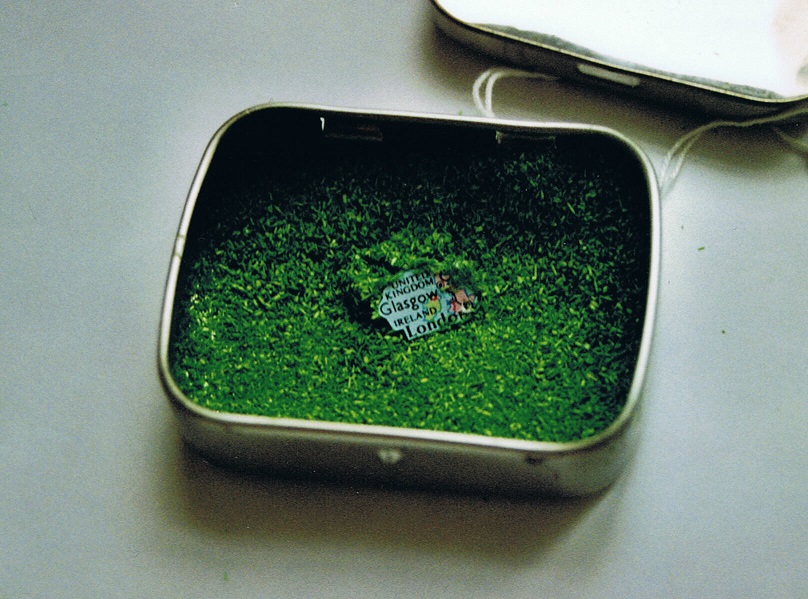
    That isn’t too say that my environment, technology or company doesn’t have a big impact. They do. But they don’t define my practice. What really matters, what makes me work well, what helps me achieve, that I take with me. A bit like the suitcases I used to create as a sculptor or draw in my sketchbooks, I think I have a carry-on of essentials that I don’t leave behind. They help ground me and my work when things change or I do. In my experience everyone has an equivalent of those types of things, but here are my top 5:

    Reflective writing
    Whether it’s in a journal, on loose paper, on my private blog or digital doc, at least once a week and often more frequently I sit down, reflect and write. It doesn’t matter where I am or how busy things get, reflective writing forms an essential part of my practice. It helps me gain perspective, empty my head and make time to enjoy what’s gone well or give myself a break for things that have gone awry. I write around 80,000 words a year, so cloud storage is a good thing. 

    Long term list
    No matter what shape my daily to list may take, I always keep a list of ideas, links and actions to consider in the long term. It’s a dump for anything important, but not urgent, as well as more creative ideas or plans. I review it periodically, maybe once a month or so, to mark things as completed, delete and re-order. Some items take years to complete… .

    Pictures
    A visual record of what I am working on, where I go or whom I meet is really important to me. It’s useful to be able to look back, revisit particular conferences or trips or lunch. That also includes images or artwork I (help) create – in particular if I have been working on something for a while.

    Making time to listen
    Harder to make the suitcase metaphor work with this kind of thing, but still an essential. It sounds very obvious that listening is important, but so few people actually do. Most of the time, it’s all about talking, transmitting, being heard. The busier things get the more difficult it becomes to find time to listen and make space for others to find their voice, share their thoughts. So from train journeys to coffee breaks, I make a point of putting my laptop or phone to one side and really focus on the people I am with.

    Complete something fun
    As often as I can, I dedicate some time to doing something fun. For example, I enjoy making a web page and publishing it. Or making an image for something. Or reading/writing something. It doesn’t really matter what it is, it’s about completing it and getting a sense of achievement from it. A quick win. A lot of what I work on is a) long term, b) invisible or c) collaborative and so in order to balance these with feeling that I have accomplished something I often do ‘something fun’ and see it completed. It reminds me of how good I am at making things happen and often helps me see bigger, more complex things through to completion with a greater sense of confidence.