Yep, this is another post about houseplants… or rather things we can learn from plants. I’ve previously published leadership lessons from office plants and in the same spirit this post is all about houseplant inspired tips for managing a period of change or transition.
It’s inspired by my own experience of moving between jobs this month and my adventures in caring for a growing collecting of plants in my home and home office. It’s the first time in a long while that I am changing jobs, but the last few years have brought so much uncertainty with them that I feel I have quite a lot of practice of coping with the unexpected. What the last few years have also highlighted for me is how important it is for us to have strategies for periods of transition – and like many I found solace and inspiration in bringing a bit of green indoors.
So in the spirit of open practice, here are my personal reflections and practical tips. You can also listen related episode of my podcast on Apple Podcasts.
Allowing time to be less productive
One of the things I have struggled with a lot in recent months is just how much there is I don’t know or can’t control, both when it comes to changing jobs and also in relation to my plant collection. Although I am looking forward to the changes ahead, it’s still disconcerting not to know what the next day, week or month will bring, how it will feel, if what’s ahead is fun or frightening. While I have plenty of practice in dealing with uncertainty both professionally and personally, the emotional toll of not know is still there.
Hence there is a lot of need to get comfortable with accepting what I can’t control and to sit with my feelings, comfortable with being uncomfortable. Spending time with plants is one way of making that space and time to acknowledge to myself (and where appropriate to others) what I am feeling. I might go for a walk or sit quietly somewhere, or lie on the sofa cuddling my dog. The particulars don’t really matter. What does matter is that in that extra time I need I am not being as productive as usual. I am not achieving or working in the way I usually do. It’s a season of change, and just like my plants aren’t always growing new leaves or in bloom, I am adjusting and trying to enjoy this period for what it is.
Reflecting to gain perspective
Reflecting is a key part of my professional practice. I like reflecting in conversation, by writing in my journal, or just thinking about things. That said, at the moment I am finding it difficult to focus. I sit in front of a blank page and I can’t find the words to start. There seems to be too much to reflect on to know where to start, or indeed everything I can think of doesn’t seem worth mentioning.
Fortunately, I have a coach whom I get to lean on in times when my own capacity to gain perspective is low, but I also found some prompts to help me reflect. What I do is to start on a fresh page, and write down 3-5 questions that I then answer in turn. Here are some examples of the kind of questions I ask myself:
What was hard today?
How would you like tomorrow to be different?
What do you wish you had done or said differently?
Why are you feeling the way you do?
What has changed in the past week/month?
What are you looking forward to next?
What would you wish would go away?
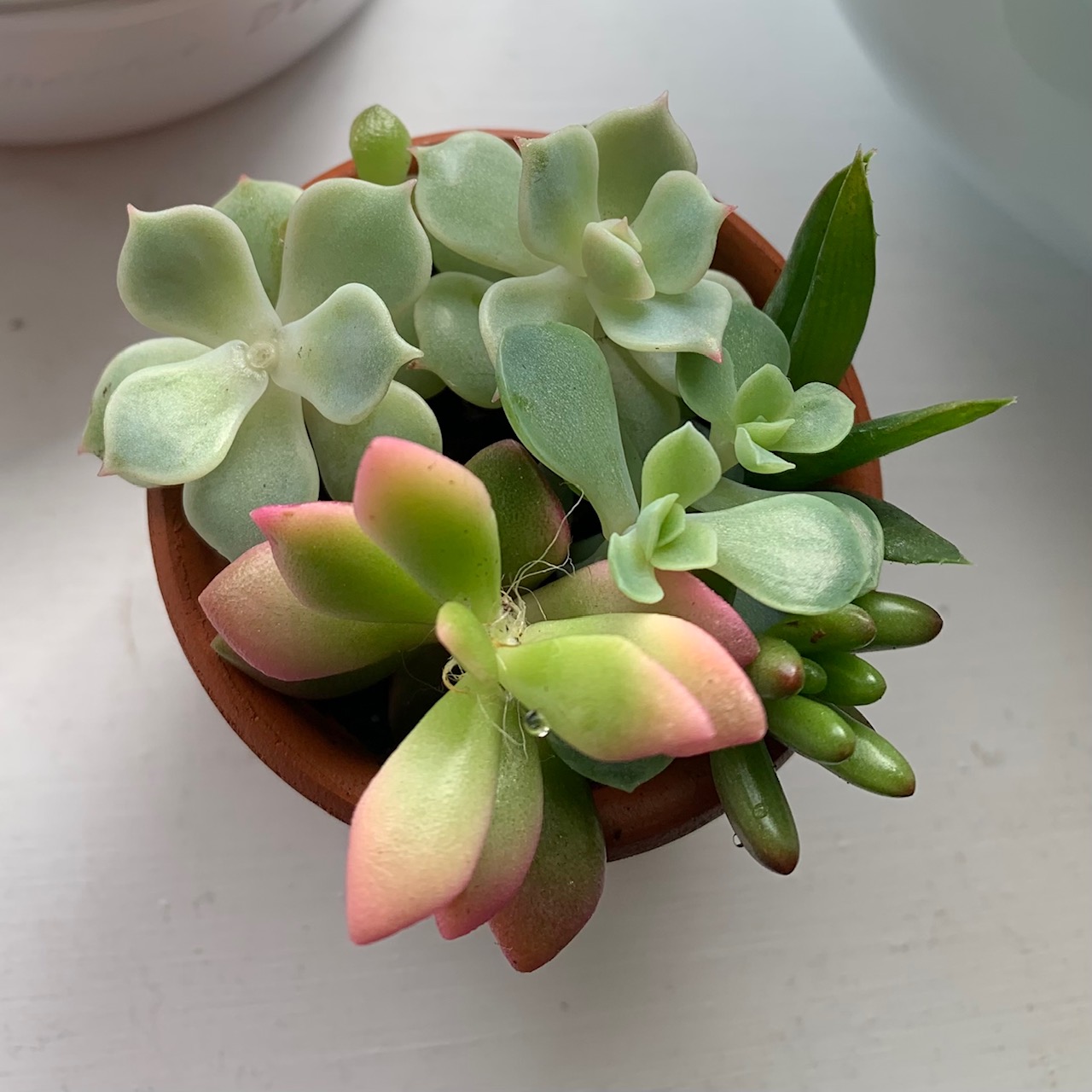
I have some very small succulents at the moment, and they are so interesting to watch. Day to day they don’t really change, and sometimes I give them to much water or too little, and some of them don’t like it, but with patience, they do change and grow and you can also really see those changes over a period of time. Similarly, in my journal, I can usually only spot the patterns when I look back at what I wrote 3 months or even a few years ago. It serves to remind me that my current perspective is always limited by the here and now.
Focus on what stays constant
Even in times of transition many things remain the same and it can help to focus on these. For me, it’s easiest to find constants in my home, my daily routine and my own skills and capacity. Here are some examples:
Home: I like finding my favourite comfy spots to read and have tea. Particularly during a stressful day, I enjoy looking out of the window and observing the outside world. I also have a great fondness for plants, and I have about 10-15 houseplants in my office. Plants change at a much slower rate, as they grow and develop. I enjoy observing them closely and soak up some of their patience and calm along the way.
Daily routine: tea in the morning, walking the dogs, even answering emails can be comforting routines. I really enjoy routines and habits, even though my week is not planned out in every respect. I like having flexibility to decide when I want to exercise or do chores, but doing familiar things is still comforting.
Skills and competencies: one of the things I find most comforting about change is that I can continue to rely on my own skills and competencies even when the context in which I apply them changes. For instance, I love planning and organising things. I enjoy being creative and producing content. My work rate is extremely high, and I get a lot done. All of these aspects remain the same, and I try to lean into those strengths.
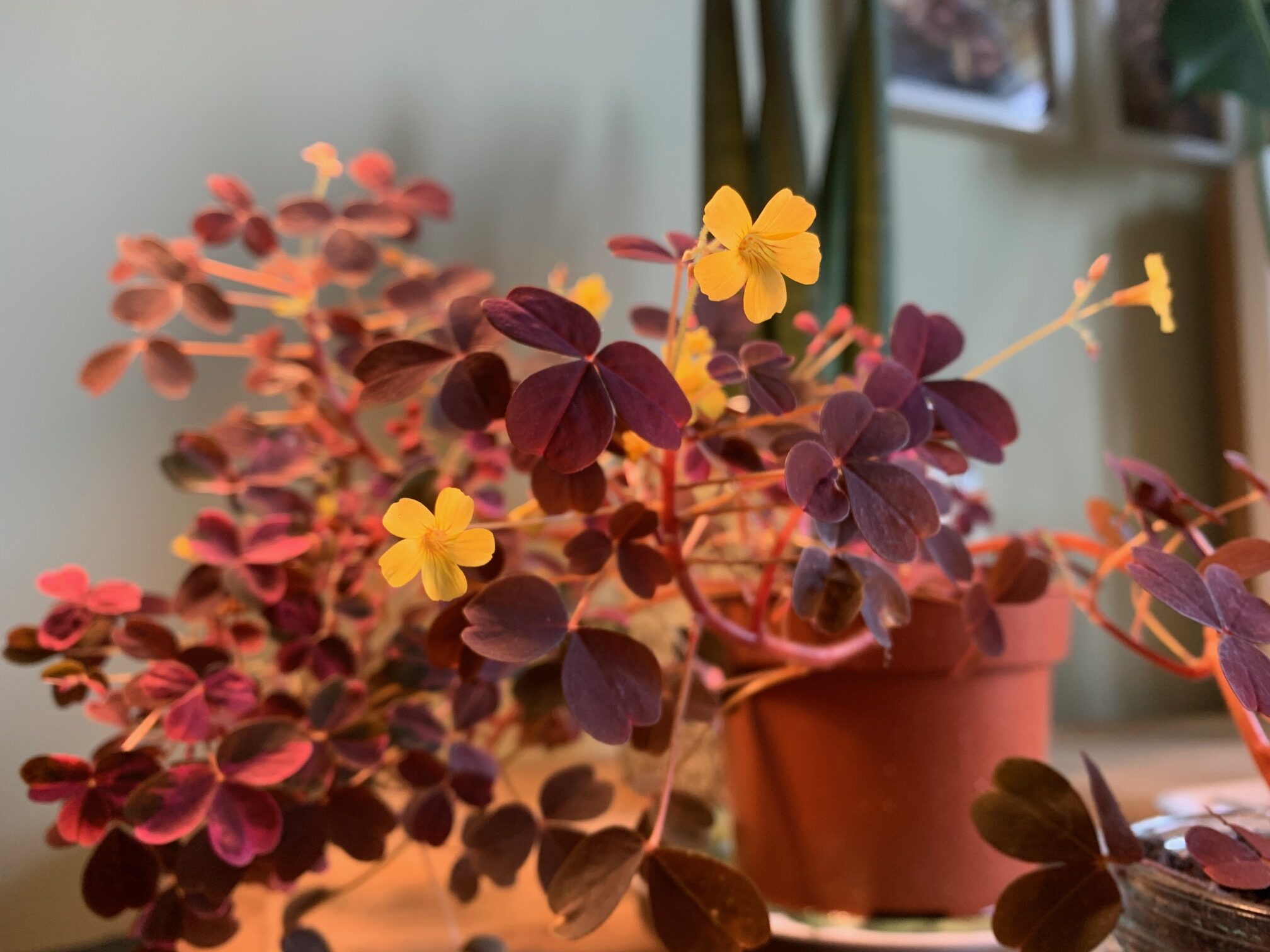
This plant, an Oxalis, arrived at my office from a local plant fair very recently. It usually grows near water, like a brook or stream, and is used to having some sun, but not too much, and to be kept moist and not dry out. So far, I am happy to say, I haven’t managed to kill it, but there’s always a high probability of failure with a new plant I am still learning about. I don’t know yet how the plant will adapt to my office, or what it might need. Context is everything, and with a change in environment there’s always a risk of failure. Like with plants, people, too, need conditions to thrive, and they provide a constant reminder of that.
There are other strategies that work for me at the moment, including making time to practice gratitude, taking breaks, planning for a holiday and re-inventing some of my weekly routines. In short, everything I do when moving at ‘plant pace’ (slow, intentional, balanced, looking after my needs) feel good and are helpful in this period of transition.
There are also some things that aren’t working for me:
Can’t rush settling in
One of the aspects about change that frustrates me is that you can’t rush it. Things take time to adjust, and other people and processes need time to catch up. Most importantly, I need time to adjust. And yet, my mind would like it to be sometime in the future when everything feels settled and the new routines have become familiar.
Feeling unsettled is hard and most of the time actually making a plan happen takes a lot longer than conceiving of it in the first place. Although I can comprehend that things simply take time to change, and that I need time to adjust and process everything I still find it frustrating at times.
Digital difficulties
The other part of transitions that I find difficult is in how many different places information needs to be updated. From social media sites to email footers, to life admin and address books, it feels like a mammoth task to even change my email address. That is one aspect of changing roles that I really don’t enjoy as it’s simply tedious to go through and unsubscribe, update or delete everything.
I am going to check back in on this in a few months, partly to report back on progress, and also to get a feel for how my perspective is shifting as the transition continues.
Enjoyed this post? Get my free monthly newsletter directly to your inbox.
Next week, the OER Conference comes to Inverness, and I am very much looking forward to it! There’s a packed programme, lots of ways to engage and the anticipation has been building for months, as these guest posts show. OER23 has a super Conference Committee of nearly 100 volunteers who have worked together for months to peer review papers, organise social activities, help plan conference delivery both in person and online and spread the word about the conference far and wide.
Why this post?
I’ve had a professional involvement with the event since 2015, and I’ve been one of the lead organisers since 2016, helping to steer the event through years of growing in impact and engagement followed by the crisis of spring 2020 and the (post) pandemic years since then.
I’ve had the pleasure and the privilege to be involved in many wonderful events over the past 15 years, and it’s not possible to pick a favourite amongst so many special moments, moving keynotes and memorable evenings.
That said, when it comes to my own practice, the OER Conference is probably the event from which I have learnt the most, at which I had those conversations that changed the path of my career and encounters that have led to a decade of collaboration. Openness in all its forms is fundamental to my work and my worldview and the OER Conference was my gateway to that world.
So, as this is my last year as one of the lead organisers, I want to say thank you to the OER Conference and this blog post is full of love for what has been quite a ride… .
Looking back at my journey with the conference
You won’t be surprised to see that I have written a lot about the OER Conference since 2015. Going through these posts there is so much that jumped out at me, so here are some personal highlights that give you a flavour of the journey we’ve been on to get to Inverness next week:
2022 was the year when things started to come together again (cautiously)
‘Wow. It’s really happening. This time, we are hitting not only the virtual but also the physical road again in order to journey to the OER Conference. OER22 here we come!
The last time the OER Conference took place as planned as in Galway in 2019, and since that time, three years ago, no edition of this very special event has gone to plan. In 2020, OER20 pivoted online with less than two weeks to go, and became very much a pandemic conference. In the crisis mood of those early days of the pandemic, OER20 became a free event with refunds winging their ways across the globe to participants who suddenly had a lot more to worry about than a cancelled conference. …’
What I recall most clearly about last year, is that 2022 was the year of careful hugging.
2021: OERxDomains21
The 2021 edition of the conference brimmed with creativity and joy against a backdrop of bleak pandemic reality. We had hugely high expectations and months of work from everyone all aimed at Reclaiming the Joy of EdTech. OERxDomains21 was also a conference of firsts:
… the first time we had FIVE Co-Chairs – who brought all their expertise, passion and ideas to bear.
… the first time participants remixed 159 conference badges.
… the first time we recorded 220 of 236 participants synchronously networking online on Discord, flooding the Hallway Chat, Introduction Channel and resource pool with contributions.
… the first time that these two organisations (ALT & Reclaim Hosting), and two conferences (OER and Domains), mashed up together to create this new, joint event bringing two communities together.
… the first time that we delivered a synchronous and asynchronous programme for participants from 18 countries and plenty of time zones for a total of 75 hours of programming.
… the first time that we found streaming platforms that made high quality recordings immediately available to participants and then to the public, enabling late arrivals to catch up and supporting delegates from across the globe.
… the first time we delivered an event with a staff team of 11 (up from the usual 5-6), many of whom had never met before.
… the first time that we delivered an online event without Martin Hawksey, who headed up ALT’s event delivery for the past seven years (waving to you, Mr Hawksey, I hope we did you proud :).
… the first time anyone had the most special TV programme design that went from emails to programme pages and beyond thanks to the work led by Reclaim Hosting, enabling our participants to quite literally step into their own Community TV Channel.
… the first time we managed staff handover between time zones seamlessly between sessions as one staff team ended their day and the other arrived.
My most vivid memory from that year is Jim Groom singing ‘we did it again’ over and over.
2020
The year before, 2020, things looked very different. A lot of what I have written about the cancelled conference that lost us a huge amount of money and still happened with 1100 people online with only two weeks notice to move from in person to online… is hard to read now. At the time we had no idea of how long the impact of those early weeks of crisis would stay with us. But even in those dark days, there was joy at OER:
For me personally, there were two moments that really captured both the joy and the sadness of the times in very unique ways.
One was a live online session led by Frances Bell celebrating the FemEdTech Quilt of Care and Social Justice. You can catch both the recording of the session and the accompanying video via the conference page. I have contributed to the quilt project both personally and professionally and yet the power of the live session really took me by surprise. I don’t think any webinar moved me to tears along with half the audience before this. It was a moment of connecting with fellow collaborators across the globe that was so special and made the distances and isolation between us, the crisis we are all weathering, palpable.
The other session was the evening’s #OER20 #KaraOERoke Night. I don’t think I had laughed more than that in weeks. It was very special, but also fun and incredibly moving to see conference participants and their families join in with the Frozen song, reviving classics and demonstrating their singing ability with everything from Motörhead to Kate Bush. Those moments, whether online or in person, are unforgettable.
It still rings true to me, reading this three years later. Those moments are unforgettable. Yes, so much of what we do has started to take place in person again, but not because online wasn’t enough or good. We do so much online. Being able to connect in person, alongside all we do virtually, is a joy (and a privilege), that I wouldn’t want to give up.
2019
No year did connecting in person feel more important to me than in 2019, when OER came to Galway:
Openness is many things to many people and the vision that the conference co-chairs have brought to the event has really inspired me and helped me reach a new understanding of the challenges we face by including more diverse voices and perspectives and also by ensuring that openness has been stitched into the fabric of OER19.
In turn, that has inspired the work that ALT does to support this conference in the run up to the event such as tweaking our systems to encourage more sharing, the Board of Trustees funding more scholarship places for students than ever before, contributing to global events during Open Education Week led by the Open Education Special Interest Group, and post-OER19 to the Creative Commons Global Summit. …
Thanks to everyone involved, everyone who puts time and effort and resources into making OER19 happen, I feel like actually getting to go to the event in Galway is just the finishing flourish. OER19 has been a living, breathing, inspiring part of my professional practice for over a year already. But when I watched the sun rise over Galway Bay nearly a year ago, I didn’t realise how rich, how thought provoking and nourishing a journey working on this event would be. I’m grateful that I have been able to contribute, and I look forward to playing my part in making it happen and to build on what will be shared at OER19 to continue to promote openness and support those involved in the coming year, weaving a stronger thread of openness into the fabric of things.
Being a keynote speaker can be a powerful thing particularly if you choose to use the platform it gives you for a cause that chimes with your audience. And it seems that in the case of OER19 that definitely happened. So much emotional investment and enthusiasm is rare at conferences I attend and as we are now nearly two weeks after the event and the posts and discussions keep on flowing this is further reflected in the continued engagement and activity. So there are fresh role models for me to be inspired by, keynotes to relive that really struck a chord and transcend what you can normally expect from an hour in a lecture theatre. And indeed there are many involved in making OER19 happen whom I have been inspired by in the past, like the Co-Chairs Catherine Cronin and Laura Czerniewicz, alongside Jim Groom, Lorna Campbell and Sheila MacNeill, or Bon Stewart, Martin Weller and Maha Bali and Jane Secker. All of whom have kept their audiences spellbound at previous OER or ALT’s Annual Conferences and I remember sitting back, listening, enjoying what each contributed to those events and to my own thinking. Some of these talks opened up my perspective to completely new concepts or problems, others inspired me with their example and encouraged my own practice. But each have made the hour I spent listening and participating very special, a moment stuck in my mind.
Galway was a beautiful conference destination, and OER Conference fortunately is not too big to take advantage of going off the beaten track. In 2018, OER took over the Waterside cinema in Bristol… and (obviously) it all kicked off with a VHS tape and – shoes!
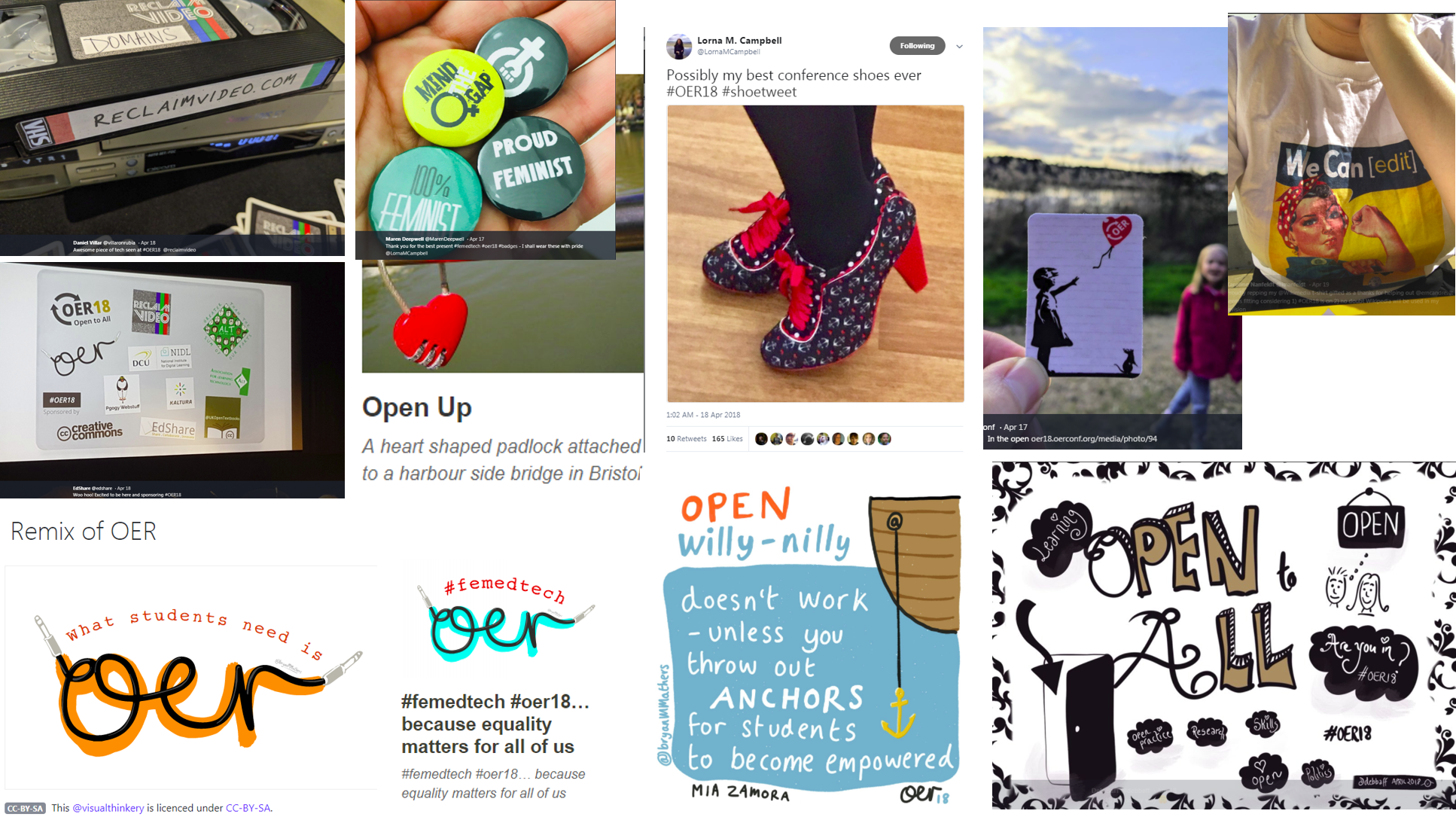
It all started with a shoe tweet … and like the insightful and thought-provoking narrative that Lorna presented in her opening keynote, the red ribbons on her shoes started to wind themselves through our conversations over the following two days. The anchors and the nautical theme that reflected both Lorna’s research interest and the conference location reflect a thoughtfulness that was part of every aspect of Lorna’s talk and I was grateful to be able to sit back and listen as her vision took shape. …
There is a strong component of gift giving and exchange at OER Conferences as people who have never or only rarely meet in person exchange tokens that express and develop their digitally conducted relationships. It’s an opportunity to show what you stand for, what you believe in, to share and show your colours.…
Far beyond the swag was a boat tour, sunshine (the weather gods are definitely on the side of openness), music, walking tours and apprenticeship – OER18 brought people together to learn from each other, see the world from a new perspective and to listen to the other voices in our community.’
More than swag: #oer18 material & visual culture https://marendeepwell.com/?p=1453
I blogged a lot about OER18, and I still look back at the sunny days at the harbour side in Bristol with real joy. In those years, the event created such momentum, and a wonderful tradition of nearly every participant being a speaker, too!
We used to joke that OER is the conference for which keynotes could be randomly chosen from anyone in the room. Everyone had a story to tell, everyone had a voice. And that’s still the case today. Looking down the list of participants this year, there are so many past and future keynotes.
2017
This was especially true in 2017, when OER came to London for two days of capital fun and high impact open policy making. This was also the conference that opened with Maha Bali’s incredible keynote – that alone made it a stand out year!
My hope for OER17 was to make time for people and conversations. That was probably the most enjoyable aspect of my days, and like many other participants I was delighted to be able to connect in person with many individuals from my social networks. One of the highlights was joining a Virtually Connecting session with Lisa Taner and Lucy Crompton-Reid, facilitated by Martin Weller – and I am grateful to Maha Bali for inviting me. You can now watch it on YouTube .
Meeting participants from different continents and having a conversation that bridges the physical divide was a great way of seeing things through someone else’s eyes. The social events before and during the conference were another good time for catching up and I was impressed by the bowling, ping pong and karaoke going on all around.
London followed Edinburgh and Cardiff as host cities of OER in 2016 and 2015 respectively. I may be biased, as I love Scotland, but I think the glorious sunny days right in the heart of Edinburgh may have been my favourite OER days:
2016
On the train on the way to Edinburgh to the OER16: Open Culture conference I was past York and heading North when the sun came out. A while later the train tracks approached the coast and I looked out at the sea for the first time in months. A wide blue sea under an open sky. In the distance LEGO-brick like shapes of container ships appeared as we neared the shipping lanes and in the brilliant sunshine we approached our destination. It felt like this conference certainly had good meteorological karma. …
Melissa Highton’s closing keynote gave me a glimpse into what it takes (and whom!) to make OER and openness work at scale across a whole institution, for hundreds of staff, tens of thousands of students and the wider community. Armed with a strong vision and persuasive arguments for senior decision makers it was awe-inspiring to hear at what scale and with what commitment Melissa leads colleagues working to achieve the university’s vision for openness. For someone in my position who has to make arguments for openness all the time, there was a lot to take away and adapt in this presentation.
Led by the Open Education Special Interest Group alongside many other groups across the community this engagement continues to further the work ALT does in Open Education, advocating for change and influencing UK policy makers. There is a whole body of policy work that the OER conference has inspired and sustained in the UK and internationally the importance of which is not be underestimated.
2015
Back in 2015, the start of my time with the OER Conference, I had no idea when I was sitting in the beautiful Royal College of Music in Cardiff, that this event would have such an impact on my practice and my wider work for ALT in the years to come.
Looking back at the blog posts that chart my evolving thinking about open leadership, I can trace the connections between those (for me) early days, and the work I now do on leading virtual teams:
When I recorded a podcast this week, on why open practice is so important for leaders in hybrid and virtual workplaces, I looked back at those posts and reflected on how much has changed:
Little did I know then how important open leadership would become for me as we closed ALT’s offices in 2017 and later managed a global crisis from home.
As I look forward to this year’s event in Inverness, I feel grateful for all the fun, inspiration and creativity that the OER Conference has brought me.
With my CEO hat on I have had to carefully balance the bottom line with wider impact and that equation has become more precarious since 2020. But if I’ve learnt anything from my work with the OER Conference is that the balance sheet doesn’t tell you all that’s important and that this particular event is important to so many people, that it happens even when a global pandemic cancels all plans two weeks before.
It takes a village… and fortunately this conference attracts just that: passionate and politically astute co-chairs, committed and hard working committee members, enthusiastic and inspiring speakers who double as participants, unique keynotes, influential researchers and super staff that help bring it all together.
So as we prepare to bring the proverbial band back together online and in the Scottish Highlands next week, aiming to ‘do it again’ as Jim Groom might sing, I say hats off to you for making it happen!
Thank you for your involvement over the years, for your contribution, for helping make this conference a spiritual home for many, me included.
P.S.
2015 was not only the year in which I attended the OER Conference properly for the first time, it was also the year that I met Martin Weller, then OER15 Co-Chair, and later a Trustee and President of ALT until 2020. Little did I know then that six years later, six years that felt like an age thanks to a global pandemic, divorce and several house moves, Martin and I would end up sharing a home, two dogs and our lives together.
Our home has OER sofa cushions and Bryan Mather’s OERxDomains21 conference artwork on the wall, and you won’t be surprised to hear that our shared commitment to openness in general and open education in particular is one of the things we have in common. So in a very personal sense the OER conference has brought me, in a roundabout way, great happiness, and for that alone I will always have a whole lotta love for it.
For the past ten years, I have focused on celebrating International Women’s Day in a professional context, and I am lucky indeed to be part of networks and groups that help me grow and learn about equality and equity in education and the non-profit sector. Ever since my student days I have found so much inspiration and strength in the people I work with and I am grateful indeed to all the amazing colleagues, collaborators and co-conspirators I have know. I salute you!
This year, as I am in the middle of a career transition and a bit overloaded with online activity just now, I want to take a more personal approach, and use this International Women’s Day for a moment of personal gratitude: gratitude for the women in my life whom I don’t often talk about on this blog: my friends and family, my personal network.
Growing and learning and contributing is never done in isolation, and I am grateful indeed for the inspiration, support and appreciation that keep me going no matter what the day may bring.
Many of my clients are looking to make progress in their work or personal lives: to make a change, develop their career path or build personal habits. Many of us have goals like ‘progress in my career’ or ‘be happier’… but it can be hard to break down exactly what to do in order to achieve our aims and define what ‘success’ means to us. Here are five tips that will help you create a milestone map that works for you:
Choose a format that works for you
It’s hard enough to set out a milestone map without having to do battle with the interface. Maybe you are someone who thrives on learning all about a new productivity tool (hello, fellow Asana fans), and if that’s the case, then use that extra motivation to get you started in a shiny new template. If pen and paper seems more attractive, or post-it notes on a whiteboard get you thinking, then choose those. You can use pretty much any format you like. The key is that you need to pick something you can easily work in, add to over time and access, and something that will enable you to add a lot of information if you need to (when you break down goals like ‘develop my career’ into smaller, actionable tasks).
If you have a work tool that you need to use for a performance review or appraisal, then ideally start somewhere else and late copy your finished thoughts into the required format. Give yourself space to think first and foremost.
Pick your goal(s)
Is this map going to help you plan out the next five years? Focus on finishing a book or a project? Is this a map to a career transition, a healthier you or a bucket list? Do you already know exactly what you are aiming for?
If you have a clear goal: then set out your parameters first. For example, if you are planing for a writing project, note all the specifics such as word count, deadlines and so forth. For example, if your goal is to: submit a paper to a major conference; this could be made more specific: Submit a 5,000 word research paper to a conference by July.
If you are searching for clear goals: often it can be hard to set out goals straight away. It’s helpful to think about broad categories to start focusing, e.g. ask yourself what timeframe you are planning for; what aspect of your life you want to think about, such as work, family, relationships, hobbies, self; consider what’s important to you and how this can be reflected in your plans. For inspiration, have a look at the Wheel of Life tool or List of 100 Dreams I have previously blogged about or start with a list of your values to help guide your thinking.
Turn goals into milestones
Once you have your blank page in front of you and picked your goal(s), it’s time to turn the goals into milestones. Earlier I used the example of a writing project, where the goal is to: Submit a 5,000 word research paper to a conference by July. For this kind of project, ask yourself questions like: who else is involved? How will they input? Are any parts of this time-sensitive? What is the end product? How do I get there? Or what is the first step? What is the next step?
Group tasks that go together and define a milestone for each group. For example:
Write 500 word outline
Research initial references
Share with colleague for feedback
Milestone: Draft a full paper structure
Then, consider how to move from your first milestone to the next.
The same approach works for much bigger goals, such as working towards a promotion or leading an initiative. Whatever you choose to focus on can always be broken down into individual steps and milestones.
Check your map
Part of the magic of this kind of planning is that it really works, provided that the map is true to you. By that I mean that the map reflects what can you can reasonably achieve. If you usually write less than 500 words a month and your plan is to write 5,000 words a day, then you will very likely not achieve your goal.
The trick is to dream big and allow yourself to set goals that are truly meaningful to you, which you then turn into achievable actions that fit within your life.
Similar to prioritising your to do list, you can prioritise your milestone map. A long term goal might go on the back burner while you focus on a more urgent opportunity for example. A map is not a to do list, but a tool for you to make the changes you want to make happen.
Ask why?
I often come across milestone maps that are all about what people feel should be on them instead of goals that align with what’s truly important to us. So my final tip for when you have your map, is to check in with yourself about the why.
Why is this goal on your list? Why is it important? Why do you want to spend the next three years working towards this?
Milestone maps often bring out our inner need to conform to other people’s expectations. Maybe there is a specific deliverable you need to meet to get more funding for your project. Or maybe there is a hoop to jump through on the path to tenure. Whatever you are aiming for, remind yourself of why it’s important to you.
Make your hybrid working milestone map
I recently worked with the wonderful folk at Reclaim EdTech on a course all about hybrid working, and as part of the course I designed a roadmap for professional practice in hybrid working. If this is something you are interested in, drop me a line and I’d be happy to send you a template so you can make your own.
In my last post, I reflected on the benefits of a monthly newsletter as a tool for reflection and monitoring progress. For example, I shared how looking at my blog posts for the month gives me a chance to think about aspects of my work I have enjoyed and want to do more of, things I’d prefer to spend less time on, what I want to focus on in the coming month and what is going on the back burner or stopping all together.
This kind of approach, focusing on what to stop/start or do more/less of is generally helpful, but I find it particularly effective when I review what I have been working on and can use specific examples. Now, in my CEO role, my team and I have started to use Asana last year to support collaboration and reporting across the organisation. I found it extremely useful from the start, but transferring all of my personal to do lists and productivity habits into a new platform has taken some time. As I became more confident in the platform, I found new ways to manage my workload and to review my own progress.
One example of this, is that I have started to use Asana more for my weekly work planning, and I wanted to share some tips about how I do that:
1. Reporting
The reporting menu in Asana comes with a “My first dashboard” set up, and I have used this to set up a personal view of tasks by going into each one of the charts and adding a filter that selects only me as an assignee of the tasks being reported on. This way, I can see all of my tasks at a glance.
It’s the first time in my career that I can analyse my workload at this level of detail, and it’s fascinating to compare my own sense of how things are going and what I am spending time on with what the dashboard view captures. It’s a useful exercise for me to consider what’s not being captured and why.
Most of the time, I find leadership related activities are absent from the reporting. Although I have both shared and private plans that capture most of what I do “think about staffing problem” or “ruminate on difficult email response” type tasks are not always easy to quantify.
2. Unscheduled tasks
One of the key priorities for us as a team in order to make the most of Asana, is to ensure ALL tasks we add have a deadline and are assigned to someone. I get a lot of tasks assigned to me, and using the reporting feature helps me identify the proportion of tasks that are currently without a due date and thus falling off my radar.
I love the discipline and accountability a tool like Asana brings with it, particularly as it helps you capture what you are doing wrong (planning work without giving it a deadline or a lead) as well as what you are doing right. It’s fascinating for me to reflect on why this is happening in certain areas of the work we are doing, as it often points to a lack of communication or clarity elsewhere, which in turn helps me understand what I communicate effectively and what I need to do better to get across.
3. My Tasks
In Asana the Board view of My Tasks is starting to feel more helpful to me. I have set up a “To do this week” section, which I add tasks to at the start of my week. That helps me get a sense of whether my workload is reasonable or not.
I have also set up a CPD section for myself, in which I dump all CPD related stuff. I then have a recurring monthly task that reminds me to review this section. I intend to use this section as a short-cut to complete my CPD list during my next appraisal.
Yesterday saw the start of a new server experiment on Mastodon. Over the next three months ALT Members are invited to join in an exploration of this social space, and learn more about how to use it for personal and professional use along the way.
We are excited to partner with Reclaim Hosting to offer 3 fun, informative sessions focused on Mastodon. The sessions are open to all and free to attend so you should have no issues accessing them here. The sessions will offer interested parties valuable insight into how the federated social media software Mastodon works, with everything from joining a server, to helping them find their way around, as well as providing a peek behind the scenes of the moderating and hosting process. We need you to join the sessions, participate and report back:
Session 1: Mission briefing: 19 January 2023 at 16:00 GMT (WatchRecording)
Session 2: Verifying your progress: 23 February 2023 at 16:00 GMT (Watch Live)
Session 3: 30 days until self-destruct: 23 March 2023 at 16:00 GMT (Watch Live)
For any of the above sessions you can join the Reclaim Discord server to join the chat during the live broadcasts: https://reclaimed.tech/discord .
If you’d like to register and get reminders about each session, head over to the ALT website and register now.
Why are we doing this?
The server we set up will act as a platform for our communities to explore and get to know Mastodon. The server will be temporary, but depending on what we learn along the way, we will decide how to proceed. So, whether you are completely new to the fediverse, or looking for other edtech folk to connect with, join us to explore and learn together.
ALT and Reclaim EdTech are already active on Mastodon, and many in our communities are, too. We are looking to learn more about how we can support folk in this space, how community servers might function, how they could be moderated and what the costs involved might be, too.
This is an opportunity to learn more about being active on Mastodon as well as learning about setting up, hosting and moderating servers for communities like ours and complement what we can learn from already established communities and servers with hands-on experience.