Category: open practice

  • Positive feedback by post: what happened next…

    Nice to CC you by Dr Maren Deepwell CC-BY-SA

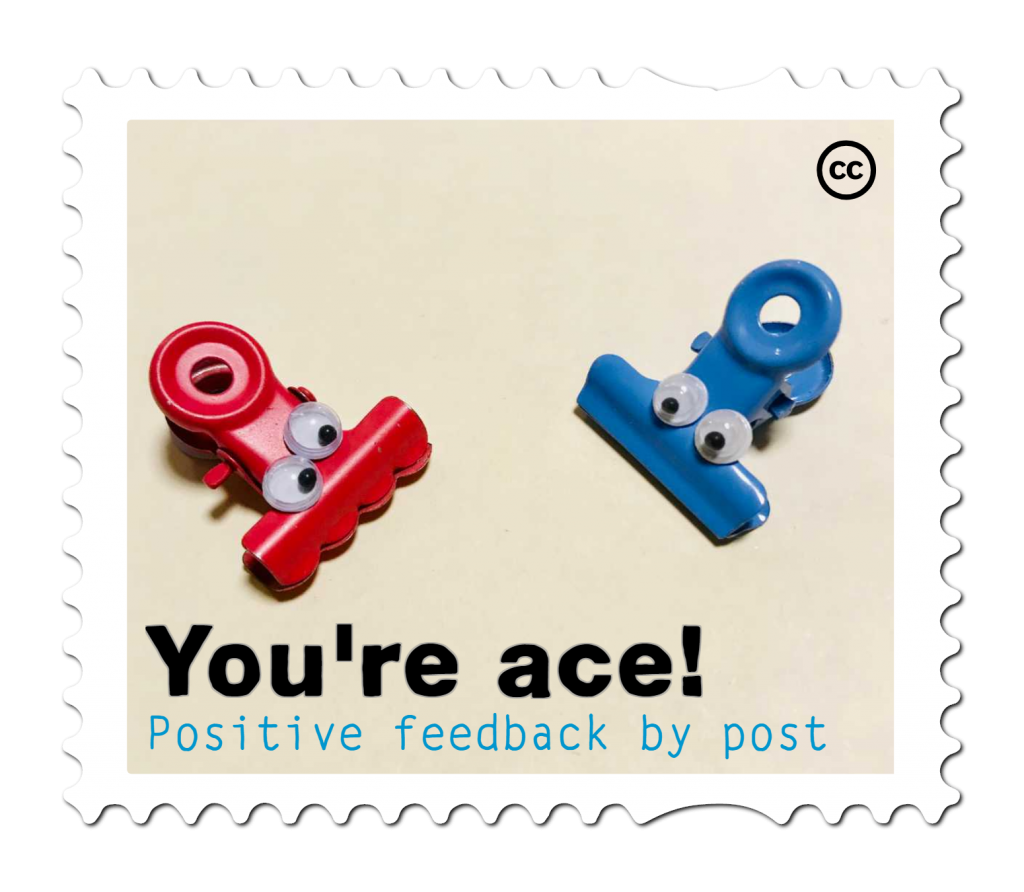
    In a recent post on positive feedback I talked about how to use positive feedback for personal & professional development. As I wrote the post I had an idea to try out a new approach to giving and receiving positive feedback in a virtual, distributed team: I made a template and sent an envelope to each of my colleagues in the post, enclosing a piece of positive feedback from me to them, as well as templates, envelopes & stamps for them to send each other positive feedback. That way, I hoped, we would each receive several pieces of positive post in the mail over the next week or so.
    If you’d like to have a look, here is the CC-BY template I created.

    So, what happened next?

    Writing and sending feedback

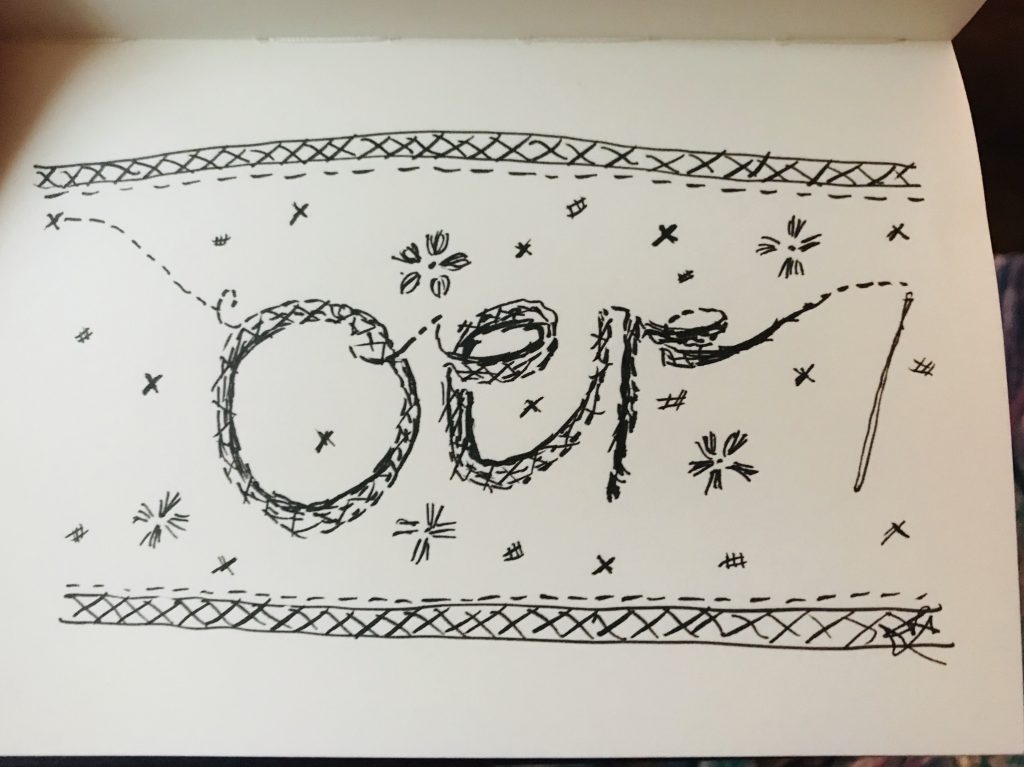
    I really enjoyed the process of printing, folding and making each envelope to send and in particular writing the feedback by hand. I hardly send or receive any personal letters and putting pen to actual paper made this feel special.

    Writing solely positive feedback, rather than including constructive criticism like I would for a performance review, felt liberating.

    I wasn’t sure what to say, at least initially. Or how much to write or what to focus on. But looking back at the original article that prompted me in this action, I tried to find something that I felt had made a big difference and why. Once I got started, there was a lot I wanted to say.

    Once I had written everyone’s feedback I put the envelopes in the post and I didn’t keep copies.

    You’ve got post!

    The following week I told my colleagues about the project, shared the blog post I’d written and everyone started to wait for their letters to arrive.

    As a distributed team we only rarely receive physical materials, mostly equipment or printed materials. My last letter from work was a tax certificate. Sending and receiving mail that we all knew would contain only good news made a difference.

    We send each other secret santa presents by post, and sometimes souvenirs from conferences or thank you presents, but it’s a rare occurrence to get those, so a special delivery like this is noteworthy.

    And it wasn’t just a single person, i.e. me, sending something to everyone one way. Instead, everyone sent a letter to everyone else (our team being small enough for that to be practical).

    You also never quite knew when a letter would be arriving and for remote workers post and parcel deliveries (mostly for other people) are a common feature of work days. But getting something just for yourself makes for a welcome change.

    Reflection

    Creating, distributing and receiving small moments of positive feedback was a very worthwhile exercise.

    Firstly, it made me focus on the positives more and once I did, there seem to be more of them!

    Secondly, it was useful to practice receiving positive feedback. It is true that it feels more powerful when not accompanied by negative feedback at the same time. Making space to absorb positive feedback meant that it stayed with me a lot more than it may have done otherwise.

    The reaction from colleagues to both the method and the focus of the exercise was also positive.

    A cpd task, which we as a team set every month, that focused not on learning new stuff or improving something, but on recognition for what is good, what we do well, proved a joyful experience and a relaxing one, too.

    As well as practising receiving positive feedback we all had the chance to articulate something positive to each other and that, too, felt worthwhile.

    P.S. Maybe it’s time for further thinking about postal projects for distributed teams… .
  • Positive feedback by post: on open practice and reflecting on your ‘best self’ in a virtual team

    I recently came across this article in the Harvard Business Review on how to use positive feedback for personal & professional development. The article points to a tool/service but in itself contains useful pointers and ideas explaining why positive feedback is important, how to give/receive it and reflecting on why this may be difficult:

    ‘Most people are well-attuned to critical feedback; it is jarring, threatening, and emotional, and as a result, quite memorable. In contrast, it is often easy to let positive reflections on our actions subtly slip us by. Lingering in the glow of praise can also feel uncomfortably immodest. It therefore takes practice to savour moments of positivity and to hold them in your memory.’

    In my experience that certainly rings true and I found the suggestions the authors make for practising helpful. They come up with five steps:

    • Noticing positive feedback, including creating a space where you can save it, like an email folder or pin board;
    • Asking questions, teasing out exactly what it is about what you did that made a positive impact;
    • Studying your success (personally I don’t like this phrase, but the idea is sound), reflecting on what you did and how/why you succeeded;
    • Practising enacting the most positive aspect of yourself, making space in your day to day work where you can see the positive impact you have on others, or on the organisation;
    • Share positive feedback with others, establishing giving and receiving positive feedback more firmly in your practice.

    One of the things that really stood out for me is the prompt to reflect on what I did well, what made a positive impact, rather than reflect in order to improve, focusing on what I could have done better or to gain a more critical perspective. I don’t think I habitually make time or space to focus exclusively on positive feedback although I receive quite a lot of it.

    That brings me to another point, which is how this sits within open practice. There are many upsides for me to being an Open Practitioner. It often brings with it a lot of valuable input from others, interesting ideas, suggestions for how to develop, sharing their perspective etc. But it doesn’t (for me) make for the most comfortable space in which to share praise or reflect on positive feedback. I can express a balanced perspective, i.e. including things that went well alongside things that could have gone better, but there’s always a sense of vulnerability when I write about a success because someone might well respond to point out flaws, mistakes or their own personal negative experience. In a leadership role especially it’s common to express positive achievements in such a way that there’s always room for contrasting views. And that doesn’t create the right kind of space for focusing on positive feedback alone.

    I’ve also come to realise that positive feedback means more to me when it’s given in private. Sometimes I receive heartfelt praise, sent to me personally rather than shared publicly and often the tone and content of feedback like is more meaningful for me. It matters that someone took the time to send positive feedback specifically, thought about it enough to feel the need to share it with me. I try and do this myself regularly and what I say and write to individuals personally differs from what I would say when praising them in public. Even within a small team, praising someone has meaning for all who are present, whilst personal positive feedback can be worded to be more relevant to the individual alone. It’s not an aspect of my practice that I feel can easily be translated into the open – but maybe that is something worth thinking about.

    Next: Positivity by post

    Given that I work in a virtual team, positive feedback generally comes in digital form. But I want to try and create something very tangible to test out some of the ideas I’ve discussed above and here is how: I’m going to send an envelope to each of my colleagues in the post, enclosing a piece of positive feedback from me to them, as well as three feedback slips from them to each of us and envelopes to send those to each other. That way, I hope, we will each receive some pieces of positive post over the next week or so. Positivity by post, if you like. I’ll report back on how it turns out.

  • OER19 preview post: openness in the fabric of things

    OER19 is nearly upon us and as part of the organising team the next two week will be really busy for me. I am really excited about the event this year and so while there’s still time, I want to share my thoughts in this preview post.

    I’ve also been reading Invisible Women by Caroline Criado Perez (it’s an excellent read) and one of the points I took away from the book was how women’s rights and gender equality more broadly are treated as a minority interest, something that is never at the top of the list of priorities for government or industry even though we have evidence that shows why it should be. Instead it’s treated as a ‘nice to have’. This is far more eloquently expressed in the book, but my own day to day experience reflects this attitude very clearly: every time I speak about the issue somewhere there are those who roll their eyes or those who nod along patiently waiting until the talk turns back to things that really interest them, things that really matter as if they’re thinking ‘who cares about the gender data gap when there’s an AI revolution to profit from’.

    Now, openness I find provokes a very similar response, and is equally demoted to the bottom of the list of things to do, because it also seems like a ‘nice to have’. To those who don’t know better openness is the domain of the dreamers, the prerogative of the privileged, a idealistic idea that doesn’t fit into the education industry of today other than as window dressing, as a veneer to enhance current business models.

    In both cases short-sightedness, self interest and lack of imagination present real barriers for meaningful progress – but that isn’t to say that there is none. Fortunately for all, those committed to driving forward the open agenda are succeeding in winning many arguments, changing policy, winning funding and developing viable business models all across the world. This year’s conference programme is filled with examples (https://oer19.oerconf.org/programme/) from a broad spectrum of practice, research and policy making. From institutional case studies and national reports to individuals collaborating on open projects the programme includes sessions that set out to tackle the difficult questions and dilemmas that will come to define the future of openness.

    Openness is many things to many people and the vision that the conference co-chairs have brought to the event has really inspired me and helped me reach a new understanding of the challenges we face by including more diverse voices and perspectives and also by ensuring that openness has been stitched into the fabric of OER19.

    In turn, that has inspired the work that ALT does to support this conference in the run up to the event such as tweaking our systems to encourage more sharing, the Board of Trustees funding more scholarship places for students than ever before, contributing to global events during Open Education Week led by the Open Education Special Interest Group, and post-OER19 to the Creative Commons Global Summit.

    Openness is a very practical core value for ALT as an organisation but it’s also become a more practical and fundamental aspect of my own thinking and practice in particular on open leadership and also contributing to the oer19 open space for femedtech has been inspiring.

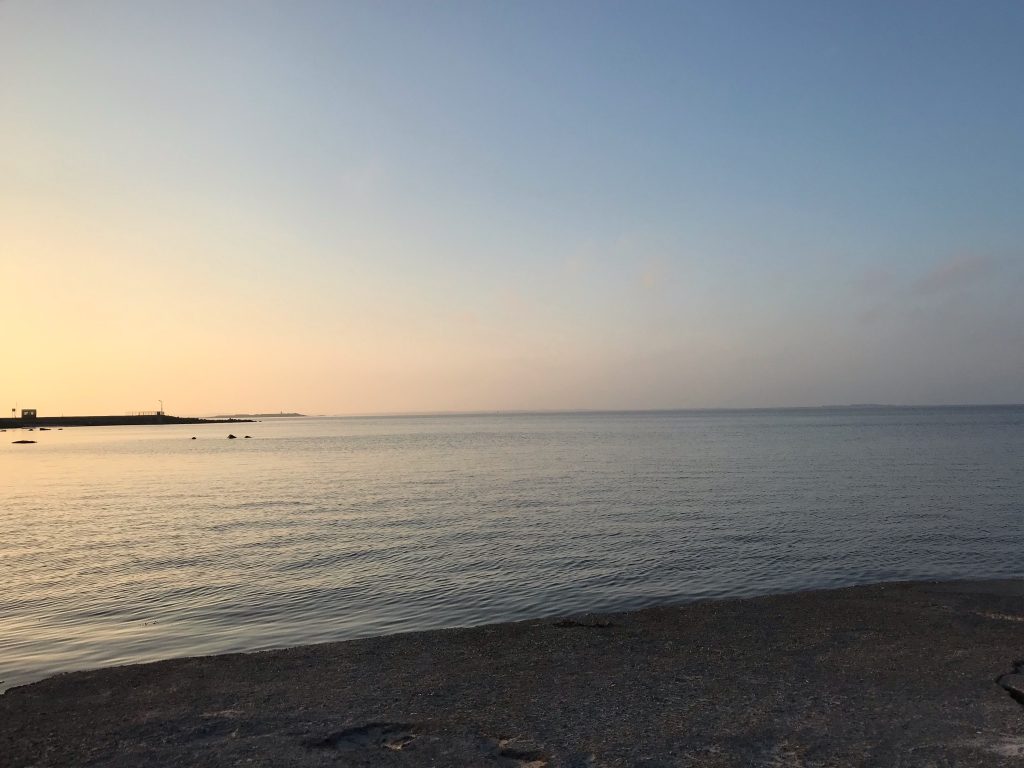
    Thanks to everyone involved, everyone who puts time and effort and resources into making OER19 happen, I feel like actually getting to go to the event in Galway is just the finishing flourish. OER19 has been a living, breathing, inspiring part of my professional practice for over a year already. But when I watched the sun rise over Galway Bay nearly a year ago, I didn’t realise how rich, how thought provoking and nourishing a journey working on this event would be. I’m grateful that I have been able to contribute, and I look forward to playing my part in making it happen and to build on what will be shared at OER19 to continue to promote openness and support those involved in the coming year, weaving a stronger thread of openness into the fabric of things.

    Galway Bay, May 2018
  • Who’s responsible for the future of open? #femedtech #oer19

    This post is for the inclusive Open Space session coming up at OER19 in April. You can read all about the session here. It is posted on the FEMEDTECH OER19 OPEN SPACE. Here is a link directly to the post.

    I have chosen to focus on the question: “How do we manage sustainable spaces for exploring challenging issues around open?” and my response has also been inspired by a recent blog post by Martin Weller on ‘Learning the rules of predicting the future‘. In the post, which deserves extra credits for inspired use of Parks and Recreation gifs (note to self: up your GIF game), Martin sets out the following “rules” for predicting the future for education (I am quoting only very briefly here, so you should really read the whole post, as it makes for excellent reading):

    • The first rule to learn about change in higher education is that very little changes, while simultaneously everything changes.
    • A second rule is that technological change is rarely about the technology.
    • The third rule is to appreciate the historical amnesia in much of educational technology.
    • The fourth, and final rule I would suggest is that technology is not ethically or politically neutral.

    And that has inspired me to think about rules for making sustainable spaces, which links to the broader question of who takes responsibility and how to take responsibility for the future of open spaces of all shapes and sizes. It also relates to the question of permanency on the web and in technologically mediated social spaces in general (I have written about Cemeteries of the web: parallels between Victorian burial culture and digital infrastructure previously). So here goes:

    First, I would argue that in most cases planning for the long term, for sustainability in any sense, does not come into the development of new spaces, platforms or tools. So many sites and systems come and go, disappearing often with all the content we have created and without much notice or help for migration. Interoperability standards, transferable file formats and all that goes with it are rarely at the top of anyone’s priority list whilst iterative, agile approaches to development force users to move along regardless. When funding dries up or business models change repositories, community sites, communication platforms etc become unsupported, derelict collections of broken links and unanswered support requests. This is not only inconvenient, but has serious consequences: it makes it difficult to have a sustained critical debate as we constantly loose records of what we have already done; it puts the focus always on reinventing, re-establishing, re-designing new spaces and it promotes the kind of historical amnesia in much of educational technology that Martin Weller warns us about.

    Sustainable spaces for exploring the challenging issues around open also require us to address the question of who has ownership of those spaces, both in a practical sense, i.e. who owns the domain, who controls access, who pays the bills, as well as the social aspects such as who controls the conversation, who records it, who can participate and who ends it. Some of the hardest questions we must ask have strong political and ethical dimensions. If the organisation or entity that hosts or supports such a dialogue has a strong agenda, be that commercial, political or social, then we need to question how that impacts on the kind of discourse we can foster and also how this may impact on the sustainability of the project. Open means many things to many people and there is a whole range of motivations to get involved and try take ownership of spaces that support open communities.

    One of the things that’s really tricky about both open in education and technology in education is what Martin Weller describes as ‘very little changes, while simultaneously everything changes’. I find that is often to do with our goalposts constantly moving further ahead and at the same time the spectrum of individual and organisational practice spreading out. What I mean is that the range of challenges we ask technology to help us meet is huge – from basic infrastructure to educating millions across the globe. Similarly, when it comes to thinking about open, there is a vast array of situations to tackle. It all depends on the perspective you start from and it can be difficult to find common ground in a conversation that brings together many different contexts – this is exactly the reason why an open space like this one can help.

    I don’t seem to have come up with very clearly articulated rules, but rather characteristics and questions around the lack of long term planning, questioning ownership and motivation and the need to appreciate different perspectives from which what we find challenging about open can be explored. One very generic sounding conclusion to draw is that the only rule is to make use of your voice, to continue to engage and question, not to become indifferent or disengaged no matter how difficult that can seem at times. But it is, for me, a powerful reminder that we each have agency, and that taking part, contributing something that helps others understand our way of seeing the world, our perspective on open, our world view (as a women, as a feminist, as a contributor in my case) is a meaningful and important act.

  • A day in the life of a #femedtech guest curator

    It’s my second time to volunteer as a guest curator for the @femedtech Twitter account and in the past year, since my last time as a curator, much has changed.

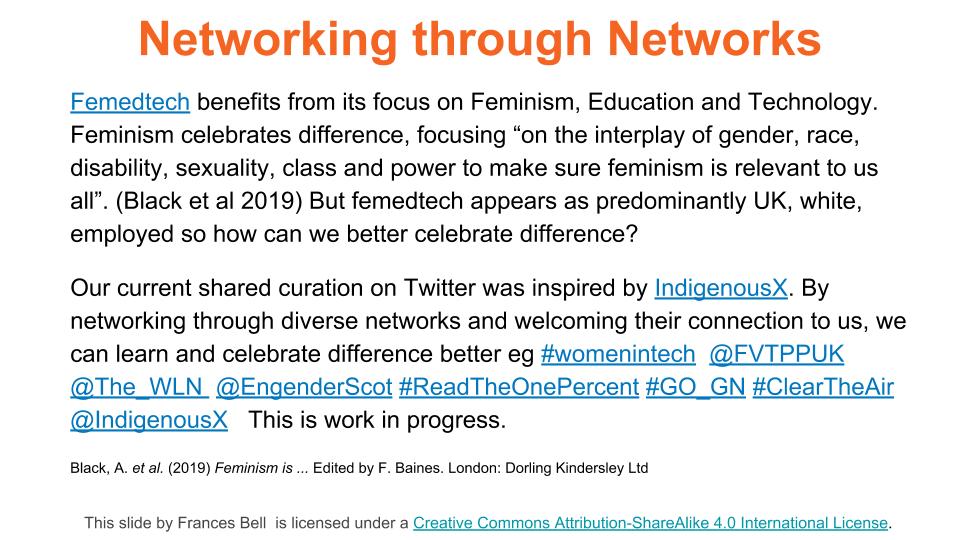
    In 2018, I followed Helen Beetham, being only the second person to try out how to be a guest curator. At the time, the account had 122 followers, had tweeted about the same number of tweets and we were just in the process of writing some guidance for the activity, making it up as we went along and learning from the wonderful examples of networks around us. Frances Bell contributed the slide below to the community-sourced slides for International Women’s Day 2019.

    So what is it like to be a guest curator now, that the following is ten times bigger and the network is growing rapidly, organising activities around events and interests?

    I start each day by checking in with the account, checking first on the notifications and new followers. Following back those who are new and welcoming them is one of the key things I try to do each day. It’s fascinating to see who follows the account and often I come across individuals and accounts I also want to connect with in my personal capacity.

    Then I look for new tweets that have been tagged with the hashtag #femedtech and like or retweet those. This can open up quite a few new rabbit holes down which my time disappears as I find a new book, artist or research that I want to learn more about. In contract to my own Twitter world, there is a much more varied and unexpected range of things being posted. Here are some examples from recent days:

    You can see, there is a really varied range of things being posted, so I strongly recommend you follow the account yourself and join in.

    Then, each day, I try and find and contribute something new, something from my own network or frame of reference, and which I can share to enrich the conversation or open it up to include new accounts. So this week I posted:

    And I also work to communicate from what the network does in my day job, for example this week I had the opportunity to speak at the 13th Research and Innovation in Distance Education, and eLearning (RIDE) annual conference  and I included a section on promoting equality in my talk, specifically focused on new analysis my colleague Martin Hawksey did of ALT’s Annual Survey focused on comparing gender perspectives, and his related post makes for interesting reading.

    Being a guest curator for the #femedtech network really opens up new perspectives for me, it helps me get into the mindset of being a volunteer (and my day job relies heavily on the goodwill of volunteers, so that is particularly helpful for me) and it’s a powerful reminder that whilst we are making a lot of progress, there is always so much more to do to create a more equal and equitable society.

    And on that note I’d like to mention a last opportunity to make your voice heard, to join in the conversation, which is a new open space for femedtech created in the run up to the OER19 conference. You can read all about it here and consider the following questions:

    • How do we balance privacy, openness and personal ethics?
    • How do we mediate our place in the open community, aspects of which might conflict with our personal ethics?
    • Is openness an act of conformance and / or defiance? And are there performative aspects to openness?
    • Do we feel pressured to be more open than we are comfortable with, or do our boundaries constrain us?
    • How do we manage sustainable spaces for exploring challenging issues around open?
  • Virtual Team outtakes: tools, superstructures and keep asking ‘why’?!

    I really appreciate following the work of Alice Keeler (@alicekeeler) on Twitter. I learn something new from her every week and find the tips and ideas being shared extremely accessible and easy to use. So when I saw this tweet recenlyt, proclaiming “I WANT my tech tools to become OBSOLETE” I sat back and paused – because I was just in the process of spending a few hours making one of the tools I use at work obsolete and it felt like a good point to remind myself why that is a good thing.

    When we wrote about cpd and digital well being for our series on leading virtual teams, Martin Hawksey and I talked about how important it is to revisit our relationship with technology as personal habits change and professional practice develops. And I mentioned some of the more frustrating aspects of constant iteration, of ‘agile’ approaches to developing software and hardware. What we didn’t get around to talking about is what Alice’s post picks up on, the opportunity to start from scratch, with a blank slate, to improve, to re-imagine – rather than to simply edit or update. Alice’s post reminded me that it’s sometimes good when platforms or tools change because we are then forced to take a fresh look at what we are doing and why. But some processes that I work on are so fundamental, so much part of the fabric of my working world, that there’s rarely an external prompt to start from scratch.

    The structures that shape workflows, processes, thinking… usually they are either complex and technologically challenging, in which case I need others to actually do the re-imagining with and for me, or they are very simple and tend to disappear into the foundation. This second category is rarely rocked by obsolescence. As tools go, spreadsheets and documents, in one form or another, don’t often change dramatically enough to really make you take a fresh look at things. So this time I am going to not focus on the ‘how’ but the ‘why’. What do I need this to do? Why is it being produced? Why is it being read? Why is it important to know? Or is it?

    It’s a good thing to do, to take a fresh look at something and consider how it could do better. How it could be more efficient. Or more engaging. More transparent. More impactful. How it could be cheaper or more expensive. How it could be more fun, more enjoyable, more rewarding. And whether you need it in the first place. Does it still serve a purpose?

    I am not a great fan of doing things because they have been done before. Or of doing things in a certain way simply because that’s how it was done before. That’s not a good enough reason. I always want to know why. Why, why, WHY???

    There are some problems with this approach: you don’t have the comfort of accepting things as they are (and that is not to be underestimated), you can waste time and effort on something that is not worth it, you need to make sure you don’t change things for the sake of it and it’s a lot more work to constantly trying to improve everything than to simply repeat it.

    There are much bigger upsides (for me): it’s not boring. You develop judgement. You can achieve more (I think). It’s fun learning new things all the time. You get to re-invent the structures that determine the shape of your work.

    When I was a research student, I worked part-time in my department’s archive. A small collection of materials that students could borrow from a room filled with book cases and filing cabinets. I worked there for two years and left a new cataloguing system, the first complete catalogue, a new lending process and loans up by 100% when I left. A few hours a week sitting in a small, boring office where activity was not at all incentivised presented an opportunity for me to reinvent things from the ground up. Given time, space and a particular problem, I had enough freedom to… make things change. It never occurred to me to ask for permission.

    And that’s why I liked that post from Alice and her thinking about changes in tools and platforms as opportunities to ask ‘why’? Any catalyst that get’s us to ask that question, to reflect on our work and our aims and the underlying systems, the assumptions is to be welcomed. Not ‘just’ for teachers, but for each of us.

    If you have missed it, go back and read the most recent post on leading a virtual team.