Category: Mentoring

  • Rookie (or a year of mentoring)

    Rookie (or a year of mentoring)

    For the past few years I have volunteered as a mentor for the 1 Million Mentors programme, a national initiative that provides free career focused mentoring for 16-25 year olds. This week another year of mentoring comes to an end, and so I want to reflect on how it went and what I take away from the experience.

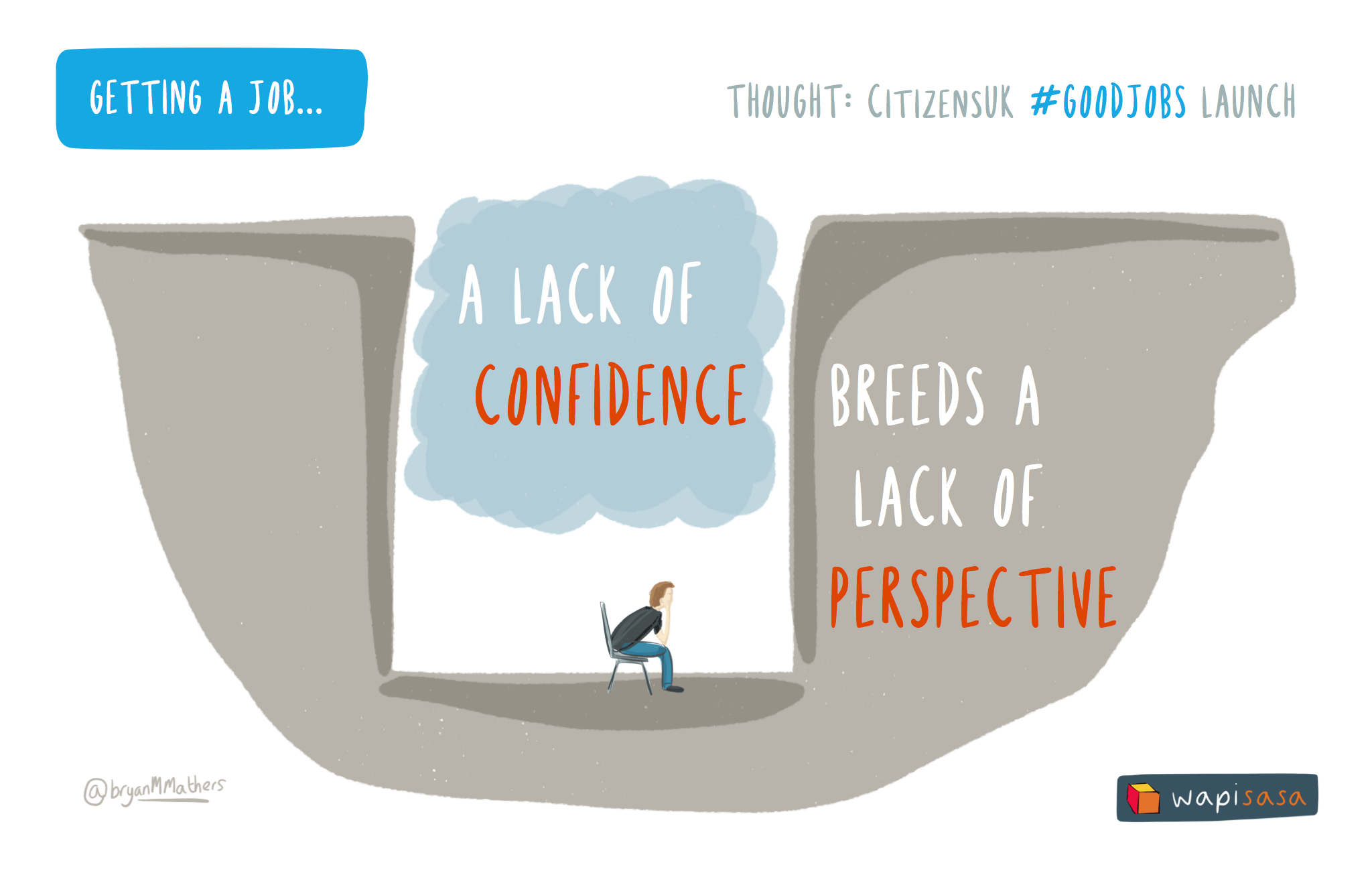
    Confidence and Perspective, the image featuring in this post created by Bryan Mathers / Visual Thinkery, relates very well to how I felt as a mentor and at times when putting myself in the shoes of my mentee.

    Rookie year

    This was my first time mentoring a final year undergraduate. As my previous experience as a volunteer mentor was with mentees looking to move into post-16 education or training and my professional coaching clients are mostly in employment already, you might call it a ‘Rookie’ year for me. It was all about finding my way in the very fast moving, competitive undergraduate recruitment market.

    That is my first take away from this year: it was a new challenge that kept me on my toes, and that is always a good thing.

    AI and recruitment

    Both in my work with clients and in my own experience I have come up against how far and how deeply AI-powered tools and platforms are changing recruitment. However, I found the practices we encountered through our mentoring work even more stark and opaque. Entry-level, science-based jobs lend themselves well, it seems, to automation, and that can make the process of applying for opportunities difficult and disheartening (at all stages of one’s career, but especially, I would say, at the beginning).

    That brings me to my next take-away: authenticity is key to making any part of the recruitment process meaningful. Any practice that doesn’t allow for that deters good candidates.

    Connecting in safety

    Much of my work happens on the open web and I am an advocate for open practices, including open leadership practice. That said, this year’s mentoring experience really made me question how well we are doing in Higher Education to help students gain not only skills but also the confidence to connect in a way that feels safe to them.

    Kudos to the mentoring programme, which provides excellent training on safeguarding and sharing information. But beyond the confines of institutional provision, the open web, especially social media platforms like LinkedIn, soon became problematic or felt unsafe.

    My take away here is that there is a palpable pressure to optimise yourself and your online identity which is in conflict with the aforementioned desire for authenticity and finding meaningful work connections and opportunities.

    Students welcome, but…

    One of the sessions that made me reflect the most was a day when we looked at professional bodies and industry organisations that were explicitly trying to welcome students and recent graduates.

    As soon as we dug a little deeper, the friendly welcome turned into incomprehensible next steps. There was little to go on for a student looking to learn more about a specific career path or connect with professionals in their chosen field.

    Having worked in this space for much of my career I was disappointed to see just how hard to navigate this was – and just how much confidence was needed to take that first step into a new profession.

    This resonates closely with my coaching work, in which building confidence is a theme for both emerging and established leaders – particularly when connecting or collaborating online.

    Home and work

    Lastly, and this made me reflect a lot on how to build confidence and find perspective, is the role of home study and home working in all this. In my research for my new book I’ve come across data that indicates strong disparities between how established and new employees experience virtual work, and this affects early career workers still more.

    Food for thought for me and my research, and a highly complex challenge for leaders and their institutions.

    Thank you!

    I am deeply grateful to my mentee and to the programme for a highly rewarding experience, and I am already looking forward to volunteering again next year.

  • Mentoring and Coaching Podcasthon Special

    Mentoring and Coaching Podcasthon Special

    This is the first year I am taking part in Podcasthon, the biggest charity event in the podcasting world! There’s no money involved—it’s all about raising awareness for various charitable causes and for my podcast, Leading Virtual Teams, I’ll be dedicating this week’s episode to support a charity and a cause that truly matters to me – mentoring emerging leaders with One Million Mentors.

    Podcast Charity Logo

    Out Friday, 20 March!

    Listen to the PodCasthon Charity Special from 20 March 2026. The podcast is available on different podcast platforms and I hope you enjoy the show.

    As always, share your ideas and feedback in the comments, or on social media. If you have a specific questions or comment, contact me . I look forward to hearing from you.

    Learn more about my chosen charity: 1MM (One Million Mentors)

    1MM mentoring empowers young people to become the best version of themselves: building relationships – free of assumption and judgement – where they benefit from another’s experience and perspective and can think bigger, find their own answers and take the next meaningful step into their future.

    I trained as a mentor with 1MM a few years ago and in the episode I share my experience and what made volunteering as a 1MM Mentor so rewarding 🙂

  • Changing habits with a Pie Chart Diary

    Recently I have been working with a number of clients who are finding hybrid working habits hard to change. Busy days blend into each other, and at the end of a week or even a month, routine tasks like answering emails or attending meetings have taken up all the time and other priorities or more creative work have had to take a back seat.

    I have struggled with this for years. Changing habits to make more time for writing, research or simply finding a moment to hear yourself think can be a challenge. Particularly when your working days are punctuated by the ping of notifications, endless emails or mandatory meetings, finding what some call the right cadence, a balance between busy work and creative tasks merits our attention.

    Setting abstract targets like “make more time for…” or “be more research-focused” can feel unachievable. So where do you start? One place to start is to get a new perspective on how you spend your time, so that you can pick a good moment to change your habits.

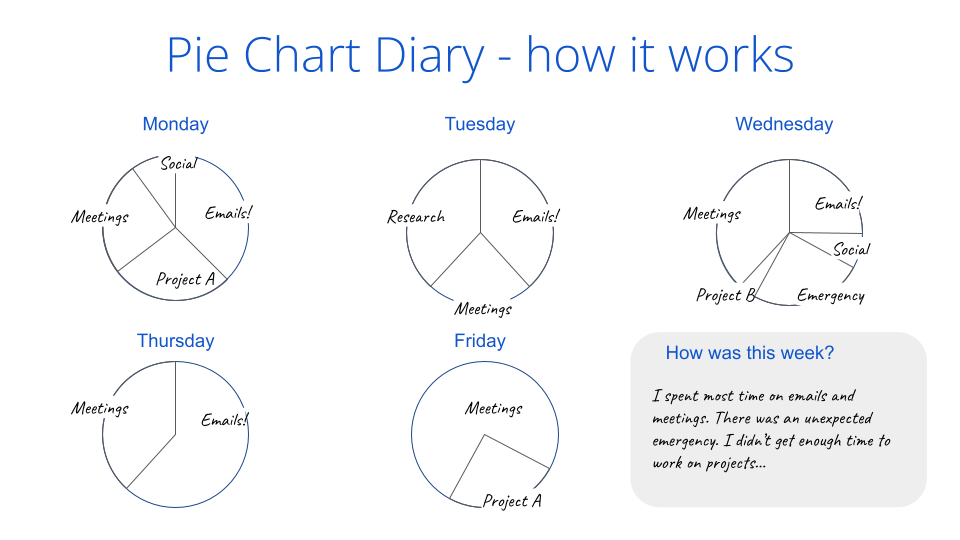
    For me, a bit of a spreadsheet nerd, I decided to track my time manually. I spend 2-3 minutes at the end of each day making a pie chart of what I had done that day. I continued to do this every day, always just before leaving my desk, and over the period of a month or two, I learnt some things about how I work:

    • I found that Tuesday, for example, were days when I never achieved my goals because they are dominated by meetings.
    • Wednesday mornings and Friday mornings were most productive for me.
    • I generally found time for things once I had a firm deadline.

    Here is an example of the Pie Chart Diary tool and how it can be used:

    Use it over a period of a few weeks or months, and reflect on:

    What do you spend most/least time on?
    What days of the week are you more likely to you achieve your goals?
    What is missing from your days?
    What could you change most easily to find better balance
    or to meet your goals?

    You can download this template if you’d like to try it out for yourself. Depending on your preference, you may want to print the template and write on it or simply use a blank piece of paper to make your charts. Or, if you prefer, use a spreadsheet or similar to track your categories and how you spend your time.

    The important part is to take a moment at the end of each day, and honestly reflect on what you actually did during the day. If there is something that takes up time, distracts you or interrupts you, consider adding it to your chart.

    When my dog was a puppy, my pie chart diary would have definitely included a “puppy” category as it took a lot of time out of my day to look after her.

    Look out for a podcast episode exploring the pie chart diary. As always, I’m curious to hear from you, what tools you use to track your days and what you learn along the way.

  • Mentoring unpacked III: mentoring through tough times and sharing our reflections

    This is the third and final part in this series on mentoring. This time, Margaret and I focus on our experience of mentoring through tough times and also reflect on what we have learnt working together over the past six years and how this has changed our professional practice.

    If you have missed our earlier posts, go back to:

    The last six years have had many ups and downs. Margaret has been a constant presence in my life and together we have worked through many personal and professional crisis, anything from when I had to take on the responsibility of being a carer for my mother, who has cancer, to problems at work that encompassed everything from finance and governance to management and staffing, the sad passing away of a serving President of the organisation and major restructuring. Being a CEO can feel like every month brings with it a new insurmountable problem, a steep learning curve or frustration.

    It’s important, I feel, to acknowledge that there have been tough times and explain how mentoring has helped me through them. For example, when I was new in my role and had very little support or sense of what kind of support I would need or want, having a trusted mentor at my side could feel like a lifeline. Or times when we worked to identify specific issues and worked out how to address them. Making changes was successful at times, but painful, too, when things went wrong. I worked hard to grow my own network and become more resilient. Some things that used to be difficult have become easier as I’ve gained experience and I have learnt how to manage them without Margaret’s support. But even once I needed less practical support day to day, having a mentor continued to be important: it helped me face difficult questions and to be honest with myself. It instilled in me a reflective approach that prompts me to put the good of the organisation before all else, even when it’s hard to do. It seems like an obvious point to make, but I find it helpful as a guiding principle that I keep coming back to.

    Margaret adds:

    A key issue now is to make sure that Maren or the organisation isn’t just coasting along or that Maren isn’t getting bored. She is someone who thrives on challenge but appreciates that organisations need periods of consolidation. What is the next step for ALT, what is the next step for her and are they the same or different? Difficult questions but ones we need to come back to again and again.

    Over the years, we’ve had so many conversations that I don’t even need to speak with Margaret at times as it’s enough to write and reflect on a situation and I know what she would say or ask me to think about. It’s a bit like the voice of a driving instructor in your head, reminding you to check your blind spots. I maintain a private blog, which has grown to hundreds of entries charting my professional life and that writing forms a cornerstone of my reflective practice. Margaret has helped me devise other strategies, too, to cope with problems and become more resilient – giving me the tools to navigate difficult days.

    Yet, even with practical tools and the support of a mentor, there are always some things I am not prepared for, like when a journalist asked me in an interview about education policy why I don’t have children.
    Or when I didn’t get to speak in a meeting as the Minister leading it didn’t know my name.
    Or when someone burst into tears in response to something I said.
    Or when I had to speak at a funeral in my professional capacity.
    Often, it turned out to be quite a mix of personal and professional factors that made some situations unexpectedly difficult.

    From working with Margaret I learnt how important it is to build trust and be able to share the highs and lows of working life with someone – but in a leadership position that can be difficult. Many things are too confidential or too personal or simply too raw to talk about with most people

    Margaret adds her perspective, reflecting on a particularly tough conversation:

    Probably the most difficult mentoring session we had was when Maren was dealing with a very difficult issue and felt very pissed off with her job. Maren was angry with the situation and the lack of support she was getting at the time. The issue was taking up all her time and energy and stopping her moving the organisation forward as she had planned. It was the only time, I ever saw Maren wanting to give it all up!

    This all came up in a phone conversation which was very tricky to handle. More than anything Maren needed a hug but I was 150 miles away. I was really not sure what to do to help. But I can remember feeling that bad myself and looking back I realised that these difficult situations do come to an end. You just have to stick in there as a CEO and realise there is light at the end of the tunnel even with the most difficult people or problems.

    So I gave Maren reassurance that her feelings were valid, that she could and would get through the issue and things would get back to normal. I remember walking round and round my sitting room while on the phone, listening and reassuring. And it worked! I was very relieved. Maren went away and sorted the problem brilliantly so she could take forward her plans for ALT.

    Even reading this now, years later, I recall that moment, that phone call, as clearly as Margaret does. And yes, a hug would have been good.

    But, more importantly, I learnt a lot from getting through that particularly tough spot: I learnt to trust that eventually things do go back to normal, that I am able to get through it and that I was glad indeed that I chose to stick with it.

    Reflections

    Having a mentor and working with Margaret has been a formative experience for me. Similarly, Margaret’s approach to being mentor has been informed by our work together. Over time our relationship has changed as our practice has developed.

    Margaret reflects:

    Is a Mentor a critical friend?

    I have heard people say that a mentor is a critical friend but I don’t agree in our case. Maren is more than critical enough in her practice and as a CEO has lots of criticism to deal with.  I think I am definitely a friend but not critical at all. Supportive, non judgemental and maybe inquisitive are better words. I am less involved in the day to day so can help Maren step back and see the bigger picture or encourage her to be really creative in finding solutions but my role is not to criticise.

    In addition, here are some reflections I want to share:

    Being a chief executive is a privilege. No matter how difficult things may be at times, working with Margaret has made me realise again and again that it is a huge privilege to serve my organisation as chief executive. I love what I do and an inspiring mentor who has kept challenging me has helped me do my best for the organisation.

    Most of the time, I already know the answer. Often Margaret has made me see things in a new way, and has made me realise that I already know what to do to solve a problem but maybe I haven’t realised it or hadn’t wanted to face it or was afraid to do it.

    I choose my own path. Margaret has helped me gain confidence in my own judgement, in my values and myself. Being a chief executive is a lonely path and you need to be able to rely on your own instincts. That’s not to say that listening to or learning from others is not essential, of course it is. But realising my own potential is something I have to do in my own way. It always comes back to asking myself what kind of chief executive I want to be. I choose my own path.

    I’m a human being. Be kind to yourself, give yourself a break, reflect on how you feel, look after yourself… I am not very good at those things. A combination of high expectations, a strong work ethic and a love for my work can result in a sincere lack of empathy for myself. Margaret has reminded me again and again to do all those good things that help restore balance, perspective and calm. Over time, I’ve become better at taking into account that I’m a human being with feelings and needs and moods and to afford those around me the same consideration. It still surprises me how much of a difference it makes.

    And for all these things as well as everything I haven’t mentioned I am extremely grateful. Thank you, Margaret.

    We have written these three posts with the aim to reflect on and share our experiences of working together for the past six years. We have unpacked our mentoring relationship so that you can explore our perspectives and use our insights to inform your own approach to finding, working with or indeed being a mentor.

    As you can tell from the narrative we have created, we have enjoyed facing the highs and lows together and we are fortunate to have had much laughter along the way.

    Maren and Margaret, November 2016 Image credit: Sarah Caroline Photography

  • Mentoring unpacked II: A ‘blended’ approach to mentoring

    Welcome to the second part of the story, for which my mentor Margaret Bennett and I have collaborated to share our insights into what it’s like to work together as mentor and mentee. Looking back at six years of working together, here we share our insights into the process. We have already recounted how we first met and got started and also discussed the benefits of having a mentor in the first part of the story. Next time, in the third and final instalment we’ll be looking at mentoring when things are tough and reflecting on what we’ve learnt.

    Maren and Margaret in conversation, November 2016 Image credit: Sarah Caroline Photography

    This post is about how we found an effective ‘blended’ approach to mentoring, how we have worked together using technology to bridge big distances, creating safe situations to work together on some of the biggest challenges and achievements over the past six years.

    One of the defining characteristic of the mentoring approach we have developed is that we are not located close to each other. We live hours apart and with busy jobs and limited funds there was never an option to meet up in person frequently. Most of our communication is via email and phone calls, and we use online collaboration tools or shared documents if we need to work on something specific together. Meeting in person has been more or less frequent depending on circumstance and also the kinds of things we were focusing on. As I was already used to working remotely with colleagues and had previously had a Line Manager also working remotely, this was in some way not a big adjustment to make, but there are specific characteristics of the way in which Margaret and I work together that made a real difference to me:

    In the early days in particular my mentoring needs could feel very urgent at times: in those instances email or phone were often the most immediate way to get help or support when a crisis arose. The responsiveness that a call afforded was much more important to me than the personal presence meeting Margaret in person could have provided. It gave me more confidence to know that help was at hand should I need it and it helped us build trust more quickly.

    At the same time, things were always very busy and I rarely had the opportunity to step back from my day to day responsibilities. Thus, I came to value having the chance to have a few hours to think and to spend time with Margaret more highly. I prepared for or thought about what I wanted to talk about – sometimes leaving really hard conversations or more strategic, abstract thinking for those occasions whilst dealing with more practical matters remotely. Leading an organisation the way I like to work, in a very collegiate manner, takes a lot of thinking and time with Margaret constituted valuable pockets of inspiration.

    Working with a mentor also gave me a chance to see what it takes to make a blended working relationship work from a new perspective and that helped me become a better line manager for my distributed staff team in later years. It was good practice for building trust and establishing a rapport using a blended approach. Some of this thinking still informs the work my colleague Martin Hawksey and I are doing on open approaches to leading a virtual team.

    I wonder, Margaret, how typical it is in your experience to take this approach and how well it works from your perspective?

    Until I worked with you all my mentoring had been face to face and so it was new to me. But as we had so quickly developed a good rapport together it became very easy to talk on the phone or via email or Google docs.

    I think there is a big difference though in the type of discussions we have.

    When we talk on the phone there is always an immediate practical issue that we need to work on. So our phone calls are very practical and solution focused. And while they involve a lot of moral support to they are very focused.

    When we use email or Google docs, we are at our most practical: I may comment on a document, article or letter or may be sharing a risk register template or business plan structure that might work for Maren.

    Sometimes we just send very short messages to each other – messages of support or congratulations, celebrating success or commiserating when things don’t quite work out.

    And I think the blended approach has really helped that as by using phone calls and emails to deal with current, more practical issues, we have been able to focus our face to face time on the big picture.

    So that is how our work together took shape after the first meeting we described in the earlier part of the story. We put a lot of effort into building a working relationship that fit the organisation as well as each other. We adjusted the balance of working together in person or remotely depending on circumstances over time.

    When I look back at the last six years, I divide my experience of mentoring into what we worked on in pivotal moments when things were going well and how we dealt with things going wrong.

    For example, ahead of the biggest changes I’ve led or milestones the organisation has reached, Margaret and I spent sessions on strategy and vision, on planning for the future and on preparing for change. That element of our work I’ve come to value a lot: Margaret got me thinking ahead, planning for the long term.

    Most of the people in my working life are necessarily focused on the task at hand or the current year. But doing too much myself that’s concentrated on the here and now made me less effective in my role, less able to make a plan for what’s ahead and steer in the right direction.

    There’s a degree of that strategic thinking I would do with colleagues or Trustees or horizon scanning with external input, but having a mentor really prompted me to make time to think about and nurture my own vision. And at the rate things were achieved it was constantly important to do that afresh. To be more ambitious, to challenge myself rather than to rest on whatever was achieved.

    Margaret describes it here:

    When we meet face to face we usually have the time and the headspace to take a step back, looking further into the future and explore long term objectives. We usually spend about three hours together and that is hugely valuable. We have the time to tease out where Maren wants to be in five years time or what difference ALT should be making on the world!

    We’ve always had long term goals that we come back to over many seasons and it is so great that Maren has achieved those over the six years we have worked together

    To me, in whatever manner we work together, mentoring acted as a catalyst at pivotal moments.

    Another important part of our work that shaped how I work and lead has been to figure out how to be myself in my role. It’s not always been about what to achieve, but also how. So for example we talked about what kind of professional image I wanted to have, what I wanted to look like, what would be acceptable to wear in certain situations and how to have fun with it! I bought a very serious, dark blue suit when I went for my job interview and during the first year or so I often found myself in situations where wearing the most formal outfits I owned felt like the only acceptable option. That’s changed over time, as my own ideas about being a leader have changed.

    Margaret adds:

    I think the best leaders are those that are truly authentic. When people are new to the leadership role they may feel they need to copy someone else, or follow in the footsteps of their predecessor etc. And people don’t always realise that this needs to be thought about and proactively managed. It’s a kind of brand management but the ‘brand” has to be genuine too if a leader is going to inspire trust.

    There is also something about being confident in yourself, what you believe in and how you do things rather than trying to be someone else. So when Maren and I have talked about chief executive shoes that hasn’t just been a distraction from her leadership role but about building confidence in who she is and how her image can support that. And a great pair of comfortable shoes can really boost your morale!

    That’s a good point to pause our story and draw this post to a close. In the next  and final post we will be looking at how we worked together through some of the toughest times and what we learnt in the process.

  • Mentoring unpacked I: How it all began…

    Maren and Margaret in conversation, November 2016 Image credit: Sarah Caroline Photography

    Ever since I started working in a leadership role in Learning Technology I have had a mentor. My mentor, Margaret Bennett, has been a big influence on my practice for the past six years and I have come to value the relationship we’ve built and the work we have done together very highly.

    As part of my commitment to an open approach to leadership, I’ve asked Margaret to collaborate with me on this three part series to share our insights into being a mentor and what it’s like to have one.

    We’ve divided our story into three parts:

    There are a few reasons why we want to unpack our experience and share it more widely: for us it is a useful way to reflect on the work we have done and a way to better understand each other’s perspectives; and we also hope these posts will provide inspiration for your own mentoring journeys whatever shape or form they make take.

    A note on what we haven’t written about: Many aspects of mentoring, particularly in a leadership position, are around sensitive issues – both personal and professional. We have tried to find a balance between sharing insights that illustrate our experience, including the ups and downs we have worked through, and avoiding sharing details which are confidential or too personal.

    Now that you know what to expect, and you are still reading, let’s go back to the very beginning, the start of our story.

    How it all began… meeting each other for the first time

    Margaret and I started working together in 2012 and as I had never had any formal mentoring before that, I was not entirely convinced that I needed or wanted a mentor when we first met.

    Indeed, I was about to start a new and exciting job at the end of a gruelling recruitment process that had taken months and included extensive psychometric testing, practical skills exercises, presentation and interview, so I wasn’t sure whether the suggestion to have a mentor didn’t reflect a lack of confidence in my ability to succeed.

    In addition, I had practical concerns, such as how we would build trust, how often we would meet or talk, what kinds of things we would discuss and to what extend I would really get something out of it. In short, I was highly doubtful whether a mentor would really be on my side and whether I had time to invest in something I didn’t see the value of when there was so much to be getting on with.

    Despite these doubts I knew that I had a big challenge ahead and that I wouldn’t be very effective in my role if I didn’t listen to advice or make use of help when it was offered. So I decided to at least give mentoring a go, to at least go to the first meeting. I was also curious to meet the person whom my predecessor had recommended. That, actually, made me more doubtful about working with Margaret initially, because I felt impatient to stand on my own two feet, but the recommendation turned out to be excellent and six years later, I am still extremely grateful for what led to establishing one of the most important relationships in my life.

    Back to late February 2012, when after an initial email exchange I was on my way to meet Margaret for the first time. I can recall that early morning train journey from Oxford to Sheffield very clearly. I was nervous and apprehensive, trying to decide what I would say or do if things went well and if they didn’t work out. I had nothing except a brief email exchange to go on, so I had no idea what to expect.

    That’s what it was like when we first started working together from my perspective. Margaret, thinking back to that first meeting and how we got started, how did you prepare for that? What stands out from your perspective?

    When I first met you, Maren, I did not know anything about you but I knew I could give practical help as well as hoping to provide emotional support. Having run some small and larger charities I have lots of practical tools and templates that I can share with Maren. Not having to reinvent the wheel and finding out how other people do things can save Maren a lot of time and energy. It isn’t essential but it meant our relationship had some quick wins.

    I’d been a chief executive of a charity so knew how lonely it could be with a voluntary chair as my line manager and where I could only share so much with the staff I managed. I knew how valuable having a safe space where I could admit doubt, anger or pain could be so I wanted to provide that for Maren. And a place to celebrate and laugh without being judged.

    I’d had an excellent mentor when I’d been a chief executive and later a very helpful coach when things had been very hard. I knew what good looked like for me so had an idea of what it could be for Maren too.

    So that was how things started with a meeting in the Winter Gardens in Sheffield over a few cups of tea that turned quickly into a couple of hours of intense conversation. Until that meeting I had no idea how much I had to say, share and reflect on – but talking to Margaret it quickly became apparent that there was a lot to discuss.

    How we made it work… and some of the benefits of having a mentor (in a small organisation)

    Once we got started, it quickly became clear how many benefits having a mentor can have, particularly if you work in a small organisation. Some of these were obvious from the start, but others only became apparent over time. To some extend the benefits of having a mentor will depend on the individuals involved and the relationship you can build, but many positive aspects are more generally applicable.

    From my perspective, working in a small organisation in which I was the only or later one of two senior staff, gives me limited scope for dialogue with or support from someone who is not either reporting to me or someone I report to. Particularly in volunteer-led organisations, small charities or membership bodies, it’s often difficult to provide effective support for senior staff like me.

    Working with Margaret had the advantage of me being able to share ideas or concerns without the constraints of another (reporting) relationship. As an external person to work with, Margaret prompted me to step back from day to day work and look at things from a different perspective – to get out of the mindset within the organisation.

    Another benefit of having a mentor when you lead a small team or organisation is that it can be difficult to advocate for yourself at times and having a more independent, external voice when negotiating for yourself can be really helpful and also provide support for your Board or colleagues. Carrying out the annual appraisal process and collecting 360 degree feedback is an example of when having a mentor proved extremely useful.

    Over time and through the annual appraisal process and more strategic work, we identified a number of areas in which permanent support was needed, HR for example, and put that into place. Other areas that we worked on together resolved themselves and didn’t require permanent action or support. In that manner, mentoring helped shape my role and the support required for it for the benefit of the organisation and in a manner that would not have been possible with only input from other staff or the Board.

    As well as the practical advice and support that mentoring provided for me, the sense that the organisation I work for is prepared to invest resource into a mentor for me has also made me feel valued and better supported and that has made a big difference, in particular during difficult periods.

    Margaret, what do think made a difference for us, what helped us make it work?

    Having the same values is really important – valuing staff, empowering people, making a difference,  exploring new ideas, having fun and being creative.
    We are both quite similar characters (same Myers Briggs, I think) but that is not as important as sharing the same values. And we love working collaboratively.

    We quickly found a way to be reflective and questioning – happy to share emotions and feeling and reflecting on what works and what doesn’t work.

    Maren does a lot of thinking in between sessions and writes things down even if she doesn’t share it all with me. So things move on quickly even if we don’t meet for several months. It is very satisfying to mentor Maren as things get taken forward and implemented brilliantly after our sessions.

    We also share a willingness to try out different ways of working together – mentoring while we walk in the park, sitting on a bench in the sunshine, or in a sauna planning strategy! You can say some things much more easily to someone you are walking beside than when you are face to face. You can be more tentative, more playful and so creative over a nice meal (and a good French red!)  Some of Maren’s bravest decisions came after some more informal chat while we were admiring the Botanical Gardens or warming ourselves in front of a roaring fire.

    It’s not always about having an answer immediately but trusting that together we can find an answer if we talk things through. In the early days, I sometimes thought I have no idea what to do or say in this situation but by the end of the session we had always got to a good solution or a better place.

    Sometimes just listening is enough.

    Your perspectives really chimes with me and I clearly found having someone to talk to crucially important. Leading a small organisation or team can be really challenging and in particular when I first started in the role I found it difficult to find the right balance between being a leader and line manager whilst getting support from colleagues. I didn’t have the network I have now and I often felt lonely or isolated. Having a mentor meant that I could explore the more difficult, personal aspects of my work in a safe space, reflecting on how I felt, but also having someone to talk to who had experienced similar challenges for themselves. Margaret made me see commonalities with her own and others’ professional journeys, in particular how other women have succeeded in leadership positions.

    One of the questions we came back to again and again is what kind of chief executive I want to be. In other words, what do I aspire to – and that is a very interesting question to ask yourself in relation to your own role. What do you want to be? How do you want to work or lead? What kind of example do you want to set? What do you want to communicate, to get across?

    I have never stopped asking myself that question and as I have developed in my role and gained more experience and a broader perspective, I find that my values remain pretty constant whilst my aims keep moving on.

    Having a mentor who keeps challenging me and encourages me to grow my vision has been a big influence on my practice, but also on how I support and work with others.

    It has, over time, helped me to build a diverse and supportive network, find like minded people to work with, identify role models to be inspired by and to invest time and energy into building relationships that have enabled me to accomplish far more than I could otherwise have.

    This is the end of the first part of our story. In the next post we will be looking at how we created a ‘blended’ approach to mentoring and our experience of mentoring when things are going well.