Category: Conferences

  • Designing a hybrid conference programme

    Designing a hybrid conference programme

    This post is cross-posted from the #altc blog.

    Preparations are in full swing for ALT’s Annual Conference this September, and we are working hard to design a hybrid conference programme that reflects our values and the needs of our Members.

    In the past we have openly shared ALT’s expertise designing and delivering innovative online events, and during the early days of the pandemic we published resources about running events online. This blog post continues this practice, sharing our thinking for hybrid conferences.

    Our approach to hybrid

    The question we started with was what a ‘hybrid conference’ means for us. We have over a decade of experience running wholly online conferences as well as in person conferences with an online element, such as live streaming keynotes for example.

    For our approach to hybrid conferences, we wanted to ensure that we make the most of a return to in person session formats, enabling participants to engage in discussion and collaboration without the constraints of being live streamed or having to interact with participants online in every session.

    At the same time, we want to continue to offer Members the opportunity to participate and contribute online, and to connect with everyone who is at the event.

    Whilst the majority of events we run are openly accessible as a membership service, our two large conferences a year have to cover their costs and contribute to our income as an independent charity. Fees for this year may be the lowest in five years for our Annual Conference, but we are well aware of the squeeze on budgets and inequalities in income. Alongside our scholarship programme, online participation offers a lower financial barrier to participate.

    We work also within the operational constraints of what we can make possible in the venue we work with, with the limited financial resources we have and also what expertise we have to deliver the event.

    It’s important to us that the way the event is run and organised reflects the Association and its values, and that makes us reluctant to give external organisations control over how the event is delivered or indeed who keynotes. Whilst we value the support from our sponsors and partners enormously, we have also set clear limits of what we offer in return for that support and that, too, shapes how we organise events.

    Earlier this year, we had a fantastic opportunity to run our first hybrid conference, OER22, and learn from that experience. Building on the lesson learnt, we designed our conference programme to:

    • Start and finish online, bringing everyone participating together;
    • Deliver all keynote sessions online and in person, with in person speakers where possible;
    • Design the programme to accommodate most UK travel to and from the event on conference days;
    • Find a balance between online and in person programming that is reflected in the fee structure;
    • Account for staffing for simultaneous online and in person delivery.

    An unknown quantity: Submissions and Peer Review

    Our Conference Call for Proposals opened for submissions after we had to start designing the programme, and the largest unknown quantity was that we had no sense of how many submissions we would get, how many would be for online and how many for in person, and what percentage would make it through the Peer Review process.

    With OER22 we started to ask participants to choose a format (including whether they wanted to present in person and online) at the time of submission, and this worked well, with only 1% of authors requested to change this subsequently.

    We thus used the same approach for submissions for the Annual Conference, asking authors to choose what format they wanted to present in from the outset.

    The Call for Proposals opened on 6 May and we sent out the initial decisions to authors on 23 June. Those weeks can feel like a long time in which to wait to see the shape of your conference programme. Here is what we hoped for an what happened:

    No of submissions: We aimed for receiving 100 – 150 submissions. We received 132!

    Online/in person split: We planned for 35% online / 65% in person. We received 29% submission for online, 71% for in person sessions.

    Acceptance rate: the initial acceptance rate is ~70% after round 1 of the review process. Depending on how many authors submit revisions and how many of those are accepted, this may increase. Overall these rates are in line with previous years.

    We won’t know all papers that will feature in the programme, until all accepted authors have registered and all outstanding revisions have been submitted later this month.

    (Incidentally, if you are an author in need of help or you have questions, contact helpdesk@alt.ac.uk ).

    Programme design
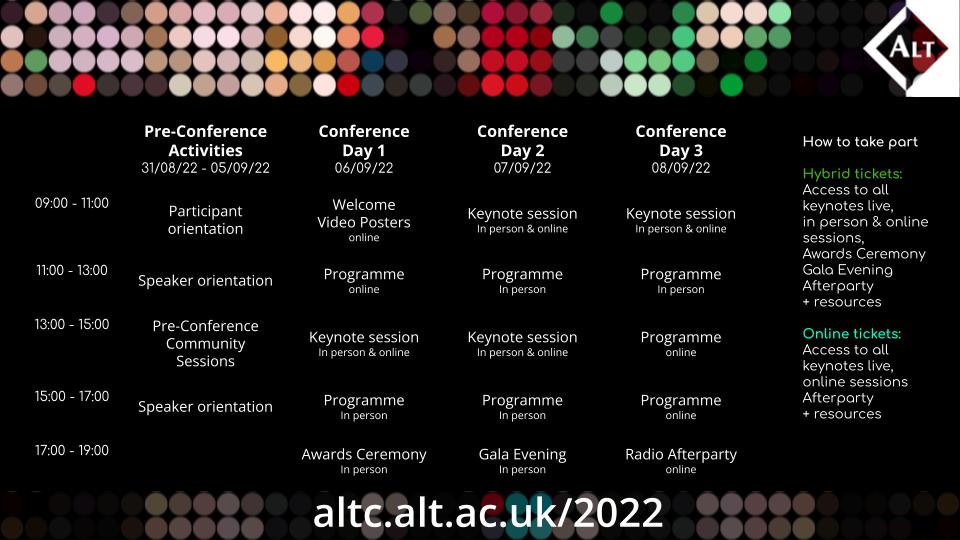
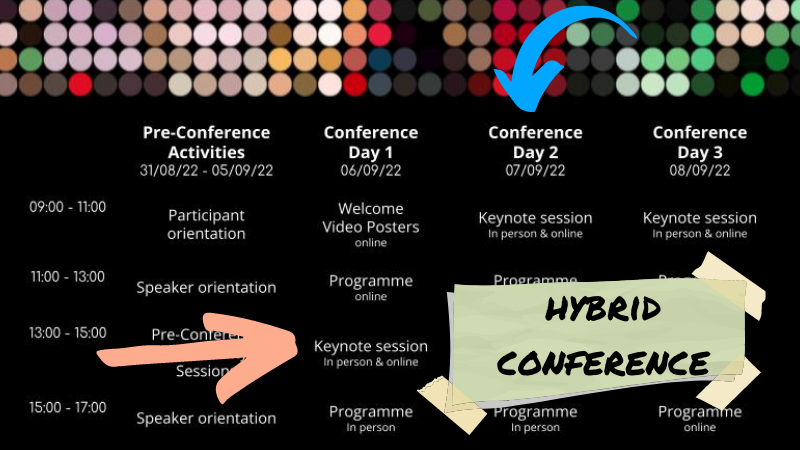
    Screenshot of the draft programme for the conference which includes schedules for pre-conference activities and each conference day.
    Work in progress: Screenshot of the draft programme for the conference.

    Now that we have a better idea of the submissions for the conference, we can start to work on the actual programme, scheduling sessions and working out conflicts in scheduling.

    Pre-Conference activities

    We will run pre-conference activities 31st August to 5th September and these will be open to all and free to attend. This is an important point, as these activities include sessions run by our Special Interest Groups and Members Groups. During this time we also run participant orientation sessions online, helping to onboard everyone on the conference platform and starting the conversation in our social space.

    Twice daily speaker orientation sessions will help prepare speakers to present either online or in person and pick up logistical questions about session formats and session chairing.

    6th September – Conference Day 1

    The morning of day 1 will be online with an online welcome and live sessions including video posters. In the afternoon, the programme will be in-person. Keynotes will be live-streamed to online participants. In the evening, we will hold the 2022 Learning Technologist of the Year Awards.

    7th September – Conference Day 2

    Day 2 will be in-person and in parallel we will stream pre-recorded sessions with live online discussion. Keynotes will be live-streamed to online participants as well. In the evening, we will celebrate the launch of Digital Transformation, our collaboration with ITN Productions as part of our conference gala.

    8th September – Conference Day 3

    The morning of day 1 will be in-person, again with sessions online as well. In the afternoon, the programme will move to online only. Keynotes will be live-streamed to online participants. In the evening, the conference after party will be online and hopefully see the return of #altc radio on the airwaves.

    What’s next…?

    Designing the hybrid events programme is only one of many steps on the road to #altc22, and we’ll continue to share our practice as we go along. We hope you will join us in September!


  • OER22: On the road again

    OER22: On the road again

    Wow. It’s really happening. This time, we are hitting not only the virtual but also the physical road again in order to journey to the OER Conference. OER22 here we come!

    The last time the OER Conference took place as planned as in Galway in 2019, and since that time, three years ago, no edition of this very special event has gone to plan. In 2020, OER20 pivoted online with less than two weeks to go, and became very much a pandemic conference. In the crisis mood of those early days of the pandemic, OER20 became a free event with refunds winging their ways across the globe to participants who suddenly had a lot more to worry about than a cancelled conference.

    Helloooer CC-BY Bryan Mathers

    When I look back at the posts and reflections from that year, it really hits me how much the world changed for all of us, and for this event as well. Our small staff team worked wonders to make this one happen.

    In 2021 we did plan to hold OER online, and then decided to join forces with the Domains Conference from Reclaim Hosting, bringing two communities together for what turned out to be… a journey into the wonderful unknown. OERxDomains21 was born.

    Title image from the OERxDomains21 programme

    I organise, speak at and go to a lot of different conferences of all shapes and sizes. Each conference has its own way of working, and there are some big differences between them.

    The OER Conference feels to me very much like a labour of love. It has its own voices, its own way of interpreting the criteria for peer review, its own priorities of what is important and what is not.

    I have had the privilege of being involved in organising this event since 2015 and in that time I have learnt much about the generosity of the people who shape this event, their shared passion for open education and the values that connect them.

    Inspired by the OER Conference I became an open practitioner and an open leader myself. I joined the community that this conference supports here in the UK and increasingly in other countries, too. Through the OER Conference I made connections with others who lead important work in this space, and I am grateful to be part of an expanding network, a community that is coming together again this week.

    We are coming together in person and online to recharge and re-connect. To share, learn and discuss. I am so excited to see friends, colleagues and new acquaintances in person and online. For those who are unable to take part, there will be a lot of OER Conference goodness openly shared and disseminated after the event, adding to what is now a substantial collection of videos and resources.

    Let there be penguins!

    As you may have noticed by now, the GO-GN Penguins have taken over OER22 for this year, and they are truly everywhere, both online and in the physical world. I recently shared a True Story of how a Westminster meeting led to… penguins. I am deeply grateful to the creative, collaborative and collegiate minds at Visual Thinkery and at GO-GN for helping us bring this year’s event to life with these penguins centre stage. Usually I am more of a shoe(tweet) sort of conference goer, but I must admit that the penguin theme defeated my shoe selection… so I went a little overboard and decided to go fully ‘on brand’ in a different way for OER22.

    A photo of my hand with painted nails, one of which is an image of a penguin

    … and there is a session, too

    In the last bit of the programme on Thursday, I am excited to actually get to lead a session in the programme! Long-time colleague and friend Lauren Hanks, Director of Operations at Reclaim Hosting and one of the Co-Chairs of last year’s edition of the OER Conference, and I, are getting together to reflect on the connections between open education and open approaches to online collaboration and work.

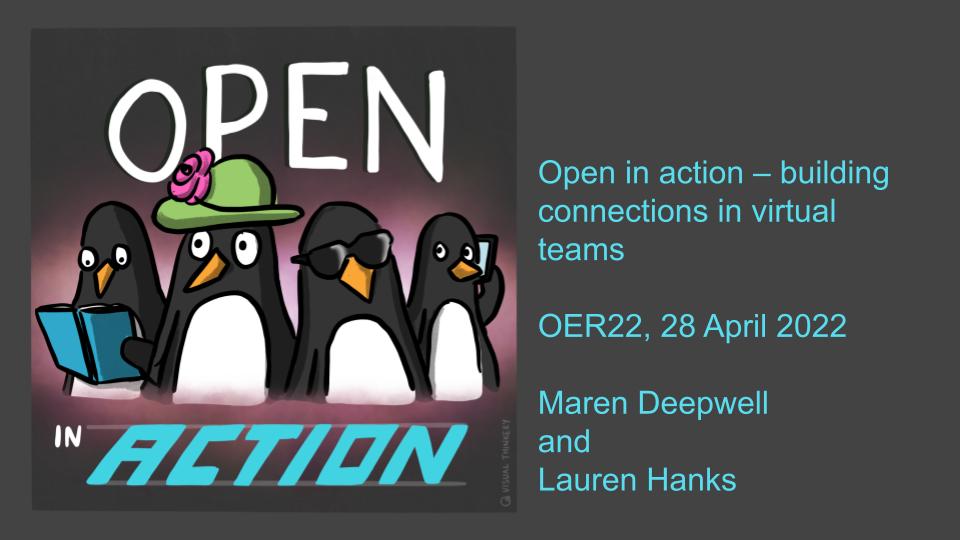
    Title slide for our session: Open in action – building connections in virtual teams.

    As leaders of virtual teams, we want to critically examine what lessons we can learn from open approaches to learning and teaching and how we can use that knowledge in an increasingly virtual workplace.

    This session builds on a recent episode of the Remote Work Show on DS106 Radio, in which we started to unpack some of this (recording to follow).

  • Talking about ethical approaches to Learning Technology during Digital Universities Week

    This week I am chairing a discussion about ALT’s development of a framework for Ethical Learning Technology with a wonderful line up of speakers: ALT’s Chair, Professor Helen O’Sullivan, Javiera Atenas whose work helped shape the framework and our President, David White. Each will bring a different perspective to the conversation, helping us explore why taking an ethical approach to digital education is important for leaders, professional and academic staff and, first and foremost, students.

    Programme entry

    Since it’s initial launch in September last year, ALT’s Framework for Ethical Learning Technology (FELT) has continued to develop with input from Members and the wider community. The first part of the work is that we are collecting case studies and examples of policies from across sectors to help establish a baseline of practice and also of gaps in practice, of questions or problems to which we don’t have robust answers as yet. The second part of the work we have focused on is the development of resources that help individuals and teams translate the framework into practice. The first resources, our FELT Reflective Self-Assessment, launched at the end of 2021:

    You can use this assessment tool to reflect on a particular project, a new tool or platform or you can use it to focus on a particular aspect of your work. We encourage all Learning Technology professionals to undertake this self-assessment to reflect on their professional practice in relation to FELT’s four core areas. Based on the outcome, you can then move on to complete individual sections focused on particular aspects of your practice. The self-assessment is mapped to the CMALT accreditation framework and this is indicated throughout the assessment. 

    https://www.alt.ac.uk/about-alt/what-we-do/alts-ethical-framework-learning-technology/felt-resources

    These resources form the start of our efforts to put the framework into practice, and the session this week will enable us to share these more widely as well as exploring why it’s important in different contexts.

    As many of us are emerging into some sort of post-pandemic way of working, we need to make some space for considering the ethical dimension of digital practices in our strategies and the FELT framework can offer a practical starting point for exactly those conversations for institutions, teams, with students and with industry.

    … and returning to in person conferences

    Like many, I am just about to make my first steps back to in person conferences. It feels like closing a loop, the “what I last did two years ago” loop. Part of my role as a CEO is to represent my organisation and share the work we do and the voice of our Members on the best possible platforms. For the past two years, that has been a lot harder than it used to be, and there is a whole dimension of networking and influencing that has been absent from much of my day to day work during the time of online only events.

    Like many, I have mixed feelings about the return of travelling for work, partly because here in Wales we continue to have more restrictions in place than is the case in England. But mainly I am grateful to have the opportunity to represent my organisation again, to have the option of generating engagement (and income) through running events both in person and online and, most of all, to reconnect with colleagues who inspire me and who contribute to my enjoyment of my work.

    Given how much of my professional practice is online, I know what really, really great virtual work looks like. I experience it every week. And I also know how much effort and time and resources it takes to make it happen, and that relatively few people have either the skills or the set up to make it work consistently.

    So I am looking forward to returning to the comparatively ‘easier’ way of connecting in person. And, in just over a month, to dancing with penguins…

  • Looking forward to my 12th ALT Annual Conference – completely online

    Looking forward to my 12th ALT Annual Conference – completely online

    My first ALT Annual Conference was in 2009 in Manchester (I missed the first year I was working for ALT because I was submitting my PhD that September).

    Umbrellas, badges, fire alarms.. looking back

    In 2019 we were in Manchester, in the magnificent (and at times chilly) McEwan Hall. 2018 was in Manchester to celebrate 25 years of ALT with custom pin badges and a special gala dinner! in 2017 we took the conference to Liverpool for the first time, and as well as a lot of fun, this year will always stay in my head as the year in which we had a fire alarm during a keynote (I did my best flight attendant impression for that one).

    2016 we were in Warwick, and things took a playful turn with a special conference game. in 2015 we were in Manchester as well and maybe one of my all time favourite keynotes from Laura Czerniewicz. 2014 was the first Annual Conference in Warwick, 2013 was the 20th anniversary conference in Nottingham, 2012 (also in Manchester) was my first conference as CEO, 2011 took place in Leeds, 2010 we were in Nottingham and that year I think it was so wet we bulk bought umbrellas and 2009, my first outing at the conference, was in Manchester with balloons and sweets at the ALT stand.

    In 2020, we were planning to take the conference to London for the first time, and that was the first time we had to cancel our Annual Conference all together. Instead, we held a crisis summit.

    This year, we were determined to hold our Annual Conference, as its such a special event for our Members and our community, so we headed online to make sure it would all go ahead as planned.

    Today, our 2021 Annual Conference is getting underway.

    Custom emoji, treasure hunt and yoga… looking ahead

    It takes to make this conference happen, and planning has been underway for 9 months, led by the Co-Chairs and Conference Committee. Over 150 speakers are running over 90 sessions over 4 days. There are 350 participants from 24 countries coming online, supported by a staff team of 10 and plenty of volunteers, too.

    As everyone who works in Learning Technology knows, it takes a lot of creativity and ingenuity to make an activity online feel like fun – and we work hard to make that happen. To create conference fun online whilst working on a properly robust conference delivery with a difference.

    There is a CMALT Ceremony complete with balloons and custom emoji on the chat channels in the social space. There is a hallway chat (both text and voice) in which folk can hangout in and bump into each other. There is a gala evening with a glitzy film premiere. There is a Helpdesk staffed with a team to help with everything from access codes to finding rooms.

    There is a shop for conference goodies, a community report launch and a treasure hunt, yoga and meditation sessions. Plus a quiz, panel discussions, keynotes and parallel sessions.

    The programme is designed to be rich, but not overwhelming, and there are plenty of breaks, late starts and social activities to drop in to when time permits.

    Say hi!

    DM me on the conference Discord site or @ me on Twitter, or email me if you prefer. It’d be great to say hello and hear from you #altc21.

  • OERxDomains… Reclaiming the Joy of EdTech

    OERxDomains… Reclaiming the Joy of EdTech

    I am really excited (just like Jim Groom), because something special is happening in April… as OER meets the Domains Conference in what I hope will be a really awesome two days!

    Cue ALL the hashtags, #OERxDomains, #OER21 and #Domains21.

    It’ll be a lot of work to pull this together and I am thrilled that we have a whole team of Co-Chairs to make it happen: Heading up the Domains strand are Lauren (Brumfield) Hanks and Jim Groom and leading on the OER side are Lou Mycroft, Louise Drumm and Joe Wilson.

    From a main stage which should host some of the most exciting voices in Open Education, to a whole range of fringe events and activities to connect, network and hangout with old and new friends… I think this is one of the most exciting things I am going to be working on in 2021.

    Submit your ideas

    The conference will put the spotlight on both the value and limitations of Open Education in a (post)pandemic world. We are particularly keen to hear from people who have an interest in the following indicative areas of practice:

    • Theme 1: Openness, care, and joy in the times of pandemic;
    • Theme 2: Open Education responses to surveillance technologies and data ownership in education;
    • Theme 3: Open in Action: open teaching, educational practices and resources, how you might be using Domains and other tools;
    • Theme 4: Shifts in agency and creativity as empowerment of learners and educators;
    • Theme 5: Open Source Tools: infrastructure, cloud environments, targeted teaching tools.

    Wildcard proposals that specifically address the conference themes in relation to open practice, research and policy are also welcome.

    The Call for Proposals is now open https://go.alt.ac.uk/CfP21OERxDomains .

    Deadline for submissions: 31 January 2021

  • Summit week (with heart) #altc #altcSummit

    Summit week (with heart) #altc #altcSummit

    It’s been a busy week at ALT HQ as we have been busy with the ALT Summer Summit and this weekend, a much-needed long weekend, has seen me mostly offline, but there is a radio show to do on a Sunday, and that’s led me to blog, too.

    I really liked this heart, that was put up on a farm fence close to the hill, and it seems like an excellent visual jumping off point for reflecting on a summit (with heart). So here are ten tweets from this week #altc #altcSummit:

    It was an awesome event, which gave me a sense of community and connecting, and a sense of hope that I am grateful for.