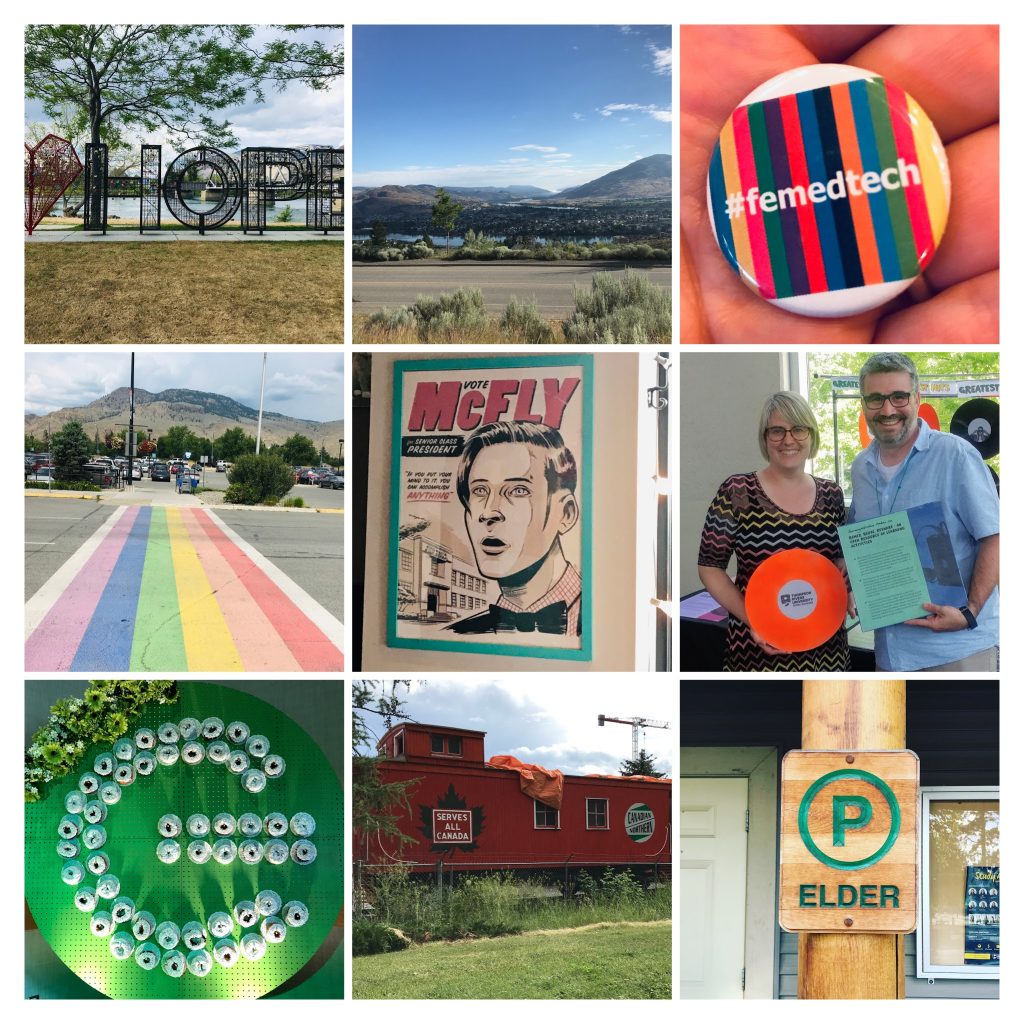
Last week I had the pleasure of participating in the ETUG conference in Kamloops, Canada. It was a real privilege for me to be there, to have been invited to contribute a keynote to ETUG’s 25th Anniversary Conference, and also to have the honour of taking part in National Indigenous Peoples Day. I learnt a lot from my time in Kamloops and I want to share a few reflections in this post:
The event had strong sessions about openness, including a great workshop on ‘Fostering a culture of openness: a work in progress’ which was about: “factors including institutional norms, leadership, relationships, humility and criticality that were identified as being instrumental in fostering a culture of openness at the school, faculty, and university levels. It will share the tensions and conceptual, practical and technical challenges experienced in developing a culture of openness in a higher education institution that to date has no formal institutional open education strategy or open policy in place” and I found the tool and questions we explored extremely helpful. It was a great session that resonated strongly with work explored at the OER19 conference in April.
Also on the theme of open education I really enjoyed Amanda Coolidge’s talk on ‘$3 million, now what?‘ in which Amanda talked about how on “on April 17, 2019 the Ministry of Advanced Education Skills and Training announced their continued commitment to open education with the funding of $3.26 million toward open education in British Columbia and then outlined what the strategy looks like for the next three years of open education development and disbursement.” Coming from a UK perspective, I found this really inspiring and much food for thought when working with policy makers here.
The day before the conference I was invited to take part in a workshop hosted by Brian Lamb around the work of the OpenETC project, which launched a collaborative WordPress platform, with hundreds of new users from institutions across the province. At the conference, this work was further explored in this session. Closely focused on education technology and collaboration, this project really chimes with a lot of priorities we have in the ALT community.
There were many more sessions I found inspiring including a wonderful presentation from Tony Bates, who was sharing findings from the annual survey of online and distance learning in Canadian post-secondary institutions (and whom I very much enjoyed meeting in person for the first time), an unforgettable Gasta session which included not only Clint Lalonde but also the musical John Churchley (whom you should immediately look up online), a presentation about the ETUG Community Survey and a very engaging session on LightBoards for teaching.
I felt very much at home at the ETUG conference because just like the ALT community it is all about collaboration, reflection and sharing of best practice. After 25 years of working together (celebrated with a great donut birthday cake) this community has come to hold dear very much the same values as I do, recognising the power of sharing practice and research and working together to make change happen for students and staff alike.
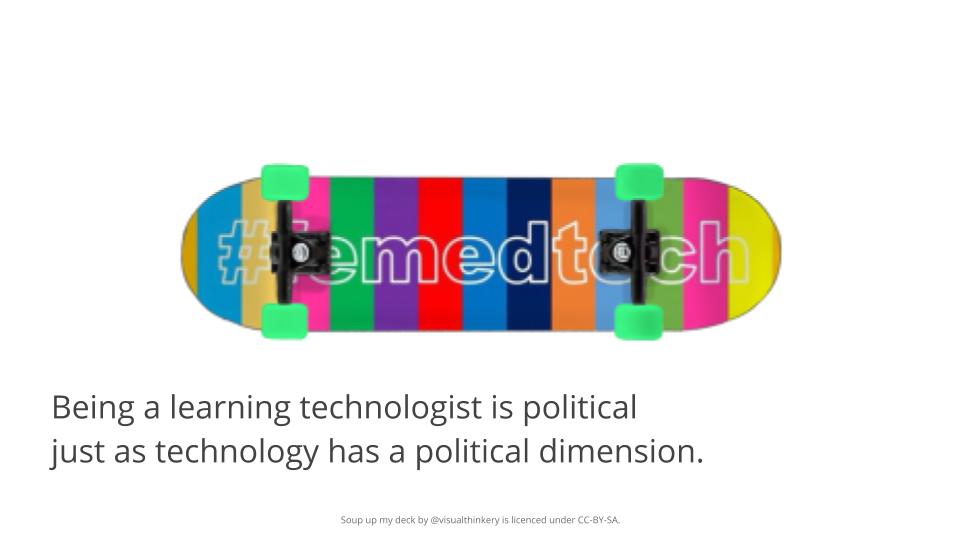
And you could tell that this event was very much organised with heart. Little touches everywhere made participants and speakers feel welcome from the start and created a space in which the moving narrative from Elder Mike on National Indigenous Peoples Day found an equally receptive audience as the newest members of the community sharing research findings or #femedtech conversations about equality and women in #edtech.
Many people contributed to making this conference happen and many helped ensure that I had such a great experience – I want to say a BIG thank you to each of you. I hope I can come back to ETUG another time to contribute and take part and continue to build a relationship with this community that has so much in common with us #altc.
Next week I’ll be joining ETUG’s 25th anniversary conference, and I am really looking forward to contributing what is promising to be a very special event. The schedule for the conference looks great and there’ll be plenty of opportunities for everyone to engage, including VConnecting and no doubt a lot of tweeting throughout. It’s a privilege for me to be able to travel all the way to Canada (my first trip to that part of the world). I’ve been following conference preparations from afar as I have been writing my talk for the second day of the conference, which is on National Indigenous Peoples Day, which will be marked by a special smudging prior to the start of the conference programme.
Here is what my talk is going to focus on:
What I’ve always been interested in is how we, as human beings, relate to the world around us, and in particular our relationship to technology. For me, there is no better context than education and lifelong learning to explore how that relationship is evolving as digital technology becomes more pervasive in our lives. My keynote will challenge the perception that the ‘march of the machines’ is moving us to a future in which we are all just data points, gadgets or messy human problems that need to be solved by technology.
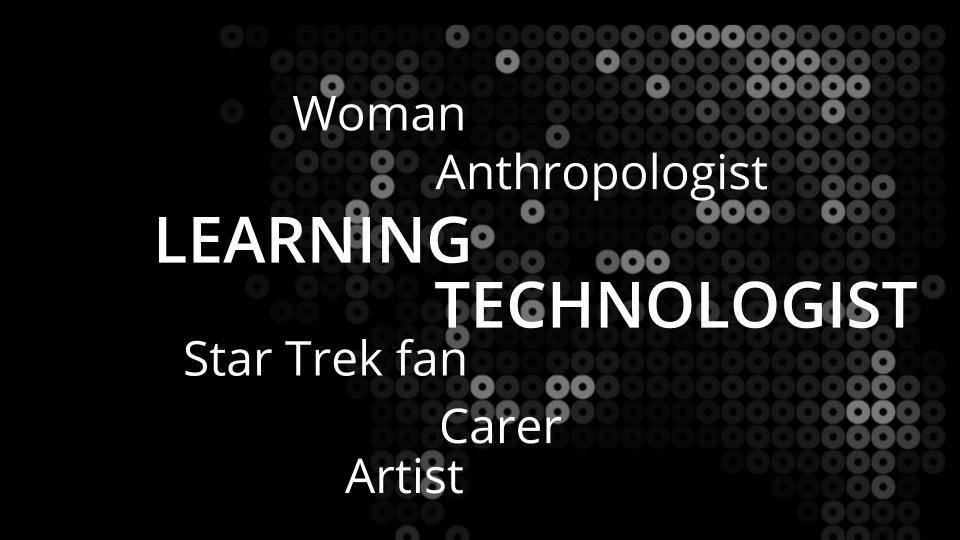
In my case… that’s a starting point for mapping my professional identity:
Focusing on the conference theme about people and technology, I am going to focus on three things in this talk: First, I am going to question how we can develop a more mature, reflective, a more critical perspective in our professional practice and why that is important.
I want to focus on some of the sticky points around ethics, student consent and data literacy and our role in addressing them. This will lead me to examine what skills and capabilities education technology professionals need in order to tackle those questions and last I am going to look at the role of technology in our efforts to make education more equitable for all.
I’ll post the slides & a transcript of the talk next week, but for now, have a look at what’s in store on the conference website.
This year I was able to take part in the Creative Commons Global Summit alongside my colleague Martin Hawksey, and it was a fantastic experience. I have long been involved in the Creative Commons community and various activities but this was my first visit to the event which is at the heart of it all and I was met with real warmth and welcoming acceptance. The creative and joyful atmosphere of the conference, from the handmade designs on the badges to the samba music playing throughout the museum conference venue conveyed a sense of celebration and joy at this meeting of so many in the Commons but also motivated to pull up your sleeves, get stuck in and do plenty of work (and there was A LOT to be done).
One of the strands I followed throughout the conference was around gender equality, visibility and leadership starting with Kelsey Merkley’s session on the UnCommon Womens project and later in a powerful keynote during the opening evening and running throughout all three days.
I also had the privilege to take part in some of the VConnecting sessions organised around the event, opening up the conversation to those not able to attend in person and I really enjoyed meeting participants from all across the globe in that manner as we sat in corridors and next to lifts, supported most capably by both online and onsite buddies (thanks Ken & Christian!!) who made it possibly for us to talk all things open across time zones and continents.
Having a creative start to the day #ccsummit finding out about creating with CC-Create for artists, musicians, makers… pic.twitter.com/yCXIPWH1i8
I also really enjoyed the more creative side of the Summit and I met makers and artists as well as platforms (Hello, CC-Create) that had never heard of before, opening up completely new perspectives on how art, music and design function in the Commons and how big an impact openness in these contexts can have from delivering education to making tools more accessibility and affordable.
As well as talks around creativity and equality I was able to participate in a number of sessions and workshops around digital literacy, staff development and copyright literacy, including this particularly fun session in which I learnt a lot of new things about copyright:
And one of the highlights of the final day was a critically inspired panel about AI (maybe the first conference session on the topic that didn’t leave me frustrated or angry) very elegantly facilitated by CC’s CEO Ryan Merkley:
From killer robots & facial recognition to copyright, privacy and licensing… AI discussion #CCSummit is very broad ranging in the face of complex issues – what happens next and how can we influence it? pic.twitter.com/sbeu92McUh
The final highlight for me was that Martin & I were able to share some of the developments that are happening in our community with the Summit. It was a real privilege for us to have our proposal accepted and we really enjoyed our sessions and were really grateful for the interest & questions it stimulated:
Many custard tarts were eaten, there was rain, fog, wind & plenty of sunshine, there were many useful conversations, resources & ideas shared and I am taking back a lot of inspiration as I join on last VConnecting session from Lisbon Airport.
CC Summit, I certainly hope to be able to join in again another year and thank you for a wonderful experience.
Given that it’s early in the year and a cold, dark morning in Nottingham, UK, I felt it would be useful to start this talk with a sunnier view of beach near Sligo, Ireland, a place to feel the sun and the sea on your skin, a place to take some time to reflect and breathe and take a break. Those aren’t things that I generally associate with social media, in particular in Higher Education. Social media often comes with a general sense of the superficial, showing just the best side of myself, trying not to avoid being vulnerable for social media can be a toxic space for many, particularly for women, for people of colour, for anyone whom the trolls choose to single out. So if you are already a place in your year where you feel your digital shadow is looming large, maybe it’s time for a digital detox https://datadetox.myshadow.org/en/detox . I came across this useful tool via Mozfest a few years ago and I found it helpful as a way to check in with my relationship to social media.
Slide: Social media is powerful. Social media is personal. Social media is pervasive.
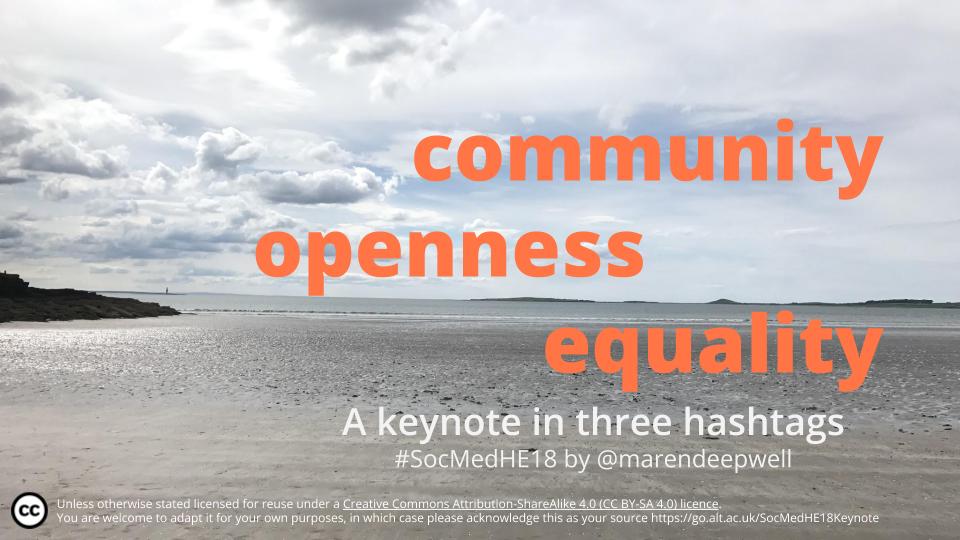
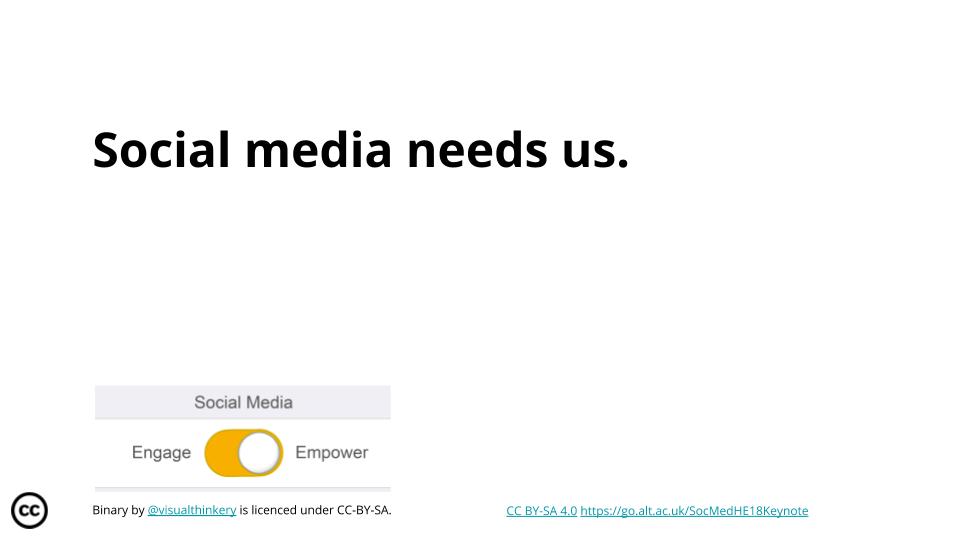
It’s important to think about because social media is powerful, it’s personal and pervasive. It’s part of our personal lives and professional practice in education. It’s part of what our colleagues do, how our learners work and part of our social reality from citizenship and dating to job hunting and even death and remembrance. As human beings we rely on our social interactions no matter how they are conducted and in this age social media is part of how we live for an increasing proportion of the global population. Because it is important, we can’t leave it up to others. Because it’s important, social media needs us. Social media needs us to question, investigate, reflect on, engage with, challenge, shape, control, monitor, analyse, track, investigate, govern and take ownership. And that’s what I’ll explore in this talk in three hashtags:
How is social media changing professional practice? How does social media support openness in education? Social media for social good?
Slide: #altc – a perspective from Learning Technology
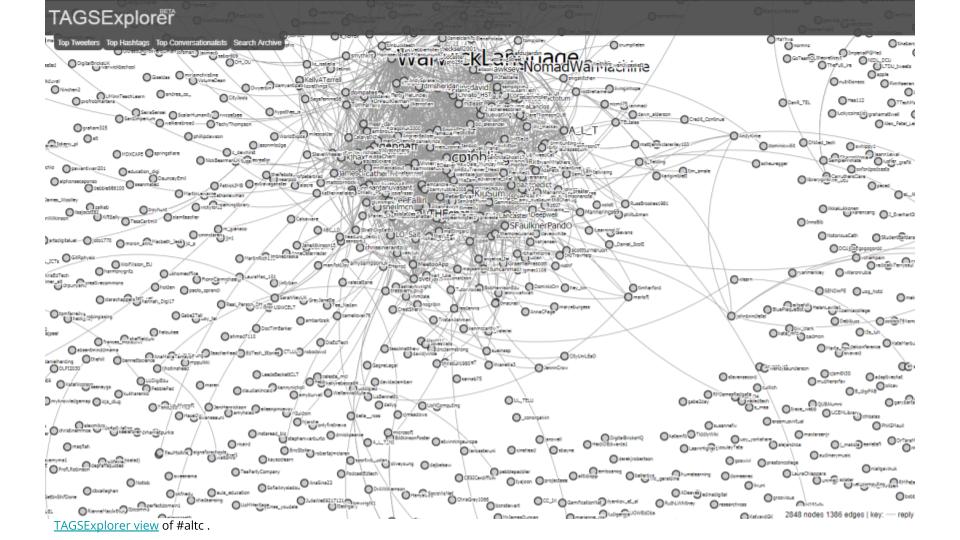
The first hashtag is #altc and it’s probably the biggest hashtag in my working life. To begin with the hashtag was used only during events, mainly ALT’s Annual Conference and it changed each year. Since 2014 however the hashtag has been used not just for the conference, but increasingly throughout the year. To begin with the “c” stood for “conference”. Now the hashtag has come to mean more than that thanks in large part to the vision of ALT’s Martin Hawksey, now the “c” stands for community, conference, create, collaborate, communicate and so forth. And it now generates more tweets in a single week during the Annual Conference than we previously recorded for an entire year. It’s developed far beyond the single use event hashtag it started out as and that reflects how the activities it supports have expanded also. As a membership body for Learning Technology professionals, ALT has become very active on Twitter and our network and the conversation is growing – you can see how this is visualised here on the TAGSExplorer view of #altc .
Slide: TAGSExplorer view of #altc
The community is now active throughout the year and the way that social media is used really varies and includes individuals actively using the network to share practice, ask questions and celebrate achievements. ALT as an organisation is powered by its Members many of whom volunteer for the Association and one of my favourite examples of using social media and the #altc hashtag last year was celebrating ALT’s 25th birthday. We wanted everyone to be able to celebrate whatever is important to them, to add their own voice and for the anniversary to reflect some of the diversity and breadth of the community we serve. On social media you could thus create your own celebration postcard, including your message and image, remixed under a Creative Commons licence using the Remixer developed by Bryan Mather/Visual Thinkery (go to https://remixer.visualthinkery.com/ and have a go at remixing yourself). It’s a small way for individuals to have a voice in ALT, be able to shape the organisation and reflects its values and aims to encourage participation and collaboration and openness.
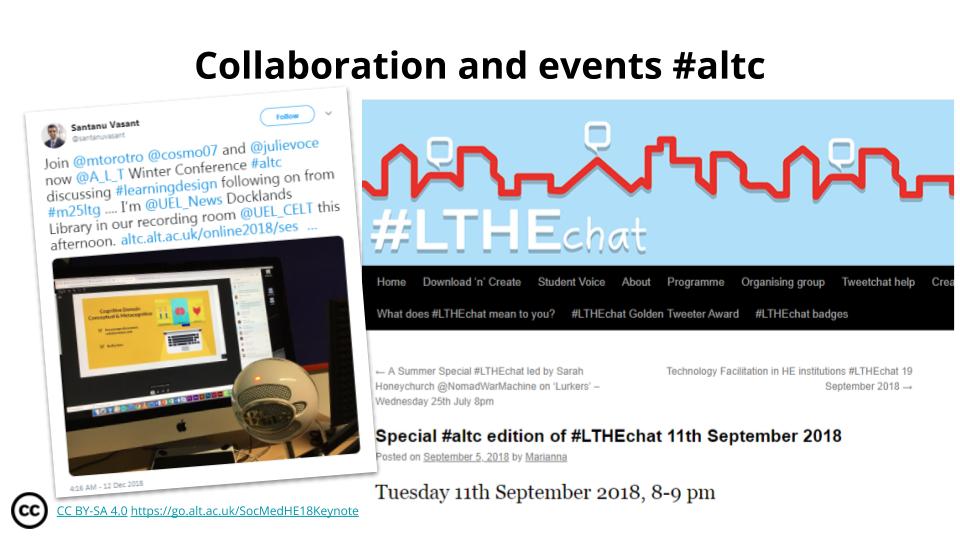
Slide: collaboration and events #altc
Beyond individuals we have leveraged the power of our hashtag to collaborate with others and to enable relationships between Member-led initiatives and the centrally supported network. That’s particularly important in Learning Technology as much of the work we do reaches across disciplines, sectors and often beyond the UK. This approach to social media isn’t about distributing marketing messages or one way communication. Our aim is to support and develop a positive online space, a social media channel that Members and the wider community can make us of and have ownership of, a space that supports our work in strengthening professional recognition and advocate for our Membership.
Our Members meanwhile have a strong open ethos and much of what we do is consequently openly accessible to the benefit of the wider community. Openness is so important in Learning Technology because the tech landscape develops at such a rapid pace that the most effective way to keep pace with it is in collaboration with others, by sharing resources, research and reflection. Like social media, openness is not unproblematic and like social media openness has great potential in education. And that brings us neatly to hashtag number two and also to my second question: How does social media support openness in education?
Slide: #open
I want to start by highlighting two examples, two policy developments in Higher Education, that I have worked on, firstly the Higher Education Funding Council for England Consultation on the second Research Excellence Framework and then also the Open Education and OER – A guide and call to action for policy makers. The first is particularly relevant because it provided an opportunity to argue the case for the role of social media in how impact is measured in Higher Education and the second as it highlights how Open Education and OER can expand inclusive and equitable access to education and lifelong learning, widen participation, and create new opportunities for the next generation of teachers and learners, preparing them to become fully engaged digital citizens.
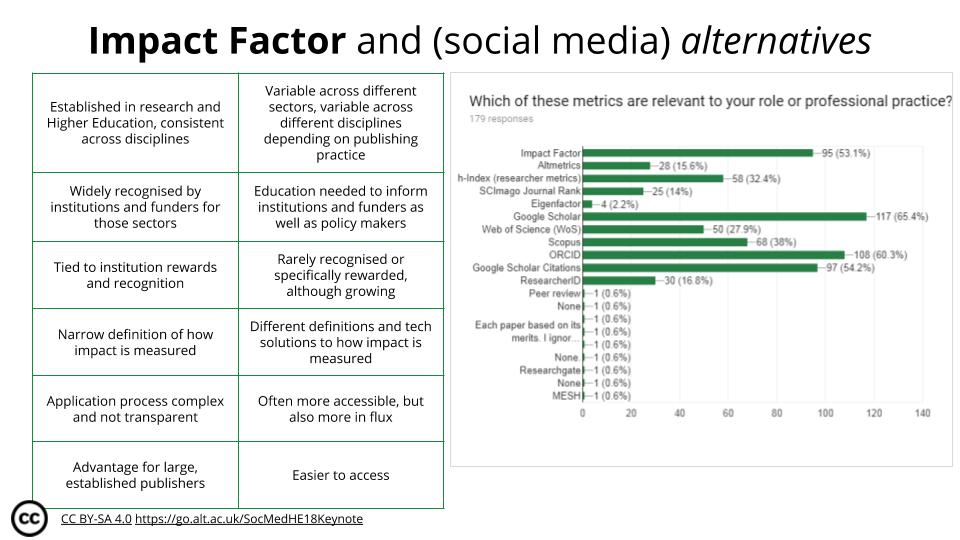
But are policy developments such as these making a difference in practice? Has policy changed much since 2014 when for example The Metric Tide by HEFCE was published (http://www.hefce.ac.uk/pubs/rereports/year/2015/metrictide/#alldownloads)? It’s aim was to “reduce emphasis on journal impact factors as a promotional tool, and only use them in the context of a variety of journal-based metrics that provide a richer view of performance. Publishers should also make available a range of article-level metrics to encourage a shift toward assessment based on the academic quality of an article rather than JIFs.”
Social media plays an important role in the alternatives to the traditional Impact Factor and is increasingly used not just by publishers and authors, but to recognise the important role of peer reviewers and support their recognition, too. Research in Learning Technology, the journal ALT publishes, is of special interest to me because I was part of its pioneering transition to become the first Gold Open Access journals published by a UK professional body. Since then I have had hands on involvement in two further transitions between publishers, leading to the journal now being independently published by ALT, financially supported by Members and edited by a group of volunteer Editors who lead peer review and author support.
It hasn’t been awarded an Impact Factor to date and we are actively investigating all alternatives, how their are used, how they are developing, what their longevity is and how sustainable they are. Open Access has seen the readership and reach of the journal increase from hundreds to hundreds of thousands. Social media supporting innovative ways of measuring impact may help its impact grow further. For now, openness helps ALT influence policy makers, increase the impact of research for public benefit, build a shared vision for the future of professionalisation in Learning Technology and grow our community of Members.
Slide: Impact Factor and (social media) alternatives
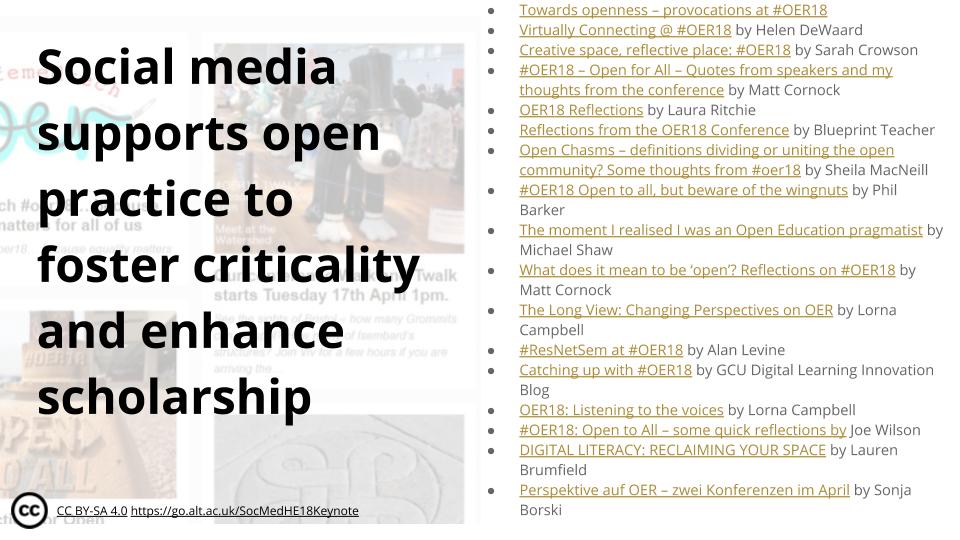
I now want to look beyond organisational boundaries to focus on individual professional practice and how social media supports open practice to foster criticality and enhance scholarship. In my experience there is no better example of this than the work that is happening around the #oer hashtags, no, conferences, and the way in which social media is used here to address some of the most difficult questions including how privileged participation in such events is, how we can find and support the voices of those we are not already hearing and how we can meet some of the global challenges that education faces through openness: access to education and equity.
It’s become somewhat of a social media tradition that the blog posts and tweets start long before an actual OER Conference, last year reaching such a large volume that there was more conversion online than anywhere else. It connected those who couldn’t attend in person (to some degree) and enabled a much richer discussion, more criticality and scholarship than before.
Slide: social media supports open practice to foster criticality and enhance scholarship
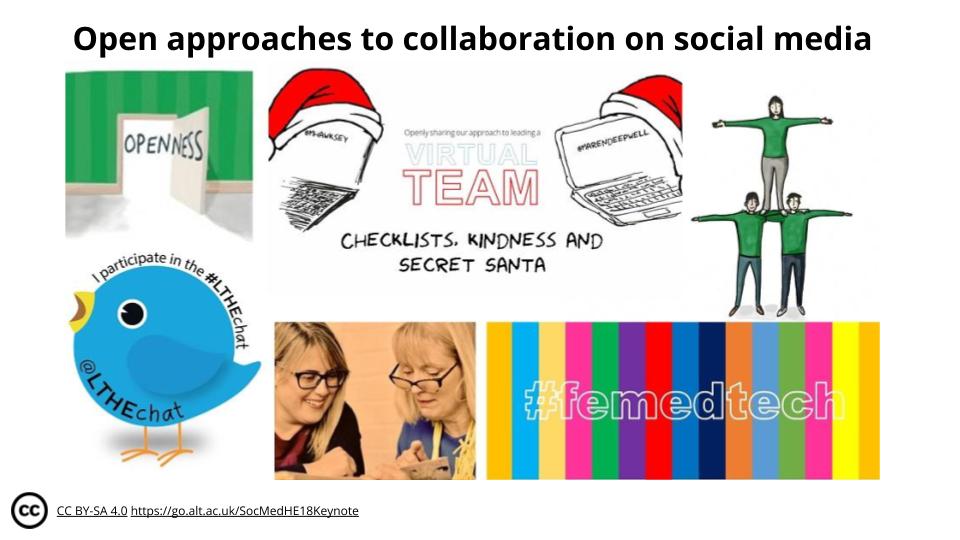
And as an open practitioner myself I am inspired, challenged, prompted to try and step up in my own work, to contribute something, to question how I could do things differently, better. And last year was very much a year of collaboration in the open for me, with many projects taking place on social media, including twitter chats and many blog posts.
Slide: open approaches to collaboration on social media
I wanted to progress leadership as an open practice – which, incidentally, is one of the sections in my CMALT portfolio and something for which I get a lot of feedback and input on social media. But the collaboration which has prompted me to reflect the most on the pros and cons of open practice on social media is my work with Martin Hawksey on leading ALT through its transition to becoming a distributed organisation and establishing a new working culture as a virtual staff team. Our monthly series of posts has been at the heart of all my work last year, touching on everything from people management and well being at work to the technical challenges of remote working and the nuances of working in the open. Writing these posts whilst everything is actually happening, rather than sharing output from work that is in the past, felt far more scary than similar kinds of work I had done before. There is much of what I do day to day that I hadn’t managed to make part of my open practice before this collaboration – leadership, management… these are not the most straight forward topics to share (especially when you are everyone’s ‘boss’). There are a lot of pros for me in this kind of approach, but also some downsides: sharing work in this way puts you in a vulnerable position, for example if someone personally attacks you, if you are not performing well, when you make mistakes or when things go wrong. Social media can be a scary place when you are not sharing success. It’s always personal and there’s a limit to how well you can protect yourself once you are out there, in the open. But on the other hand, I want to be open about how to lead, how I work. I want to show that things do go wrong, that mistakes happen and how to work through them. It’s important to share questions and doubts. It’s part of my ethos, my approach to leading a team, to leading an organisation, and I want my presence on social media to reflect that. When I first became a CEO I found it really difficult to find role models on social media (and indeed in real life) and alongside all the people who have inspired me along the way, I want to try and help others find the right way of building their professional identity.
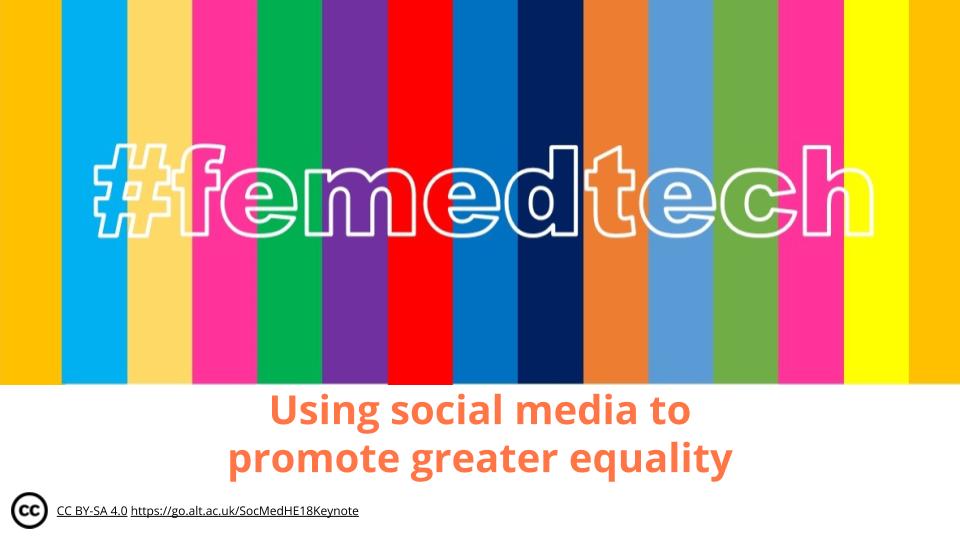
Slide: #femedtech – Using social media to promote greater equality
And on that point, thinking about identity, we arrive at the third and final hashtag and the last part of my talk: #femedtech. The challenge here is using social media for social good. And in terms of equality, and equality in Learning Technology in particular, we still have a long way to go. Equality is for everyone, it’s in everyone’s interest and it’s everyone’s look out. Femedtech is a growing network and I am a volunteer and supporter, giving my time and voice to help promote a cause I believe in.
It’s only one example of how we can use social media to engage and empower in education and to make use of the digital, critical and technical skills we have to take some ownership of how we grow, support and chart the development of our network. And that is an important point to consider, because it is the skills and knowledge that we have that enable us to do that – the fact that we know quite a bit about social media, technical infrastructure and how data is generated and used. It’s our skills that enable and empower us to use the tools and platforms to enable and empower others – hopefully leading to greater equality along the way!
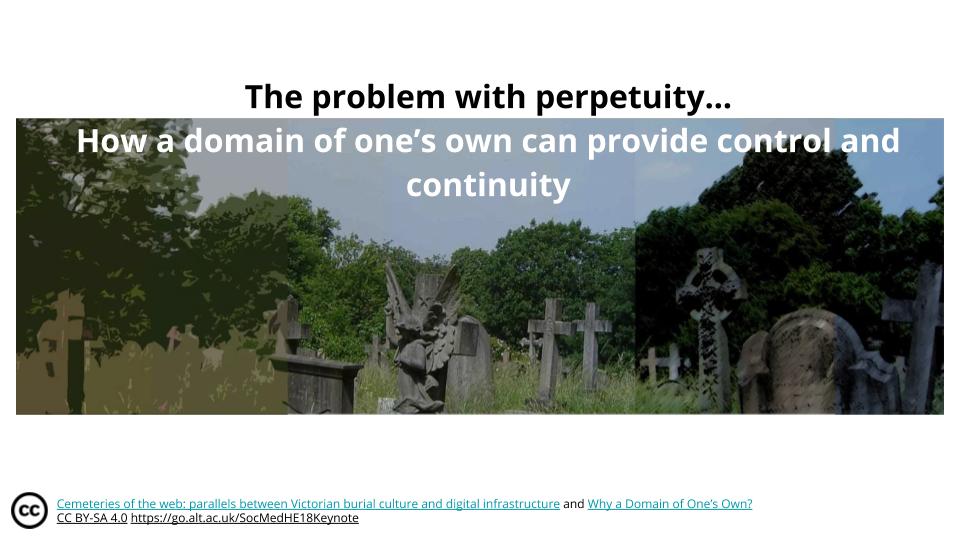
Slide: The problem with perpetuity… how a domain of one’s own can provide control and continuity
With that, we are not just going against the grain of the traditional power relationships that govern education and by extension Learning Technology. We are also going against what social media and online platforms in general wish us to do. They want our data, our attention, our engagement and in return they promise us much.
Now, I should pause here briefly, because the relationship between Victorian burial culture and digital infrastructure may not be immediately obvious, and I suggest if you are interested to read my blog post on the subject – but suffice to say that I have a PhD in cemeteries and with that comes a frame of reference that I find is very applicable indeed to thinking about our relationship with technology.
One commonality between Victorian burial culture and digital infrastructure, for example, is that a lot of digital infrastructure gives a promise of permanency in order to secure our engagement and content and Victorian entrepreneurs created urban cemeteries with the same promise. In the digital realm and in particular on social media your posts, pictures or updates remain in place while their are valuable to the platform, but can disappear or become inaccessible with little or no notice. The newly created burial space in Victorian cities would similarly be described as a place for eternity, not just safeguarding bodily remains, but securing status and remembrance for future generations. And like its digital counterpart, cemeteries, too, could disappear for building projects or urban development with gravestones stacked unceremoniously against a wall or used as paving material.
A domain of one’s own (alongside the aforementioned skills and knowledge) is key in my mind to a more empowered relationship to technology and social media. Post on your own domain, repost everywhere else – and when everywhere else stops their service, you still have your posts on your own domain. I am really inspired by the work Jim Groom has been doing in this area and I suggest you read his post on a related project.
The kind of relationship that I envisage us to have with technology and social media has a lot to contend with: we have questions about who controls the dominant discourse and how to foster diverse voices inside filter bubbles, we have a lot to work out around privacy and the right to be forgotten, the ownership of data and data literacy and the future of social media.
Slide: Social media needs us.
I hope that brings us to a point where we can explore these questions further, putting the emphasis not on the technology, but on human agency:
How can we use social media to enhance our professional practice? How can we use social media to support openness in education? How can we use social media for social good?
A big thank you to all whom I work with, who I have been inspired by and in particular the participants and organisers of the #SocMedHE18 conference for listening.
I am really looking forward to giving a keynote as part of ALT’s upcoming 25th Annual Conference, and I am even more delighted to do so alongside the inspiring Amber Thomas, whose work I have followed and admired for a long time and also Tressie McMillan Cottom, whom I can’t wait to meet in person.
So, here is a preview of what the keynote is going to be about and also a link to watch it on the day 🙂
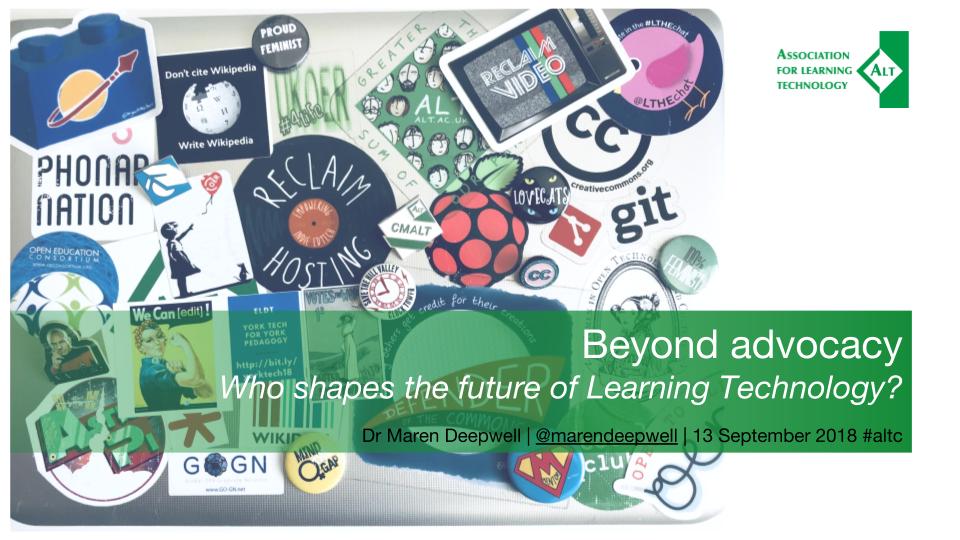
Beyond advocacy: Who shapes the future of Learning Technology?
This keynote poses the question ‘who shapes the future of Learning Technology?’. We will explore current thinking about what drives how we use technology in learning and teaching and questions the promise of tech that never quite delivers. For decades, technology has promised solutions to help us learn, teach, assess and care better, and yet these visions of the future are always just beyond the horizon.
But how do we move beyond that promise?
How do get beyond tech advocacy and realise the potential of our professional practice for the benefit of learners and the greater good?
To start answering these questions I will explore how professional practice has developed charted through new research into ALT’s CMALT accreditation scheme and share examples from recent collaborative work promoting equality in Learning Technology.
I am really looking forward to taking part in ILTA’s upcoming conference, TEL Quality Matters – People, Policies and Practices, 31 May – 1 June at IT Carlow. You can see the full programme here http://programme.exordo.com/edtech2018/ .
Working with ALT’s new strategic working group for the development of the Open Access journal Research in Learning Technology, I have been working on understanding more about alternatives to the established Impact Factor for independent Open Access journals generally and more specifically for researchers in Learning Technology (revisit my first and second post on this subject) and next week’s conference is a valuable opportunity for me to meet some of the colleagues who are part of the group and find out more about their experiences.
Meanwhile I have come across two new interesting articles (thanks to Neil Morris for making me aware of the blog post).
Citations, JIF, and h-index have served as the triumvirate of impact evaluation for many years, particularly in STEM fields, where journal articles are frequently published. Many studies have pointed out various flaws with reliance on these metrics, and over time, a plethora of complementary citation-based metrics have been created to try and address various proficiencies. At the same time, we see altmetrics emerging as a potential alternative or complement to citations, where we can collect different data about the ways in which research is viewed, saved, and shared online.
The authors share useful insights from their work surveying chemistry researchers to “gauge their perceptions of significance, importance, and highly cited materials. The results, while not truly startling, were nevertheless a stark illustration of how different these concepts are.”
The post ends with reflecting on how meaningful assessment of research can be developed within individual disciplines and I think this is a useful approach for Learning Technology in particular, given the diversity of research and research active professionals as well as the broad range of media and technologies we utilise.
Another interesting post I have come across is this from the Scholarly Kitchen which examines the role of preprint repositories and their impact on journal citation rates https://scholarlykitchen.sspnet.org/2018/05/21/journals-lose-citations-preprint-servers-repositories/ . The article in itself is interesting, but in particular I found it helpful to look at how some of the practices in Open Access publishing have developed. What I am particularly interested in is the messiness that results in different versions of the same research being linked to and cited on different platforms and how this impacts on citation rates and access to research over time.
One of the questions in the post is why people keep linking to and citing pre-prints even when the published version of an article is available. There is no tidy way of making everything link up in one place and so whichever platform is used most becomes the most useful even though the life cycle of publication is designed with a different aim in mind. The post uses the example of bioRxiv to examine how this, but this can easily be applied to other, similar platforms formal and informal.
The post concludes with this:
A citation is much more than a directional link to the source of a document. It is the basis for a system of rewarding those who make significant contributions to public science. Redirecting citations to preprint servers not only harms journals, which lose public recognition for publishing important work, but to the authors themselves, who may find it difficult to aggregate public acknowledgements to their work.
I am looking forward to exploring these and related questions next week. You’ll be able to access all details of my presentation via the conference website http://programme.exordo.com/edtech2018/delegates/presentation/1/ . I’d also like to add a note of thanks to the wonderful Bryan Mathers for making his Visual Thinkery available under Creative Commons licences and thus enabling me to use (and credit) them in my presentation. Thank you.