Next week is ALT’s first summer summit and the first time since 2009 that I don’t spend this weekend packing up clothes, shoes and EVERY cable and charger in my study and make a 5 day trip to Edinuburgh, Manchester, Nottingham or this year London.
But just because I am not packing my suitcase doesn’t mean I am not preparing for what is promising to be a crazy and fun week!
Conferences are serious shoe business for some of us… and one of the real upsides of virtual events is that there is really no limit to the shoe tweeting you can do, combining all your shoes or trainers… after months of not having a real reason to dress up, I for one am looking forward to the opportunity to have a bit of fun and get back into conference dressing 🙂
Pizza
Having pizza the night before a big event has become something of a tradition in our staff team. I take the blame for that as it’s probably me suggesting it year after year… but it’s led us to have dinners in some very fun places over the years in different cities across the country!
So this year, we are tuning in to ALT Summer Summit Radio Show at 7pm UK time on Tuesday, to join our very own online radio show in partnership with The Thursday Night Show, hosted by The Thursday Night Show and ALT Members.
I have really fallen in love with online radio during the pandemic, so I am looking forward to hearing those sets and sharing some pizza with my colleagues, no doubt tweeting along a bit as well. The night before the storm that is the opening day of a big event… good company is key 🙂
Not walking 10 miles a day
One characteristic of my conference trips is that I end up walking many miles each day, depending on the venue. On a normal day, it’s up to 10 miles. One of the reasons why I always wear flat shoes to events.
But this year it’s all virtual, so I have come up with a number of ways in which I am going to keep moving throughout next week: first up, standing up whenever I can, and I have a small standing desk for just that purpose. So I expect to gear up to the keynotes, panels and parallel sessions standing up at least.
Also, being online for 10 hours a day is tiring, so mornings and evenings are going to need some walking. Fortunately most of the evening social events such as Monday’s LTHEchat or the ALT Quiz on Wednesday I will be able to participate in from my phone, so… a bit of fresh air and movement is definitely on the cards. Er… and my excuse to not inflict my singing voice on the good folk from Reclaim Hosting as we are lucky enough to have the KaraOERke master Jim Groom host the show on Wednesday night.
Virtual hugs, but no chicken
One of the things I miss most about running face to face events is meeting people (and hugs, too)!. It seems distant, like another era entirely, but I miss it anyway and so I am going to make an extra effort to connect with both old and new colleagues. I am going to drop by the Summit Cafe, take part in Social Bingo… I am going to tweet along #altc #altcSummit… I am going to post word into wordclouds… say hello to participants, speakers and sponsors… I am going to revel in my community.
A community that has been through so much and kept going so long through this year… the year we all found out what a Learning Technology emergency looks like. An emergency which is now into months of duration and for which I can sense no kind of normal.
But despite everything (and thank you, A-level results day, for adding another layer of complexity to the chaos) and maybe particularly because of everything, I am really excited. Tired, too, but also inspired that a few hundred participants from the UK, Ireland, Canada, America, Sweden, Germany, Australia, Mexico, Uruguay… and many other countries have signed up for this ride.
I haven’t been to many virtual events that had real heart, but if OER20 is anything to go by, then this Summit should be a very special occasion indeed. It’s a milestone moment, championing everyone in Learning Technology, against a backdrop of bleakness and burnout.
It may be that you only get a virtual hug this year… and the dancing will have to be in your own living room. But there won’t be cold conference chicken and coffee should be excellent.
I am heartened by reading the blog posts and browsing through the programme that there is appetite for asking the hard questions, for sharing knowledge that will help meet the challenges of the next academic year… and that there is so much of our community at the heart of this Summit.
If you want to say hello and exchange virtual hugs, ping me @marendeepwell.
Usually at this time of year I start to blog about what’s coming up at ALT’s Annual Conference in September. For over ten years this event has shaped my working life, setting the rhythm of when things go from busy to frantic. It’s not ‘just a conference’, but also a focus point around which engagement in activities that happen at other times of the year is planned (find our more).
When ALT’s Board of Trustees took the difficult decision to not hold an Annual Conference until 2021, I felt that as an organisation we made the best decision. We put the well-being of everyone involved first as it was very clear that we couldn’t manage the risks involved in holding a large international event with over 500 people in London this autumn. Or indeed at the start of what is looking to be a very demanding academic year for everyone in Learning Technology.
Yet the need to share knowledge, to learn from each others practice and research is more urgent now as Learning Technology has moved centre stage. Hence we are organising a virtual Summer Summit over 2 days, 26-27 August 2020 – and I am getting really excited about what’s in store.
From the crisis drop ins, weekly webinars and Members’ feedback in recent months we have picked up topics which are most urgent such as virtual labs, digital inclusion, well being and scaling up blended and fully online provision and for each of these and more there will be practical, parallel sessions running throughout the programme.
We have put an issue that concerns us all at the heart of the summit, and are fortunate that Angela Saini will be joining the summit for a special Q&A session #BlackLivesMatter.
Building on the recent success of #GastaGoesGlobal, a special ‘Crisis & Care’ Gasta session features doctoral researchers from the Global OER Graduate Network (GO-GN) and will be chaired in the best #altc GASTA tradition by Dr Tom Farrelly, Institute of Technology, Tralee (ITT).
Alongside a wonderful line up of featured speakers, we have also been thinking hard about how to translate some of what makes our events special into a new online format. We want to not look at a grid of faces for two days running, so asynchronous sessions are in the programme, too, as well as a quiz, radio and… karaOERke…! There may even be a 2020 #altc community portrait 🙂
Registration for the Summit is open and tickets are £49 and free scholarship places are available. Register to get access to live sessions, recordings and resources and join us for what is promising to be a very special two days this August #altcSummit.
I am glad to be able to contribute this opening keynote (slides) to what has been a conference long in the making. Originally this conference was to take place in late April – but this being the year it has been, the organisers have worked very hard to create a virtual event.
The eAssessment Association is a fellow professional body, and like ALT, plays an important role in support a community of professionals who are under a lot of pressure just now to deliver at a scale and within a scope that exceeds much of what we have been used to.
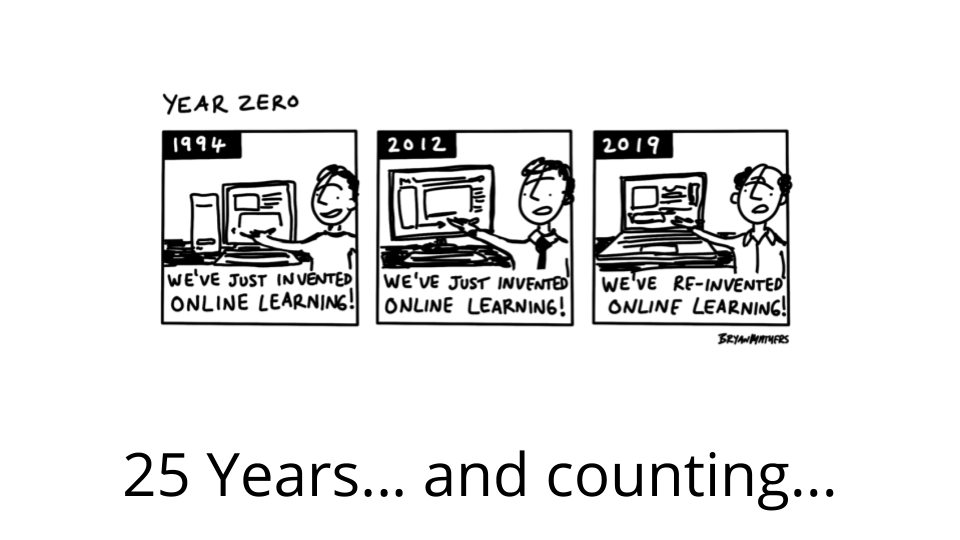
And that is important to remember and reflect on as we consider what we can learn from 25 years of history in Learning Technology to meet the challenges of an uncertain future.
I have organised and participated in many virtual events of all shapes and sizes, and I find that being online and watching video for hours is extremely tiring. We have all had many weeks of highly stressful and exhausting days, both at work and at home. So I invite you to sit back and listen. The slides from this talk including links to all the references I mention are openly accessible and there is nothing to do now for the next 25 minutes except to enjoy the start of what I am sure will be a wonderful conference.
Specifically, this talk will focus on sharing practical insights and expertise in relation to three key questions:
how to build staff capacity to use technology for learning, teaching and assessment effectively online and at scale;
how to make use of best practice frameworks and open education practices;
how to tackle equity and inclusion in online education.
Before we jump right in however, let me tell you a bit about who I am and the community of thousands of Members from the UK and beyond whom I represent.
The Association for Learning Technology (ALT) is the leading professional body for Learning Technology in the UK.
We define Learning Technology as the broad range of communication, information and related technologies that are used to support learning, teaching and assessment.
The pervasiveness of learning technology means that many working in education will be involved with it in some form, so therefore we embrace the diverse range of roles, titles and terminology in Learning Technology across sectors.
Until recently, I had no idea what a ‘Learning Technology’ emergency might be. But after months of crisis support, organising webinars, collating resources and sharing whatever support we can, I have a very clear idea of how big a challenge we are facing when it comes to scaling up learning, teaching and assessment with technology.
In the rush to pivot, pirouette or simply rush to virtual ways of doing things, it felt like a whole new audience was discovering questions that many of us were already familiar with. From being a ‘nice to have’ using technology effectively suddenly became a must have for everyone overnight. It’s not surprising that in the early days of the pandemic and the lock down it felt like we had no idea how to meet these enormous challenges. But even though this global crisis is often described as ‘unprecedented’ we do have in fact decades of research and successful practice, partnerships with industry and knowledge sharing networks across the globe. As an Association we celebrated our 25th anniversary nearly two years ago and the expertise and experience we have as a community certainly shows us what steps we might take into an uncertain future.
It is important for us to learn from the history of education technology, to explore what we know works and what doesn’t – and importantly to gain a sense of perspective that the current crisis makes is extremely hard to retain.
As staff leading organisations to the start of a new term amidst a lot of uncertainty, taking a longer view can help us gain a better understanding of when technology can help and what it can’t do. Looking back, as well as ahead, also prompts us to reflect on our relationship with technology, and how it mediates the way we work with each other and the way we relate to students.
Assessment has always been key to using technology in education. It’s an expression of what we value, what we can measure… and what goes left unsaid. Right here, right now, you trust me to present this keynote talk to you and I trust you to participate. There are many, many things going on where we are, family members coming into the room, pets, too, there is probably windows with work emails, windows with social media feeds, windows with personal shopping, windows with… anything else that currently demands your attention. Trust is part of the virtual undertaking just as it forms an important part of how we behave towards each other in person.
People, not technology, are what makes online learning work – and there is no magic button to solve all the messy, human ‘problems’ that are part of every virtual learning experience. People, staff and students, are always at the heart of our work.
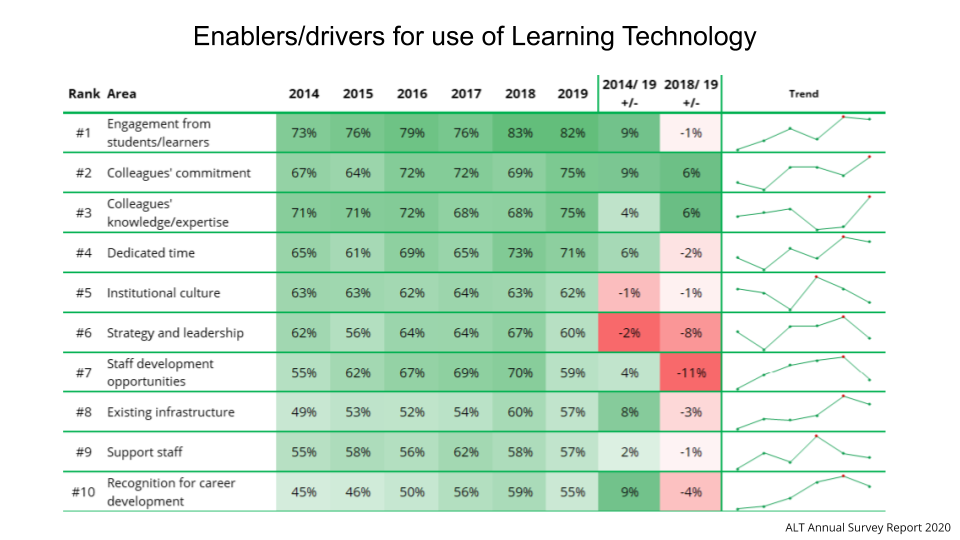
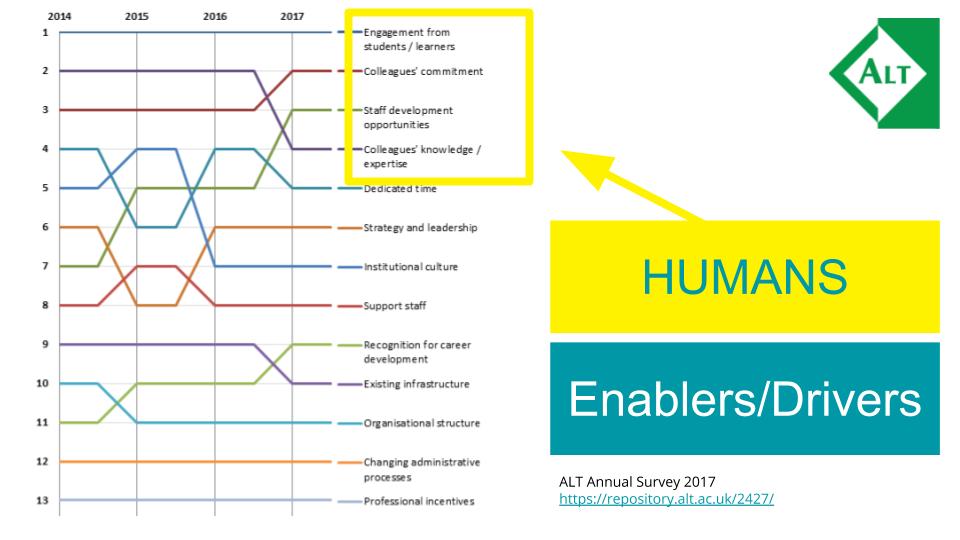
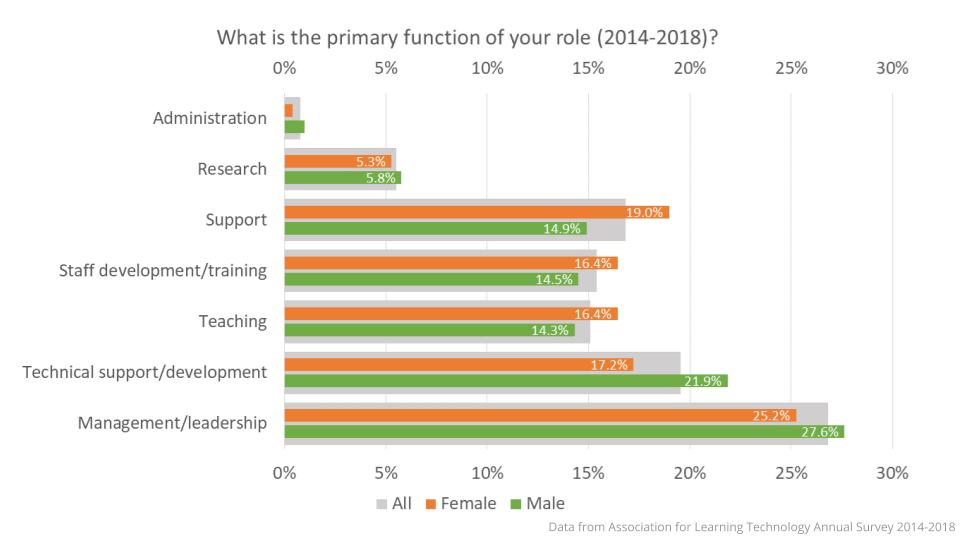
For several years now, ALT’s Annual Survey has provided valuable insight into current practice in Learning Technology and how technology is used across sectors
When we look at what the key enables and drivers for use of Learning Technology are, the top results are always student and staff engagement, commitment, knowledge and time. Scaling up design and delivery online is going to require increasing capacity. Professional bodies like ALT can help by providing access to expertise for recruitment, openly sharing research and best practice and facilitating knowledge exchange between organisations across sectors and with industry.
Recent estimates shared by Professor Tony Bates showed that institutions in the US and Canada are preparing for an increase in staff supporting Learning Technology by 15-25%. ALT’s Annual Survey 2020 highlights priorities for learning, teaching and assessment that point towards an increase for Learning Technology across the board. Of particular note in the survey is the recorded increasing importance of web conferencing/virtual classroom software and collaborative tools suggesting that the sector was already building capacity in these areas prior to COVID-19.
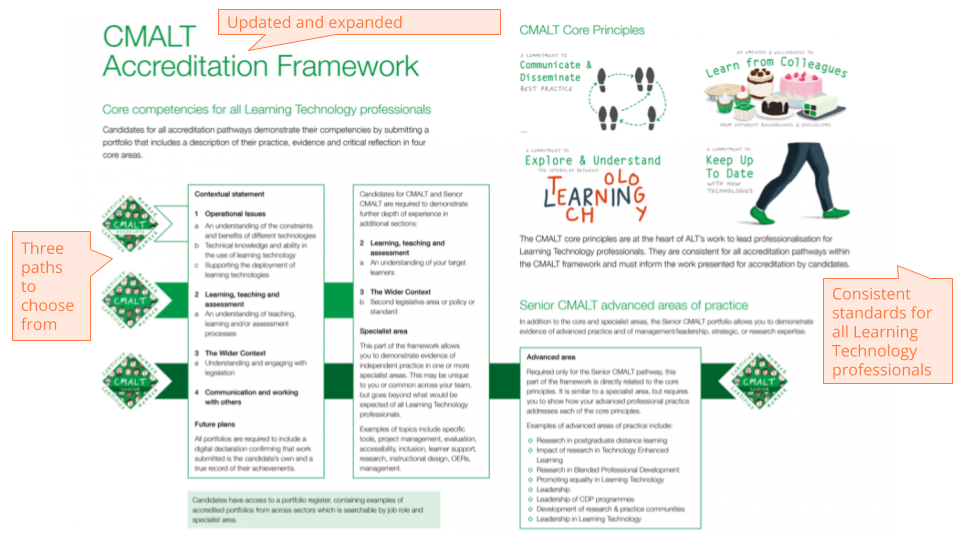
One of the ways we have recently contributed to building professional capacity is to expand ALT’s framework of professional practice and capabilities to reflect the increasingly wide range of roles that have a Learning Technology component. The number of roles which require Learning Technology is only set to increase in the coming years, making it ever more important to set out not just operational standards, but also recognise the wider context of Learning Technology policy, theory and history as fundamental to its ethical, equitable and fair use.
The analysis of current and future trends also helps establish key areas in which to grow capacity, such as virtual learning environments, particularly in the light of the expanded accessibility legislation; virtual classroom and web conferencing tools, which are now in high demand and also collaborative tools as well as with e-assessment. E-Assessment has continued to be a to priority over the past six years, including online submission & feedback tools.
Yet as the technology has become more sophisticated and more widely adopted, so have concerns regarding their ethical and inclusive use. Learning Technology as a whole, and technology for assessment in particular, has brought wide ranging concerns and questions to the forefront of professional practice.
We have to act now, to tackle inequality and discrimination in all its forms, particularly as we look beyond the crisis. We already know that certain groups and communities are more affected by the pandemic and that working and learning at home brings with it a plethora of issues around access to infrastructure, devices and space. Beyond practical considerations, we must consider how complex technologies and algorithms function and how their inherent biases impact on staff and students alike particularly when it comes to assessment.
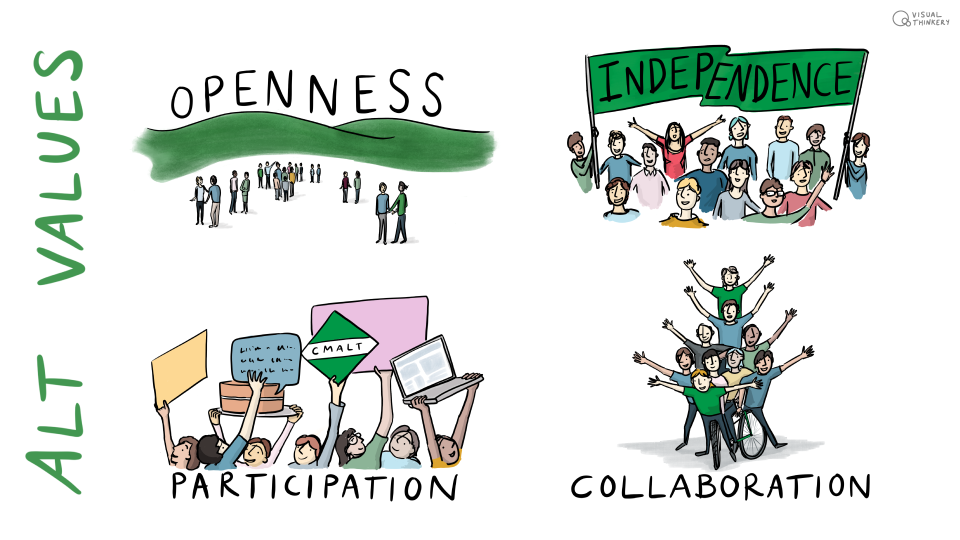
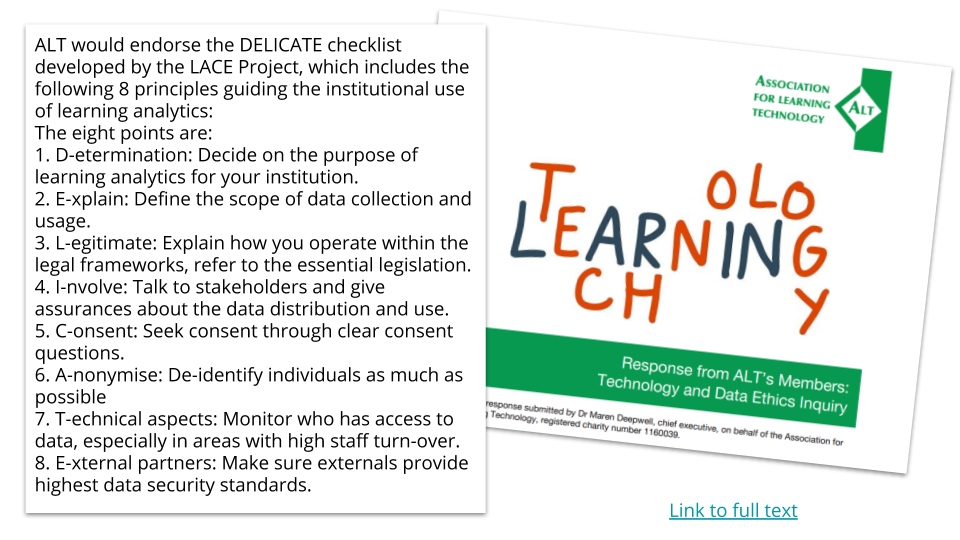
ALT has long supported open education in all its forms. In the recent crisis in particular, we have been able to support our Members and the wider community more effectively through open approaches, fostering knowledge sharing and transparency. We encourage professionals and organisations to adopt open licences for course materials, research and other content. Two areas in which this has been of particular importance are policy advocacy for ethical approaches to using data in education, copyright for online learning and sharing best practice around accessibility:
Weekly webinars organised by Members of ALT started on Friday 20th March in response to queries largely from those in higher education related to copyright and online learning following the outbreak of the COVID-19 pandemic and the shift to online learning. The webinars are free to all and aimed at those interested in talking about copyright challenges at the current time and how we can address them. The organisers have published a page full of resources and the original blog post that led to starting this series on Copyright, Fair Dealing and Online Teaching in a time of Crisis.
I feel it is important to focus on these aspects of using technology as well as more operational questions as these issues are only becoming more urgent as we move more and more students online. Our professional practice has to find ways of tackling (structural) inequalities and help identify the blind spots in our perspectives.
Last summer when our Annual Conference took place in Edinburgh, I was very inspired by a wonderful keynote given by Jesse Stommel. I’d encourage you to watch the entire talk, Critical Pedagogy, Civil Disobedience and Edtech. For this talk, I’d like to include one particular quote, which encourages us to undertake a ‘critical examination of our technologies, what they afford, who they exclude, how they’re monetized, and what pedagogies they have already baked in. But it requires we also begin with a consideration of what we value, the kinds of relationships we want to develop with our students, why we gather together in places like universities and how humans learn.
Now, a year ago, this already seemed like an urgent priority, but in light of what has happened this year, it seems even more poignant. As we plan for an uncertain future, trusting in students and trusting in staff, rather than implementing more sophisticated ways of tracking, analysing and watching each other seems like a good place to start. And that is the thought that I hope you will carry with you over the next days and week as you participate in this conference and as you go on to plan for a new, unprecedented, academic year.
This year has started with two very different keynotes: the first in January I wrote for an event on scaling up Learning Technology which was chaired by Dr Michael Flavin, and the second, a joint keynote with my colleague Martin Hawksey, was written for a one day workshop organised for the Data Human Interaction Plus network.
If you’d like to have a look at the slides and references for the two talks, you can access them here:
From empowered professional practice to empowerment in the age of surveillance: opportunities for human data interaction – joint keynote with Martin Hawksey for the Human-Data Interaction Network Plus
Some common themes emerged for me from contributing to these two events:
More tech-critical voices This year I feel I am hearing more voices that are critical towards use of technology in education and more broadly our relationship to technology as a society and as individuals. More people are questioning where the boundaries of technology and the tech industry should be, who should enforce them and how. I hear suggestions of limiting our use of technology or at least to stop proceeding unquestioningly with scaling up what we do. There are more questions being asked about ethics, policies and equality – questions that are becoming more specific and informed, not simply articulating a general, vague concern.
More wholesale digital adoption At the sometime there is a growing number of institutions who are ‘doing digital’ across the board. The examples I come across most often are focused on systems or platforms more administrative in nature or common software packages and productivity tools. But the transformation can still be powerful and there is often a drive to up-skill and develop the workforce and the learner population at the same time. This is very much about digital skills and literacy not often about the more expert design, implementation or support of Learning Technology more specifically but this often gets conflated in the way the process is described. Whilst on the whole a very positive move, there are two challenges that I often see come up next: first, as the tools change iteratively the process of training users has to continue and fostering a culture which normalises that is hard to do. Hence there is a lot of messiness in how people use technology long term, little patches, work arounds, small idiosyncrasies which accumulate over time. Everyone has legacy systems, spreadsheets, databases and so on they don’t know what to do with. The other challenge is to find enough resources (of every kind) to continue to do Learning Technology beyond the core systems you have scaled up and to invest in the expertise you need to do that in the long run rather than to outsource innovation to private sector companies and loose that capacity.
Negativity, pace and productivity Whilst I still meet with a lot of genuine enthusiasm for technology a lot of narratives I have come across during the start of the year are driven by negativity, primarily about the wider context. Political, social and economic factors shape our perception of technology. The pace of innovation continues to be a factor also: should we try to keep pace, and why? Will technological change keep accelerating and how does this impact upon the world we live in? Meanwhile I feel productivity has snuck into our ways of thinking about research and practice. Playful approaches, mindfulness, even time specifically set aside for ‘moon shoots’ is really all about doing ever more with less. Always contactable and on the go whilst in reality there are too many meetings in which nothing happens at all.
Resistance and hope, articulated Against this rather bleak backdrop however, power is rising. Expertise is multiplying, action being taken and there is a drive to resist surveillance capitalism and to find alternatives that can provide hope whilst still offering functioning business models are cropping up more and more frequently. It’s always a privilege to be invited to contribute to events as a speaker and if the first two talks of 2020 are anything to go by the resulting discussions will be extremely interesting this year.
This week I am looking forward to contributing to the 4th Annual Further Education Technology Forum in London. It’s a great opportunity for me to spend a day learning from and listen to colleagues who work for FE providers and I very much value the practical insights that the day affords me.
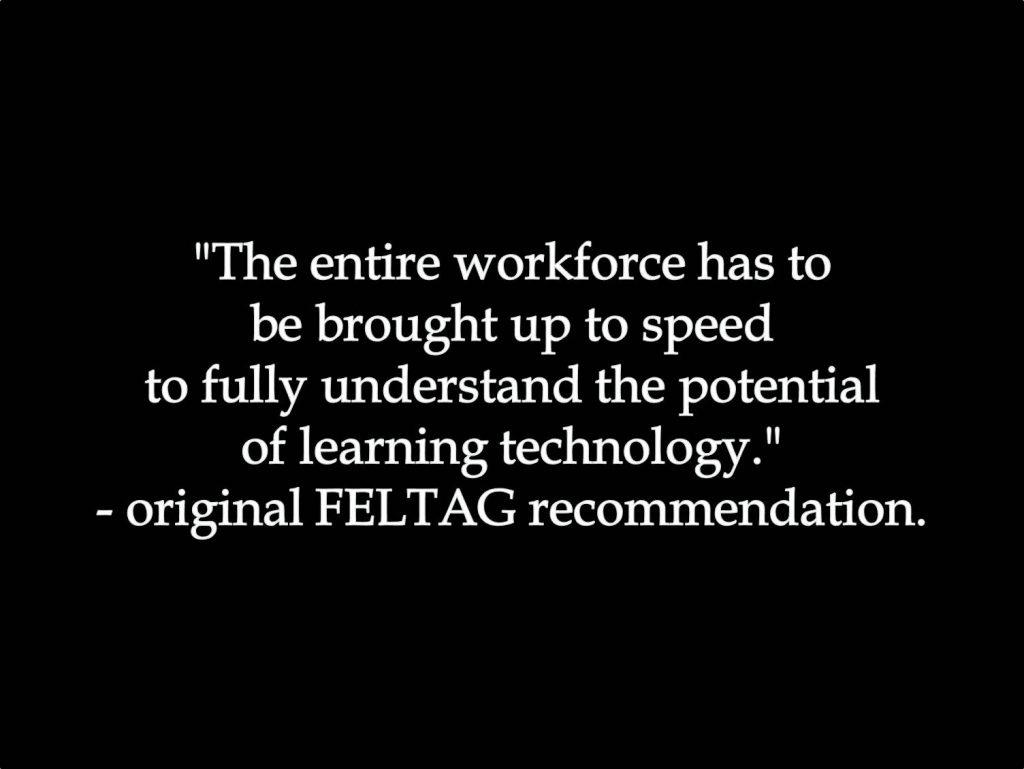
This year, due to some fortunate circumstances beyond our control, I am delighted to speak together with Bob Harrison, whom I have known and worked with ever since I became chief executive of ALT in 2012. Bob was one of the first people to engage with me as a new arrival to a then brand new ministerial consultation group. Amidst all the politics that I as a newcomer was largely unaware of, Bob was always ready to listen, to learn and to change his mind – three qualities that I have since only encountered rarely in such contexts and together we contributed first to FELTAG, then to ETAG and to every policy development regarding Learning Technology in FE since. We share a passion for what FE is all about and our closing keynote comes under a heading which gives us scope to explore all the key issues, entitled as it is ‘Re-Invigorating the FELTAG Agenda and Discussing the Edtech Strategy- Evaluating Progress To Date and Discussing Priorities Going Forward’.
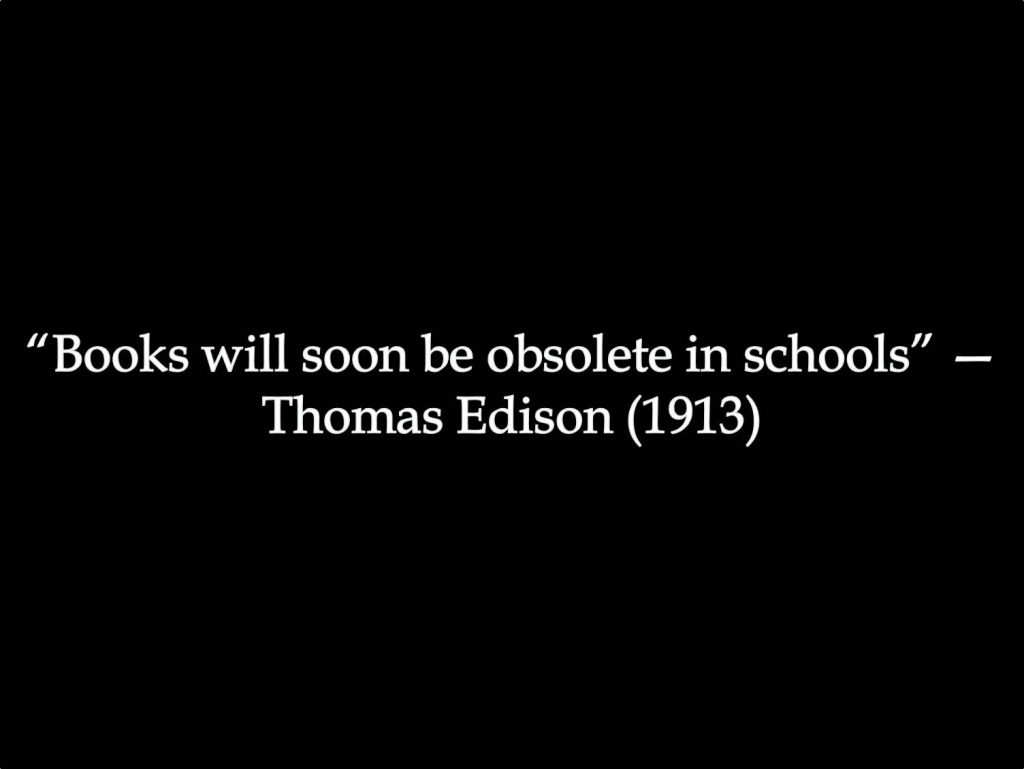
And my concluding thought then was this: It has been over a century since Thomas Edison predicted the demise of books in schools and his predication has failed to come true. It’s also been over three years since that first meeting of the FELTAG group. We are now beyond FELTAG, we are finally living the future that’s always been just beyond the horizon and that’s a lot of responsibility for each of us.
A year later, I focused my keynote talk on Talking about #FELTAG: keynote on workforce development in Learning Technology. The talk focused on very practical and urgent needs identified in relation to two key sector needs: Digital Skills development in the workforce and Accreditation fit for a (digital) purpose? In FE Week, I concluded “that FELTAG set out, .. that ‘digital technology was not the end goal in itself’. … As an action group we [FELTAG] set out how Learning Technology can help meet the increasingly challenging demands in Further Education. Not primarily for economic or political gain, or indeed to the benefit of the employers, providers and developers involved. It’s the learners and the diverse constituency they represent and the contribution they make that is at the heart of the system. The kind of transformation you can witness in Forth Valley College and beyond demonstrates what’s achievable against all the odds. Against all the bleak headlines of recent months and years, it left me with a note of hope for the work we do as professionals across the UK and the future of FE(LTAG).”
That still rings true now.
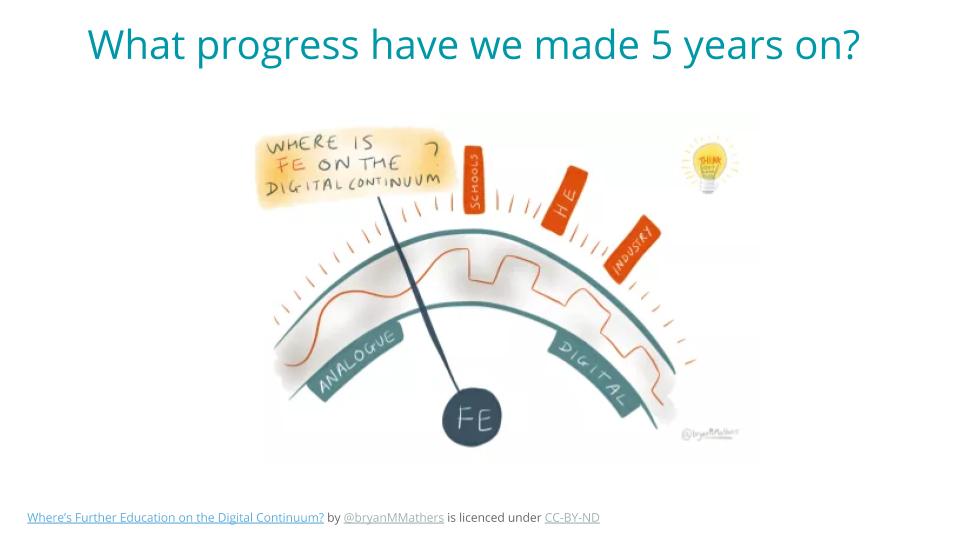
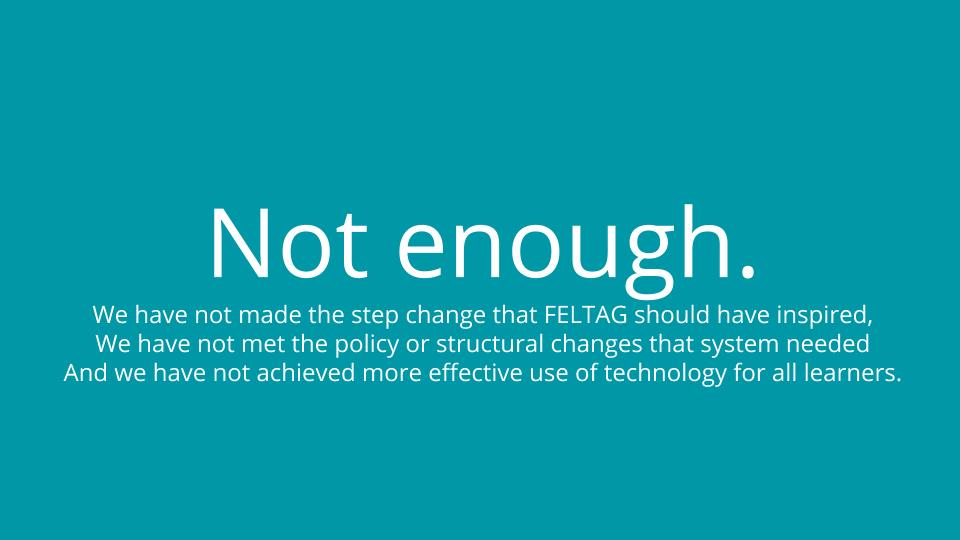
Then, last year, against an increasingly dark FE landscape, my keynote looked at FELTAG – 5 years on: what more can we do and this time I took a more critical look at what progress we had made:
Now, this year, in a year which has seen strong activism and advocacy for the sector, strong political engagement on behalf of colleges and the whole vocational education system, I want to try and focus on two things (and you can access my slides here): first, to share some very practical resources with my audience to share the particular expertise and knowledge from the community I serve, the Members of the leading professional body for Learning Technology in the UK. A community whose Members are increasingly taking on more responsibility and more senior roles as organisations recognise that they need the kind of specialist skills and insights that Learning Technology professionals have in order to take effective decisions about how to use technology for learning, teaching and assessment.
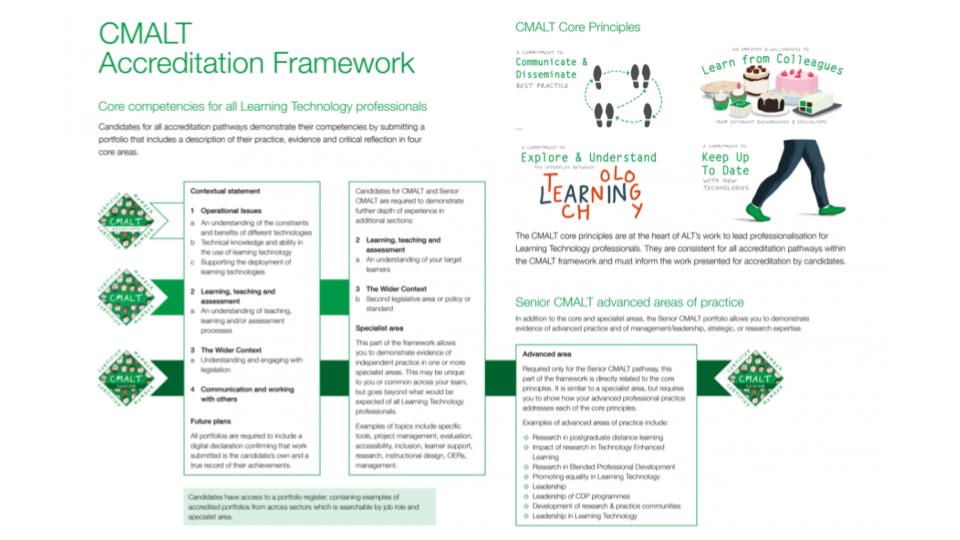
One of the resources I will share is a new, expanded framework for professional recognition. Developed with the input from many of our accreditation Members and peer assessors, this framework provides pathways to peer-assessed accreditation for Learning Technology professionals in the UK and internationally. It includes core competencies and core principles of professional practice as well as guidance on ethical considerations and reflects the broad range of professional roles that require an increasingly specialist Learning Technology expertise.
Another new development to share in relation to the accessibility and inclusion agenda at the heart of the Department for Education’s Edtech Strategy is a growing set of webinar recordings and resources hosted by ALT in collaboration with the Further Higher Education Digital Accessibility Working Group (FHEDAWG). The series now includes topics such as ‘Inclusivity by design in Virtual Learning Environments’, the ‘Web Content Accessibility Guidelines (WCAG) explored with policy makers’ and ‘Digital Accessibility as a right’ and all recordings and content from the sessions is freely available to all.
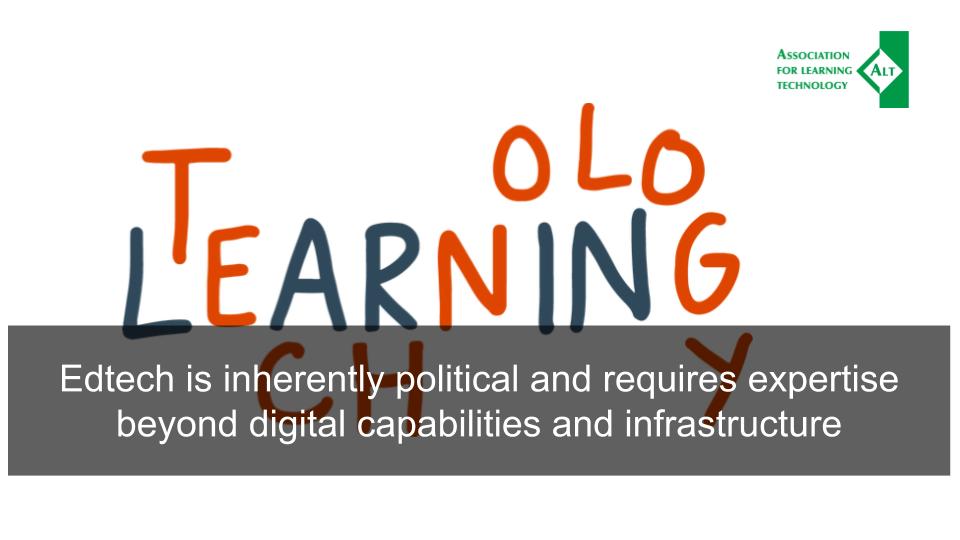
The other issue I want to focus on in my talk, is that Learning Technology and by extension being a Learning Technology professional, is inherently political – and our role is to not only manage the risks involved for staff and students, but to face up to some of the big questions that using technology in education at scale brings with it: issues around privacy, transparency and the well being of learners. We need to continue to focus on access, inclusion and equity. We need to acknowledge that the skills required to tackle such questions goes far beyond digital literacy or even data literacy and I want to champion the role of the Learning Technology professional in that endeavour.
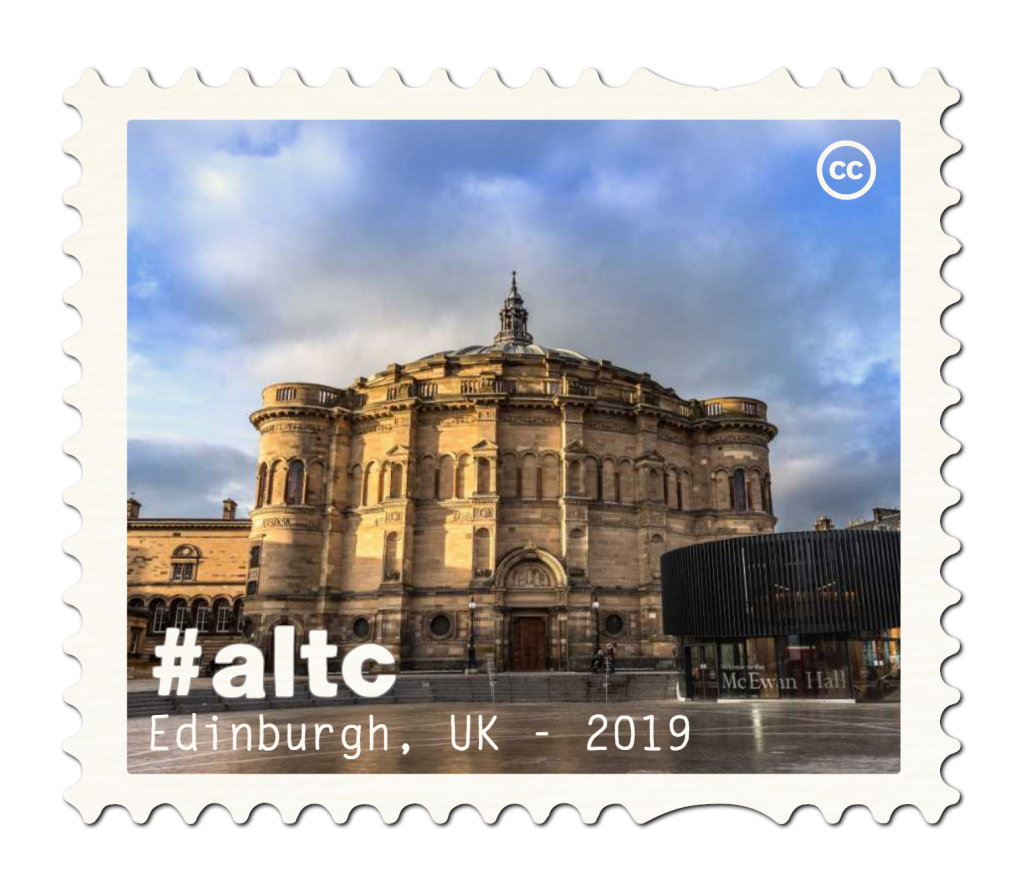
It’s nearly September and since 2008 that’s meant that – at least in my world – it’s time to get ready for ALT’s Annual Conference. It’s an exciting time of busy preparations, 101 things to remember and, importantly, shoes to line up to pack for the week ahead (those of you who know about #shoetweets will understand).
As ALT’s chief executive my role in the conference run up is all about strategy, income generation, academic review procedures… in short, there are A LOT of spreadsheets involved and reports to write. It’s rewarding work and very important to ALT as a membership organisation. But there comes a time, and that’s today, when my thoughts turn more to what attending the conference would be like if I were a delegate… which sessions I would like to go to, whom I’d like to see speak or catch up with.
So here is my personal #altc preview, if I was attending as a delegate, either virtually or in Edinburgh:
In some ways I attend the conference virtually every year, because so much time is devoted to the conversation on the #altc hashtag. I really enjoyed reading what’s in store on social media and online this year in this post by Lorna Campbell. I particularly liked this bit:
The ALT Conference has always had a really lively and engaging social media presence, which draws in participants from all over the world. I’m delighted to help facilitate this as part of ALT’s social media team, along with partners in crime Rich Goodman (@bulgenen), from the University of Loughborough, and photographer Chris Bull (@chrisbull1980). My role is to livetweet the conference keynotes from ALT’s official twitter account @A_L_T, while Rich will be tweeting Chris’ photographs, which really capture the buzz and energy of the conference. You can see Chris’ pictures from last year’s ALT Conference on ALT’s flickr channel, and in keeping with ALT’s strategic commitment to openness, they’re all Creative Commons licensed.
That sent me down a rabbit hole of looking at photos from previous years and reminded me how much sessions like the Assembly Meeting, the Annual General Meeting and the CMALT Ceremony as well as the Learning Technologist of the Year Awards help make the conference the wonderful experience it often is. So these sessions are definitely in my calendar:
My other plan for engaging with the conference, and other events I attend, is to try and find sessions about which I know very little and go to those in order to discover something new. In that spirit, the following session also get included on my #altc calendar:
Last, I am planning to take some time to spend in the exhibition at the ALT Stand meeting Members. In my first year, when I didn’t know anyone, I was greatly relieved to be seeing some friendly faces, to be made to feel welcome and to have people to talk to who shared what their day to day work was like. A few years on and I still find sitting at the stand and listening the best use of my time for much of the conference. I might also have some #femedtech stickers and badges on me… 😉
I’m also going to try and join into some of the remote activities like VConnecting and look out in particular for blog posts starting to flood in now that the guest posts written in the run up have concluded in a lovely welcome from the Co-Chairs.
So, Edinburgh or virtually, here we come. This may be the calm before the storm, but I feel there is a fair (conference) wind blowing and that is something to be celebrated given the times we live in. For whatever joy, inspiration and enthusiasm next week holds in store, I think we are going to need every ounce of it in the year ahead. And maybe we will raise a ‘wee dram’ to that #altc.