Last week I went to see Gwen John’s major retrospective, Strange Beauties at the National Museum in Cardiff:
Gwen John: Strange Beauties is a once-in-a-generation exhibition, bringing together rarely seen works from Amgueddfa Cymru and collections from around the world to celebrate her 150th birthday. It is the first major collection of her work in over forty years. It tells Gwen’s story as it’s never been told before — revealing new ways of seeing her life and art and celebrating an artist whose vision still feels strikingly modern today.
I am not always a big fan of exhibitions of portraits, which was up to recently the only type of work by Gwen John I was familiar with, so I was surprised how much I enjoyed and got from the exhibition. Thoughts and ideas have been percolating in my mind, exploring how what I saw in the exhibition relates to my work and why I found it so urgently relevant now. Here goes:
Sketchbooks
Sketchbooks are a recurring topic which I have blogged about before, and I was intrigued to see several sketchbooks on display in the exhibition. In keeping with the era in which John was active, most of these were tiny, smaller than a postcard size, and her drawings and sketches were correspondingly small, often no larger than the size of a sticker or even a stamp. And yet, the acute skill of observation pretty much jumped off the page. The drawings themselves were rough skteches, but what was captured, what was noticed, was astonishing.
It got me thinking about how much a painter like Gwen John has to develop the ability to be present, to be observant and to be curious. To pay attention to the world around her in order to notice, in order to see and capture those subtle moments, a shift of the light, a curve of the neck, which later gets translated into paint. It’s a skillset that is becoming harder and harder to cultivate and maintain nowadays, and something that I often work on in my own practice and in my leadership coaching.
When I was at art school, most of my tutorials were about me and my tutor looking through my sketchbooks from the past couple of weeks, discussing bits that stood out, or considering which ideas to develop more. In many ways those tutorials (and the formative assessment they provided) taught me to respect the process, to value my practice, as much or more than the eventual output, and that training continues to inform the way I work and my leadership practice still. Gwen John’s work was deeply inspiring in that respect and made me reflect how it’s something I work on again and again with emerging and even established leaders and teams, and a precious skillset well worth nurturing.
Series
One of the other things I found astonishing about the exhibition was the sheer quantity of artworks that the curators had brought together. Gwen John is not a famous enough artist that you see many rooms in general museums dedicated to her work, and her paintings are usually quite small in size, which makes them blend into a general collection rather than stand out, at least to the casual observer.
However, in this exhibition there were rooms and rooms filled with her work, which often included paintings in a series all about the same or similar subjects. My favourite of these was a series of five paintings called “Convalescent Girl” which showed a young woman sitting with a book, in slightly varying poses, and with slightly different light or angles. The long contemplation of the same subject, and immersing one’s practice in it in order to observe “strange beauty” is where the exhibition finds it title.
It probably doesn’t sound particularly amazing when you describe it like this, but it was incredible to see work develop, different shades, different light, a slightly different way for the hair to fall across the face and so on. It wasn’t that the earliest painting was just a sketch and the last one the final product. No, each of them brought something new or different to light, and each of them contributed to the overall series.
It made me happy to see these series, and how much they articulated the curiosity at work. It takes a lot of practice to be that good at being curious, curious enough to want to explore something quotidian so deeply. It was incredibly calming to look at these series and relax into being curious myself.
In a way that series of paintings, all of the same girl in more or less the same pose, is the opposite of how we meet images or information online, in an endless scroll of novelty and hooks designed to prompt us to click. This was the same image over and over, giving you permission to linger. Permission to slow down and just be present. Which is another skill I value highly.
Cats
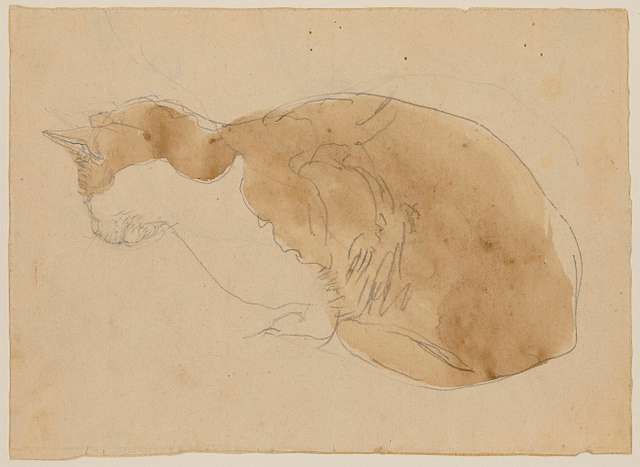
I hadn’t come across Gwen John’s drawings of cats much before this exhibition, and there was a whole wall dedicated to them here: in a long line, one after the other, there were drawings of cats, sitting, lying, sleeping. Some in pencil or charcoal, others in watercolour. They were playful and messy and beautifully observed.
They were also a lot of them and in the museum shop I saw a huge poster of just cat drawings including many that weren’t on display. Preserving those cat drawings, like the sketchbooks, gave you a different perspective to explore and reminded me of the effort many of us go to preserve our digital practice in our blogs, on our own domains, in archiving what we post and keeping track of how and when.
Its a niche in the digital realm, to keep your own archive, and one that becomes more and more valuable over time as you can see patterns and build habits. One line drawing of cats alone wouldn’t be particularly interesting, but a whole collection of them, produced over a long period of time, and ranging across different media, that suddenly becomes something different.
It’s interesting to me how much any one of these drawings would probably seem unremarkable, but a whole body of work coming together reflects a practice we can respect and revere. Just like a single blog post may not feel like it matters, especially if no one reads it, but a practice that grows over years and decades becomes a life’s work, becomes something to be proud of.
I left feeling deeply inspired and hopeful, and with much food for thought for my own practice. Thank you, Gwen John.
Image source: Gwen John drawing of a cat lying down