Category: stories

  • The beautiful long tail of (un)social media

    The beautiful long tail of (un)social media

    I really like this recent article by John Naughton on how social media has turned unsocial. In it he shares some interesting figures about the declining proportion of users, particularly younger adult users, who post on social media sites and the increase in consuming content passively, scrolling mindlessly.

    It echoes with my own use of these platforms, both in terms of my personal posting habits and my ability to reach and connect with others. Things have changed, that’s for sure. And yet I am one of the lucky web generation that experienced the age of social media and blogging that built real personal connections and friendships, many of which still persist.

    Never has that been more apparent than on a recent trip to Canada, a holiday which gave me the opportunity to catch up with many friends first made on social media, through conferences and collaborations. In many cases it’s been many years since we last saw each other in real life, hugged and shared food, and we keep in touch sporadically via letters and postcards, or old-fashioned family facebook posts or indeed on signal and wherever else.

    We shared travels tips and subsequently visited many eateries and vinyl shops and beaches recommended by friends. It really made the trip so much more special, and led to sharing many photos and travel updates along the way.

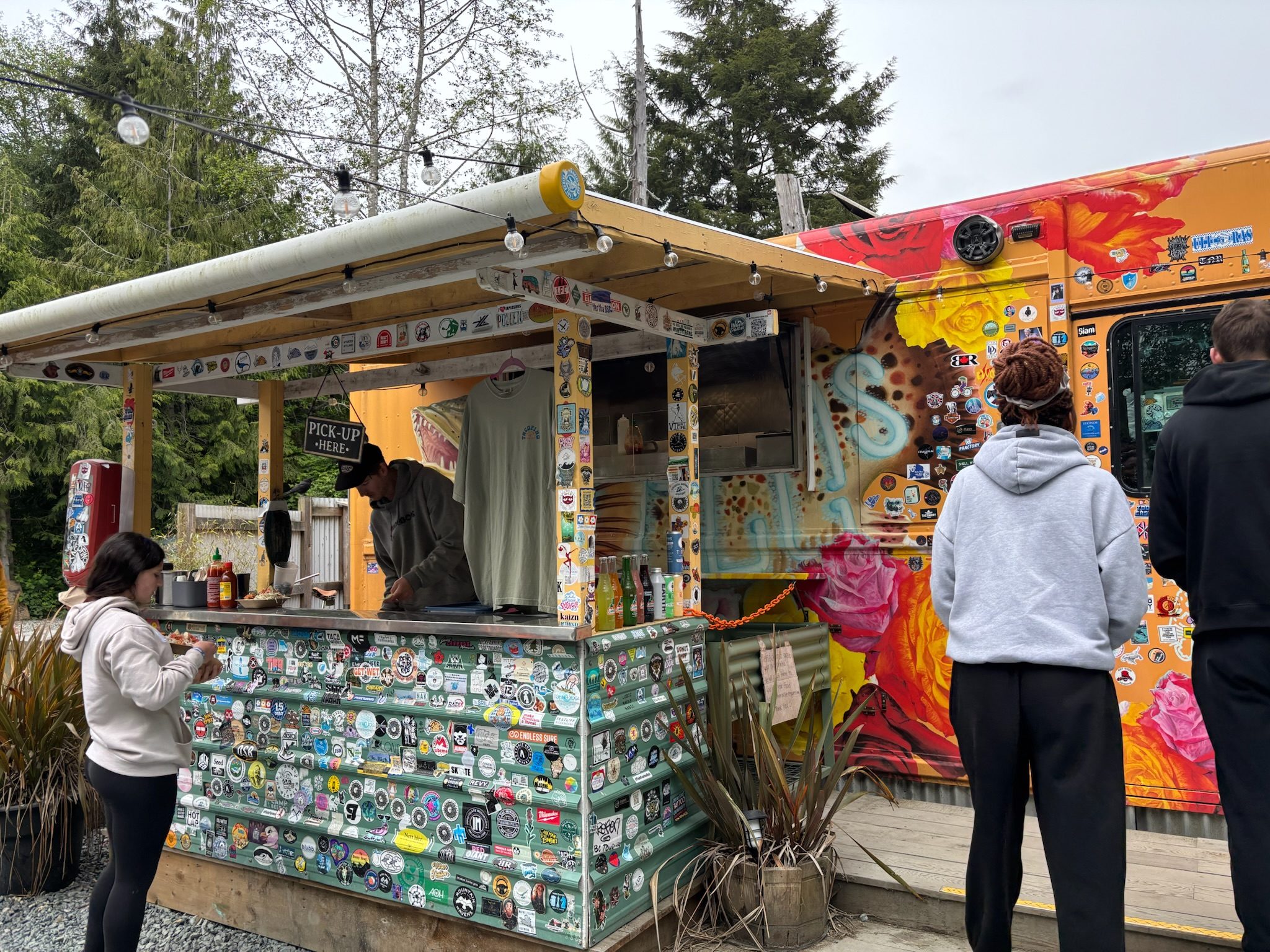
    A photo of the Tacofino taco truck in Tofino.
    A photo of the Tacofino taco truck in Tofino.

    We collected stickers, now proudly covering my suitcase, from as many places as we could, and it reminded me of my laptop that likewise used to be covered in stickers from conferences (it still is, I just travel a little less nowadays) and how I used to collect and send stickers from events on to friends who couldn’t make it. Once we had a regular ‘black market’ for Bryan Mather’s beautiful creations between the edtech lady pen pals of the world.

    I may not like what many mainstream social media platforms are turning into today, and I will continue to try and connect and engage via federated social media, but I am most grateful for the connections that I made in the before times, and all the beautiful friendships that have resulted from them.

  • Long time reader…

    Long time reader…

    I often talk about blogging, but this post is different. This is a thank you to two writers whom I have been following for a long while, and whose work continues to inspire me.

    Julia Harrison

    First up, is Julia Harrison, a North Carolina-based artist, anthropologist, and educator, whom I met when I was studying Anthropology at UCL.

    Julia’s work is all round awesome, and I am a regular reader of her blog, and a great admirer of her creations. From wooden paper bags and jewellery to awe-inspiring public art and furnishings, her domain is a treasure trove of inspiration. You can even join her for a virtual studio visit!

    What I appreciate the most, however, is Julia’s newsletter. It’s semi-regular, and whenever a new edition lands in my inbox I happily read the whole thing. I love the tone and voice, I am always interested to learn about what’s been happening and it balances a great mix of work/art and life.

    Nick Tabone

    Around the same time as I was at UCL, I also worked at Foyles, and London’s melting pot delivered a wonderful group of co-workers including Nick Tabone. Already full to the brim with book and music recommendations then, many of which I still have on my bookshelf and in my record collection today, Nick’s writing has evolved over the years as his life has taken him to become a writer, a sailor, a runner, and a skateboarder.

    I mostly follow his non-fiction, usually written from aboard ship, always compelling and beautiful. And there is a huge amount of poetry and fiction to explore as well, which I strongly recommend you do.

    One day, I hope that copies of Nick’s published books will sit alongside all the volumes he inspired me to read on the shelf next to my desk.

    May the blogging continue 🙂

    Image:  Hat tip by Maren Deepwell is licenced CC-BY-SA 4.0

  • Read, Run, Write. Repeat.

    Read, Run, Write. Repeat.

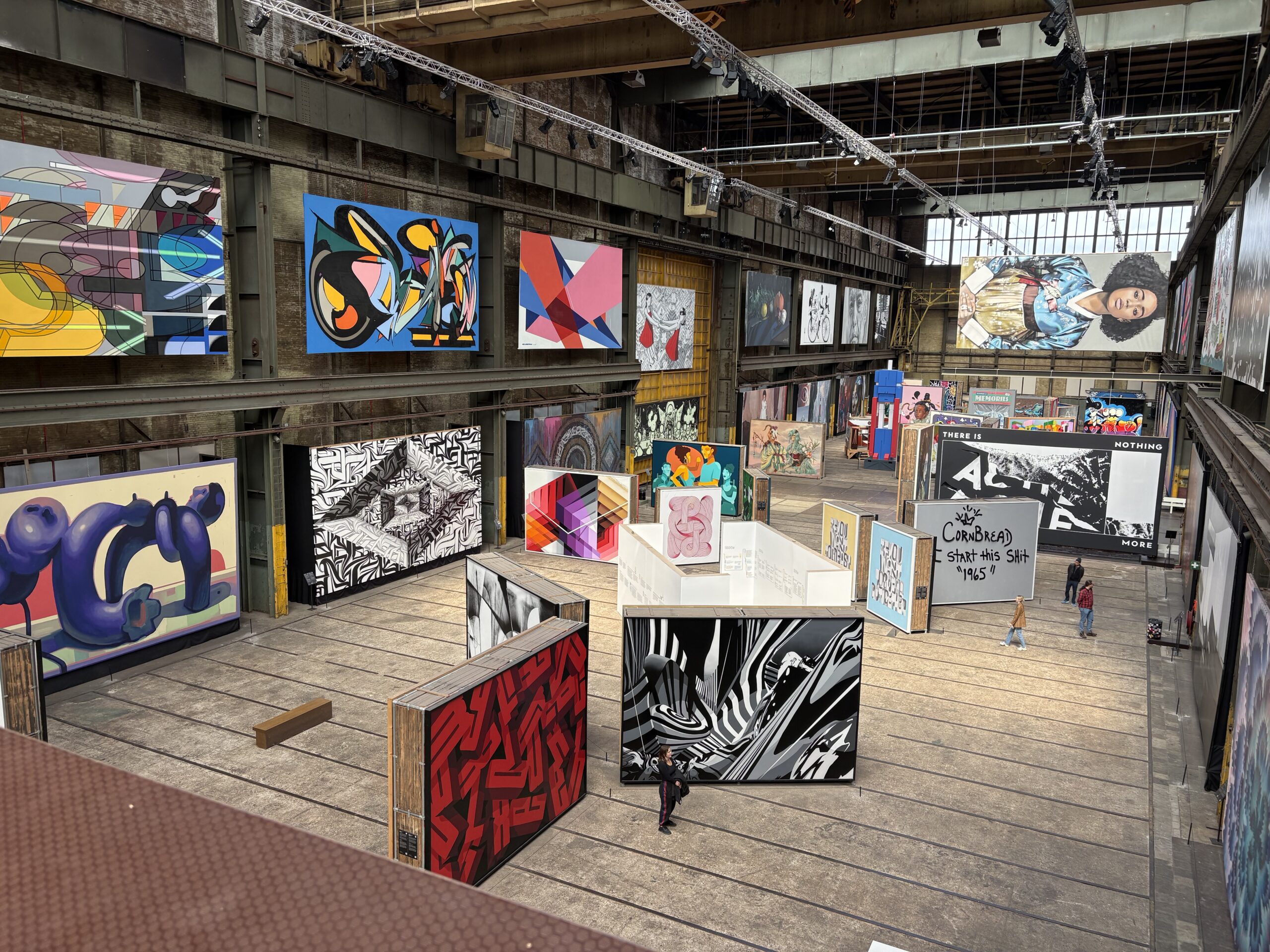
    After a week away I have returned to my desk to write (freshly inspired thanks to the museums of Amsterdam). Progress on the book this month has been better, and I have found a new rhythm: read, run, write. Repeat.

    It helps me to read more to feed my creativity and find inspiration, and I am lucky that my recent haul of books from the library has been plentiful in both. The running gives me space and time to think about things, and although I rarely manage to actually record anything whilst I jog along river paths (I need the breath for running), by the time I return home I am usually ready to get writing.

    In my writing journal I keep a record of the days I write, and how long I have worked for. At the moment, I have started with 90 minutes, then step away. My concentration doesn’t last much long yet, as I am finding my way into the book. Flow is patchy, but there is a vague shape of things now. I am getting words down on the page.

    This month was the first in my new writing regime, and it feels good.

  • The Lost Podcast: Talking career (meaning) making with Kin Lane

    The Lost Podcast: Talking career (meaning) making with Kin Lane

    Inspired by Kin Lane’s post Having a Career I recently posted my own career story, and this blog post exchange inspired me so much that I reached out to Kin to record a conversation for the podcast. And so, two humans and two dogs assembled online to do just that. 

    We chatted for an hour, and the conversation was so thought provoking! In addition, meeting the one and only Poppy R Lane (follow her on Instagram) was especially fun (my own dog eyed the bike side car with envy… ;)). Unfortunately the tech gods weren’t smiling and I didn’t manage to capture the conversation audio, resulting in no podcast. Sigh. 

    Instead, I want to use this post to capture some of the things that came up (for me) during our conversation and also express how much it inspired my thinking. In an ideal world, the conversation would have happened in a NYC park, where I was supposed to be later this month, and instead we made do with the best virtual equivalent. Maybe this ‘lost podcast’ is a good metaphor for why some conversations have to happen in the here and now. Maybe there will be another version of the conversation we eventually record as a podcast. 

    Creating measure for what matters

    One of the things we talked about was finding new meanings for what matters when traditional metrics of career progress, financial or reputational reward, become less meaningful. In the context of reinventing yourself and your career path. We shared examples of manual jobs we had early on, and how there is no straight line, no template to predict the path from those origins via all the things that have been accomplished since, to where we are now. Each on our own journey to reinvent and I suppose reinvigorate our thinking at the intersection of technology and society.  I shared the example of beach/life balance (my measure for how often I can afford time off to go to the beach with the dogs), which I have come to use to check in with work/life balance and focusing on things outside of my computer screen. 

    Holding your own space on the web

    Kin is a prolific blogger, both on his own domains Kin Lane and the API Evangelist. As a writer and a storyteller he holds his own space on the web, and we reflected on how we would advise new or emerging bloggers. This was prompted by me being asked recently how and why I started to blog and how to get started now. I couldn’t really recall exactly how I got started initially, but it was during my time at art school, when I was experimenting with writing and sketching and sharing my work in any way I could. Given how much the web has evolved since then and what being present online necessarily brings with it, we came up with quite a few hesitations about starting now. From staying safe and dealing with inevitable unpleasantness to navigating the dynamics of social networks and the struggle to actually find someone to connect with. 

    And yet, Kin mentioned how important it is to hold your own space on the web, to have your own domain and to use it to articulate, to have a voice. 

    If you haven’t come across it, watch Kin and Jim Groom chat about Blogging over on Reclaim TV.  

    It takes work. 

    One of the things that really resonates with me is Kin’s commitment to doing the work. The work of reading and writing, to try and see the world from different angles, and to educate yourself about different points of view. It’s a human activity, a necessity (to my mind at least), that you can’t outsource. It takes time and effort and energy. It’s a lot of work. And only you can do it. 

    I may have had a very different path, but that notion of doing the work, and seeing value in that, it means a lot to me, and it reflects how much I treasure being part of the world, and how much there is to enjoy in the everyday, in being a human being (with a dog;) . 

    Thank you, Kin and Poppy. 

  • Working on the ‘Princeton University: Domain of One’s Own’ Case Study

    Working on the ‘Princeton University: Domain of One’s Own’ Case Study

    It’s been a lot of fun to help establish a new blogging community of practice with Jim Groom and the team at Reclaim since that start of the year, and you’ll no doubt hear more about blogging from me as the year goes on 🙂

    Alongside that project however I have also had the opportunity to write some case studies based on interview conversations Jim leads, and the first of these has recently been published on the Reclaim blog: Princeton University: Domain of One’s Own . As a Higher Ed case study this piece focuses on a six month’s project of a large scale server migration.

    This case study shows how the collaborative effort between the Office of Information Technology, their campus partners and Reclaim Hosting, ensured the desired outcome for stakeholders across campus, resulting in the successful and timely completion of the project [and includes] take aways which will help replicate the success of this project for future initiatives.

    It’s a unique opportunity for me to hear how amazing teams at world-leading institutions make educational technology work in the long term, and find out how they find a path through the sometimes messy reality of serving the diverse needs of an academic community in a fast moving technology landscape.

    Listening to the interviews it also strikes me how much the technology itself recedes into the background. Although the technology is what we’re talking about, it is the people that draw the focus: the large spectrum of users who bring their individual needs, deadlines and digital literacy to the work at hand, liaising with the teams on campus who navigate their projects within a complex framework of institutional policies and practices alongside a myriad of teams and directorates, and at the other end the expert team at Reclaim who are supporting the work with technical expertise, troubleshooting and their years of experience.

    Work on the next case study is already underway, and I am really looking forward to seeing this one published and to add to this body of work that tells a story of open, independent EdTech in Higher Ed right now (and that’s a story I don’t hear all that much about elsewhere just now).

  • Having a Career

    Having a Career

    When I came across Kin Lane’s post Having a Career I felt inspired. His post prompted me to think about whether it’s worth having a career, and what that means, and if it matters. These words in particular chimed with me:

    However, now I see having a career is about me. It is about owning my own professional narrative as much as I possibly can. I consider a career adjacent to entrepreneurship or running your own business, but it is something that will span multiple businesses, and give you much more control over the work you do and the money you make. A career is about me. It isn’t some category on a college aptitude test. My career isn’t chosen for me. 

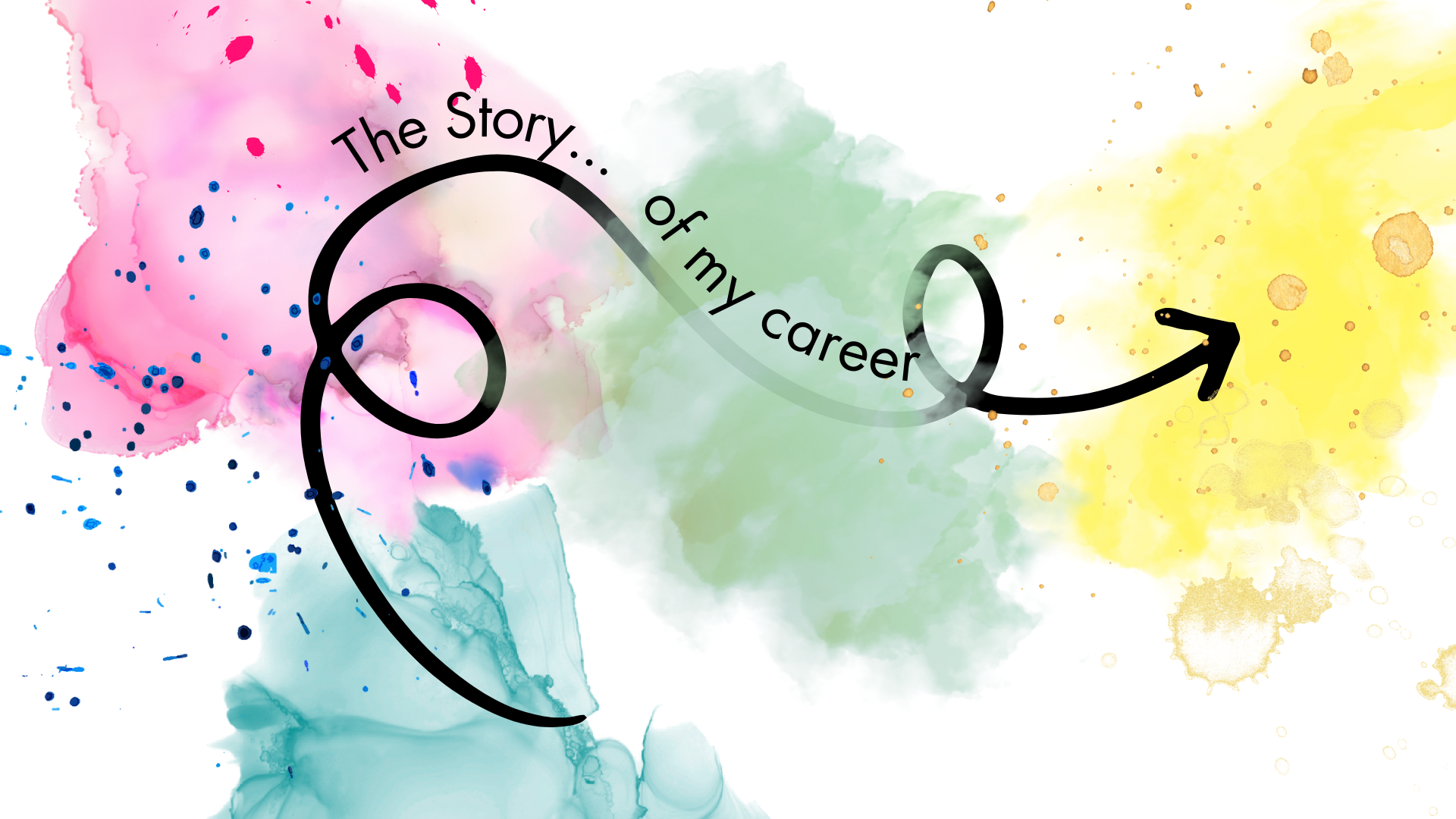
    Thanks to this inspiration, I’ve been trying to create a story about my career, and tried to make a drawing, too. That proved trickier than I had anticipated, because I started to plot my journey along a rough timeline that started in the mid 90s with summer jobs and somehow portrayed the next three decades as a linear progression. Which it wasn’t.

    Similar to Kin’s younger self, 17 year old me wanted no career. 17 year old me wanted to live a life which was authentically mine. I felt the world deeply as a young person, and it poured out of me in writing poetry, plays, novels, art, music and a lot of difficult behaviour. That I was academically able and got good grades made early adolescence easier, but eventually I outgrew my ability to fit into a regular school system. It must have been very difficult for my family and friends to make sense of my behaviour. It was very difficult to for me. I had no idea how to navigate life. Thanks for leaving school at an unconventional time, without sitting the traditional exams at 16 or at 18, I never ended up having career’s advice and made up my own instead.

    From that point on, my list of jobs started in earnest: I had every bar, cafe and restaurant job London’s service industry would offer a young immigrant with broken English. I graduated to working in bookshops, cinemas, shops, and eventually in bilingual marketing and market research. I had a job once that only paid me in tips (which took me months to realise. Once I did, I left with the whole tip jar after one very good Saturday night never to return).

    From 17 to 32 I mostly worked at whatever job I could to fund my education. Having left secondary school I discovered that there was a whole world of learning out there, and London, and later Athens, and even later Oxford, offered me every opportunity. Looking back it now seems implausible that I worked 40 hours and studied full-time as an undergraduate and later as a Masters stundet, but I loved it! Studying first design, then art and then anthropology allowed me to explore my curiousity and challenge my mind, spending days in the libraries and museums. I was lucky that I always managed to get scholarships to fund my fees (this being an era of education in which that was still possible).

    In 2004 life changed for 3 glorious years, thanks to a full AHRC PhD scholarship that enabled me to give up work. I recall the moment I found out exactly. I was on my way to work in a cafe in West London and picked up my post in the student hall where I had rented a room in for the summer. Gower Street was hot, noisy and there was no lift between my single room on the top floor (shared bathrooms) and the laundry room in the basement. I opened the letter on my way to the bus stop and right there and then, life changed. I resigned my job that day and that September I started to be a proper full-time student for the first time, with spare time to go to seminars and lectures in the evenings, and student bars, too, of course.

    It was during those years that I started working with more intention, finding jobs as a archive admin, then as a teaching assistant and as a Moodle admin at my university. As my funded years came to an end, job hunting to fund the final year of my PhD began again, and I found an admin role in a nearby university in Oxford. The deciding factor that convinced me to take the job was that I could walk to the office. Writing up my PhD in the Radcliffe Camera library sounds romantic, and it was certainly a lovely environment to work in, but it also came with a problem: I didn’t want to be an academic. My interest in my research topic had been genuine, but had been satisfied. It offered no clues as to what might be next, and so my admin summer job gradually turned into a manager role, which turned into a more senior manager role. As a side hustle I started to work as a researcher and consultant on projects. I was hungry to learn and quick to figure things out, which made me a good contractor. A few years later I decided to apply to become the CEO of the organisation I was working for, and for the next 12 years that (mostly part-time) role and my continued work as a consultant turned into a very fulfilling career.

    In my early years being a CEO I often struggled to explain to people how I had ended up in the role with a PhD in cemeteries, a degree in art, a penchant for making stuff and evidently little leadership experience. A young immigrant and a women to boot. No one had ever heard of me and my story didn’t really make sense. Working hard and being good at what I did eventually helped establish my place.

    Being a CEO of a small not-for-profit that employed fewer than 10 staff and often just 5, and turned over around half a million pounds a year (and sometimes much less) offered me the opportunity to learn a bit of everything, from finance and HR to governance and operations. It also offered me lots of opportunities to get involved in activities and communities, and to work for something that aligned with my values and that made a difference. I developed a much greater appreciation for the ethical dimension of work, of having a career. It let me experience what it’s like to have a (small) platform, and helped me develop my voice.

    As my interest in leadership and mentoring developed and I started to train as a coach and write my first book, a new chapter in my career story started. I began to re-invigorate my freelance work, which during the pandemic had dried up, and started a period of transition, letting go of one role and building a new one. I started to plan out more books I want to write, and began to sketch out a new vision for better work life balance and more independence once again.

    To many people the move didn’t make sense. It wasn’t a step up, a move to running a bigger organisation, building on what I had achieved in a smaller organisation. My pension provision agreed with them. Depending on my own little venture at this stage was (and is) risky. But it felt and still feels right to me.

    Making sense of the story so far sounds something like this in my own head:

    I started out looking for things that interested me and would challenge me. I gained some knowledge and skills, and found a lot of interesting things. So I put those capabilities to use and see what else I could do. Then I found that I could make a positive difference to others, and poured my energy into making that happen. Eventually, when I felt I needed more balance, and to spread my energy across more areas of my life, new interests led to new goals and a wish to fulfil some bigger dreams; like writing books and getting a dog and living near the sea.

    And so, I started to put together the building blocks for a small, independent business venture that would help me fulfil these and other dreams, whilst doing work that makes a positive difference in the world and aligns with my values. It makes perfect sense to me, even if on a day to day basis it remains equal parts imagination and profitable job.

    This summer it’ll be 28 years since a young Maren climbed the steps from the tube station up into the streets of London, carrying a duffel bag, a pillow and a role of The Cure posters (and an open ticket to fly home anytime, because my parents thankfully had more sense than I did).

    At the time I felt the urgency of life deeply. I thought time to be my true self would run out when I reached the (what I then thought) calm and boring reaches of adulthood, of middle age. I think my younger self would be relieved (if disbelieving) to learn that existential dread and big questions still float around my head every day, even though I have become a lot better at managing daily life. I like to imagine that 17 year old me would LOVE my dog Posey, and would appreciate that I have managed to publish my first book, and being on my way to the second.

    I am not sure what I thought “success” would look like when I was 17. Money or status has never driven me, even though I have always safeguarded my financial independence. Ethics and values are important to me, as is making a difference. The best I way I have to explain it is a metaphor:

    For years and years I’ve kept sketchbooks filled with writing, drawing, sketches, pictures and small mementos. The process of keeping the sketchbook is much more important than individual pages, and often I might find a little gem flicking through the pages years later. I still have a lot of my sketchbooks, and I treasure them. They are the best metaphor for how I imagine my career, and what makes it successful in my mind. Having a career, for me, is like a sketchbook. I fill pages and pages, and over the years these amount to a substantive amount of work, of me. Looking back, there are gems and there are duds, and it doesn’t really matter. What matters is that I follow my curiousity in order to create and contribute.