Category: leadership

  • Preview: World of Learning Summit

    Preview: World of Learning Summit

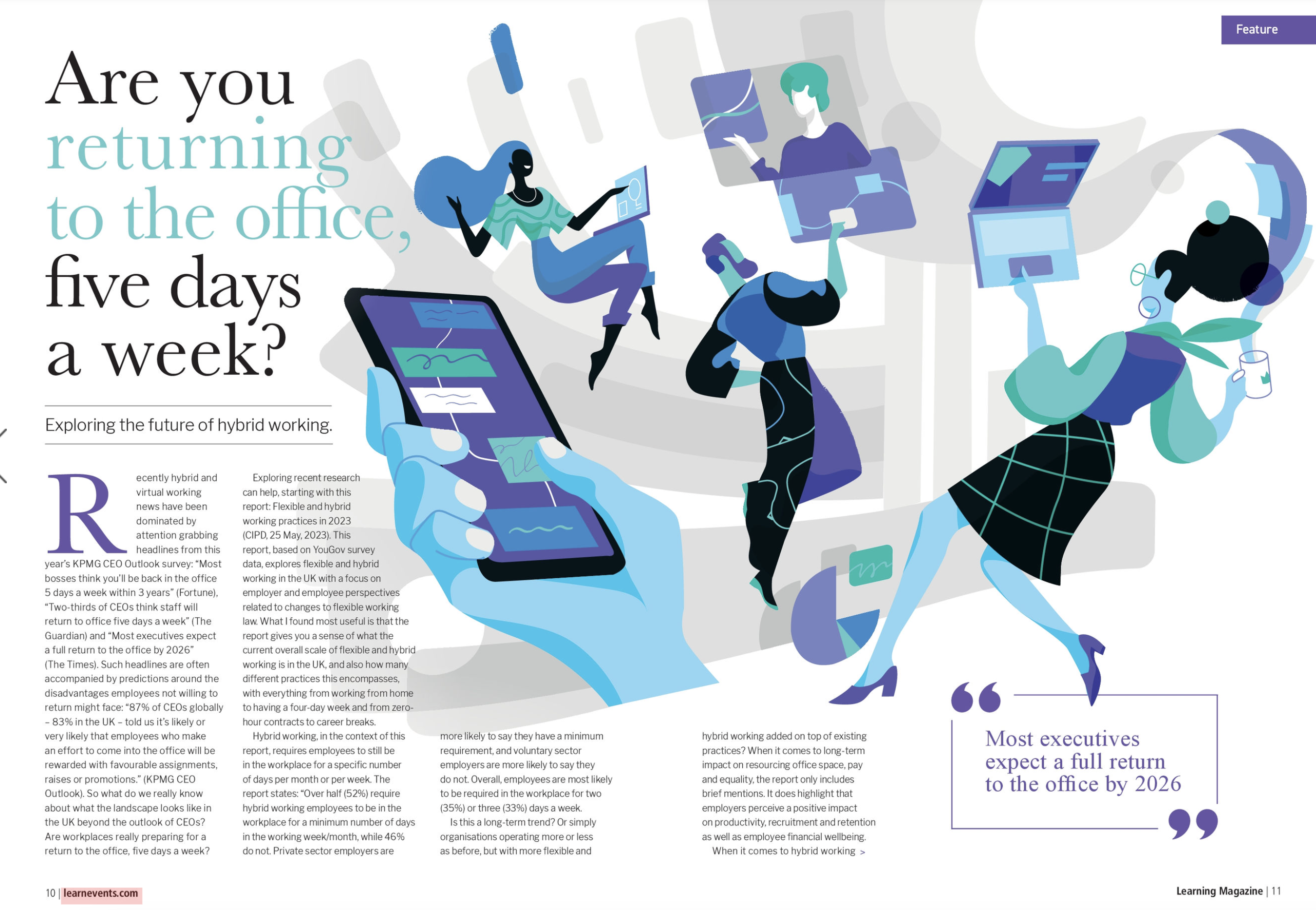
    I am really looking forward to speaking an next week’s World of Learning Summit. In preparation for the session and to offer an insight into what my session will be about, I contributed an article to the Learning Magazine: you can read the article freely online.

    Screenshot of the article with the caption: Are you returning to the office, five days a week?

    My session at the summit is on Wednesday, and focused on offering an interactive discussion forum for leaders. We’ll explore hybrid working recruitment and retention, new trends in hybrid working and also challenges that arise over time from recruitment to long term retention.

    Look out for the slides of the session, which I’ll be sharing via my linktree.

    Don’t miss a post. Subscribe to my free newsletter and get a summary of everything once a month to your inbox.

    [newsletter_form type=”minimal”]

  • Origami, walking and a lot of space to think

    Origami, walking and a lot of space to think

    It’s been great fun this week to head up to Edinburgh to facilitate an away day for a senior leadership team at the university, and I wanted to share a few snippets of what made the day really memorable for me. The focus for the day was all about hybrid working and leading people and projects in a continually changing context, managing the enduring impact of lockdown working alongside emerging policies and priorities. Here are some reflections:

    First of all, there’s the venue! The photo of this post shows the building where we spent our day with a beautiful view of Arthur’s Seat. It was great to have a venue which had such scenery on the doorstep, particularly as we could see the hill from the meeting room where we were based for the day. Lots of natural light and air always helps, I find. The venue was a good fit for some of the activities I had built into the day, designed to encourage everyone to step away from their screens and do some thinking together whilst getting some movement in.

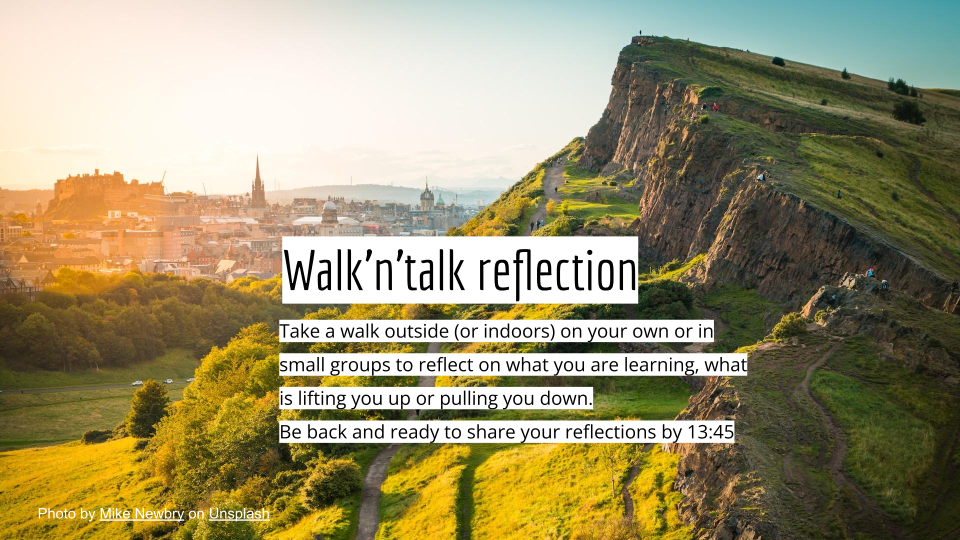
    Slide from the presentation day showing a picture of the hill and sharing instructions for a walk and talk reflection.

    The walk and talk reflection after lunch was a really popular part of the day, giving everyone time and space to talk about things in a less formal setting than sitting around a meeting table. This activity also offered those who needed some quiet time to reflect on their own a way to do that between a busy morning of group working and the afternoon brainstorming session.

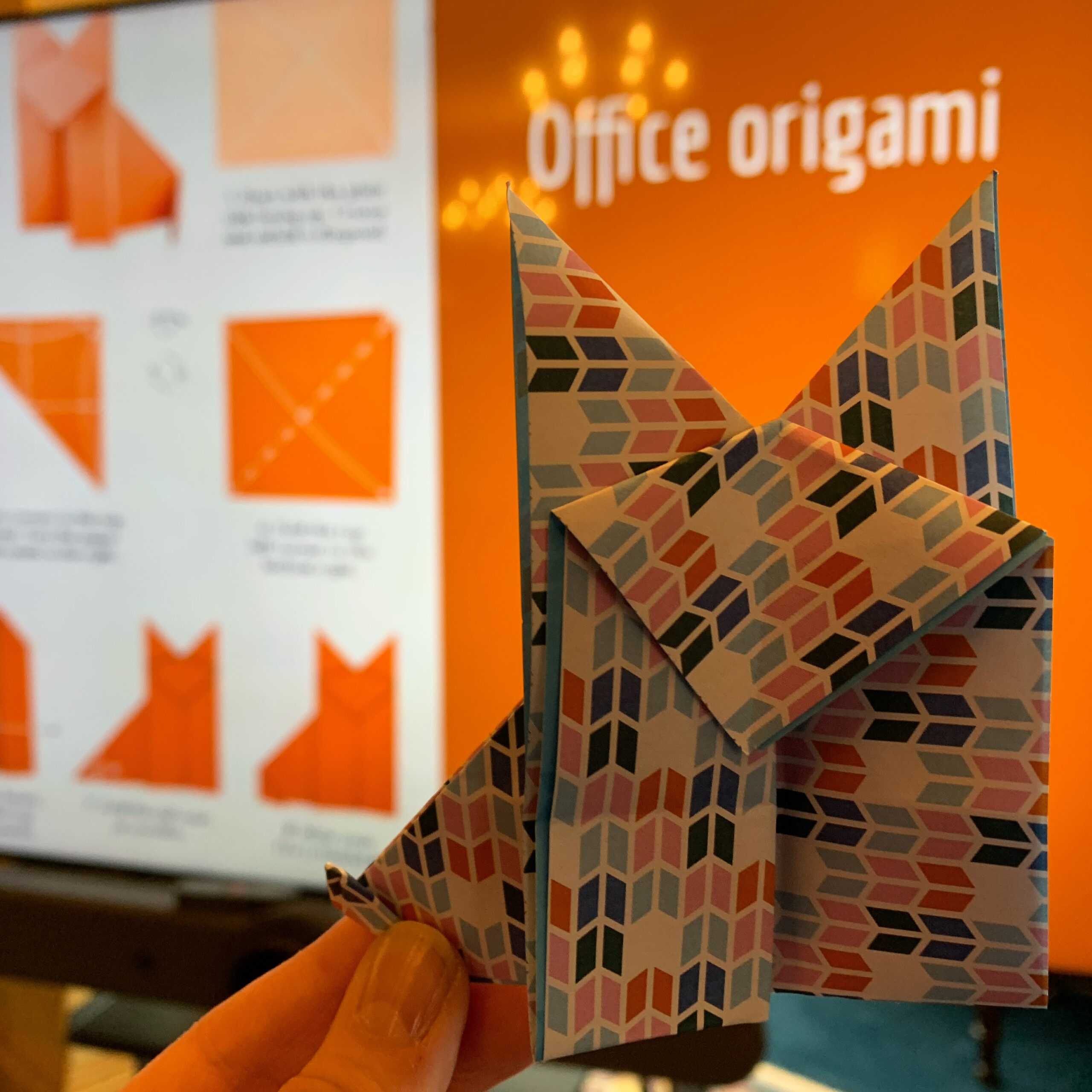
    Office origami

    One of the sessions on the agenda explored fresh ideas for fostering a sense of community and encouraging engagement in hybrid workplaces. For example, we discussed how working radio or shared playlists could work, even scope to have a silent disco… 🙂 . I loved that idea in particular. We also tried out office origami as a communal activity.

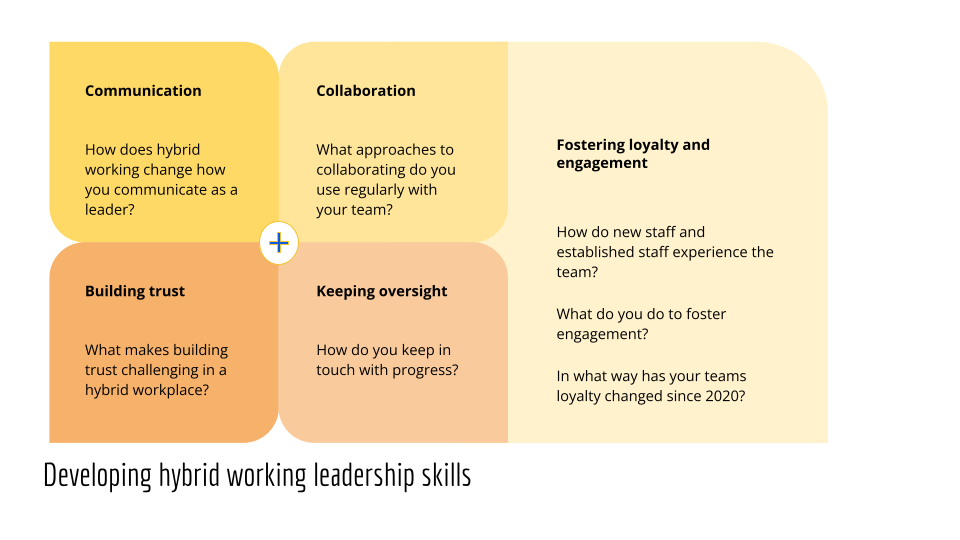
    Now, for most of the day we worked on hybrid working leadership skills, exploring areas like communication and collaboration as well as building trust and keeping oversight of progress. Most importantly we talked about fostering loyalty and engagement, considering how the experiences of new and established staff could differ and how the role of leaders changes over time as hybrid working becomes more established.

    What was really inspiring for me throughout the day was to see all the experience and expertise a team like this can bring to bear on the challenges of hybrid working. Working in learning technology builds a lot of capacity for the challenges ahead, especially as there are a lot of things we know about blended learning that can now be applied to hybrid working.

    Over the past year I have run my hybrid working leadership course, inspired by my book on leading virtual teams and coaching tools I have developed to support these offerings and it was great to see a lot of elements from these activities come together into one packed day of leadership development.

    I had quite a few requests from folk elsewhere who are interested in hosting a day like this at their institution or take part in an online version. If you’d like to be added to the waiting list for that, get in touch.

    Keep in touch with new events and the work I am doing by subscribing to my free monthly newsletter.

    [newsletter_form type=”minimal”]
  • Re-inventing Mondays… 2 months in

    Re-inventing Mondays… 2 months in

    It’s been a month since I last updated on my progress with the new chapter in my working life, free-lance working life, and my mission to re-invent my week, starting with Mondays.

    Unfortunately, as I type this, I am still recovering from a cold, and so podcasting is on hold for this week and instead I get to write this blog post. Blogging is, still, where it’s at.

    Beach/work balance

    One of the goals in my strategy for my business for this year is to achieve a better work/life balance. I am not sure how common a goal that is for a business plan, but my thinking is that work/life balance is one of the key goals of my career change. Being a CEO made work/life balance hard, partly because everything that goes really wrong eventually lands on your desk and partly because running an organisation always involves a crisis or three. Over time, you find strategies to set boundaries, but ultimately it’s a responsibility that is part of job and it’s hard to leave that behind even when you are not working.

    Although I loved it, one of the reasons why I chose not to pursue another CEO role is that I want to give myself the chance to explore a life with less responsibility for a while and to see if I can find a work/life pattern that is better for me in every sense. When it came to it, sitting down and trying to define what that would look like in practice, I didn’t really know what the answer would look like.

    Over the past couple of months I have come up with a practical metaphor: beach/work balance. To me that means that I am prioritising getting to the beach during the week every other week, and my partner and the dogs and I can enjoy a couple of hours where we love being the most.

    It’s a good measure for how much my life goes to plan, and how much scope I have to plan in an afternoon or a morning away from my desk and for it to actually happen, too.

    The picture at the top of the post is from last Friday, when we managed to get to the beach an hour before sunset, watching the wintery sunset as the week wound down. For me, that’s a huge win.

    So, at least for now, beach time is one of the indicators that help me assess whether I am finding the right balance.

    Doing enough of what gives me joy

    I don’t want to give the impression that all my days are spent doing yoga with my dog or going to beach. Far from it. Since the start of October I have been working hard and I have been doing a lot of hours.

    In these first two months I have been dividing my time between working as a consultant and a coach, doing both paid and pro bono work.

    It’s been great to continue the work with ALT and AmplifyFE, a partnership project around a growing network of 2,700 professionals in FE and Vocational Education for which I am the Strategic Lead. Alongside the day to day work on the project this past month has been a busy one of travel and talks for AmplifyFE, including launching new research.

    I’ve also continued my work with Reclaim Hosting, where my official title is now Asana Overlord. I love working with Jim Groom and his team on strategy, business development and team coaching. Alongside the work we do which is focused internally, I get involved in some of our community activities, which are hopping into festive mode this month. Karaoke for Christmas? Yes, please!

    The work I do with Reclaim is closely related to my interest in hybrid working, and this past month I have done a lot on that front as well, running a session for Oxford University, delivering my second free and open hybrid working course and marking a year since the publication of my Open Access book on the topic.

    Coaching groups or teams has become a much greater part of my practice than I had anticipated, and I have some new projects in that space planned for early 2024 which I am excited about. In the meantime my coaching for individuals is also continuing to develop.

    Coaching is a fantastic tool that I hope more people, particularly those of us who are juggling a lot whilst also achieving a lot, will make use of. I know just how hard it can be to find time and funds for professional development. That’s why I offer 10% of my coaching sessions pro bono and over the past month I have been able to offer pro bono sessions to four new clients.

    Auditioning days

    In the midst of working on a lot of different projects and with a whole host of people and finding time for the all important beach visits, I have noticed that I have started to reflect a bit more on what I enjoy doing the most. Subconsciously, I am ‘auditioning’ days, checking in with what I want to do more of and what I will say no to and refer to colleagues instead.

    When my former mentor Margaret and I discussed my free-lance venture, Margaret said something that really stayed with me. She said that it’s easy to re-invent your job without noticing and that it’s even easier to forget to say no when opportunities are on the horizon. Feeling the precarity of giving up a permanent role and worrying about where money to pay the mortgage was going to come from, I didn’t really get it at the time. Don’t get me wrong, the precarity is obviously still very much on my mind, but I find that being a CEO and being responsible for the annual turnover and salaries of an organisation was good preparation for managing income generation for myself as a free-lancer. There are always risks.

    However, what I am learning at the moment is that I need to manage my capacity carefully and to not commit to too many things just in order to hold my financial worries at bay. Instead, I am looking for things to do that are the best fit, and stretch me in ways I find rewarding.

    It’s a privileged position to be, and it’s an opportunity I don’t intend to squander. This is my time to evolve in my working life, and the sense of reinvention that comes with that is very precious to me. Over the past twenty years I have gained a lot of experience and skills and I am very good at many things. Right now, I am becoming better at figuring out where I can make the biggest difference and what I find most rewarding. Every day is an opportunity to figure it out.

    One of the things I am planning to do is a day out later this month, to give myself space to think and plan for 2024. A retreat for one, if you like. If you are interested in having one of those for yourself, look out for the next blog post 🙂

    Thanks for reading and thanks to all who’ve helped me along the way .

    Listen

    All the podcasts about my fresh start in order:

    Listen to Leading Virtual Teams on: Apple PodcastsGoogle Podcasts and Spotify

    Enjoyed this post? Get my free monthly newsletter directly to your inbox.

    [newsletter_form type=”minimal”]
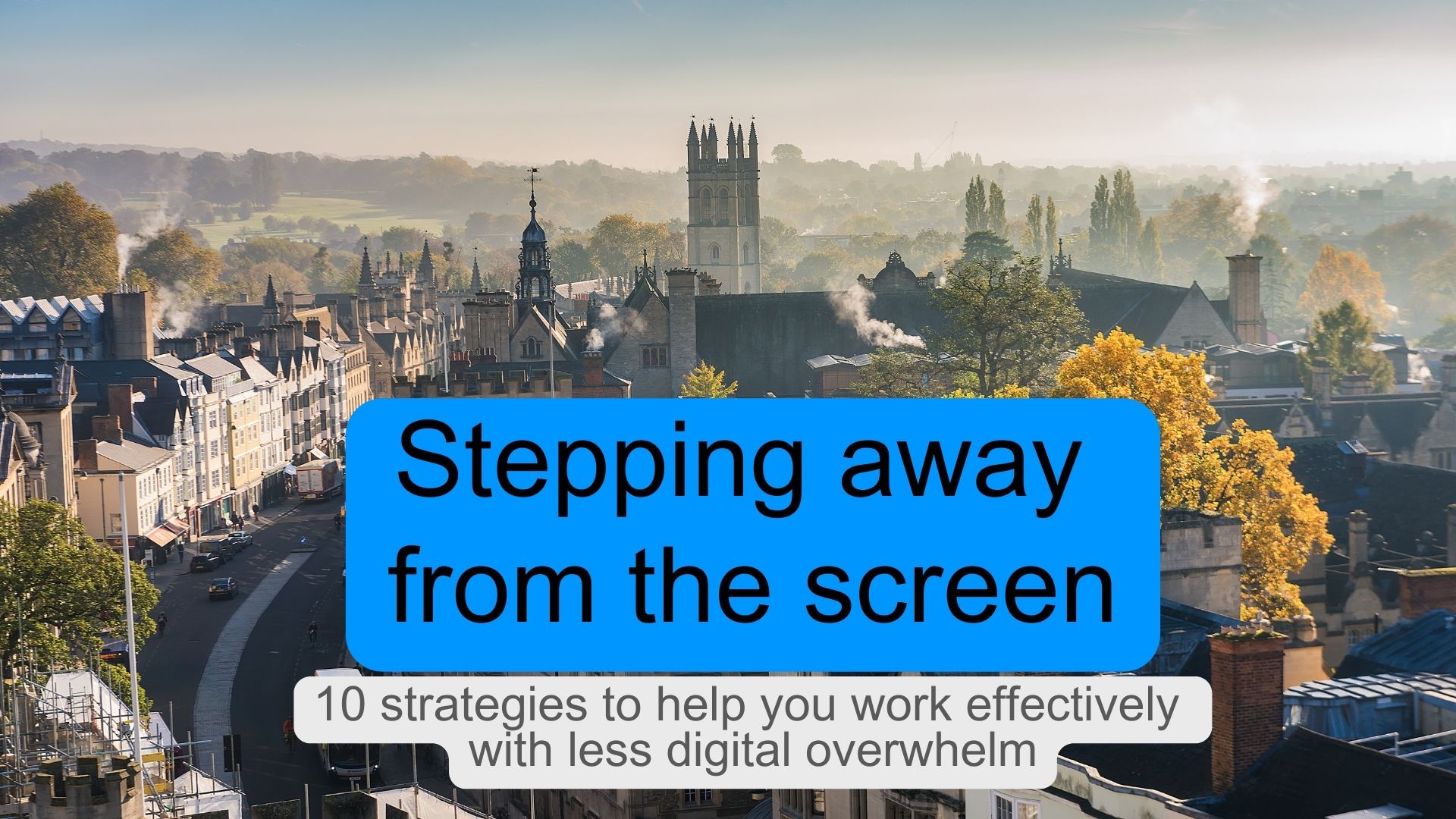
  • Stepping away from the screen – a lunchtime digital skills development session

    Stepping away from the screen – a lunchtime digital skills development session

    This week I am joining the university in Oxford online for a lunchtime digital skills development session. I am really looking forward to this talk, partly because the topic is a lot of fun and also because I love the format: it’s opt-in, open to all and informal, hence it (hopefully) attracts the kind of folk who are already interested in the topic or need some help. Whatever the case, it’s a win to have an engaged audience.

    The talk is structured as a pick and mix offering, in which I share different strategies, resources and tips about hybrid working. I have included ideas for individuals to check in with their personal set up, starting with their workspace. I also include activities teams or groups could try out and share some experiences of how these work in practice and why they are valuable. To prompt deeper reflection, the session also has a some elements that support you to think through your relationship with the way you work, technology and what work means to you.

    I have recorded a special podcast episode in which I deliver parts of the talk and you can also look at the slides which include all the links and references on the final page.

    Listen to the podcast

    Enjoyed this post? Get my free monthly newsletter directly to your inbox.

  • Listen… to the practitioner’s voice

    Listen… to the practitioner’s voice

    Today is a big day! Together with colleagues from all across the UK, I am heading to London. It’s the Week of VocTech, and the annual showcase of everything that’s happening across the sector.

    I feel fortunate to be continuing my work as Strategic Lead for the partnership between ALT and the Ufi VocTech Trust even though I stepped down as ALT’s CEO earlier this year. There’re a couple of reasons why: from a personal perspective, I love working in Vocational and Further Education because that’s where I took my first steps from alienated high school drop out to finding my way into further learning. Next, I love being part of a partnership where so much actively happens (and we have achieved much in the last few years). The biggest reason however is AmplifyFE. Yes, it’s a project, yes, it’s working in partnership, yes, there are awesome people involved, and it is also so much more than that: it’s a grassroots community of practice that is connecting the dots between individual practitioners, innovators and industry for the benefit of the learners furthest from opportunity. Since it’s launch in October 2020 (remember that time?) our community has grown to connect 2,700 practitioners.

    Over the past twenty years I have worked with lots of projects that tried to achieve what we have done, and my bookmarks bar is a graveyard of moribund communities of practice in which tumbleweeds flourish. So what is the secret sauce of our success?

    As we enter our fourth year, here are my reflections:

    We connect, we don’t compete

    When we first started setting up AmplifyFE, we were very clear that we were building a network of networks, not a new network. This distinction is key to our success: we don’t aim to replace or take over existing networks, we act as a meta network, an overarching connection that links one specialist group with another, one sector event with practitioners who don’t know where to start. We don’t wait for you to come to us. We try to find and come to you.

    Part of our mission is to help those who are isolated within their institution or specialist subject, those EdTech or IT teams of one, to connect with people who speak their language and share their concerns.

    We put everyone on the map

    All of our artwork is created with Bryan Mathers via a Visual Thinkery process. Our community map was one of the first things we developed, and it was born out of a desire to show the communities and conversations that we already knew about and to allow others to (literally) put themselves on the map.

    That’s a very powerful message to send. We say: put yourself on the map, and we will help others find you, join in and contribute. We want to map where the conversations about practice are really happening, no matter how informal or niche your interest. In a sector in which everyone is under pressure, short of funding and faced with mounting challenges, let’s connect you with the people who are in the same boat. We are not gatekeepers, we are map makers.

    We reflect our community in our research and case studies

    We also take a deeper diver into how learning technology and digital tools can be designed and deployed to support vocational learners most impacted by the ‘digital divide’. We explore what key advice can we give to those beginning or continuing an innovation journey in VocTech.

    Our Insights Report shares fresh research and case studies that show what makes for truly successful co-creation between vocational educators and digital design project teams. We unpack how we can create effective learning solutions working in partnership with vocational learners to help narrow the ‘digital divide’ for those most in need of workplace skills development. Basically, we find practical examples that show what is the difference between what really works and what doesn’t deliver.  

    We learn from others

    One of the phrases we think a lot about is ‘by the sector, for the sector’. I am always curious about what people mean when they say it. How much do you know about ‘the sector’ to begin with? How do you take part? How do you contribute? And what are you asking in return?

    We work with a community that suffers greatly from the ever-changing policy and funding changes starting at top-level government policy, to sector bodies and then filtering down to the local level and to individual institutions. Excellent programmes are launched, and then disappear again 3 years later. Or funding is cut for frameworks and skills training that had been invested in for years.

    From the outset, our work with AmplifyFE was designed to learn from that. We wanted to find the data that shows how much the constant changes impact on professional development and innovation. Since 2020 we have collected and analysed this data annually, and published the results in our sector audit.

    It’s a fantastic piece of work that really shines a spotlight on the scale of change that Further and Vocational Education has to weather. We learn from that, and we aim to change that.

    We use our funding to stay free and open

    Thanks to the funding from the Ufi VocTech Trust and the partnership work between the trust and ALT, we benefit from three decades of expertise in how to run an independent community of practice and we can stay free and open to all practitioners to join.

    We are able to amplify the voices from networks across the sector via regular events, blog posts and podcasts as well as the long term work we do via our annual audit and research.

    And that brings me to the biggest lesson I learnt over the past three years:

    We are here to stay

    Building trust is key to our success. Our team (the fabulous Emma, Lynne, Chloe as well as Lou and also others) includes only people who really understand the sectors we serve, who have worked in Further and Vocational Education and often they still do. We are transparent about our aims and also what we won’t do (i.e. commercialise our community) .

    Active communities of practice that grow are gold dust. We know from our sector audit how many communities disappear each year, either because no one is active or because of funding or policy changes. Or sometimes simply because a certain social network is taken over by madness. Remember the sector forums that suddenly closed? Or the demonstrator programme that stopped? Or the skills training that was cut? Well, we do, too. And that is why we are here to stay, actively supporting our community and amplifying what is happening across sectors as an independent network of network.

    You are welcome to join us.

    Enjoyed this post? Get my free monthly newsletter directly to your inbox.

  • There’s nothing more permanent than a temporary hack

    There’s nothing more permanent than a temporary hack

    This morning’s Memex 1.1, John Naughton’s Substack newsletter, including this quote by Dave Winer: “There’s nothing more permanent than a temporary hack.” and it feels like a great theme for my day today, which I am spending sorting through my own temporary hacks from the past 15 years.

    It’s my day to clean out my archive of files and emails at ALT, the last steps in a long handover process. Documents I filed away in 2017 to be reviewed later are stacked alongside old references I have written for former employees and pictures from past keynotes.

    Most of this stuff can just be deleted all together, but I am mindful that some things are important for the organisation’s history and legal records, GDPR permitting.

    What I am pondering if how many times I didn’t circle back to things I implemented as a temporary hack, and hence today’s quote really chimed with me. Here are some examples of what I’ve come across:

    • My CMALT portfolio that I published in a Google folder (an organisation-hosted Google folder, for which, I just discovered, you can’t transfer ownership outside of your organisation’s domain);
    • An email filter I set up in 2015 when I first joint a very busy Jiscmail list, and which has quietly filled up a folder with tens of thousands of emails since… EEEEK;
    • A shortcut to a file to a shortcut to a file to a shortcut to a file….;
    • Lists of things I want to do, and a lot fewer lists of things I did! Fortunately I discovered a file with old appraisals going back to 2008, so hopefully somewhere in there are records of what I accomplished in more detail than the lists I sporadically kept.

    Even Gmails hefty power is taking time to delete all the emails, one year at a time. It feels extremely satisfying however, and is also necessary, as my new free-lance role within the organisation is limited to a specific project and I want to ensure that I have a clean footprint on which to work.

    As I delete things, I also need to bring some order to my own domain, and again the newsletter provided some inspiration in the form is this XKCD comic about university websites:

    University Website (XKCD, 773)

    It’s easy to fall into the same traps for one’s own website as organisational ones.

    Enjoyed this post? Get my free monthly newsletter directly to your inbox.