Snapshots from my presentation as part of a panel at OEB15, 3 December 2015 in Berlin. You can also download the entire presentation (CC-BY) OEB15_MarenDeepwell_2015 (1).
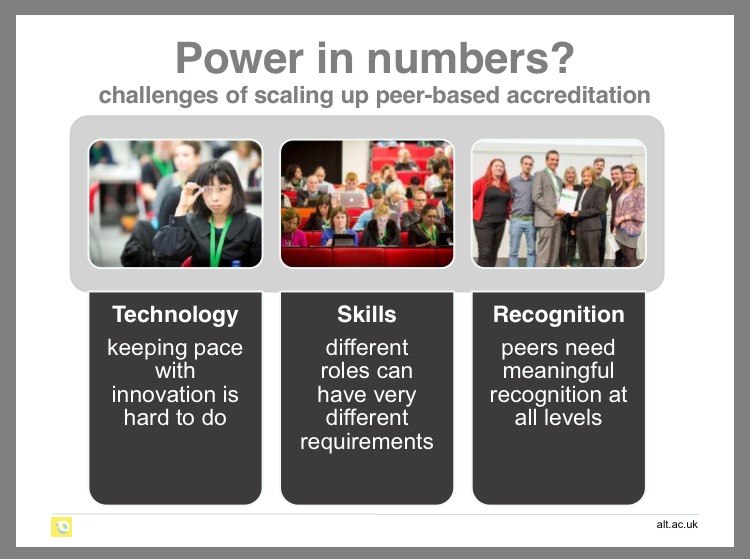


Snapshots from my presentation as part of a panel at OEB15, 3 December 2015 in Berlin. You can also download the entire presentation (CC-BY) OEB15_MarenDeepwell_2015 (1).
 I’ve been working in my #CMALT portfolio. Given that I haven’t yet submitted it for assessment (it’s not quite finished) you might rightly think that a blog post about sharing it is a little premature. Of course you are right – and I won’t actually share it until it has been assessed and (hopefully!) passed sometime in the future. But my intention to share it openly has definitely shaped how I have approached things and to me it’s interesting to reflect on the why and how of that process.
The main reason why I want to share my portfolio is that reading others’ portfolios has been a really valuable part of making my own. I have found it interesting to see how others have build theirs, from the technology used to reflections shared. At times, I have been humbled by what others have achieved (often single-handed) and often I have felt empathy with individuals whom I don’t know, but who were struggling with the same things I have. In what is largely solitary undertaking the portfolios of others have provided inspiration and motivation.
 But sharing what is essentially a personal artifact incorporating examples of work and reflection has not been entirely straight forward. My chosen format, Google docs, makes sharing easy. I can even set up a shared folder for additional evidence and control who has access. Licencing, too, I have considered. The most restrictive Creative Commons licence seems like it might work for this purpose. Some of the examples/evidence in the portfolio is already licensed under Creative Commons so that aligns well. I should be able to produce backups, copies for updating and different formats of the portfolio quite easily and that is an important consideration for me – I wanted to make it as easy as possible for me to actually do work on it initially and subsequently keep it updated.
But what about the actual content, what I describe and reflect on – in particular working with other people? What about reflecting on failures? In most instances I have opted for not mentioning individuals by name, using role titles or generic terms instead. This is particularly important I feel when talking about colleagues in the team I lead. While it hasn’t always been easy, the consideration that what I am writing could potentially be read by anyone has contributed to making my work more balanced. But there has also been tension between accurately describing what I do and respecting the privacy of those I work with. Now that the portfolio is nearly finished I have shared with my staff team for feedback. This way everyone who is referred to has the opportunity to read what I have written and comment on it.
A further consideration has been including things that don’t work, things that have gone wrong. Given that this is a portfolio meant to demonstrate professional experience and skills, you are more likely to include examples of things that have worked. But for me there is value in reflecting on things that could have gone better, what I could have done differently. Including that in a publicly-shared document however deserves consideration.
From the outset, the intention of sharing my portfolio has shaped how I have approached my portfolio. It’s been particularly valuable as it has encouraged me to reflect on the guiding principles of the #CMALT framework in my work – one of which is empathy with and willingness to learn from others. In that spirit, I hope that my portfolio can one day be useful to others in similar ways.
 Compiling my portfolio for submission for CMALT, ALT’s peer-based accreditation scheme, has been a long term project. Originally I started in 2011, but I didn’t complete it. Now I am close to finishing and planning to submit my portfolio (finally). As part of the process, I have made drawings for each section of the portfolio, usually one per section. The first few drawings I made close to a year ago, but I am still adding new ones. Some are illustrations based on CMALT criteria or headings, others are from my work and blog posts. Most of the drawings start life with pen and paper, but many end up being re-drawn on the paper app on an iPad and later edited again with more apps to add text, adjust colours and so forth. This kind of professional development definitely doesn’t require you to get your colour pencils out and start drawing things, so why? Here are my thoughts:
 First, drawing is something that’s been a key part of my practice, of the way I think, long before I started working in Learning Technology and I still find it an invaluable part of my work today. Whether it’s designing open badges or trying to figure out a complex network of use-cases, I often find drawing things down helps with problem solving and communication.
Second, drawings are a good way for me to express different parts of my vision, my personality. I like using them as part of my approach because they can be more eloquent than words and allow me to contribute something more. When I contributed #rhizo15 earlier this year, I found that drawings were a great tool for participating either together with text posts or as stand alone posts. There is something about using colour and images that really connects wit the way I think about things. In the case of my #cmalt portfolio, adding drawings helped to make it feel more like me, help me focus on what I wanted to communicate about my work.
 Finally, and importantly in this context, drawing takes time and focus. For me it is an excellent way to reflect and reflecting on your practice is a key part of the #cmalt framework. I often started a section with a drawing and by the time it was finished, I would be ready to start writing, having laid out the ideas in my head. The reflection is probably the most rewarding part of the process for me.
It’s not really about the drawing in itself, more about the process as a way of giving myself time and space to really think about things, figure out how I feel about something and sometimes, it ends up surprising me with unexpected ideas. That’s the best part for me.

Earlier this week I spent two days in Cardiff at the #oer15 conference on Mainstreaming Open Education. I was able to ask one of the keynote speakers, Sheila MacNeill, a question and I asked about what she would like to see happen next to help further openness. Her response was ‘getting senior decision makers engaged’ – and that got me thinking. What would I like to see happen, what would I want, not in my capacity as CEO of the Association for Learning Technology, but as a senior decision maker and as someone who works with others who hold roles of responsibility. Something Sheila had mentioned earlier in her keynote was my answer: I’d like to try and adopt open practice in my role and connect with others who do the same. Like teachers, researchers or developers who share their practice and resources openly, I’ll try to follow their example. To make my work, which is mostly about leadership, governance and management in Learning Technology, an open practice. This is the experiment that I’m starting with this blog post.
Let me unpack what I am thinking about: this is not about transparency or democracy. Indeed, the organisation I serve has openness as one of its core values from governance to publishing to the services we provide. I am not thinking about what my organisation does, but what and how I do my job. Like a teacher who may share what they do, I’ll use what I do as a basis for sharing, reflecting and practicing in the open. To try and conduct myself, in my role, as an open practitioner, an open leader. That’s the challenge.
A quick search shows me that there is already a lot of advice out there about how to become a better leader by using open software, by using social media, to transform an organisation through open licencing… and so forth. But I don’t intend for this, most likely a series of blog posts to begin with, to be about getting ahead by making ‘open’ work for me. No, my main motivation is twofold: to join a community of open practitioners using my day to day work as a basis and to see if this process can make being in a position of power and responsibility less like an island.
My experience over the past three years of working with others who hold roles like mine is that most, like me, don’t have a lot of space for reflecting on their practice. I am fortunate to have excellent support from colleagues and my mentor and so I’ve always been able to create space for me to focus on what I do as well as whom I serve or represent. This experiment is about making this space open – transitioning from the safety of an audience of one, me, to the relative uncertainty of open practice. I am curious to see if in a few months or years I, too, become an open practitioner. As a first step, I am going seek others who have done the same and see what I can learn from their example.
