Category: leadership

  • Empowering agency and expertise for EdTech futures

    Empowering agency and expertise for EdTech futures

    This week, I am looking forward to speaking at Bett for the first time in a few years, having missed last year’s event with Covid 🙁 . This year however promises to be a lot of fun, and I am excited to speak alongside two inspiring colleagues: uiyin Wong and Julie Voce.

    Here is what’s in store for our session:

    The Association for Learning Technology was established 30 years ago, in 1993. Since then, much has changed! Yet as the decades have become ever more digital, our focus on the central role of human agency and expertise has remained strong. This session brings together findings from benchmark surveys, insights from leaders and practical resources to help tackle professional development and recognition challenges in the sector. We will share new findings from ALT’s Annual Survey 2023, charting how practice is shifting in the sector and what institutions are investing in. We will also reflect on the continued challenges rapid digital transformation poses for staff development and professional recognition.

    https://www.aheadbybett.com/agenda-2023/empowering-agency-expertise-edtech-futures

    If you are heading to the event this Friday, we hope to see you at the session and look forward to saying hello.

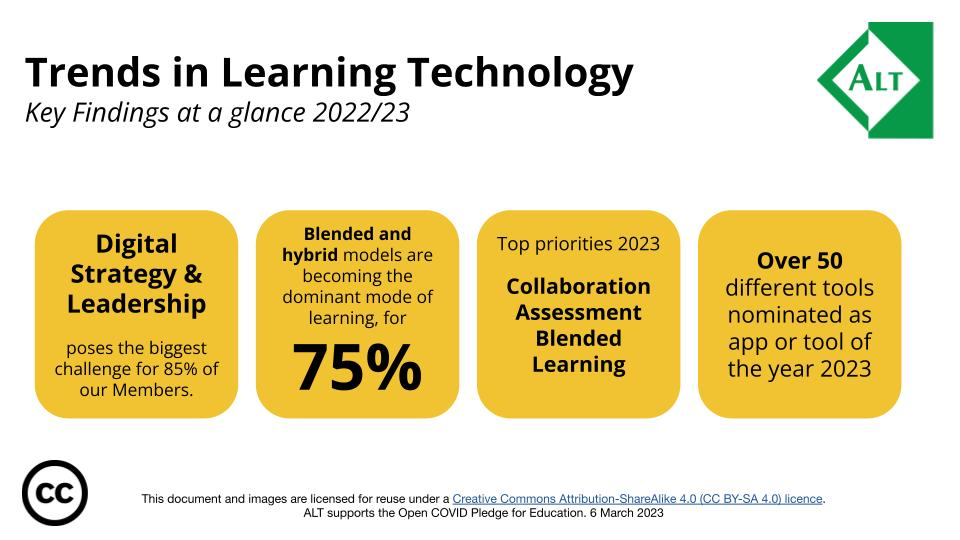
    Whether you are joining us or not, you can also explore the key findings from ALT’s Annual Survey which are now available online:

    This year, the survey explores the main trends in learning technology with a focus on the digital transformation, that includes:

    • The top nominated tools as the software of the year
    • Models of learning in the UK
    • Biggest challenge for digital transformation

    This survey is available to provide an insight into how Learning Technology is being used across sectors as well as identifying emerging trends in current and future practice. 

  • Career transition update: March 2023

    Career transition update: March 2023

    A month ago, I shared the news that I will step down as ALT’s CEO this September to focus on my work as a coach. It’s been a hectic few weeks since the announcement and I want to take a moment to step back and reflect. In 2018 when ALT started to work as a virtual team, we shared monthly updates on that transition and what we as a team learnt along the way. Just like big organisational change, leadership transitions like this too often happen behind closed doors. Obviously, like with any recruitment exercise, there are some aspects that are not appropriate to share as things progress, but I feel it could be useful to chart my perspective and share some of the experiences along the way.

    Reflecting on the past month

    After ALT made the announcement last month, I was overwhelmed by the many comments and messages I received. It was a wonderful moment for me and enabled me to connect with many people whom I have worked with over the past 15 years. It was bittersweet to be reminded of the many fun projects and events I have been involved in and to look back at how things have changed.

    I have always felt valued at ALT, and the warm reaction to the announcement has only emphasised how much we have achieved in recent years and how much the work we do means to our Members. Although it has been bittersweet, it’s also felt right to me to have made the decision to move on.

    Meeting candidates

    The recruitment panel who will appoint the next CEO of ALT is chaired by Professor Helen O’Sullivan. My part at this stage of the process is to meet candidates for informal conversations about the role, and I have been enjoying these meetings very much.

    It’s interesting to talk about how we work as an organisation, our journey through the global pandemic and what we are working on at the moment. I like answering all the questions candidates have, and to try and see the organisation through their eyes. As the recruitment process moves towards the application deadline next week, more and more of these meetings pop into my diary, and I am really pleased that I can play my part and help give candidates a sense of what it’s like to be ALT’s CEO day to day.

    The most commonly asked question, other than those around finances and strategy, is what it’s like to be the CEO of a fully virtual team day to day, whether I meet my colleagues in person and what I find easy/hard about it.

    Day to day

    Outside of the recruitment process, not much has changed in my day to day work. I have a long notice period, and my planned departure date in September is still nearly six months away, so at this time, my work continues as before. This week, two new members of staff join our team, one providing maternity cover for our Admin Officer who had a baby earlier this year, and also a new colleague to lead our refreshed hybrid events programme.

    With the OER23 Conference coming up in a few weeks, we have much to focus on and even more to deliver each week. One thing I am doing differently is documenting my work. I keep more meticulous notes than I might do otherwise and I make sure to document any processes I am the owner of, so that I can ensure a smooth handover when the time comes.

    Interested in becoming ALT’s new CEO?

    I can heartily recommend working for ALT! So, if you are interested in leading a learning organisation with a wonderful staff team and a dedicated Board of Trustees, head over to the ALT website to find out more, arrange an informal chat and apply. Applications close on 27 March 2023.

  • What’s so important about open practice for hybrid leaders?

    What’s so important about open practice for hybrid leaders?

    At the moment, a lot of my work is focused on the upcoming OER23 Conference. OER23 is the 14th annual conference for Open Education research, practice and policy is organised by ALT, the Association for Learning Technology, in partnership with UHI, the University of the Highlands and Islands. OER23 will bring together the strong Scottish Open Education movement and international participants to leverage our shared expertise for change in policy and practice. The conference will be co-chaired in partnership with the GO-GN Global OER Graduate Network, connecting emerging researchers and a global perspective with local and national knowledge.

    Suffice to say, I am super excited about this event which I have been fortunate enough to help organise since 2015 and which is always a great highlight of my year. This year, I am especially looking forward to heading up to the conference, partly because it’s in one of my favourite parts of the world, the Scottish Highlands, and partly because it will give me a chance to catch up with many friends and colleagues I haven’t seen in a while, including long-time collaborator, Lauren Hanks.

    Lauren and I have been talking about hybrid working and leading virtual teams for the past few years, and at least year’s OER Conference we even ran a session together: As leaders of virtual teams, we critically examined what lessons we can learn from open approaches to learning and teaching and how we can use that knowledge in an increasingly virtual workplace. Since then, I have been thinking a lot about why open practice is so important for knowledge workers, and particularly managers and leaders who work in hybrid, distributed or fully virtual teams:

    Sharing practice openly to improve practice

    A few years now I was fortunate to interview a manager from Google together with my then colleague Martin Hawksey. We spent an interesting hour talking about leading a virtual team, and what struck me (and what’s stayed with me since) is how similar some of the challenges were and the solutions we had each come up with. Similar despite the fact that Google and a small, independent charity with less than 10 employees where clearly very different workplaces.

    It struck how easily we forget to share how we work alongside what we do outside of formal training and development. Yes, there is a whole industry out there dedicated to workplace learning, but few of us who work in education or the third sector have a lot of scope to engage with that day to day. More often than not, a project deadline or the start of term looms large, and so we focus on the output of what we have achieved, rather than how.

    In order to overcome that challenge, I build into my work routine a moment to reflect on WHY something went well or not, alongside what the outcome has been. For example, if I found a way to improve a workflow or manage my time for a project more efficiently, then I will share that with my colleagues as I go along. That is how “show & tell” time was brought into our weekly team meetings.

    I am less interested in the amazing outcome of something than I am in how it was achieved and what made it work or fail. Crucially, I am most interested in sharing those insights to help us as a team and an organisation learn from that, and to help others avoid our mistakes and build on our work.

    Hybrid and remote teams often focus on reporting outputs, rather than process, and so it is especially relevant for us working in virtual teams to create routine moments for reflecting and learning together casually.

    Opening up space for sharing leadership practice

    A really common issue for leaders in this space is worrying about “is it just me who is struggling with this?”. When everyone works from home and all you see is a carefully curated or blurred background with a professional, well-groomed headshot framed by a flattering camera angle, it can be hard to get a sense of how others are coping day to day and easy to feel that you are the only one who is struggling.

    Complaining about workload or being busy is in my experience a lot more common than the kinds of problems you experience when you are leading a team or a large project. Performance management, HR trouble, lack of productivity, loss of communication… these are just a few of the issues that commonly challenge us and that can be difficult to talk about.

    This is often compounded by working with colleagues who have a large online presence. When you see blog posts, podcasts or social media conversations all sharing exciting updates or personal successes, or when you see those group chats full of cheer and inside jokes rolling past you, then how do you join in? Where is the space for questions about things you are not sure of or worry you are doing wrong?

    Open practice in a leadership position is different from sharing things like new publications, or blogging about exciting projects. It opens up a space to share the practice of leading, of managing people, not just the end results.

    Modelling leadership with intentional communication

    One of the most challenging aspects of leading people or projects in hybrid or remote teams is lack of comparison. In a traditional workplace you’d see more examples of how others lead, what their meetings or one-to-one catch ups might look like, how they deal with difficult situations or simply how they act day to day when at their desk or on campus.

    Depending on how hierarchical or closed an organisation you worked for, you may see a lot of conversations happening behind closed doors, or at the pub after work, but even a lack of openness would set some kind of example.

    Mediated by technology, tools and platforms, leadership can be a lot harder to observe. There is a lot of communication that you may never be aware of at all, happening in individual or group chats you are not part of, and during meetings certain ways of behaving may be the result of technical issues, lack of digital competency or simply a bad hair day. It’s much, much harder to observe how others lead effectively (or not), and to learn from that approach for yourself when everyone works remotely.

    It’s also a lot harder for teams to follow the example of those who lead them, as there is so much that is not visible. You can’t really tell if your Line Manager is working hard or watching videos on YouTube when you never see them. What it comes down to is a much greater need to intentionally communicate to fill in the blanks created by hybrid working. Here are some examples from my own experience:

    • Tell colleagues what to expect from a meeting ahead of time, and be specific about what kind of engagement you are looking for from them;
    • Share when you are having a screen break or stepping away from work for a bit, to normalise taking breaks;
    • Set out a clear format for regular activities like 1-to-1 catch ups, and communicate what’s the same for everyone, so that others can learn from that example when organising their own meetings.

    Image: Photo by Luke Southern on Unsplash

  • How to make a milestone map

    How to make a milestone map

    Many of my clients are looking to make progress in their work or personal lives: to make a change, develop their career path or build personal habits. Many of us have goals like ‘progress in my career’ or ‘be happier’… but it can be hard to break down exactly what to do in order to achieve our aims and define what ‘success’ means to us. Here are five tips that will help you create a milestone map that works for you:

    Choose a format that works for you

    It’s hard enough to set out a milestone map without having to do battle with the interface. Maybe you are someone who thrives on learning all about a new productivity tool (hello, fellow Asana fans), and if that’s the case, then use that extra motivation to get you started in a shiny new template. If pen and paper seems more attractive, or post-it notes on a whiteboard get you thinking, then choose those. You can use pretty much any format you like. The key is that you need to pick something you can easily work in, add to over time and access, and something that will enable you to add a lot of information if you need to (when you break down goals like ‘develop my career’ into smaller, actionable tasks).

    If you have a work tool that you need to use for a performance review or appraisal, then ideally start somewhere else and late copy your finished thoughts into the required format. Give yourself space to think first and foremost.

    Pick your goal(s)

    Is this map going to help you plan out the next five years? Focus on finishing a book or a project? Is this a map to a career transition, a healthier you or a bucket list? Do you already know exactly what you are aiming for?

    • If you have a clear goal: then set out your parameters first. For example, if you are planing for a writing project, note all the specifics such as word count, deadlines and so forth. For example, if your goal is to: submit a paper to a major conference; this could be made more specific: Submit a 5,000 word research paper to a conference by July.
    • If you are searching for clear goals: often it can be hard to set out goals straight away. It’s helpful to think about broad categories to start focusing, e.g. ask yourself what timeframe you are planning for; what aspect of your life you want to think about, such as work, family, relationships, hobbies, self; consider what’s important to you and how this can be reflected in your plans. For inspiration, have a look at the Wheel of Life tool or List of 100 Dreams I have previously blogged about or start with a list of your values to help guide your thinking.

    Turn goals into milestones

    Once you have your blank page in front of you and picked your goal(s), it’s time to turn the goals into milestones. Earlier I used the example of a writing project, where the goal is to: Submit a 5,000 word research paper to a conference by July. For this kind of project, ask yourself questions like: who else is involved? How will they input? Are any parts of this time-sensitive? What is the end product? How do I get there? Or what is the first step? What is the next step?

    Group tasks that go together and define a milestone for each group. For example:

    • Write 500 word outline
    • Research initial references
    • Share with colleague for feedback
    • Milestone: Draft a full paper structure

    Then, consider how to move from your first milestone to the next.

    The same approach works for much bigger goals, such as working towards a promotion or leading an initiative. Whatever you choose to focus on can always be broken down into individual steps and milestones.

    Check your map

    Part of the magic of this kind of planning is that it really works, provided that the map is true to you. By that I mean that the map reflects what can you can reasonably achieve. If you usually write less than 500 words a month and your plan is to write 5,000 words a day, then you will very likely not achieve your goal.

    The trick is to dream big and allow yourself to set goals that are truly meaningful to you, which you then turn into achievable actions that fit within your life.

    Similar to prioritising your to do list, you can prioritise your milestone map. A long term goal might go on the back burner while you focus on a more urgent opportunity for example. A map is not a to do list, but a tool for you to make the changes you want to make happen.

    Ask why?

    I often come across milestone maps that are all about what people feel should be on them instead of goals that align with what’s truly important to us. So my final tip for when you have your map, is to check in with yourself about the why.

    Why is this goal on your list? Why is it important? Why do you want to spend the next three years working towards this?

    Milestone maps often bring out our inner need to conform to other people’s expectations. Maybe there is a specific deliverable you need to meet to get more funding for your project. Or maybe there is a hoop to jump through on the path to tenure. Whatever you are aiming for, remind yourself of why it’s important to you.

    Make your hybrid working milestone map

    I recently worked with the wonderful folk at Reclaim EdTech on a course all about hybrid working, and as part of the course I designed a roadmap for professional practice in hybrid working. If this is something you are interested in, drop me a line and I’d be happy to send you a template so you can make your own.

  • Lunch break ideas for hybrid workers

    At this time of year, it’s easy to focus on ever busy work schedules instead of activities that help with balance. Here in Cardiff the weather is dreary and grey, and not particularly inspiring even in the lightest hours of the day. Leaving my desk and screens in favour for a proper break feels much easier on sunny days.

    When I came across a book called Gone for Lunch: 52 Things to do in your lunch break (by Laura Archer), in the library recently it felt like a great opportunity to find some inspiration.

    Here’re my 10 favourite ideas for lunch break activities, inspired by the book but specifically adapted to the needs of hybrid workers. The ideas in the book are divided into for sections: activities you can do while sitting, being active, inside and outside.

    As most of us hybrid workers probably spend enough time sitting inside already, most of the activities on my list involve being active and/or outdoors, but there are two exceptions and I’ll start with those:

    1 Take a nap

    This is also in the book, and there are some useful tips here: aim to nap for between 10-30 minutes, don’t forget to set an alarm, and make sure you nap before 4pm and no later, to avoid disturbing your sleep in the night.

    One of the nicest upsides of working from home is that there usually are much better places to nap than in an office or on campus, and, in my case, the presence of willing pets who are just as keen to cuddle up for half an hour as I am.

    2 Meditate

    The book includes tips of trying desk yoga or to focus on ‘wish, pray, hope’ , so inspired by that, I am going to include meditation as a lunch break idea. There are plenty of apps out there like Calm or Insight Timer that offer free recordings, breathing exercises and timers to help engage in mindfulness and meditation.

    Personally, I find coming to a complete stop and resting in stillness for a few minutes is a powerful way to reset for the rest of the day, no matter how or where I do it.

    3 Green spaces

    I really like the idea of visiting green spaces. The book suggests that “spending as little as 40 seconds looking out over green space can boost concentration” and goes on to explore other benefits for our physical and mental wellbeing of spending time in nature.

    Depending on where you live and how much green space there is around you, looking at some maps of your local area will help you discover new green spaces close by, and help find new routes that you do not usually take.

    4 Local Café

    Adopted from the idea to visit local markets included in the book, you can visit (independent) local cafes which are close enough to where you live. Many of us find remote working from home can become quite lonely over time, and visiting local cafes or delis for an hour can help us reconnect with people and offer a change of environment.

    5 Listen to a podcast

    As a big podcast fan, I enjoyed reading the suggestions in the book for listening to podcasts during lunch breaks: start with short podcasts to find out what you like, look for podcast recommendations on blogs or sites you usually use, rather than charts within podcast apps to get more personal recommendations and make use of the broad range of subjects on offer to engage with different interests.

    One problem I encountered unwittingly with podcasts at lunchtime, is that I gravitated towards ones related to work. Listen to podcasts became more like professional development or catching up with things I hadn’t had time to read or listen to during work, which was productive, yes, but didn’t provide the break that I need at lunch to recharge. If you are looking to disconnect from work and really relax, choose a podcast with a relaxing topic unrelated to work.

    6 Take a photograph

    As an avid taker of photographs, the idea to take a “take a carefully considered photograph” really chimed with me. The idea is to really focus on the colour, form, shape and composition of the photograph, and to take time over it. Practical tips include turning on gridlines, focusing on a single subject, using reflection and so forth.

    This is an interesting activity as it’s completely flexible and can happen indoors and outdoors at any time. One I am going to try out for sure.

    7 Local Wildlife

    Another suggestion is to explore local wildlife, which could include taking part in activities like an online national butterfly count or bird watch, anywhere from gardening containers on a balcony, a nearby park or field.

    8 Play with a pet or care for a plant

    The most ‘local’ of animals for me are our dogs, and one of my favourite things to do during my lunch break is to play with the dogs in the garden. Hiding small treats for them to sniffle for or playing with their favourite toys and really focusing on them is a brilliant way to relax, and gives me a great sense of connection.

    Given that I am also devoted to my plants, another way to take a proper break from my screen is to care for my plants. Regular watering, dead heading flower pots… whatever it is on any given day really helps me to stay away from my screens for a while.

    9 Go for a wander

    This one probably doesn’t need much explanation, and can easily combine with several of the other activities… walk while listening to a podcast, walk a dog, wander in a green space, explore your local area and so forth.

    Or… for a complete change try a mindful walk. Really focus on the activity itself and avoid distracting yourself from what your senses tell you about your environment. Breathe easy and follow your feet.

    10 Visit a Cemetery

    My favourite moment reading the book was when I spotted “visit a cemetery” in the list of activities. Clearly, this is my favourite given that I spent years as an anthropology student in graveyards. For me, any opportunity to visit a cemetery is welcome.. so if you, too, like a bit of an explore through such spaces, then find your nearest one and enjoy your lunch break.

  • Wakelet from #LTHEchat 254: Hybrid working: new frontiers in professional practice

    It was a great pleasure to return as a guest to the wonderful #LTHEchat for a conversation all about hybrid working.

    For #LTHEChat 254 we shifted our focus from learning to work. We discussed ways in which learning and teaching practices can inspire a more sustainable and equitable hybrid workplace. If you haven’t yet seen it, read the original post on the #LTHEchat site.

    I was very curious to hear different perspectives and see where this conversation would leads us, and it was a very fast paced, lively discussion on the evening. I found it hard to do more than read, and like or retweet during the live conversation, and I also wanted to give as much room as possible for everyone to express their views and share their experiences, instead of dominating the conversation.

    It’s been such a pleasure to work together with the amazing people who organise and support this important community activity, and I am so grateful for their support and guidance before, during and after the chat.

    The chat in action

    Here are the questions we explored:

    Q1: What is your experience of hybrid working? #LTHEchat
    Q2: How has hybrid working made a positive impact in your institution? #LTHEchat
    Q3: What can we learn from hybrid learning to develop effective hybrid working? #LTHEchat
    Q4: What role should staff play in the hybrid learning/working skills development of students?   #LTHEchat
    Q5: What do you see as the biggest challenge for the future of hybrid working #LTHEchat
    Q6: Share one hybrid working tip that you would recommend to others (and why). #LTHEchat

    LTHEchat 254

    There was a lot of rich conversation and I am still reflecting and delving back into various exchanges, which I hope to write about more in due course. For now, here are a few moments that jumped out at me on the day:

    Screenshot of a tweet from the chat

    It was inspiring to see how many different answers everyone had in response to “What is your experience of hybrid working”. It’s easy to loose sense of how different contexts impact on our ways of working, both personal and institutional, and this opener to the chat provided a vivid reminder of the broad range of hybrid working models that are happening across this community.

    Screenshot of tweet

    Another aspect of hybrid working that came across strongly was the enduring importance of social connection. This is something many contributors mentioned in a number of ways, regardless of whether they had long term experience of working in remote and distributed team or whether they were relatively new to it.

    The LTHE chat to me always feels like a valuable opportunity to connect with folk in and of itself, but this topic brought this to the forefront of my mind more than usual. It was amazing to glimpse a little of what folk feel is the reality of their home office life, office days and travel.

    Screenshot of tweet

    A lot of posts sounded very positive about hybrid work, with many contributors feeling more productive and seeing many upsides to the increased flexibility. But we also spoke about a lot of challenges: from equipment and connectivity to the lack of leadership, appropriate policies and lack of trust.

    There is so much more to dive into.. have a look at the chat for yourself.

    Explore the Wakelet

    You can now explore the whole conversation on the Wakelet: https://wakelet.com/wake/hx_8tyRERoRoSUhq-AFyj