Category: hybridWorking

  • Are you returning to the office, five days a week? The week in hybrid working click bait headlines…

    Are you returning to the office, five days a week? The week in hybrid working click bait headlines…

    This past week all my networks about hybrid and virtual working have been dominated by attention grabbing headlines from this year’s KPMG CEO Outlook survey:

    Most bosses think you’ll be back in the office 5 days a week within 3 years (Fortune)

    Two-thirds of CEOs think staff will return to office five days a week (The Guardian)

    Most executives expect a full return to the office by 2026 (The Times)

    These headlines are usually accompanied by predictions around the disadvantages employees not willing to return might face:

    87% of CEOs globally – 83% in the UK – told us it’s likely or very likely that employees who make an effort to come into the office will be rewarded with favourable assignments, raises or promotions.

    KPMG CEO Outlook

    There is some mention of the need to carefully handle a return to the office, to take into account what employees need and want, but overall, there is a strong sense of relief that established corporate power structures are flexing their muscles by demanding that workforces return to their rightful place in every sense of the word.

    When I carried out the research for my book on virtual working, I found a distinct lack of evidence that the employment policy landscape in the UK or the US was changing. Other countries, especially around Europe, used the increase in home working during the pandemic to establish laws around employees’ rights to disconnect. But here in the UK there was no sense from government of urgency to create similar policies for the long term. Instead, UK policy flexed to accommodate emergency measures and short-term solutions.

    So what do we really know about what the landscape looks like in the UK beyond the outlook of CEOs? Are workplaces really preparing for a return to the office, five days a week?

    Recent research

    Report: Flexible and hybrid working practices in 2023 (CIPD, 25 May, 2023)

    This is an interesting report, based on YouGov survey data, that explores flexible and hybrid working in the UK. The report focuses on employer and employees perspectives related to changes to flexible working law.

    What I found most useful is that the report gives you a sense of what the current overall scale of flexible and hybrid working is in the UK, and also how many different practices this encompasses, with everything from working from home to having a four-day week and from zero-hour contracts to career breaks.

    Hybrid working, in the context of this report, requires employees to still be in the workplace for a specific number of days per month or per week. The report states: “Over half (52%) require hybrid working employees to be in the workplace for a minimum number of days in the working week/month, while 46% do not. Private sector employers are more likely to say they have a minimum requirement, and voluntary sector employers are more likely to say they do not. Overall, employees are most likely to be required in the workplace for two (35%) or three (33%) days a week.

    Is this a long-term trend? Or simply organisations operating more or less as before, but with more flexible and hybrid working added on top of existing practices? When it comes to long-term impact on resourcing office space, pay and equality, the report only includes brief mentions. It does highlight that employers perceive a positive impact on productivity, recruitment and retention as well as employee financial wellbeing.

    When it comes to hybrid working specifically, the report states that “Eighty-three per cent of organisations have hybrid working in place. Forty-five per cent have a formal policy, 24% take an informal approach, and 13% are developing policies through learning/trialling. When CIPD last asked this in a similar survey in June 2022, fewer had hybrid
    working (77%) and fewer had formal policies in place (34%).”

    This is really interesting, particularly when thinking about the managers leading teams in half the organisations that have hybrid working in place, but do not have formal policies. The need to develop skills for manage this scale of changes in the workplace is clearly becoming more urgent as the proportion of workplaces who offer flexible and hybrid working increases. The report reflects this as a negative impact of more flexible and hybrid working:

    • Specially, ability of managers to lead teams effectively (-18)
    • and identify as challenging for managers managing remote teams from a wellbeing and performance perspective (41%)

    Developing your skills as a leader or manager in this context is particularly difficult because so few organisations have expertise to draw on and there is little formal training led by experts who actually have a track record beyond their personal experience of working from home.

    Interested in evolving your approach to Hybrid Working? Registration for my next course starting 20th October is now open and it’s free for everyone. Sign up today.

    Changes to workplace laws

    One of the biggest changes in the UK this year is the Employment Relations (Flexible Working) Bill. This Bill has wide-reaching consequences for employers and employees, including granting employees the right to request flexible working from day 1 instead of after 26 weeks (background info) with the aim to make employment ‘flexible by default’.

    As part of the work of the Flexible Working Taskforce, there now are a growing number of resources for employers and employees, including:

    This follows on from last year’s UK consultation Making flexible working the default (December 2022) which included a focus on better understanding how informal flexible working operates in practice. It is very clear how far-reaching this particular issue is, even if the proposed changes to employment law don’t encompass all aspects:

    Flexible working doesn’t just mean a combination of working from home and in the office – it can mean employees making use of job-sharing, flexitime, and working compressed, annualised, or staggered hours. … The ‘Making flexible working the default’ consultation recognised that flexible working is different for every employee, employer, and sector – it does not come in one size only. For an office worker, they may benefit from a job-share so they can better care for their children, or a factory worker may request different shift patterns that suit their balance between home and work. Because of this, the government will not instruct employers or employees on how to carry out their work, instead we encourage both parties have constructive and open-minded conversations about flexible working and find arrangements that work for each side.

    https://www.gov.uk/government/news/millions-of-britons-to-be-able-to-request-flexible-working-on-day-one-of-employment

    However, the proposed changes do not go far enough in addressing the wider issues at stake here and this WIRED article provides a helpful insight into what’s not being tackled.

    What does this tell us?

    The change in the law around flexible working seems to be paying lip service to what employees demand, but is not going far enough in tacking the hybrid working issue that grab the headlines. This bill won’t protect the rights of employees if bosses increase demands to return to the office full time or ensure that those not returning won’t be disadvantaged. It doesn’t put onus on employers to up skill managers or upgrade infrastructure to exploit the full potential that hybrid working could offer. What it covers is too broad an area and not clearly enough defined to support hybrid working specifically.

    There’s also something else at stake here, which comes out in the KPMG survey, a sense that work is all about people, “that business are about people, after all”. There is a lot of talk of nurturing wellbeing, supporting careers and offering the right sort of value proposition to employees with whom “hybrid working is extremely popular”.

    Businesses are about making profits, and I am pretty such that the companies that take part in the KPMG survey and those quoted as ‘leading the return to the office’ such as Amazon and Google, are not seeing how giving employees more flexibility, continuously up-skilling managers to adapt to flexible workforces and making less use of extensive corporate campuses will benefit their bottom line.

    Hybrid working is extremely popular not because some people can’t see that it’s more fun to have a coffee with colleagues than staring at endless video calls through a laptop screen. Hybrid working is popular because it enables people to cope with the competing demands of their lives, including family or caring responsibilities. It means spending less time and money on commuting, eating lunch alone and buying office appropriate clothes. Hybrid working has opened up a new perspective for many that work matters less, and being outside, spending time with family or simply taking a breath is more important than work.

    Yes, hybrid working is complex and not without downsides, as I have explored at length elsewhere, but these headlines about mandating a return to the office seem to be much more about executives clinging onto old power structures than caring about people. Let’s not give into that and instead use the momentum created by the increase in hybrid working during the pandemic to shape the future of work for good.

    Enjoyed this post? Get my free monthly newsletter directly to your inbox.

    Image credit: Photo by Adolfo Félix on Unsplash

  • The start of a whole new chapter: Day 1

    The start of a whole new chapter: Day 1

    Today is an exciting day. It’s the first Monday of the first week in which I am full-time in my new business. Maren Deepwell Coaching & Consultancy is now fully underway. Woohooo!

    It’s been a long time coming, and I didn’t really know what to expect from today. It feels a little strange not to return to the familiar busy inbox and long-time colleagues after returning from a two week holiday. Instead I sit at the same desk, in the same room, but in the unfamiliar virtual HQ of my new venture. It does feel strange and also thrilling.

    As I have had months to wait, plan and prepare for this day, I have intentionally made a schedule for my first day and my first week on the job. The purpose is to provide a structure within which I can start to establish my new workflows, processes and routines.

    Of course, the structure I put in place needs to flex in response to the demands of the new projects and clients I get to work with, that was clear to me from the outset. That said, one of the reasons why I set out to work on a free-lance basis is that I get to have a lot more control over what my days look like.

    Monday mornings are not my favourite time of the week, and used to be taken up with a lot of catching up with emails, staffing matters, meetings and so forth. When I sat down to decide what my ‘ideal’ start to the week would look like I had to pause and think. After decades of not having much choice, suddenly having all options open felt a little daunting. Quickly I realised that what I really want to start the week with is time to think. To use the energy, focus and creativity I have early in the day to work on things that require some vision and some uninterrupted time to think.

    Thus, my schedule for first thing Monday morning now reads: thinking time. And it feels awesome to have such a start to the week.

    Today was my first morning of thinking about things, and I am quite pleased with how it went. I use Asana to plan and organise my work, and I set up a weekly task for Monday mornings, so I can keep a running list of anything that I need to work on or think about. Today’s list included writing a strategy document for the remainder of this year, to update my business plan for Q3, and to think about my financial strategy and reporting. Plus, blogging my first day.

    Our day at home started early today, so I was at my desk first thing, with a blank screen in front of me, ready for ‘thinking time’. It’s a bit odd to change jobs as a home-worker, as you don’t have a lot of physical changes to help you make a transition like this: No new commute, new office, new desk or coffee with new colleagues.

    Instead, I made efforts to change my digital set up and create a new workspace for myself: a new desktop, a new desktop organiser, new tools like a new email client, calendar and so forth, as well as nice filing structures etc.

    Working with Canva and Asana, I made good progress on the strategic tasks for the day, updating various plans and actions, scheduling tasks and thinking through what I would need to do to achieve my objectives for the last few months of the year.

    It really helps that I already have a couple of exciting projects lined up, working with the amazing team at Reclaim Hosting and also continuing with the wonderful AmplifyFE Project, as well as my coaching clients and upcoming hybrid working course. So this first week already feels quite buzzy.

    It’s been a while since I started a new role, but what I am quite certain of is that time flies when you have a lot of new experiences, and so I want to chronicle some of my days via the blog (and some via my closed work journals). I love looking back at my entries from previous roles and projects, and reflect on how much things have developed since.

    If you are interested in the hybrid working course. Join us from 20th October – register free now.

    Enjoyed this post? Get my free monthly newsletter directly to your inbox.

  • The story behind… Hybrid Working Habits

    The story behind… Hybrid Working Habits

    In this week’s podcast I share some of my personal history and how I came to be so interested in all things hybrid and virtual working. From Germany to London in my art school years, and from Athens to Oxford as my work moved from Art to Anthropology and then Education, this episode sets out what I think is interesting about hybrid and virtual working, why it’s important and why now is the time to really find ways of working that work for you.

    Listen to the episode:

    What are your hybrid working conundrums? Leave a comment or email me with you questions and problems when it comes to hybrid working, and I’ll pick these up in the upcoming episodes.

    Learn more about the course

    Change your Hybrid Working Habits, my new 4 week course, starts 20th October 2023.

    One of the consequences of the global pandemic in the workplace is an increased demand for flexible and hybrid working. In response, employers are offering staff to work from home more regularly, and come into the office or on campus for less time each week. Flexible working is intended to increase staff satisfaction, productivity, and retention at a time when we have moved from the great resignation of 2021 to an endemic of ‘quiet quitting’. At the same time, effectively working from home has become a sought after skill in the workplace, particularly as some of the negative impacts of long term home working on (mental) health, equality, diversity and inclusion and staff engagement have started to emerge. 

    Bridging the gap between the growing hybrid workforce of knowledge workers and the (lack) of organisational vision for the post-pandemic workplace, are the managers and leaders leading increasingly virtual teams. It is their job to translate the newfound flexibility into effective collaboration between colleagues. It is their challenge to establish communication channels that engage a hybrid workforce with diverse needs, balancing work with other commitments. A workforce for whom coming to the office or on campus may be a hated necessity or indeed a much sought after opportunity. Not everyone loves working from home, sharing a desk or meeting in a coffee shop. 

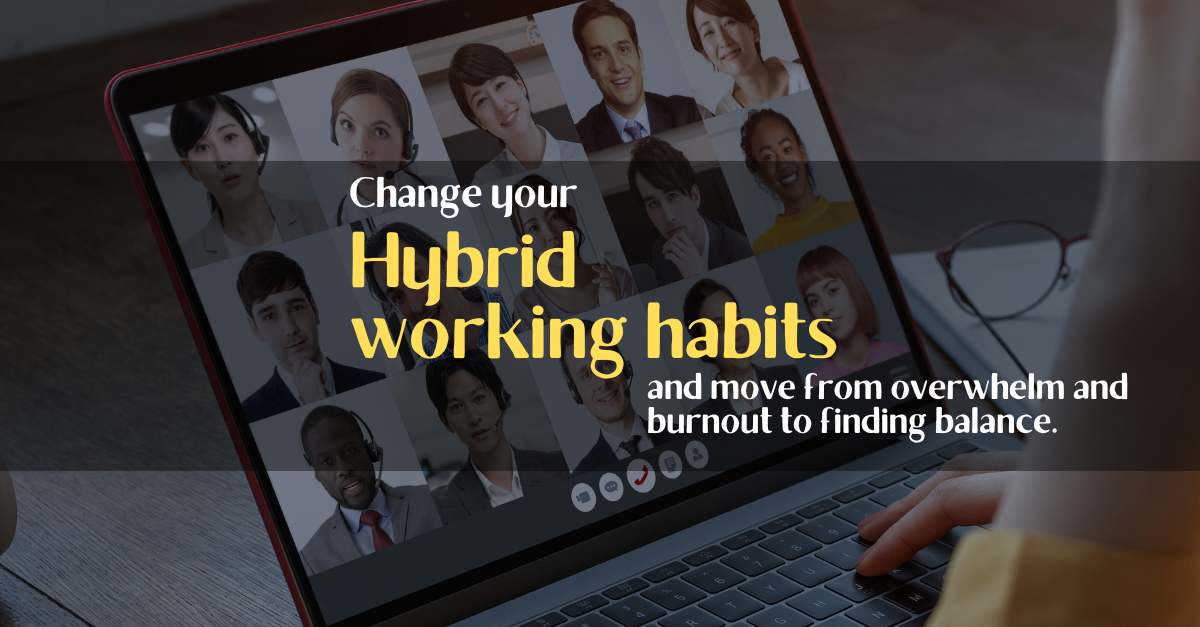
    If you are looking to move from overwhelm and burnout to finding balance, then this course is for you. 

    Develop the skills you need

    This course is designed to help develop skills to:

    • Audit your hybrid working habits to find out how your current habits are impacting on you and what to change;
    • Set boundaries for a better life/work balance and stick to them even when things are busy;
    • Increase productivity away from the screen by using strategies for communicating and collaborating outside of meetings;
    • Communicate more effectively in the hybrid workplace in a way that works for you and reduces digital overwhelm.

    Course activities

    Listen to the podcast

    The course has four parts and each part is introduced by a podcast episode that sets out the key ideas for the topic. I have chosen the podcast format to enable you to follow the course at your own pace, listening when it suits you and also to minimise screen time needed to take part in the course. Whether you listen to the course as you walk the dog, cook or sit in a comfy chair, this course is designed to take you away from your screen and constant stream of notifications. You just have to listen.

    Reflect on your practice in weekly hangouts

    Each topic is accompanied by prompts and questions to help you reflect on your professional practice. We will use these prompts in weekly course sessions to take a deeper dive into ways of working in the hybrid workplace and reflect on how your habits aligns with your goals and values. You can choose whether you write your reflections down, share them with others in the course or keep them private for yourself.

    Explore new ways of working

    Each topic comes resources and tools to explore. You can try out new idea for yourself or join one of the weekly drop-in sessions for personalised support.

    Who is the course for?

    This course is designed for emerging and established leaders and managers working in a hybrid or fully virtual setting in education and the not-for-profit sector. We will focus on how to develop effective home/hybrid working strategies. Whether you are collaborating online on a project, organising distributed volunteers or managing a whole hybrid working department, this course will support you to move from overwhelm and burnout to finding balance.

    Register today

    4 Week Course Listener – free

    • Listen via your favourite podcast app
    • Follow at your own pace
    • Explore resources via the show notes
    • Upgrade anytime!

    4 Week Course Explorer – £29

    • Course content straight to your inbox
    • Weekly course hangout & drop-in support
    • End of course summary with resource pack
    • Certificate & badge upon completion

    4 Week Course Explorer + Personal Coaching – £229
    Course Explorer package PLUS:

    • 4 x 1-to-1 coaching sessions tailored to you
    • resources and tools
    • personal plan and accountability check-ins

    Register now

    Enjoyed this post? Get my free monthly newsletter directly to your inbox.

  • Summer coaching inspiration

    Summer coaching inspiration

    I’ve put together three ideas to try out whether you are having a busy summer or taking a break. So if you are looking for some inspiration and ideas to recharge for the next academic year, have a go:

    Tips for a week of complete rest

    It’s taken me a long time to be able to step away from all types of work all together, and for me, having a complete week off is a big achievement.. as well as a reflection of how busy I have recently been. I took some practical steps to ensure that I had a complete break, and I wanted to share some tips that worked for me:

    • I completed a holiday handover, with my amazing colleagues and deputy, and then logged off all work systems completely on my last day at work;
    • No laptops came on holiday, and all computers at home where switched off when work ended;
    • I deleted all work-related apps from my phone or switched notifications off completely, included direct messaging, emails, and task management apps;
    • I logged out of/deleted all social media apps, like Twitter and LinkedIn, that I only use in a professional context;
    • calendar notifications were switched off or paused
    • A simply note to make a list of anything that I thought of, which were work related and which I wanted to pick up upon my return;
    • I intentionally packed books, audiobooks and other entertainment that would help me focus on things other than work.

    >> Longer read

    How to make a milestone map

    Many of my clients are looking to make progress in their work or personal lives: to make a change, develop their career path or build personal habits. Many of us have goals like ‘progress in my career’ or ‘be happier’… but it can be hard to break down exactly what to do in order to achieve our aims and define what ‘success’ means to us. In this post I share practical steps to help you put your goals on paper and break them down into achievable chunks, including:

    • How to choose a format that works for you
    • How to pick your goal(s)
    • How to turn goals into milestones
    • How to check your map

    >> Learn more

    List of 100 Dreams

    I am always on the look out for new tools or resources for coaching, and I want to share this one I came across in a blog post by Laura Vanderkam: It’s called a ‘List of 100 Dreams’. If this is a new concept, then head over to Laura’s blog to read more about the original exercise from Career coach Caroline Ceniza-Levine and how Laura has used this exercise as part of her work on productivity and time management. The ‘List of 100 Dreams’ is exactly that: a long list of things you wish to do, have or devote time to. In essence, it’s a very long bucket list. 

    I felt this was a lot of fun to try out, so if you are curious to learn more and try this for yourself, here’s how to get started.

    >> Get Started

    Enjoyed this post? Get my free monthly newsletter directly to your inbox.

  • Meditation and mindfulness in a virtual team

    Meditation and mindfulness in a virtual team

    During the recent Mental Health Awareness Week, I looked for new tips and ideas for virtual and hybrid teams keen to embed mindfulness and meditation into their ethos.

    I’ve previously shared tips, which I have updated and included again below. This year my focus has specifically been on finding resources for meditation and mindfulness.

    Sometimes it can be most helpful to bring in external facilitators to lead this kind of work, and run live sessions for teams. One of the challenges however is to schedule these sessions at a time when everyone can attend and also find a format that meets the needs of diverse individuals.

    So instead of looking for a specific course or facilitator, I have been looking to find approaches that are easily available and accessible in a flexible way, so that colleagues can engage as and when they wish to. There are a lot of free resources online as well as specialised apps such as Headspace, Calm Business and Insight Timer for Work.

    We tried Insight Timer for Work and offered colleagues the opportunity to explore resources such as meditation recordings in a huge library of content available in 44 different languages. We are a small team, and as such as weren’t focused on creating a particular level of engagement or meeting goals. We don’t use the analytics that the platform can provide.

    Instead, we started to share content we came across that was helpful to us, and we organised an informal meet up for staff to spend 15-20 min online. To make this as flexible as we can, the format we adopted brings us together in a video call at the start of the session, and we say hello and check-in with each other. It’s encouraged but not required to share what 5 or 10 min track you are planning to listen to. Then cameras and mics are switched off, and everyone engages in their meditation or mindfulness activity. At an agreed time, we return to the video call, and reflect a little on how we got on.

    Scheduling the meeting provides a way to stay accountable to the intention to take a mindful break for those who want it, and is opt-in only. We decide each time if we want to meet again, and then put another date in the diary.

    It’s a small step, but a welcome reminder to take a breath in what is a very busy time indeed.

    More Tips for hybrid and virtual teams:

    • Create time and space to talk: For many people working from home seems to be a never ending marathon of back to back meetings in Teams or Zoom. That’s a tough context in which to create time or space to talk about mental health. I’ve often blogged before about different ways of working, around a document, whilst walking, offering time to reflect and write together… and you really need to find pockets of time and space that suit your team(s) in order to get meaningful conversations.
      In addition to weekly group meet ups, make time to have one to one catch ups and wherever possible don’t schedule meetings back to back for the whole day or week. Consider how you might use informal and formal spaces which are always there, such as chat channels, for meet ups, chat and conversations.
    • Read the signals: For some, what works for everyone else isn’t a good fit. That applies to in person management just the same, but I feel working virtually increases the danger of missing obvious signals. If you have just come from one meeting and the other person has done something different, it’s easy to talk at cross purposes. So if you are talking about personal stuff, asking about wellbeing or mental health, you need to be prepared to look out for subtle signals, including tone of voice or chat, body language and even emoji.
      It’s helpful to have a communication channel in which discussing sensitive topics is safe and personal. Or rather than changing how you talk, consider what else you can modify to create a different atmosphere: go for a walk and talk; or have a phone call with cameras off. We don’t always feel the same, so our working practice shouldn’t always be the same either.
    • Talk about mental health: aim to normalise talking about mental health in an appropriate way and check in on how everybody is doing regularly. Clearly sign-post ways to seek expert or confidential advice such as via HR professionals, at appraisals, through organised coaching, therapy and other support.

    Enjoyed this post? Then listen to my podcast episode on mindfulness and meditation:

  • A party without a cake is just a meeting…

    A party without a cake is just a meeting…

    June is my birthday month and inspired by my upcoming celebrations, I thought I’d share some ideas about celebrating occasions like birthdays or milestones at the home office. You may prefer to ignore these all together or not celebrate with work colleagues, and I share some of the reluctance. However, during the pandemic especially, celebrating birthdays became a welcome focus for our virtual team, an excuse to spend an hour or two doing something other than fire fighting. And so, I came to enjoy and value moments of connecting with colleagues and spending time having a few laughs more and more.

    Like many people I prefer not to work on my actual birthday, and take a bit of time off. Alongside the time away from work, I make it a point to have some celebration at work, and to share something that I am comfortable to with colleagues as a way to get to know each other a bit better.

    In 2020, when I turned 40 having moved to a new city just months before, at the start of lockdown here in the UK, my colleagues organised a surprise birthday party, dropped off by a safely socially distanced colleague who lived close enough to make it both legal and practical to visit me in my garden. We ate cake, with other colleagues joining via video call, and I received lots of small, thoughtful gifts and cards that brought a huge amount of cheer to me during a dark time.

    As a manager or a leader it’s especially important I find to spend some time with colleagues informally, and when you are based at home or a hybrid worker, then those opportunities can be few and far between. More often than not, team days or long planned meet ups don’t happen with everyone involved, and although interacting online can feel less connected, it is often more achievable.

    So here are some ideas to help make that moment of celebration stand out a little, and create memories:

    • Switch away from your usual platform: switching platforms can be a really powerful way of changing the tone of your interactions with your colleagues, especially if you have a less formal alternative to the usual Teams or Zoom calls;
    • Experiment with backgrounds: if you can’t step away from the habitual online space or even if you can, consider have a bit of fun with different backgrounds. You can pick a theme (Tropical Island, Outer Space) or just encourage people to pick something fun and off beat – it really makes a difference when you are not staring at the same old corporate backdrops for a bit;
    • Play some tunes: play some music as you are all joining, so people coming into the space immediately have a different experience from usual. You can invite suggestions for songs, make a themed playlist, and of course birthday tunes or similar could be fun, too (if not necessarily to sing along to);
    • Have a plan for the session: I’d advise against inviting folk and simply hoping fun will happen as it probably won’t. Have a loose plan for the session, and limit the time from the start. 20-30 min is probably enough, depending on how many people are coming, and have an activity such as sharing a snack, unwrapping gifts, presenting a card or saying a few words, planned for the start and end. If you expect folk to take a picture with everyone waving (I would recommend against it), then warn everyone in advance;
    • Consider going off camera: Lots of fun can still be had on voice only or even text chats when you are celebrating or socialising, and it offers a lot more flexibility. Setting up a dedicated chat space can offer options for everyone to take part from wherever they are and work especially well later in the working day or first thing;
    • Don’t take up breaks: Many home and hybrid workers have strong routines around their breaks that they value. So wherever possible don’t assume that folk will want to give up their lunch hour or meet after work. Connecting socially is an important part of team building, and well worth an hour during your work day;
    • Engage the senses: Seeing and hearing are the senses we use the most in front of our screens all day long, so to make an activity more memorable, consider how you can engage more of your senses: if you can, share a drink or something to eat, either provided by post or brought by everyone themselves, and spend a bit of time focusing on that.

    I’m very much looking forward to putting some of this into practice as I celebrate my birthday at my home office, and I’ll be sharing what we got up to in a follow up blog post.

    Enjoyed this post? Get my free monthly newsletter directly to your inbox.