Category: hybridWorking

  • Wakelet from #LTHEchat 254: Hybrid working: new frontiers in professional practice

    It was a great pleasure to return as a guest to the wonderful #LTHEchat for a conversation all about hybrid working.

    For #LTHEChat 254 we shifted our focus from learning to work. We discussed ways in which learning and teaching practices can inspire a more sustainable and equitable hybrid workplace. If you haven’t yet seen it, read the original post on the #LTHEchat site.

    I was very curious to hear different perspectives and see where this conversation would leads us, and it was a very fast paced, lively discussion on the evening. I found it hard to do more than read, and like or retweet during the live conversation, and I also wanted to give as much room as possible for everyone to express their views and share their experiences, instead of dominating the conversation.

    It’s been such a pleasure to work together with the amazing people who organise and support this important community activity, and I am so grateful for their support and guidance before, during and after the chat.

    The chat in action

    Here are the questions we explored:

    Q1: What is your experience of hybrid working? #LTHEchat
    Q2: How has hybrid working made a positive impact in your institution? #LTHEchat
    Q3: What can we learn from hybrid learning to develop effective hybrid working? #LTHEchat
    Q4: What role should staff play in the hybrid learning/working skills development of students?   #LTHEchat
    Q5: What do you see as the biggest challenge for the future of hybrid working #LTHEchat
    Q6: Share one hybrid working tip that you would recommend to others (and why). #LTHEchat

    LTHEchat 254

    There was a lot of rich conversation and I am still reflecting and delving back into various exchanges, which I hope to write about more in due course. For now, here are a few moments that jumped out at me on the day:

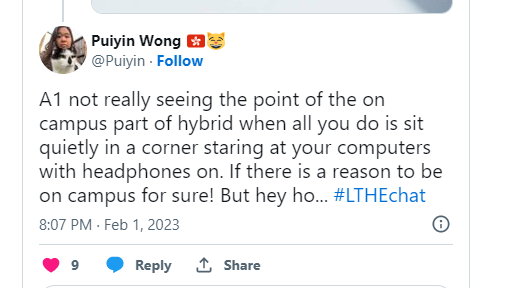
    Screenshot of a tweet from the chat

    It was inspiring to see how many different answers everyone had in response to “What is your experience of hybrid working”. It’s easy to loose sense of how different contexts impact on our ways of working, both personal and institutional, and this opener to the chat provided a vivid reminder of the broad range of hybrid working models that are happening across this community.

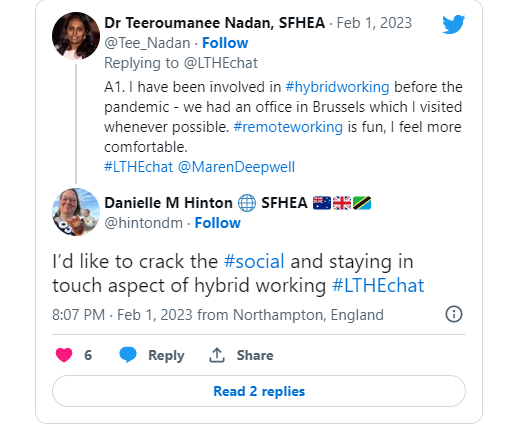
    Screenshot of tweet

    Another aspect of hybrid working that came across strongly was the enduring importance of social connection. This is something many contributors mentioned in a number of ways, regardless of whether they had long term experience of working in remote and distributed team or whether they were relatively new to it.

    The LTHE chat to me always feels like a valuable opportunity to connect with folk in and of itself, but this topic brought this to the forefront of my mind more than usual. It was amazing to glimpse a little of what folk feel is the reality of their home office life, office days and travel.

    Screenshot of tweet

    A lot of posts sounded very positive about hybrid work, with many contributors feeling more productive and seeing many upsides to the increased flexibility. But we also spoke about a lot of challenges: from equipment and connectivity to the lack of leadership, appropriate policies and lack of trust.

    There is so much more to dive into.. have a look at the chat for yourself.

    Explore the Wakelet

    You can now explore the whole conversation on the Wakelet: https://wakelet.com/wake/hx_8tyRERoRoSUhq-AFyj

  • #LTHEchat 254: Hybrid working: new frontiers in professional practice. Led by @MarenDeepwell

    Image of a team leader doing a team review with his team virtually.

    Image of a team leader doing a team review with his team virtually. (Source: iStock)

    I am really looking forward to returning as a guest to the wonderful #LTHEchat for a conversation all about hybrid working. I’m curious to hear different perspectives and see where this conversation leads us. Below is a re-post of the original post on the #LTHEchat site:

    For #LTHEChat 254 we are going to shift our focus from learning to work. We will explore ways in which learning and teaching practices can inspire a more sustainable and equitable hybrid workplace.

    Digital technologies enable remote and hybrid working in new and more connected ways, but it is by no means a new practice. Many industries have depended on home working over the centuries. In the UK we are at the beginning of a new era of widespread homeworking, prompting urgent questions about the rights of hybrid workers, working conditions, and how new working practices may increase inequality. Some workers may now have more flexibility working from home, but the pressures of competing demands such as caring for children or other family members whilst earning an income remain constant. Other issues such as the increasing digital surveillance of employees and privacy concerns around hybrid working practices further highlight the need for a careful and considered approach to setting out policies for the future of working remotely.  

    One indicator of the changes in how we work is new laws and policies that seek to formally express how the relationship between employers and their digitally connected and increasingly distributed workforce is changing.  For example, in the UK we have not yet seen an introduction of a code that would give employees a legal right to disconnect, whilst other countries, including France (2016), Italy (2017), Spain (2018), and Portugal (2021) have introduced such policies over the past five years and others including Ireland are working towards doing so. 

    We invite you to share your experiences of hybrid working and critically reflect on some of the downsides alongside the positives. What do we gain when we move beyond simply translating office-based practices and envisage a truly hybrid way of working? How can we help create welcoming and warm hybrid places to work that help sustain well-being and work/life balance? How can we empower ourselves and others in making hybrid working an equitable and engaging reality that benefits the organisation and the individual alike? 

    We are at a watershed moment for remote working in the sense that we have an opportunity to set out a vision for what is ahead that is informed by lessons from the past, as well as, the shift in perspective that the pandemic has brought about. 

    In 2017, I set out to find creative and fun ways to work and build meaningful relationships in the virtual workplace. The resulting Open Access book, Leading Virtual Teams, brings together case studies and practical advice to build on. This LTHEchat #254 offers an opportunity for a conversation about current practices and how things are changing. 

    Join us to share your own inspiration, questions, and prompts for reflection. From recruitment and induction to establishing effective and sustainable ways of working in the hybrid workplace we will explore the highs and lows of what it means to work in hybrid organisations in the long term. 

  • The world is bigger than my desk. 

    As I am writing this, I am on a delayed train with wet feet, hoping to still make at least some of the meetings that I got up in the dark for this morning. Working from home permanently does have downsides, but on days like this it’s hard to feel that wading through flooded roads to the train station before 7am is worth it. 

    The folk around me on this train are frantically trying to get work done despite the poor internet connection and the poor person across from me is slowly being bored into a stupor by an over-eager and oblivious co-worker who has her cornered in the window seat. We are all waiting for lines to be cleared of flood water that has accumulated over night before we can continue our journeys North. 

    I am picking up snatches of conversation, passengers reflecting on how long it’s been since they last travelled, commuted or sat in an office. Most of the conversations are on mobile phones, updating colleagues about ETAs, delays and rescheduling meetings that were meant to take place in person, and are now maybe happening via a patchy WIFI connection. 

    Ever since the concept of ‘returning to normal’ started to be talked about, I have disliked it. After such a long period of crisis things have moved on, not back. We are moving forward all the time, every day, and of course things are different. 

    I spent many years travelling a lot by train, then years not travelling much at all, and now I am back to travelling regularly. It’s both by my own choice and also thanks to folk being more ready to embrace meeting virtually that I am no longer spending as much time typing cramped in train seats.

    But I am still excited to do it some days. It makes my job much easier and enables me to better represent the organisation I lead. It helps connect and build relationships, and it reminds me that, yes, I can do this! 

    Standing on a stage giving a keynote, delivering a talk in front of an audience, delivering a report in a meeting, all these things are part of the work I do. Being comfortable and confident in all kinds of different contexts and with a broad range of stakeholders is a key skill that requires practice. If I stay at home I feel that I loose those skills gradually. 

    It’s important for me to be able to run late or be uncomfortable and still have a productive day. Travelling is a very effective way for me to keep those skills sharp. Small journeys make the longer ones easier to prepare for. 

    When travelling first resumed, I was so excited to meet with colleagues once again and a lot of our focus in those early days was all about travel, wearing masks on trains, getting dressed for work, keeping safe and well, managing the stress of it all and so on. We were adjusting to going out of our homes once again and to be in public spaces in a work context. 

    I found it hard initially. Harder than I had expected. I felt it was hard to leave home, the safety and comfort I enjoyed daily, and swap it for the dubious benefits of travel and seeing people in person. But now I don’t want to give up the ground I have gained, the familiarity I have regained. I don’t want to loose the skills that are coming back to me as I work through my inbox on route, saving frequently in case my connection drops. 

    The world is bigger than the small desk, surrounded by plants and accompanied by a dog bed, that I spent so much of my time at. And it is filled with people whom I want to connect, chat and collaborate with. People I will hug, eat and laugh with. 

    So I have wrung out my socks and trouser ends, opened a new document and started blogging, making myself at home for the journey. Happy and safe travels to you. I’ll see you out there 🙂 

  • Leading Virtual Teams: Missed moments

    With the holiday season coming up, our team has had a long overdue in person Team Day and we are also planning a virtual get together in a few weeks. These social activities are important to virtual teams, and I really value the opportunity to spend time with colleagues in a more relaxed way.

    Blended approaches to working together can help shape the dynamic of the year, and punctuate long periods of remote working with new inspiration and energy connecting with colleagues in person can bring.

    That said, this year it’s proving hard to make that actually happen. A mix of post-pandemic factors, cold + flu season, taking long overdue leave and simply bad luck have resulted in many of us missing one or more of these important moments.

    Does it really matter, though, that we are not able to all meet together? Does it make a difference that I miss a Team Day or a get together?

    Here are my thoughts on this:

    Yes, it does…

    In our team we set clear expectations that we meet in person 3-4 times a year. In 2022, thanks to train strikes and various other factors, our meet up got delayed and rescheduled several times, and it really had an impact. Relationships can change if you lack an expected amount if in person interaction.

    Touch base: One of the aspects of being in an organisation in which everyone works from home that I find challenging is that I can easily forget how different an experience home-working is for each of us. What you see on a video call is only a small sliver of colleagues’ reality. Meeting in person really helps me touch base with colleagues and get a different perspective on how everyone is doing.

    Joining in: We often have a social focus for meeting in person, and we have tried out a lot of different activities over the years. I enjoy joining in those activities, and being part of everyone interaction in a different way. The recent activity I missed out on was an escape room, and I am sorry I missed it!

    Getting a sense of things being ‘normal’: This is a clumsy way of putting it, but I am not sure how else to express it. What I mean is that, our team met 3-4 times a year in person in 2019 and it matters to us that we are back to meeting in person in 2022. Things are not the same as in 2019, but we aim to have a blend of working from home and meeting in person, and it feels reassuring (and fun!) to get back to that schedule. Care

    No, it doesn’t, if…

    It’s a reality of any virtual team that someone is off or unavailable and thus misses out on a shared experience. The larger the group of people trying to get together, the higher the chances that people are missing out. There are plenty of ways to make up for the missed interaction, such as:

    Share what happened: in the case of our Team Day, colleagues took photos and shared these with everyone afterwards, and also shared their stories at the next virtual meeting. We talked about what happened on the day and included everyone in the conversation.

    Make it clear what others got out of it: we had planned to swap Secret Santa presents on the day, and these swaps largely moved online. We also went through some training for a new productivity took we are trying out, and that, too, continued virtually so that everyone could take part.

    Encourage alternative forms of engagement: in the weeks after the event, we offered other ways to engage, and continue to conversation even though we were busy and had a lot of other things happening at the same time. That’s a crucial point for me: if it was important enough to spend time and energy to bring a group of people together, then there should also be an emphasis on afterwards including everyone who wasn’t able to get there.

    Care goes both ways

    During this year, I have been thinking a lot about the boundaries between work and personal space, about finding balance between the needs of the employer and the needs of the individual. In my context, working for a small employer with fewer than 10 employees, even a very small number of colleagues being unavailable as planned has a huge impact.

    Today, for example, out of 6 employees: 33% are on holiday, 16.5% are off sick, 16.5% are not scheduled to work, and 33% of us, two people, are working.

    When you are working in a team or organisation of a small size, balancing the need to work together on things and share experiences with the needs of each individual can be a difficult balancing act. Care goes both ways. We want to show care for each individual and their needs (take leave, be off sick, work flexibly) and also the needs we have as a team (collaborate in real time, meet to discuss new plans, spend time together).

    Those missed moments can add up. In order to have good cohesion as a virtual team, you need to have enough of them with enough of your team to benefit long term. Which is why I am already looking forward to our next get together 🙂

  • Hacks for Hybrid Working… flex course reflection

    In the past couple of months I had the wonderful opportunity to work on a project outside my day job. Together with the awesome folk at Reclaim EdTech, and working closely with Lauren Hanks, we embarked on a journey to design and run a four week flex course all about hybrid working.

    It was interesting to learn more about the format of flex courses, which are run regularly each month in the Reclaim EdTech community (check out the events calendar). I have experience of different formats of courses, but I hadn’t come across one yet that uses this format, combination of Discord, blog posts, videos and interactive sessions.

    With a blend of synchronous and asynchronous element, I love that these course fit around busy schedules, and are available to offer expertise and support when needed.

    What the course was about

    This particular course focused on a different topic each week, and here is a quick overview quoting Lauren Hanks’ post:

    EVENT SUMMARY

    For many of us in Higher Ed, hybrid working is here to stay. So whether you’d like to create a better work/life balance juggling being on campus with working from home, or you are looking to move from crisis mode to a way of working that is more sustainable, healthful or simply a little more joyful, this course is for you. Join us to explore hacks to create a better hybrid workplace for everyone.

    We are excited to join forces with Dr Maren Deepwell, author of Leading Virtual Teams and each week features ideas to try out, prompts to reflect on and resources with a host of community voices. Here’s our topic list:

    • Week 1: Hybrid Working Unpacked
    • Week 2: Digital Tools in the Virtual Workplace
    • Week 3: Exploring Hybrid Working Hacks
    • Week 4: Complete your Hybrid Working Roadmap

    The final post we published at the end of the course gives you a bit of a flavour of what it was all about in practice.

    What I learnt along the way

    What I enjoyed most about the course are two things: firstly, it was super stimulating to work with Lauren, who, like me, lives and breathes the reality of leading a hybrid workforce day in, day out. We had a lot of fun running sessions, designing activities and reflecting on the questions from our participants.

    It was a huge learning curve for me to work with a different team, in a new environment, and having such experienced collaborators made it all feel easy and interesting. You can always tell when you are working with folk who know how to work together virtually, and it was impressive to experience that as a ‘newbie’.

    The other aspect of this project I really got a lot from was the input from everyone who took part. As well as synchronous conversations happening around live sessions, we had an ongoing chat for the course which brought up thought provoking points every week and activities like a splot site that gave us a glimpse of what other people’s homeworking and hybrid working spaces look and feel like.

    We do something similar in my own team each year, and it never stops being useful to see what others’ day to day looks like in reality.

    A highlight of the four weeks was definitely a hybrid working radio show on DS106 radio, for which we were joined by Jim Groom. Chatting hybrid working hacks for an hour was definitely too short!

    It was also stimulating for me to step into a different role professionally, and getting to focus on the design and delivery of a course. It’s been a few years since I last did that and it was useful to flex those muscles once again.

    Look out for a podcast coming soon, in which Lauren and I will reflect together and share our perspectives on Hacks for Hybrid Working 🙂

  • Preparing to wind down work for 2022

    It’s December and for me, the quietest time of the year. That doesn’t really mean that things aren’t busy, but some of my biggest deadlines are currently a few months into the future, and there is no more major travel planned between now and January, so this is as ‘quiet’ as it gets. And I am keen to capitalise on that.

    As someone who actively tries to become less efficient and work less hard (looking for more sustainable, balanced productivity instead) this time of the year offers a much needed chance to spend some time tidying up. Here is what I intend to do in the run up to the holidays:

    Calendar refresh

    I have plenty of recurring meetings in my diary, and at the end of each year I check in on them. I look at whether I still need the meeting at all, whether the time still works, what’s changed and how I can adjust and plan for my week better.

    The kinds of meetings I often change are individual catch ups, mostly due to working patterns changing or the focus of collaboration shifting.

    Long term to do list clear out

    My long term to do list is a a long list of things I want to tackle at some point, action items that are usually neither urgent nor important. Long term to do lists, for me, are the back of the back burner.

    This is where I brain dump ideas, links to things that may be interesting one day, long term hopes or ideas that I could investigate.

    At the end of each year, I review and prune my list. Usually there are a couple I have actually implemented, which can be marked as completed. Some have become obsolete and get deleted, whilst others may now move towards the actual planning phase.

    Pruning other to do lists

    I also prune and tidy my other lists, primarily trying to complete quick wins and plan for larger pieces of work come 2023. I try to be realistic, spacing them out for the new year, so that I don’t start January with a completely unachievable list on day 1.

    Clear out the old…

    Alongside that, I have a clear out of files and folders, my inbox and desk. Out with the old… and make space for fresh thinking for the new year. I usually book a half day out in my calendar in the last working week of the year, for precisely that purpose. I want to make sure I have time to clear up, and leave things in a nice way for the new year.

    One thing I don’t do is to send 100 emails clearing my inbox just before I finish for the year. I am the recipient of many of these from others, and I dislike it personally. If something wasn’t urgent up to 23rd December, it can probably wait until 3 January.

    So in order to empty my inbox, I schedule or draft emails ready to send in the new year and that way, I don’t get lots of harried responses and others don’t get 100 more emails from me.

    …in with the new

    One of the biggest joys of ending the year is to start planning for a fresh new year. I ordered a new journal yesterday, and this is always one of my favourite things to do. Have a little re-arrange, tidy and make space for new things.