Category: hybridWorking

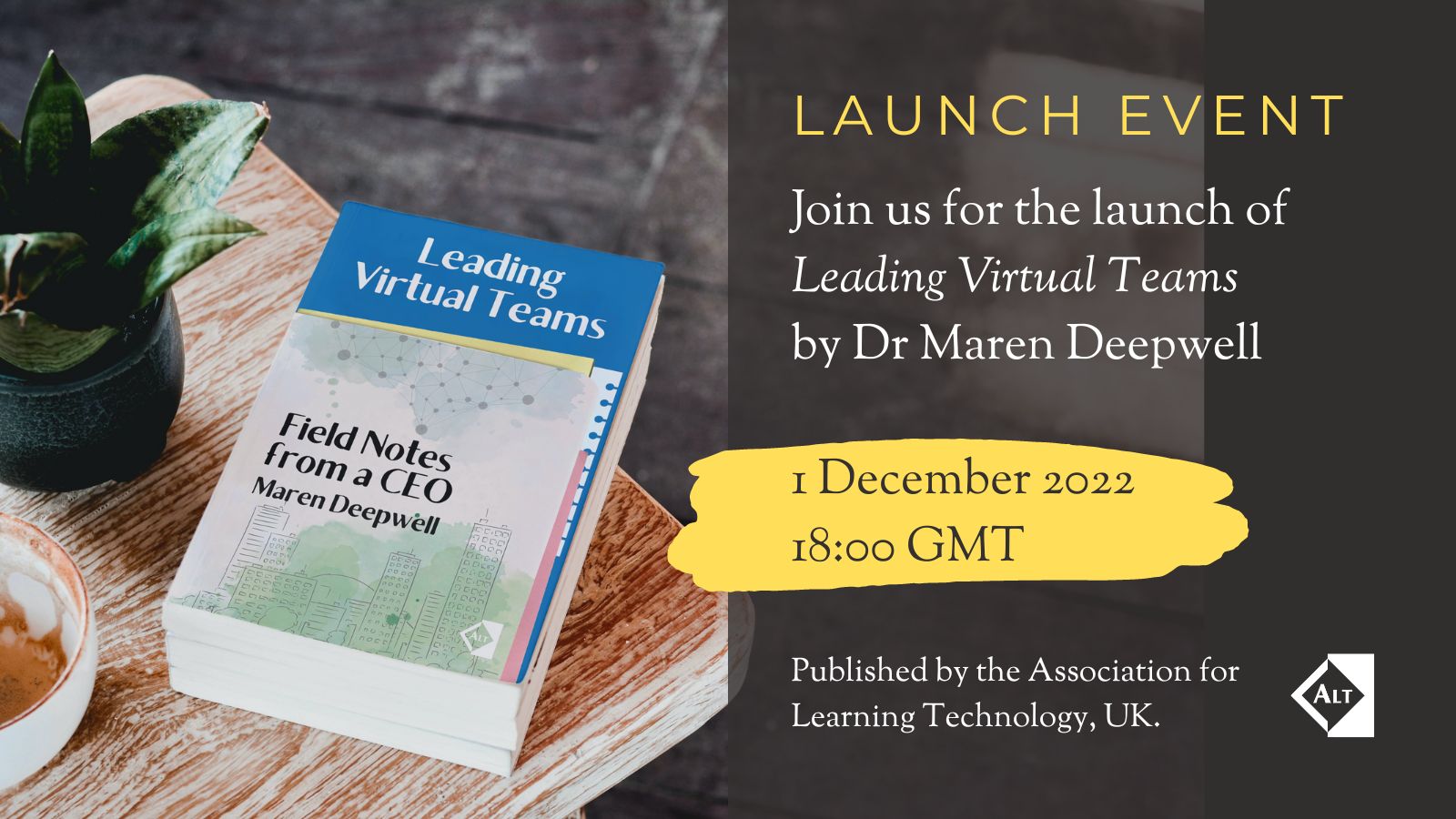
  • Out now! Leading Virtual Teams

    Out now! Leading Virtual Teams

    Today is an exciting day for me, as my book goes out into the world. It’s my first experience of this kind of publication, and feels quite different from anything I have published before.

    As an Open Access publication, the book is immediately and freely available to download and read online and I am really looking forward to celebrating the launch of the book this evening in conversation with ALT’s Chair, Professor Helen O’Sullivan.

    Thanks and acknowledgements

    First and foremost I would like to thank the Association for Learning Technology for the support for this venture. Special thanks go to Professor Helen O’Sullivan, Chair of the Board of Trustees, without whom this publication would not have happened, as well as the Trustees at time of writing, who reviewed the manuscript: Bella Abrams, Peter Bryant, Lorna Campbell, Elizabeth Charles, Shonagh Douglas, Sharon Flynn, Natalie Lafferty, Keith Smyth and David White. 

    Many of the examples in this book were collected between 2017-2022 in my role as CEO of the Association. I am grateful for the input from everyone I worked with, especially the core staff team, with whom I shared the transition to becoming a virtual team and the years since. The transition was a unique opportunity for me and the team as a whole to shape a new era of a long established organisation. Many of our experiences from 2018-2020 were chronicled in collaboration with Martin Hawksey. Martin has given his kind permission for this book to include many of the ideas we originally blogged about. 

    This book is subtitled Field Notes from a CEO because my years as an Anthropologist taught me how to adopt a researcher’s outlook. Although I have settled into a different mindset in my ten years as a CEO, no longer just observing, but leading, I still find myself just as curious about seeing the world from someone else’s viewpoint and doing my best to walk a few steps in their shoes. Leading a virtual team has challenged that ambition in interesting ways, and provided me with a new field for inquiry. My fondest thanks to the Material & Visual Culture staff and colleagues at the Department for Anthropology at UCL, who inspired me so much during my time there. 

    Last, but certainly not least, I would like to acknowledge all the open practitioners and researchers who have shared their insights and provided input along the way. 

    Thank you. 

    Get your copy

    You can read and download a free digital edition, published as an Open Access publication by ALT in partnership with Open Academia. The Open Access print edition, published by Lulu.com, will be available to purchase soon.

    Digital edition – out now

    Print edition – coming soon

    Leading Virtual Teams is licensed under a Creative Commons licence CC-BY-NC-ND, copyright Maren Deepwell 2022.

    Sign up for the free Leading Virtual Teams course

    If you’d like to learn more about leading virtual teams, join my free course starting in spring 2023. This course translates key parts of the book into practice:

    • Onboarding and setting expectations
    • Fostering a shared team culture
    • Managing people and processes
    • Strategies for succeeding in hybrid workplaces in the long term

    This course offers a unique blend of inspiration, practical support and resources. Join us to explore ways of working in the hybrid workplace that are aligned to your goals and values and how to lead with agency and authenticity.

    Sign up now

    Explore resources, blog posts and podcasts

    There is a wealth of resources and inspiration in the Virtual Teams blog posts, more recent blog posts and resources and podcasts .

  • Book launch week unpacked

    Book launch week unpacked

    I am really, really happy that this week my book is finally going to be published. The digital edition has been ready for a while and the first proof of the print version arrived this week, so it’s starting to feel real. Yesterday I added the ISBN to the cover design and ‘BOOM!’ – it felt like a proper book.

    Publishing a book feels scary. It took me nearly two years to write, although I started with years of blog posts and presentations to draw on. I rewrote pretty much all of the material I already had, cutting and editing along the way. If you have followed the progress of the book or read any of the draft chapters I published along the way, you will know just how much of an evolution this project has been through.

    Even after the editing process was finished, I found an error in the introduction, and fortunately there was time to get it fixed and the files updated. I am sure the print edition will include some typos, too. So I am making a list of things to fix in the 2d edition.

    It’s not perfect, that’s for sure, but I am proud of this piece of work. It’s useful and interesting and an attempt to grapple with issues that many in leadership roles will be familiar with. Obviously I want it to be well-received and reflect positively on ALT, as so much of the inspiration and case studies are focused on my work there. I appreciate it enormously that the book’s digital edition is published by ALT as an Open Access publication. Sharing knowledge is after all what this book is all about.

    I also feel a little sad, to let the book enter the public domain. Since I started working on it, it’s been my project, mine to nurture and progress. It’s been my focus on days off, evenings and weekends and a writing holiday. Sure, I have published extracts along the way, and I have shared some of the resources from the book on radio, in my podcast and the Hacks for Hybrid Working course. And the book has bee read by colleagues and Trustees who helped review it. In some ways, there is little in the book that isn’t already out there.

    Once the book in its entirety is out, then it belongs to all who read it. It becomes lots of different things to many people and they make their own meaning, shaped by their experiences and context. I am excited to see how the book may be used or interpreted by others and I hope that the related resources, blog posts and podcasts will help make it a valuable resource.

    Meanwhile my thoughts have started to turn to the course which I will run in spring 2023, offering a practical approach to leading virtual teams #excited.

  • Changing habits with a Pie Chart Diary

    Recently I have been working with a number of clients who are finding hybrid working habits hard to change. Busy days blend into each other, and at the end of a week or even a month, routine tasks like answering emails or attending meetings have taken up all the time and other priorities or more creative work have had to take a back seat.

    I have struggled with this for years. Changing habits to make more time for writing, research or simply finding a moment to hear yourself think can be a challenge. Particularly when your working days are punctuated by the ping of notifications, endless emails or mandatory meetings, finding what some call the right cadence, a balance between busy work and creative tasks merits our attention.

    Setting abstract targets like “make more time for…” or “be more research-focused” can feel unachievable. So where do you start? One place to start is to get a new perspective on how you spend your time, so that you can pick a good moment to change your habits.

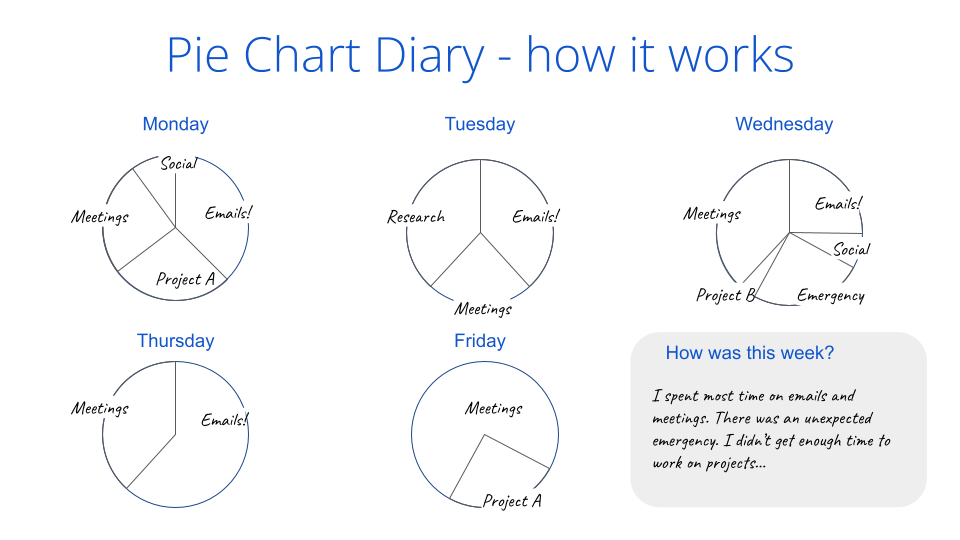
    For me, a bit of a spreadsheet nerd, I decided to track my time manually. I spend 2-3 minutes at the end of each day making a pie chart of what I had done that day. I continued to do this every day, always just before leaving my desk, and over the period of a month or two, I learnt some things about how I work:

    • I found that Tuesday, for example, were days when I never achieved my goals because they are dominated by meetings.
    • Wednesday mornings and Friday mornings were most productive for me.
    • I generally found time for things once I had a firm deadline.

    Here is an example of the Pie Chart Diary tool and how it can be used:

    Use it over a period of a few weeks or months, and reflect on:

    What do you spend most/least time on?
    What days of the week are you more likely to you achieve your goals?
    What is missing from your days?
    What could you change most easily to find better balance
    or to meet your goals?

    You can download this template if you’d like to try it out for yourself. Depending on your preference, you may want to print the template and write on it or simply use a blank piece of paper to make your charts. Or, if you prefer, use a spreadsheet or similar to track your categories and how you spend your time.

    The important part is to take a moment at the end of each day, and honestly reflect on what you actually did during the day. If there is something that takes up time, distracts you or interrupts you, consider adding it to your chart.

    When my dog was a puppy, my pie chart diary would have definitely included a “puppy” category as it took a lot of time out of my day to look after her.

    Look out for a podcast episode exploring the pie chart diary. As always, I’m curious to hear from you, what tools you use to track your days and what you learn along the way.