Category: leadership

  • Leading a virtual team: blended is BEST

    Leading a virtual team: blended is BEST

    We’ve previously written about how important a blended approach is to leading a virtual team (in this post from 2019 about delivering in person events as a virtual team and in this podcast) but the past year has changed that conversation on a global scale.

    What’s best?

    Getting ‘back to the office’?

    Staying with working from home?

    Who decides and what should we base this decision on?

    Having led my team from being office based to working from home with in person elements to working entirely from home for 12+ months with no in person contact, I’ve had a lot of experience with the different options.

    This article, which I discovered thanks to Matt Lingard, explores a lot of interesting options that organisations are now thinking through when designing their approach in (what’s hopefully one day to be) a post-pandemic workplace:

    After months of working remotely, we have all learned that most tasks are accomplished and most meetings go just fine without the office.

    But that, the authors warn, doesn’t mean companies should suddenly abandon their workplaces. Going to the office, they argue, has never been just about work. And technology won’t make socializing less dependent on direct interpersonal contact anytime soon. In this article they describe the important social functions of an office: It’s where people build trust through personal interaction, learn the nuances of their job, and build and maintain organizational culture. And it’s through random in-person encounters between people from different functions and cultures that many of the most innovative business ideas are born. The authors conclude by showing how design, technology, and management practices can be used to make tomorrow’s offices more effective as social, learning, and innovation spaces.

    https://hbr.org/2021/03/designing-the-hybrid-office

    We need a ‘Social anchor’

    One function of in person contact that is explored in the article is that of social interaction (outside of formal meetings) to foster relationships, social bonds and cooperation – the ‘office as a social anchor’. In person interaction, it argues, helps built commitment and support for each other and the organisation. One of the examples cited is the ‘The WELL (Whole Earth ’Lectronic Link), which started in 1985, is one of the oldest virtual communities in existence’. 35 years later, we have A LOT MORE technology and connectivity to help us establish and grow our virtual teams and communities – but what many of the teams and organisations who only moved online in 2020 don’t have, are the shared experiences of meeting up, sharing life events, supporting each other longer term.

    Even in our team, having worked mostly remotely for 3-4 years now, sharing those events over time, has had a big impact already. It takes times for enough birthdays, weddings, births and so forth to happen in order to share them and for that shared experience to strengthen team and organisational culture and belonging.

    Sharing ‘how things are done’

    In my experience the onboarding or induction process, is one of the biggest challenges of leading a virtual team and I agree with the authors who write:

    Classically, this on-the-job learning takes place through apprenticeship. New employees learn the correct and proper way to behave—“how things are done around here”—from directly observing those around them, especially their mentors.

    Technology can certainly be used to facilitate this sort of learning, but without question an office makes the process a lot easier.

    We are currently in the midst of one such induction process, and we have developed a number of approaches to help us provide as many opportunities as possible for the kind of learning that’s described in the article. For example:

    • As a team, we each spend time working synchronously with a new member of staff, enabling them to observe how we use tools and systems and explore what we do day to day;
    • We provide a comprehensive induction checklist, with links to processes and procedures, which we work through together;
    • We start the induction process before the first day, to ensure that a new colleague knows what to expect and how to prepare, including undertaking a home-working review and assessment;
    • I provide a lot of the induction focusing on the ‘why’ and bigger picture context of what we do, rather than the ‘how’.

    Creating the collaborative spark

    Without exception, what I hear the most about working form home as well as virtual conferences, is that everyone missed those watercooler moments and hallway chats above all else. The authors identify these types of interaction potential for ‘unstructured collaboration’. This, without exception, takes THE most time, effort and imagination to make happen, and initially I spent A LOT of my management time experimenting with different approaches to make this happen in my team, including setting up a ‘watercooler chat’, having unstructured ‘show & tell’ elements in weekly team meetings and so forth.

    Over the past year, I’ve come to the conclusion that all of these efforts contribute something, but by far the most effective is to lead by example. Even as a senior leader, you have to make the effort to have open conversations, exploring ideas and questions, sharing thinking in progress, so that you create not only space but also time for the kind of unstructured collaboration you want to happen.

    It’s a skill that a few of the senior leaders I work with cultivate – and you can see the difference immediately. The result is less presentation, more collaboration – fewer meetings where no one speaks up and everyone has their cameras turned off and more hangouts in which everyone contributes and ideas spark.

    You can learn to cultivate that kind of approach to leading virtual teams, and it takes a high level of focus on your own skills in communicating and collaborating online. You need to put yourself intentionally in a position in which you would naturally be in an office – sitting at your desk with work in progress, staring out of the window whilst thinking about a difficult problem.

    Blended is best.

    I have started planning to see my team in person again. The first of our joint away days may still be 6+ months away, but we are preparing for increasing the in person element of our ‘blend’ again after a long period of not meeting up. Both social and work interaction is planned for 2022 and that thought in itself provides welcome structure and motivation through these months of continued pandemic life. In the interim, we have puppy pics, snack boxes, t-shirts, feedback by post and… online karaoke and radio to keep that blended spirit alive.

  • That was February… with max funk

    This Sunday’s Sunday Special has a special International Women’s Day theme – and we started the show by playing an awesome tune by last week’s guest Chahira Nouira and her band the Max Funk Institute 🙂

    Plants!

    One of my strategies for getting through lockdown/pandemic burnout is to have a lot of green in my workspace. This month I blogged about looking after my plants every Friday morning makes me think about.

    Strategy Days.. pandemic style

    This month I also really needed to get some headspace in order to think about strategy at work… so I started by organising a solo strategy away day for myself:

    On the day, I have a session with a wonderful coach I sometimes see, who works for a small, independent HR provider, based in Sheffield. Working with agencies that serve solely small charities like ours really helps find support that is both excellent value for money and affordable (even in cash strapped times) .

    Weather permitting, we will be speaking on the phone whilst going for a walk in our respective local areas and step outside of the usual desk/home office environment.

    If it’s raining, I might decamp to the garage or at least the living room, to make sure I have a change of scene.

    https://marendeepwell.com/?p=2909

    and I also did some visual thinkery as part of the process:

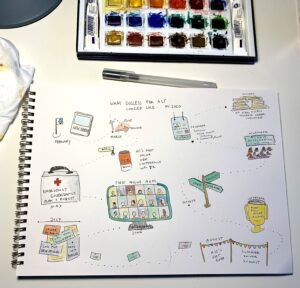
    I find it helpful to start with a blank page and the first thing I drew was a little flag, planted at the start of the year. It marks the launch of ALT’s (then) new strategy for 2020-25 (…best laid plans etc).

    From there, it was a story of firsts… the first pivot online… our first ever fully online OER conference… the first time that we ran an event with 1,000+ registered participants, and the first ever time that we had to fully refund hundreds of paying delegates AND the first time those participants donated nearly £10,000 to help cover the losses we were making.

    https://marendeepwell.com/?p=2912

    It was really, really useful to write the post and do the drawing as part of my thinking process.

    Virtual Team leadership

    It was great to make time this month to blog about leading a virtual team as well – and never has there been so much to think about leading a virtual organisation than 1 year into lockdown.

    This month I have been reading a number of really interesting posts about life/work balance and pandemic burnout:

    … I took real inspiration from Ben and the next day we implemented these new signatures across our team. Internally, the feedback was really positive as many of our staff have different working patterns including caring for family, home-schooling and so forth. Externally also, I received some spontaneous positive feedback from contacts I wrote to.

    As a CEO, it’s part of my responsibility to model the kind of behaviours Ben blogged about and make that part of our culture as a virtual team: respecting different working patterns, not to work all hours, but only productive hours – particularly in these times of pandemic.

    https://marendeepwell.com/?p=2929

    And at the very end of the month… a new puppy, Posey, arrived, on four cute, big paws and with absolutely no need to sleep after 5am. Life has never been less boring and it feels a bit like I have reached peak lockdown 🙂

  • Leading a virtual team: life work balance

    Leading a virtual team: life work balance

    Last month, we, that is my whole team, blogged about celebrating three years as a virtual team! It was really, really enjoyable and rewarding for me as CEO to read the words and hear the voices of all of my colleagues. I am so grateful that some took the plunge to blog for the first time and others made time to contribute in the face of a big workload. It was a big deal for us as a team to mark the start of year four as a virtual team – a digitally and geographically distributed organisation. Where many other teams started in 2020, we were a few years ago – intentionally and with both strategy and time on our side.

    That said, like every other small, agile team, we have been having to reinvent what we do, how we do it and, importantly, how we support each other in these challenging times of crisis and heartbreak.

    You can find out more about how we are weathering the crisis and revisit all of our virtual teams posts here.

    February 2021

    This month, the focus is on achieving the right life work balance at a time of change – not ‘just’ with established colleagues within the organisation, but also with new teams and on new tasks. 

    I have had a lot of opportunities to explore this in recent weeks, as part of a new collaboration with the team at Reclaim Hosting, to organise the forthcoming OERxDomains conference (exciting!), as part of an external quality review panel for a university and through activities organised by a professional body for UK Association executives. 

    Collaboration with new folks is always inspiring, and also brings with it getting to know someone else’s working rhythm and practices. For example, when working across different time zones, it’s hard to avoid scheduling work outside of everyone’s normal working hours. I don’t normally work, at least visibly, outside my normal working hours, unless it’s for something like delivering a conference. 

    Many people rate CEOs who work all hours and show ‘commitment’ by working at weekends and through holidays, but I am not one of them. This post ‘Working on weekends‘ exemplifies some of what’s at stake, particularly when you are a manager or in a leadership role, really well.

    “… there’s often a cultural belief that if you’re not burning the candle at both ends – if you’re not pulling 18 hour days and working on the weekends – you’re not trying hard enough. … Most knowledge workers can muster up to 4 to 6 hours of really productive work a day. After that, you get into make-work; the going through the motions, non-reflective phoning-it-in work that isn’t going to rock anybody’s world. Likewise, constant interruptions, eg on Slack, through random calls, or half hour meetings sprinkled throughout the day, interrupt flow state and dramatically drop productivity and well-being.”

    https://werd.io/2021/working-on-the-weekends

    Alongside the blog post, I came across this tweet:

    I took real inspiration from Ben and the next day we implemented these new signatures across our team. Internally, the feedback was really positive as many of our staff have different working patterns including caring for family, home-schooling and so forth. Externally also, I received some spontaneous positive feedback from contacts I wrote to.

    As a CEO, it’s part of my responsibility to model the kind of behaviours Ben blogged about and make that part of our culture as a virtual team: respecting different working patterns, not to work all hours, but only productive hours – particularly in these times of pandemic.

    From Ben’s post, I moved to reading Mary’s post on life work balance (my coach recently mentioned how she puts ‘life’ ahead of the word work in this term – life comes BEFORE work)

    Mary is an excellent writer and thinker and her post really struck a chord with me:

    “…What isn’t such a good thing though, is not being able to turn off that running strategy session in my mind. It also runs when I’m reading in bed before going to sleep, when I’m meditating and when I’m playing video games with my teen. … I have become compassionately ruthless with myself when I have intentionally created a space for something like reading or meditation and my thoughts start running away. I don’t get mad at myself (this is also something I’ve had to learn how to do). I calmly guide myself back to the activity and resume focus. Sometimes I do that over and over and over.”

    https://www.linkedin.com/pulse/work-life-balance-mary-burgess-she-her/

    I found a lot of support in having a good therapist for much of 2019/20 and what Mary reflects on, the techniques used such as meditation, resonates with my own experience. You don’t have to suffer from Anxiety with a capital ‘A’ for these kinds of patterns of behaviour to become an issue – and lack of the right life-work balance really contributed to poor mental wellbeing in my case.

    I am fortunate that I had the support to change things and it’s been a lot of hard work that continues each and every day, particularly during these times when there is always something urgent that demands my work attention or my personal attention. Care is work.

    Which led me to this episode of the InVinoFab Book Club, which was all about burnout – a condition that we are reading more and more about at the moment. ‘Pandemic burnout’ rears its ugly head all too often and working in Learning Technology over the past year has rarely felt like anything other than fighting burnout.

    I have blogged a bit about the strategies I use to combat burnout, from organising strategy days for one and making drawings to adopting more office plants and blogging to recapture the joy of EdTech… .

    But sometimes small practical steps have the most powerful impact, such as changing your email signature to send a clear signal that you DON’T expect anyone to respond to you immediately or outside their normal working hours.

    Or finishing work on time or even early.

    For me, there is a soon to be adopted puppy about to cause some (welcome) chaos in my working life as a CEO. No power cable will be safe… 😉

  • Drawing 2020 – a bit of strategic ‘visual thinkery’

    Earlier this year, I blogged about that I feel I am starting a ‘new job’ as things have changed so much over the past year… so this week on Friday I am having a strategy away day, pandemic style.

    CEOs often get asked what success will look like in 3, 12 and 36 months. Asking yourself that question is a useful way to get your own thoughts in order and prioritising short, medium and long term goals.

    Often, the kind of success measures or KPIs you’d include range from internal to the organisation to external stakeholder groups, from local to national to international. That’s the kind of thing an Impact Report is made for and that is important – but not helpful for me just now.

    I am looking to re-imagine, to re-assess and to start from a blank page. Cue a bit of drawing and colouring…

    Putting pen (and brush) to paper

    I find it helpful to start with a blank page and the first thing I drew was a little flag, planted at the start of the year. It marks the launch of ALT’s (then) new strategy for 2020-25 (…best laid plans etc).

    From there, it was a story of firsts… the first pivot online… our first ever fully online OER conference… the first time that we ran an event with 1,000+ registered participants, and the first ever time that we had to fully refund hundreds of paying delegates AND the first time those participants donated nearly £10,000 to help cover the losses we were making.

    The first time that we drew up an emergency budget and plan just two months after setting the first ones… the first time we made an emergency strategy and held an emergency Board meeting.

    In June we held our first ever fully online AGM with in-house voting. And in July, ‘business as usual’ included open calls for volunteers, editors, committee members – all for activities which were changing continuously.

    Our first ever online Summer Summit took place in August, the first ever fully online awards short-listing process in September and the start of term saw us provide a second wave of support webinars, resources and care for an increasingly exhausted membership, preparing for an academic year that would be like… no one knew.

    In November we launched our first ever CMALT Accelerator workshops and in December the Winter Conference saw our first ever online Awards Ceremony and first ever Community Award to every Learning Technologist.

    By the end of the year, we had also published 49 new research papers, double the average number and the first time that we reached such a high number of publications.

    A year of firsts – pandemic style.

    Doing this drawing, sitting and thinking, letting my pen guide my thoughts, is incredibly helpful. It allows me to see beyond the KPIs and budget columns – and these don’t feel terribly meaningful anyway in a global pandemic context.

    What does feel meaningful to me is the picture I have in my head of the past year. A picture of an agile, learning organisation where everyone contributed to us achieving a lot of successful firsts.

    I also see thousands of professionals whom we have supported through the ups and downs of 2020… from sharing open resources and offering full scholarships to running support webinars and providing much needed CPD.

    I like the idea of last year being a year of firsts and as well as all the bad stuff, there are a lot of positives to take with us.

    The next blank piece of paper is going to be for 2021. A year of… ?

    What success for ALT looked like… in 2020
  • Strategy Away Day – pandemic style

    Next Friday, I am having a Strategy Away Day – pandemic style. In past years, when I need time to really focus on strategy, I was often able to take an afternoon or a whole day and spend it with some members of my Board, colleagues or external contacts, having conversations over coffee or whilst walking in a park.

    My first mentor Margaret and I often spent hours walking through whichever city we met in, plotting and planning the future – and I came away having mapped out my plans and ideas for the year ahead.

    Ideas like closing our office and moving online first came up during one such conversation many years ago… and how we are into our fourth year as a virtual team with no looking back.

    But in these strange times… and confined to my home and immediate surrounds, how can I have an away day? Well.. here is what I am thinking:

    Things are very hectic just now, but as a CEO, there is nothing more urgent or important on my priority list than to have a clear vision, a strong focus of what’s ahead. So I have clearer the day in my diary.

    That in itself feels like a win, as I haven’t had much time like this over the past year.

    On the day, I have a session with a wonderful coach I sometimes see, who works for a small, independent HR provider, based in Sheffield. Working with agencies that serve solely small charities like ours really helps find support that is both excellent value for money and affordable (even in cash strapped times) .

    Weather permitting, we will be speaking on the phone whilst going for a walk in our respective local areas and step outside of the usual desk/home office environment.

    If it’s raining, I might decamp to the garage or at least the living room, to make sure I have a change of scene.

    Catering is another factor I am planning ahead for: my weekly online shop is going to contain some unusual items as I return to buying provisions I would have had whilst travelling, including maybe a smoothie or a pre-packed coffee. Every little thing I can do to create some headspace is going to contribute to the success of my day.

    I am also planning to work on a pitch, mostly to myself, but also to focus my thinking ahead of a day’s meeting with the Board the week after. I’d like to look back at some of the plans I made previously, and how they have changed.

    I recently attended a monthly meeting of UK Association CEOs discussing ‘what will success look like in 2021’ and this gave me inspiration to try and ask myself that question in a new way.

    In 2015, I wrote about about how I had hopes for ALT to reach 1,500 Members… now we have 3,500. Things have changed and there is so much scope for the work that we do to grow.

    Strategy Day… here I come 🙂

  • Leadership lessons from office plants…

    Leadership lessons from office plants…

    One of my strategies for getting through lockdown/pandemic burnout is to have a lot of green in my workspace. I can see at least six plants from where I sit each day.

    Some of them are good at cleaning the air, some grow in intricate pattern and some grow in interesting shapes. Having discovered that I love succulents, I went about finding a local supplier and thanks to the wonderful Blasus Succulent Emporium, which is situated in a small independent shop collective here in Cardiff, I am now fully stocked 🙂

    (Blasus is the Welsh word for something scrumptious, delicious or… succulent)

    Crassula Estagnol

    I know very little about plants and have killed many in my time, so in order to succeed with my new office buddies, I looked up specific care instructions and I try my best to follow them.

    Cheeseplant

    As a result, things are flourishing! That said, not every plant is doing so great, regardless of how carefully I try to look after them. Some are in shock due to the change in environment from a cool shipping container with freezing temperatures outside whilst others are struggling to find the right spot which has the appropriate amount of light, shade, warmth and cool.

    What looks like dying chives is actually a rather special Albuca Spiralis, a plant that is meant to grow in spirals… it’s now in it’s fourth spot to try and find a sunny enough home in these dark days.

    Similarly, my first and most stripy plant companion is struggling to grow happily. She is doing better now, in a bigger pot, but still not altogether in a happy place.

    Transitions are tough. When things change, we react in different ways and the start of this year has brought with it a fair share of transitions and uncertainty. Unlike my office plants, the elements of my working life don’t come with such clear care instructions or indeed any labels that tell me what conditions they would flourish in. It’s a mixture of experience, trial and error… and hoping for the best.

    Like with caring for plants, care and patience is much needed, and in these bleak times it can be hard to remember that. Somehow caring for the plants in my work space reminds me of that and I find new joy and inspiration in their efforts to grow – which translates into my working life.

    In a meeting with other UK-based CEOs this week, someone said that there is just such uncertainty, that it makes no sense to base decisions about the future on our experiences of the past 10 months. We all agreed that the uncertainty was extremely tiring and that not knowing in itself was the worst aspect of being a leader in these uncertain times… cue pandemic burnout (which, to me at least, feels like a relatively fortunate type of burnout to suffer from in comparison with what others have to suffer). Yet, in my context, it still presents real and difficult challenges. Challenges that my green office buddies help me overcome.

    Tomorrow is Friday, and it’s become a routine for me to start each Friday by looking after all the plants. I go round with an old deep plate and start a watering routine, giving everyone a drink. Sometimes one gets a new, bigger, pot. Some weeks there are dead leaves to remove or feed is needed.

    Care. Time. Patience. Consistency. And with time, most will flourish. Definitely not a new insight, but it feels worthwhile to remind myself when sitting in the nth meeting of the day, answering endless emails and trying to balance all the different demands that leading an organisation through these times places upon me. Having plants for company somehow makes it all better, a little easier, a bit more… fun 🙂