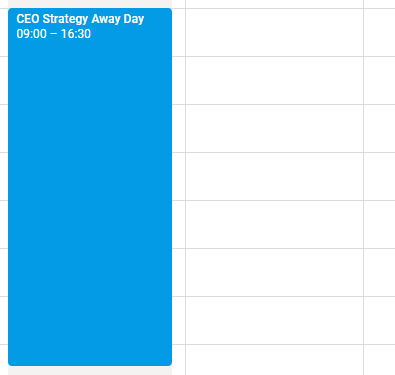
Next Friday, I am having a Strategy Away Day – pandemic style. In past years, when I need time to really focus on strategy, I was often able to take an afternoon or a whole day and spend it with some members of my Board, colleagues or external contacts, having conversations over coffee or whilst walking in a park.
My first mentor Margaret and I often spent hours walking through whichever city we met in, plotting and planning the future – and I came away having mapped out my plans and ideas for the year ahead.
Ideas like closing our office and moving online first came up during one such conversation many years ago… and how we are into our fourth year as a virtual team with no looking back.
But in these strange times… and confined to my home and immediate surrounds, how can I have an away day? Well.. here is what I am thinking:
Things are very hectic just now, but as a CEO, there is nothing more urgent or important on my priority list than to have a clear vision, a strong focus of what’s ahead. So I have clearer the day in my diary.
That in itself feels like a win, as I haven’t had much time like this over the past year.
On the day, I have a session with a wonderful coach I sometimes see, who works for a small, independent HR provider, based in Sheffield. Working with agencies that serve solely small charities like ours really helps find support that is both excellent value for money and affordable (even in cash strapped times) .
Weather permitting, we will be speaking on the phone whilst going for a walk in our respective local areas and step outside of the usual desk/home office environment.
If it’s raining, I might decamp to the garage or at least the living room, to make sure I have a change of scene.
Catering is another factor I am planning ahead for: my weekly online shop is going to contain some unusual items as I return to buying provisions I would have had whilst travelling, including maybe a smoothie or a pre-packed coffee. Every little thing I can do to create some headspace is going to contribute to the success of my day.
I am also planning to work on a pitch, mostly to myself, but also to focus my thinking ahead of a day’s meeting with the Board the week after. I’d like to look back at some of the plans I made previously, and how they have changed.
I recently attended a monthly meeting of UK Association CEOs discussing ‘what will success look like in 2021’ and this gave me inspiration to try and ask myself that question in a new way.
In 2015, I wrote about about how I had hopes for ALT to reach 1,500 Members… now we have 3,500. Things have changed and there is so much scope for the work that we do to grow.
One of my strategies for getting through lockdown/pandemic burnout is to have a lot of green in my workspace. I can see at least six plants from where I sit each day.
Some of them are good at cleaning the air, some grow in intricate pattern and some grow in interesting shapes. Having discovered that I love succulents, I went about finding a local supplier and thanks to the wonderful Blasus Succulent Emporium, which is situated in a small independent shop collective here in Cardiff, I am now fully stocked 🙂
(Blasus is the Welsh word for something scrumptious, delicious or… succulent)
Crassula Estagnol
I know very little about plants and have killed many in my time, so in order to succeed with my new office buddies, I looked up specific care instructions and I try my best to follow them.
Cheeseplant
As a result, things are flourishing! That said, not every plant is doing so great, regardless of how carefully I try to look after them. Some are in shock due to the change in environment from a cool shipping container with freezing temperatures outside whilst others are struggling to find the right spot which has the appropriate amount of light, shade, warmth and cool.
What looks like dying chives is actually a rather special Albuca Spiralis, a plant that is meant to grow in spirals… it’s now in it’s fourth spot to try and find a sunny enough home in these dark days.
Similarly, my first and most stripy plant companion is struggling to grow happily. She is doing better now, in a bigger pot, but still not altogether in a happy place.
Transitions are tough. When things change, we react in different ways and the start of this year has brought with it a fair share of transitions and uncertainty. Unlike my office plants, the elements of my working life don’t come with such clear care instructions or indeed any labels that tell me what conditions they would flourish in. It’s a mixture of experience, trial and error… and hoping for the best.
Like with caring for plants, care and patience is much needed, and in these bleak times it can be hard to remember that. Somehow caring for the plants in my work space reminds me of that and I find new joy and inspiration in their efforts to grow – which translates into my working life.
In a meeting with other UK-based CEOs this week, someone said that there is just such uncertainty, that it makes no sense to base decisions about the future on our experiences of the past 10 months. We all agreed that the uncertainty was extremely tiring and that not knowing in itself was the worst aspect of being a leader in these uncertain times… cue pandemic burnout (which, to me at least, feels like a relatively fortunate type of burnout to suffer from in comparison with what others have to suffer). Yet, in my context, it still presents real and difficult challenges. Challenges that my green office buddies help me overcome.
Tomorrow is Friday, and it’s become a routine for me to start each Friday by looking after all the plants. I go round with an old deep plate and start a watering routine, giving everyone a drink. Sometimes one gets a new, bigger, pot. Some weeks there are dead leaves to remove or feed is needed.
Care. Time. Patience. Consistency. And with time, most will flourish. Definitely not a new insight, but it feels worthwhile to remind myself when sitting in the nth meeting of the day, answering endless emails and trying to balance all the different demands that leading an organisation through these times places upon me. Having plants for company somehow makes it all better, a little easier, a bit more… fun 🙂
Three years ago this week, we closed the door on our last physical office space and moved to becoming a distributed team. Since then, we have chronicled the journey we have been on as an organisation and as a staff team in regular blogposts, podcasts and conference papers, starting with this post from February 2018. A year on, in January 2019, I reflected on how the move changed things in this blog post and we also recorded a podcast. Last year, we wrote about how things were developing and we continue to collate resources that chart our journey as a virtual team.
This January, we celebrate our three year anniversary as home-workers, running the leading professional body for Learning Technology as a virtual organisation and successfully charting a way through the ups and downs that the last three years have brought for us as a team.
Over the past year, many other organisations and teams have had to rapidly adopt a way of working, that our organisation chose for strategic reasons and made a transition which we had time to prepare for. Trustees of ALT took the decision to move ALT’s operations away from a long-standing hosting agreement with a university to a more independent model, to ensure that ALT’s strategic aims and values are underpinned by an effective, agile base of operations providing more direct support for Members across the UK.
As we now know, this decision turned out to be a good one, both for ALT’s continued growth and success and also our ability to weather the global crisis we are currently facing. We have been walking the walk of using technology effectively for learning, management and governance day in day out.
Jane Frankel, who manages ALT’s charity finances, is one of our longest serving members of staff and a colleague who made the transition from physical office to virtual team with us.
Reflecting on how things have changed over the past three years, what’s been your experience of transitioning to being a full-time home-worker in the ALT staff team?
“Having been self-employed for many years and frequently worked from home, the transition to home working wasn’t difficult. My commute was certainly shorter! However, transferring several years of documents to electronic format and adapting to a home based team with less frequent face to face time was challenging. I miss my colleagues! Although we do meet online and communicate constantly, it’s still hard to get used to not having a face to speak with in person. Getting used to managing family and being home for kids when they’re back from school is definitely a plus. ALT has also made a point of ensuring everyone has flexibility in their work schedules to take time for themselves, which is extremely valuable.”
ALT became an independent employer at the same time as transitioning to working from home, and our Events Manager, Emma-Jane Brazier, joined our team on the first Monday as a virtual team, on 5 February 2018. Since then, we have been fortunate to have Emma-Jane’s expertise for two periods of maternity leave that Jane Southgate has been on, and Emma-Jane has thus been through two rounds of a fully virtual recruitment and onboarding process.
Emma-Jane, what’s your experience of working with ALT as part of a virtual team?
“I had never worked virtually before. Coming from a teaching background (prior to Covid) I was very much used to dealing with 100s if not 1000s of people a day. I thought it would be lonely but actually at times I could do with some more alone time! ALT has fostered a close knit, highly communicative and effective team. We talk with each other throughout the day, have regular catch ups and work collaboratively ALL the time. I really enjoy this and cherish it as I know from speaking with friends who have recently had to pivot to online working that this working environment is not always present. Having the physical team meeting days and events (in normal times) brings welcome opportunities to catch up with people and I hope for the team that they are able to return as soon as is safe.”
Before ALT made the transition to working from home for everyone, several members of staff were already home-based, enabling us as a team to work more closely with Members across the UK. Martin Hawksey, who served as ALT’s Chief Innovation, Community and Technology Officer until recently, was based in Scotland in the years leading up to the organisation closing its office in 2018.
Thinking back to a time when some of us were working from home full-time and some of the team were office-based, what has our move to being a fully virtual team brought with it for you, Martin, and what would you say are the upsides of everyone working as a distributed team for a small, agile charity like ALT?
“For organisations one of the big advantages is there is greater parity for staff. Before ALT became an entirely distributed team we were using a hybrid of office and home based staff, which meant that communications between the team were different depending on where you were based sometimes requiring additional measures to ensure the exchange of information and awareness of what was going on. With a fully distributed team effort is still required for formal and informal interactions, but everyone is in the same boat. Another big advantage for distributed organisations is when recruiting staff you are less restricted by geography allowing you to access a bigger pool of talent.”
In 2019, which now seems like a long time ago, our team found its virtual stride having successfully delivered two years of ALT’s full portfolio of activities, from large, international conferences and our peer-review journal to membership services across the UK.
We capitalised on the advantages of working as a distributed team and found solutions to the problems we encountered. Importantly, we didn’t completely stop meeting in person, retaining a blended approach that included team days for which we met in person (the team portrait from our 2019 team day in Birmingham gives you an idea of the ways in which we used to work together).
Being a virtual team, changed our organisation for the better and we reflected on this here.
We were lucky to recruit two new members to our team in 2019, with Fiona Jones joining us in June, followed in September by Debbie Baff.
Fiona leads on administration across all of ALT’s activities and is the person Members have most day to day contact with on the phone, via email and on social media. Fiona joined our team having had previous experience of working from home and a background in educational technology.
Fiona, why did you choose to work from home and what is your experience of being part of the ALT staff team?
“Having previously had experience of working at home before I joined ALT, I was very familiar with the concept, and really enjoy the flexibility that homeworking brings. Having extra time in the mornings and evenings with no commute is so beneficial, especially in these winter months when you can get out for an early walk in the sunshine. I also love being able to wear slippers for the whole working day! Creating your own comfortable environment is a huge factor for working efficiently.
When I joined ALT in 2019, it was so refreshing to join an organisation that does working from home so well. I love being part of the ALT Team, and we all do our best to try and provide alternative virtual versions of what we each miss from an office environment. I love being able to still celebrate colleagues’ birthdays and important events virtually, even though we are spread over hundreds of miles. Day to day, it’s also always nice to know that someone is always on the end of a chat message to help with a query, or to jump onto a video call with a cup of tea!”
As more and more of ALT’s Members have had to adapt to working from home since March 2020, often alongside home-schooling as well, we have been providing regular support in the form of webinars, drop in sessions and resources. Our Membership and Professional Development Manager, Debbie Baff, has been the member of staff who has led and supported many of these sessions, experiencing what ALT’s Members are contending with at work and at home.
Debbie, you started working with ALT and from home only months before the pandemic. Since your first day on the job at ALT’s Annual Conference 2019 in Edinburgh, how have things changed for you and how is working from home as part of our team for you?
“My first day on the job at ALT was spent at the annual conference up in Edinburgh, little did we know then that it would be our last face to face event for quite some time. That seems such a long time ago now. For me, I have to admit coming to work for ALT has been life changing. In my last job I had a 3 hour round trip commute down the M4 to work and back. That was so very tiring and quite frankly a real pain and let’s not go there about not being able to park when you eventually get there ! Being able to avoid all of that commuting hassle is just so much more productive and makes much more sense to me. Although I have had other experiences over the years of working from home before, it was a whole new experience of working for an organisation where everyone works from home. I remember wondering how that would work in practice before I started. I didn’t need to worry mind you as I think ALT has really got it right in terms of recreating a sense of belonging and fostering online social presence within the team. We are constantly in touch with each other either through messaging apps, email or video calls, we have regular meetups and as we are such a small team we are actually very well connected. These things don’t happen by magic though and have been very carefully thought out and planned for, in my experience you have to be a lot more deliberate in your communications when working at a distance to avoid misunderstandings and ALT works very hard at this.
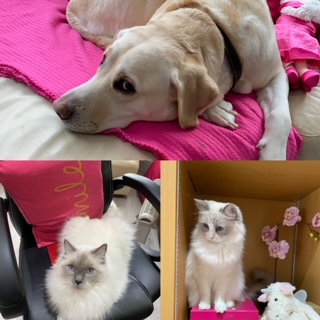
Working from home during the pandemic has meant another level of readjustment though. I went from being at home all by myself with just the dog and two fluffy cats for company to a house full overnight. My husband was on furlough for a while which meant he was at home, and I have two teenagers so I have the whole homeschooling thing going on. Competing for wifi and bandwidth has become a daily occurrence, as has having to make lunch for other people during my lunch break rather than just grabbing what I want ! (Sadly I was hoping that having other people at home might have meant that I had a surprise cup of tea brought to my home office occasionally but I am however still waiting for that ! HINT HINT teenagers”
As the chief executive, my working practice has changed much since starting to work from home. I am deeply grateful that ALT’s Board of Trustees had the vision and foresight to steer the Association in this direction. I am very proud of the impact we have had over the past few years since the transition.
That said, it’s taken me a while to adapt to leading a team and an organisation from home and I continue to discover new ways of working, of finding balance between the demands of a very busy diary and needing space to think about the bigger, strategic picture. I now know more about the pets, kids and plants of my co-workers, Board members and colleagues across the world, and that has made my job more enjoyable and interesting.
As we, as a team, look ahead to what 2021 may bring and as we enter a more experienced and mature phase as a virtual team, we want to share some of the worst bits and some of the highlights that three years of working as a distributed team have held for us.
We invite you to reflect with us, share your own and hope that you will find something useful and inspiring in our continued journey as a virtual team.
The worst bits… there have to be some
The most difficult part of working from home for me, is having to provide virtual support in a crisis. When someone is having a really bad day or something unexpected happens, there’s only so much I can do via phone and video calls.
I end up doing more than my usual share of domestic chores as a home-worker.
I miss hugging colleagues when they need one!
Being not as active. Little walks to a bus stop, or tram, walking around an office all add up during a week so you have to make sure you don’t stay sedentary (to keep off the lbs! Must say I’m no expert at this)
Funnily enough one of the things I do miss from my looooong drive on the M4 every day is that decompression time and being able to listen to podcasts guilt free. For some reason I am also really bad about forcing myself to get outside and go for a walk, something I know is really important to do and something I am working on. I also miss being in an office when the banter is going on – I do love a good giggle. Although we do still have our fair share of funny memes across the ether which does help. Also in terms of the impact of the pandemic obviously there are the issues that has brought too although I have been lucky enough to be able to make some small changes to my working hours which means I can start earlier and finish earlier and that has definitely made a difference in terms of the bandwidth issue and also for a bit of headspace before the home schooling starts.
And the highlights… of which we have many!
I really don’t miss my 1+ hour long commute and I love the time I have regained for things other than sitting on delayed trains.
When I have caring responsibilities for my eldery parents, these are easier to fit into my working day from home than they were in an office.
No commute!! This is a big one as I didn’t realise how tiring it was. It also meant I could get rid of my car which is better for the environment. Also I think being able to work from home allows you to keep on top of household chores. E.g during my lunch I can quickly put a load of washing on or wash the breakfast dishes
The best bits, well that is a hard question, there are actually so many great things about working from home. It has definitely given me some life balance back and I love how it takes me 30 seconds to get to work in the mornings. I am really lucky in that I have a dedicated home office and don’t have to clear everything off the kitchen table at the end of the day. That would make things so much harder to manage. I love our little team, everyone is very thoughtful and so kind and even though we are based all around the UK somehow that distance really doesn’t seem to matter.
Written by Maren Deepwell with contributions from Emma-Jane Brazier, Debbie Baff, Jane Frankel, Fiona Jones and Martin Hawksey.
This post has been re-posted from the ALT website.
Ever since the phrase “new normal” became part of our vocabulary, I’ve struggled to figure out what it means. Over the past year, it’s become clear that when in comes to Learning Technology, COVID-19 has created many opportunities.
So whilst it’s not all bad news, it’s certainly not normal. Not today at least.
Before I started my working day today, I was on the phone arranging volunteer responders to pick up medication for my parents, who are shielding again as clinically vulnerable in this pandemic. Luckily for my family, everyone is (still) safe and sound and after a couple of phone calls yesterday and today, we are fortunate indeed to have the necessary support in place, thanks to the tireless efforts of the volunteers in their local area.
That dealt with, I headed to my desk and my inbox. I open the first email, which turned out to be a message informing me that a long-standing Member of ALT and colleague passed away a few weeks go.
We are very sad to learn belatedly that Lesley Diack passed away before Christmas. Lesley was a very long-standing Member of @A_L_T and the Editor in Chief of ALT’s journal #altchttps://t.co/AM1kykYett
Lesley Diack was one of the first Members of ALT I started working with in 2008 alongside Haydn Blackey, and a presence at many of our events and conferences, committee meetings and more of the years.
I am so saddened and shocked to hear of Lesley’s death and judging by the messages in my inbox and on social media, many more colleagues and friends feel the same. I DM all my colleagues and invite everyone to join me for tea if they feel like it, some do, others step away to take a break and digest the news.
It’s part of my role to notify everyone, from Trustees and fellow Members to staff, of news such as this, and so I sat at my desk and started writing emails, planning for cover for the role of Editor in Chief, which Lesley held until her passing, and considering what other steps we need to take, how to send ALT#s condolences and my personal wishes to her family.
During the one to one catch ups I have with staff every Tuesday, we discussed a forthcoming conference (fully online of course), regular CPD and support webinars (to continue our crisis support), making resources available and signposting them openly and touch base on support ALT provides for individuals, such as flexible working hours, during this time of working from home during schooling from home and so forth.
Very productive, all things considered, but coloured in every way by the current situation, this ‘new’ normal.
The sad news we received today reminds me to make the most of every day and to contribute positively to a community I am glad to be part of. It also reminds me not to accept this ‘new’ as normal.
RIP Lesley Diack – you will be much missed in the #altc community.
Like everyone else, I found last year very tough indeed, even with several key advantages: I have years of experience in my role; I had weathered other crisis before this one and I knew how to manage some of what 2020 threw at us; I had successfully led the transition to us working online a few years ago and we were thus able to continue our work with less disruption than many others. I am proud of what I achieved last year, and what I was able to contribute to the continued success of the organisation, to the well being of our staff and to the efforts of our Members.
As I head back to my desk in 2021, I feel like I am starting a new job and I have blogged about looking ahead here and also in this post. I wrote about how being the CEO of a small, independent charity, the leading professional body for Learning Technology and an organisation who used to rely on face to face events for 50% of its annual turnover is a very different ballgame in this new context.
I feel it is important to re-examine the context my professional practice as a leader, as someone working in Learning Technology, as the CEO of a small, independent charity, as a feminist and as a human being in order to be mindful of why my voice and my work have value and relevance.
To find inspiration in what I can achieve and where I am making a difference even as global events continue to unfold.
Remix ‘n’ Match by @visualthinkery is licenced under CC-BY-SA.
Situating my professional practice
I recently read a very elegant and eloquent book How to Make Art at the End of the World (Loveless 2019) and I was struck by how powerful an introduction the author opened with. Not only did that first chapter provide a clear and convincing argument, but it very intentionally situated the professional practice and perspective of the author within a wider context.
With everything that is going on in the world, I feel this kind of situating is becoming ever more important, and I would like to reflect on some of the key points Natalie Loveless and explore how they relate to my approach to leadership. As an aside, as far as I can see, this is an excellent read beyond the introduction, so if powerfully theoretical discourse on artistic research and academic practice is your thing, I would strongly recommend this book 🙂
In the acknowledgements Loveless mentions how much her work depends on and is inspired by colleagues in her university and whilst I work in a much small organisation, I have built up a strong network of ‘fierce, feminist, decolonial colleagues’. It takes extra energy to be all of those things in the challenging times that we live in and enduring this pandemic has certainly made it even more important to stay principled in professional practice. Finding time to address these issues through volunteering or activity in networks has been nearly impossible, so instead I have and will continue to use my sphere of influence to make a difference in whatever small ways I can: donating free conference places or speaker fees, promoting voices that would otherwise find it hard to find an audience and highlighting inequality and the actions we can take to address them everywhere I go.
Acknowledging my context
In one of the paragraphs in the introduction, Loveless reflects on how her “arguments and examples sometimes fail to fully account for the ways in which similar debates have been taken up… [by] voice and texts from other cultural, geographic, or institutional locations” going on to say that she recognises that by choosing one perspective, informed by her context and training, results in another perspective not being told. “All I can hope is that what is missing does not overshadow what is present, and that the claims at the heart of this book come across with respect and care” (p. 13-14).
Over the past year I have worked at educating myself about issues such as how to promote gender equality, fight digital poverty and racism in Learning Technology, and that has made be ever more aware of how many blind spots I have. I want to get better at acknowledging my own context, the relative privilege that shapes my view of the world and my identity.
Being ALT’s CEO gives me the opportunity to give a platform to others, but it also requires me to represent the views and voices of the community I represent. Part of my job is being visible, to have a public profile, to be on stage and to have a voice. And I very much relate to Loveless’s aim to get her message across with respect and care and an awareness of my own context.
Working in… compromised times
Since working in a leadership role, things have certainly changed in the world and writing this in lockdown in a country in which I, as a European, am now more formally classed as an immigrant and required to have proof that I am allowed to access medical care or work makes this even more palpable.
“There is no longer any question that we are living in compromised times, within which the fantasy of an uncompromised self is isolationist, privileged and dangerous (Shotwell 2016). Global ecological and economic collapse are discussed with alarming regularity in the newspapers and newsfeeds that surround us” (p.16). All this has a direct impact on my professional practice.
Part of my job as CEO is to manage risk, and this certainly has become more ‘red’ as various crisis hit us.
My responsibility is to enable the organisation to fulfil its strategic mission, to achieve its aims – and also to ensure that we contribute to the public good.
To make a positive difference to Learning Technology professionals and the work that they do, in very compromised times.
Every few years, usually a year ahead of when a new strategy is due, I undertake a thought experiment. I imagine what it would be like to apply for my job afresh and sometimes in my head and sometimes on paper, I write out a new statement of why I want to be the CEO of ALT, what I bring to the role and what my vision is for the organisation going forward just as I did in 2011 during what seemed like endless rounds of the recruitment process.
This time, as I put myself in this position, the role I am imagining has changed completely. My job has always had a lot of new challenges in it and many steep learning curves, and I love that about it. I enjoy not knowing what kind of new problems each day may bring with it. It’s never boring and it keeps me interested, keeps me developing and upping my game.
2021 is definitely going to require levelling up in more ways than one.
Running a small business, pandemic style
Running a small business, which ALT as a independent charity with a turnover of £500k a year and six employees essentially is, in a pandemic which has wiped out half of its revenue streams at least for a couple of years is going to require a completely different approach to the growing, steady and thriving concern I was building a year ago. It’s a new challenge to work as a team to restructure how we work, what we focus on and how we invest our charitable income to the maximum benefit of our community.
The past few months have shown an upward trend that proves that the measures our Board took and the strategies we have implemented work, so that I feel we are heading in the right direction. With a competent staff team and many committed volunteers, we have everything we need to succeed in 2021 and I am looking forward to writing a business plan that we may actually be able to implement instead of the many versions I drafted last year and which were rapidly overtaken by events.
Working with new audiences
Like many colleagues who work in Learning Technology, I spent most of last year having to adapt to a whole new audience: the biggest group were the ‘just discovered EdTech‘ learners, parents, teachers, policy makers and the general public whose first real experience of what is possible when you use technology for learning, teaching and assessment was the emergency response to COVID-19. Needless to say, that was less than ideal.
For the newbies, the confused, those looking for help and advice, I am going to offer signposting to practical resources, ways to get involved in the right networks, talks that provide some context and help levelling up an understanding of educational technology basics. In short, ways to make sense of what is going on, help to avoid ‘known issues’ and, importantly, I will highlight that there are professionals such as learning technologists, instructional designers, educational, academic technologists, librarians, IT champions and many more who have the expertise to help find the way forward. Learning Technology may not have met a crisis like this one before, but we do have the know-how, research and policies to scale up and skill up.
A second growing group I am working with are those moving from islands of innovation to navigating an ocean, those who are trying to find a way to make effective use of Learning Technology at scale – but not necessarily with a proportionally greater workforce of EdTech experts.
Part of my role is to educate organisations and in particular leaders about the value of professional expertise that Learning Technologists and other experts have, where to recruit them and how to use professional frameworks such as ALT’s CMALT framework in order to align role descriptions and rewards structures appropriately. This is also where our networks knowledge exchange opportunities are essential and where I can contribute a wider perspective on developments across the UK.
My core community are those who have real expertise and experience in Learning Technology. All of whom have done a year of heavy lifting through ever increasing pivots online, creating and sharing resources, running support sessions, advocating for safeguarding the well being and safety of staff and students as educational technology became an emergency response.
More than ever before, my job here is to fight for professional recognition and reward, to influence policy makers and leaders to take on board the expertise of those who know how to tackle the challenges ahead of us and – to champion their voices.
Yet there is also a need for working on the darker impacts of the past year: acknowledging burnout and exhaustion, overwork and stress across sectors. Taking action against those who are profiteering from the EdTech emergency response, who are taking unethical practices and scaling them up. Surfacing the impact of digital poverty affecting students and staff.
Together, these three stakeholder groups open up a new direction for my role as CEO, and for ALT as the UK’s leading professional body for Learning Technology which was established in 1993.
Setting new aims
Last year gave me a new context and a rapidly expanding group of stakeholders. So I am starting 2021 with a very different job to the one I had a year ago and that is exciting.
With the input from a strong and strategic Board of Trustees, the results from ALT’s Annual Survey (which is still open for responses until 11 January 2021) and the expertise of our staff team, it will be interesting to see what new aims we set out for the year ahead.
One project I know that I am going to contribute to is ALT’s Ethical Framework for Learning Technology, setting out principles for the ethical use of Learning Technology by professionals, institutions and industry.