This past month has been BUSY. I am good under pressure, but it took a lot of energy and effort to keep things in some sort of resemblance of balance this month.
ALT is always busy in August, because we run our biggest event of the year in September, and it has keep us all working hard. It’ll be worth it when we see it coming together in just over two weeks. If you haven’t already registered, I’d encourage you to join us (and applications for scholarship places remain open, too).
I am looking forward to us convening as a community. Hundreds of participants and speakers, many of whom I know. It will be good to reconnect after what has been quite an isolated year.
Here is a quick run down of what I’ve been up to other than conference prep:
I made a terrarium
Blasus Terrarium Workshop
Thanks for a wonderful independent plant shop, I was able to join a “make your own” terrarium last week. It’s a succulent terrarium, my favourite kind of plant.
It was a great way to do a local activity and go somewhere new – plus, there is now a beautiful new terrarium next to my desk.
Blogging
I blogged quite a bit this month (for me).
JOINING CONVERSATIONS FOR EQUALITY, DIVERSITY, INCLUSION & BELONGING: I recently joined the anti-racism & learning technology group. I am particularly interested in the mentoring and coaching area and also recruitment. I am currently in the process of recruiting for a member of staff and post no. 3 is very relevant to me, encouraging us to ‘disrupt the current procedures in place, and to ensure that we can action diversity rather than pay lip service to racism issues in the sector’.
WE ARE LOOKING FOR A COO… A LOOK BEHIND THE RECRUITMENT DOORS: We are currently recruiting for a Chief Operations Officer for ALT, and I couldn’t be more excited! Now we are planning ahead for post-pandemic times. Whilst we have an excellent track record delivering online activities and a lot of expertise in virtual events, we don’t just want to follow our old ways. Instead, we are starting to innovate and that has helped us redistribute our income streams and ensured that we are back to generating the charitable income we need to achieve our mission. Next, we are looking to develop blended ways of doing things and improving what we are already good at. In order to achieve that, we have created a new role and are looking to grow our staff team… .
MAKING TIME FOR CPD IN A LEARNING TECHNOLOGY LEADERSHIP ROLE: In the past year it’s been hard to make much time for professional development, or at least the kind of professional development you can plan. Like many in my position, I had a huge amount of professional development focused on keeping my organisation running in a crisis, emergency governance, financial crisis management and so forth. Things are STILL extremely busy, and look like they will continue to be for some time to come, but I am making time do actually plan some CPD beyond giving talks and attending (virtual) conferences.
POSEIDON, BIN COLLECTOR, JUDGE. WHAT I WANTED TO BE WHEN I WAS A KID: When things are busy, it can be tough to make time and space for YOU. So in order to make some space for ME on MY blog, this is a blog post all about… me ?. Reflecting on ‘career’ progress for want of a better word is an important part of charting your own development, and this is something I have been doing as part of reviewing and updating my Senior CMALT Portfolio. The time frame for updating the portfolio is the last 3 years… but what we I look back 30+ years instead?
Book progress
I have been working on Chapter 3. This includes some of the most interesting sections relating to Learning Technology and Open Education, in particular a section on open approaches to leadership.
The chapter was harder to write because I had a lot of things I wanted to refer to which would be covered in other parts of the book, which don’t exist yet. On the plus side, I have managed to get into a good routine with my writing, and I found a regular writing (half) day, which helps a lot.
We are currently recruiting for a Chief Operations Officer for ALT, and I couldn’t be more excited!
It’s always great when you get to grow your team, particularly when there are only seven of you and each individual makes a big impact.
Why this role, why now?
We are the leading professional body for Learning Technology in the UK – and we have been pretty busy in the past eighteen months! Learning Technology has never been more in demand and as a consequence the work we do to support our growing community has increased month on month.
After a year of supporting our Members through the global crisis, we have re-grouped and set out a strategic plan for the year ahead. 2020 was a tough year for us an independent charity as we traditionally generate half of our annual turnover from two face to face events. Thanks to our prudent financial strategy in past years, we had reserves to help us through times of crisis.
Now we are planning ahead for post-pandemic times. Whilst we have an excellent track record delivering online activities and a lot of expertise in virtual events, we don’t just want to follow our old ways. Instead, we are starting to innovate and that has helped us redistribute our income streams and ensured that we are back to generating the charitable income we need to achieve our mission. Next, we are looking to develop blended ways of doing things and improving what we are already good at.
In order to achieve that, we have created a new role and are looking to grow our staff team:
The Chief Operations Officer (COO) is responsible for day-to-day operation of ALT, including technical infrastructure and systems used to deliver ALT’s services to 3,500 Members. The COO acts as the Deputy for the Chief Executive and represents and advocates for ALT with our key stakeholders across sectors.
This is an opportunity to see projects through from conception to completion and play a part in shaping how we work and what we do. You will be reporting directly to and working closely with ALT’s CEO and have opportunities to develop your own skills in running an organisation in an innovative and human way.
https://www.alt.ac.uk/about-alt/work-us
If that sounds like the kind of work you would enjoy, read on.
For the past few months it’s been all ladies working in the team, and we are making a real effort to recruit the best candidates for each job whilst increasing the diversity of our team, which is a big priority for us (all recruitment and selection is undertaken in line with ALT’s aims and values and in accordance with ALT’s policy on equality and diversity).
As it stands, we are based in three of the four nations in the UK; three of our team, that is 42%, are currently completing a PhD (and one of us already has hers) and over 40% of the team are either Certified Members of ALT or currently working towards their accreditation.
As far as I know we have 5 cats and 5 dogs between us, and come Friday plenty of unicorns, too (Fridays we usually celebrate ‘unicorn’ day, a tradition even those of us who are not generally into things that are pink and fluffy have come to appreciate).
We have a real range of backgrounds and have a former chartered surveyor as well as an expert in Victorian cemeteries in the team. As many of us work part-time, mostly 3 and 4 days a week, it’s quite common for us to have other responsibilities to focus on, be that studies, kids or other interests.
If you’d like to find out what it is like for us working as a virtual team, read our blog post from earlier this year, celebrating three years as home-workers. Find out what our highlights and lowlights of pandemic working have been and how we thrive as a virtual team.
When I first started working for ALT, as an Assistant Administrator (Maternity Cover) in 2008, I was just finishing my PhD and I had no inkling that a career in Learning Technology was ahead of me. As it turns out, the field has proven so interesting and challenging that I find always something new to do and to learn.
The senior team of a small organisation is an exciting place to be. I love the freedom it gives me to make things happen, to be able to respond to the changing needs of our community without having a complicated hierarchy to negotiate. We believe in robust and transparent governance, and we get things done.
I am proud to be part of a journey that has seen the size of our membership double several times since 2008, and writing our Impact Report 2021 has reminded me of how much we achieve as an organisation and as a team. For me it’s an exciting place to be with a good dollop of life/work balance and a team culture we all benefit from.
Working for an independent charity with a staff team of fewer than ten people is a very different value proposition than working for a large institution such as a university or a commercial organisation with thousands of employees. For me, it’s a rewarding leadership position that allows me to practice what I preach 🙂
Not a working day… looking out over Cardiff countryside
Find out more
If you are interested to find out more, head over to the ALT website or contact me for an informal conversation.
Apply by sending us your covering letter and your CV by 17 September 2021.
All candidates will be notified after the initial short-listing by the end of September and short-listed candidates will be invited to online interviews in October.
I recently joined the anti-racism & learning technology group. If you’d like to learn more about the work of the group, there is a series of blog posts on the #altc blog which provide a great starting point:
The AR<CoP has been meeting since November 2020 to address these challenges and currently encompasses three areas of activity:
Guidance for Content Developers. The focus of this area of activity is to create a set of recommendations to incorporate anti-racism in digital learning content.
Research Connected Activities. Research, seminars and advances in the field of digital education are covered in this area. For example, diversity and digital leadership, and the influence of biases in Artificial Intelligence and machine learning.
Mentoring & Coaching. This area of activity aims at creating connections between colleagues who wish to support and receive support for career advancement and managing the complexities of an increasingly fast-changing work environment.
I am particularly interested in the mentoring and coaching area and also recruitment. I am currently in the process of recruiting for a member of staff and post no. 3 is very relevant to me, encouraging us to ‘disrupt the current procedures in place, and to ensure that we can action diversity rather than pay lip service to racism issues in the sector’. Specifically, looking at:
Gender empowerment and more diverse students/staff pool
Unequal pay between white staff and other ethnicities
Demographics of the UK and the geographical locations of applicants
Reflections
The first meeting I was able to join in with was on 29 July, and this introduced Bold Conversations for Equality, Diversity, Inclusion & Belonging – activities planned for the autumn term. I really appreciate the opportunity to join the group’s discussions and the opportunity to educate myself, challenge my ideas and blind spots.
The main part of the session was about setting up circles for discussion and coaching each other, offering safe spaces for mindful listening and voicing issues around the core areas of activities. I found it really interesting to hear and listen to the approach modelled here and how it reflects the values of the group.
It was good to learn about a particular strand of work of the wider group, and I am particularly interested in the coaching approach used.
Come the new autumn, I am looking forward to being more actively involved in the work of the group and I am grateful to the inspiring group facilitators for moving this forward.
I was on a long awaited break at the end of June and I missed out blogging about what I did in June… and so you get double the monthly blogging goodness in one post 🙂
First up… CEO updates
Things were BUSY for me as a CEO in June, as I wrote in my report to Members of ALT. Not only did we hold our AGM, announced new Trustee appointments and a Board meeting all in the same week, but we also launched our Impact Report, which I am really proud of:
A page from the ALT Impact Report 2021
That was my week of the year to hit all the big annual milestones and I am glad to say that the feedback was excellent. After the year we and everyone in Learning Technology has had, it means a lot to me that I have contributed to turning things around for us. We are once again on an upward trajectory, and as an independent charity we have weathered the crisis, for now at least. That is a great achievement as a CEO and for my whole team.
We also shared the consultation response to the draft ethical framework we are developing and this is a project very close to my heart. We conducted an open consultation from 7 May – 9 June 2021 and received 165 responses – thank you! The consultation asked for feedback and input about different elements of the framework:
Ethical principles for professional practice in Learning Technology
Putting principles into action – reflective practice, practical tools and a checklist
Work is now underway to create the resources which will launch in September. Speaking of September…
There is also a very exciting (and online first) ALT Annual Conference on the horizon…! Even after running a whopping 157 online events in the past year with over 5,000 participants in total, we prepare for the Annual Conference somewhat differently. It’s our biggest event, our flagship conference, with a lot of history, and meaning for our community.
The kind of value we want to provide goes well beyond sharing solutions and disseminating findings. To me, and to many others, ALT’s Annual Conference is ‘not just another (online) conference’ but it is an opportunity to make plans, to connect to colleagues and to energise and mobilise your networks for the year ahead. That kind of energy and inspiration is much needed and precious. Here is a blog post sharing what I’m hoping for for #altc #altc21.
Lovely surprise early gift, card & tea from my @A_L_T Team for tomorrow. I love my work and really appreciate my fantastic #altc colleagues ? Now it’s time for a two week break from work?️ pic.twitter.com/ErPXWX63gH
I absolutely LOVED reading Where you are is not Who you are by Ursula Burns (thank you, Catherine, for the recommendation). It’s an awe inspiring and awesome read and really made me think about being a CEO in a new way. It was fantastic to read about the reflections of someone who has had a successful career as a principled leader.
Another great read from this past month has been Girl, Woman, Other by Bernadine Evaristo. And all the while, I was listening to DS106 Radio of course, and took part in the 24 hour marathong that Jim Groom organised to celebrated it’s 10 year 6 month (106) anniversary. You can read my love letter to emergency broadcasting here.
But. Most excitingly I have started to finally write the Leading a Virtual Teams Book and I am now two chapters into what I hope will be a year long writing project. And of course, you can read along:
Blog Post no. 2, which shared a bit of the first draft chapter
This month, I am writing Chapter 3: Leading a virtual team:
Is leading a virtual team very different from leading a team that is geographically co-located? This chapter explores what the reality of leading a virtual team is like for managers and leaders, reflecting on the ups and downs of leadership and sharing ideas for how to find your own virtual leadership style.
Exciting times and hopefully some useful output for everyone who finds themselves leading a virtual team.
Quick links
Key insights for 2021 – a presentation for Russel Group Universities IT Directors (RUGIT), 14 July 2021;
Developing ethical approaches to learning technology, a Fair Comment article, Common Wealth of Learning, July 2021;
ALT was founded in 1993 and last year was the first (and hopefully only) year in our history that we didn’t run our Annual Conference. Instead we organised a Summer Summit that provided much needed crisis support to our community in the run up to a start of term like no other.
This September, our Annual Conference is back, and the excitement is building under the leadership of our three wonderful Co-Chairs, Roger Emery, Farzana Latif and Matt Lingard, and their large and active Conference Committee, who have been blogging about the conference for the past months.
The response to the Call for Proposals was much larger than expected and we are just about to complete the second round of the peer review process with ~90 sessions accepted into the three day programme. That’s a LOT.
The theme of the conference this year is exploring Learning Technology through ‘Shared Experience, Different Perspectives’ with a specific focus on:
Leadership in learning technology
Inclusive practice
Digital well-being
Digital and physical spaces
Our small team and our large committee of volunteers are working together to make this the very best online conference that we can make it and I want to share my hopes for September with you:
We want our online events to be…
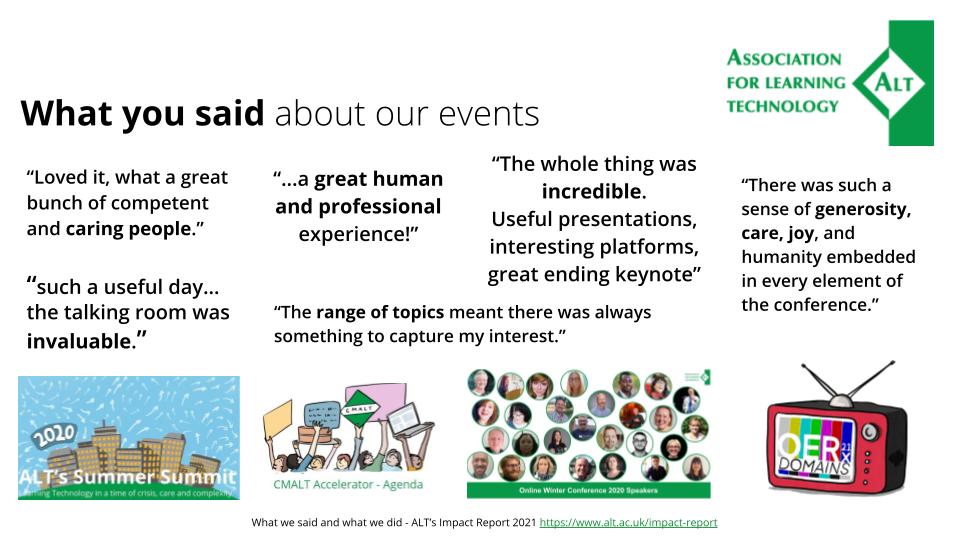
As an organisation we have ten years experience in running online events and that is a great asset for us. We learnt a whole lot more from running OERxDomains21 in partnership with Reclaim Hosting and we had such excellent feedback from the format that we are building on this to deliver this year’s Annual Conference.
Feedback for our online events from participants in 2020/21
But even after running a whopping 157 online events in the past year with over 5,000 participants in total, we prepare for the Annual Conference somewhat differently. It’s our biggest event, our flagship conference, with a lot of history, and meaning for our community.
The kind of value we want to provide goes well beyond sharing solutions and disseminating findings. To me, and to many others, ALT’s Annual Conference is ‘not just another (online) conference’ but it is an opportunity to make plans, to connect to colleagues and to energise and mobilise your networks for the year ahead. That kind of energy and inspiration is much needed and precious.
Flexibility built in
Many participants will have a lot of competing priorities in the same week that the conference is taking place. Protecting the time in which you attend a virtual event is hard and it’s become common practice to dip in and out for keynotes, the session where you are presenting and maybe one or two others. We have built in flexibility from the start, to help participants make the most of the event, including:
Sessions are available instantly to replay
A single dedicated resources channel which is accessible to all throughout the event and afterwards
Long breaks at the start, middle and end of the day and short breaks throughout the day
Wellbeing activities scheduled for quiet times and reflection
For our previous online events, this model worked well and we are adding extra tweaks to do justice to a huge programme over three days.
A different online space
We don’t use Zoom or Teams internally and we don’t use either for delivering our online events at the moment. Instead, we have created a different online space using a combination of tools. For some participants it will mean getting the hang of unfamiliar technology, but for many YouTube, Discord and an online conference programme will be familiar already.
I really relish the combination of individual chats, group channel chats and drop in spaces to accompany an online programme of live streamed sessions. If you are curious what it looks like in practice, looking back at what we did for OERxDomains21 on its programme and help pages.
The cost of online conferences
As an independent charity that used to generate 50% of its annual turnover from paid for face to face events, we have been thinking more than most about the cost of online events. The costs we incur (servers, technology, insurance, marketing, media production, staff time) and what’s affordable for participants.
For us, running online conference isn’t free, and we have to square our business objectives with our strategic priorities to supporting our Members and provide open access to much needed CPD, research and practice.
The conference costs £99 for speakers to attend, £129 for Members and includes both academic and social programmes, access to recourses and recordings and more.
We also offer scholarship places and we have awarded over 50 of them in the past year. We promote our scholarship places alongside registration and we encourage you to select the option best suited to your circumstances.
We also make resources and recordings from the conferences openly available after each event.
A conference with heart and difficult questions to tackle
One of the things we pride ourselves on is that this is a conference with heart. It’s organised by Members, we don’t sell the keynotes to sponsors (and we value the support of the sponsors we have who understand why that’s important and support our event year after year!) and we set aside time for tackling some of the difficult questions we face in Learning Technology.
Last year for example, Angela Saini led a Q&A session which gave participants the opportunity to explore questions such as what we mean when we say that race is a social construct, why racialised thinking persists in science and academia, and reflection on the BAME health disparities during the pandemic.
This year’s programme is going to prompt participants to think about the hard questions we are all coming up against as the use of Learning Technology is scaled up.
Kicking off proceedings this year will be Professor Sonia Livingstone, whose research examines how the changing conditions of mediation are reshaping everyday practices and possibilities for action. I have long been hoping to hear Sonia at one of our events, so I am particularly looking forward to this keynote.
Also very exciting is that we have Mutale Nkonde headlining the Wednesday of the conference week. AI For the People (AFP) is a communications firm, founded by Mutale Nkonde. AFP’s mission is to empower general audiences to combat racial bias in tech.
And alongside three outstanding keynotes there is also time for proper debate and reflection in three discussion sessions focused on:
Learner Experiences
Future Perspectives
Ethical approaches to professional practice in Learning Technology
The last of these sessions is dedicated to the launch of ALT’s new framework, which we have been working to develop since October 2020.
Three days, over a hundred speakers… it will be a very busy conference week in which we will pose questions as well as help find answers.
I hope to see you there, 7-9 September 2021 #altc #altc21.
Join the team
Would you like to be part of making such events happen? We are currently recruiting for a Chief Operations Officer.
Just over a month ago, this project to write a book about leading virtual teams got underway. If you missed the first post that explains what the book is about and the open approach I am taking, then head here to catch up.
Progress since the last post
Since my last post, I have outlined what the book is going to be about and each chapter within it. I have set out word limits for the book overall and each individual chapter and I have gone through the material I already have and I have assigned it to each chapter.
Then, the task of writing the first chapter began. I picked Chapter 4: Pitfalls and problems of virtual teams to start with as this includes a section on the pandemic and crisis working, which is something I am thinking about a lot at the moment.
I have dedicated one afternoon a week to focus on writing and doing bits and pieces for the book around that. I started writing over 5 weeks and took some time off to have a holiday, and the chapter changed a lot from zero to 12,000 words and is now 9,475 words long.
It was really useful to start writing and I learnt a lot from drafting this first chapter. It still needs more references and the tone isn’t quite right, but having the first draft of the first chapter is a nice milestone.
For the next four weeks, I will be working on Chapter 3, on leading a virtual team.
As planned, I will be sharing extracts from work in progress (read the first extract below) and invite you to read along, reflect and share your thoughts. As part of the book writing process, I will also organise virtual drop in sessions which are open to all and free to attend and there is a regular newsletter with updates about the book and upcoming events or get in touch with me directly.
Chapter overview: Pitfalls and problems of virtual teams
Many unforeseen problems arise in a virtual team over the years. In contrast with managing a traditional, office-based workforce, there are a lot of factors at play that you have little or no control over when you manage people remotely, from moving house to problems with technical infrastructure. This chapter explores some of the difficult and dark times I experienced leading a virtual team and ways to cope with them. I also discuss ideas for establishing a positive life/work balance for remote workers and hopefully avoid many common problems from the outset.
One of the lessons I learnt about leading a virtual team is that many problems only arise over time. Something that isn’t an issue early on can become problematic a year down the line when you no longer benefit from things you have done when you were working together in person in the office. One example of this is the renewal of a contract last renewed when there was still a physical filing cabinet with the relevant papers in it next to your desk. In my case, it took literally a calendar year to sort out a complex mail forwarding arrangement that still gives me nightmares. Even in a relatively small organisation like the one I lead, certain processes only occur every 2-3 years or less frequently. I found that in particular governance, audit and quality assurance processes can become harder over time as the organisational memory of how things were done fades and you need to establish new ways of doing things remotely.
Your portfolio of problems will change over time, and there are several other factors, such as staffing changes or establishing a new service for example, that can cause new issues to arise in the dynamics of a virtual team. Each onboarding process brings with it an unknown quantity of home-working related variables that over time impact on your team. Everyday challenges can seem easy to overcome at first, but the lived experience of spending every day at home and working can be difficult to anticipate.
It’s worth taking a moment to reflect on how many things shape life at home and by extension working from home and how much things can change abruptly and without warning. It may be a new pet, a sudden illness or redundancy that causes home life to change overnight. Or it may be external factors such as a building site or noisy neighbours. Managing a virtual team involves to some degree connecting with the reality of home life of your workforce and all that brings with it.
Whilst a lot of what I focus on in this chapter is about creating balance between life and work, about maintaining a degree of professional detachment and separation between home and work, there are limits to what can realistically be achieved. There will always be situations when not going out to work means that there is no escape from a difficult situation at home and this is one of the most challenging aspects of managing a remote workforce.
I have divided this chapter into three sections: first, I want to focus on everyday challenges that virtual teams experience. That includes negotiating the tension between working from home and doing housework, working from home in different time zones and seasons as well as wellbeing for home-workers.
The second part of the chapter is about managing crisis and change as a virtual team, such as moving house (which can be more impactful than anticipated) and how to communicate and build trust when things really go wrong.
The final part of the chapter is dedicated to reflecting on working in times of pandemic. Before 2020 none of us had experienced this scale of global health crisis as a virtual team and we learnt a lot from the experience which we tried to meet with grace and compassion.
Draft Chapter extract
Below is an extract of the draft chapter. This is the third and last section of the chapter.
Working as a virtual team in times of global crisis
“Hello from month two of lockdown here in the UK. I initially started writing this post on 23 March 2020, but since then so much has happened that I stopped and now, a month later, I’ve started again.
I’ve been reading so much about the current crisis: at first there were emergency announcements and lockdown measures, then support and help for coping, then about the ‘new normal’ and now we’ve arrived at predictions for the future.
It is both incredibly busy and extremely boring.
I am not sure how I feel about the idea of ‘business as usual’. I can understand the desire for a sense of normality and keeping to a routine, but no one can really function normally just now, so I am starting to think about what measures we can take to lead our team through the coming months..
My ideas include a 20% reduction in overall productivity (to give us as a team more flexibility around care commitments etc), setting priorities for each week and creating a clearer overview for us as a team (kind of like what you would do for a project, ie treat the crisis as a project) and to try and set aside small pockets of time for thinking about things, rather than just doing…”
Reading the opening paragraphs of a blog post I published on 4 May 2020, and it takes me right back to those dark days. Obviously, the COVID-19 crisis had a much wider impact than I can comment on in the context of this book. The social, economic and political ramifications here in the UK and globally cannot yet be fully understood. The human cost, which continues to rise, is huge. Personally and professional we have all been affected.
In the context of working as a virtual team, the great pivot online introduced a great number of people to work from home and this is something I have discussed earlier, in the Introduction.
When the crisis hit, our team was already working from home, and in that respect we were safer than many others. Also, our organization was safer. We already had established processes for working from home and that was a huge plus.
However, no one had prepared for what was to come next, and I want to reflect on the practical as well as the leadership challenges of leading a team through such a crisis.
For me personally, the global pandemic coincided with a period of great personal upheaval including divorce and a move to a new city, which made this time one of the most challenging of my career as a CEO.
Practical measures
To begin with, we took a lot of practical steps to support staff during this time of crisis. This included:
Extra paid time off, extending Bank Holidays for example
Regular, individual check-ins with HR and support staff
Diverting funds usually spend on development like attending events to offer financial support for coaching, mentoring and counselling
Including wellbeing check-ins in weekly team meetings
Encouraging staff to share tips for wellbeing, for example links to online meditation sessions, helpful reading, recipes or entertainment
At times of high stress, even two weeks can seem like a long time and a lot can change in how a team is feeling or coping. It’s challenging to share how everyone is when some of the things that are happening to everyone are very personal.
What I focus on is to find some balance between work being an escape, a bit of “normality” for everyone and work being a source of social interaction and support. These two things are not necessarily mutually exclusive, but they can sit uneasily alongside each other when for example one person wants to try and have a ‘normal day’ and someone else feels like sharing their personal or crisis news.
One of the most recognisable features of working from home during the pandemic is the video call, which “can be cognitively demanding keeping an eye on the chat as well as listening to what the presenter is saying and looking at their slides”. ‘Why is video conferencing so exhausting?’, exploring factors like “non-verbal overload” and “constant gaze” as reasons video calls can be more tiring than meeting face-to-face.
As someone who does lots of online meetings back-to-back his is something I can relate to. I am not a fan of back to back video meetings and I find there are alternatives:
having a phone call (often more personal),
meeting around a document,
or screen sharing something that everyone can focus on instead of video,
or having an audio call maybe with video briefly at the start to wave hello.
If… nothing helps and you do have to have back to back meetings, as I often do, then what works for me is
to have them standing up (I currently have a standing desk only),
to keep each one to half an hour or less,
to take regular breaks between meetings,
and to check in with everyone participating at the start.
Being one of many faces in a grid of video camera pictures is not a helpful way to visualise what having a productive meeting looks like. We don’t all just stare at each other in person. So having a visual focus other than those individual feeds, like an agenda document or a shared screen is key to getting things done for me.
We also explored using a virtual backdrop in video calls, like in a meeting or at a conference, and I am in two minds about it. Whilst I prefer seeing people in their context, I appreciate that many are not in environments they are comfortable sharing widely or wish to protect their privacy.
Strategies for crisis working
As time went one and as we passed 100 days since the lockdown in the UK commenced, more strategies for working as a virtual team in times of crisis emerged .
As well as focusing on our own team, I received requests every week from organisations who were considering adopting working as a virtual team as their ‘new normal’. Every few days I had calls with senior managers who are trying to decide whether they still need a physical office, managers whose employees want to have more flexibility, less commuting and more virtual collaboration. We talked through things like PO boxes, GDPR for home-workers, financial support and line management – but we also talked about the reasons for such a shift, how important it is to think through strategy and values underlying those moves to virtual teams.
Over time, my concern grew that there is a lot that was being left behind, particularly messy HR problems, access issues and long term implications of not meeting in person. For a lot of people I spoke to, endless Zoom meetings or Microsoft Teams was all they have to go on when they start to think about what their virtual work world will look like.
When I started thinking about what our team would look like online, I must say that tools for video conferencing were not even on my list! I was thinking about consulting employees, drafting what I wanted to be the most equitable changes to employment contracts and setting out a blended model of working together that saved some costs, but also budgeted for others such as team days in person, equipment, travel costs, home-working allowances and so forth.
Even with an established distributed working culture the impact the crisis could be seen on our virtual team. Many went from having their own dedicated workspace in a calm home to suddenly discovering this had become a shared workspace with other members of the household. Sharing a workspace, an increase in video calls, homeschooling and childcare meant even established remote workers are also having to rediscover ways to make things work.
Whilst ALT is a distributed organisation there has always been a recognition of the importance of face-to-face time both one-to-one and through team away days. 100+ days of social distancing also meant we as an organisation missed our regular face-to-face team days. I found I really miss face-to-face away days and the opportunities to meet individuals in person. The longer the period that we do not meet up as a team the more I feel the impact of not having more informal catch ups.
Many of us were not able to easily find a quiet spot for a conversation in lock-down homes, and even when not surrounded by family, there is a lot going on within the home environment that can be distracting. All of which makes it more difficult to really focus on conversations, particularly in a Line Management context.
Fellow CEOs I talked to are finding they are similarly experiencing some deterioration in those important relationships. Some people find it easier to establish an equivalent level of trust and exchange than others.
Ideas we have tried to create different kinds of spaces to interact in are:
Meeting around documents
Walk and talk conversations on the phone, whilst we go for a walk individually
Good old-fashioned phone calls
Virtual get togethers for social occasions such as birthdays
In year one of us being a virtual team, we had a lot of change to cope with but enthusiasm was high. Year two was mostly about settling into being a virtual team and ironing out less straightforward issues. We strengthened policies for home working and collaboration that made our way of working more robust and sustainable. Year three started off with a new strategic vision to take us further, to build on what we had established and six months in we have a completely different business model and context to contend with.
What I am thinking about really is what year four should look like… . I read a lot about a desire not to return to the old ways, but I don’t really empathise because the way in which we work as an organisation had already departed from the traditional model well before the pandemic forced many into the great online pivot. Personally, I wouldn’t relish a professional life without face-to-face interaction with colleagues or Members. I miss it.
I have put in place a feedback form that I hope we can complete every few weeks or months to ask individuals about their personal preferences regarding travel, having meetings or catch ups face-to-face and also going to events – taking into account their personal circumstances and wellbeing.
The differences between colleagues who live in different parts of the UK, even in our small team, have really become clear to me in recent weeks, particularly as the lock-down in Wales, where I live, was last to lift.
Dealing with precarity outside beyond our control
As life, in the UK at least, entered a new phase and restrictions were being eased, workers started to return to offices in greater numbers. Holidays at the end of a difficult year were on the horizon and in many ways things were starting to improve. We moved from crisis mode to post-pandemic living. And yet there was no let up in sight at work. For my team, work continued at full pace, and the strain of the last 18 months was showing. Everyone had their own particular challenges, their own struggles and personal circumstances that shaped their experience of this time. What we did have in common is less capacity to cope with stress, with things going wrong.
The continued impact of the pandemic, of self-isolation cases at school and at work, the lack of childcare, transitions and changes at work, as well as crowded family homes and all that we didn’t do the previous year catching up with us created a sense of continued precarity beyond our control. Many of us had been fully vaccinated by this time and grateful to be safer from a deadly virus, but we continued to have a lot to contend with in our own ways.
Acknowledging things not being normal
Through the loss of being able to run face to face events and also due to other factors, our organisation lost nearly half of its turnover in 2020. Like many charities, we struggled with that scale of loss and although our strategic response had a positive impact very quickly and helped us weather the most difficult period, we had to make savings and cuts wherever we could. A year on, I was pleased to see that month by month things were improving and new income generation strategies were starting to pay off. Yet we were still having to be extremely fastidious when it came to managing our resources. Some staff costs had to be cut in order to safeguard the future of the organisation and we were not yet in a position to relax those measures.
This was a singular context but it does translate into many situations when a team or an organisation is coping with a difficult period and it got me thinking about ways in which to provide support and acknowledge challenges.
Usually, I would have looked to structural changes first, to aim to provide more staffing resources, more support for existing staff or financial rewards and benefits.
In the context of post-pandemic recovery, my scope for those sorts of measures was extremely limited however and I had to think about other approaches. Something that would go beyond the formal support already in place and which had been positively received. One of the ideas we put into practice was a wellbeing day. A duvet day if you like.
A day when you don’t have to come to work, you don’t have to use a day of holiday. You can take it whenever you need to and you can focus on rest, relaxation, whatever you feel might improve your wellbeing.
I was glad when our Board approved this proposal and granted the extra day to all staff. The aim of this was partly to give everyone an extra day to breathe and also about acknowledging that things weren’t normal. That we still have a lot to cope with, a lot to contend with. Here are some of the ideas we came up with for how to use the day:
Mentoring & cake: Sometimes an extra day off is just what you need to do some thinking. Get in touch with your mentor, coach or a friend and arrange a chat over a long walk. Take a step back from your daily grind and get some head space. Aim to end your chat somewhere with excellent cake.
Early run and pub lunch: Maybe a wellbeing day for you starts with a nice run (jog, walk) along the river or around the park, enjoying the feeling that everyone else has to go to work, but you don’t. Follow your feet, and breathe in the morning. Job done for today. At lunch, head to the pub for an early lunch (int optional) and revel in the luxury of not having an improvised sandwich for lunch.
Bed: This needs no explanation. Stay in bed. Enjoy.
Tidy and new pictures: Maybe you want to use your day to make your working space the best it can be. Have a tidy and clean and then get creative by putting up some new pictures. Extra points for making something yourself. Also extra points for dog/cat photos. The nice thing about this kind of day is that you get both unlimited tea AND a nicer desk when you do have to go back to work.