Category: leadership

  • October ’21: Writing and working

    October has been very busy indeed and I haven’t had as much time for blogging and writing as I had hoped. Even my round up of everything that happened in September was quite late. But as it’s the 31st today, I am back on track.

    And just in time to wish you Happy Halloween. As you might expect from someone who wrote their PhD about the material culture of cemeteries, this is my favourite celebration of the year and the house is full of decorations, sweets and carved pumpkins.

    Before I get ready for trick or treat, here is a quick summary of what I have been up to this month:

    Blogging

    This month in blog posts I have published on this blog:

    • OPEN BADGE NEWS: CMALT ASSESSOR BADGE: I have been a peer assessor for the CMALT accreditation scheme for many years and I really enjoy undertaking assessments. It’s a great way to keep in touch with how professional practice is developing across the sector. Since the introduction of Senior CMALT accreditation, I mostly assess portfolios of peers in leadership roles and that is particularly rewarding.
    • TIME WITHOUT BUILDINGS: LEADERSHIP REFLECTIONS: Recently I have led a number of leadership development sessions, which was a lot of work as well as a lot of fun. I enjoy working with established and emerging leaders who work in education and the Edtech industry and help them find new approaches to digital transformation. In the sessions I focused on providing creative ways to get participants thinking and reflecting, using open tools to remix images (thank you, Bryan Mathers, for your Fabulous Remixer Machine), and demonstrating how this Framework for Ethical Learning Technology can provide a basis for strategic work with staff and students.

    Book progress

    Since my last post, I have been working on Chapter 1 which is all about setting out as a Virtual Team. It’s been very rewarding to work on this chapter as it include a first hand account of the key milestones I experienced leading a team from the office to working remotely and I enjoyed re-reading some of the posts one month, six months and a year into the process. It was useful to reflect on how much the reality a few years later meets with the expectations I had at the beginning and what has changed.

    Read an extract from the chapter here.

    Talks and events

    I have updated my running list with new events I am taking part in or speaking at:

    • Institute for Emerging Leadership in Online Learning, Digital Transformation and Sustainable Development Goals, 26 October 2021;
    • Digital Transformation: leadership practice, Sheffield Hallam University Senior Leadership Group, 20 October 2021;
    • Discussion Panel: Higher Education Conference: Ignite HE – From Response to Revival, 7 of October 2021;

    #Pupdate

    Posey is 10 months old now and we are embarking on a month long training schedule to nail the last bits of puppy training. She’s making excellent progress, but there are also things we still need to work on.

    Posey the Puppy at 10 months old
    Posey the Puppy at 10 months old

  • Time without buildings: leadership reflections

    Time without buildings: leadership reflections

    Recently I have led a number of leadership development sessions, which was a lot of work as well as a lot of fun. I enjoy working with established and emerging leaders who work in education and the Edtech industry and help them find new approaches to digital transformation.

    In the sessions I focused on providing creative ways to get participants thinking and reflecting, using open tools to remix images (thank you, Bryan Mathers, for your Fabulous Remixer Machine), and demonstrating how this Framework for Ethical Learning Technology can provide a basis for strategic work with staff and students.

    What does your experience of ‘digital’ look like day to day?

    The term ‘digital’ can be a useful shorthand to describe whatever it is that people do with technology. Used in job titles it can mean anything from being in charge to procuring a new virtual learning environment or heading up IT to designing blended learning models to training staff in how to use Moodle and supporting students in using online resources to study.

    Whilst using more precise language is important, comparing what our experience of ‘digital’ feels like day to day is a useful starting point as its likely quite different for each person in the (virtual) room.

    That experience isn’t just limited to what happens at work, as personal use of digital devices and habits come into how we manage online working, too.

    A few things that most of us who work in education have in common just now, is that ‘digital’ means online meetings. Lots of them. Depending on what you do, you might have 3-4 a day or 8-10. Chances are you are spending A LOT of time in video calls one way or another.

    We all know that there are other ways to get things done and work together, but online meetings remain an insidious part of our daily working lives.

    Meetings and events ‘hopping’

    The result is that many of us ‘hop’ from one meeting to the next. Sometimes, we join just for the agenda item for which we are needed for an hour or even half an hour. If we are there for the whole time, then it’s likely that we need to spend time answering emails or writing reports whilst the meeting goes on. We have a lot to do, and there is no time to do it all in when you spend 6 hours or more a day in meetings.

    I dislike this way of taking part in meetings and events as it gives me no opportunity to properly focus on whatever I am attending. Instead it’s expected that I give a high quality talk to a ‘cold’ audience and then move on deal with whatever else is on my agenda for the day.

    There are clear upsides to being able to attend a particular event or meeting virtually that otherwise wouldn’t have been possible. There are also potential environmental upsides and financial savings. But it does have downsides for both the participants and speakers.

    Nowadays, it feels like a luxury to spend a WHOLE DAY at an event without simultaneously keeping on top of workloads, emails and other meetings. It has become harder to be unavailable. I used to spend days each month on the train, often without WIFI and sometimes I even travelled to different time zones, making me unavailable except of rare emails for a whole week.

    Standing on a stage and representing my organisation was a valid way to excel at my job, leading my organisation, and we all accepted the travel time and absence that entailed .

    My role as a CEO is four days a week, which gives me (in theory) one day a week to blog and think and write. Luxury time that I value more highly than the salary sacrifice I have to make to work less than full-time. And even still I find it hard to find any time for reflection.

    Time without buildings

    That sense of being time poor is something I hear again and again, from senior leaders and emerging ones. The past eighteen months have been a catalyst for many things, including pushing all of our schedules into online emergency mode: always in meetings, always available, always chasing the next milestone.

    We no longer have the same amount of travel to events, commuting to campus or even walking between buildings. If you are in an office or on campus it is likely that you still take part in meetings with people who are working remotely, and the schedule continues to be BUSY.

    We are struggling to make time to reflect, to think, to let things calm in our minds.

    A few years ago the open education conference I help organise took place in Galway, Ireland. It’s a beautiful, green campus and the conference took place in two different buildings.

    One of my jobs required me walking back and forth between buildings and I walked dozens of miles that week. On the way, I chatted with many delegates, I thought about the talk I had just heard and sometimes I just sat down for half an hour and had a break.

    Now, I walk no more than 500 steps during the days when we run a large, international event. I don’t have any time on the train to prepare myself mentally or chat with my colleagues. I don’t spend six hours on the train to Edinburgh reading or blogging.

    Instead, I am going to make time.

    I used to have the time I spent travelling, waiting, queuing, walking and talking. I still do. I am going to reclaim it from my meeting schedule and the next time I give a one hour talk, I will block our some time before and after, so that I have time to think before I step on a virtual stage.

  • September ’21: a late update

    My post looking back at what I have been up to this month is a bit later than usual, as my month ended with some well deserved holidays.

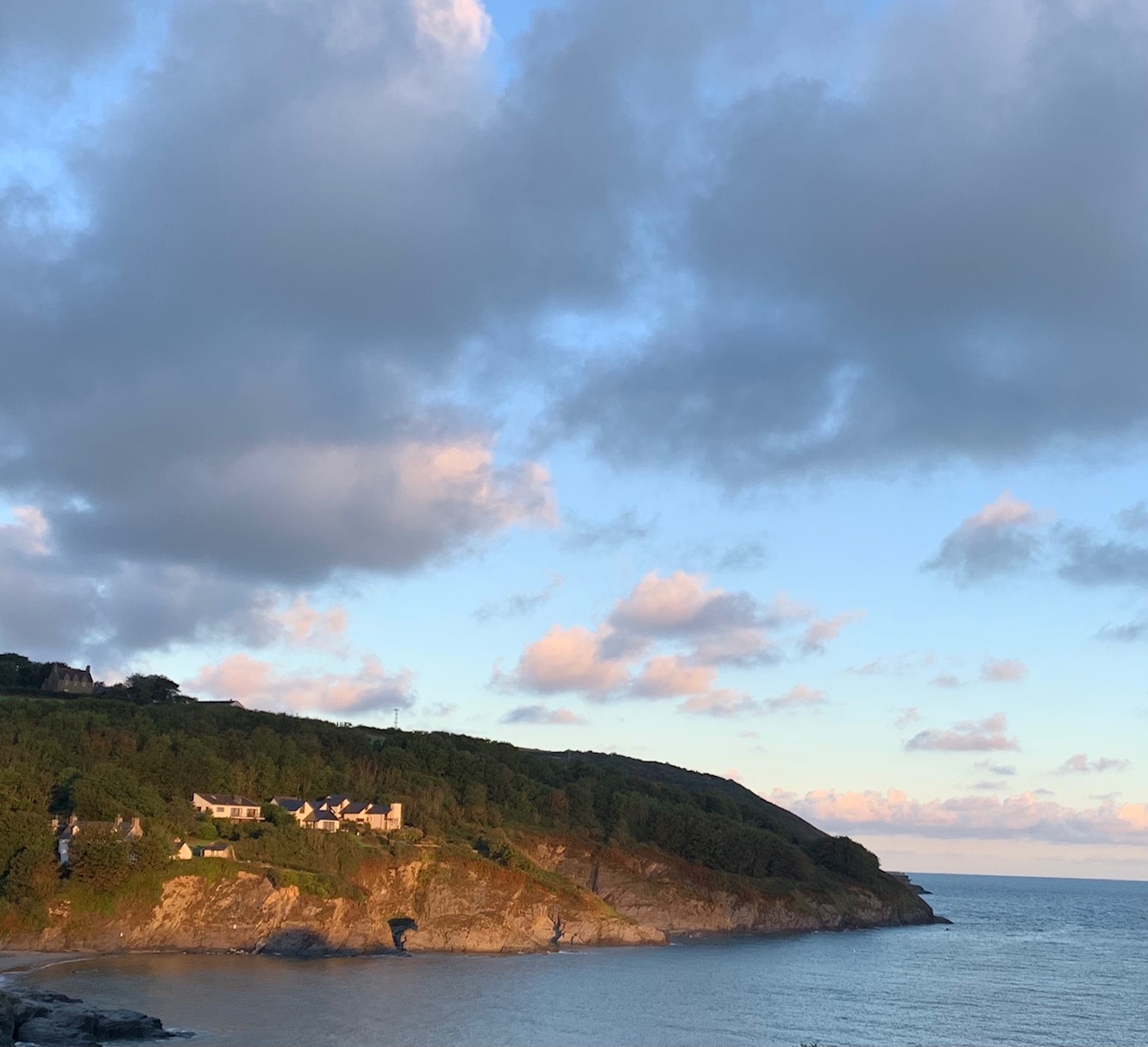
    A holiday photo of the Welsh coast at sunset.
    Wales, UK

    Once I got back there was a lot to do and catch up on, but September had so many highlights that it feels good to look back now:

    Annual Conference

    I very much enjoyed this year’s event. Lots of resources and videos from the conference are now available openly:

    Blogging

    This month in blog posts I have published on this blog:

    • LOOKING FORWARD TO MY 12TH ALT ANNUAL CONFERENCE – COMPLETELY ONLINE. My first ALT Annual Conference was in 2009 in Manchester (I missed the first year I was working for ALT because I was submitting my PhD that September).
    • DIGITAL DETOX – WELLBEING WEEK. A couple of weeks of spending long days online and working hard have prompted me to embark on this year’s digital detox. The last one I did was in November 2020 and focused on the Data Detox Kit. This time, I am going to focus on an approach for wellbeing for my physical rather than my digital self.
    • DIGITAL DETOX – PART 2. A couple of weeks ago I blogged about embarking on a digital detox, and as in previous years, I put a new (to me) process to the test. Here is what happened this year, what worked for me and what didn’t:
    • JOB SATISFACTION FOR VIRTUAL TEAMS. At the moment I am writing on Chapter 1 of the Leading Virtual Teams Book, and this chapter covers recruitment and selection as well as starting out as a virtual team and making the move from office-based to virtual. One of the things I have been thinking about as I am writing, is what makes it rewarding to work in a virtual team and how those of us who are permanently home-based measure success.

    Book progress

    I have been working on Chapter 2. It was great to work in this chapter as it includes a lot of practical strategies and case studies, which were fun to revisit.

    Next, I will be working on Chapter 1, Setting out as a virtual team.

    I have completed drafts for three of the six chapters now, and I am a total of 29,000 words into the process, which means I am halfway to a complete draft.

    Read this month’s book post.

    Upcoming talks and events

    I have updated my running list with new events I am taking part in or speaking at:

    • Discussion Panel: Higher Education Conference: Ignite HE – From Response to Revival, 7 of October 2021;
    • Developing ethical approaches to learning technology, article in Future of EdTech Q3, Education Technology in Business and Industry, 23 September 2021;
    • Keynote: Transforming Learning Conference, Sheffield Hallam University, 14 September 2021;

    #Pupdate

    A picture of Posey, the puppy, in her red basket in my office.
    A picture of Posey, the puppy, in her red basket in my office.

  • Job satisfaction for virtual teams

    At the moment I am writing on Chapter 1 of the Leading Virtual Teams Book, and this chapter covers recruitment and selection as well as starting out as a virtual team and making the move from office-based to virtual.

    One of the things I have been thinking about as I am writing, is what makes it rewarding to work in a virtual team and how those of us who are permanently home-based measure success.

    This Liz and Mollie visual promoted me to try and make my own pie charts of how we might measure job satisfaction and success at different stages of a career journey. The chart includes salary, job title and liking what you do which I have included in mine below also. Instead of free time I have include life/work balance and I have included wellbeing instead of physical and mental health.

    Chart 1: Measuring success as a home worker. 
The pie chart has five equal slices labelled Salary, Job title, life/work balance, Liking what you do and Wellbeing, each covering 20%.
    Chart 1: Measuring success as a home worker.
    The pie chart has five equal slices labelled Salary, Job title, life/work balance, Liking what you do and Wellbeing, each covering 20%.

    To begin with, I have assigned each aspect an equal value. Whilst recruiting for virtual teams over the past few years, I have encountered a lot of different versions of this equation: for example, for some the job title and liking what you do slices of the pie are smaller, and the emphasis is on life/work balance and salary.

    Chart 2: Measuring success as a home worker with an emphasis on life/work balance. 
The pie chart has five slices labelled Salary (20%), Job title (5%), life/work balance (50%), Liking what you do (5%) and Wellbeing (20%).
    Chart 2: Measuring success as a home worker with an emphasis on life/work balance.
    The pie chart has five slices labelled Salary (20%), Job title (5%), life/work balance (50%), Liking what you do (5%) and Wellbeing (20%).

    This measure is often motivated by the benefits of working from home making commitments outside of work easier to manage, for example caring for family or research. In this case, the benefits the job delivers in terms of flexibility and income outweigh the nature of the work or the position. In this context the ability to work from home is often essential to enabling the individual to work at all, and that can be a big opportunity for virtual teams who are recruiting from a larger pool of talent.

    Chart 3: Measuring success as a home worker with an emphasis on liking what you do/job title. 
The pie chart has five slices labelled Salary (10%), Job title (20%), life/work balance (10%), Liking what you do (50%) and Wellbeing (10%).
    Chart 3: Measuring success as a home worker with an emphasis on liking what you do/job title.
    The pie chart has five slices labelled Salary (10%), Job title (20%), life/work balance (10%), Liking what you do (50%) and Wellbeing (10%).

    Often, working as part of a Virtual Team can offer opportunities to individuals to do a job they love that isn’t available locally. This is one of the best aspects of recruiting for Virtual Teams, as it can significantly increase the commitment to roles and organisations, performance and job satisfaction. This kind of value system is often found in individuals in highly specialised or creative roles or jobs in particular industries.

    What would you add?

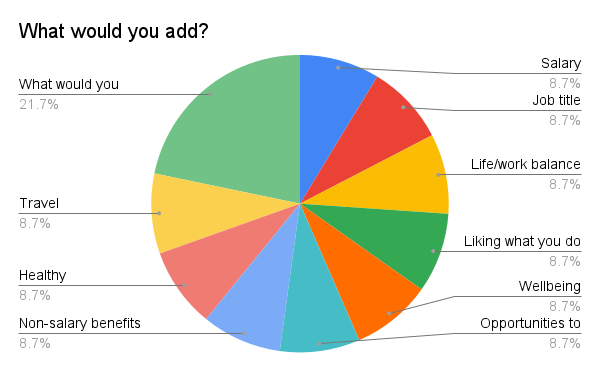
    There are different slices you could add to this pie, for example opportunities for professional development and learning. Good non-salary benefits or working on a healthy organisational culture. You could add opportunities to travel and having fun.

    In addition, what importance we accord to each slice of the pie will change over the course of a career and due to other circumstances. A job that is a good fit at the start, may not be a good fit a few years down the line and working from home may not be a good fit when life changes happen.

    A quiet office away from the kids or a workplace that gets you out of the house and meeting people is not easily added to the value proposition for working in a virtual team.

    Large or resource rich organisations may be able to offer a blend of working from home and working in the office that increases the spectrum of what you can add to the range of value added. But a blended approach doesn’t necessarily always deliver the best of both worlds, but can result in many people sitting in Zoom meetings in the same building, without any of the benefits of sharing the space with co-workers.

    Chart 4: Measuring success as a home worker - what would you add? . 
The pie chart has ten slices labelled Salary , Job title , life/work balance, Liking what you do, Wellbeing, Opportunities to learn, non-salary benefits, healthy organisational culture, travel and fun and the biggest slice is labelled: "What would you add?" .
    Chart 4: Measuring success as a home worker – what would you add? .
    The pie chart has ten slices labelled Salary , Job title , life/work balance, Liking what you do, Wellbeing, Opportunities to learn, non-salary benefits, healthy organisational culture, travel and fun and the biggest slice is labelled: “What would you add?” .

    If you are interested in reading more, head to the Leading Virtual Teams Book page where I share extracts from individual chapters in monthly blog posts.

  • Digital Detox – part 2

    Digital Detox – part 2

    A couple of weeks ago I blogged about embarking on a digital detox, and as in previous years, I put a new (to me) process to the test. Here is what happened this year, what worked for me and what didn’t:

    Screen free day… kind of

    The plan I followed culminated in having a screen/device free day at the end of the week, and I did more or less do that. For me, that’s not as big a change as it may be for some, and I was on holiday, which helped. Still, I use my phone to listen to audio books and take pictures, and I missed those things.

    So instead of having a completely screen/device free day, I have set my phone to only enable access to specific apps on Sundays, excluding all social media apps. I have chosen photos, camera, maps, a meditation app, maps, books and audio books as well as music to remain. All else is off limits on Sundays.

    It’s proven a great way to really get away from screens during the weekend and having the phone limitations switched on has given me a much greater awareness of how much I do check in with various channels. I feel I have more choice as a result and choose not to engage most of the time.

    Evenings and meal times

    I have used a similar approach for evenings from 20.30 and at mealtimes. This had an unintended consequence, as a lovely chat with a friend was suddenly cut off as it was 20.31… I called right back and explained. Following the steps of the detox programme made me reflect on how much I actually did use my phone in the evenings or during dinner.

    There was a real difference between what I *think* I do and what I actually do. That alone has made the process worthwhile for me.

    What I learnt

    I think of myself as digitally literate and informed when it comes to using my devices and social media. Previously, a lot of my efforts have gone into using tools and platforms safely, being aware of what data I generate and how this may be used (against me, for profit etc). With a distributed network of family and friends keeping in touch online has been a lifeline long before the pandemic introduced me to a whole new level of communicating using online tools.

    That said, I have spent less time observing how being online for work and personal activities impacts on my wellbeing, both physical and mental. This year’s detox process has helped me focus on those aspects of working and living using digital technologies.

    That’s something that I will write more about in the next post, inspired in part by this visual:

  • Digital detox – wellbeing week.

    Digital detox – wellbeing week.

    A couple of weeks of spending long days online and working hard have prompted me to embark on this year’s digital detox. The last one I did was in November 2020 and focused on the Data Detox Kit.

    Since I tried out the kit, there has been a new addition, HOW MANY TREES DOES IT TAKE TO POWER THE INTERNET? which definitely looks worth checking out.

    In 2018 my digital detox focused on my digital shadow, and I learnt a lot through the process.

    This time, I am going to focus on an approach for wellbeing for my physical rather than my digital self.

    Unsubscribe

    The first two tasks are:

    • Monday: Switch push notifications off
    • Tuesday: Unsubscribe from mailing lists, chat groups, facebook groups etc

    I found both of these useful reminders to check in with what I am actually doing v what I think I am doing. For example, I think I have all notifications switched off, but a few new apps have sneaked in.

    Similarly, a number of apps for projects, conferences, a particular friend etc have started to appear and once they are on my phone, I use them. So I deleted all work-related ones.

    Email

    I don’t have work emails on my phone and I already refresh manually, so Wednesday’s task is easy. Checking my emails late in the day is less easy. Similarly, I think I rarely use my phone at the dinner table, but actually leaving it in the hallway is a reminder that even here picking it up to check something can sneak in. So Thursday is all about leaving the phone in a different room during mealtimes.

    I find that hard during breakfast.

    Switching off

    The next task, for Friday, is to switch off all devices 90 min before bedtime. It’s been interesting for me to reflect how I do use my devices before bed, particularly as I am a big fan of listening to audio books as I fall asleep. One suggestion I found useful is to enable airplane mode instead of switching the phone off all together.

    Pausing (work) emails until Monday morning is another suggestion I might be trying out – although I rarely check work emails at the weekend anyway.

    Social Media free weekend

    The task for the weekend is to start building in 1 hour periods during which you are without a device and then to expand those to eventually include a whole day. One bit of the advice that chimed with me was to enjoy moments and not post them on social media.

    I have done that a lot over the past two years, first prompted by a lot of personal upheaval during a time of divorce, moving house and then lockdown, but also for holidays. I probably still take pictures as I love doing that, but not post them.