Category: leadership

  • CEO’s Report, Spring 2022

    Adapted from the original report on the #altc blog.

    This is my quarterly update as CEO of ALT on our progress as we move further into the year. We now provide access to expertise to a much wider community of digital practitioners. We work hard to champion professional recognition for a growing range of Learning Technology roles and we inform and support institution leaders engaging with digital education. Our strategy needs to reflect this growing remit. 

    Informed by the findings from our Annual Survey, our Board of Trustees and I have worked together to set strategic goals to move us firmly into this (post) pandemic landscape towards our Annual Conference and AGM in Manchester in early September.

    One of the strategic priorities we have identified is to develop a new hybrid CPD and events programme, which will launch in autumn and set out a schedule of webinars, workshops and events running online and in person.

    We are also looking to develop our professional recognition activities, including refreshing the ALT Awards and pathways to CMALT, details of which we hope to share with Members soon.

    Things to look out for

    • Resources from the OER22, ALT’s Open Education Conference in the UK, chaired by the Global OER Graduate Network, are now available.
    • We launched a new collaboration to tell the stories from our community with ITN Productions: Digital Transformation. Building on the success of last year’s programme, this year’s film will explore the potential of digital technology in education and industry and its impact on approaches to learning.
    • News about this year’s AGM and Trustee elections will be published alongside the Call for Nominations for Honorary Life Membership in May. Look out for information about how to stand for election and how to vote.
    How our profession is changing

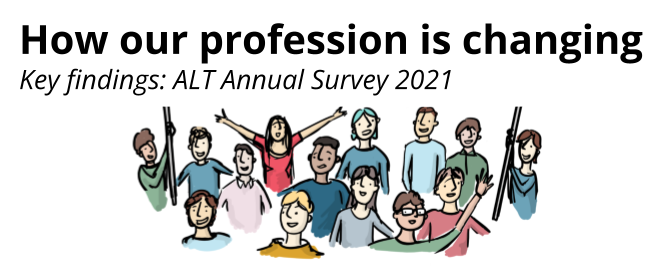
    This second report from our Annual Survey explores one of the key questions we ask in the survey: how are institutions investing in Technology-Enhanced Learning? We continue to see an increase in investment of over 30% overall, although smaller than the previous year, when 45% of Members reported an increase in their budgets. From 2020 to 2021, investment in permanent posts has increased from 32% to 54%, and for fixed term posts from 34% to 50%, emphasizing the continued and growing demands for Learning Technology professionals in the long term.

    ALT’s Annual Survey has run each year since 2014, with a number of the core questions remaining unchanged. We think it provides a unique insight into how learning technology is used across sectors as well as identifying emerging trends in current and future practice.

    You can also read more about the report from ALT’s Chair, Helen O’Sullivan, and myself in this #altc blog post.

    Celebrating the launch of the AmplifyFE Community Space in partnership with Ufi VocTech Trust

    AmplifyFE is a partnership project which works to connect and amplify communities of practice for digital learning, teaching and assessment. The AmplifyFE Community Space works across the whole Further Education and Training sector in its widest terms engaging with vocational educators and those who support them.

    The aim of this space is to:

    • Provide a place for vocational educators to share and learn from each other, increasing their access to learning technology expertise, digital pedagogy and professional development opportunities
    • Champion the use of accessible, inclusive learning technology to help those adult learners most impacted by the digital divide so that more people in the UK have improved access to vocational skills
    • Engage with FE groups and communities of practice and researchers in vocational learning to share best practice
    • Work across the whole Further Education and Training sector in its widest terms engaging with vocational educators and those who support them in FE Colleges, Adult and Community Learning (ACL), work-based and independent learning providers, prison learning, ESOL communities, ‘HE in FE’ providers, the whole, diverse sector.
    • To amplify the voice of professionals in strategic developments across the sector, led by organisations including ALT and Ufi.

    Find out more via the AmplifyFE website.
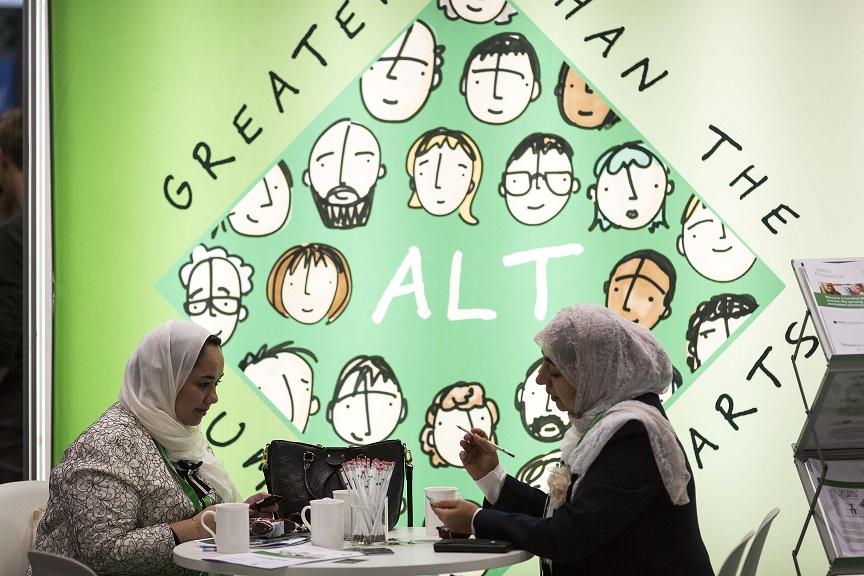
    Picture by Chris Bull for Association For Learning Technology 11/9/18 ALTC 2018 day one. www.chrisbullphotographer.com

    Preparing for our Annual Conference and AGM 2022

    For the return of the Annual Conference to Manchester, 6-8 September 2022, we will bring together different critical perspectives from across our community that will examine the challenges ahead and question the shape of things to come. We are putting our values into practice and Members at the heart of the conference, so in this spirit the event will be chaired collaboratively by the Trustees of ALT.

    Conference themes

    • Digital transformation beyond the crisis: what is your vision for learning, teaching and assessment? This theme is focused on how we are transforming education and training through digital practices in a post-pandemic world.
    • Co-creation with learners: this theme explores how to use digital technology in partnership with learners to design sustainable approaches that work for everyone. How can we co-create student engagement and enjoyment and make the learning experience more open, inclusive and equitable? 
    • Emerging leadership for a new strategic vision: we are seeing a growth in more strategic responsibilities in roles with a focus on digital education and training. This theme is dedicated to the work and vision of both emerging and established leaders in both institutional and community roles seeking to share their expertise and learn from like-minded colleagues in a dedicated leadership strand of this year’s event. 
    • Developing Digital Fluency: there has been a big shift in the digital skills and capabilities that we need to develop and recognise in both students and staff: from digital citizenship to critical data literacy and ethical considerations, what does it mean to develop digital fluency? 
    • AmplifyFE: this conference strand is dedicated to proposals from the FE and Vocational Education sector, and we encourage submissions that share expertise around digital tools and technologies, skills development and collaboration (not competition). 
    • Creativity wildcard: if your work doesn’t fit into the traditional research or practice themes, then this theme enables you to submit research, practice or policy proposals from any sector including Further Education, schools, vocational learning and training, lifelong learning and work-based learning.

    Registration and scholarship applications are now open.

    Ethical Framework for Learning Technology

    We have been sharing the framework with the sector at a number of conferences and events this spring, including the THE Digital Universities Week and Ahead by Bett. ALT’s Framework for Ethical Learning Technology (FELT) is designed to support individuals, organisations and industry in the ethical use of learning technology across sectors. The following resources, including the FELT Reflective Self-Assessment are available to Members:

    Another great session at #THEdigiweekuk, this time with @daveowhite, @MarenDeepwell, @jatenas and @osullihelen looking at https://t.co/IKyZSA53ck; @A_L_T‘s Framework for Ethical Learning Technologies (FELT). Hadn’t been aware of this, seems a great way to assess what we’re using! pic.twitter.com/YponqKhKWY— Chris Trace (@chrisEtrace) March 16, 2022

  • Nuggets of inspiration: how we work and what works for us

    I like revisiting or exploring different frameworks to think with, not necessarily to adopt them whole, but because they usually offer me small nuggets of inspiration. Here are some examples of what I explored and what I found out along the way:

    Ways to explore your traits, motivations or fears

    • Enneagram Core Motivations: This is a tool which combines modern psychology with an ancient personality system, and it helps you identify one of nine core motivations. There is a helpful post that explains how to choose your type, and plenty of free online tests available to experiment with. I found this really helpful as a prompt for reflection and enjoyed thinking about which core motivations I would NOT choose and why.
    • Gallup Clifton Strengths Assessment: this is a popular assessment tool, particularly in a work context. Whilst the assessment tools either require a paid subscription or one off fee for completion, there is a wealth of articles, tools and resources online via the official site. This could be good fit for you if you are working in a large organisation for example, and may be something employers offer.
    • Myers Briggs Personality Types: This is probably one of the best known frameworks, and it offers free online tests as well as resources to explore. I have done several of these over the years as part of recruitment and coaching, and always found it helpful not least because it’s interesting to see if your answers change over time.
    • Spark Types: This framework offers a free test to help you find your Spark Type and is based on the work of Jonathan Fields, and his accompanying book ‘Sparked – Discover your unique imprint for work and what makes you come alive’.
    • Harvard Business Review: If you prefer to explore rather than do an assessment, there are plenty of examples online to help you reflect on different leadership styles or personality types. I found the later video especially helpful as it focuses on potential limits rather than strengths.

    Beyond finding a fit

    At times, finding a framework you feel affinity with can be hard or feel unproductive. So here are some ideas for what I explored in that situation, starting with Emilie Wapnick’s TED talk and related book, How to Be Everything (and you can be a ‘multi-potentional-ite’). I have always been interested in working (and thinking) at the intersection of different interests, different disciplines, and so the perspective Wapnick shares chimes with me.

  • Feminist + open = superpower. Celebrating International Women’s Day 2022

    I like celebrating International Women’s Day. It reminds me each year that there is always more I can do. And each year, I try to do something along many of my professional colleagues and friends, to contribute to this overall effort.

    This year, I am focusing my volunteer effort on the FemEdTech network as we are celebrating the launch of a special issue of the journal Learning, Media & Technology with the theme ‘Feminist perspectives on learning, media and educational technology’.

    Learning, Media & Technology, Vol. 47, No. 1

    https://www.tandfonline.com/toc/cjem20/47/1

    It’s a great publication from a group of insightful authors, and I encourage you to explore this rich set of papers whilst it remains freely available (fittingly so, during Open Education Week). Feminist + open = superpower.

    Particularly in my context, in educational technology, these voices are now needed. We need them because our sector is growing faster, expanding and scaling up fuelled by the events of the past two years.

    Gender equality is not often at the top of the agenda and this year it may feel like there are too many other crisis which take priority. Each year, this day reminds me that no matter what else is happening in the world, there are things I can do, as a CEO, as an employer, a leader, an author, a collaborator, a coach, a colleague, a friend, a partner, a daughter… that I can do as a woman, to make a difference.

    And so I do. What I can.

    Imagine a gender equal world. A world free of bias, stereotypes and discrimination. A world that’s diverse, equitable, and inclusive. A world where difference is valued and celebrated. Together we can forge women’s equality. Collectively we can all #BreakTheBias.

    Celebrate women’s achievement. Raise awareness against bias. Take action for equality.

    Find out more https://www.internationalwomensday.com/ .

    O’meter by @visualthinkery is licensed under CC-BY-SA. Remix by Dr Maren Deepwell.
  • 10 years as a CEO: celebrating a personal milestone

    This week I celebrate ten years as a CEO. I can’t quite believe that it’s been a decade since my appointment as a Chief Executive. My predecessor had served a similar term and at the time, I couldn’t properly appreciate his achievement. Now I have a better idea…

    When I first stepped into the role, being a CEO seemed daunting. I had respect for the responsibilities and power such a role brings with it regardless of how large or small an organisation you lead. When I was appointed I was 31 and I was lucky to have a wonderful mentor who had a wealth of first hand experience of what it was like to have an executive role as a young woman.

    Over the past ten years the organisation I lead has achieved much. Every time we publish a new Impact Report, I look back at the year and reflect proudly on all that our staff, Trustees and Members have done. Each time, my respect for and appreciation of how much impact we can make as a community is rekindled.

    As a new CEO, what motivated me was curiosity and confidence. Every day brought new challenges and my working life was far from boring. I was keen to challenge myself. Curious to find out whether I was equal to meeting the demands of an executive role. What I lacked in experience, I made up for in organisational knowledge. I had several roles in the organisation before I was appointed as CEO and that allowed me to get to know the organisation from the ground up. Having seen what we do at events and for Members, I was confident that I had what it took to make a positive contribution, to help the organisation thrive.

    Forging my path and finding my voice was never easy. For a time, I was so focused on my work that I became nearly synonymous with the organisation. Our values align with my personal ones so strongly, that it felt rewarding to stay in the flow of work for much of my time. We were making great strides to transform the organisation and the way we worked and I loved seeing my hopes become a reality.

    With the help of many colleagues and inspired by many keynotes, blog posts and conversations I gradually found my voice. Once I found it, I used it to amplify our work and increasingly also my personal professional priorities. My blog became a place where that started to happen more and more and on social media and later on internet radio, too, I found ways to build a personal network. Around the same time, I started give a series of keynotes, including one at the ALT Annual Conference in 2018, that helped me to articulate my particular perspective more widely.

    Throughout this period, I have benefited much from everyone around me sharing their practice. It may still be quite rare to find leaders who do, but in our community there are many who work in the open with generosity and grace. Inspired by their example, I share my expertise and experience both in my day to day work and beyond it. I am working on a book on leading virtual teams which is due to be published later this year and I have begun to coach women seeking to develop in their careers in Learning Technology on a pro-bono basis.

    So what’s next? Ten years is a long time in the same job, especially a high pressure job. To me, it feels like I have had at least three different jobs over the past ten years. The first five years as a CEO in the aftermath of the financial crisis in 2008 were a steep learning curve. Then the transition to leading a virtual team in 2017 and closing our office in 2018 provided a unique a new opportunity for learning how to run our organisation all over again. And then the global pandemic happened and in 2020 and 2021 we had to adopt a new business model as the Learning Technology landscape changed beyond recognition.

    I can honestly say I have never had a boring week and that is exactly what I was hoping for when I applied for the job. I also have the privilege of working with a wonderful group of people, our Board and Members, a deputy I can trust and colleagues whom I love working with.

    The past two years have prompted many to re-evaluate their work/life balance and make a change. For me working throughout the dark days and months of lockdown has only increased my respect for our community and given me a renewed sense of purpose. All the reasons why I felt that the work we do is important ten years ago have now taken on a new context, a new sense of urgency as the digital dimension of education has become a more contested space.

    Whilst the constant uncertainty of the past two years has made it clear that it is not wise to assume that we know what is ahead, I am grateful that I will continue to serve as the CEO of ALT for the foreseeable future. I hope to bring the same curiosity and confidence that I have started with, with added expertise and experience that I have gained in the past ten years.

    Most importantly, I feel a fierce commitment to working for an independent charity that has found its voice grow more influential and that gives me the support and space to have my own voice, too.

    Photo of Maren Deepwell in 2022.

  • Care and curation #femEdTech

    This month a few of the long standing volunteers of our network are getting together to try and re-energise some elements of our community activities. Whilst much has happened over the past few years, activities like the curation of our twitter account and amplifying the posts tagged with the #femEdTech hashtag have been difficult to sustain.

    Finding balance between care and curation

    In these times, which for some of us are becoming post pandemic days and for others are still very much pandemic days, it is important to find sustainable ways to support the causes we care about.

    No one working in education or education technology has much time, energy or bandwidth after the past two years.

    I first become involved in FemEdTech because I wanted to do something to increase equality in Learning Technology. At the time, it was gender equality that I was particularly focused on. My own experience of working in the sector had highlighted how far we still had to go, particularly at a more senior level. Joining this community helped me identify practical actions I could take to make a difference and helped me increase my awareness of the structural inequalities that caused many of the issues I wanted to tackle.

    When Invisible Women was published in 2019 it felt like new perspectives and dialogues were opened up. The book helped raise awareness as well as highlighting many (to me new) biases against women in every arena of life. Learning Technology needed to confront its own biases, not only gender biases, but all (inherent) ways in which it contributes to inequality and discrimination.

    The past two years have heightened my perception that we need to act and my day to day work has become more focused on these issues. I am learning more about how to take anti-racism action in Learning Technology, about developing an ethical framework for professional practice and so forth. It has been heartening to see projects that set out to tackle inequality.

    That said, I also feel that in some ways things have never been worse when it comes to gender inequality. Even what limited data we have points to women experiencing a greater detrimental impact from the pandemic in everything from research to housework. All around me are colleagues in crisis, struggling with burnout and juggling ever increasing care commitments with hybrid working.

    For all of us, I hope that a gradual return to our online space may provide a sense of hope. A small ray of sunshine in what for many is a bleak time. For this reason, and whilst we do some admin and overhauling of our community processes, I have decided to focus on wellbeing and care during my time as a curator.

    I am going to retweet, follow and help share news from across our community. And I am also going to post some moments of calm and hope, sending a little bit of care from me to you.

    If you feel like saying hello.. please do. And if you don’t have capacity to engage at all, then we’ll still be here whenever you feel like returning to this space.

    Posts from my previous stints as a curator

    • 2021 still in pandemic times
    • 2020 during the early days of lockdown
    • 2019 my second time as a guest curator
    • 2018 when I first volunteered

    New here? You are welcome!

    If you haven’t come across FemEdTech before, I encourage you to:

  • How to make working from home 1% more comfortable

    On this month’s remote working radio show on DS106radio we talked about how to make working from home 1% more comfortable… and improve your work wellbeing in the process.

    The idea comes from practices like yoga and meditation. As you lie down in order to relax or sit still to focus, your teacher may prompt you to move, wriggle, to use a pillow or a cushion, anything to try and make yourself a little bit more comfortable.

    Most of the time, pausing to consider what you can do to make yourself more comfortable in itself is the most valuable part of that process and can really help you gain more awareness of what’s going on in your physical self.

    So, it’s worth asking yourself that very question, in particular when it comes to working from home.

    The past two years have been tough, so anything and everything you can do to make things even a little easier is welcome.

    Where to start

    If you haven’t done so in a while and especially if you have recently moved things around, checking in on your work set up from a basic health & safety perspective and reviewing display screen equipment guidance is a good first step.

    Many of us become blind to constant factors that make working uncomfortable, like glare, noise, a bad chair and so forth. Try and look at your set up with fresh eyes.

    If someone else had to use it for a week, what do you think they might like or find difficult?

    25 obvious, but effective, ways to improve your working environment

    There are a lot of things you can try, and what will make a difference to you depends on the way you work and your personal preferences. Here is a list of 25 things to get you started:

    1. a plant
    2. a nice coaster
    3. a new mouse mat
    4. wrist rest/mouse rest
    5. glare protector
    6. photos/pictures/art
    7. lights for different times of day, i.e. a work lamp, fairy lights, a candle
    8. scented candle
    9. diffuser for aromatherapy oils
    10. foot rest (cushion or yoga bolster can work, too)
    11. cushioned slippers or shoes (particularly handy for standing desks)
    12. find a window sill or high shelf you can use as a place to have meetings with your laptop
    13. headphones that suit your ears
    14. a mouse you like (mine glows in rainbow colours)
    15. a selfie or ring light
    16. eye mist
    17. an alarm or similar that reminds you to take regular screen breaks
    18. a water bottle
    19. new flavour hot (or cold) drinks to try such as new herbal teas or coffees
    20. a secret snack stash (healthy or not)
    21. music
    22. a mat for your chair/you to stand on
    23. a rock or shell from somewhere you like
    24. cleaning products for your workspace, i.e. eco wipes, disinfectant, screen cleaner
    25. A place for a pet to be… if you can persuade them

    Moving beyond 1%…

    Support from your employer with purchasing office equipment for home working (or if you are self-employed here in the UK, you can apply for support with office equipment costs from the Department for Work) should help with making bigger changes, such as buying an adjustable desk, a suitable chair and other equipment.

    And there are other ways to improve your home working environment, especially when things are stressful. One example are resources you can dip into during short breaks or a subscription to an app like Calm which offers work-focused support.

    Over the past two years many of us have started to value support for managing stress and finding balance more and more. Asking yourself how you could be 1% more comfortable may lead to answers that are less tangible and more about mental wellbeing.

    What are you going to try to make your day tomorrow 1% more comfortable?