This past academic year I have worked on a number of different projects all connected by the theme digital wellbeing. This post brings these different strands of work together and offers some key take aways.
Now, before we jump in it’s worth being clear what we mean by the term ‘digital wellbeing’:
- In the wider context of digital health it can mean using technology, applications, websites or online services to help us manage our health and wellbeing.
- In the workplace, and specifically in an increasingly hybrid workplace, we often use the term digital wellbeing or digital wellness to describe how the use of digital technologies impacts our physical, mental or emotional health and wellbeing, for example screen fatigue or stress caused by digital overwhelm and constantly being connected.
It’s interesting that in one context technology is seen as a solution to managing health and wellbeing and in the other we have to manage technology to improve our health and wellbeing. In my work the second meaning of digital wellbeing is most relevant, as I work with individuals and organisations who are seeking to increase their awareness of and control over their relationship with digital technology in a work context.
What is the challenge?
The biggest challenge is having common ground to discuss what’s beneficial and what is having a negative impact when we think about technology and wellbeing in the workplace. It depends on a lot of different factors from the job you have, where and how you work, how you use technology outside of work, where and with whom you live and so on. An introverted researcher with a dedicated home office who lives alone is going to have a very different baseline from a member of support staff who is always on call and who has small children at home.
Professional development in digital wellbeing is thus not a ‘one size fits all’ teaching scenario. Although some advice will be helpful and relevant to most, it’s largely a case of cultivating a sense of awareness, of curiosity to begin with. In my experience an inquiry based approach seems best suited to address the topic and in many of the resources and course designs I feature resources and tools to help participants analyse and reflect on what aspects of hybrid working most impact on their digital wellbeing and why. The aim overall is to increase awareness and offer tools to start noticing what is working and what isn’t.
Common factors
Once you get to a point at which reflection is happening, some common factors emerge:
- A desire to take more regular breaks or indeed an awareness that one should doesn’t easily translate into action. In very few workplaces is it seen as normalised to take regular screen breaks;
- Senior managers are generally seen as unaware of the issues and hybrid working often makes people in power perceived as more distant, less accountable. The few exceptions I have worked with, i.e. senior leaders who do take an active interested, reap the rewards from and with their teams;
- Desk/workspace set up are usually less than ideal. Space, equipment, improvements like a sit/stand desk, are often wished for, less often realised;
- Everyone appreciates more time at home and/or with their family, but that doesn’t lead to less time working. Work/life balance feels more under pressure for homeworkers with a busy home life, especially with young children or care responsibilities;
- The office, campus or HQ is perceived as problematic, either because it is too empty or because space has been reallocated and is now shared. Flexible/hot desking doesn’t seem to work for most;
- Putting your phone away during screen breaks or lunch time is something most won’t attempt;
- In every group I have worked with there are some who would return to the office tomorrow, and do not wish to ever use Teams or Zoom again. There are an equal number of folk who would never countenance the prospect of returning to the office, and most see working from home 2-3 days a week as the norm. Mondays and Fridays especially.
Teaching things like taking a break from sitting in front of your screen is hard to do in a format that requires yet more screen time, and I made an effort to experiment with different modalities including blended, audio only and asynchronous approaches. Making space to be silent, to pay attention to only one thing or only one window on the screen is key, and yet it’s very hard to achieve. Digital desktops are as unique as their users, and most have dozens or tabs, files or windows open whilst engaging with digital wellbeing activities online.
The wellbeing piece needs more expertise
In my work from coaching and teaching to leadership development the wellbeing part of digital wellbeing has always been an area I felt I need more expertise in. The literature on digital wellness and digital wellbeing, at least in the context I work on, is very often focused on the digital part of the equation, not the human being. Nearly all of the tips shared by participants in different context where related to technology and included wearing glasses that protect from blue light to using timer apps to remind you to take a break. Dedicated meditation mindfulness apps such as Calm, Headspace or Insight Timer have extensive and well produced content for wellbeing at work, but often such support doesn’t reach those harder to convince.
What’s needed is more practical expertise on how our bodies work (at work) and how we can increase digital wellbeing in practical ways. That’s the direction in which I am keen to develop my work next, and I am looking forward to sharing more details of an upcoming collaboration that will do precisely that in the coming months.
Listen to the podcast episode:
My projects in Digital Wellbeing, academic year 2023/24
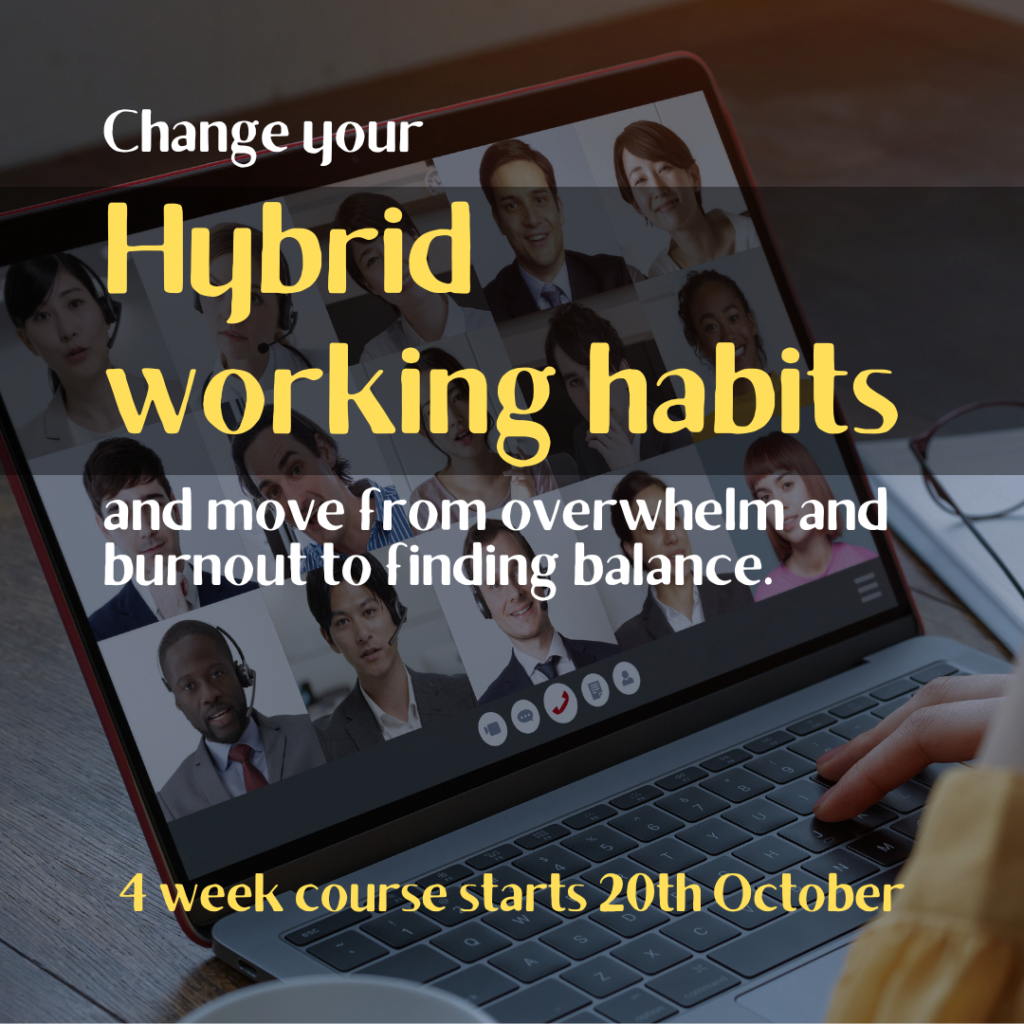
The first project was my free course Healthy Habits for Hybrid Working, which I ran in October and November last year. The course was designed to share practical tips that you can use to find ways to make hybrid working really work for you (or you team or organisation) in the long term and covered the following topics:
1: Audit your hybrid working habits to find out how your current habits are impacting on you and what to change;
2: Set boundaries for a better life/work balance and stick to them even when things are busy;
3: Increase productivity away from the screen by using strategies for communicating and collaborating outside of meetings;
4: Communicate more effectively in the hybrid workplace in a way that works for you and reduces digital overwhelm.
The work of the course then evolved into a series of resources, coaching tools and podcast episodes over a period of months, which included running dedicated workshops for teams and leaders.
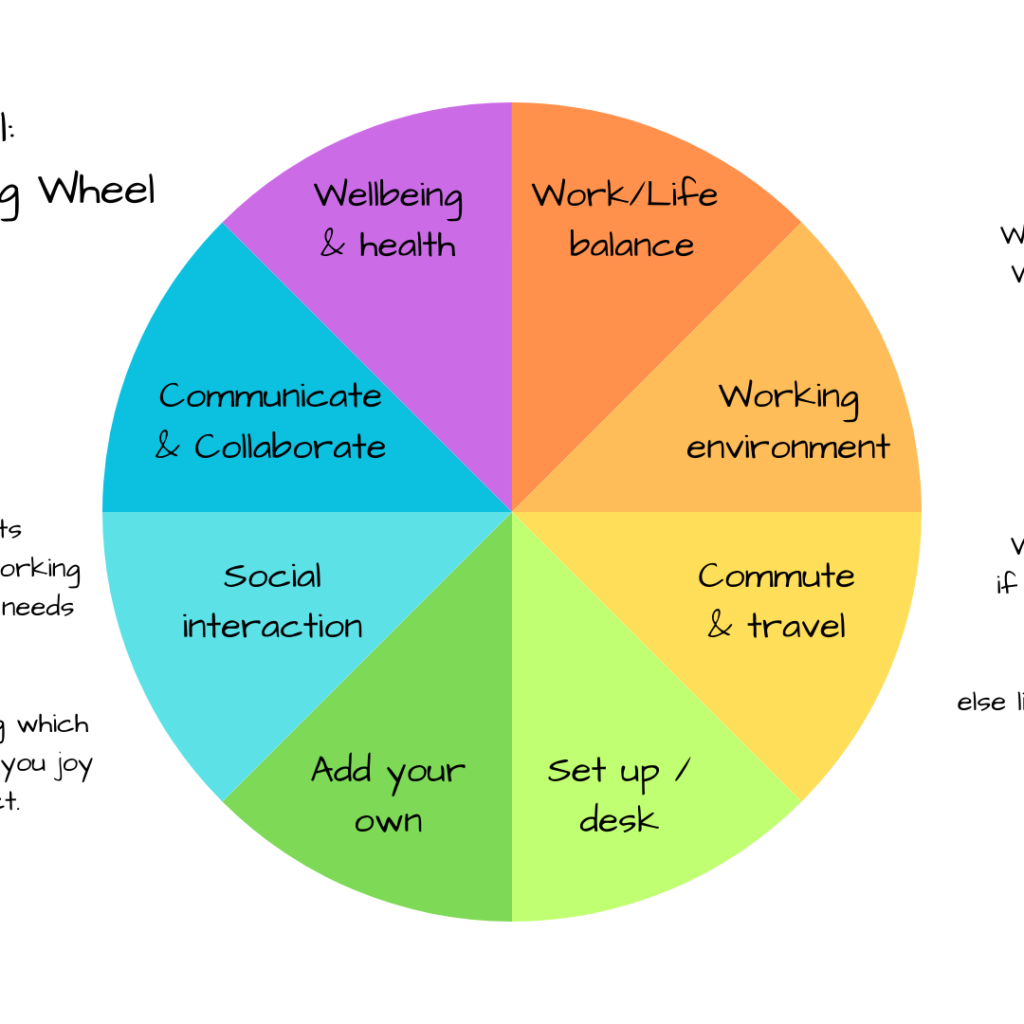
One of the most popular of these is an adapted coaching tool called the Hybrid Working Wheel, which many of my clients started using, and I organised a holiday ‘reflect-along’ session over the holidays which was a lot of fun!
I was also invite to run a really inspiring leadership day on this theme at the University of Edinburgh, which offered me new opportunities for developing the leadership element of hybrid working and wellbeing.

Teaching digital wellbeing and hybrid working as a short-course at the University of Oxford’s IT Learning Centre was one of my favourite projects of the year, and I worked with a growing cohort of faculty and staff over two terms.
This course was specifically designed to enable participants to:
- Reflect on how your current habits are impacting on your digital wellbeing
- Identify your hybrid working skills strengths and areas for development
- Understand the long term impact of hybrid working on digital wellbeing
- Develop a sense of how to foster digital wellbeing
For more information, visit the course page.
I also explored the topic on my weekly podcast, Leading Virtual Teams.
Recent podcast episodes relates to digital wellbeing:
- S04E04 – Hybrid Working & our senses: Part 2
- S03E32 – What happens to our senses in the hybrid workplace?
- S03E24 – Reflecting on a day of leadership development for hybrid leaders
- S03E21 – Holiday ‘reflect-along’: Hybrid Working Wheel
- S03E18 – Stepping Away from the screen
The podcast is available on different podcast platforms and I hope you enjoy the show. As always, share your ideas and feedback in the comments.
Keep in touch. Subscribe to my free monthly newsletter: