Tag: #altc

  • Talking about leading a Virtual Team #OEB19

    Nice to CC you by @visualthinkery is licenced under CC-BY-SA. Remixed by Maren Deepwell.

    This is a special #OEB19 post (cross-posted here) sharing our conference session: Leading Change through Open Conversational Digital Practice. In the session the two of us, that is Martin Hawksey (@mhawksey) and Maren Deepwell (@marendeepwell), openly share our approach to leading a virtual team. 

    As a senior staff team working in educational technology we have worked for the past two years to develop a conversational digital professional practice that enables us to focus on mission-led innovation, develop an open approach to leadership and to lead our virtual team, both digitally and geographically distributed. 

    In our session we discussed why this kind of practice should happen in the open and why it is important; why and how you, as a learning professional/educator, can try to adopt this approach; and what the barriers you may encounter are. 

    You can access the full slide deck here: https://go.alt.ac.uk/tts242

    Do you have your own approaches to open leadership or working in or leading virtual teams you would like to share? If so we’d love to hear from you. Comments on Martin’s blog are open or you can reach us on Twitter @mhawksey and @marendeepwell.

  • Is a strategy all about the future?!

    Creating strategies is a big part of my work. Some are small and fit a particular purpose, others span an entire organisation and many years. It’s the second kind that I am currently working on as ALT is half way through setting out a new strategy for 2020-2025.

    Our process involves many people, with their own views, ideas and voices and it’s all the richer for it. ALT’s Chair, Sheila, and I, blog about our progress regularly and if you haven’t already, I would encourage you to engage and make your voice heard.

    For me, this new strategy will be a living, breathing, practical framework for pretty much everything I work on for the next five years, just as the last one has been. So every ounce of effort, every speck of gold dust that I can help channel into it now, is going to make a big difference further down the line.

    A lot of my thinking as ALT’s chief executive develops alongside and through the wider consultation process with our Board of Trustees, staff, Members and the wider network. But there are some things I think through on an individual basis.

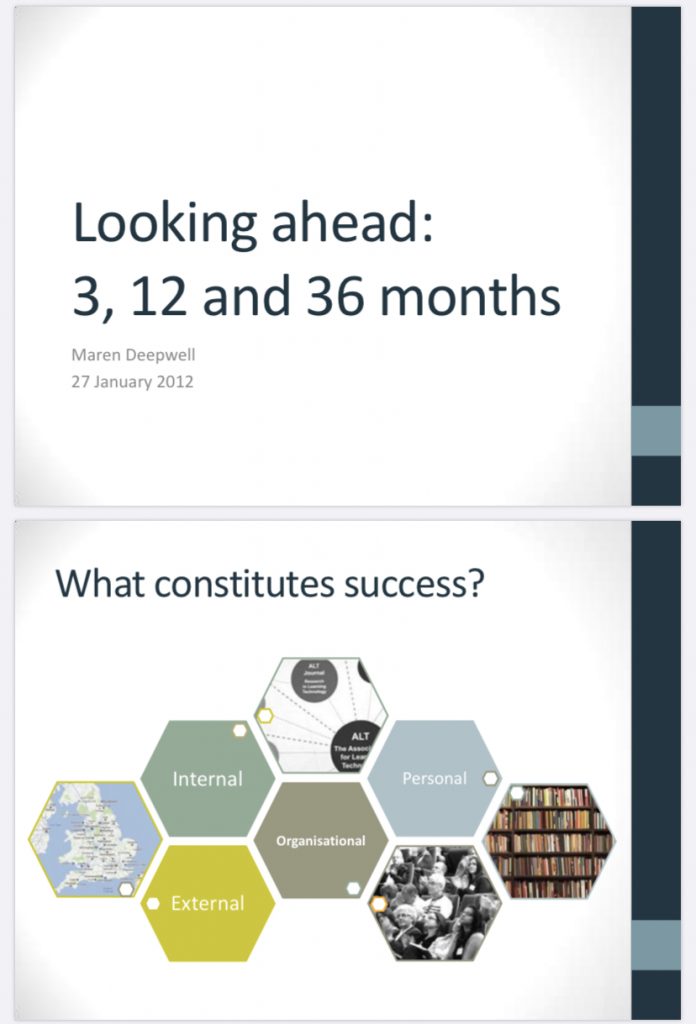
    For example, when I applied for my job in 2012, part of the interview process involved giving a presentation about my vision for ALT. I still have that slide deck…

    Since then, ever few years when we start to write a new strategy, I sit down, and I prepare another presentation pretending to be applying for my job all over again.
    It’s a useful tool I find. It helps me to step outside of what I think I already know about the organisation and try to see it with fresh eyes. It prompts me to ignore all practicalities and focus on vision instead. As a new ceo you never quite know what you are going to inherit. How many skeletons in the closet.. how much willingness to change.. what kind of internal agendas that dictate what can and cannot happen. You have an excuse to clean house, to start from a blank slate.  A new strategy has a similar power… it can help reset the board. It gives you the freedom to start afresh. It’s an exciting moment.

    As we began working on the strategy, one of my colleagues asked me whether a strategy is all about the future. That’s a very useful question. I suppose, in a practical sense, much of the strategy itself will focus on what’s ahead. But in many ways I don’t think creating a strategy is all about the future because you also want to understand, learn from and build on where you have already been. Making meaningful progress and change depends on not ignoring what you already know, problems you have already identified. In many ways it’s the opposite of what Sir Humphries does in Yes, Minister in order to manage his Ministers. Dusting off the same old idea and repackaging it in brand new marketing is a successful way of avoiding change whilst always hailing the next big thing. It doesn’t challenge the status quo.

    Change is good to think about in the context of strategies. The more radical your vision, the more work it takes to bring everyone with you. The more things change, the more effort it takes to communicate that change and make everyone notice. Here’s where working closely with the tech sector is not always an easy thing because the narratives of change in technology tend to be about shininess, all about seamless transitions and problem solving. Often I come across sexy must have solutions to problems I didn’t know existed. That’s the kind of change that’s easy to buy in to, literally. Change that takes years to plan and longer to bed in and real effort to implement for years and at scale is far less sexy and so much more meaningful for an organisation like mine. That’s why looking at the landscape, listening to what’s at the heart of the community, taking time to step back and really look at where we’ve come from is so valuable.

    I like to dabble in doing some development work. I can’t do the really tech heavy bits, but I like doing design, documentation and bug testing. Sometimes I get too ambitious about how many things can be improved or changed in one iteration, and getting others to test the workflow is a good way of identifying those things and improving the design in response. Strategies are quite similar for me. I start from a point of where I can see we will be in 5 years time and then work backwards until my ideas converge with everyone else’s. Sticking with my tech metaphor, the strategy becomes like a user interface for where we are headed.

    The last time we created a strategy the process taught me much about the value of listening and collaborating, of what can be achieved when you work together, share power and responsibility. It was an rewarding experience for me on a personal basis as well as greatly beneficial for the organisation. It also taught me the value of setting aside time to dream about the future.

  • Virtual Teams: Strategy unpacked… how being a virtual team is changing our organisation

    Welcome to this month’s post (cross-posted here) in which we, that is Martin Hawksey (@mhawksey) and Maren Deepwell (@marendeepwell), openly share our approach to leading a virtual team. 

    This time we talk about how much strategic progress we have made in the last few years and how being a virtual team has contributed to that. We also discuss our values as an organisation, how we have tried to reduce our impact on the environment and the upsides of being geographically distributed. 

    New here? Catch up on earlier posts, podcasts or find out more about ALT

    September 

    Maren: in our last podcast we talked about approaching our second anniversary of becoming a distributed team. Given that it took a year to execute the transition it was about this time three years ago that the strategy for this organisational change was set out. We are currently in the process of reviewing our strategy so this seems like a good time to take stock: let’s start with money. Financial efficiency was not a key driver for becoming a digitally and geographically distributed organisation but it was part of our strategy to spend less of our resources on renting under-utilised office space and all the costs associated with it, and instead increase resources for the services we provide to our members. Even taking into account one off transition costs, we have been able to redistribute between 5-10% of our annual turnover and that has begun to make a real positive difference to our budget each year. In this series we often focus on our experience of leading a distributed team day to day and in our last podcast we discussed how the distributed nature of our work has become a benefit to how we deliver events. It’s interesting for me to take a step back and see what other benefits it has delivered. Another example is our aim to recruit staff located in many different parts of the UK in order to better collaborate with our national community. We have previously talked about the positive experience of recruiting for our virtual team and how being independent of location has enabled us to attract a much wider pool of high calibre applicants. 

    Image credit: Voronoi by @visualthinkery is licenced under CC-BY-SA.

    Whilst a charity with a staff team of six can’t cover all parts of the country, we are now far more geographically distributed and able to travel to local events and meetings than before. In contrast to only two years ago when nearly the whole team was Oxford based and our ability to support remote working was limited, our reach has significantly increased! That’s two big wins: more financial resources for what matters most and more people power where it makes a difference. 

    Martin: It’s interesting to reflect on the bigger picture and the differences from 2-3 years ago. Something I’ve not analysed but is at the back of my mind is differences in travel and in particular air travel. With a team located across the country more travel is required for us all to come together. We try to be efficient in terms using other commitments like the face-to-face events we run our our Board meetings to minimise additional travel. In terms of whether we are generating more carbon emissions the calculation is complicated because when our office was located in Oxford I would fly down approximately once a month. In a distributed team my need to meet face-to-face is less frequent, but there are more of us to move around the country. In terms of carbon cost none of us need to commute to work. As a distributed team we’ve also greatly reduced our print requirements moving to a virtual filing system. Even our expenses are entirely electronic and we’ve no need to print or post receipts. Some of our changes are by design, others are born from practicalities. For example, I know that you will often take the train for events in Scotland because it is impractical for you to get to an airport. For this year’s Annual Conference it was fortunately on my doorstep making it easier to transport the equipment we require. How much equipment we need varies from event to event, but with the environmental impact or air travel I’m rethinking how our get to our events and meetups. 

    Maren: I suppose it’s all relative.. and there is always more we can do – but having reviewed our operations over the past 3 years, we can see that we have definitely reduced our impact on the environment overall. A different kind of strategic change I’ve been thinking about and which relates directly to our organisational values is creating and using openly licenced content, anything from our strategy documents, call for proposals, photos from events, artworks, member badges and more. The call for proposals and guidance for reviewers have been adopted by other conferences and remixed to fit their purpose, whilst some of our policies, such as our privacy policy, and governance documents have likewise been used by other organisations and referenced back to us. We have also been working with Visual Thinkery to create a number of remixes and those often take on a life of their own in the wider community. For me, these are examples of how our values shape our operations and a contrast to how ALT operated when I first joined. In a recent blog post Frances Bell wrote about her sense of the Association being a generous organisation and that made me reflect on how generosity is a big part of our approach to leadership and one of the motivations behind our open practice. 

    Martin: I’d also read Frances’ post and it was interesting to reflect on whether having a virtual team with an inclination towards “generalised reciprocity” makes things easier. In terms of qualities I think it does make a difference to have people willing to support others particularly when contact time in a distributed team can reduce those serendipitous ‘watercooler’ moments – this is not so say those opportunities don’t happen instead they take place in other spaces, there however has to be a willingness and culture that values sharing and values supporting others.

    Just coming back to the environmental factors for homeworkers. We’ve previously talked about the advantages of working from and having more control on your working environment. At the recent Labour Conference shadow equalities minister Dawn Butler announced a proposed policy which is designed to consider the specific needs of menopausal women in the workplace. As part of this “adjustments that employers could be required to make could include the provision of ventilation facilities”. There are a number of factors that can affect your personal thermal comfort level and research has shown there can be biological gender differences. As the colder weather arrives, so does the annual team chat about our individual workplace temperatures, which can bring its own challenges. These are not just limited to personal comfort levels.  From the Wikipedia page on thermal comfort:

    Residential buildings in particular can vary much more in thermal comfort than public and commercial buildings. This is due to their smaller size, the variations in clothing worn, and different uses of each room.

    So as our team starts the ‘discussions’ with partners over the thermostat there are plenty of opportunities for us to show some generosity towards each other … and pictures of snuggly pets.      

    Maren: I have lots of thoughts about how the seasons impact on homeworkers and on balance I much prefer a working environment in which you can feel the changes in the weather and adjust accordingly instead of being at the mercy of a centrally controlled heating system or indeed working in a building where you can’t open the windows.

    What really struck me however is you talking about an organisational culture that values sharing and values supporting others. I recently had a conversation with the Chair of our Board of Trustees, Sheila MacNeill, where this came up strongly and it resonates, too, with what Martin Weller wrote recently in a post on ‘meticulous informality’. The point I am getting at is that our values, as an organisation, are very practical, day to day elements of how we lead our team and how we operate and leverage them to achieve our strategic aims. And more than that, our values as an organisation and the core principle of our professional accreditation scheme are closely aligned:

    When we set out to define our shared values in 2016 I didn’t fully consider how these elements connect with each other. Now I think that this is one of the most interesting areas to think about and there’s a lot we could unpack here, for example how openness enables us to critically examine the interplay between technology & learning or how ALT being independent of government and industry supports effective (and less biased) sharing of practice. You recently achieved your accreditation (and blogged about it) and I wonder whether you have any thoughts on this, as you work as a Learning Technologist in a senior role? 

    Martin: It’s really interesting to consider how our values and core principles interact with each other and influence what we do, including as a virtual team. In terms of openness for me I can’t see a direct link to critically examining the interplay of learning and technology … just because you value openness doesn’t mean you have a more critical eye. Generally I do however believe those who value openness are more considered in what they do. As someone who has been blogging for over a decade I developed a level of comfort in publishing things in the open. I’ve published a variety of content from thought pieces to practical tutorials and there is still always an aspect of how it will be judged by my peers but at the same time the consequences of publishing something that is wrong are fairly low. In the case of my peer reviewed portfolio for CMALT the stakes are higher, you are seeking accreditation of your knowledge and skills.  In my case I deliberately chose to do my portfolio privately, only publishing it once I knew I had passed. I know others who have very successfully developed their portfolios in the open getting feedback, encouragement and contributions as they produce it. For a number of years my philosophy was that everything should be done in the open, but more recently this has become more nuanced and I now recognise that learning can be a very vulnerable process often referring to Alec Couros’ ‘thinning of the walls’ in my presentations on this topic.  In the context of virtual teams it is perhaps useful to think in a similar way. Aspects of virtual teams can for some expose vulnerabilities and discomfort, for example, most video conferencing applications include a preview of your webcam which some people might find discomforting – when you meet face-to-face it is very unlikely that the person you are speaking to will hold up a mirror so you see yourself.

  • Virtual Teams: The perfect blend? Bringing the skills of distributed teams to face-to-face events (special podcast edition)

    Welcome to this month’s post (cross-posted here) in which we, that is Martin Hawksey (@mhawksey) and Maren Deepwell (@marendeepwell), openly share our approach to leading a virtual team.

    This time we talk about how we as a digitally and geographically distributed team connect face to face and why we think a blended approach is important. 

    New here? Catch up on earlier posts, podcasts or find out more about ALT

    August

    Maren: from the outset our approach to running a virtual team has been blended. In these posts we’ve talked about face to face team days, conference meet ups and even cpd by post – all examples of how we blend virtual working with ‘real world’ elements. What I’d like to talk about is why it’s so valuable to share some coffee & cake in person from time to time – to build relationships, communication & collaboration. I don’t think meeting up in person in itself is enough though. Over the last ten years I’ve come to realise that the more I prepare for a meeting and share my thoughts and expectations with whomever I am meeting, the more I get out of the time spent together. In my case, my former line manager, my mentor and every Chair I’ve reported to as CEO have been distributed remotely and rare face to face meetings have been precious. In order to make the most of them, I reflect on how things are going, how I feel, beforehand, so that I am better able to convey what I want to say when I am meeting someone in person. I’m curious about how that can also apply to conferences or other events. This year I was fortunate to meet many Canadian colleagues I’d never met before in person and I spent a lot of time chatting with them online in advance. I received travel tips & help preparing for the trip and it really made a big difference to how well the trip went and our ability to work together easily once I arrived. I think what I am getting at is that often people assume it’s the physical proximity that makes the difference in communication or collaboration and I’m keen to explore why it’s more nuanced than that. Some of the most important communication in my experience has been entirely online and depended more on the effort and engagement of those involved than their location. And yet… you can’t beat working alongside someone for learning new keyboard shortcuts. I realise that is a small thing, but it always reminds me that there are some things you miss out on in virtual working. So that’s my opening for this month’s podcast. What do you want to talk about? 

    Martin: Having just delivered our biggest annual face-to-face event with over 450 attendees joining us for our Annual Conference the benefits of physically coming together is at the forefront of my mind. This is one of the few times of the year when we come together as a team. The conference itself is usually over a year’s worth of planning and there are as you can imagine a lot of moving parts. The majority of the conference preparation is done as a distributed team and we’ve previously talked about how this works as a virtual team. Something that I thought really clicked together this year was our team communication during the event. As part of the conference we had to manage the attendee experience across multiple venues. To do this effectively, our team is spread across the conference site. We have a very detailed run plan so you generally know where each team member is going to be at a particular time, but to coordinate things we have a group Google Hangout chat channel. With this we can share how the conference is going, note any issues, answer quick questions or highlight the need for refreshment/breaks:

    We’ve previously tried to use Google Hangouts chat as part of our events administration, but this year was the first time I felt it really worked. There were a couple of reasons I felt this worked better this year, in particular, given we use Google Hangouts chat in our day-to-day activity we were all very familiar with this tool and how to use it. Another important factor was that this was the first year we also took the time to make sure we could access the chat regardless of whether we were on a Chromebook/laptop or using our mobile devices. Often when Virtual Teams are discussed it feels like you are always arguing against how it compromises operations. In the case of our Annual Conference our experience of working in a distributed team I feel actually greatly benefits us.

    Maren: that’s an interesting point. Initially I suppose it was mostly the other way round, ie existing relationships or knowledge made it easier to establish an effective virtual working environment. As this is our second year as a distributed team I think you are right about our virtual working practices becoming a benefit to working together face to face. I’ve really noticed the difference in my own mindset, I no longer feel like I haven’t seen a colleague for a long time when I see them in person. Instead our last virtual interaction ‘counts’ in my mind. That makes building relationships a lot easier, because you are not starting from scratch every few months. Another factor that has changed is mandating what’s required and what is optional. When we set up virtual operations we offered a lot of choice in terms of which platforms, tools or devices to use and the first two years have helped us, as a team, determine what is essential for effective operations such as the instant chat on different devices and what’s up to the individual, such as personal to do list formats. Delivering events has been a big part of helping us figure that out. The other big factor in such a small team is having a sufficient number of people present to check whether your idea of how things should run actually works. When there is only two or three people engaging it doesn’t work as well. In a small team one individual may represent 20% of the overall team and so everyone’s actions have a big impact. For example, for me personally that makes a big difference when it comes to sharing priorities for upcoming catch up meetings. Initially I was happy for everyone to choose a format but over time I realised that it takes too much time to switch between all the different tools for lists that are shared and having a common format also means that we all learn from each other’s practice, like the keyboard shortcuts I mentioned earlier. 

    Martin: As our team has grown I can see the benefits of having standardisation. As part of my role I support the implementation of our infrastructure. This includes the physical purchase of equipment as well as supporting staff with how to use it. Broadly the technology we use is fairly standard with a mix of Windows laptops/desktop and Chromebooks. Generally where practical we repurchase the same product or a similar product from the manufacture. This makes things easier so for example in the case of Windows laptops we have variants on the Lenovo X200 series so I know how the software Lenovo provides to manage device hardware generally works. The same is true for Chromebooks and we currently predominantly ASUS Chromebook Flip C302s. It means I generally know what USB-C hubs to buy as well which monitors have suitable connections and adjustments. As I’m not a day-to-day Chromebook user an area I struggle more is shortcut and command keys but luckily we’ve got a good cross-section of experience in the team now so if I can’t help there is generally someone else who can point us in the right direction. An area I’m often left in the dark with is iOS (for the last decade I’ve been exclusively using Android based devices). At ALT, we don’t have a policy of providing mobile devices to staff, the exception being our events manager. In the case of our recent Annual Conference it meant when one of our team asked how to install Google Hangouts chat on their iPhone I was completely lost, but fortunately as you are an iOS user you were able to help. The desire for a standardised provision is likely to be the wish of every IT manager in the land, in a distributed team it perhaps becomes more important because remote support of physical things becomes much harder. Similarly, I can see why having a common format for catch-ups means time better spent. 

  • Virtual Teams: Creativity Hacks for Virtual Teams (and why we maybe do like emoji after all)

    Hello and welcome to this month’s post on leading a virtual team. In this post (cross-posted here) the two of us, that is Martin Hawksey (@mhawksey) and Maren Deepwell (@marendeepwell), continue our series of openly sharing our approach to leadership. 

    If you are new here, you can catch up on earlier posts and podcasts or find out more about ALT, the organisation we work for as senior staff. We really appreciate comments and feedback and welcome questions or suggestions for future posts. 

    This time we get creative as we share our favourite ways to have some fun, create, collaborate and share. We also have another think about emoji.. which a year ago we gave a rather cold review. 

    July

    Maren: When I started thinking about this post, I realised that creativity is a much bigger part of how we collaborate as a team than I initially thought. I’m excited about having some fun and sharing a few of my favourite ideas from the last year, starting with this example of an alternative team portrait:

    We’ve made others, one with biscuits representing each member of the team particularly sticks in my mind, but this is definitely a favourite. A bag full of craft supplies, a table, an hour of chatting and making together and you have a fun, creative portrait. I much prefer this to posing for artfully smiley photos that end up on social media and the process of making the portrait together acts as a catalyst for conversation. 

    Another recent example of a bit of remixing fun as a team was creating our own Pet Top Trumps, featuring some of the four pawed companions we have as home workers: 

    One of the challenges of remote working is to find ways to interact with each other informally, to have some fun and that is particularly important when things are busy! Creating and sharing our Pet Top Trumps developed some new skills and really improved our spirits on a hot, long and busy summer day. These cards were remixed using the Fabulous Remixer Machine, which we also use in other creative ways. 

    Martin: Informal interaction is a really interesting point and thinking about it probably one of the toughest areas in a distributed team to get right. It’s quite easy to add informal conversations to the start/end of video calls but more challenging when catch-ups or team calls aren’t scheduled. It’s also probably easier to incorporate informal chat in one-to-ones because with our team meetings, particularly in Annual Conference prep mode, it feels like there is pressure that chatting might be delaying someone else from getting back to their to-do lists. In the past during busy periods we’ve also scheduled coffee breaks where we can hangout together. One of the challenges I find is when these have been purposefully set up they lose some of the spontaneity that you might get in a traditional office environment. Something I’ve found that works well is working with someone on a piece of work whilst in a video call with them. This could be a task like writing a piece of text together or working on some spreadsheet data. These moments are also useful for those serendipitous moments when you discover something new which might be a different way to do a task or just something you didn’t know about the other person. Within our team we also use a group text chat, which allows everyone to say hello in the morning and gives us opportunities similar to an office based chatting across the room. Currently we are using Google’s Classic Hangouts Chat for this which doesn’t have some of the additional features you get in the newer version, or other tools like Slack. Having used newer chat interfaces as part of other communities I’m part of I find my original dislike of emoji’s and reactions, which we talked about last year, slowly being eroded. I’ve yet to use these tools in the context of a virtual team and I can’t wait for Google to integrate the new Hangouts Chat into Gmail. When we talked about emoji almost a year ago you had similar hesitations for using these in a distributed team. Has your own view changed?

    Maren Bitmoji

    Maren: No. Yes. Maybe. My emoji literacy is still poor. I am one of those people who has to search for explanations of what ‘:s’ means… someone who having made her first ever Bitmoji promptly never made a second one. My icon vocabulary is rudimentary at best. I speak more Greek than emoji! That said, sometimes only a ‘:)’ will do, so I adjust how I express myself according to my audience. I value instant chat a lot for spontaneous interaction. Like you, I’m a year further into my experience using more ‘engaging, agile, responsive…’ chat interfaces. My feelings are still very mixed: I dislike that at times the volume of reactions/interactions can make the interaction meaningless, it becomes noise. I find the amount people have to actually engage or think about how they are reacting is minimal, which devalues the increase in interaction for me. I prefer someone not engaging to token reactions. I object to the notification push these interfaces try to dictate, i.e. ‘check who has liked your comment in the last hour…’. I don’t want to be notified in this way. And then there is context. Someone being silent can speak volumes and if they click the occasional ‘like’ I might miss their silence. So there are still a lot of downsides to the world of chat and emoji to me (and chatbots, for that matter). On the other hand, I love the playfulness, the fun, the sense of humour, creativity and flexibility these tools enable us to have. And that is really important in a team setting. I had an experience today discussing email, and a colleague pointed out a way in which we could save emails between us. The suggestion was prompted by them understanding how I work better, getting to know what’s important to me and why. A whole range of formal/informal communication led to that realisation, and to me, that’s what matters. Like drawing or walking or making something, I value things that get us thinking together. 

    Martin: In the case of reactions I can see a distinction between ‘likes’ in a personal setting compared to a professional context but at the same time, as we talked about in our last post, there is often a blur between social networks/chat in a work and personal life setting. I’ve only came across bitmoji recently and while I’ve seen others use them they are not something I’ve played with a great deal. Given the level of expression and potential outlet for creativity you get from some of the designer apps perhaps I should. Something that has put me off, particularly with the basic bitmoji you get with built-in virtual keyboards for Android, is the expression always seems a bit extreme for my mild mannered personality. While I’m becoming more inclined to emoji the next problem is given I’ve previously stated I dislike them in the past it feels more awkward to start using them purely because of my suborn streak. Given the reliance on online tools for virtual teams it’s perhaps worth remembering new tools get added, existing tools change in functionality and tools even get discontinued which means there is a degree of continual change with personal choices so having an organisational cultural alignment that supports this is important. In terms of creativity one of the aspects of my job I really enjoy is the opportunity to produce and collaborate on some of the artwork we use. This includes things like our Annual Conference splash screens to remixing some of the artwork and popup banners for the OER conference. Having recently bought a sticker machine I’ve been enjoying providing one-off creations. 

    CPD badge

    Maren: Stickers are a great example of a creative outlet. I also came across this digital badge, which I made on a drawing app and using Google slides, as part of the team appraisal process a couple of years ago. Making one/off badges for individual staff is a quick, creative way to provide recognition and feedback with a twist. Another example of a creative approach to feedback is the ‘positivity by post’ exercise we did recently. That involved using a template to send each other feedback by post and that was really interesting in that it was a) positive feedback only, b) handwritten and c) delivered by post rather than email. For me personally changing the method of communication made the process both more creative and impactful. The final example I’d like to mention is clothing.. shoes, t-shirts, hoodies:

  • Virtual Teams outtakes: Heatwave home-working

    It’s hot! Even for home-workers. So in this post, which is an ‘outtake’ from my regular series of Virtual Teams posts with Martin Hawksey, I share some of our experiences and tips for home-working during a heatwave…

    When I was still office-based hot days were always a challenge. Fans were going on all the desks, commuting was a nightmare (if the trains were running at all) and everyone was trying to schedule as much time away from their desk, taking calls outside, having meetings in the cafe and taking frequent trips to the water cooler to fill up their bottles. Working when the weather is really saying “you should be on a beach… in the park… or in the pub with a cold pint” is always hard.

    Dressing for the weather: one of the key advantages of being a home-worker during the heatwave is that you don’t have to leave the house, get on a train or sit in a meeting. You can wear shorts and t-shirts or loose clothing that would not adapt well to commuting or an office environment. For me, sleeveless silk blouses are a friend for formal meetings, but most days shorts and running gear makes work in hot temperatures much more productive!

    Cooling your work-space: Airing your work space as much as you can in the early morning or late in the evening is key and I also find drying large sheets/laundry near an open window is a great way to cool air as far as possible. I have a south-facing window in my work space at home, so the blinds come down by about 10am in order to keep the sun at bay during the hottest hours of the day.

    Fan yourself: Personally, I don’t like electrical fans, but having recently received a very useful hand fan from a friend I have found that to be an absolute life saver. It’s a great accessory not just during hot weather and will be firmly established in my travel bag.

    Care & check-in: Especially during hot weather frequent check ins are important and in our team we use instant chat for that as well as daily video contact. It’s important to check in with each other’s well being and acknowledge the unusual conditions as you would if you were co-located.

    Head outside: in my case the proximity of a road and a railway line and a building site makes working outside or in the garden a poor option, but some of my colleagues enjoy taking a laptop and heading outside at least for part of the day.

    The fridge is your friend…: One of the things I find much easier at home is keeping hydrated and eating well during the hot weather.

    Enjoy the sunshine 🙂