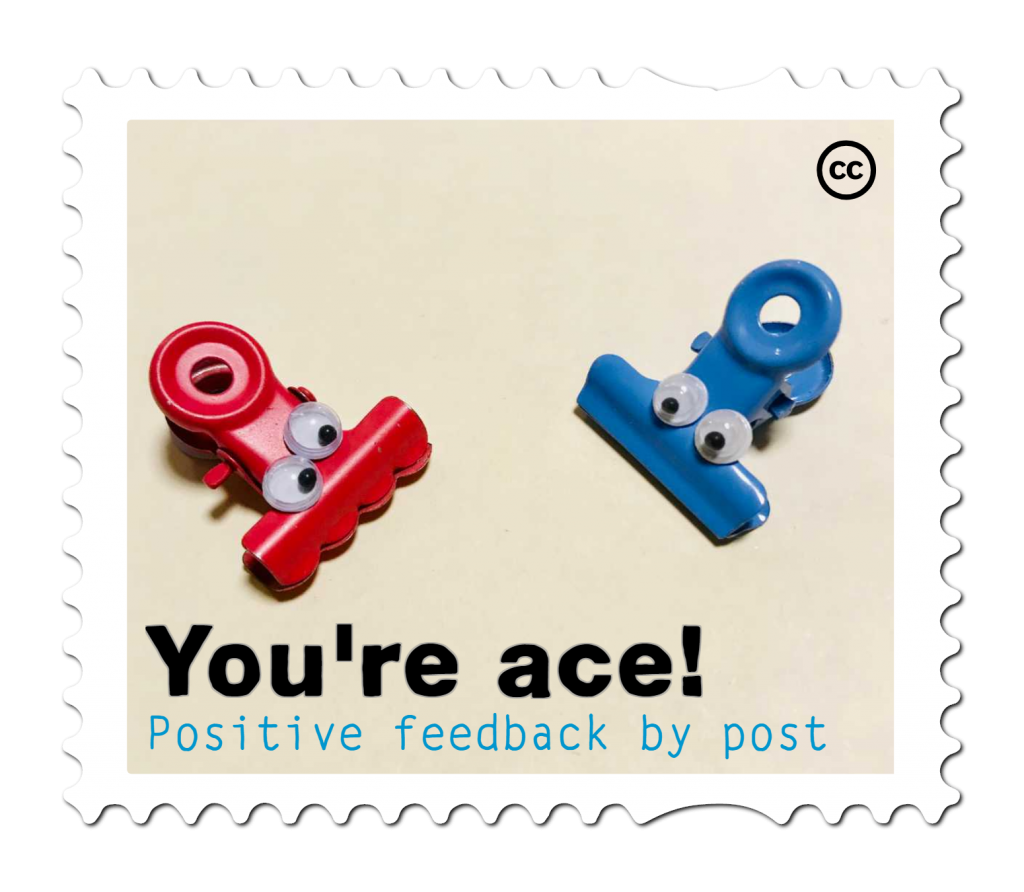
In a recent post on positive feedback I talked about how to use positive feedback for personal & professional development. As I wrote the post I had an idea to try out a new approach to giving and receiving positive feedback in a virtual, distributed team: I made a template and sent an envelope to each of my colleagues in the post, enclosing a piece of positive feedback from me to them, as well as templates, envelopes & stamps for them to send each other positive feedback. That way, I hoped, we would each receive several pieces of positive post in the mail over the next week or so. If you’d like to have a look, here is the CC-BY template I created.
So, what happened next?
Writing and sending feedback
I really enjoyed the process of printing, folding and making each envelope to send and in particular writing the feedback by hand. I hardly send or receive any personal letters and putting pen to actual paper made this feel special.
Writing solely positive feedback, rather than including constructive criticism like I would for a performance review, felt liberating.
I wasn’t sure what to say, at least initially. Or how much to write or what to focus on. But looking back at the original article that prompted me in this action, I tried to find something that I felt had made a big difference and why. Once I got started, there was a lot I wanted to say.
Once I had written everyone’s feedback I put the envelopes in the post and I didn’t keep copies.
You’ve got post!
The following week I told my colleagues about the project, shared the blog post I’d written and everyone started to wait for their letters to arrive.
As a distributed team we only rarely receive physical materials, mostly equipment or printed materials. My last letter from work was a tax certificate. Sending and receiving mail that we all knew would contain only good news made a difference.
We send each other secret santa presents by post, and sometimes souvenirs from conferences or thank you presents, but it’s a rare occurrence to get those, so a special delivery like this is noteworthy.
And it wasn’t just a single person, i.e. me, sending something to everyone one way. Instead, everyone sent a letter to everyone else (our team being small enough for that to be practical).
You also never quite knew when a letter would be arriving and for remote workers post and parcel deliveries (mostly for other people) are a common feature of work days. But getting something just for yourself makes for a welcome change.
Reflection
Creating, distributing and receiving small moments of positive feedback was a very worthwhile exercise.
Firstly, it made me focus on the positives more and once I did, there seem to be more of them!
Secondly, it was useful to practice receiving positive feedback. It is true that it feels more powerful when not accompanied by negative feedback at the same time. Making space to absorb positive feedback meant that it stayed with me a lot more than it may have done otherwise.
The reaction from colleagues to both the method and the focus of the exercise was also positive.
A cpd task, which we as a team set every month, that focused not on learning new stuff or improving something, but on recognition for what is good, what we do well, proved a joyful experience and a relaxing one, too.
As well as practising receiving positive feedback we all had the chance to articulate something positive to each other and that, too, felt worthwhile.
P.S. Maybe it’s time for further thinking about postal projects for distributed teams… .
I recently came across this article in the Harvard Business Review on how to use positive feedback for personal & professional development. The article points to a tool/service but in itself contains useful pointers and ideas explaining why positive feedback is important, how to give/receive it and reflecting on why this may be difficult:
‘Most people are well-attuned to critical feedback; it is jarring, threatening, and emotional, and as a result, quite memorable. In contrast, it is often easy to let positive reflections on our actions subtly slip us by. Lingering in the glow of praise can also feel uncomfortably immodest. It therefore takes practice to savour moments of positivity and to hold them in your memory.’
In my experience that certainly rings true and I found the suggestions the authors make for practising helpful. They come up with five steps:
Noticing positive feedback, including creating a space where you can save it, like an email folder or pin board;
Asking questions, teasing out exactly what it is about what you did that made a positive impact;
Studying your success (personally I don’t like this phrase, but the idea is sound), reflecting on what you did and how/why you succeeded;
Practising enacting the most positive aspect of yourself, making space in your day to day work where you can see the positive impact you have on others, or on the organisation;
Share positive feedback with others, establishing giving and receiving positive feedback more firmly in your practice.
One of the things that really stood out for me is the prompt to reflect on what I did well, what made a positive impact, rather than reflect in order to improve, focusing on what I could have done better or to gain a more critical perspective. I don’t think I habitually make time or space to focus exclusively on positive feedback although I receive quite a lot of it.
That brings me to another point, which is how this sits within open practice. There are many upsides for me to being an Open Practitioner. It often brings with it a lot of valuable input from others, interesting ideas, suggestions for how to develop, sharing their perspective etc. But it doesn’t (for me) make for the most comfortable space in which to share praise or reflect on positive feedback. I can express a balanced perspective, i.e. including things that went well alongside things that could have gone better, but there’s always a sense of vulnerability when I write about a success because someone might well respond to point out flaws, mistakes or their own personal negative experience. In a leadership role especially it’s common to express positive achievements in such a way that there’s always room for contrasting views. And that doesn’t create the right kind of space for focusing on positive feedback alone.
I’ve also come to realise that positive feedback means more to me when it’s given in private. Sometimes I receive heartfelt praise, sent to me personally rather than shared publicly and often the tone and content of feedback like is more meaningful for me. It matters that someone took the time to send positive feedback specifically, thought about it enough to feel the need to share it with me. I try and do this myself regularly and what I say and write to individuals personally differs from what I would say when praising them in public. Even within a small team, praising someone has meaning for all who are present, whilst personal positive feedback can be worded to be more relevant to the individual alone. It’s not an aspect of my practice that I feel can easily be translated into the open – but maybe that is something worth thinking about.
Next: Positivity by post
Given that I work in a virtual team, positive feedback generally comes in digital form. But I want to try and create something very tangible to test out some of the ideas I’ve discussed above and here is how: I’m going to send an envelope to each of my colleagues in the post, enclosing a piece of positive feedback from me to them, as well as three feedback slips from them to each of us and envelopes to send those to each other. That way, I hope, we will each receive some pieces of positive post over the next week or so. Positivity by post, if you like. I’ll report back on how it turns out.
This year I was able to take part in the Creative Commons Global Summit alongside my colleague Martin Hawksey, and it was a fantastic experience. I have long been involved in the Creative Commons community and various activities but this was my first visit to the event which is at the heart of it all and I was met with real warmth and welcoming acceptance. The creative and joyful atmosphere of the conference, from the handmade designs on the badges to the samba music playing throughout the museum conference venue conveyed a sense of celebration and joy at this meeting of so many in the Commons but also motivated to pull up your sleeves, get stuck in and do plenty of work (and there was A LOT to be done).
One of the strands I followed throughout the conference was around gender equality, visibility and leadership starting with Kelsey Merkley’s session on the UnCommon Womens project and later in a powerful keynote during the opening evening and running throughout all three days.
I also had the privilege to take part in some of the VConnecting sessions organised around the event, opening up the conversation to those not able to attend in person and I really enjoyed meeting participants from all across the globe in that manner as we sat in corridors and next to lifts, supported most capably by both online and onsite buddies (thanks Ken & Christian!!) who made it possibly for us to talk all things open across time zones and continents.
Having a creative start to the day #ccsummit finding out about creating with CC-Create for artists, musicians, makers… pic.twitter.com/yCXIPWH1i8
I also really enjoyed the more creative side of the Summit and I met makers and artists as well as platforms (Hello, CC-Create) that had never heard of before, opening up completely new perspectives on how art, music and design function in the Commons and how big an impact openness in these contexts can have from delivering education to making tools more accessibility and affordable.
As well as talks around creativity and equality I was able to participate in a number of sessions and workshops around digital literacy, staff development and copyright literacy, including this particularly fun session in which I learnt a lot of new things about copyright:
And one of the highlights of the final day was a critically inspired panel about AI (maybe the first conference session on the topic that didn’t leave me frustrated or angry) very elegantly facilitated by CC’s CEO Ryan Merkley:
From killer robots & facial recognition to copyright, privacy and licensing… AI discussion #CCSummit is very broad ranging in the face of complex issues – what happens next and how can we influence it? pic.twitter.com/sbeu92McUh
The final highlight for me was that Martin & I were able to share some of the developments that are happening in our community with the Summit. It was a real privilege for us to have our proposal accepted and we really enjoyed our sessions and were really grateful for the interest & questions it stimulated:
Many custard tarts were eaten, there was rain, fog, wind & plenty of sunshine, there were many useful conversations, resources & ideas shared and I am taking back a lot of inspiration as I join on last VConnecting session from Lisbon Airport.
CC Summit, I certainly hope to be able to join in again another year and thank you for a wonderful experience.
Hello and welcome to this month’s post on leading a virtual team. In this post (cross-posted here) the two of us, that is Martin Hawksey (@mhawksey) and Maren Deepwell (@marendeepwell), continue our series of openly sharing our approach to leadership.
If you are new here, you can catch up on earlier posts and podcasts or find out more about ALT, the organisation we work for as senior staff. We really appreciate comments and feedback and welcome questions or suggestions for future posts.
This time we’re talking about team culture, upgrading workflows, the ISO9001 Standard, the MIT90s Framework, our dislike of management terminology and the impact of being busy on communication and collaboration as a virtual team.
April
Maren: one of the themes we keep coming back to is how to improve our processes and I have been thinking about that in relation to my personal approach, what we do as a team and how we function as an organisation: first, on a personal basis I have been doing some upgrading to how I manage my own to do lists. This has brought me back to re-reading one of the first books on productivity I ever read, Dave Allen’s Getting Things Done and his “five steps that apply order to chaos” are still a useful reminder for me now. I’ve also been looking at the ISO9001 Standard and the seven quality management principles that inform the standard. Management speak notwithstanding these principles are very much what we do day to day, even if as an organisation we don’t articulate our approach in that manner. It’s useful to review these things from time to time, to remind ourselves of the baseline of how organisations function and how what we do aligns with that, similar to the Open Leadership Handbook we recently looked at. But the part of the puzzle I am most interested in at the moment is how we communicate what we do to our Members and the public in general and I have seen some interesting examples of how other organisations do that, for example the ETUG survey results and Open Education Week sharing its impact summary. One of the challenges we have as a small organisation is to balance getting things done with ensuring what we do is visible and I have the feeling that the busier we are the less communicative we become about what’s been achieved.
Martin: There is a culture aspect of this that is worth unpicking. Last month we highlighted the difference between ‘cultural fit’ and ‘cultural alignment’. Evolving our culture to make they way we communicate to our Members and the public needs us to consider how we adjust our cultural alignment as a team. With a smaller team resource is always a huge factor and change requires time. At the moment given we have two vacancies in our team that we are filling there is perhaps an opportunity to do something as the dynamic in our team changes. In a previous learning technology role culture was a hot topic, in particular, how do you change organisational culture. Something often discussed then was the MIT90s framework in which Scott Morton (1991) purposes that organisations are comprised of “five sets of forces in dynamic equilibrium among themselves even as the organisation is subjected to influences from an external environment”.
Seeing the organisation in this light has made business managers realise the importance for the organisation to transform to meet the needs of the time. But more importantly, underneath a successful transformation is two conditions that must be met for this transformation. They are: (1) the creation of a vision which must be clearly understood and supported by everyone in the organisation; and (2) the ability to align infrastructures (such as information technology, work structures and processes) with the business goals. No matter what form or structures the organisation takes, these conditions must remain true; even for the virtual organisation.
So in terms of developing a culture where staff are more focused on visibility and communication you could argue that the changing team dynamic is an opportunity for everyone to engage in a new vision and ensure our infrastructures (IT, processes, structure etc.) are aligned. I feel I’ve taken us down a bit of a rabbit hole with this but I’m interested to know if you have an answer to “the busier we are the less communicative we become”?
Maren: My response to that would be that the busier we get the more likely we are to loose perspective. In any busy team, or role, there is always a balance to be struck between getting things done and finding time to think about things – and different factors can make it harder to find that balance: lots of change, things happening outside of work, ill health, heavy workloads etc. Signs of not quite finding that balance in my experience are things like not using project plans or to do lists properly, but instead allowing one’s inbox to dictate what to focus on (we talked about noisy versus important things in a past post), arranging to catch up and not remembering what about, feeling stressed but not that things improve when you tick things off your list etc. Kindness towards one self and others is key here. Giving oneself a break is particularly important when things are busy and can be hard to do. And it always helps to go back to basics, like the to do list strategy I mentioned earlier, and use the processes you have in place to regain some of that perspective, which in turn makes it easier to communicate what you are doing, progress being made and importantly achievements to colleagues and stakeholders. One simple tweak we have made this year is to add to our Operational Plan a column that prompts everyone to consider how they would sum up the output of a task in 280 characters or less and a column which asks us to note what’s new in any given area of operations. We are just about to make use of these new elements for the first time and I am curious to see how useful that will be for us to gain that sense of perspective and balance as a team. I really like our plan and find it really useful to track strategic progress and operational load, and it’s been great to tweak things to try and make it even better. One of the things you talk about is shared vision and that is a really interesting topic when like us you are in the final phase of delivering a really strong, shared vision and strategy before creating a new one. When people get involved in an organisation at this stage in the cycle, how can we best approach that? Any thoughts?
Martin: For me I think it’s important to remember that there is a distinction between our strategy and our processes, recognising that they are still interconnected, but that our processes are likely to have more impact on our culture. It is obviously still useful if our team engages with our strategy but I don’t see that as essential if they are delivering, it being the responsibility of management to make sure they are delivering the right thing. That said, there is probably some overlap between our values and processes, for example, something like openness is hopefully reflected in some of what we do in terms of some of the practicalities of sharing resources (e.g. documents, slides and other outputs are Creative Commons licensed and publically shared), but again you could argue some are more engaged with the processes of finding sharing resources under Creative Commons rather than the underlying value of openness. So ultimately I don’t think the stage we are at in our strategy has that much impact on our culture or vision. Where it has a bigger impact is potentially around processes, for example, if our next strategy has a different focus there might be different performance indicators that our processes have to deliver. So in terms of bring new people in to the team I think by focusing on the processes there is an opportunity to give them a sense of our existing culture and vision. Something I think important to remember is new people may bring new culture and vision which can be greatly beneficial to the organisation.
Maren:There is a lot to talk about here and I have many different thoughts in response that it could be interesting to explore, but in a nutshell, the key thing for me is for everyone to understand, established staff and new colleagues alike, why we do what we do. You are right that maybe where we are in a strategy cycle isn’t as important as long as everyone is on the same page about what needs to happen, why and how. I conceptualise the why as the strategic perspective, the how as reflecting our values and the what as the practical delivery. Maybe there’s a podcast in the offing for our next episode, so that we can talk about some of these questions in more detail, but one final thought I have on the communication front is a ‘Tell someone about it’ or ‘Who needs to know about this’ checkbox that could be added to everything.. reminding us to keep communicating as we start the busiest period of the year.
In June I am heading to Thompson Rivers University in Kamloops on what is a long awaiting (first) trip to Canada. Thanks to the organisers of the ETUG 25th anniversary conference I have a wonderful and rare opportunity to meet with colleagues in British Columbia and visit a community that has much in common with my own organisation, ALT – both long-established Member-led professional bodies committed to Learning Technology and sharing similar values and priorities.
The ETUG Twitter account has been sharing news about the event, which has a movie inspired anniversary theme of Back to the Future: Looking Back, Moving Forward and so as one of the keynote speakers my own planning and preparations have long been underway.
You can watch a short video of me talking with Clint Lalonde here as we get very excited planning for my talk.
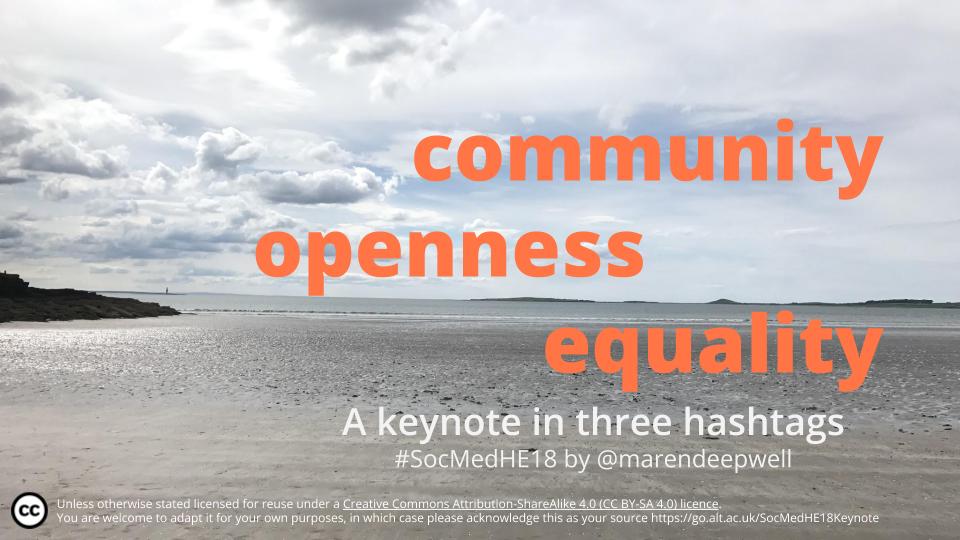
And that got me thinking about all the work that goes into crafting a keynote for an event like this and the opportunity it presents for me to read, research, remix, make and think about things. Back in January I contributed to the #SocMedHE18 conference and the talk I ended up writing (Community, Openness, Equality: a keynote in three hashtags #SocMedHE18) was the result of a really inspiring process in dialogue with the conference committee and following the Twitter conversation, creating new artwork and images along the way.
Whilst I do give a lot of talks the kind of opportunity to give a keynote of a more challenging or creative nature is rare for me and I value the chance to start from a blank canvas and re-imagine, re-think my ideas and views from scratch.
One of the things I like best about crafting new keynotes is creating the artwork or images for the slides and I usually use my own or remix them. This time, I am hoping to remix a lot of images and use them to underpin my argument visually. It’s a great creative outlet for me to make openly licenced slide decks that I can then share back for others to use or remix. It also allows me to give credit in my talk to all those whose work I build on.
But writing keynotes or planning them ahead of time is also very practical. After all, few people can create an engaging narrative with a strong argument on the fly and some of the speakers whose talks I have most enjoyed certainly write and think out what they will say well ahead of time. I find writing a summary at least, that I will then flesh out in the month before, adding slides and key points to remind myself is not only useful for me, but also provides transcripts for others to refer back to later or indeed remind myself of what I said or meant to say.
But this keynote that I am working on just now may end up having a playlist more than a list of references and I think that is to do with what I took away from OER19 and the collection of reflections I have been reading. For one reason or another I missed all of the keynotes at the conference this year and like many who were not able to attend themselves, I have been going through the programme and listening to and watching the sessions we recorded – but my strongest impressions of the speakers has been through the memories and reflections of others who have written about them. And that has been quite an extraordinary experience because much of what others took away from the talks seemed to be about values, about what the speakers and their practice stand for.
Being a keynote speaker can be a powerful thing particularly if you choose to use the platform it gives you for a cause that chimes with your audience. And it seems that in the case of OER19 that definitely happened. So much emotional investment and enthusiasm is rare at conferences I attend and as we are now nearly two weeks after the event and the posts and discussions keep on flowing this is further reflected in the continued engagement and activity. So there are fresh role models for me to be inspired by, keynotes to relive that really struck a chord and transcend what you can normally expect from an hour in a lecture theatre. And indeed there are many involved in making OER19 happen whom I have been inspired by in the past, like the Co-Chairs Catherine Cronin and Laura Czerniewicz, alongside Jim Groom, Lorna Campbell and Sheila MacNeill, or Bon Stewart, Martin Weller and Maha Bali and Jane Secker. All of whom have kept their audiences spellbound at previous OER or ALT’s Annual Conferences and I remember sitting back, listening, enjoying what each contributed to those events and to my own thinking. Some of these talks opened up my perspective to completely new concepts or problems, others inspired me with their example and encouraged my own practice. But each have made the hour I spent listening and participating very special, a moment stuck in my mind.
We have all met speakers and participants who turn up for their session, who seem to have missed all instructions or information provided beforehand, who run over time, who don’t answer questions, who don’t speak on what they promised and who don’t really contribute.
Fortunately, there is also the opposite of that. Keynotes who make the best participants and participants who make the best speakers and OER19 felt a lot like everyone’s places could be swapped around every few hours because everyone was working so hard to contribute, to listen, to make it happen for everyone else.
And that is a big inspiration for me to take away and apply to participating and contributing when I head to Canada in June. And I am remixing and making and crafting to a soundtrack of inspiring working songs. Because sometimes music says it better and the mood from OER19 is not easily contained in words or even pictures.
Hello and welcome to this month’s post on leading a virtual team. In this post (cross-posted here) the two of us, that is Martin Hawksey (@mhawksey) and Maren Deepwell (@marendeepwell), continue our series of openly sharing our approach to leadership.
If you are new here, you can catch up on earlier posts and podcasts or find out more about ALT, the organisation we work for as senior staff. We really appreciate comments and feedback and welcome questions or suggestions for future posts.
March
Maren: this month I’m keen to pick up on a couple of things we started talking about in the last podcast, talk about all things open as we get ready for OER19 and also discuss a book you recommended, Invisible Women. It’s an awesome read full of interesting facts and laugh out loud moments (car manufacturers’ advice to lower my voice to help AIs understand my ‘atypical’ high female voice made me giggle it seemed so ludicrous) and there are many things that really chimed with me in the context of this series on open practice, starting with how important it is for women & men to each contribute their perspective to policy, research and practice equally. The joint keynote we wrote for International Women’s Day at UHI is a good example of this – neither one of us could have written the talk on their own.
It’s the open collaboration, the dialogue, that produces deeper insights. Gender data gaps discussed in the book provide countless examples of where that kind of dialogue is lacking from workplace practices (biases in recruitment software) to disaster relief (male only committees designing shelters without cooking spaces). Another point the book prompted me to reflect on is how important transparency and openness are for promoting equality. There are countless examples of complex technologies, especially AIs, that are proprietary and don’t permit us to investigate potentially biases much less address them. The two overarching thoughts I took from the book are that firstly, in one way or another, women, and by extension anyone who doesn’t fit the ‘template’ is made to adjust in order to fit – even if changing the underlying policies/design/structures would have bigger benefits for all. And secondly, how we always prioritise something else, focus on the next crisis, instead of focusing on gender equality ‘because we see the rights of 50% of the population as a minority interest’.
Martin: ‘Fit’ is an interesting topic. As part of our talk at UHI I thought I’d look at the findings of the ALT Annual Survey to see if there are any notable differences for survey responses based on gender. This was a very quick analysis so I can’t say if the results are statistically significant but it was interesting to see differences in areas such as enablers/drivers for the use of Learning Technology by male and female respondents. Fit, and in particular culture fit, features as a chapter in ‘The Open Organization Leaders Manual’, which you recently shared. In this Jen Kelchner’s writes about “Stop hiring for culture fit“. As part of this Kelchner argues that instead of cultural fit organisations should recruit for ‘alignment’:
“Fit” implies that your organization seeks to indoctrinate new members into its specific way of life—to clone its vision of the ideal member in everyone who joins it. When we talk about “fit” we create the potential for exclusion. It prompts us to seek someone who already embodies the values and principles we think are best (then seek to “fit” them into a pre-existing spot in our organizations), and ignore others. Achieving “alignment,” however, is different. Alignment involves embracing diversity of thought and building inclusive, innovative, community-driven teams that are all oriented toward shared goals, even if they look and think differently from one another.
‘The Open Organization Leaders Manual’ uses five principles as part of it’s Open Organization Definition: transparency, inclusivity, adaptability, collaboration and community. In terms of transparency it’s highlighted that:
In open organizations, transparency reigns. As much as possible (and advisable) under applicable laws, open organizations work to make their data and other materials easily accessible to both internal and external participants; they are open for any member to review them when necessary (see also inclusivity). Decisions are transparent to the extent that everyone affected by them understands the processes and arguments that led to them; they are open to assessment (see also collaboration). Work is transparent to the extent that anyone can monitor and assess a project’s progress throughout its development; it is open to observation and potential revision if necessary (see also adaptability).
I feel to our members and the general public that our operations are very transparent (our joint posts being a case in point). In terms of our distributed team it feels like more effort is required to be transparent, as in “to the extent that anyone can monitor and assess a project’s progress throughout its development”, than if we were all physically in the same office. We’ve previously talked about the challenges of virtual operations and the removal of some of the affordances of being physically co-located. Even though we are over 12 months into our move to operating as a distributed team this feels like one of the areas where we have the most continued evolution in our systems and procedures. This is also an interesting time as our staff team will have a number of new faces and I’m interested to see how candidates align to ALT’s values.
Maren: I like the concept of ‘alignment’ instead of ‘fit’ and it is a useful way of thinking during recruitment in particular. But whilst I found the open org manual really useful, its perspective comes from open source/software companies. In our context, in a small charity with a wide breadth of projects it’s harder to make the kind of internal ‘joined-up-ness’ work for everyone than when you are all focused on making a product shipping deadline. There’s a balance to be struck between enabling individuals to get on with their work and effective team communication. And it can be hard to determine how much information is actually useful and why. For instance, I’m finding it rewarding to develop and improve our internal processes for reporting, budgets and project overviews. It’s part of the ongoing effort you refer to helping us as a team work together even better. Like you, I have a lot of enthusiasm for an iterative approach to designing processes. That said, I’m also acutely aware that any change requires time and effort that would not be needed if we just kept doing things the same way. It’s a big ask (and one that requires a strong common understanding of the reasons behind it) to spend time and energy changing things when there’s so much to be getting with. Especially when things don’t look ‘broken’ but still need ‘fixing’ to avoid disaster in the long run it can be a hard argument to make. As well as requiring time and effort, changing internal processes can also temporarily rob us of the comfort and confidence that comes with familiarity. Which leads me to reflect on what alternative sources of comfort I turn to when uncertainty and change are a constant. One example of what I do is to look beyond a period or process of change, and thinking ahead to what things might look like 3 months into the future or a year ahead. And it can be useful to do that as a team as well to create a greater measure of the kind of transparency you speak about. Here’s one such approach, similar to a SWOT analysis, that I found interesting and maybe we can try something like this at our next team day in April.
Martin: Your comment on things that “don’t look ‘broken’ but still need ‘fixing’” made me smile. I’ve some wooden decking at home that falls into that category thanks to some rot, but I get we are talking about something very different here. Having recently gone through my annual appraisal thinking ahead is still fresh in my mind. It’s interesting to reflect on personal goals and I can also see the benefit of exploring and articulating team goals. As often with these collaborative posts they are an opportunity for me to start googling for answers to questions that pop into my mind. Something I started wondering was the impact of churn as staff move on and new faces join virtual teams. I didn’t find anything in particular that talks about this and I suppose the stronger influencer in this instance is less on whether or not you are dealing with a virtual team but the size of the team you are dealing with. As part of my search Google Books did throw up ‘Leading Effective Virtual Teams: Overcoming Time and Distance to Achieve Exceptional Results’ by Nancy Settle-Murphy. As part of the uniques challenges of virtual teams Settle-Murphy highlights that “it’s harder for team members to tell whether they’re out of alignment about important issues … and once out of alignment, it takes virtual teams much longer to pull back together”. Settle-Murphy goes on to highlight one of the challenges for virtual team leaders is “ensuring that all share the same understanding of team goals”. The modified SWOT approach you mentioned looks like it should help with identifying goals, the issue I see is the timing as we’ve potentially got two new starters joining us after April. In a team of six, two new starters make a big impact and with a high percentage of the team changing it’s going to be interesting times but the timing is good as whilst not a lull it does mean we are not throwing our new starts straight into our Annual Conference.
Maren: ever since I took on a leadership role I’ve waited for the right timing for all those things, for the mythical steady state, that blank slate from which to start planning and doing afresh, ideally with all aims clearly defined and understood by everyone. But leading organisations or teams, working with technology and with people is always messy. There’s always history, legacy, mess you inherit, missing pieces of the puzzle and my favourite – the unknown unknowns. Our work is always work in progress. That’s why when you have a moment when things work out, when you achieve something or can enjoy something, it’s worth pausing and revelling in the moment. Send a hug, share a smile, take a breath. And then take that next step towards the inevitable chaos that will no doubt put an end to that peaceful moment.