Tag: #altc

  • How to be… not in a meeting and 10% more comfortable

    A friend of mine wrote to me today and talked about how working from home was going, something along the lines of endless Zoom meetings, and lots of good moments, but also low moments, missing having colleagues around to ask something or bounce ideas off.

    Many people I know are feeling that way, and in addition many are also juggling working in provisional set ups (sofas are not necessarily comfortable 6 hours into a long day), working from home surrounded by (small) people and, oh yes, a global pandemic to boot. All risk registers have long turned to red.

    I struggle just the same, with my personal circumstances, my work, coping with uncertainty… and as a relatively healthy and employed person, I am fortunate indeed.

    But… I do know some answers to the question of how to make what many are missing when working remotely happen when you are stuck working online and I want to share some examples of what has worked for me:

    Spend time online, not in a meeting

    The first time I really started to spend time working with someone online outside of meetings was when my colleague Martin joined our organisation (Martin won’t mind me writing about this, as we blog about working as a virtual team regularly). He and I are a senior staff team of two and so from the start I knew that being able to work together well was going to be really important. We started off having regular catch ups, meetings and so forth, but things weren’t working as well as we wanted them to – we didn’t have enough time to bounce ideas off each other. So we started getting into the habit to work together online, for example on a long or repetitive tasks, to share our screens, and to work together and chat alongside it. Over time, we started to get comfortable working together without being distracted or limited by the technology and the quality of our thinking increased rapidly.

    For me, there are a couple of things that make this work:

    • by sharing a screen or looking at something other than ourselves on video, we have something else to focus on together rather than just ourselves. It is less confrontational and formal, it feels less like a meeting. It’s still important to look at something together however, so that we don’t disengage and get distracted by emails…
    • spending time together outside of meetings or catch ups happens easily when you are based in the same space and as its not planned or accounted for, you are probably not even aware of how much time you would spend talking with others. Video meetings are exhausting, and people have the tendency to schedule too many of them, but booking out an hour or two every week when we do not have meetings but work or think about something practical, creates a very different mode of engagement
    • building trust and having conversations about difficult things or things we are not sure about or things we worry about is much easier when you have regular interactions that are informal, but still productive. The time we spend working together gives us that space. For us, over time, this became a huge benefit and translates into working practice across the team.

    Be your own best work colleague/you are your own worst work colleague

    Working from home, particularly under less than ideal circumstances, means you are both constantly confronted by everyone and everything from your personal life and also yourself. I found out pretty quickly that I don’t like myself as my own and only work colleague very much. I talk too much, I don’t take enough breaks, I am bad at jokes and when I am hungry I get in a bad mood quickly.

    Without the balancing effect of other people around me who are also working (and that is an important bit as people, however loved, who are not working, don’t ‘count’ as colleagues), spending every day with just myself was a bit of a shock to the system and I know many who feel similar. Here are some things I have found helpful to become a better work colleague for myself:

    • Saying good morning: I like greeting people, seeing them on the way to work, saying hello. I missed this a lot when I started working from home, so I always start each day at work saying good morning online. I find it grates if the first thing I get is a chat that starts with “Hi, can you help me with this problem” or “Oh no, see what’s happened now…” or “I’m so tired today”. All valid of course, but my usual response is, “Good morning, X, hello to you. How are you doing? I’ve just arrived at my desk, so I’ll have a look at … just as soon as I have said hi to everyone” or something like that.
    • Breaks and snacks: we use a ‘water cooler’ chat channel to share things like what kind of biscuits we are having as a snack or pictures of our pets. I often use the fact that others are having a break as a prompt to have a break myself, to go and make a cup of tea, stand outside for a moment if its dry. Getting up and moving about really helps both my body and my mind and is something that I forget to do if left to my own devices.
    • Dress for others: OK, so at the time of writing this may be harder to achieve than it normally is, but it can be helpful to dress for others as if you were meeting them in person. I often dress according to what meetings I may have that day, for a specific person I am catching up with or a team meeting and so on. I would normally “dress for myself” if you know what I mean, but when you are at home on your own or with your family for weeks on end, that becomes more of a challenge as you may not get past sweatpants and t-shirts.

    Consider how you could be 10% more comfortable

    I had a wonderful yoga teacher for a couple of years and one of the things she taught me was to pause and consider how I could make myself 10% more comfortable. It may sound a bit trite, but I found it to be a powerful tool, particularly when you are working from home. Small changes such as a thingy to help with screen glare (technical term), a cushion at your back, a colourful coaster or mouse mat, a change in position… these things can make a small but important difference to how stressed, tense and sensitive I am at work.

    I find I can loose my sense of humour or perspective rapidly when my back aches or I can’t see the screen properly… and things that start out as quite small niggles can quickly escalate when everyone is less than comfortable. In these times, when everyone is under pressure, everyone deserves compassion, everyone wants to be reassured, it is a powerful tool to try and make things 10% more comfortable. 10% is always achievable. 10% does make a difference. 10% a day or a week or even a month does add up.

    The 10% thing also encourages me to remember that whilst most of what I do might be digital, I am most definitely made of flesh and blood and aching bones. Few people feel their best just now and many feel up and down and thoroughly discombobulated. We are far from ‘business as normal’ even if we are achieving many things and people are working hard – no matter how well we are coping, we could probably all do with 10% more comfort.

    So there you are. Take care.

    Dedicated to my friend Margaret who inspired this post.
  • OER20: definitely not ‘business as usual’

    I have blogged about every OER Conference I have been to, and this year’s was a very special one. So I want to try and continue the tradition, but what can I say about the cancelled conference that happened online with 1100+ people?

    There is plenty to discover and reflect on about OER20 – and this post captures some of the voices, and includes links to content and resources. I’d also encourage you to have a look at the #OER20 hashtag on Twitter and if it is expertise about running events online you are after… then we are collating resources from ALT and others on this resources page for the community. We have also put together a slide deck (and webinars) about “How ALT runs events online: Sharing our expertise” https://go.alt.ac.uk/EventsOnline.

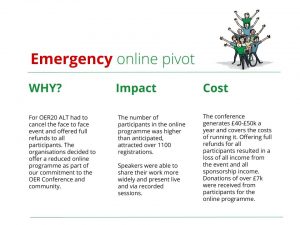
    Slide from “How ALT runs events online:
    Sharing our expertise” https://go.alt.ac.uk/EventsOnline

    But I don’t want to write about the business model, the money lost, the ‘blood, sweat and tears’ that it took to make it happen. Instead I want to share my thanks for the openness of OER20:

    Sharing open leadership in a crisis

    In the run up to the event, the global situation changed quickly. Plans made one day, were superseded by events 24 hours later. Risk assessments undertaken on Friday turned into disaster mitigation plans by Monday morning. Taking decisions in the face of uncertainty on such a scale is difficult. And being a CEO IS about taking decisions first and foremost. Colleagues from across the globe shared examples of the statements they published, actions they took, plans they made – putting our usually relatively quiet CEO networks into overdrive. I am grateful to everyone who shared their work so freely to help us help each other ‘rescue’ our events in the face of a global crisis.

    Yes, academic conferences are certainly not at the top of the list of priorities amidst a pandemic, but professional bodies like ALT serve thousands of individuals at the forefront of keeping learning, teaching and assessment going – and the exchange of information that conferences provide still plays a role in supporting the work they do even in a crisis. Also, there are hundreds of people who have invested time, money and resources into planning trips, who are, in some cases, already on route. Hundreds of individuals who deserve clarity and support from organisations like the one I run.

    Precarious circumstances become more challenging when uncertainty increases across sectors and OER20 supports the involvement from many in precarious circumstances through scholarships, bursaries, practical support and so forth. Sharing information and best practice with other organisations enabled us to find the best approach we could, supporting individuals and our community, ultimately enabling us to deliver some of the event online. The work we are doing now, sharing what we have learnt from the experience, is hopefully useful to others who are facing similar decisions in the weeks and months ahead.

    Sharing joy and tears in the open

    Many contributed much to making OER20 happen. To each of you, thank you. For me personally, there were two moments that really captured both the joy and the sadness of the times in very unique ways.

    One was a live online session led by Frances Bell celebrating the FemEdTech Quilt of Care and Social Justice. You can catch both the recording of the session and the accompanying video via the conference page. I have contributed to the quilt project both personally and professionally and yet the power of the live session really took me by surprise. I don’t think any webinar moved me to tears along with half the audience before this. It was a moment of connecting with fellow collaborators across the globe that was so special and made the distances and isolation between us, the crisis we are all weathering, palpable.

    The other session was the evening’s #OER20 #KaraOERoke Night. I don’t think I had laughed more than that in weeks. It was very special, but also fun and incredibly moving to see conference participants and their families join in with the Frozen song, reviving classics and demonstrating their singing ability with everything from Motörhead to Kate Bush. Those moments, whether online or in person, are unforgettable.

    Sharing care in openness

    Rarely has a conference theme turned out to be quite so prophetic as OER20’s The Care in Openness. Little did we know in April 2019 that pedagogies of care would take centre stage in a global pandemic by the time the conference came to be. As it turned out, care was to be central to everyone’s life in April 2020.

    We talked a lot about care at OER20, care for students, care for staff, care in institutions, care for each other, care in every aspect of life. What we demonstrated most however is that we all need more of it.

    From babies and children taking part in conference sessions, to sharing the event’s ‘official’ pyjama dress code, to dropping in and out of taking part whilst caring for family and friends, pausing to rest and sleep – everything about OER20 reminded me that things were about as far from ‘business as usual’ as conferences can get. In some ways, and for obvious reasons, it was heartbreaking and horrible, to witness how the world was changing and disrupting our community. In other ways OER20 felt hopeful and provided moments of respite, a small measure of solace. And that is most precious in times like these.

    Thank you.
    Thank you to everyone who helped make it happen.
    Thank you for creating openness in a crisis.
    Thank you for caring.

  • Leading a virtual team… from your kitchen table

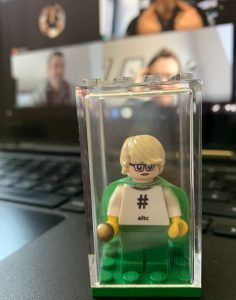
    LEGO me… my lunchtime cover 🙂

    I loved seeing tweets this week of signs and posters saying ‘daddy’s in a Skype call :)’ or ‘don’t come in – I’m in a meeting’… it gave expression to how much worlds are colliding just now. Whether you are a seasoned home worker or a newly (crisis) minted one, no one has experience of working from home during a global pandemic during lock down, without childcare and alongside every member of their household, pets included. And, with the worry of EVERYTHING THAT IS GOING ON, on their mind. ‘Business as usual’ this is not.

    I have been working on ALT’s response (if you are looking for Learning Technology support, help is at hand) and also sharing my own (team’s) expertise to help, but this post is more about my open practice as a leader.

    Openness comes under pressure when there is a crisis, but this crisis runs so deep, that much of our usual behaviours have given way to sharing our perspective, solutions and problems. Each day I get emails from fellow CEOs sharing useful information re employment or legal developments alongside personal updates. I hear from colleagues around the world who are at different stages of lock down, loss and recovery. I connect with colleagues closer to home, with suppliers and freelancers, paying bills and ensuring the essentials that keep us all going, and getting paid, are as safe as we can make them.
    But we are now a few weeks into this proper madness, exhaustion and frustration are definitely more visible than they were at the start and as I wrote in my last post, there’s a lot to contend with when you are (suddenly) leading a virtual team in this time of crisis.

    Finding balance between business as usual and no business at all

    Like everyone else I work (and live) with people on a whole spectrum of responses to the situation, from those who are coping, keen on as much normality as possible, those who focus on specific priorities, adjust to new daily routines to being completely scared, unable to function, sick and tired of it all. Leading any effort in times when tempers run hotter than usual, when communication , particularly online, can easily lead to conflict is tough! Finding balance between business as usual and no business at all is harder than you think… so I try to continue to create different spaces for different types of interaction:

    • Regular team meetings: focus largely on business as usual, with a set agenda and ideally max 1 hour long and video on for all as standard;
    • Coffee/tea get together: no business at all, just focus on social/personal conversations and checking in with each other;
    • Individual one to one: start with ‘how are you’ and establish context before then moving onto discussing work and end by setting a small number of clear and achievable priorities – ideally 30 min and always video on;
    • Group chats: establish formal/informal ones as needed but be very clear which one is essential. Give options to join in others, but prioritise one.
    • Individual chats: be available as you can be to deal with anything really urgent or personal or just to be present.

    Press pause and accept grey areas

    In the current crisis things can move quickly from one simple issue to a whole chain of unsolvable problems. When you are surrounded by so much uncertainty most people’s instinct is to lock stuff down, to create certainty, to be clear what’s right or wrong. You want to do the same of course, be clear, make the right decision, communicate effectively and so forth. But most of the time you and I are going to make it up as we go along, doing our best just as anyone else leading people and organisations through this madness, to take the best decision we can in completely unprecedented circumstances. From policy officials to shop keepers everyone is making it up, trying their best – and constantly re-assessing. Sometimes virtual teams can move at too fast a pace, things get frantic and it’s good to remember that you can press pause, take a breath and consider things. You won’t always get it right (I know I don’t) but you can take time to think it through and accept freu areas. Acknowledge those explicitly. Make it clear if you are compromising. Articulate, to your colleagues, why you are taking a decision or why you are waiting/reflecting. I am often in online meetings and a decision is required and I don’t know the answer. In that case I say it don’t know, I will need to think about it, I’ll get back to you by (whenever the decision is required). Being a leader in uncertain times requires us to get comfortable with uncertainty.

    Asking for help and setting an example

    In times of crisis a show of strength and certainty often goes a long way. But months of complete mayhem?! You are going to need to ask for help more and more often. You are going to need to model that and no one will see those urgent calls at the kitchen table, those pacing walks on the balcony, those late night glasses of wine over spreadsheets. Communicating how you seek help and why is just as important as solving problems, maybe more so. It helps normalise and make visible a process that is much harder to translate into virtual teams, where office doors that are open or casual conversations in the corridor are harder to come by. It’s much harder to admit what you don’t know or find the right moment to ask a question when you are (newly) working from home and your dog, spouse or whole team is listening in. I had a meeting (an important one as they all are these days), this week which I brought to a conclusion saying I had to rush off. Someone asked where to and I replied to have my lunch, to eat a sandwich. Everyone laughed and suddenly started to bring their own lunch into camera view. We said bye to hurry to have a break. It’s not unprofessional to be a human being, hungry and in need of a break. It’s not unprofessional to need help. When you are in a crisis situation that is going to last weeks or months, there is no way you can keep going without adjusting, giving yourself and others time to recover, collect your energy, get some headspace. It feels good to be busy and productive, but setting an example of being like that all the time isn’t helpful for leading people or organisations. It creates an unrealistic expectation for everyone.

  • How to lead a virtual team… tips & tricks

    For the past two years I’ve been blogging about our approach to leading a virtual, fully distributed team for ALT, the Association for Learning Technology. Together with my colleague Martin Hawksey I have charted our journey in podcasts and blog posts.

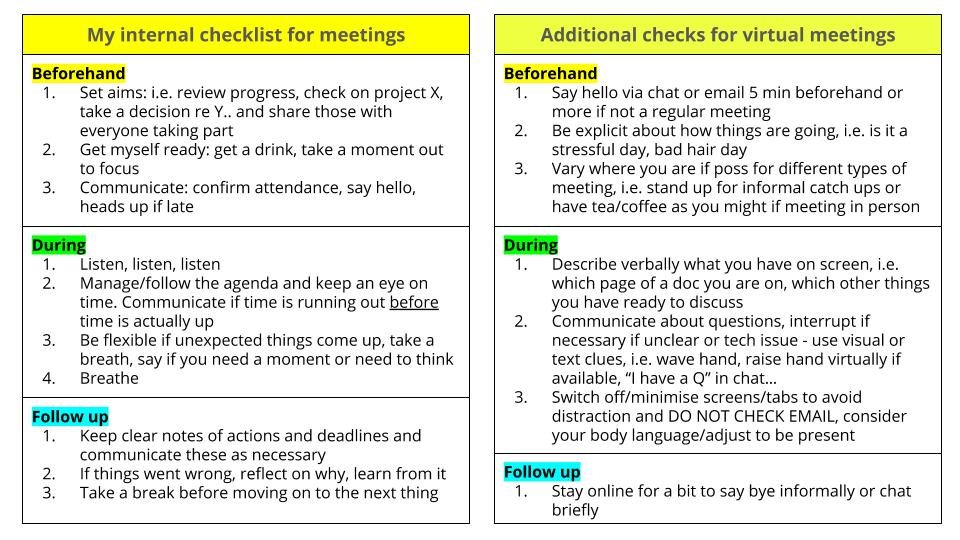
    Your own ‘journey’ may be only a few hours, a day or a week, probably not by choice and at a time of global emergency. So here are the tips & tricks I wish I had been given BEFORE I became the Chief Executive of a virtual organisation:

    Basics for you

    Putting together work spaces at home in a hurry is always going to be a compromise, but checking on some basic things like the height of the chair, angle of your arms when typing, glare on the screen(s) etc is important. You will feel it after hours and days of sitting at your new station and being uncomfortable or in pain will become an issue. Try to find a compromise that works or at least be aware of potential issues and get up frequently to help your body adjust. Everything going online doesn’t mean your physical self doesn’t have needs and it makes a big difference to you if you can feel settled at your new ‘desk’ to some degree at least. Consider small tokens of familiarity, pictures, or even post it notes to help you ‘move in’.

    Share tips or niggles with your team and ask colleagues to do the same. It is really helpful to acknowledge that you, too, find it surprisingly uncomfortable to work on the sofa, that kids dropping in unannounced drives you mad and that you had NO IDEA that the dog would only accept sitting on your lap all day. Team building starts with sharing the reality of the transition as a person, not just a job role.

    Routine is your friend

    Working virtually is easiest when you have a routine. At this point, that may not be entirely possible, but you might be able to do something like: set up a daily 30 min check in for groups or everyone; set up a schedule of regular one to ones (for example on a specific day each week), set regular team meetings; or designate a time slot as your “office hours”.

    Routine, and establishing a new rhythm is key to leading a virtual team. It provides a structure around which a team can function and sets deadlines for individuals who may be feeling bereft of their usual routines. Not everyone can easily hold it together when in addition to a crisis they are suddenly working from home, at an uncomfortable kitchen table, surrounded by laundry and dishes and 101 other things that demand their attention.

    Replicating structure for both focused work meetings and tea and coffee breaks/water cooler moments is going to help everyone. Start the week with half an hour of team chat about the weekend, or end the week with a wind down catch up. Create space for being social as well as productive.

    LISTEN (and then listen again)

    Working virtually is going to rob you of many ways in which you would normally manage people. Body language, tone of voice, observing how people interact or sit at their desk… you are going to get A LOT less information about the people you lead. So when you do meet, close windows and browsers, sit back, make eye contact and listen (and then listen again). Don’t let yourself be distracted by other things, or even how someone might react because they are self conscious on video or a voice call.

    You can get a lot from virtual interaction if you focus and are prepared to deal with what’s coming your way, which is likely to be not all good! It can make you feel helpless when someone is in tears on video chat. It can be really tough to have a disagreement over the phone, particularly when you are used to dealing with situations like that face to face. But with months of uncertainty ahead, you won’t be able to park a problem and then solve it when you are back in the office. So encourage your staff to talk to you and tell them that they have your undivided attention. That’s the magic sauce.

    Keyboard shortcuts are a killer

    There will be many moments when you are working together with someone, and there is miscommunication. You are on one page, they are on another. For you it’s working, for them it isn’t. Even if you all have a similar level of digital competency, you are likely to use different methods to achieve the same aim, and things like innocent little keyboard shortcuts can be a killer.

    Because YOU CAN’T SEE what someone else is doing on their keyboard, even when you share screens, you will likely miss a lot of stuff. It’s surprising how much. So try to get used to describing what you do as you are doing it (literally say… I am clicking on this..) and document as much as you can, ideally together.

    Sometimes you just need to take a deep breath and start again.

    The darkest day: and how to get up again tomorrow

    Leading a virtual team is just as hard and tiring and trying, just as fun and enjoyable as leading people in person – so at times like this it’s a complete nightmare. You have to have all the answers, but it’s a lot harder to project confidence when WIFI is down and you are sitting at a make shift desk trying desperately to complete a risk register. At that point, someone has a personal crisis, stops communicating and because you are all at home you have no idea what is happening. Are they OK? Will they come back to work? What should you tell everyone who is waiting? What’s happening to the person who has been silent all day? Why did you not get the report you were waiting for? And why, why, are there already 200 new emails.

    You are facing impossible odds, and leading a team is always more work when there is a crisis, and in particular when there is a prolonged period of uncertainty. You will have dark days and people rely on you to get up and do it all again the next morning. Here is what I do to help with that:

    • keep to work hours wherever possible and protect non-work time
    • sit for a while at the end of the day to ‘commute’ and reflect on my day
    • draw a circle and divide it up into a pie chat of everything you are worried about
    • label each worry
    • give yourself a break
    • leave your laptop shut for the rest of the night and wherever possible don’t put work emails on your phone

    Good luck. You can do this.

  • Virtual Teams: moving parts

    Welcome to this month’s post (cross-posted here) in which we, that is Martin Hawksey (@mhawksey) and Maren Deepwell (@marendeepwell), openly share our approach to leading a virtual team. If this is your first time visiting this post series or you’d like to review previous posts go to our Virtual Teams summary page.

    This month we start our third year as a virtual team and we talk about the ups and downs of moving house as home workers, how to give yourself a break during times of upheaval and supporting each other.

    February

    Maren: I have been looking back at the first post in our series. Although it’s two years ago, that moment of closing our physical office door for the last time and starting the next morning as a virtual team is still palpable. At the time, creating stability, a sense of security and permanence seemed like a formidable challenge. Every aspect of our operation was in flux, new systems everywhere we looked. Tasks like receiving post or signing an invoice became things that required an extraordinary amount of time and thought. Two years on and nearly half of our staff team are planning to move house over the next year. Instead of work being in flux and ever changing, the ability to take our work with us, to remain part of a virtual team regardless of location, provides security. It’s interesting to reflect on how things have changed. We have supported quite a few colleagues through home working house moves and this year it’s our turn. What are your thoughts? 

    Martin: When I started working for ALT over 6 years ago the ability to work from home was an essential requirement as relocating to our then base of operations in Oxford was simply not an option. Six years on the ability to relocate without having to give up my job is another big win, although admittedly our move this time is just 10 minutes away. When looking for a new home accommodating my workspace was one of the criteria, but another was what sort of internet connectivity was available. I’m actually looking forward to setting up a new office, a chance to design my new space. Transition is also a consideration. Unfortunately we aren’t able to move straight into our new home so I’ve got a period without my own space. This is going to be a bit of a journey into the unknown, particularly in terms of connectivity. We’ll be staying in Airbnb’s so hopefully hosts have made sure they’ve got good wifi to keep guests happy and I’ve got a VPN for a secure connection. Should connectivity still be an issue I’ve got access to three different PAYG mobile networks. Over the years I’ve also accumulated a couple of portable external displays so I’m not anticipating issues, but these things can sometimes be hard to predict just as it was two years ago when we changed operations. What are your thoughts on moving?

    Maren: Moving house is not something I read about in charity management handbooks! Like so many other aspects of leading people it wasn’t discussed much or at all. When you don’t have the option of working from different locations a house move often means finding a new job as well. So it’s a huge plus to be able to keep the job when you have to relocate. Since we became a virtual team more than half of us have moved and the disruption has ranged from serious and prolonged to very minimal. Moving is a big, stressful life event and has a long tail of practical consequences. Like moving offices or rather moving out of an office it takes a lot of planning and doing and that takes headspace and time. All of which causes a certain amount of distraction from work. For some work acts as a welcome break from the stress of moving as it presents more predictable problems to solve. For others productivity slows when they lose their habitual set up and environment. Although we live in a culture where working from home is becoming more normal, most parts of life aren’t really set up for it. ‘People’ just assume you ‘go to work’ and moving processes are not designed to prioritise continuity for home workers. We have taken steps to support staff during periods of transition such as providing a mobile WiFi hub (which is passed to whoever needs it), putting our flexible work policy to good use to accommodate moving dates etc and so forth. In terms of work I think house moves function in a similar way to holidays. It’s a deadline that can focus the mind and it forces you to take a step back from your usual perspective. It’s also incredibly stressful, uncomfortable and discombobulating and the only way I can deal with it is just to sit with those feelings and accept that ‘chaos’ is upon me. It reminds me, very forcefully, that every professional, no matter how successful, is a human being first and foremost. We all deserve some kindness and compassion from our colleagues and ourselves, we deserve to give ourselves a break. 

    Martin: I don’t know if it was prompted but it feels like the ALT team are giving me some extra care and consideration, which is quite remarkable given how caring they are already. It’s small things like pre-empting questions with “I know you are busy but could you help me with…”. In terms of disruption we now have a possible entry date for our next property which isn’t until the end of May. Whilst this length of time isn’t ideal it’s nice to have a date and it doesn’t feel like forever. In terms of planning and trying to prevent disruption a particular problem, perhaps unique to virtual teams, is the extra preparation for the equipment I store for ALT used at our face-to-face events. As I manage the livestreaming this includes AV equipment, lots of cables and magic boxes, as well as various other bits and pieces we use as part of our events. The removers we’ve employed are very nice but I don’t think I’ll be thanked if I have to ask for something accidentally put into storage. Another potential disruption looming at the time of writing is Coronavirus (COVID-19). As a distributed team we benefit from not having to send employees home should someone contract COVID-19, or spend time disinfecting workspaces. This is not to say we can ignore the risks associated with the wider impact that could happen such as the UK Government imposing travel restrictions, or members of our team becoming unwell … all part of being human. For me it’s a reminder of the benefits of small things like our Monday morning watercooler chat. As we aren’t co-located I find this is the perfect chance to see how someone is feeling.

    Maren: yes, at a time when we do a risk assessment a day those touch points to check how everyone is are key. Processes and procedures are always important when an unexpected crisis hits and I suppose we have had ample opportunities to stress test ours. Virtual working makes it even more crucial to communicate regularly and effectively and it’s actually helpful, I find, not to be able to rely on being co-located but to be forced to communicate expressly. It’s an example of how working remotely promotes better practice by default. The year ahead looks like it may prompt more organisations to adopt flexible working practices and in many ways using technology to manage a crisis really worries me. Our blog series highlights so many aspects in which you need time and resources to support a transition like this effectively no matter how good the technology is: it’s never going to be seamless. I feel there is a real danger to erode support structures, labour rights and established norms that should not be disrupted. So I am glad that our way of working as a distributes team was not formed at a time of crisis, but a planned transition in which employees were consulted and supported. We chose this path. I hope what we learnt so far continues to be useful to others who are now rushing to find solutions. We certainly work in interesting times just now!

  • From suggestion box to strategy… please read on!

    Be warned. This is a blog post about strategy… which is not the most exciting of topics (usually). I was trying to find a good title for this post and all the ideas I had sounded awful:

    • What a difference good governance makes…
    • The privilege of being a CEO
    • The power of really listening
    • Making stuff happen…

    Anyway. If you are still reading this then I am grateful as I really want to share some work I have been involved in over the past 9 months that has inspired me and reminded me that when you put your mind to it, you can really make a lot happen.

    I am writing this during a week when much is already going on in the world, in the UK, in education and in Learning Technology. Come Thursday, when ALT launches its new strategy to its membership, there will be something else to add to the list. And this one matters much to me, and to the Members we work for and represent, as it will set the direction for the next five years.

    There are a few things that I used to be doubtful about when it came to strategies such as: does anyone ever read them?! Does anyone, including staff or Trustees, know what they say?? Does anyone care? How does a suggestion made actually shape the things that appear in the final, committee approved version? Most of the time, the answers to these questions are not encouraging. But I am not feeling cynical today and I want to share some of the things that I feel set ALT’s next strategy apart from many I have come across previously and also what makes the process of arriving at the strategy so valuable and effective.

    Strategic Conversation captured by Bryan Mathers

    What’s involved in making our strategy? 9 months of listening.

    Phase 1:  initial internal planning (June – July) This phase included:

    • Project plan
    • Initial visual thinkery conversation
    • Consultation timeline
    • Operational review & planning
    • Financial review & planning
    • Review progress of current strategy

    Phase 2: external consultation (July – January) This phase included: 

    • Strategy suggestion box
    • Quarterly updates to Members
    • Assembly meetings every month
    • Online Winter Conference with dedicated strategy sessions
    • Annual Survey – data from which is published openly each year

    Phase 3: Board of Trustees strategy work (July – January) This phase included: 

    • Fortnightly progress updates
    • Board of Trustees meetings
    • Visual Thinkery sessions
    • Strategy progress and impact report
    • Consultation plan & outline
    • Draft strategy & planning

    Phase 4: Staff Team strategy work (July – February) This phase included: 

    • Staff Team meetings every month
    • Individual input from each member of the team
    • Strategy thinking session for senior staff
    • Review Priorities year 1-5 based in input from Members

    What shapes our strategic priorities? Members having their say!

    One of the things we look at in the final phase of writing the strategy is where input for specific aims has come from, which this year includes: several suggestions received throughout a 6 month period through an online suggestion box, which are directly included in this year’s strategic priorities. Also, we get feedback through events, which included a strategy session at the Annual Conference in September and the Online Winter Conference in December as well as monthly meetings of the Members Assembly. In addition, some of the priorities we identified during strategy days, the formal consultation and the Annual Survey as well as a specific consultation around ALT’s CMALT framework.

    Whilst most of the input comes from Members already involved in ALT, much of the consultation process is open to everyone with an interest in Learning Technology and it’s been really valuable for me personally to think along with people who don’t know much about ALT, who don’t know what we have already done, where we have come from since 1993. Having worked for the same organisation for over 10 years, it’s useful to have the opportunity to look at what we do, how we talk about it and what we could do better through fresh eyes. One of the ways in which we do that is through Visual Thinkery.

    Strategy… by Bryan Mathers

    Conversational leadership: one way of reminding myself of what I don’t know…

    Creating this strategy is a collaborative process and many people have input, many voices shape the thinking that goes into it. Yet in my position as CEO there is a certain amount of leadership that I need to bring to the process for everyone involved from Trustees to Members to staff, a kind of overall vision that frames the work that is going on. I used to be more rigid in my approach to providing that kind of leadership, but over the years I have come to find that it results in a poorer output, a less ambitious, less relevant strategy. So how do you lead a conversation without knowing what you don’t know? I found working with Bryan Mathers one way of achieving that, my favourite way to having a genuine conversation, an authentic consultation that gives everyone, myself included, permission to really think.

    And the result?! Well, you will have to keep your eyes peeled at the end of this week to find out what the future holds in store #altc (and it may NOT all be green).

    I, for one, am deeply grateful that nine months of work, that so many have contributed their time, energy and effort to, have resulted in a shared vision and shared values that I believe in, that inspire me and that will make a positive difference to Learning Technology professionals in the UK and further afield. Thank you for making this the best strategy I have been part of (yet).