Category: CPD

  • My personal vault. Or what I learnt from a decade of progress tracking

    My personal vault. Or what I learnt from a decade of progress tracking

    I made a fun discovery today: It’s now been over ten years since I started this list of things I have done. Wow! I had no idea it had been that long, and seeing those entries from 2013 made me pause and reflect on the habit of keeping the list, a decade in the making.

    Why did I start tracking progress in this way?

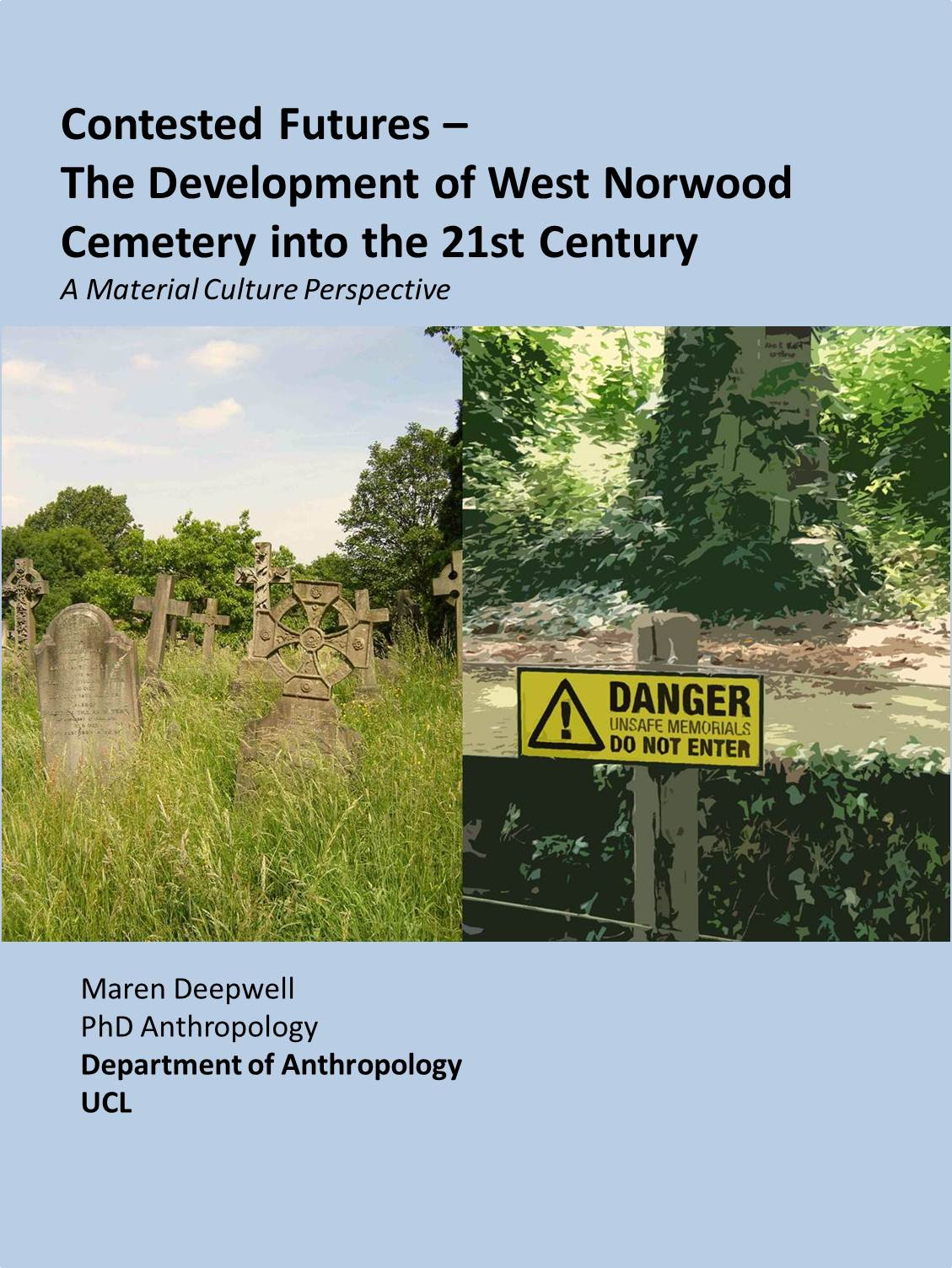
    My archive page is a lot like a personal vault. If you scroll all the way to the bottom of the page you’ll see that at the start I added some entries a bit like you would on a CV. I added dates of degrees I completed and images of things like my doctoral thesis from 2008:

    Initially, I added these things as I was moving blogs, and I didn’t want to loose track of what I was up to. I was just in the finishing years of my graduate studies, and started working full-time and I had no real idea of what was going to happen next.

    For a while, in the first few years of working at ALT, I didn’t really keep a record of anything until I started blogging publicly again in 2010 on WordPress, rather than my old Google Blogger sites. But then from 2013 onwards I started keeping a running list of projects I completed, conference papers, media stuff and so on.

    Looking back to 2013, this entry makes me smile: June: Radio 4, Today Programme . Not particularly helpful for anyone other than myself, but it does bring back the morning I spent nervously sitting next to a very intimidating John Humphreys in the BBC radio studios in London. Similarly, in 2014 I went to the European Parliament in Brussels… noted in a similarly cryptic entry, but equally memorable for me. And although the 2015 link to an appearance on Parliament TV still works, many of the older links have rotted.

    As we progress through the years the list of things I recorded each year becomes both longer and more comprehensive, particularly as I started to add links to blog posts on my own domain that contain a lot more information about a specific event or project. 2020’s entry is a bit shorter, but it looks remarkably ‘normal’ given everything that happened that year.

    What do I use it for?

    So, how is this useful?

    Well, the practice of making the list and adding new entries to it is useful to me in itself. I could probably use a tool to compile this kind of information for me, but there’s great value for me in the act of processing what I have done and reflecting on it as I make the list.

    For example, adding new items to the 2024 section of the list earlier today made me realise just how busy a year I have had so far, and we are only three weeks into it:

    So on a regular basis, as I publish something or a new project gets scheduled or completed, I will update the list, add links and date each entry. Wherever possible I try to capture what I am doing in a blog post as I add it to the list, so that I don’t have to rely on external websites to retain the information.

    Then, on a monthly basis as I compile my newsletter, I refer back to the list, and cross-check what else I may want to mention. This is super helpful for me and makes compiling the newsletter pretty easy.

    I also use the list as an archive in case someone asks me what talks I have recently given or what papers I have published on a particular topic and I make use of it for reviewing my progress or performance.

    It’s a kind of super power when it comes to things like annual appraisals or planning career development. It doesn’t take me long to answer the questions like ‘What have you done in the past year ?’ or make a list of articles I have published. That is magnified if I want to write end of year reviews or reflections.

    It’s important to me to keep learning and developing and over the years keeping this archive up to date has become a natural process of my workflow, just as blogging or journalling have become part of my practice.

    Tips for starting your own archive

    If you are keen to start your own list, get started with literally anything. You could add a workshop you have run or an event you attended, or even books you’ve read. You could add projects you have been involved with or led, or papers you have published.

    The key is not to worry whether something is worthy of being included, and to simply include everything. I find once you start making a list of everything, things quickly amount to more than expected.

    Over time, as you practice keeping the list, the satisfaction of adding to it will become a good motivator for keeping going but initially it can be difficult to find the courage to get started.

    You might prefer to keep your list private, which is completely fine. The reason I have mine on my blog is that I am comfortable working here and I use my blog every few days. It’s a convenient place for me to refer back to or to send people to, but I don’t think the page that shows my archive gets a lot of visitors.

    For me however it is priceless, and it reminds me when I have low days how much I have achieved over the years. Maybe your list will do the same for you.

    One consideration for me is that I want to do what I can to keep the data safe. That is why I don’t rely on a platform like LinkedIn to keep this information. In an ideal world I might update the information somewhere like that, a network where folk who consider working with me might more easily get an idea of what I have accomplished. However, although that would be useful, I don’t trust that the information will still be there in 10 years or that it won’t suddenly get reformatted or repurposed as platforms change. Thus, I keep it here on my own domain first and foremost, and I update everywhere else when I feel it’s necessary.

    So, good luck if you are just getting started and kudos to you if you are already on your way to keeping that precious list of everything you’ve done.

    Subscribe to my free monthly newsletter!

    [newsletter_form type=”minimal”]

    Cover image credit: Photo by C M on Unsplash

  • The story behind… Hybrid Working Habits

    The story behind… Hybrid Working Habits

    In this week’s podcast I share some of my personal history and how I came to be so interested in all things hybrid and virtual working. From Germany to London in my art school years, and from Athens to Oxford as my work moved from Art to Anthropology and then Education, this episode sets out what I think is interesting about hybrid and virtual working, why it’s important and why now is the time to really find ways of working that work for you.

    Listen to the episode:

    What are your hybrid working conundrums? Leave a comment or email me with you questions and problems when it comes to hybrid working, and I’ll pick these up in the upcoming episodes.

    Learn more about the course

    Change your Hybrid Working Habits, my new 4 week course, starts 20th October 2023.

    One of the consequences of the global pandemic in the workplace is an increased demand for flexible and hybrid working. In response, employers are offering staff to work from home more regularly, and come into the office or on campus for less time each week. Flexible working is intended to increase staff satisfaction, productivity, and retention at a time when we have moved from the great resignation of 2021 to an endemic of ‘quiet quitting’. At the same time, effectively working from home has become a sought after skill in the workplace, particularly as some of the negative impacts of long term home working on (mental) health, equality, diversity and inclusion and staff engagement have started to emerge. 

    Bridging the gap between the growing hybrid workforce of knowledge workers and the (lack) of organisational vision for the post-pandemic workplace, are the managers and leaders leading increasingly virtual teams. It is their job to translate the newfound flexibility into effective collaboration between colleagues. It is their challenge to establish communication channels that engage a hybrid workforce with diverse needs, balancing work with other commitments. A workforce for whom coming to the office or on campus may be a hated necessity or indeed a much sought after opportunity. Not everyone loves working from home, sharing a desk or meeting in a coffee shop. 

    If you are looking to move from overwhelm and burnout to finding balance, then this course is for you. 

    Develop the skills you need

    This course is designed to help develop skills to:

    • Audit your hybrid working habits to find out how your current habits are impacting on you and what to change;
    • Set boundaries for a better life/work balance and stick to them even when things are busy;
    • Increase productivity away from the screen by using strategies for communicating and collaborating outside of meetings;
    • Communicate more effectively in the hybrid workplace in a way that works for you and reduces digital overwhelm.

    Course activities

    Listen to the podcast

    The course has four parts and each part is introduced by a podcast episode that sets out the key ideas for the topic. I have chosen the podcast format to enable you to follow the course at your own pace, listening when it suits you and also to minimise screen time needed to take part in the course. Whether you listen to the course as you walk the dog, cook or sit in a comfy chair, this course is designed to take you away from your screen and constant stream of notifications. You just have to listen.

    Reflect on your practice in weekly hangouts

    Each topic is accompanied by prompts and questions to help you reflect on your professional practice. We will use these prompts in weekly course sessions to take a deeper dive into ways of working in the hybrid workplace and reflect on how your habits aligns with your goals and values. You can choose whether you write your reflections down, share them with others in the course or keep them private for yourself.

    Explore new ways of working

    Each topic comes resources and tools to explore. You can try out new idea for yourself or join one of the weekly drop-in sessions for personalised support.

    Who is the course for?

    This course is designed for emerging and established leaders and managers working in a hybrid or fully virtual setting in education and the not-for-profit sector. We will focus on how to develop effective home/hybrid working strategies. Whether you are collaborating online on a project, organising distributed volunteers or managing a whole hybrid working department, this course will support you to move from overwhelm and burnout to finding balance.

    Register today

    4 Week Course Listener – free

    • Listen via your favourite podcast app
    • Follow at your own pace
    • Explore resources via the show notes
    • Upgrade anytime!

    4 Week Course Explorer – £29

    • Course content straight to your inbox
    • Weekly course hangout & drop-in support
    • End of course summary with resource pack
    • Certificate & badge upon completion

    4 Week Course Explorer + Personal Coaching – £229
    Course Explorer package PLUS:

    • 4 x 1-to-1 coaching sessions tailored to you
    • resources and tools
    • personal plan and accountability check-ins

    Register now

    Enjoyed this post? Get my free monthly newsletter directly to your inbox.

  • Tranquillity by Tuesday

    I’ve really enjoyed reading Laura Vanderkam’s Tranquillity by Tuesday: 9 Ways to Calm the Chaos and Make Time for What Matters. From an anthropological perspective, it’s interesting to read a book rooted in the experiences of a group of people putting the productivity and time management ideas into practice and I especially enjoyed reading why things did and didn’t work for particular individuals. I found it helpful to read about their experiences alongside the expert guidance provided, as it helped me think through how and why certain things might work for me or my coaching clients.

    Being on a journey of trying to work less hard and find more balance made this book appeal to me more with a central focus on calm and wellbeing alongside more traditional productivity techniques. The first ‘rule’ that I put to the test for me is Rule Two: Plan on Fridays.

    The basic idea is to plan for the week ahead on a Friday afternoon and the chapter goes into explaining why this is a helpful practice and how to do it. I already plan on a weekly basis, but it was still interesting to read more about why this is effective. Two things jumped out at me:

    Plan across three key categories: career (which I took to be short-hand for all types of work, paid and unpaid), relationships (which encompasses partners, family, friends, any we care for and spend time with, including pets) and self (this is the category that is easy to overlook).

    Plan on Fridays: there is a good section on why Friday afternoon is a good time to plan (provided you follow a Monday – Friday work or school schedule):

    1. there is little opportunity cost: for many of us, Friday afternoon is close to the weekend, it’s not a good time to start something new and this less busy time can be extra productive if used for planning;
    2. You can make Monday productive: start the week knowing what your day is going to bring and focusing on it;
    3. Upgrade your weekends: making more time to make plans for leisure or family time or self care rather than using the weekend for planning;
    4. Calm the ‘Sunday scaries’: meaning that going into the weekend with a clear plan for the following week helps you switch off and stop worrying about or planning for what’s ahead.

    This last reason resonates with me in particular, as I usually do planning on Sunday evenings and I have definitely found that to have downsides.

    So, that’s the strategy I am planning to adopt from Tranquillity by Tuesday, and if you are interested in exploring more, I’d definitely recommend this as a very well written, interesting read which comes with a lot of resources which are free to download on the book’s website 🙂

  • Wakelet from #LTHEchat 254: Hybrid working: new frontiers in professional practice

    It was a great pleasure to return as a guest to the wonderful #LTHEchat for a conversation all about hybrid working.

    For #LTHEChat 254 we shifted our focus from learning to work. We discussed ways in which learning and teaching practices can inspire a more sustainable and equitable hybrid workplace. If you haven’t yet seen it, read the original post on the #LTHEchat site.

    I was very curious to hear different perspectives and see where this conversation would leads us, and it was a very fast paced, lively discussion on the evening. I found it hard to do more than read, and like or retweet during the live conversation, and I also wanted to give as much room as possible for everyone to express their views and share their experiences, instead of dominating the conversation.

    It’s been such a pleasure to work together with the amazing people who organise and support this important community activity, and I am so grateful for their support and guidance before, during and after the chat.

    The chat in action

    Here are the questions we explored:

    Q1: What is your experience of hybrid working? #LTHEchat
    Q2: How has hybrid working made a positive impact in your institution? #LTHEchat
    Q3: What can we learn from hybrid learning to develop effective hybrid working? #LTHEchat
    Q4: What role should staff play in the hybrid learning/working skills development of students?   #LTHEchat
    Q5: What do you see as the biggest challenge for the future of hybrid working #LTHEchat
    Q6: Share one hybrid working tip that you would recommend to others (and why). #LTHEchat

    LTHEchat 254

    There was a lot of rich conversation and I am still reflecting and delving back into various exchanges, which I hope to write about more in due course. For now, here are a few moments that jumped out at me on the day:

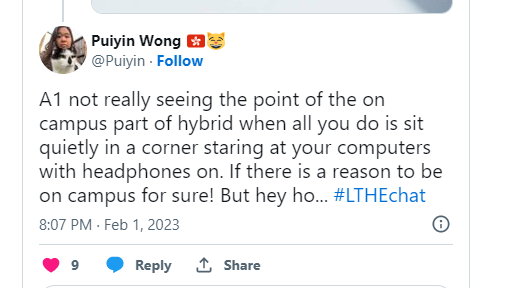
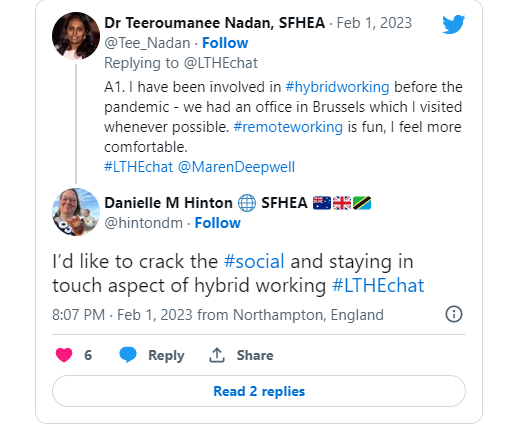
    Screenshot of a tweet from the chat

    It was inspiring to see how many different answers everyone had in response to “What is your experience of hybrid working”. It’s easy to loose sense of how different contexts impact on our ways of working, both personal and institutional, and this opener to the chat provided a vivid reminder of the broad range of hybrid working models that are happening across this community.

    Screenshot of tweet

    Another aspect of hybrid working that came across strongly was the enduring importance of social connection. This is something many contributors mentioned in a number of ways, regardless of whether they had long term experience of working in remote and distributed team or whether they were relatively new to it.

    The LTHE chat to me always feels like a valuable opportunity to connect with folk in and of itself, but this topic brought this to the forefront of my mind more than usual. It was amazing to glimpse a little of what folk feel is the reality of their home office life, office days and travel.

    Screenshot of tweet

    A lot of posts sounded very positive about hybrid work, with many contributors feeling more productive and seeing many upsides to the increased flexibility. But we also spoke about a lot of challenges: from equipment and connectivity to the lack of leadership, appropriate policies and lack of trust.

    There is so much more to dive into.. have a look at the chat for yourself.

    Explore the Wakelet

    You can now explore the whole conversation on the Wakelet: https://wakelet.com/wake/hx_8tyRERoRoSUhq-AFyj

  • #LTHEchat 254: Hybrid working: new frontiers in professional practice. Led by @MarenDeepwell

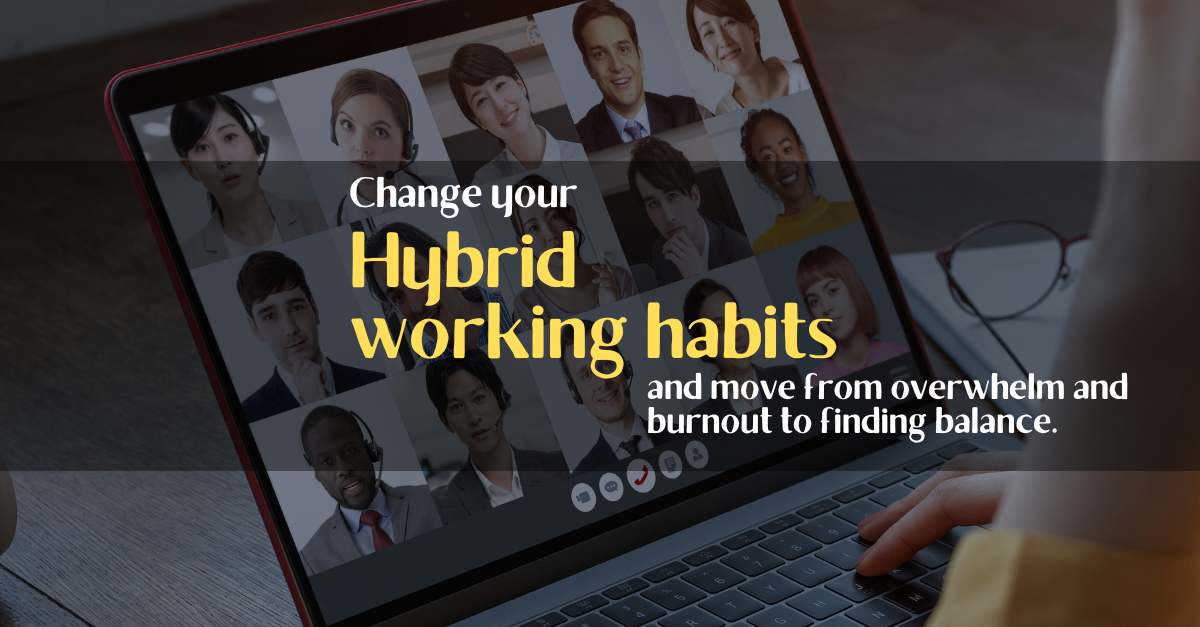
    Image of a team leader doing a team review with his team virtually.

    Image of a team leader doing a team review with his team virtually. (Source: iStock)

    I am really looking forward to returning as a guest to the wonderful #LTHEchat for a conversation all about hybrid working. I’m curious to hear different perspectives and see where this conversation leads us. Below is a re-post of the original post on the #LTHEchat site:

    For #LTHEChat 254 we are going to shift our focus from learning to work. We will explore ways in which learning and teaching practices can inspire a more sustainable and equitable hybrid workplace.

    Digital technologies enable remote and hybrid working in new and more connected ways, but it is by no means a new practice. Many industries have depended on home working over the centuries. In the UK we are at the beginning of a new era of widespread homeworking, prompting urgent questions about the rights of hybrid workers, working conditions, and how new working practices may increase inequality. Some workers may now have more flexibility working from home, but the pressures of competing demands such as caring for children or other family members whilst earning an income remain constant. Other issues such as the increasing digital surveillance of employees and privacy concerns around hybrid working practices further highlight the need for a careful and considered approach to setting out policies for the future of working remotely.  

    One indicator of the changes in how we work is new laws and policies that seek to formally express how the relationship between employers and their digitally connected and increasingly distributed workforce is changing.  For example, in the UK we have not yet seen an introduction of a code that would give employees a legal right to disconnect, whilst other countries, including France (2016), Italy (2017), Spain (2018), and Portugal (2021) have introduced such policies over the past five years and others including Ireland are working towards doing so. 

    We invite you to share your experiences of hybrid working and critically reflect on some of the downsides alongside the positives. What do we gain when we move beyond simply translating office-based practices and envisage a truly hybrid way of working? How can we help create welcoming and warm hybrid places to work that help sustain well-being and work/life balance? How can we empower ourselves and others in making hybrid working an equitable and engaging reality that benefits the organisation and the individual alike? 

    We are at a watershed moment for remote working in the sense that we have an opportunity to set out a vision for what is ahead that is informed by lessons from the past, as well as, the shift in perspective that the pandemic has brought about. 

    In 2017, I set out to find creative and fun ways to work and build meaningful relationships in the virtual workplace. The resulting Open Access book, Leading Virtual Teams, brings together case studies and practical advice to build on. This LTHEchat #254 offers an opportunity for a conversation about current practices and how things are changing. 

    Join us to share your own inspiration, questions, and prompts for reflection. From recruitment and induction to establishing effective and sustainable ways of working in the hybrid workplace we will explore the highs and lows of what it means to work in hybrid organisations in the long term. 

  • Virtual Team Adventures in Asana

    Our team is currently moving to Asana. “Asana is a web and mobile “work management” platform designed to help teams organize, track, and manage their work.”

    This is a big moment, as we have tried and not adopted various other similar tools including Basecamp, Trello, Google Tasks and Project Management tools within Google Workspace.

    However, things are finally moving into place, and with a couple of colleagues alreday familiar with and/or inspired by the platform, we are embarking on the long road to embedding new ways of working in our virtual team.

    To say that I’m excited is an understatement. (and a big thank you to Lauren Hanks for extra inspiration).

    Training

    One of the joys of adopting a new tool for me is the training. I love the process of learning about a new platform from the ground up, and there is plenty of support available in the form of online documentation, courses and online sessions.

    I found the online training really helpful, and also completed the self-paced courses. It’s good to get the basics right and I want to get a good feel for what everyone in the team is learning.

    Topics like:

    • Create Projects and Tasks
    • Keep work on track with clear Due Dates, Assignees, and Custom Fields
    • How to manage your own to-dos with My Tasks
    • How to effectively manage communication with teammates with Comments, Notifications, and Inbox

    can open up great opportunities for discussing how we collaborate and work on projects as a team.

    Re-imagining my to do lists

    I recently blogged about winding down work for 2022 and part of the post was reflecting on and revisiting and pruning my to do lists.

    Enter Asana.

    I really found it helpful to have to revisit not only what’s on my to do lists but also how they are organised and what I keep where.

    As part of my coaching with clients I often work through different models of prioritising work but I haven’t reviewed this for myself recently, so this is definitely going to be a priority as part of my transition.

    I am considering some new lists, dedicated for things I want to do less of or stop all together as well as lists of things I want to do or need to track.

    … getting everyone on board

    Time to learn and embed a new platform like this is always a challenge. No matter what tool you use, it will take longer to transfer workflows and processes than just doing the established/familiar thing.

    Also, it takes time for everyone to get a feel for why we are using this tool, why we are making this change, instead of continuing to use the established ways of working.

    In our team we are not finding that too difficult at the moment, primarily because we are all agreed that things have to enable us to have a better overview of what we are all doing and where progress is being made.

    It’s also a bonus that Asana offers lots of different ways for individuals to manage/view their own tasks in whatever way they prefer. That is popular with everyone.

    Next steps

    As well as my own to do lists and general projects, we are going to be moving 1-to-1 meetings into the new platform from January, which will support our use of Asana regularly. We are also moving our overall business plan, which is due to be updated in February, and again, supports regular use.