Tag: CPD

  • Reflecting on different modes of working

    As part of my work on the Leading Virtual Teams book, I have been careful to define what is meant by terms describing different ways of working. It’s taken me a while to bring the various terms together, and to reflect on their meaning not just now, but also before the advent of digital technologies and more widely available, reliable, high speed internet connections.

    In my childhood days for example, selling Tupperware from your garage was a popular way for women to work from home alongside bringing up children, for example, and that didn’t involve Zoom calls or being online at all.

    Similarly, there are many industries in which distributed working (i.e. across a number of different geographical locations) or working remotely (away from a central location such as a campus or corporate HQ) has been commonplace well before we had the capacity to take much of our “office” with us in the form of a laptop or even mobile device.
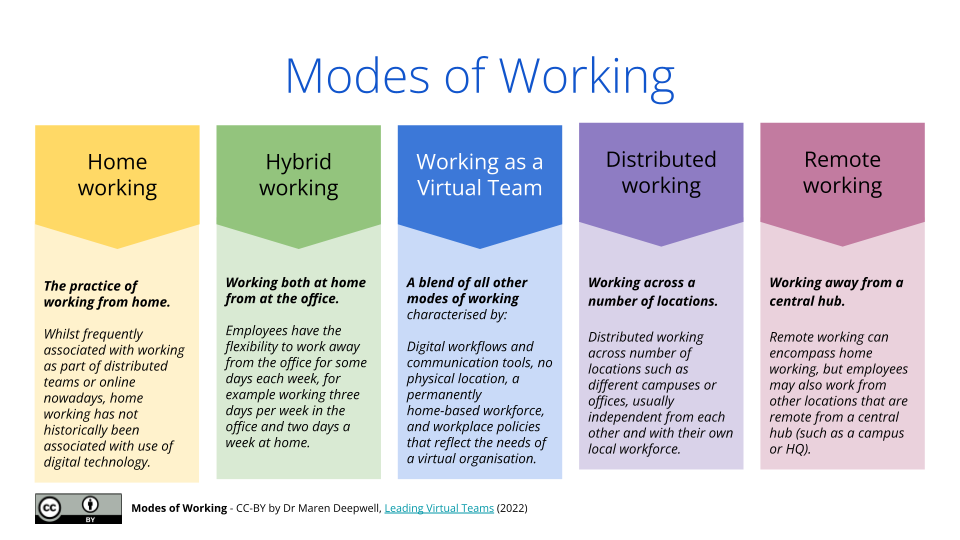
    Graphic showing an overview of different Modes of Working - CC-BY by Dr Maren Deepwell, Leading Virtual Teams (2022)

Home working: The practice of working from home.

Whilst frequently associated with working as part of distributed teams or online nowadays, home working has not historically been associated with use of digital technology. 

Hybrid working: Working both at home from at the office. 

Employees have the flexibility to work away from the office for some days each week, for example working three days per week in the office and two days a week at home. 

Working as a Virtual Team: A blend of all other modes of working characterised by:

Digital workflows and communication tools, no physical location, a permanently home-based workforce, and workplace policies that reflect the needs of a virtual organisation. 

Distributed working: Working across a number of locations. 

Distributed working across number of locations such as different campuses or offices, usually independent from each other and with their own local workforce.

Remote working: Working away from a central hub. 

Remote working can encompass home working, but employees may also work from other locations that are remote from a central hub (such as a campus or HQ).
    Graphic showing an overview of different Modes of Working – CC-BY by Dr Maren Deepwell, Leading Virtual Teams (2022)

    One of the key themes of the work I have been doing is reflecting on how the way we work impacts on us. More specifically, I am interested in how different modes of working impact on particular aspects of our lives such as physical and mental health, work/life balance or a sense of connectedness.

    Inspired by my coach training, in which our coach trainer recently asked us to practice with a coaching tool called Wheel of Life, I have adapted this coaching tool to explore different ways of working such as working from home, hybrid working,
    distributed or remote working and working in virtual teams and reflect on how the way you work impacts on you and your life.

    Here is one example focused on hybrid working:

    Example of a wheel adapted to reflect on hybrid working

    Each wheel contains eight sections, including one which is blank for you to add your own category. I have been experimenting with what categories to include based on the research I have undertaken, and the mix of what’s included changes for different modes of working.

    For hybrid working, you could reflect on and score:

    • Home working environment
    • Work/life balance
    • Physical and mental health
    • Care and family responsibilities
    • Socialising with colleagues
    • Commute
    • Office or campus work environment
    • and… a category of your choice

    Here is another example that I have completed for working as a virtual team:

    Example of a wheel with scores adapted to reflect on working in a virtual team

    In this example, I have added a lower score for “Virtual socialising with colleagues” and high scores for areas like “work/life balance” and “home working environment”.

    Try out this resource

    You can download this resource and use it or adapt it to better suit your particular needs.

    If you have any feedback or comments, I would love to hear from you. Contact me.

  • Walking into a coaching mindset

    In January I officially started my coach training in order to become an accredited coach, an ICF Associate Certified Coach, via Katie Linder’s Higher Ed Coach Training.

    We are now in Week 7 of the course and I am thoroughly enjoying it. I have learnt a lot in the first few weeks of the training, met some amazing people and started to develop a whole range of skills. It’s been a very motivating part of my practice and I find myself looking forward to each Saturday night’s session.

    Whilst the training is very comprehensive, the hours required fit well around my existing commitments, and I have been listening to readings on walks in the evening and at weekends.

    Along the way, I have set up a summary page about the work I am doing, and as my first pro-bono clients start coming on board, I have started to share coaching information and resources .

    Adopting a new mindset

    One of the things I have found the most interesting so far, is adopting a new mindset – a mindset that is focused very much on whomever I am working with. It’s fascinating to focus on not knowing the answers, but to be curious about what we might discover together.

    Curiosity is something I value highly and it’s an element of coaching that I find suits me very well. I like asking questions, and I always try to keep an open mind about what might be at the end of a thought process or a conversation, and the coach training helps me develop a new way of doing that.

    Initially I was expecting it to be challenging not to give advice or offer answers because that is often what my work requires of me day to day. But I haven’t found it to be a problem at all, quite the reverse. Focusing on my clients priorities has helped me adopt a new, a coaching mindset.

    Walking and coaching (literally)

    One idea I have had that is inspired by my previous experiences of walking line management meetings is to offer established clients I work with sessions that enable us to walk and talk. Here is what I have in mind:

    Walk with your coach

    Sometimes a video call is not the best environment to get us thinking, so for established clients I offer coaching sessions whilst we walk. Usually, this would be coaching via a phone call, but if you are based locally, we could also meet in person. Walking coaching sessions are particularly suited to think together about difficult situations or to reflect on a particular problem or idea.

  • Virtual Teams Book – Monthly News, January 2022

    Virtual Teams Book – Monthly News, January 2022

    Writing Retreat ahead

    At the end of last year I completed the first draft of the book and I am really pleased that despite everything that was going on last year, I managed to reach that important milestone. Along the way I made some changes to the structure of the book and now that the draft is complete, I can also see overarching themes emerging.

    My plan was to continue editing the draft chapters over the holidays, but when I finally reached the end of the working year and having had my booster jab, I decided to take a complete break instead. It was much needed and I am glad to have had some proper time off.

    My plan is to still fit in some editing this month before heading on a week long writing retreat at the end of January.

    Talks and events

    This month I am speaking at fewer events as many of the planned conferences have been moved to later in the year. In many ways this is a blessing as it gives me more time to focus on writing. At the end of December I looked back at the talks and articles I published in 2021 – and that were more than I expected.

    One key focus for 2022 is going to be continuing work on the Framework for Ethical Learning Technology and I am looking forward to taking part in the THE Digital Universities Week and Ahead by Bett to share process and new developments.

    Join our monthly radio meet up on DS106radio talking about the journey from learning online to working in distributed teams on Tuesday, 11th January 2022 at 19:30 GMT on DS106 Radio – chat with me or submit song requests #DS106radio.

    Coaching update

    I have had excellent coaching on my journey to becoming a CEO. My own experience has given me an understanding of how powerful the right coach can be and how valuable for developing your approach to being a leader.

    In order to become an accredited coach, an ICF Associate Certified Coach, I am taking part in Katie Linder’s Higher Ed Coach Training. I’ll be blogging every month sharing my experiences and how this relates to leading virtual teams.

    Writing buddy update

    Posey celebrated her 1st birthday this month, so she gets featured 🙂

  • Job satisfaction for virtual teams

    At the moment I am writing on Chapter 1 of the Leading Virtual Teams Book, and this chapter covers recruitment and selection as well as starting out as a virtual team and making the move from office-based to virtual.

    One of the things I have been thinking about as I am writing, is what makes it rewarding to work in a virtual team and how those of us who are permanently home-based measure success.

    This Liz and Mollie visual promoted me to try and make my own pie charts of how we might measure job satisfaction and success at different stages of a career journey. The chart includes salary, job title and liking what you do which I have included in mine below also. Instead of free time I have include life/work balance and I have included wellbeing instead of physical and mental health.

    Chart 1: Measuring success as a home worker. 
The pie chart has five equal slices labelled Salary, Job title, life/work balance, Liking what you do and Wellbeing, each covering 20%.
    Chart 1: Measuring success as a home worker.
    The pie chart has five equal slices labelled Salary, Job title, life/work balance, Liking what you do and Wellbeing, each covering 20%.

    To begin with, I have assigned each aspect an equal value. Whilst recruiting for virtual teams over the past few years, I have encountered a lot of different versions of this equation: for example, for some the job title and liking what you do slices of the pie are smaller, and the emphasis is on life/work balance and salary.

    Chart 2: Measuring success as a home worker with an emphasis on life/work balance. 
The pie chart has five slices labelled Salary (20%), Job title (5%), life/work balance (50%), Liking what you do (5%) and Wellbeing (20%).
    Chart 2: Measuring success as a home worker with an emphasis on life/work balance.
    The pie chart has five slices labelled Salary (20%), Job title (5%), life/work balance (50%), Liking what you do (5%) and Wellbeing (20%).

    This measure is often motivated by the benefits of working from home making commitments outside of work easier to manage, for example caring for family or research. In this case, the benefits the job delivers in terms of flexibility and income outweigh the nature of the work or the position. In this context the ability to work from home is often essential to enabling the individual to work at all, and that can be a big opportunity for virtual teams who are recruiting from a larger pool of talent.

    Chart 3: Measuring success as a home worker with an emphasis on liking what you do/job title. 
The pie chart has five slices labelled Salary (10%), Job title (20%), life/work balance (10%), Liking what you do (50%) and Wellbeing (10%).
    Chart 3: Measuring success as a home worker with an emphasis on liking what you do/job title.
    The pie chart has five slices labelled Salary (10%), Job title (20%), life/work balance (10%), Liking what you do (50%) and Wellbeing (10%).

    Often, working as part of a Virtual Team can offer opportunities to individuals to do a job they love that isn’t available locally. This is one of the best aspects of recruiting for Virtual Teams, as it can significantly increase the commitment to roles and organisations, performance and job satisfaction. This kind of value system is often found in individuals in highly specialised or creative roles or jobs in particular industries.

    What would you add?

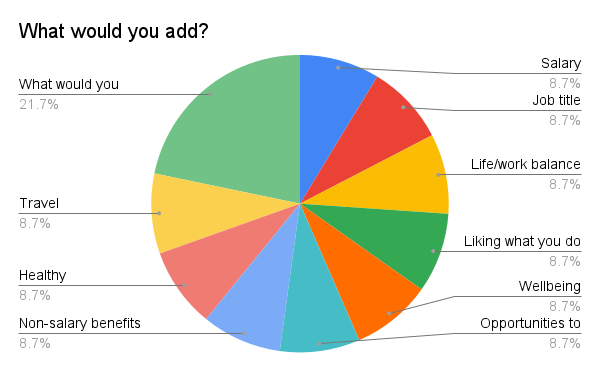
    There are different slices you could add to this pie, for example opportunities for professional development and learning. Good non-salary benefits or working on a healthy organisational culture. You could add opportunities to travel and having fun.

    In addition, what importance we accord to each slice of the pie will change over the course of a career and due to other circumstances. A job that is a good fit at the start, may not be a good fit a few years down the line and working from home may not be a good fit when life changes happen.

    A quiet office away from the kids or a workplace that gets you out of the house and meeting people is not easily added to the value proposition for working in a virtual team.

    Large or resource rich organisations may be able to offer a blend of working from home and working in the office that increases the spectrum of what you can add to the range of value added. But a blended approach doesn’t necessarily always deliver the best of both worlds, but can result in many people sitting in Zoom meetings in the same building, without any of the benefits of sharing the space with co-workers.

    Chart 4: Measuring success as a home worker - what would you add? . 
The pie chart has ten slices labelled Salary , Job title , life/work balance, Liking what you do, Wellbeing, Opportunities to learn, non-salary benefits, healthy organisational culture, travel and fun and the biggest slice is labelled: "What would you add?" .
    Chart 4: Measuring success as a home worker – what would you add? .
    The pie chart has ten slices labelled Salary , Job title , life/work balance, Liking what you do, Wellbeing, Opportunities to learn, non-salary benefits, healthy organisational culture, travel and fun and the biggest slice is labelled: “What would you add?” .

    If you are interested in reading more, head to the Leading Virtual Teams Book page where I share extracts from individual chapters in monthly blog posts.

  • Trying out new online courses: GDPR and online engagement

    I have been trying out new online courses, starting with a Futurelearn course ‘Understanding the General Data Protection Regulation‘ which many colleagues are also taking part in. I am a Data Controller and responsible for my organisation’s compliance with the GDPR framework when it comes into force, and this course forms part of our way to becoming compliant.

    I have been taking part in the course mostly by reading and absorbing the material rather than discussing/exchanging ideas with other participants – I have plenty of debate around these issues in other contexts.

    The course is clearly structured, easy to follow and has plenty of references and articles to follow up on specific issues further. I found the video component of the course, which is usually more engaging for me, less interesting in this case. I found I prefer to read the more detailed articles and lists.

    After one more week of GDPR, I am really looking forward to starting a completely different kind of course, the upcoming ‘Engagement in a Time of Polarization‘ run on edX led by Delia Deckard and Bonnie Stewart. The course is described as follows:

    How can we work together in a society where our communications channels have become so polarized? Can we engage in active, effective collaboration in a media ecosystem designed to make money from driving us apart?

    This two-week course convenes a conversation on participatory engagement models, and on building understanding and relationships even within the very real limits of contemporary social media. The course will enact the same participatory ideas it explores, and will feature input from leading voices in media literacies, disinformation, and polarization. Participants can engage on their own time and in real time, and if they wish, can build towards action in their local communities.

    The focus of this course closely relates to some of the work I do day to day, in particular around enabling engagement in online communities at scale, supporting effective open, online governance and reflecting on the skills required to participate.

    It’s also a topic I am interested in for my own practice, and I am looking forward to learning more about how debate gets polarized and how we interact online.

  • Forging new pathways to professional recognition

    Forging new pathways to professional recognition

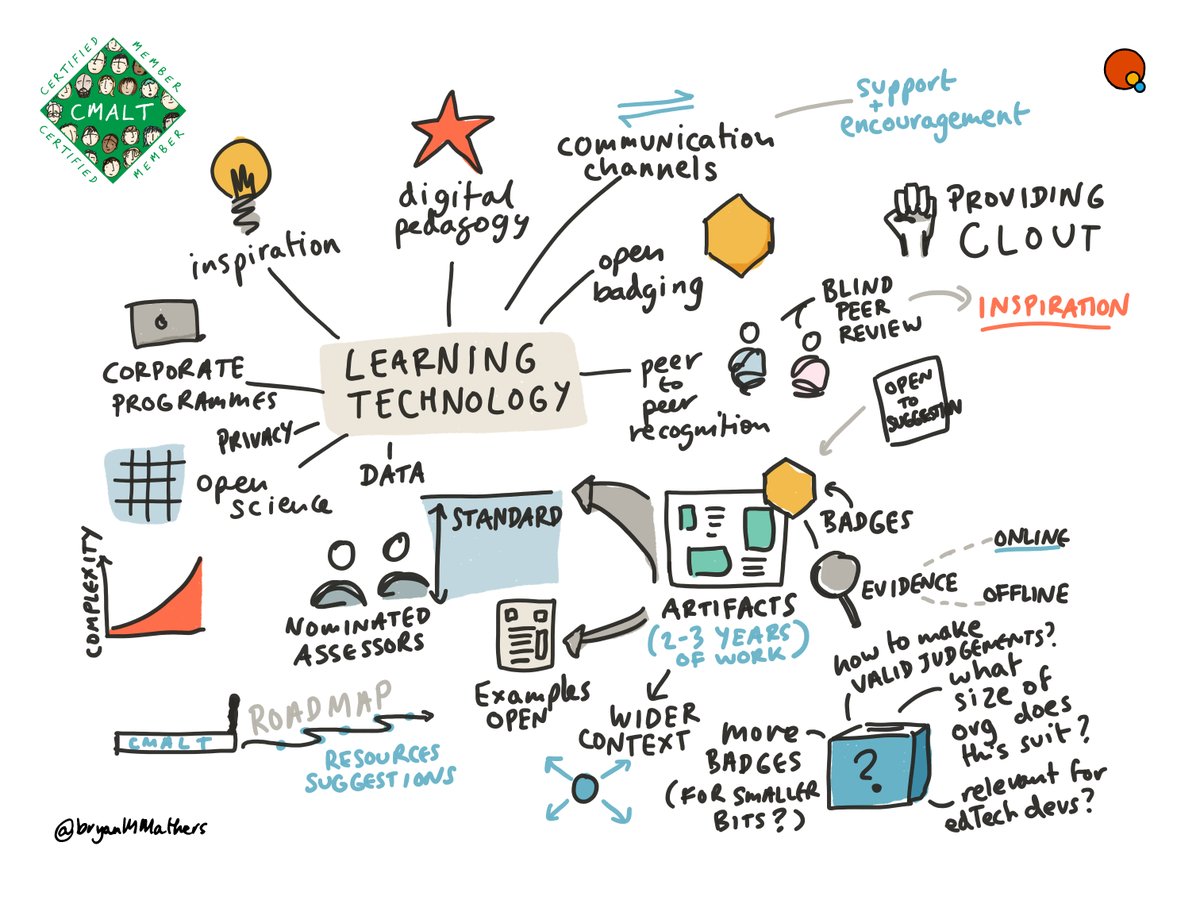
    This past month I’ve been doing a lot of travelling and contributing to a number of face to face and virtual consultation sessions about ALT’s accreditation scheme for Learning Technology professionals, CMALT.

    From Mozfest to Committee Meetings and from webinars to individual focus groups I’ve been hearing why fellow professionals value CMALT accreditation, what could be improved and how we may expand the scheme to offer valuable and robust peer-assessed recognition for a broader range of professional achievement. You can read more about the project on ALT’s website and also sign up for more information and to take part in the pilots.

    It’s been really interesting to hear about how the scheme could be developed and people’s experiences of their own journey to accreditation and then onward as a peer assessor.

    Last week the consultation coincided with a celebration of recent accredited staff at the University of Edinburgh and I was honoured to take part in giving out the awards.

    It reminded me once again how varied a professional landscape we have in Learning Technology and to how many different roles all across an institution the work of making intelligent use of technology for learning, teaching and assessment extends.