Tag: CPD

  • Don’t think you are brilliant? Think again…

    Don’t think you are brilliant? Think again…

    … and yes, I am thinking about you 😉

    But, before we get too far ahead of ourselves, let’s go back to the beginning and how I came to (nearly) write those words on an assessment form.

    As a Certified Member of ALT I act as a peer assessor for portfolios submitted by candidates hoping to gain the accreditation. It’s part of my continuous professional development in Learning Technology and in the most part it is a rewarding, equitable and collegiate activity that I really enjoy.

    In recent months I’ve graduated from learning about the assessment process and gaining experience in collaboration with Lead Assessors to becoming a Lead Assessor myself and now that I am doing more assessments I have started to reflect on the professional practice I am seeing through various submissions. It’s interesting to see what others do, what they specialise in and how they reflect on their practice or research. Personally, however, I am often taken aback by how little confidence or sense of achievement is conveyed in the work being presented. So much that should be celebrated can be overlooked or left unacknowledged. So few seem to have the confidence or awareness to recognise their own achievements or even present them as such. In short, I often find myself wishing to convey congratulations or compliments alongside more practical feedback.

    And then, there are the blog posts or thoughts of others in my field who seem to find it hard to feel their voice is important, that their perspective is worth listening to and that their work goes beyond the ordinary. Like so many before me I find again and again that those who shout the loudest about their own accomplishments are usually least deserving of our time and attention. Which makes it even more critical that those who need encouragement and support receive it.

    I think a peer-based accreditation process like CMALT that has a strong element of self-reflection can help you realise that you’re brilliant (and yes, again, I do mean you…).

    Why is that you ask?

    Here are three examples:

    Firstly, making a long list of all you have done can help you gain a sense of perspective. In Learning Technology we often move on from one project to the next so quickly that we forget to pause and recognise what we’ve achieved and what difference it has made.

    Secondly, building a portfolio in a format and manner that you choose, that you can tailor to your preferences and style, can help you build a narrative of your professional development that you take ownership of. It’s not someone else imposing a structure or crediting specific actions – you choose and shape what you present.

    Thirdly, reflecting on what you are good at might surprise you, might point you in a different direction than the one you thought you were heading towards. You might realise that you are great at something that you never even realised before. You might be able to see your professional practice in a new light.

    You might not have time or the inclination to engage with a scheme like CMALT. But you should make time to reflect and recognise your own strengths and achievements.

  • Creating a #cpd #cmalt portfolio as a solo undertaking

    Creating a #cpd #cmalt portfolio as a solo undertaking

    At a recent session with a group of Learning Technology professionals we discussed how to best compile a portfolio for CPD and accreditation such as for the CMALT scheme. One of the options we discussed was to join forces either as a group within an institution or with peers elsewhere. In many instances that involves meeting up for writing sessions, progressing through the process at the same pace and sharing work in progress. There are a lot of advantages to this, but what if you don’t have that option? I wrote my own portfolio pretty much in isolation until it was very close to completion (full disclosure: it did take me three attempts over a 5 year period to actually complete it, so my approach is not necessarily the one to follow. On the other hand, I’ve learnt from the mistakes I made). So this post contains a brief overview of how to compile a CMALT portfolio as a solo undertaking.  

    Step 1: I started with the structure, copying the heading structure that’s required into a blank Google doc. At the start is the contextual statement, the future plans section is last and in between are all the required Core Areas as well as a placeholder for the Specialist Area.

    Step 2: I then looked at the structure and tried to write down 1-2 examples of work I had done in each section. I added no details at this stage, just enough information for me to be able to identify what I meant. It was very quickly apparent that I had a lot of examples in some sections, none in others. So I moved some around which could fit into other sections. Once I had covered all Core Areas it was easier to decide what to pick for my specialist option, basically something I hadn’t already covered.

    Step 3: Once I had the structure and at least 1 example in each area, I started with the section I thought would be easiest (1b in my case) and added a description and some evidence. Once I had those, I added the reflection at the end. That’s what I did for each section in turn. Some took longer, usually because evidence was time consuming to collect or reflection felt harder. Because I already had a scaffold (i.e. the heading structure and at least 1 example for each section), working on the portfolio moved ahead at a much better pace. In previous attempts I hadn’t planned ahead and found the blank pages ahead daunting each time I moved on to a new section.

    Step 4: Once all the required and the specialist areas were complete, I took a step back and started writing my contextual statement and the future plans section. That was a lot easier with the rest of the portfolio in place because the examples I used shaped what I wrote. Also, having reflected on my work made thinking about the future much more straight forward.

    Optional step 5: Because I wrote my portfolio in isolation, without peers or feedback or someone to compare it with, I felt some feedback would be useful before I submitted it. I sent it to a few people and they came back with useful comments which were incorporated. I also shared it with colleagues who were directly mentioned.

    Hearing about the sharing and support that groups or peers provide sounds like a great way to undertake CPD. In my case, writing my portfolio was mainly confined to odd anti-social hours and I needed to progress at my own pace. If, like me, you are on your CPD or #CMALT journey in a solo capacity, I hope this post is helpful and good luck!

  • CPD #cmalt as a springboard into openness and ownership

    CPD #cmalt as a springboard into openness and ownership

    Recently there have been a lot of interesting posts on Twitter #cmalt about how compiling a portfolio of your professional practice can be an open process (if you have not come across the #cmalt accreditation scheme, have a look at the ALT website or watch this).

    My own portfolio was accredited through CMALT in early 2016 and since then I’ve shared both posts about the process and the portfolio itself. But reading the recent posts made me think afresh about how undertaking CPD like compiling a CMALT portflio can be a springboard into openness and ownership – and some of the considerations I had when deciding on these issues.

    Considering others: in the context of a portfolio that describes and reflects on professional practice taking colleagues into consideration is key. Even though the CMALT process requires you to focus on writing in the first person, to reflect on your individual practice, anyone with management responsibilities or who works as part of a team, needs to consider how others are portrayed in what they share. In my case, I asked colleagues for permission if it was necessary to refer to them directly and I chose examples of practice specifically because they were suitable for sharing.

    Continuous reflection doesn’t have to be open: one of the key benefits of gaining CMALT for me is that it prompts me to continue my reflections on an ongoing basis as I collect evidence of practice for the update to my portfolio every 3 years. Some of this is work in progress or hastily written, so I don’t share it. I choose what I share, when and with whom and it’s valuable to have safe, closed spaces within my CMALT folders and documents that encourage critical reflection as well as recording achievements. The process of deciding what is open and what is less open in itself is a valuable experience.

    Contributing to our understanding of professional practice: as well as sharing my portfolio I have also added it to the sharing initiative run by ALT. It’s not openly accessible to everyone, but only to members or individuals registered for the cmalt scheme. I think this offers the advantage of being able to contribute to a wider picture of what professional practice in Learning Technology looks like as well as helping others find useful examples in their sector, job role or specialist area. It also provides an alternative way of sharing practice instead of putting your portfolio out on the public web.

    Taking ownership of what you share: I compiled my portfolio using Google Apps for Education (more info) and I use the same tools now to track my CPD and collect evidence as I go along. Loosing access to portfolios or evidence on institutional systems is a real risk for many and I wanted to keep my content for the long term. Recently, I have decided to take that a step further and started transferring my portfolio onto this site, my own domain (thanks to Reclaim Hosting!).

    Some of it is already available now at http://marendeepwell.com/cmalt/  and in the fullness of time it should enable me to take even more ownership of my professional practice and the recognition I gain.

  • #CMALT 1 year on: #edtech reflection & professional practice

    It’s been nearly a year since I gained CMALT accreditation and I have been using the start of the year and involuntary free time caused by a severely sprained toe (which causes more mischief than I would have imagined) to look back at my CPD activities over the past year. There are three things I learnt I want to share and in the process I have come to make this slide deck on reflection.

    What I have been up to CPD-wise: I have continued to use my CPD log to record activities over the past year and from that I have discovered that it’s quite difficult to keep track of these things. The log prompts me to record courses or blog posts or conferences more readily and usefully highlights the need to record/back up evidence. One course I took part in removed access rights quite quickly after it ended, making it difficult to record much of the experience retrospectively. Similarly, informal learning or development has been harder to record unless I write a blog post or personal reflection on it at the time. The kinds of things I have recorded meanwhile paint a picture of interests explored and ideas that I have had, which provides me with insights I didn’t have before (and hopefully should make it easier to update my CMALT portfolio when the time comes).

    Finding gaps: keeping a log of my CPD and writing things down has also led me to find gaps. Areas in which I haven’t done enough or thought I did more than I actually have done. One such area for example is publishing beyond my own blog and making more of an effort to find time to attend conferences I haven’t been to recently. While it’s a bit late to make new resolutions for this year I aim to do better in the coming year.

    Reflection: the aspect of professional practice I have most conversations about is reflection. Whether it’s discussing how useful it can be, questioning how you can safely reflect openly with others or how to get started, it seems to be a key topic for many. For me it’s become clear how important a part of my professional development it really is and so I want to share my approach in the hope that it might prove useful or indeed prompt others to do likewise. I have included tips for getting started, reflecting on failure and reflecting in the first person as well as developing reflection as a professional habit.

    Have a look at the slide deck below and do send me your thoughts or feedback:

    You can also access the slide deck together with my CMALT portfolio at https://goo.gl/44I4Bd .

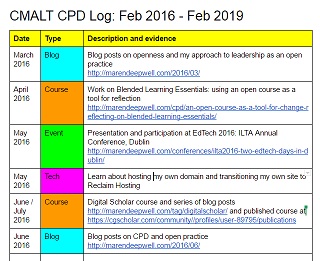
  • CMALT CPD Log: tracking professional development using Google Apps

    Since gaining my CMALT accreditation in February, I have been struck by how much of a difference it has made to me (and I am not just saying that because I work for its awarding body…). As well as providing useful evidence for my work day to day, it’s made me take a more focused and considered approach to my Learning Technology work. Part of it is developing a habit to reflect, about learning to pause and take stock before moving on to the next thing. I’ve also started being a peer assessor for other candidate’s portfolios and that has been an interesting process in itself, making me feel more connected with other professionals working in the same discipline.

    As the portfolio has to be updated every 3 years (as explained here) I’ve been considering how I am going to track my own activities. Three years is a long time and I think I would dread having to compile everything in 2019. So, like other CMALT Holders before me, I have tried to devise an approach to help me keep everything in one place and link easily into my portfolio that I built using Google Apps for Education.
    CMALT_Log

    Main aims: keep a running log of CPD activities, make it as easy as possible to log these, keep the format linked to my portfolio so that I can transfer content at the review stage and keep evidence.

    First steps: I set up a Google sheet and a form initially, but found that I didn’t like it because typing longer text into each cell didn’t work for me and the form felt too impersonal. I wanted to give myself the flexibility to add reflection and expand the format whenever I want. So I started a new Google doc instead, with a table, free text sections and an appendix section with guidance from the ALT website. I also set up a folder for additional evidence to be stored.

    Collect evidence or risk loosing it: it became quickly apparent that a lot of evidence I was logging is contained in my blog. As I now host that on my own domain (thanks, Reclaim Hosting 🙂 I feel that this works even in the long term. However one course I participated in this summer has published my work only behind a log in. So I took screenshots of the key information and stored them in the folder in case I loose access in the long run. Certainly the process of logging the evidence was the reason why I did this – otherwise I don’t think I would have.

    Where’s my CPD heading? As well as aiding reflection and encouraging me to keep my work properly backed up colour-coding different categories of CPD (e.g. events, blog, course… etc) made it very clear what I have been focusing on and areas in which I could do more.

    Tags, categories, images… couldn’t I do all of this in a more elegant way? I am sure I could. There are apps out there that would certainly make it look and feel a lot more glossy. If you have found a way that works for you, I’d love to see how it works. For me, sticking with the same format as my portfolio works for now.

  • Open CPD, Visual Thinkery, art school: my week made me think

    This post is inspired by two things I did this week: first, taking part in Wednesday’s @LTHEchat on the topic of Open CPD with Chris Rowell and second, reading my weekly delivery of Visual Thinkery in Saturday’s newsletter. Both are highly enjoyable, interesting and rewarding so if you haven’t already I strongly recommend you take a look.

    CC-BY-ND @bryanMMathers http://bryanmmathers.com/
    CC-BY-ND @bryanMMathers http://bryanmmathers.com/

    Both of these activities made me think about being online and what I do when I am online. Is it part of a process, a place or a platform? How do I do what I do and why? It’s useful to step back at times and take a look at what I do and the reasons behind it.
    In my case a lot of how I work and think was shaped during my years at art school. For six years fine art and specifically making sculptures was what I spent most of my time doing. It was where I first developed a creative process, learnt to do research, gained critical thinking skills and so forth. In practical terms being in a sculptor’s workshop is not at all like being online: it’s all about physical materials, sensual perception, working with your hands and a lot of messiness. Making something has its own pace, too. Some days go by fast and productive, on others nothing happens and sometimes you spent all your time doing something that turns out to be a disaster. In my last year at art school I learnt how to carve marble. Or rather I attempted to.

    Marble
    Marble…. largely unchanged

    I learnt the technique – but then discovered how LONG it would take to actually carve something. I ended up making a single mosaic over two terms and had a small block of marble still sitting on my table largely unchanged. While I don’t make a lot of things anymore the skills and processes I learnt serve me well in my work now, especially online.
    One thing I learnt was to be comfortable sharing a process, rather than a result. Like many people, I think of most of what I do as a process and some of the formal output is just a by product. It’s necessary, but it’s not the main aim. Similarly, place is important. Whether it’s physical or virtual doesn’t really matter, it’s equally important to me. Both in the chat, when we talked about making time for CPD and creating safe spaces in which to share/experiment/fail, and in the drawing Bryan included in the newsletter (which I have included also in this post), I thought about having control over your own places and spaces. It might be a desk or a domain, an office or an open course, a train compartment or a tweet chat. Different places for different times and activities depending on what you want to do. What’s important is to make use of it effectively. A sculptor’s studio is usually a growing collection of inspiration, sketchbooks, materials, models and more. It’s a place which you can use to think, talk, create – but it doesn’t dictate what you do.
    In a university setting I shared the space with others, had my tutorials in it or gave presentations. My place became the platform from which I launched my handiwork into the realm of critical evaluation by others. My work became my platform later on, when it sat on the floor of a gallery or in a portfolio. In many ways what I do now is the same. This blog for example acts both as a workshop and a platform, it’s about process and being part of a community of peers.
    The Visual Thinkery newsletter and the tweet chat alike made me reflect on how I use technology, how I engage in online activities and spaces. Am I doing it on my own terms? Or am I letting technology dictate the pace and mode of interaction?  Is being connected overriding other aspects? Jaron Lanier’s you are not a gadget comes to to mind here and on that note I think I have found some inspiration for the week ahead.