Tag: CPD

  • Virtual Team Adventures in Asana

    Our team is currently moving to Asana. “Asana is a web and mobile “work management” platform designed to help teams organize, track, and manage their work.”

    This is a big moment, as we have tried and not adopted various other similar tools including Basecamp, Trello, Google Tasks and Project Management tools within Google Workspace.

    However, things are finally moving into place, and with a couple of colleagues alreday familiar with and/or inspired by the platform, we are embarking on the long road to embedding new ways of working in our virtual team.

    To say that I’m excited is an understatement. (and a big thank you to Lauren Hanks for extra inspiration).

    Training

    One of the joys of adopting a new tool for me is the training. I love the process of learning about a new platform from the ground up, and there is plenty of support available in the form of online documentation, courses and online sessions.

    I found the online training really helpful, and also completed the self-paced courses. It’s good to get the basics right and I want to get a good feel for what everyone in the team is learning.

    Topics like:

    • Create Projects and Tasks
    • Keep work on track with clear Due Dates, Assignees, and Custom Fields
    • How to manage your own to-dos with My Tasks
    • How to effectively manage communication with teammates with Comments, Notifications, and Inbox

    can open up great opportunities for discussing how we collaborate and work on projects as a team.

    Re-imagining my to do lists

    I recently blogged about winding down work for 2022 and part of the post was reflecting on and revisiting and pruning my to do lists.

    Enter Asana.

    I really found it helpful to have to revisit not only what’s on my to do lists but also how they are organised and what I keep where.

    As part of my coaching with clients I often work through different models of prioritising work but I haven’t reviewed this for myself recently, so this is definitely going to be a priority as part of my transition.

    I am considering some new lists, dedicated for things I want to do less of or stop all together as well as lists of things I want to do or need to track.

    … getting everyone on board

    Time to learn and embed a new platform like this is always a challenge. No matter what tool you use, it will take longer to transfer workflows and processes than just doing the established/familiar thing.

    Also, it takes time for everyone to get a feel for why we are using this tool, why we are making this change, instead of continuing to use the established ways of working.

    In our team we are not finding that too difficult at the moment, primarily because we are all agreed that things have to enable us to have a better overview of what we are all doing and where progress is being made.

    It’s also a bonus that Asana offers lots of different ways for individuals to manage/view their own tasks in whatever way they prefer. That is popular with everyone.

    Next steps

    As well as my own to do lists and general projects, we are going to be moving 1-to-1 meetings into the new platform from January, which will support our use of Asana regularly. We are also moving our overall business plan, which is due to be updated in February, and again, supports regular use.
  • Preparing to wind down work for 2022

    It’s December and for me, the quietest time of the year. That doesn’t really mean that things aren’t busy, but some of my biggest deadlines are currently a few months into the future, and there is no more major travel planned between now and January, so this is as ‘quiet’ as it gets. And I am keen to capitalise on that.

    As someone who actively tries to become less efficient and work less hard (looking for more sustainable, balanced productivity instead) this time of the year offers a much needed chance to spend some time tidying up. Here is what I intend to do in the run up to the holidays:

    Calendar refresh

    I have plenty of recurring meetings in my diary, and at the end of each year I check in on them. I look at whether I still need the meeting at all, whether the time still works, what’s changed and how I can adjust and plan for my week better.

    The kinds of meetings I often change are individual catch ups, mostly due to working patterns changing or the focus of collaboration shifting.

    Long term to do list clear out

    My long term to do list is a a long list of things I want to tackle at some point, action items that are usually neither urgent nor important. Long term to do lists, for me, are the back of the back burner.

    This is where I brain dump ideas, links to things that may be interesting one day, long term hopes or ideas that I could investigate.

    At the end of each year, I review and prune my list. Usually there are a couple I have actually implemented, which can be marked as completed. Some have become obsolete and get deleted, whilst others may now move towards the actual planning phase.

    Pruning other to do lists

    I also prune and tidy my other lists, primarily trying to complete quick wins and plan for larger pieces of work come 2023. I try to be realistic, spacing them out for the new year, so that I don’t start January with a completely unachievable list on day 1.

    Clear out the old…

    Alongside that, I have a clear out of files and folders, my inbox and desk. Out with the old… and make space for fresh thinking for the new year. I usually book a half day out in my calendar in the last working week of the year, for precisely that purpose. I want to make sure I have time to clear up, and leave things in a nice way for the new year.

    One thing I don’t do is to send 100 emails clearing my inbox just before I finish for the year. I am the recipient of many of these from others, and I dislike it personally. If something wasn’t urgent up to 23rd December, it can probably wait until 3 January.

    So in order to empty my inbox, I schedule or draft emails ready to send in the new year and that way, I don’t get lots of harried responses and others don’t get 100 more emails from me.

    …in with the new

    One of the biggest joys of ending the year is to start planning for a fresh new year. I ordered a new journal yesterday, and this is always one of my favourite things to do. Have a little re-arrange, tidy and make space for new things.

  • Book launch week unpacked

    Book launch week unpacked

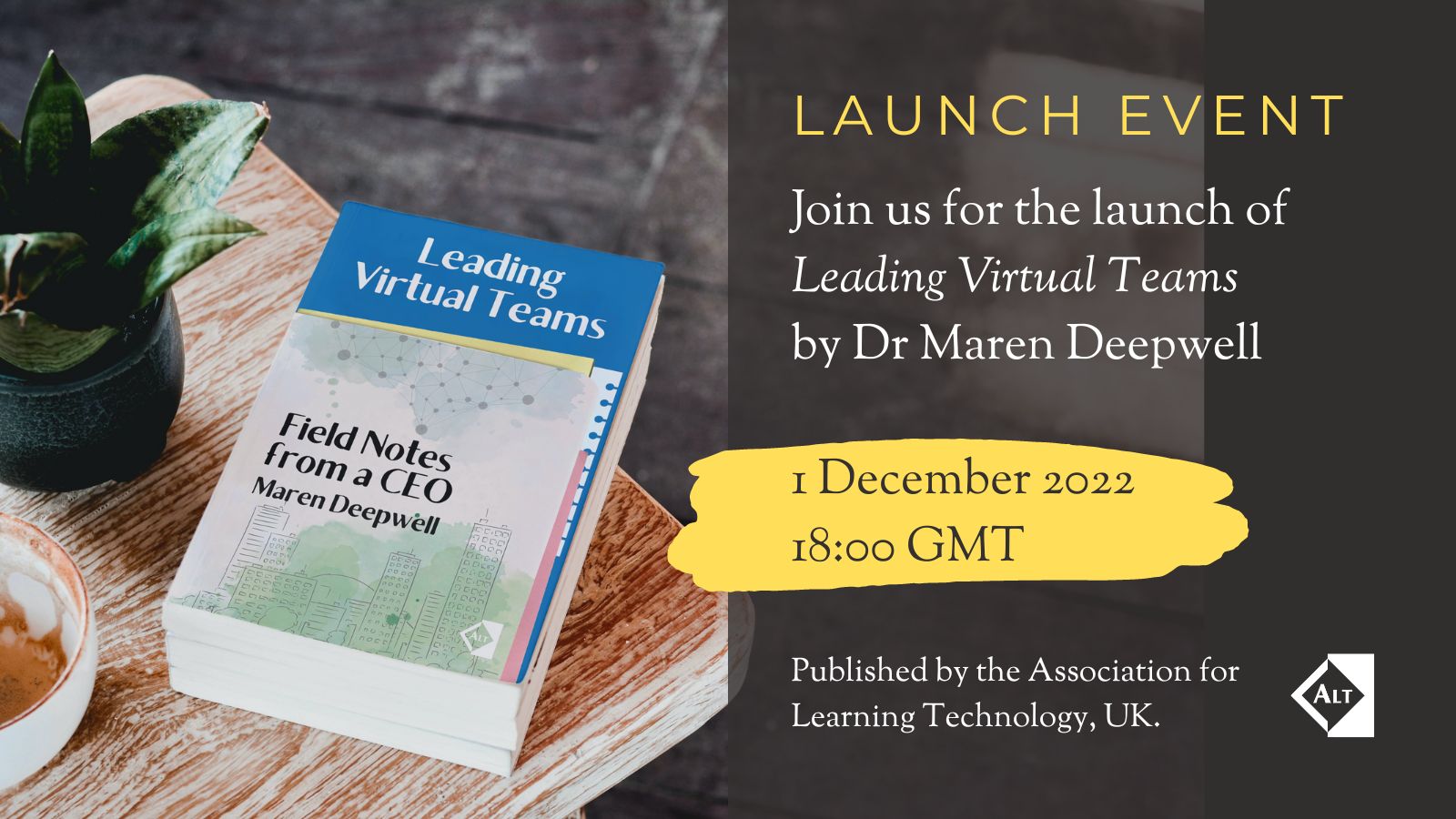
    I am really, really happy that this week my book is finally going to be published. The digital edition has been ready for a while and the first proof of the print version arrived this week, so it’s starting to feel real. Yesterday I added the ISBN to the cover design and ‘BOOM!’ – it felt like a proper book.

    Publishing a book feels scary. It took me nearly two years to write, although I started with years of blog posts and presentations to draw on. I rewrote pretty much all of the material I already had, cutting and editing along the way. If you have followed the progress of the book or read any of the draft chapters I published along the way, you will know just how much of an evolution this project has been through.

    Even after the editing process was finished, I found an error in the introduction, and fortunately there was time to get it fixed and the files updated. I am sure the print edition will include some typos, too. So I am making a list of things to fix in the 2d edition.

    It’s not perfect, that’s for sure, but I am proud of this piece of work. It’s useful and interesting and an attempt to grapple with issues that many in leadership roles will be familiar with. Obviously I want it to be well-received and reflect positively on ALT, as so much of the inspiration and case studies are focused on my work there. I appreciate it enormously that the book’s digital edition is published by ALT as an Open Access publication. Sharing knowledge is after all what this book is all about.

    I also feel a little sad, to let the book enter the public domain. Since I started working on it, it’s been my project, mine to nurture and progress. It’s been my focus on days off, evenings and weekends and a writing holiday. Sure, I have published extracts along the way, and I have shared some of the resources from the book on radio, in my podcast and the Hacks for Hybrid Working course. And the book has bee read by colleagues and Trustees who helped review it. In some ways, there is little in the book that isn’t already out there.

    Once the book in its entirety is out, then it belongs to all who read it. It becomes lots of different things to many people and they make their own meaning, shaped by their experiences and context. I am excited to see how the book may be used or interpreted by others and I hope that the related resources, blog posts and podcasts will help make it a valuable resource.

    Meanwhile my thoughts have started to turn to the course which I will run in spring 2023, offering a practical approach to leading virtual teams #excited.

  • Hacks for Hybrid Working starts on October 24

    I am very excited to spot the announcement for Hacks for Hybrid Working, a new flex course starting on October 24th, in the September edition of the Reclaim Roundup which links through to Lauren’s preview post of the course.

    For many of us in Higher Ed, hybrid working is here to stay. So whether you’d like to create a better work/life balance juggling being on campus with working from home, or you are looking to move from crisis mode to a way of working that is more sustainable, healthful or simply a little more joyful, this course is for you. Join us to explore hacks to create a better hybrid workplace for everyone.

    For me, this is the ideal project closely related to Leading Virtual Teams, which is due to be published next month. I appreciate the opportunity to collaborate with Lauren and the amazing folk at Reclaim outside of my day job and to have the opportunity to share some of the know-how gathered on how to make hybrid working work for you.

    The cherry on top is that this course is free for anyone to attend and participate, so if you are keen to learn more, register here to receive event information.

    What’s the course about?

    Lauren explains in her post:

    We’ll be meeting over the course of 4 weeks beginning late October through November to unpack hybrid working and all that it entails. These sessions will be a continuation of our OER22 presentation, Building Connections with Virtual Teams, as well as our radio broadcasts that I’ve outlined in my post, Working Habits, Self Evals, and Finding Connection. I’m really looking forward to diving further into personal working habits that take shape in virtual/hybrid settings, evaluating our relationships with digital tools, and building out a Hybrid Working Roadmap.

    Here’s our topic list:

    • Week 1: Hybrid Working Unpacked
    • Week 2: Digital Tools in the Virtual Workplace
    • Week 3: Exploring Hybrid Working Hacks
    • Week 4: Complete your Hybrid Working Roadmap

    There is so much fun in store, including a special radio session and a SPLOT site alongside the course materials and tools we’ll be trying out.

    How can you take part?

    Sessions will premier on watch.reclaimed.tech/hybrid-working when the time comes, and we’ll also be chatting in the #hybrid-working discord channel! Also, make sure you check reclaimed.tech for weekly blog posts with supplemental resources, quick links, a SPLOT or two, and even some homework.

    When: October 24 – November 18
    Weekly video sessions each Mondays at 11am ET
    Live Q&A/discussion time on Fridays at 11am ET

    We are really looking forward to seeing you there 🙂

  • Submitted! My Senior CMALT Portfolio update

    In January I blogged about getting the process of updating my Senior CMALT Portfolio underway, and my intention was to blog monthly to share my process. Alas, we are not in late September and although I haven’t blogged or indeed progressed the task at hand, today I am doing both!

    I have updated my portfolio AND am blogging about it, so YAY!

    To recap, here is what I set out to do:

    Updating my portfolio

    ALT requires portfolios to be reviewed and updated every three years in order to maintain Senior Certified Member status and I am afraid my three years were up in late 2021. I applied for an extension (last year was manic for many reasons), and now I need to get underway with my review process.

    I have had a look at the guidance first (I haven’t actually ever updated my portfolio before) and here is what I need to do:

    First I am going to have a look at my original Senior CMALT portfolio. Then, I need to add the following sections:

    • Summary of recent work/practice (500 words)
    • Overview of CPD activities over the past 3 years, with 3 examples discussed and reflected on in greater depth
    • Updated future plans (300 words)
    • Updated Confirmation and date

    At first I was not sure what I was going to use as examples of CPD activities over the past three years yet, but I once I reviewed my list of CPD activities, I found it easy to choose the examples.

    You can have a look at my updated portfolio (which has been submitted for assessment).

    Sign-posting updates

    My portfolio is a Google doc and a number of related files, all shared by a folder. For the three year review I made a copy of my original document, re-named it and updated that.

    To make it easier to assess, I highlighted the updated sections.

    What I didn’t do

    When I first submitted my Senior CMALT portfolio in 2018, it was an updated and expanded version of my original 2016 CMALT submission. It formed part of the pilot group for Senior CMALT.

    In an ideal world, I would have liked to review and update/refine all aspects of my portfolio, including moving it over to a WordPress format, a task which I have been making little progress on for over four years.

    On reflection however, I feel that I have done what the 3 year review process is designed to do and found it valuable to take stock of my development over the past 3-4 years.

    I also find that the current format, the Google doc, really works well for me when it comes to making these updates. I am comfortable working in the format, so I don’t waste time fiddling with images or making it look more impressive.

    As an assessor I see some beautifully presented portfolios, and I am always full of appreciation for professionals who can not only showcase their accomplishments and reflect on them, but to do so with real style! Kudos to you folk out there who create bespoke images, video and more.

    Personally, having struggled to complete this task since September 2021, the thought of moving to a new format or doing a major update put me off. I am glad to have completed the required sections, which turned out to be fairly short at 500 words and 300 words and 3 examples of CPD.

    If you are in the same boat as me and staring at the portfolio review deadline, good luck! You’ve got this 🙂

  • CEO’s Report, Spring 2022

    Adapted from the original report on the #altc blog.

    This is my quarterly update as CEO of ALT on our progress as we move further into the year. We now provide access to expertise to a much wider community of digital practitioners. We work hard to champion professional recognition for a growing range of Learning Technology roles and we inform and support institution leaders engaging with digital education. Our strategy needs to reflect this growing remit. 

    Informed by the findings from our Annual Survey, our Board of Trustees and I have worked together to set strategic goals to move us firmly into this (post) pandemic landscape towards our Annual Conference and AGM in Manchester in early September.

    One of the strategic priorities we have identified is to develop a new hybrid CPD and events programme, which will launch in autumn and set out a schedule of webinars, workshops and events running online and in person.

    We are also looking to develop our professional recognition activities, including refreshing the ALT Awards and pathways to CMALT, details of which we hope to share with Members soon.

    Things to look out for

    • Resources from the OER22, ALT’s Open Education Conference in the UK, chaired by the Global OER Graduate Network, are now available.
    • We launched a new collaboration to tell the stories from our community with ITN Productions: Digital Transformation. Building on the success of last year’s programme, this year’s film will explore the potential of digital technology in education and industry and its impact on approaches to learning.
    • News about this year’s AGM and Trustee elections will be published alongside the Call for Nominations for Honorary Life Membership in May. Look out for information about how to stand for election and how to vote.

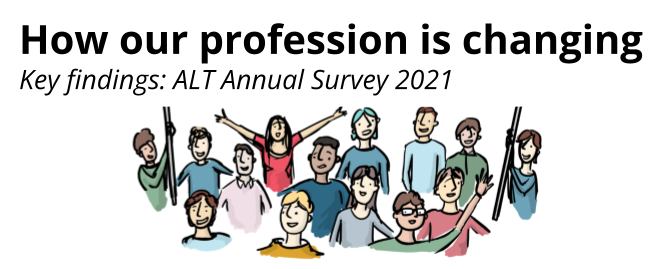
    How our profession is changing

    This second report from our Annual Survey explores one of the key questions we ask in the survey: how are institutions investing in Technology-Enhanced Learning? We continue to see an increase in investment of over 30% overall, although smaller than the previous year, when 45% of Members reported an increase in their budgets. From 2020 to 2021, investment in permanent posts has increased from 32% to 54%, and for fixed term posts from 34% to 50%, emphasizing the continued and growing demands for Learning Technology professionals in the long term.

    ALT’s Annual Survey has run each year since 2014, with a number of the core questions remaining unchanged. We think it provides a unique insight into how learning technology is used across sectors as well as identifying emerging trends in current and future practice.

    You can also read more about the report from ALT’s Chair, Helen O’Sullivan, and myself in this #altc blog post.

    Celebrating the launch of the AmplifyFE Community Space in partnership with Ufi VocTech Trust

    AmplifyFE is a partnership project which works to connect and amplify communities of practice for digital learning, teaching and assessment. The AmplifyFE Community Space works across the whole Further Education and Training sector in its widest terms engaging with vocational educators and those who support them.

    The aim of this space is to:

    • Provide a place for vocational educators to share and learn from each other, increasing their access to learning technology expertise, digital pedagogy and professional development opportunities
    • Champion the use of accessible, inclusive learning technology to help those adult learners most impacted by the digital divide so that more people in the UK have improved access to vocational skills
    • Engage with FE groups and communities of practice and researchers in vocational learning to share best practice
    • Work across the whole Further Education and Training sector in its widest terms engaging with vocational educators and those who support them in FE Colleges, Adult and Community Learning (ACL), work-based and independent learning providers, prison learning, ESOL communities, ‘HE in FE’ providers, the whole, diverse sector.
    • To amplify the voice of professionals in strategic developments across the sector, led by organisations including ALT and Ufi.

    Find out more via the AmplifyFE website.

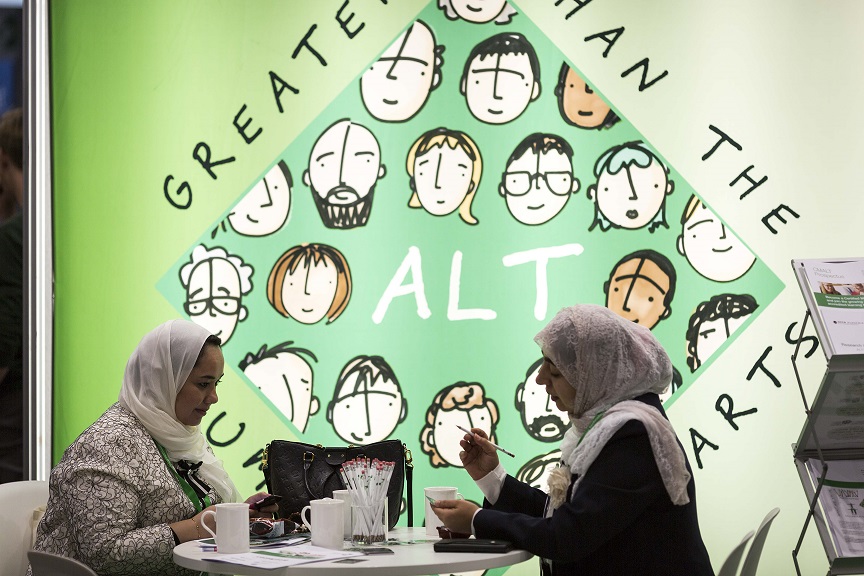
    Picture by Chris Bull for Association For Learning Technology 11/9/18 ALTC 2018 day one. www.chrisbullphotographer.com

    Preparing for our Annual Conference and AGM 2022

    For the return of the Annual Conference to Manchester, 6-8 September 2022, we will bring together different critical perspectives from across our community that will examine the challenges ahead and question the shape of things to come. We are putting our values into practice and Members at the heart of the conference, so in this spirit the event will be chaired collaboratively by the Trustees of ALT.

    Conference themes

    • Digital transformation beyond the crisis: what is your vision for learning, teaching and assessment? This theme is focused on how we are transforming education and training through digital practices in a post-pandemic world.
    • Co-creation with learners: this theme explores how to use digital technology in partnership with learners to design sustainable approaches that work for everyone. How can we co-create student engagement and enjoyment and make the learning experience more open, inclusive and equitable? 
    • Emerging leadership for a new strategic vision: we are seeing a growth in more strategic responsibilities in roles with a focus on digital education and training. This theme is dedicated to the work and vision of both emerging and established leaders in both institutional and community roles seeking to share their expertise and learn from like-minded colleagues in a dedicated leadership strand of this year’s event. 
    • Developing Digital Fluency: there has been a big shift in the digital skills and capabilities that we need to develop and recognise in both students and staff: from digital citizenship to critical data literacy and ethical considerations, what does it mean to develop digital fluency? 
    • AmplifyFE: this conference strand is dedicated to proposals from the FE and Vocational Education sector, and we encourage submissions that share expertise around digital tools and technologies, skills development and collaboration (not competition). 
    • Creativity wildcard: if your work doesn’t fit into the traditional research or practice themes, then this theme enables you to submit research, practice or policy proposals from any sector including Further Education, schools, vocational learning and training, lifelong learning and work-based learning.

    Registration and scholarship applications are now open.

    Ethical Framework for Learning Technology

    We have been sharing the framework with the sector at a number of conferences and events this spring, including the THE Digital Universities Week and Ahead by Bett. ALT’s Framework for Ethical Learning Technology (FELT) is designed to support individuals, organisations and industry in the ethical use of learning technology across sectors. The following resources, including the FELT Reflective Self-Assessment are available to Members:

    Another great session at #THEdigiweekuk, this time with @daveowhite@MarenDeepwell@jatenas and @osullihelen looking at https://t.co/IKyZSA53ck@A_L_T‘s Framework for Ethical Learning Technologies (FELT). Hadn’t been aware of this, seems a great way to assess what we’re using! pic.twitter.com/YponqKhKWY— Chris Trace (@chrisEtrace) March 16, 2022