I have been a peer assessor for the CMALT accreditation scheme for many years and I really enjoy undertaking assessments. It’s a great way to keep in touch with how professional practice is developing across the sector. Since the introduction of Senior CMALT accreditation, I mostly assess portfolios of peers in leadership roles and that is particularly rewarding.
Recognition as an Assessor
I was really pleased to receive my first Open Badge from ALT for my work as an Assessor yesterday:
Visit this page to read the full description and criteria for the award.
Badge criteria
The CMALT Accreditation Framework is run by the Association for Learning Technology (ALT) and provides pathways to peer-assessed accreditation for Learning Technology professionals in the UK and internationally who are actively involved in understanding, managing, researching, supporting or enabling learning with the use of Learning Technology.
Achieving certified membership through the CMALT scheme is recognition from your peers that you are a current practitioner. Certified Holders are listed on the ALT Website and are eligible to act as an Assessor upon receiving their certification.
There are three pathways, Associate CMALT, CMALT and Senior CMALT. CMALT Portfolios are assessed by two assessors in accordance with the Assessment Criteria outlined in the CMALT guidance. We aim to assign assessors to portfolios who have themselves completed that specific pathway or have progressed from it, i.e. assessors who have gained CMALT may assess Associate CMALT and CMALT portfolios, and assessors who have gained Senior CMALT may assess all pathways.
Acting as a CMALT Assessor enables certified members to undertake valuable CPD and contribute to the successful running of the CMALT scheme and ALT community.
In the past year it’s been hard to make much time for professional development, or at least the kind of professional development you can plan.
Like many in my position, I had a huge amount of professional development focused on keeping my organisation running in a crisis, emergency governance, financial crisis management and so forth.
Things are STILL extremely busy, and look like they will continue to be for some time to come, but I am making time do actually plan some CPD beyond giving talks and attending (virtual) conferences.
Leading Virtual Teams
Most of my focus just now is on writing a book and developing my coaching practice on leading virtual teams. The book sets out to explore what leading virtual teams is really like drawing on years of experience captured in blog posts, podcasts and presentations as a model of open leadership. I will discuss questions such as:
How do you effectively manage a crisis as a virtual team?
How do you address personal problems?
What do virtual Team Days look like when they work really well?
How do you create those all important water cooler moments?
Anti-Racism in Learning Technology
I am also educating myself more about what I can do to help anti-racism in Learning Technology, and I recently joined the anti-racism & learning technology group. If you’d like to learn more about the work of the group, there is a series of blog posts on the #altc blog which provide a great starting point:
All of this will feed into the main CPD project for this autumn, which is to update my Senior CMALT Portfolio. I gained Senior CMALT as part of the first pilot group in October 2018, and I found the process extremely useful.
The portfolio has to be reviewed and updated every three years, adding sections on professional development undertaken and future plans. If you would like to have a look at the full version of my Senior CMALT portfolio, you can access the Google doc version and the evidence folder.
Since then, the scheme has developed further and there are now Open Badges for CMALT in the offing, too, which I am looking forward to.
It’s amazing to look back at my portfolio and reflect on how much has happened since I wrote it in 2018. Three years, especially in times of crisis, feels like a long time indeed, and it will be useful for me to take a step back and take stock.
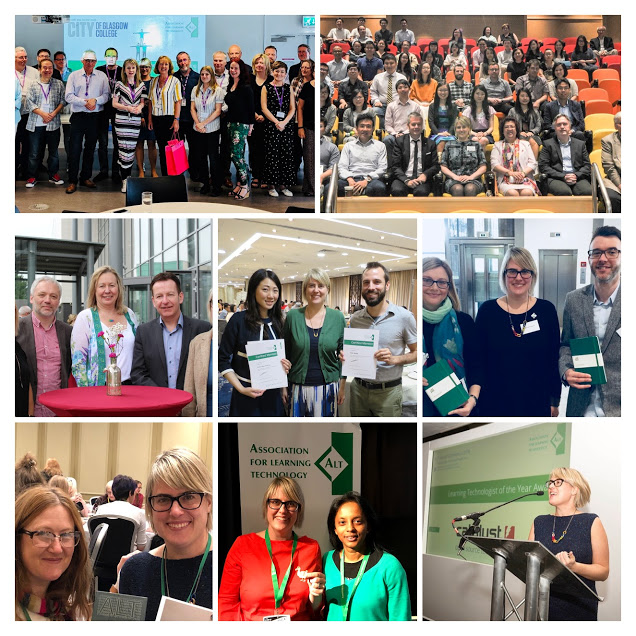
Snapshots 2018: ALT Scotland, Glasgow; Blended Learning Symposium, Hong Kong Polytechnic; ILTA Annual Conference, Carlow, Ireland; CMALT Ceremony, Hong Kong; ALT Northern Ireland, Belfast; SEDA Annual Conference, Birmingham; OER18 Open Education Conference, Bristol, ALT’s Annual Conference & Awards Evening, Manchester, UK. Thank you to everyone’s who made my year.
Against a backdrop of much political, social and environmental upheaval I have spent the past year working hard for all things Learning Technology – always on a mission to make better sense of how we relate to technology as we learn, teach and live. Learning Technology is so interesting and challenging because the work we do is happening at the intersection of education and work, constantly negotiating our relationship with technology as a society, as human beings. It brings into focus some of the biggest questions that we face in this age, questions about the role of machines in our world, artificial intelligence, about how knowledge is produced and ultimately the forces that shape our lives.
Day to day the reality of supporting lecturers with a VLE or teaching adult learners how to get online is a little more prosaic than that, but if there is anything we have learnt this year it is that the legal, ethical and moral dimensions of Learning Technology are becoming ever more important. From the role of lecture capture in labour disputes to implementing GDPR and to safeguarding well-being online there is no shortage of examples that Learning Technology has indeed come of age and that we have to face these important questions in a manner that is not only practical, but equitable and fair for generations to come. And although this year has certainly brought with it much to be dismayed about, in Learning Technology there has been a new cause for hope as our work to create a more nuanced, a more critical and reflective discourse has gained momentum. No longer do we focus primarily on advocating for technology as a solution but on a more holistic approach that acknowledges the importance of people, of learners and teachers in every learning context.
So here is my year in Learning Technology in ten highlights for you to share, make use of and be inspired by:
My favourite part of this handbook (read the review) is that is has a section on evaluating what you are doing and reflecting on it. It’s useful for many beyond Further Education and it’s written by someone who really knows their stuff – Daniel Scott. If you haven’t come across it yet, put it on your reading list for 2019.
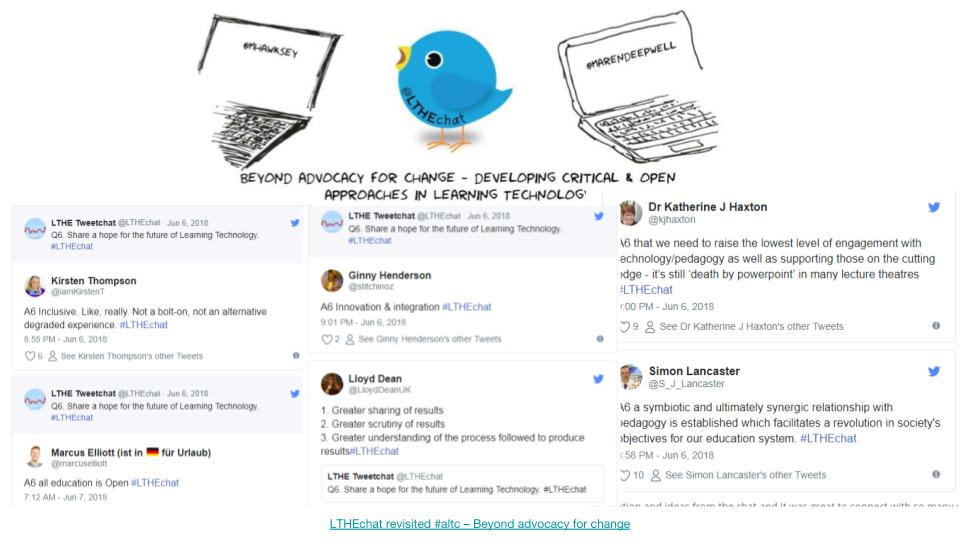
Beyond advocacy for change: developing critical & open approaches in Learning Technology #LTHEchat #altc
Extract from the LTHE Twitter chat
This twitter chat, which Martin Hawksey and I worked on together, brings together many of the themes from this year around the role of Learning Technology, how our work is changing and how we can take a more critical, open approach. You can explore the chat itself on Wakelet or read up on the follow up blog post.
Policy Making in Action – A Senior CMALT portfolio by Melissa Highton
Melissa Highton‘s approach to achieving Senior CMALT was particularly inspiring as Melissa describes how she “delivered a session at AltC 2018 exploring the interplay between technology and teaching, and learning technologists and academic colleagues. In it I talked about the importance of working alongside colleagues from different backgrounds and I used a ‘learning from critical incidents’ framework for my reflection.”
The topic of Melissa’s work was “experience of writing, and consulting on, an institution-wide opt-out policy for lecture recording” and the context that “work with technology for teaching and learning… comes into contention during a strike” as was discussed in these blog posts [written during] during the strike can be found here.
When I grow up I want to be a Learning Technologist by Clint Lalonde
Skip to 22.28 min in for Clint‘s talk or even better sit back and watch all of them compered by the inimitable Tom Farrelly.
How and why should Learning Technologists engage with start-ups? A collaborative guide…
Working with industry in Learning Technology is not always easy and one of the collaborations I led this year was to write a guide for Learning Technologists about how to work with start-ups. At the outset of the project, we wanted to find out what makes a successful collaboration between Learning Technology professionals and start-ups, what barriers may get in the way and what experiences we can learn from. We also asked the question why this is important and how it might be useful to the wider community, both individuals and organisations. You can now access the guide http://bit.ly/altcstartupguide and read the related blog post.
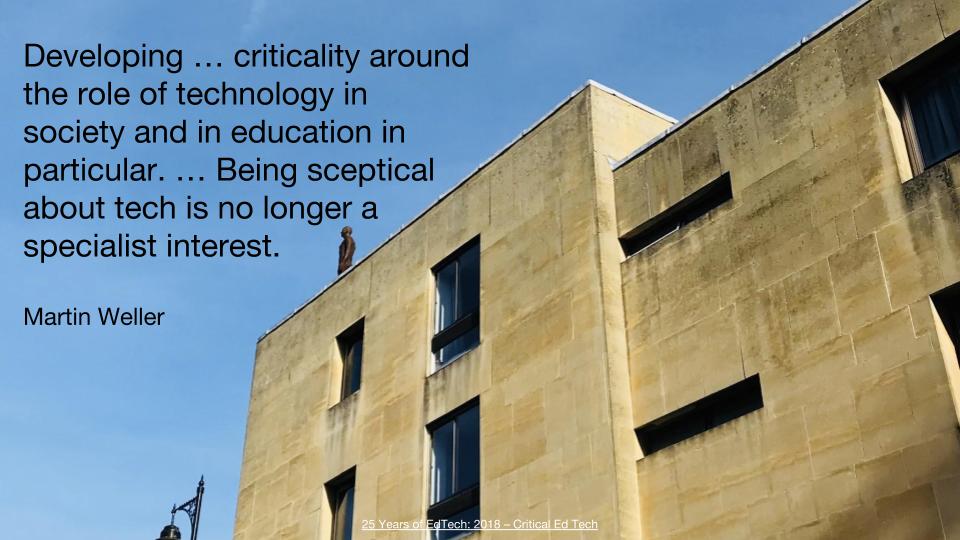
25 years of EdTech by Martin Weller
In Learning Technology we have the history, evidence, research to shape a more critical perspective and there are an increasing number of voices that articulate how things are changing. Martin Weller’s inspiring series on ‘25 years of Ed Tech’ is a great example of this (and definitely worth reading if you haven’t come across it yet). Martin emphasises the need for taking a critical approach to our thinking in Learning Technology, to examine the (commercial) interest that influence its development, ‘for example, while learning analytics have gained a good deal of positive coverage regarding their ability to aid learners and educators, others have questioned their role in learner agency and monitoring and their ethics.’
A personal, feminist and critical retrospective of Learning (and) Technology, 1994-2018
…”Our session is based primarily on two perspectives.The first perspective is rooted in our analysis of the past 24 years of ALT’s Annual Conference — as represented in published websites for later conferences, and for earlier conferences, references to the conference in ALT’s Journal (now Research in Learning Technology). The second perspective is our own personal histories that both exist beyond that narrative and intersect with it. Our initial analysis of the conference has identified Open/Active Learning and Community/Communities of Practice as themes that have persisted over several conferences and many years. We will summarise the themes and trajectories, highlighting how these ideas have been represented within ALT’s Annual Conference, how they have evolved, which perspectives have persisted and which have become irrelevant or have fallen out of favour. In addition, we acknowledge that the personal is political. Our respective critical approaches to this work reflect our own varied histories within and beyond HE, IT, and learning technology.”… by Frances Bell and Catherine Cronin.
#CMALT #altc Twitter chat
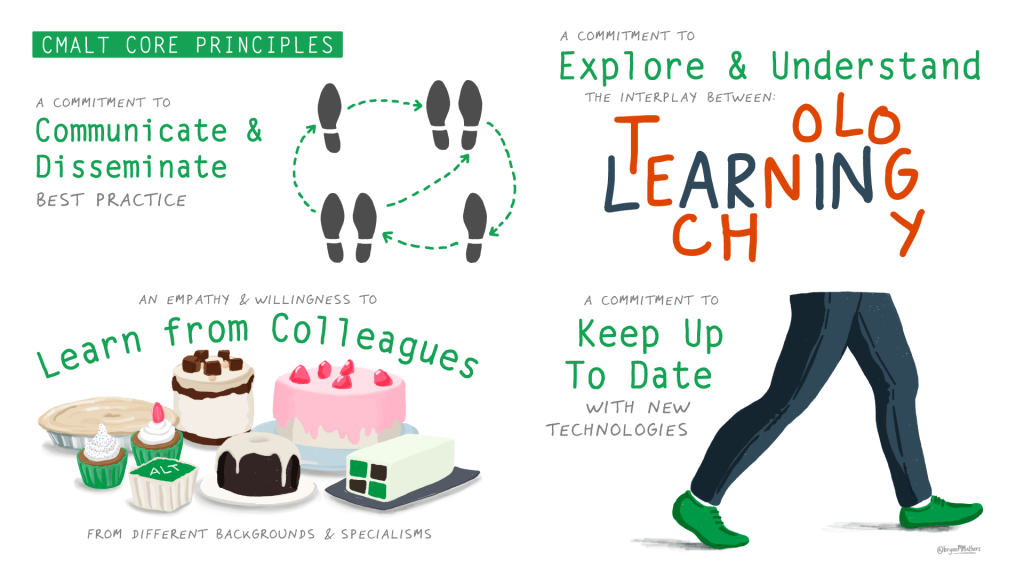
CMALT Core Principles visualised by Bryan Mathers
This year has seen a lot of work on professional recognition and cpd for Learning Technologists and this twitter chat at ALT’s Online Winter Conference formed part of a broader effort of consultation and development to forge two new accreditation pathways. With input from over a hundred Members, work has progressed so that Associate and Senior CMALT are launching in February 2019 – exciting times ahead.
Openness in education: a call to action for policy makers
Article on Wonke
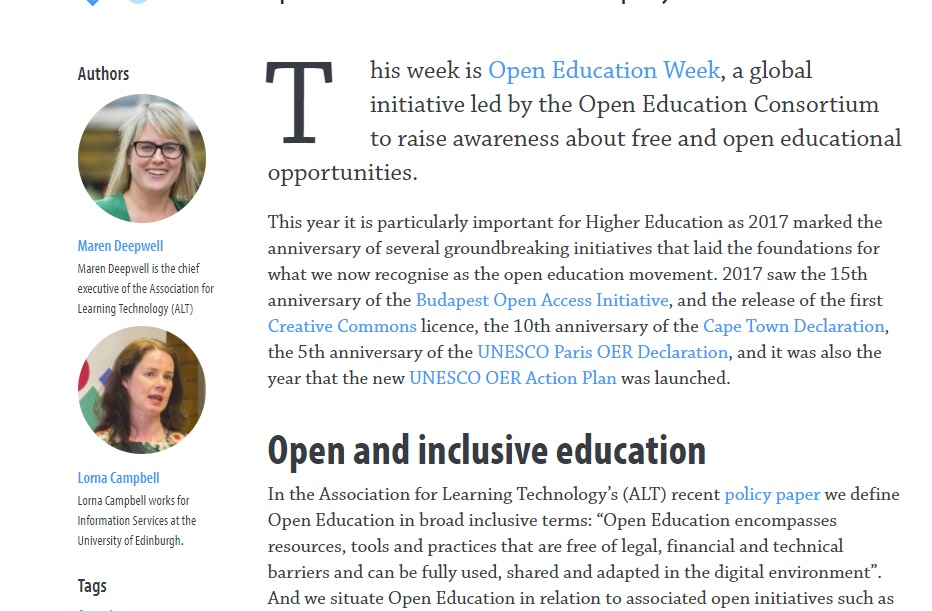
Together with Lorna Campbell I wrote this article on Wonkhe, which explains how 2018 was a “particularly important [year] for Higher Education as 2017 marked the anniversary of several groundbreaking initiatives that laid the foundations for what we now recognise as the open education movement. 2017 saw the 15th anniversary of the Budapest Open Access Initiative, and the release of the first Creative Commons licence, the 10th anniversary of the Cape Town Declaration, the 5th anniversary of the UNESCO Paris OER Declaration, and it was also the year that the new UNESCO OER Action Plan was launched.” Read more.
And finally…. in my own words: who shapes the future of Learning Technology?
This year I have a handy way of letting my work do the talking because much of what I am most interested in and many of the things that I feel are important came together in my keynote talk. This was a very special keynote to me and I was grateful to the Trustees of ALT to invite me to speak at ALT’s 25th Annual Conference. This post shares the slides and some of my notes for the talk and you can also watch a recording from the conference here . Thanks to James Clay for this video sketch note of the talk.
Keynote: Maren Deepwell – Beyond advocacy: Who shapes the future of Learning Technology?
I was delighted to be invited to speak at this year’s SEDA conference. It’s a special honour this year, as both SEDA and ALT are celebrating their 25th anniversary and my talk followed inspiring keynotes by Pauline Kneale, Pro Vice-Chancellor, Teaching and Learning, from Plymouth University and also Julie Hall, Professor of Higher Education and Deputy Vice Chancellor, Solent University Southampton as part of the conference programme.
Here is the abstract of my talk:
This talk will address the major themes of the conference – ‘meeting challenges’ and ‘supporting staff’ – from the perspective of learning technology, exploring recent developments in this area and discussing their relevance and implications for educational development and for the work of educational developers. For example, my review of initiatives and key developments from the work of the Association for Learning Technology (ALT) will include exploration of our new pathways to professional recognition and accreditation and discuss how these are mapped to other frameworks, including the UKPSF, QTL and Jisc’ Digital Capabilities. There are significant strategic challenges facing the sector and this talk will critically reflect on how we are solving these, sharing examples of research and practice from the ALT community and relating these to the larger questions they pose in relation to ethics, student welfare and the future of technology in education.
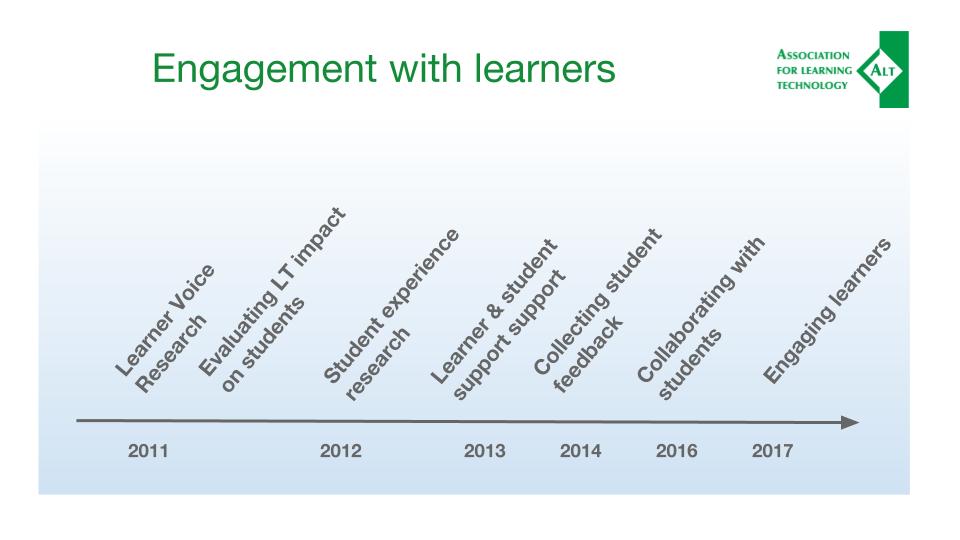
As well as looking at some of the challenges, my talk explored how we meet them and how things are changing, specially in relation to how we engage students – and how that has changed professional practice.
I am really looking forward to speaking at this year’s SEDA conference and I wanted to share a preview of my talk ahead of the event. It’s a special honour to be invited to speak this year, as both SEDA and ALT are celebrating their 25th anniversary and I look forward to hearing Pauline Kneale, Pro Vice-Chancellor, Teaching and Learning, from Plymouth University and also Julie Hall, Professor of Higher Education and Deputy Vice Chancellor, Solent University Southampton as part of the conference programme.
Here is the abstract of my talk:
This talk will address the major themes of the conference – ‘meeting challenges’ and ‘supporting staff’ – from the perspective of learning technology, exploring recent developments in this area and discussing their relevance and implications for educational development and for the work of educational developers. For example, my review of initiatives and key developments from the work of the Association for Learning Technology (ALT) will include exploration of our new pathways to professional recognition and accreditation and discuss how these are mapped to other frameworks, including the UKPSF, QTL and Jisc’ Digital Capabilities. There are significant strategic challenges facing the sector and this talk will critically reflect on how we are solving these, sharing examples of research and practice from the ALT community and relating these to the larger questions they pose in relation to ethics, student welfare and the future of technology in education.
As well as looking at some of the challenges, my talk is going to explore how we meet them and how things are changing, specially in relation to how we engage students – and how that has changed professional practice.
Part of my professional development for this year was to take part in the pilot schemes for new pathways to CMALT, ALT’s accreditation scheme for Learning Technology professionals. I acted as an assessor for the Associate CMALT pathway and updated and submitted my own portfolio, which was originally accredited in February 2016, for assessment for the pathway for Senior CMALT. Now that the pilot has been concluded, and I have been awarded Senior CMALT alongside colleagues who also took part in the pilot, I am updated the openly shared version of my portfolio here as well as on the official CMALT portfolio register.
In contrast to others, I did not choose to create a new portfolio in order to take part in the pilot, primarily because it is due to be updated in February 2019. Instead, I have added additional sections to my portfolio as follows (the other sections remain unchanged as they are already in line with the requirements of this pathway):
Specialist option(s): second specialist option added, Open Access research publishing in Learning Technology
Advanced area: new advanced area added, Promoting equality in Learning Technology
As this is a pilot of the scheme, it remains to be seen what the finalised guidance for this new pathway will say, but my portfolio will help provide a baseline of examples for future candidates.
For the first new section, I drew on an area of my work that I had previously not included in my portfolio:
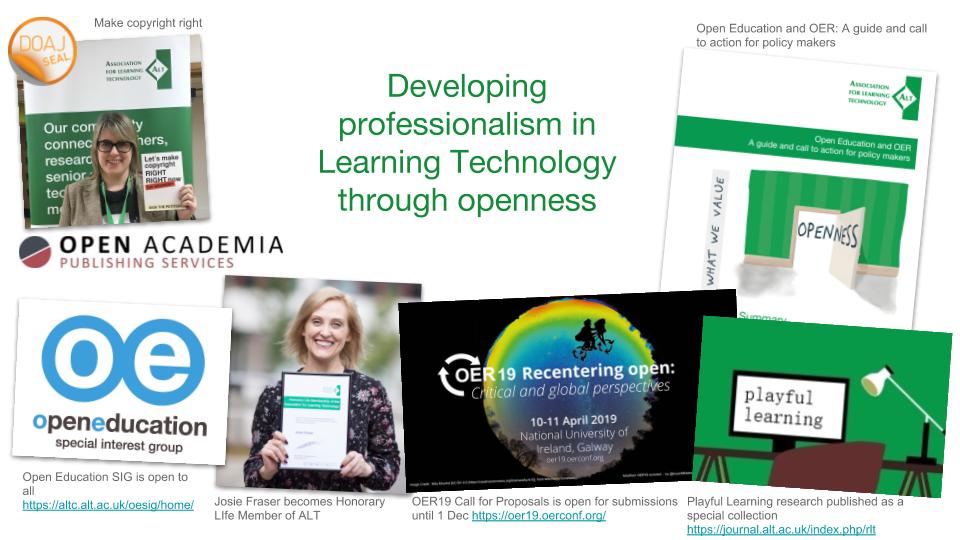
I have led and worked on a number of Open Access projects supporting research in Learning Technology including establishing the ALT Open Access Repository in 2009 (the wALTer Project), overseeing the transition to Open Access for ALT’s journal Research in Learning Technology (for which I contributed to the report on “The Transition to… Open Access”) and in 2017 the second and third transition of this journal from its Open Access publisher, Co-Action, to be sold to Taylor & Francis and subsequently taking independent ownership of the journal, which is now published by ALT in partnership with Open Academia. Since 2012 I have had responsibility for the journal, working together with its Editors and Editorial Board. In 2018 I led the establishment of a new strategic working group of the journal. The new group will help steer the development of the journal with representatives from other scholarly bodies including ascilite, ILTA and the OLC alongside our Editors. The group is chaired by Prof Neil Morris, who also chairs the Editorial Board.
Over the past 18 months I have negotiated the contracts for both transitions, first from Co-Action to Taylor & Francis and then from Taylor & Francis to ALT in partnership with Open Academia. I have project managed both transitions, supporting Trustees in their decision making as well as the Editorial Team. During this time ALT has had to suspend operations of the journal for several months and I regularly communicated with Members and other stakeholders during this time (including a transition announcement, publisher news, re-launch update and thank you). As part of my work with the working group, I have researched current practice for Open Access journals around journal impact factors and alternatives to these, including altmetrics, h index and Eigenfactor, some of which I have shared in blog posts and at the ILTA Annual Conference, EdTech2018, at IT Carlow, Ireland, in June 2018. Under my leadership, the journal has adopted Open Access best practice and has recently been awarded the DOAJ seal and has also resumed steady operations and is now publishing regularly including a recent themed collection on Playful Learning.
The other new section I have added is the advanced area of practice, and for this I chose to focus on how my practice contributes to promoting equality in Learning Technology. This is something I have written about before and also presented as part of my keynote at ALT’s Annual Conference in September 2018.
From this section, I’d like to share the reflective element in particular – relating how my work addresses the core principles of the CMALT framework:
Reflection
I have not only chosen this advanced area because I think it is really important to the success of my practice, but because in my view it has a particular relevance to Learning Technology professionals. Reflecting on the core principles of CMALT, here is how my area of advanced practice, promoting equality, relates to them:
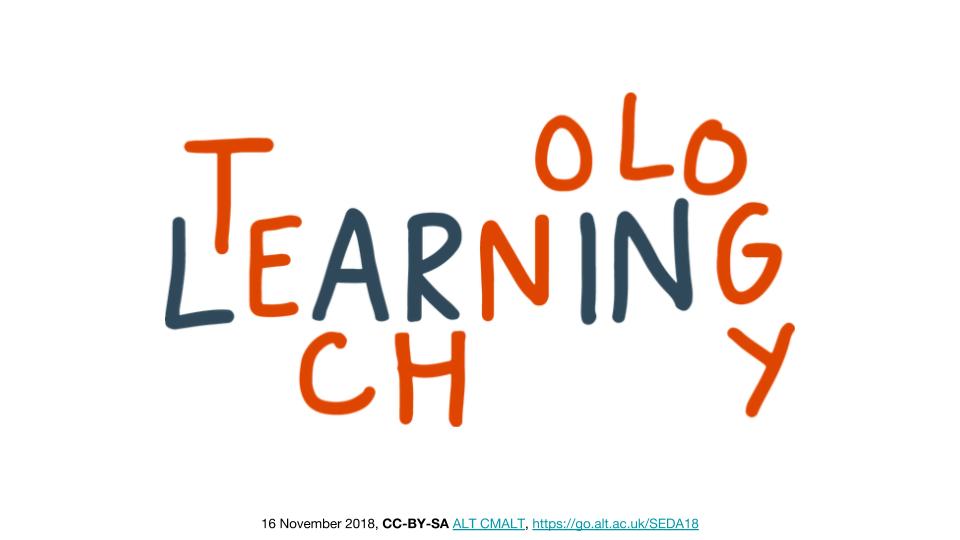
A commitment to exploring and understanding the interplay between technology and learning: Learning Technologists are often at the centre of negotiating an organisation’s, or a group’s, relationship to technology, for example students relationship to a social network or staff engagement with a cpd course. We are able to inform the perspective other, less expert, users have of how technology is used, understand how it affects our lives and our identities. How the data or content we create affects our work. At best, Learning Technologists empower staff and students in their relationship with technology, help them gain a more critical, reflective and thus effective long term engagement with the tools and platforms they use – and hopefully shape or create in future. It is a big responsibility and a big opportunity at the same time. If our practice, my practice, is shaped by values that prompt us, me, to promote equality, create greater equity and so forth, then we can make a real difference.
A commitment to keep up to date with new technologies: for me an important aspect of keeping up to date with new technologies is to understand their context: how they are financed and by whom, who has developed or tested them, or what kind of data sets informed their working, whom are they aimed at and what do they promise? What is their business model and how is it sustained? One piece of work I did this year is to collaborate with startups on a guide about how Learning Technologists can work together with start ups and through that project I had many useful conversations with CEOs of edtech startups. They were all young, white males and invariably the conversation about organisational culture reflected the pressure of moving at the speed they needed to whilst trying to have a more diverse team being in conflict with each other. It was an interesting first hand experience of how keeping up to date with technology and the constant need to catch up and adapt does not foster a culture that promotes equality. It is also an example of how our perception to need to keep pace with innovation, to move ahead, is used an an excuse, either consciously or subconsciously, not to diversify.
An empathy with and willingness to learn from colleagues from different backgrounds and specialisms: This is the core principles which most closely relates to promoting equality. In my own team I have led to establishing a strong practice of weekly meetings that include a show & tell element for example, enabling everyone in the team to ask questions, share ideas or show each other new tips or tricks from spreadsheet shortcuts to new tools we could use. Together as a team we take part in online cpd courses such as 23Things or a GDPR course on Futurelearn and I value the opportunity to learn alongside my colleagues, gain a sense of their perspective and understanding and to reflect this in my own.
A commitment to communicate and disseminate effective practice: Lending your voice to raising issues around equality is not a task for women, but for everyone and I am grateful to have many male colleagues who play an important part in this. But I don’t think you need to explicitly reference equality at all to effectively promote it. Simply taking a balanced view in whom you reference, whom you include in your perspective, can have a most powerful effect. For me, the OER Conferences are a good example of how to promote equality in Learning Technology, how to amplify the voices of those less often heard.
There is a lot more I hope to achieve when it comes to promoting equality in Learning Technology. I leverage what I have to make a difference and I do my best to take every opportunity I can to do so, but whilst I have a growing network of inspiring allies to work with, there is a multitude of indifference who will ask “So what?”.
For many, equality is something that doesn’t have anything to do with them. It’s not something they want me or people like me to go on about. It’s not a an issue because…”women can participate if they want”, because “no one is stopping them”, because “I haven’t experienced discrimination so it doesn’t exist”, etc. etc. Insert any number of cliches!
CMALT is a peer-based accreditation framework that retains its value because there is a continuous cycle of developing our understanding of what it means to be a Learning Technologist and what we understand to be good or best practice through being assessors and updating our portfolios. I think promoting equality is a big part of what makes me a good Learning Technologist and I hope that this new section of my portfolio demonstrates that.
If you would like to have a look at the full version of the portfolio I submitted for the pilot, you can access the Google doc version and the evidence folder.