Tag: #CMALT

  • Forging new pathways to professional recognition

    Forging new pathways to professional recognition

    This past month I’ve been doing a lot of travelling and contributing to a number of face to face and virtual consultation sessions about ALT’s accreditation scheme for Learning Technology professionals, CMALT.

    From Mozfest to Committee Meetings and from webinars to individual focus groups I’ve been hearing why fellow professionals value CMALT accreditation, what could be improved and how we may expand the scheme to offer valuable and robust peer-assessed recognition for a broader range of professional achievement. You can read more about the project on ALT’s website and also sign up for more information and to take part in the pilots.

    It’s been really interesting to hear about how the scheme could be developed and people’s experiences of their own journey to accreditation and then onward as a peer assessor.

    Last week the consultation coincided with a celebration of recent accredited staff at the University of Edinburgh and I was honoured to take part in giving out the awards.

    It reminded me once again how varied a professional landscape we have in Learning Technology and to how many different roles all across an institution the work of making intelligent use of technology for learning, teaching and assessment extends.


  • Talking peer based accreditation #Mozfest

    Talking peer based accreditation #Mozfest

    Some time ago I wrote a blog post about how ALT contributes to this year’s Mozfest together with my colleague Martin Hawksey. It was the first time for us to take our work to this event – one of the biggest of its kind anywhere in the world. Mozfest brings together a unique and diverse community from across the world and everyone gathers at Ravensbourne College in London over a weekend packed with all kinds of sessions, activist talks, making and discovering. 

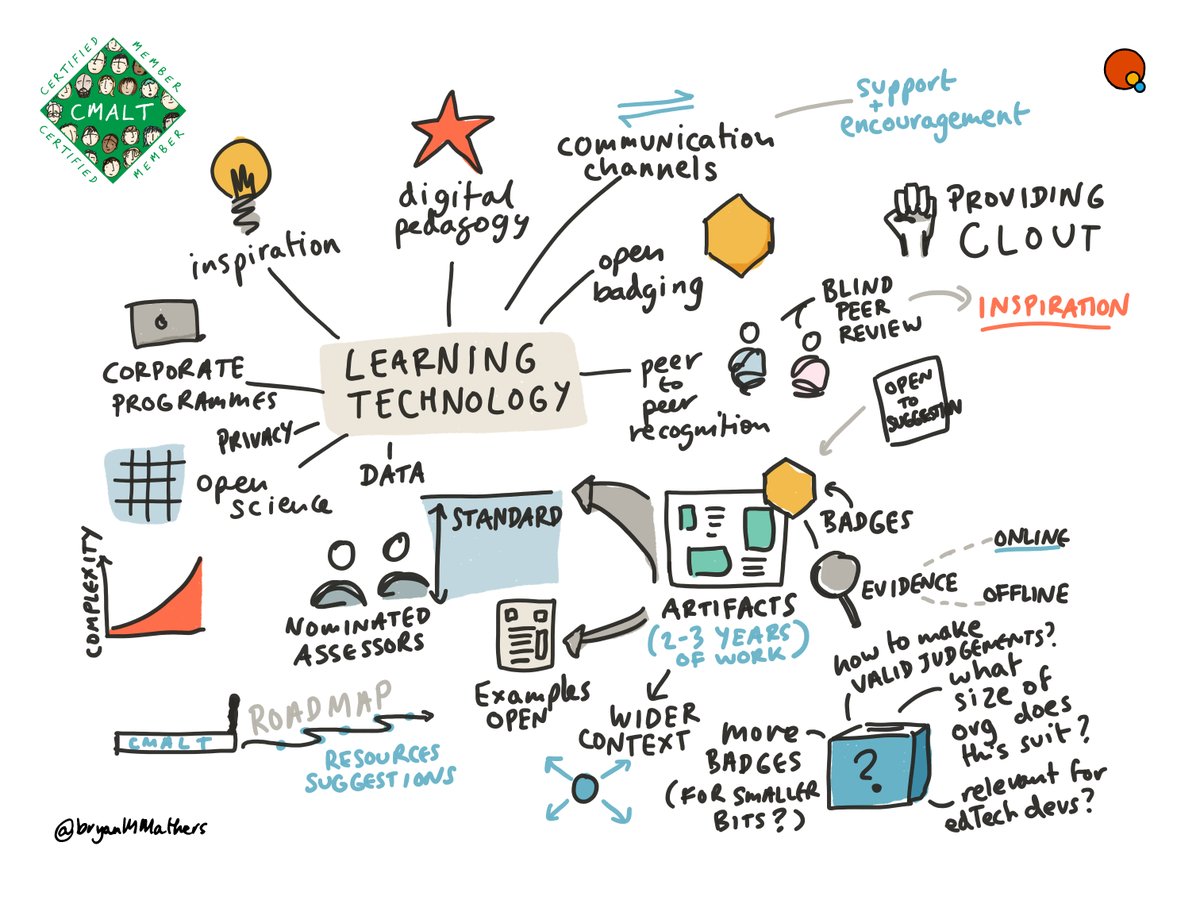
    If you are keen to find out what we talked about at Mozfest when we were joined by Bryan Mathers who contributed his Visual Thinkery to the workshop, have a look at our slides & links at http://go.alt.ac.uk/Mozfest17 which also include Bryan’s capture of participants’ contributions:

    Slides from our Mozfest workshop
    Contributions captured by @BryanMMathers

    Both Bryan (link to Bryan’s session on The Seven Co-operative Principles ) and Martin (link to Martin’s session: Machina a machina: An introduction to APIs through Google Sheets) also ran other sessions during the weekend and I am including links to them so you can explore a bit further.

    For me, my own first experience at Mozfest, which I thoroughly enjoyed, can best be summed up in these photos. It was an amazing experience – a big thank you to everyone involved in making it happen!

    VConnecting with Josie Fraser, Martin Hawksey & co
    The BEST badges
    Not a view out of the window our workshop participants were prepared for…
    I wanted to go to this session
    One of my favourite discoveries #Mozfest
  • Don’t think you are brilliant? Think again…

    Don’t think you are brilliant? Think again…

    … and yes, I am thinking about you 😉

    But, before we get too far ahead of ourselves, let’s go back to the beginning and how I came to (nearly) write those words on an assessment form.

    As a Certified Member of ALT I act as a peer assessor for portfolios submitted by candidates hoping to gain the accreditation. It’s part of my continuous professional development in Learning Technology and in the most part it is a rewarding, equitable and collegiate activity that I really enjoy.

    In recent months I’ve graduated from learning about the assessment process and gaining experience in collaboration with Lead Assessors to becoming a Lead Assessor myself and now that I am doing more assessments I have started to reflect on the professional practice I am seeing through various submissions. It’s interesting to see what others do, what they specialise in and how they reflect on their practice or research. Personally, however, I am often taken aback by how little confidence or sense of achievement is conveyed in the work being presented. So much that should be celebrated can be overlooked or left unacknowledged. So few seem to have the confidence or awareness to recognise their own achievements or even present them as such. In short, I often find myself wishing to convey congratulations or compliments alongside more practical feedback.

    And then, there are the blog posts or thoughts of others in my field who seem to find it hard to feel their voice is important, that their perspective is worth listening to and that their work goes beyond the ordinary. Like so many before me I find again and again that those who shout the loudest about their own accomplishments are usually least deserving of our time and attention. Which makes it even more critical that those who need encouragement and support receive it.

    I think a peer-based accreditation process like CMALT that has a strong element of self-reflection can help you realise that you’re brilliant (and yes, again, I do mean you…).

    Why is that you ask?

    Here are three examples:

    Firstly, making a long list of all you have done can help you gain a sense of perspective. In Learning Technology we often move on from one project to the next so quickly that we forget to pause and recognise what we’ve achieved and what difference it has made.

    Secondly, building a portfolio in a format and manner that you choose, that you can tailor to your preferences and style, can help you build a narrative of your professional development that you take ownership of. It’s not someone else imposing a structure or crediting specific actions – you choose and shape what you present.

    Thirdly, reflecting on what you are good at might surprise you, might point you in a different direction than the one you thought you were heading towards. You might realise that you are great at something that you never even realised before. You might be able to see your professional practice in a new light.

    You might not have time or the inclination to engage with a scheme like CMALT. But you should make time to reflect and recognise your own strengths and achievements.

  • Creating a #cpd #cmalt portfolio as a solo undertaking

    Creating a #cpd #cmalt portfolio as a solo undertaking

    At a recent session with a group of Learning Technology professionals we discussed how to best compile a portfolio for CPD and accreditation such as for the CMALT scheme. One of the options we discussed was to join forces either as a group within an institution or with peers elsewhere. In many instances that involves meeting up for writing sessions, progressing through the process at the same pace and sharing work in progress. There are a lot of advantages to this, but what if you don’t have that option? I wrote my own portfolio pretty much in isolation until it was very close to completion (full disclosure: it did take me three attempts over a 5 year period to actually complete it, so my approach is not necessarily the one to follow. On the other hand, I’ve learnt from the mistakes I made). So this post contains a brief overview of how to compile a CMALT portfolio as a solo undertaking.  

    Step 1: I started with the structure, copying the heading structure that’s required into a blank Google doc. At the start is the contextual statement, the future plans section is last and in between are all the required Core Areas as well as a placeholder for the Specialist Area.

    Step 2: I then looked at the structure and tried to write down 1-2 examples of work I had done in each section. I added no details at this stage, just enough information for me to be able to identify what I meant. It was very quickly apparent that I had a lot of examples in some sections, none in others. So I moved some around which could fit into other sections. Once I had covered all Core Areas it was easier to decide what to pick for my specialist option, basically something I hadn’t already covered.

    Step 3: Once I had the structure and at least 1 example in each area, I started with the section I thought would be easiest (1b in my case) and added a description and some evidence. Once I had those, I added the reflection at the end. That’s what I did for each section in turn. Some took longer, usually because evidence was time consuming to collect or reflection felt harder. Because I already had a scaffold (i.e. the heading structure and at least 1 example for each section), working on the portfolio moved ahead at a much better pace. In previous attempts I hadn’t planned ahead and found the blank pages ahead daunting each time I moved on to a new section.

    Step 4: Once all the required and the specialist areas were complete, I took a step back and started writing my contextual statement and the future plans section. That was a lot easier with the rest of the portfolio in place because the examples I used shaped what I wrote. Also, having reflected on my work made thinking about the future much more straight forward.

    Optional step 5: Because I wrote my portfolio in isolation, without peers or feedback or someone to compare it with, I felt some feedback would be useful before I submitted it. I sent it to a few people and they came back with useful comments which were incorporated. I also shared it with colleagues who were directly mentioned.

    Hearing about the sharing and support that groups or peers provide sounds like a great way to undertake CPD. In my case, writing my portfolio was mainly confined to odd anti-social hours and I needed to progress at my own pace. If, like me, you are on your CPD or #CMALT journey in a solo capacity, I hope this post is helpful and good luck!

  • CPD #cmalt as a springboard into openness and ownership

    CPD #cmalt as a springboard into openness and ownership

    Recently there have been a lot of interesting posts on Twitter #cmalt about how compiling a portfolio of your professional practice can be an open process (if you have not come across the #cmalt accreditation scheme, have a look at the ALT website or watch this).

    My own portfolio was accredited through CMALT in early 2016 and since then I’ve shared both posts about the process and the portfolio itself. But reading the recent posts made me think afresh about how undertaking CPD like compiling a CMALT portflio can be a springboard into openness and ownership – and some of the considerations I had when deciding on these issues.

    Considering others: in the context of a portfolio that describes and reflects on professional practice taking colleagues into consideration is key. Even though the CMALT process requires you to focus on writing in the first person, to reflect on your individual practice, anyone with management responsibilities or who works as part of a team, needs to consider how others are portrayed in what they share. In my case, I asked colleagues for permission if it was necessary to refer to them directly and I chose examples of practice specifically because they were suitable for sharing.

    Continuous reflection doesn’t have to be open: one of the key benefits of gaining CMALT for me is that it prompts me to continue my reflections on an ongoing basis as I collect evidence of practice for the update to my portfolio every 3 years. Some of this is work in progress or hastily written, so I don’t share it. I choose what I share, when and with whom and it’s valuable to have safe, closed spaces within my CMALT folders and documents that encourage critical reflection as well as recording achievements. The process of deciding what is open and what is less open in itself is a valuable experience.

    Contributing to our understanding of professional practice: as well as sharing my portfolio I have also added it to the sharing initiative run by ALT. It’s not openly accessible to everyone, but only to members or individuals registered for the cmalt scheme. I think this offers the advantage of being able to contribute to a wider picture of what professional practice in Learning Technology looks like as well as helping others find useful examples in their sector, job role or specialist area. It also provides an alternative way of sharing practice instead of putting your portfolio out on the public web.

    Taking ownership of what you share: I compiled my portfolio using Google Apps for Education (more info) and I use the same tools now to track my CPD and collect evidence as I go along. Loosing access to portfolios or evidence on institutional systems is a real risk for many and I wanted to keep my content for the long term. Recently, I have decided to take that a step further and started transferring my portfolio onto this site, my own domain (thanks to Reclaim Hosting!).

    Some of it is already available now at http://marendeepwell.com/cmalt/  and in the fullness of time it should enable me to take even more ownership of my professional practice and the recognition I gain.

  • #edtechReflection: getting started, reflecting on failure & other ideas

    In the previous post I talked about how the aspect of professional practice I have most conversations about is reflection. Whether it’s discussing how useful it can be, questioning how you can safely reflect openly with others or how to get started, it seems to be a key topic for many. For me it’s become clear how important a part of my professional development it really is and so I want to share my approach in the hope that it might prove useful or indeed prompt others to do likewise.

    I have included tips for getting started, reflecting on failure and reflecting in the first person as well as developing reflection as a professional habit:

    Have a look at the slide deck below and do send me your thoughts or feedback:

    You can also access the slide deck together with my CMALT portfolio at https://goo.gl/44I4Bd .