We about to embark on the third and final year of ALT’s Strategy 2017-2020. Together we have made strong, strategic progress putting our shared values into practice and meet our aims for Members and for public benefit, too.
We reported to Members and stakeholders from across sectors in ALT’s Annual Report and at the AGM in September about the changes to our organisational and governance structures. The transition to an independent, distributed organisation, has allowed us to make huge leaps in terms of meeting our strategic goals.
Since September, much has happened and so we are are now sharing more of what we have been up to in the year that saw ALT celebrate its 25th anniversary:
Open research
A key area for growth has been the Open Access research published in ALT’s journal. The full back archive reaching back to 1993 is an invaluable resource for Members at a time when reliable research is increasingly important for efficient use of Learning Technology and informed decision making.
Member organisations from industry including Blackboard and Moodle as well as individual experts such as DCU’s Head of the Teaching Enhancement Unit, Mark Glynn, have led a series of webinars on GDPR organised by ALT’s Chief Innovation, Technology and Community Officer, Martin Hawksey. Much of this work has been shared with other sector bodies such as ELESIG Scotland and also fed into ALT’s recent response to the All-Party Parliamentary Group on Data Analytics inquiry into data and technology ethics.
Enhancing professional recognition
We have also completed the pilots for Associate and Senior CMALT. These two new accreditation pathways for Learning Technology professionals will launch later this month. Led by Operations Manager, Susan Greig, working closely with Certified Members and Lead Assessors, both pathways will be supported by a growing body of community-sourced resources and a baseline of example portfolios that set a robust standard for professionals at different stages of their career and across a broader range of roles than before. We invite you warmly to sign up for the launch webinars for Associate and Senior CMALT to find out more.
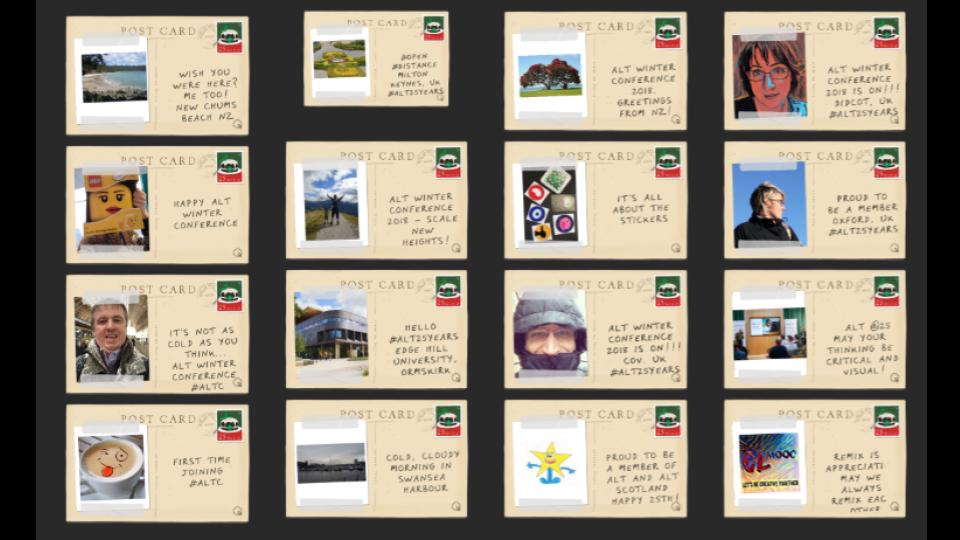
Postcards celebrating ALT@25 remixed by ALT Members
ALT Assembly
ALT’s Membership has now grown to over 3,500 Members and as a result many of our activities are now scaling up to support the larger community. Alongside increasing our operational capacity, the Board of Trustees led Members in the effort to update ALT’s constitution, bringing it in line with best practice set out by the Charity Commission and also to ensure that in our governance our community is at the heart of everything we do. That is why as part of the updated governance structure the new ALT Assembly committee has been established. The ALT Assembly is the overarching committee advising the Board of Trustees, supported by Tom Palmer, ALT’s Membership Manager, it will be bringing together former operational committees, publication and events related groups and boards as well as Members and Special Interest Groups. We hope that the Assembly will help improve communication for Members actively involved in ALT as well as the impact of the work we do together.
ALT marks one year operating as an independent organisation
In our report above we have focused on the work our Members do and with that in mind it seems only fitting to add a final update on developments that have seen us increase our organisational capacity to support Members across the UK. Today’s date, 1 February, marks the first anniversary since ALT began to operate as an independent, virtual organisation and employer. Whilst major restructuring and transition have been ongoing for most of the last 18 months, disruption to services for Members have been minimal. In keeping with ALT’s commitment to openness, Members have been regularly updated throughout the process and ALT’s senior staff have shared the journey informally in a monthly series of blog posts on open leadership. Having successfully weathered the transition, we now look forward to the benefits the more agile and distributed organisation structure will bring.
Thinking about the year ahead, with the results from ALT’s Annual Survey due to be published soon and a packed calendar of activities already planned, we look forward to increasing the impact of what we do as the leading professional body for Learning Technology in the UK. Members will convene the Assembly (both face to face and online) in the next month to work together and this new development inspires and reminds us that each contribution to the work we do makes a real difference to our growing Membership.
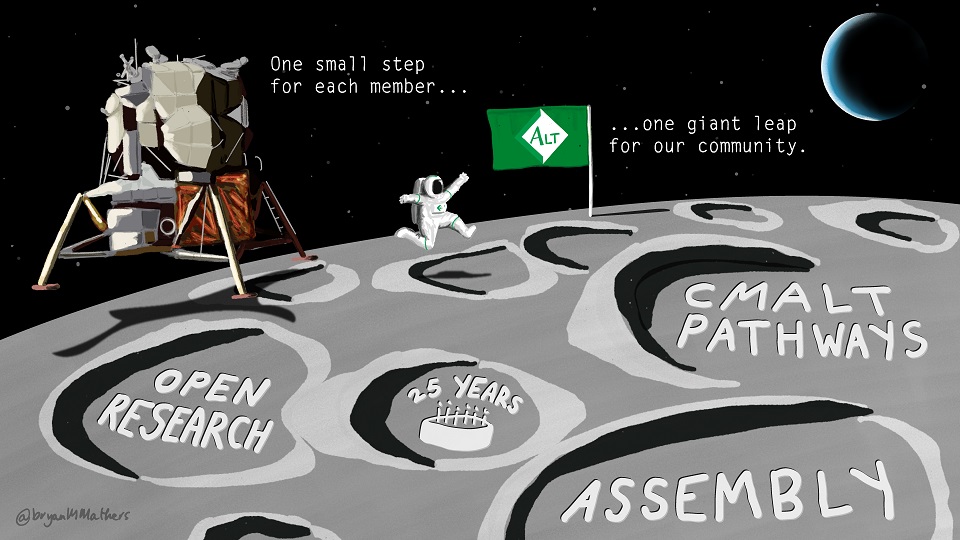
Together, and on behalf of the Trustees and staff, we thank you for helping us making many small steps into one giant leap forward over this past year.
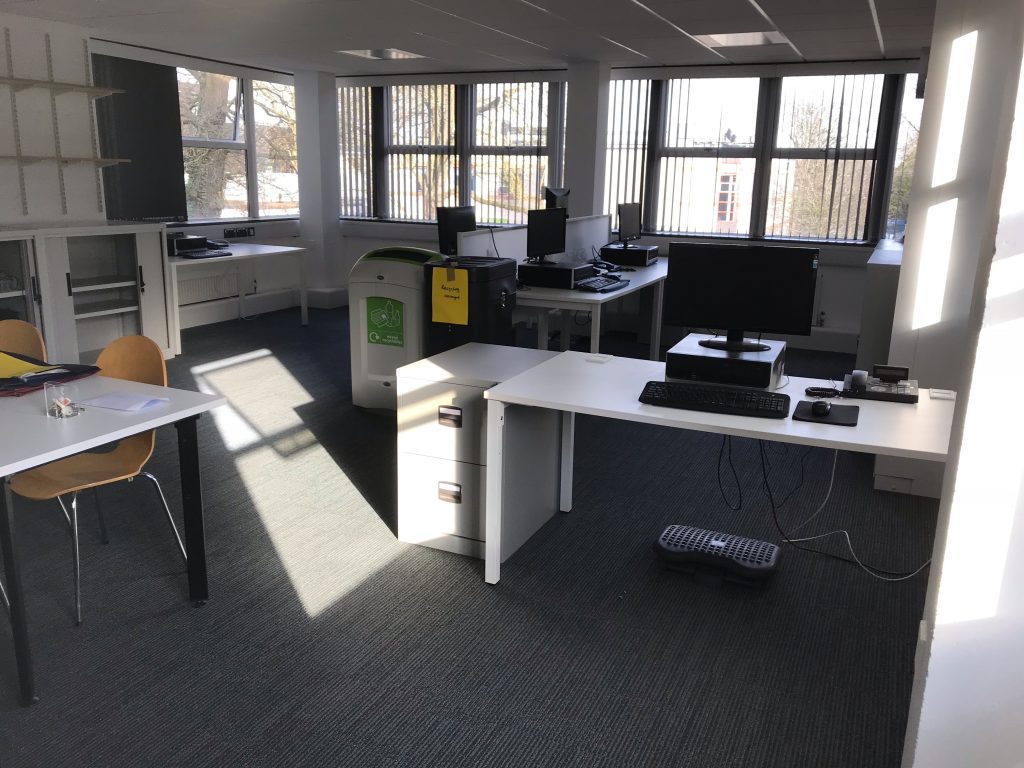
A year ago this week I locked the door to this office for the last time, handed back the keys to the estate manager (never seen such a tidy move, he said) and left the building – leading my team, my organisation into the brave new world of being a distributed organisation, a virtual team.
You can read all about what happened next… the official updates for Members written by Trustees and myself, in formal reports and audited accounts and the less formal account published in a joint series of posts with Martin Hawksey, which includes even podcasts. All together these will give you insight into how resources were saved and reinvested more effectively, strategic aims achieved with more impact, lessons learnt, home working cultures established and so forth. I am proud of that record one year after closing the office and whilst this is of course an ongoing progress of transition, there is clear evidence that all the aims we set out for the transition when we originally started planning 2 years ago have been achieved and even exceeded. It’s been a team effort.
So what’s it like to be a CEO without an office? What’s it like to represent a long established professional body without a physical base? How does it feel to be a Line Manager, everyone’s boss, remotely?
Well, let’s start with the last one: currently I manage 6 people and 4 of the 6 were recruited as virtual team home workers, to be part of a distributed organisation. I spend the same amount of time on all the things you do to manage, support, motivate and be there for others – just the way in which we connect and the locations where we see each other are now more varied. In turn, everyone, including myself, spends just as much time and effort being part of a team – again, just in different colourways and with different challenges. Instead of dirty cups that no one has washed up or bins that overflow, we focus on the logistics of office supplies or connectivity. Instead of having light bulb moments sitting around a meeting table, we have inspiring ideas meeting around a document. It works, we deliver and perform.
As the leading professional body for Learning Technologists the Members we serve as an organisation are probably more likely to appreciate the potential of technology when it comes to running an organisation. Many people involved in ALT have experience of being part of a virtual team, collaborating with others who are not based where they are and they appreciate the power of a distributed network. So when we moved from having most staff based in one location to having staff based all around the UK, there was nothing but welcome for the opportunities that opened up. Members have hosted us for the day when we all come together or have a visit, kindly providing us with a base for the day. More support for volunteer-led activities all around the country makes us a stronger community and provides greater contact with Trustees as well. If for those already involved in the organisation it hasn’t been an issue, there have been plenty of partners and other organisations who have taken some convincing. I often meet with the question of where am I based, and when I explain that we don’t have a physical HQ anymore, they aren’t really clear how that can work?! Or indeed how professional or serious we can be if the address on our business cards is now to the website. We do of course have a registered address, and a postal one for correspondence, too – but the small amount of physical post that arrives at either (and indeed our old address one year on) is rarely more thank junk mail. Although we really do appreciate the holiday greetings 🙂 That said, as we continue to work together even for those who were initially sceptical the issue of where we are based fades into the background. We deliver what we promise, we are responsive, we work hard to help where we can and all of that builds trust better than bricks and mortar.
But the question most personal to me is probably what’s it like to be a CEO without an office. To some people, it’s a akin to what it would have been like to be upper class without an estate. The office, the estate, the shiny things within bright white rooms or dark grey rooms or brightly coloured rooms with free food and pool tables… the assistants, the clothes, the coffee, the meeting rooms, the tech, the desk, the chair – the drama of welcoming guests to your office! What kind of CEO can I be without all of that? Most of the CEOs I meet are seriously wondering (and in many cases they already have to contend with my gender, age, nationality to overcome their preconceptions). Of course, there are plenty of other CEOs and leaders who are working, and have been working for decades, without an office, based remotely or travelling a lot. That’s not a new thing in itself. But sadly in many cases those in power fit the traditional template here in the UK and so their casual insistence to visit our offices, meet over coffee etc often turns to puzzlement when there is no physical space for them to pinpoint that represents the organisation I lead. For me, it’s helpful. It can be very insightful to see how people react to the “no office… virtual organisation” answer to their question about where I am based. It helps me chose how I approach them better. For some, it endows me with tech credentials (she needs to know something about tech if she runs the organisation from home…), for others, it conveys a sense that I have a flexibility approach to work, maybe understand more about work/life/family balancing acts. It can also signal that I care about putting resources where they make the most impact for the charity, rather than having a plush office. A year in, what I know for certain is that without an office I can very much be the CEO I want to be, maybe more so than before. I love the freedom not having to manage physical space has opened up and the bigger perspective it has given me.
So this Wednesday, when the first anniversary comes around, I shall be raising a glass to mark the occasion. Not to celebrate exactly, but to remind myself of something a colleague said to me the day we handed the keys back. It’s quite remarkable what you can achieve when you put your mind to it. Cheers.
When I was a young teenager, I asked my parents for a (mechanical) typewriter for my birthday so that I could type my journal, plays and poetry – on coloured paper mostly. I didn’t have the internet.
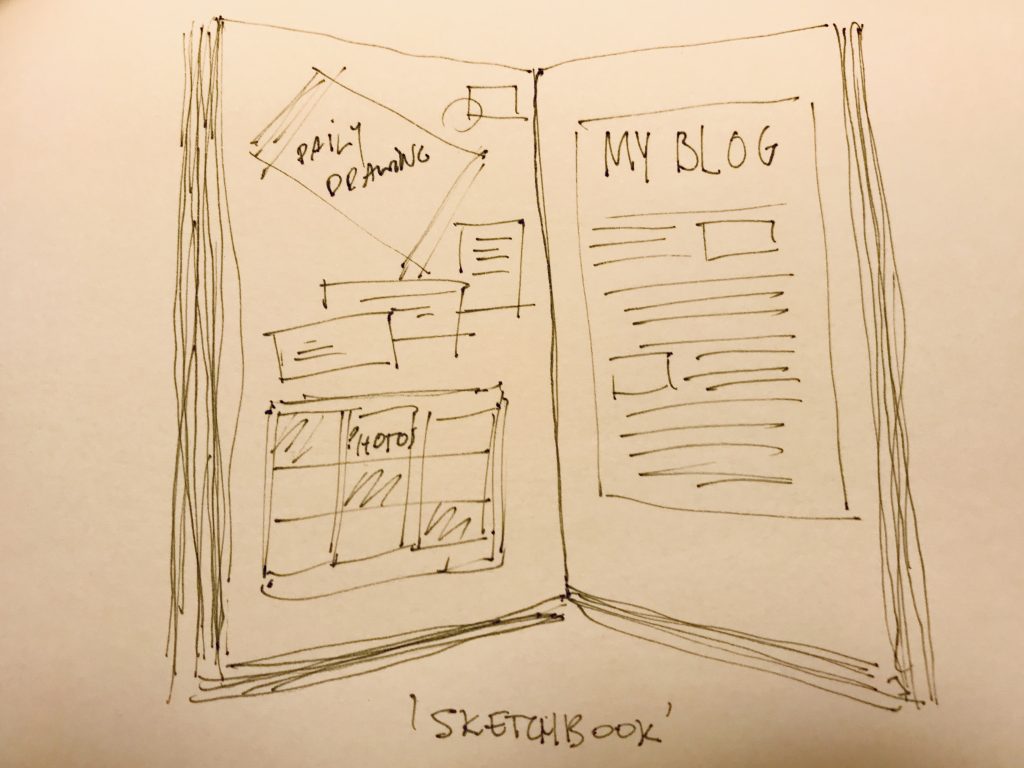
When I was an art student, my sketchbooks had pockets, windows, some smelled of strange colours or oils I had tried out, some trailed plaster dust or were covered with fabric. I also had a blog filled with all of these things (no longer accessible).
When I was writing my thesis I had binders full of flyers, photos, product samples, stories, interviews and even dried plants. I also had a blog: now the cemeteryscapes archives.
Now, I have a private blog, notebooks of daily drawings, archive boxes of things I collect for inspiration, thousands of images, cups filled with stickers and badges, many places where I write and reflect and thanks to Reclaim Hosting I have my own domain. This blog.
This is the tip of the iceberg of the messy, constant creative process that is the way I think and work. It includes images and drawings and slide decks and links to things and stories and conversations and my portfolio of professional practice. It also has many typos, personal anecdotes, moments of my life that I have chosen to share.
Sometimes I write on other platforms, for my organisation, for academic purposes, to promote things, to provide commentary, to inform, to share… but usually all things I do end up at least linked to from my archive, if not backed up on this site. All together it constitutes part of my ‘sketchbook’, part of my practice, the most open part of my practice. What’s important to me is that it forms part of my process, through which I am prompted to reflect, to work out ideas, to develop my thinking and that I have a record of that.
Having a record of my work is extremely useful when it comes to appraisal time, when I want to send a link to someone, when I need examples of things I have done. It also stops me from moving always forwards without looking back, without appreciating all that I have done, even if much of it is not polished, or finished or maybe even never sees the light of day. It includes mistakes and errors and things I’ve changed my mind about. I feel I have a measure of control, because it is my own platform.
Curiosity and creativity are messy. My work is, too. Much of it is not productive, it doesn’t lead anywhere, it’s not for public consumption, for others. It’s for me. When I have a good idea in the shower or when I’m out for a run, sometimes that idea ends of being part of my work in a way that surfaces, but most of it isn’t. That doesn’t make it less important. It’s one of the things I learnt to appreciate at art school. To appreciate that I can’t always tell what may be useful to know or keep or read. To value distraction and diversions and the unexpected. Blogging can be part of that.
You reading this now is a bonus.
In my view, open practice isn’t primarily for others. When I write on my own blog, I don’t write with an audience in mind unless I am writing for a specific event, i.e. a keynote transcript for example. I take an informed decision to publish, because I want to. I want to share my practice, provide insight into what I do and to add my voice to how professional practice is articulated. I want to be visible. But it’s not for others. If no one reads this, and plenty of my posts have only a handful of readers, that is fine with me. It doesn’t make it a less valuable part of my practice. I am in a position of privilege, yes. In addition, I have the resources and skills to host my own domain to be able to do this, blog in this way. But in one way or another, this kind of writing has been part of my life for three decades, from typing onto the coloured pieces of A4 paper, leftovers from my mother’s disused work folders, to scribbling into sketchbooks to years worth of post-it notes that accumulated during my research student years.
There is a famous quote by artist Rick Beerhorst about sketchbooks that describes well how I feel about blogging as part of my creative process: …”[Sketchbooks] help me stay free and, at the same time, help me get connected to the world around me in a deeper way”.
An inspirational hour with Lorna Campbell on blogging as academic practice, which Lorna kindly facilitated for me and my colleagues inspired this blog post and I am deeply grateful to Lorna and all who’s blog posts inspire me on a daily basis. Thank you.
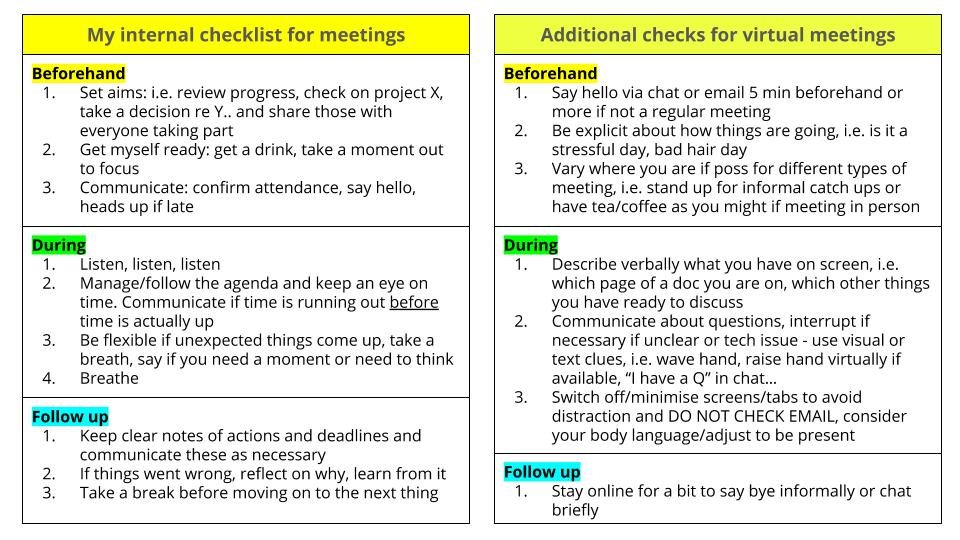
This post continues the series on openly sharing our approach to leading a virtual team – a joint project with Martin Hawksey (cross-posted here) for which we write a monthly blog post and this time recorded a podcast for you, too.
What a year…
With the transition to becoming a distributed organisation and one year of leading our virtual team under our belt, we reflect on the highs and lows, the good and the bad and most importantly on what’s ahead as we continue to develop this project in open practice.
Maren: There’s so much I’d like to talk about that it’s hard to know where to start. First, I’m excited about how a transition plan on a spreadsheet has turned into reality, how the organisation we lead has changed over the past 18 months. Second, there’re 101 things I’ve learnt along the way, from how to set up a PO Box when you are a distributed organisation (harder than you think) to how to manage a virtual team and all that that entails. And then there are all the things I’ve discovered about being a home worker… during summer holidays, family emergencies and when things go wrong. It’s never been boring, that’s for sure!
How about how? What’s been most surprising and rewarding this past year? What are you most keen to develop next? This time next year… will we be millionaires?
Martin: Time has really flown by, it only seemed like yesterday that we started putting in place some of the operational changes for moving to a distributed organisation. It’s only the fact that I’ve started to receive renewal notifications for annual licences for things we didn’t require before in a host institution that I’m reminded of the realities of the changes we had to put in place. In some ways I have to say that the most rewarding thing in the past year has been the shared monthly posts we are doing. When we started I thought it would be useful to share with others the journey we as an organisation were on. I’ll let others decided whether it has been useful or not, but regardless I’ve personally greatly benefited from the opportunity to reflect on progress and consider where we go next. Reflecting on December something that stood out for me was in September’s post on the ‘serious upsides of working in pyjamas’, we discussed remote worker wellbeing. In December as the cold has set in it’s been noticeable how we’ve swapped pyjamas for thick jumpers and blankets. As a remote worker you’ve the benefit of having more control over your working environment. The downside I find, particularly if you are a skinflint like me, is you are reluctant to put the heating on if you are the only one in the property. As an employer our organisation is limited in what we can do. We all get a home working allowance but that is limited and it is up to us individually to decide how it is used. Seasonal variations in remote teams wasn’t something I had anticipated. Do you have any standout unanticipated moments?
Maren: It often feels to me like this whole year has been one long unanticipated moment. There’s definitely a lot we could talk about in that whole area of remote working and wellbeing. Writing these posts has helped us both become more aware of the complex issues involved and it’s interesting just how much there is to unpack here, both from the perspective of a small employer and ourselves as individuals. Another question you touch upon is whom this kind of open leadership practice is for. Our readers include our own team, the Board of Trustees whom we report to, Members of ALT and our professional networks. On Twitter, LinkedIn and our own blogs as well as at events we’ve been getting comments, questions & feedback – and many of them are about open practice rather than the virtual org transition. Senior staff don’t often adopt the approach we are taking, to discuss the inner workings of their organisation as they happen. Bringing our Learning Technology open practice into how we lead the team and managed the transition feels like an important step forward. It’s prompted me to think differently about innovating, about improving things even if they are new/in progress. No one gets to start new things on a blank slate or with everything in steady state very often. There’s usually legacy issues, deadlines, risks etc from the outset. By making time to focus on how we run the organisation we’ve been able to innovate much more in that area and that’s been exciting.
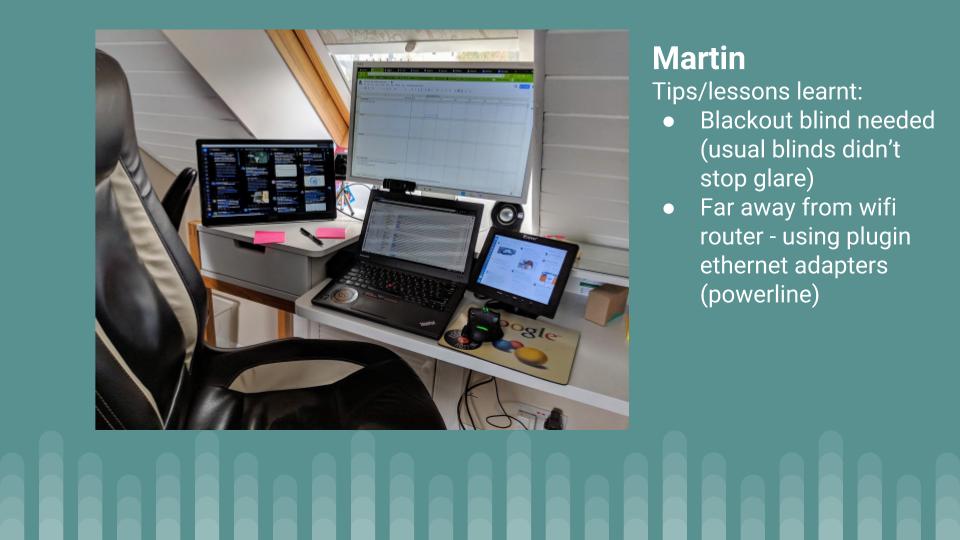
Martin: You touched upon space in terms of time and locations such as various social networks. Something I’ve been thinking about more is mental space. This is an area we’ve talked about a couple of times, but a recent experience reminded me how important I find it to compartmentalize my workspace and personal space as part of being a remote worker and also how difficult it can be sometimes for others to understand this. Recently my parents were staying with us for the holidays. At home my ‘office’ is also the spare bedroom. Having a dedicated space for me to work is very important, not least it means I can just go to work each morning and not have to set up anything, I just switch on and go. This year my parents wanted to stay a little longer which meant they’d still need the spare room while I went back to work. As part of this they said they would make sure they would be out of the spare room/my office by 9am each day. Initially I didn’t say anything but in the end had to say to them it wasn’t going to work for me. The issue I had in my own mind is going to the office as a remote worker is more than just being at your desk at 9am. With suitcases and clothes lying around I was worried it was going to feel less like an office. Knowing my parents were in the house I was worried it was going to feel less like being at work. I appreciate for many these things sound trivial, but for me they are very important. If I worked in a traditional office in my own mind I knew it was going to feel like having my parents sitting in reception all day. I think this aspect of remote working can be hard for others to appreciate. Have you had any similar experiences?
Maren: I’ve not worked from home for as long as you have and regular travel is a big part of my role, so I come to this from a different angle: I have created a mental work space that I can function in properly on a train, hotel room or at an event. I feel comfortable in that space. And it’s probably why I have a strong attachment to my chromebook, stickers and all. That said, creating that space in my head at my home has been tricky! Trickier than I had anticipated especially given how rarely I was desk based before working from home. And like you I prefer having physical space that’s ‘mine’ for that – but limited space, my cat, family etc really challenge that at times. I hated strongly disliked working in an office and I feel working from home is a hard won privilege. I love working from home and it suits me really well. Still, I have had to rearrange my set up at least 5 times in the first year, moving furniture, changing equipment, adjusting to how the sun comes in through the window and so forth. I have ended up with a yoga bolster as a footrest and using the windowsill as a temporary standing desk. I’m also a carer for my parents so my work/family lines are already blurry, but working from home has made that more… prominent in my mind. I may have also come to the conclusion that I would ideally need a bigger house! My work space is adjacent to the family bathroom and the main space to dry laundry as well as the notional spare room. Like you, I have to try and articulate my workspace not only in my own mind but to family, friends, guests & my cat. It reminds me of a Seinfeld episode in which George is talking to Jerry about his new girlfriend making friends with his other friends, how those two parts of his life are starting to mesh and he feels panic because he fears losing space to be ‘Independent George’ and end up being ‘Relationship George’ all of the time he shouts: ‘worlds are colliding, Jerry!’ I feel similarly about working from home – sometimes it seems like worlds are colliding.
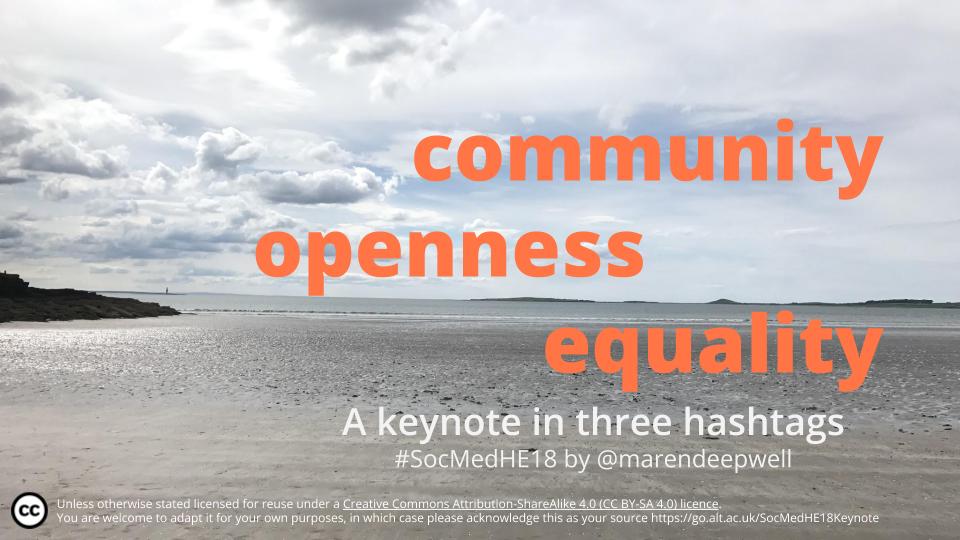
Given that it’s early in the year and a cold, dark morning in Nottingham, UK, I felt it would be useful to start this talk with a sunnier view of beach near Sligo, Ireland, a place to feel the sun and the sea on your skin, a place to take some time to reflect and breathe and take a break. Those aren’t things that I generally associate with social media, in particular in Higher Education. Social media often comes with a general sense of the superficial, showing just the best side of myself, trying not to avoid being vulnerable for social media can be a toxic space for many, particularly for women, for people of colour, for anyone whom the trolls choose to single out. So if you are already a place in your year where you feel your digital shadow is looming large, maybe it’s time for a digital detox https://datadetox.myshadow.org/en/detox . I came across this useful tool via Mozfest a few years ago and I found it helpful as a way to check in with my relationship to social media.
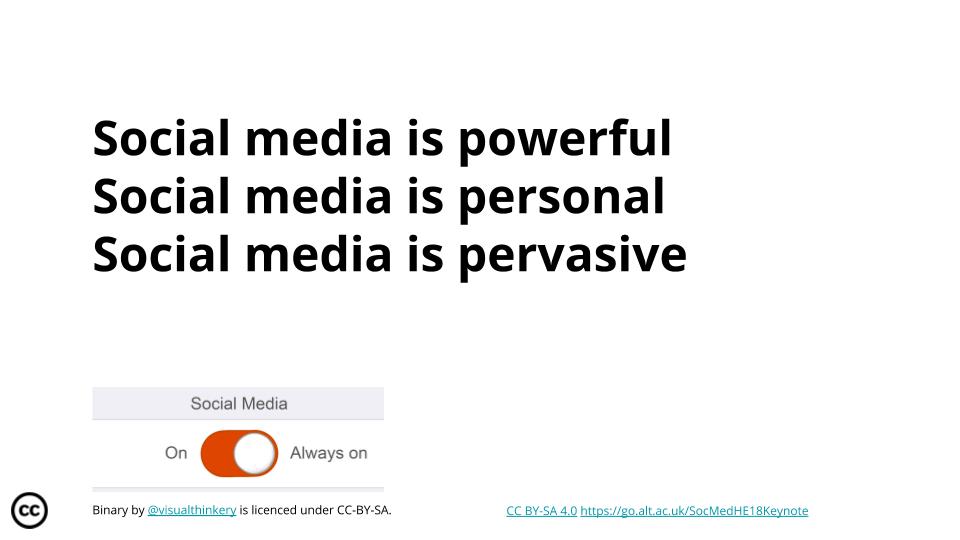
Slide: Social media is powerful. Social media is personal. Social media is pervasive.
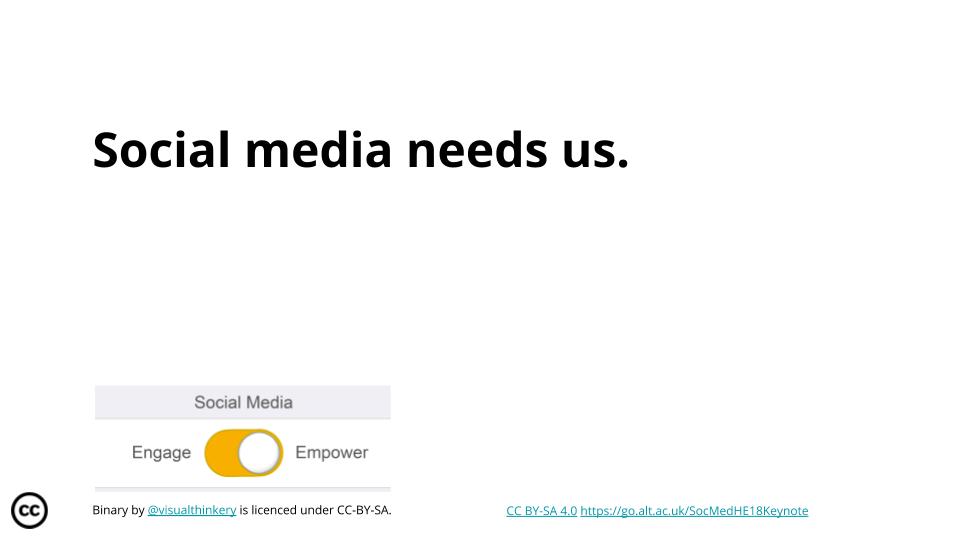
It’s important to think about because social media is powerful, it’s personal and pervasive. It’s part of our personal lives and professional practice in education. It’s part of what our colleagues do, how our learners work and part of our social reality from citizenship and dating to job hunting and even death and remembrance. As human beings we rely on our social interactions no matter how they are conducted and in this age social media is part of how we live for an increasing proportion of the global population. Because it is important, we can’t leave it up to others. Because it’s important, social media needs us. Social media needs us to question, investigate, reflect on, engage with, challenge, shape, control, monitor, analyse, track, investigate, govern and take ownership. And that’s what I’ll explore in this talk in three hashtags:
How is social media changing professional practice? How does social media support openness in education? Social media for social good?
Slide: #altc – a perspective from Learning Technology
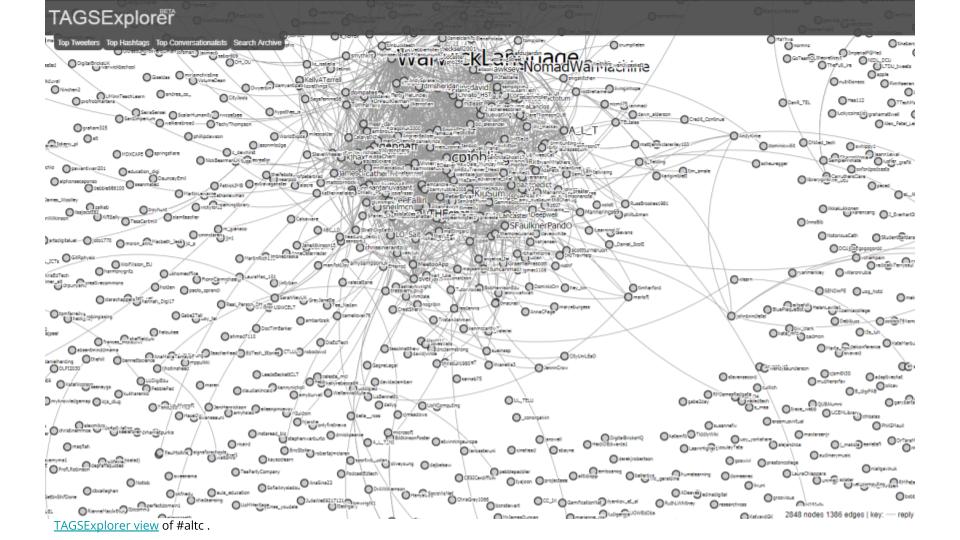
The first hashtag is #altc and it’s probably the biggest hashtag in my working life. To begin with the hashtag was used only during events, mainly ALT’s Annual Conference and it changed each year. Since 2014 however the hashtag has been used not just for the conference, but increasingly throughout the year. To begin with the “c” stood for “conference”. Now the hashtag has come to mean more than that thanks in large part to the vision of ALT’s Martin Hawksey, now the “c” stands for community, conference, create, collaborate, communicate and so forth. And it now generates more tweets in a single week during the Annual Conference than we previously recorded for an entire year. It’s developed far beyond the single use event hashtag it started out as and that reflects how the activities it supports have expanded also. As a membership body for Learning Technology professionals, ALT has become very active on Twitter and our network and the conversation is growing – you can see how this is visualised here on the TAGSExplorer view of #altc .
Slide: TAGSExplorer view of #altc
The community is now active throughout the year and the way that social media is used really varies and includes individuals actively using the network to share practice, ask questions and celebrate achievements. ALT as an organisation is powered by its Members many of whom volunteer for the Association and one of my favourite examples of using social media and the #altc hashtag last year was celebrating ALT’s 25th birthday. We wanted everyone to be able to celebrate whatever is important to them, to add their own voice and for the anniversary to reflect some of the diversity and breadth of the community we serve. On social media you could thus create your own celebration postcard, including your message and image, remixed under a Creative Commons licence using the Remixer developed by Bryan Mather/Visual Thinkery (go to https://remixer.visualthinkery.com/ and have a go at remixing yourself). It’s a small way for individuals to have a voice in ALT, be able to shape the organisation and reflects its values and aims to encourage participation and collaboration and openness.
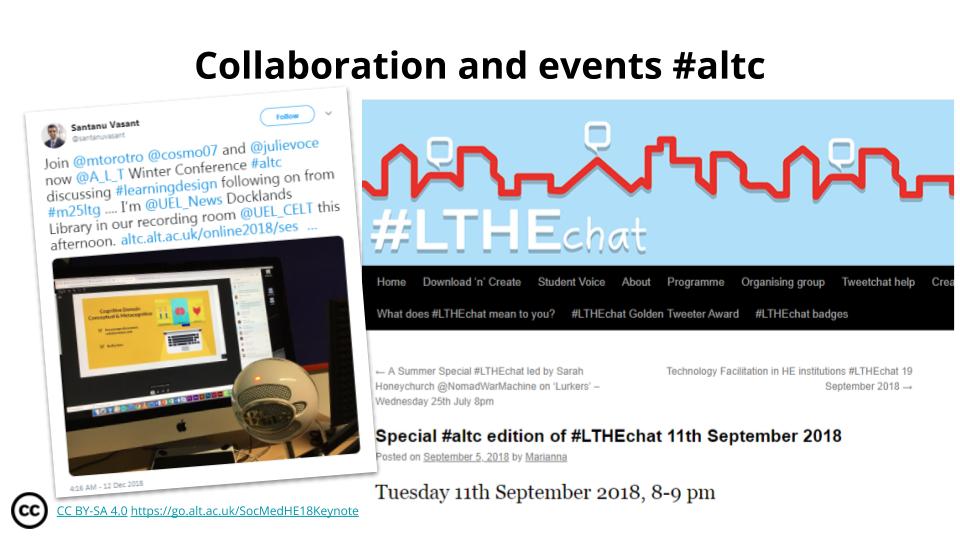
Slide: collaboration and events #altc
Beyond individuals we have leveraged the power of our hashtag to collaborate with others and to enable relationships between Member-led initiatives and the centrally supported network. That’s particularly important in Learning Technology as much of the work we do reaches across disciplines, sectors and often beyond the UK. This approach to social media isn’t about distributing marketing messages or one way communication. Our aim is to support and develop a positive online space, a social media channel that Members and the wider community can make us of and have ownership of, a space that supports our work in strengthening professional recognition and advocate for our Membership.
Our Members meanwhile have a strong open ethos and much of what we do is consequently openly accessible to the benefit of the wider community. Openness is so important in Learning Technology because the tech landscape develops at such a rapid pace that the most effective way to keep pace with it is in collaboration with others, by sharing resources, research and reflection. Like social media, openness is not unproblematic and like social media openness has great potential in education. And that brings us neatly to hashtag number two and also to my second question: How does social media support openness in education?
Slide: #open
I want to start by highlighting two examples, two policy developments in Higher Education, that I have worked on, firstly the Higher Education Funding Council for England Consultation on the second Research Excellence Framework and then also the Open Education and OER – A guide and call to action for policy makers. The first is particularly relevant because it provided an opportunity to argue the case for the role of social media in how impact is measured in Higher Education and the second as it highlights how Open Education and OER can expand inclusive and equitable access to education and lifelong learning, widen participation, and create new opportunities for the next generation of teachers and learners, preparing them to become fully engaged digital citizens.
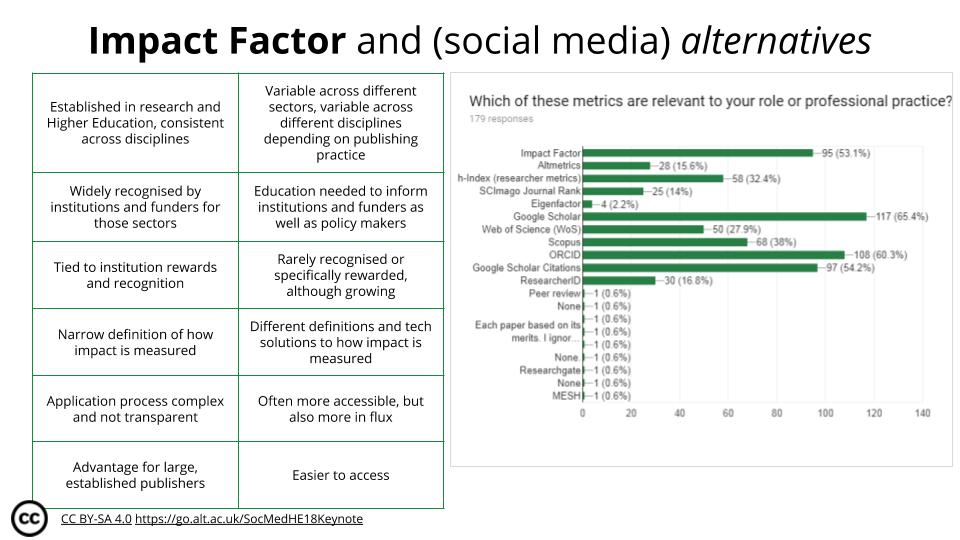
But are policy developments such as these making a difference in practice? Has policy changed much since 2014 when for example The Metric Tide by HEFCE was published (http://www.hefce.ac.uk/pubs/rereports/year/2015/metrictide/#alldownloads)? It’s aim was to “reduce emphasis on journal impact factors as a promotional tool, and only use them in the context of a variety of journal-based metrics that provide a richer view of performance. Publishers should also make available a range of article-level metrics to encourage a shift toward assessment based on the academic quality of an article rather than JIFs.”
Social media plays an important role in the alternatives to the traditional Impact Factor and is increasingly used not just by publishers and authors, but to recognise the important role of peer reviewers and support their recognition, too. Research in Learning Technology, the journal ALT publishes, is of special interest to me because I was part of its pioneering transition to become the first Gold Open Access journals published by a UK professional body. Since then I have had hands on involvement in two further transitions between publishers, leading to the journal now being independently published by ALT, financially supported by Members and edited by a group of volunteer Editors who lead peer review and author support.
It hasn’t been awarded an Impact Factor to date and we are actively investigating all alternatives, how their are used, how they are developing, what their longevity is and how sustainable they are. Open Access has seen the readership and reach of the journal increase from hundreds to hundreds of thousands. Social media supporting innovative ways of measuring impact may help its impact grow further. For now, openness helps ALT influence policy makers, increase the impact of research for public benefit, build a shared vision for the future of professionalisation in Learning Technology and grow our community of Members.
Slide: Impact Factor and (social media) alternatives
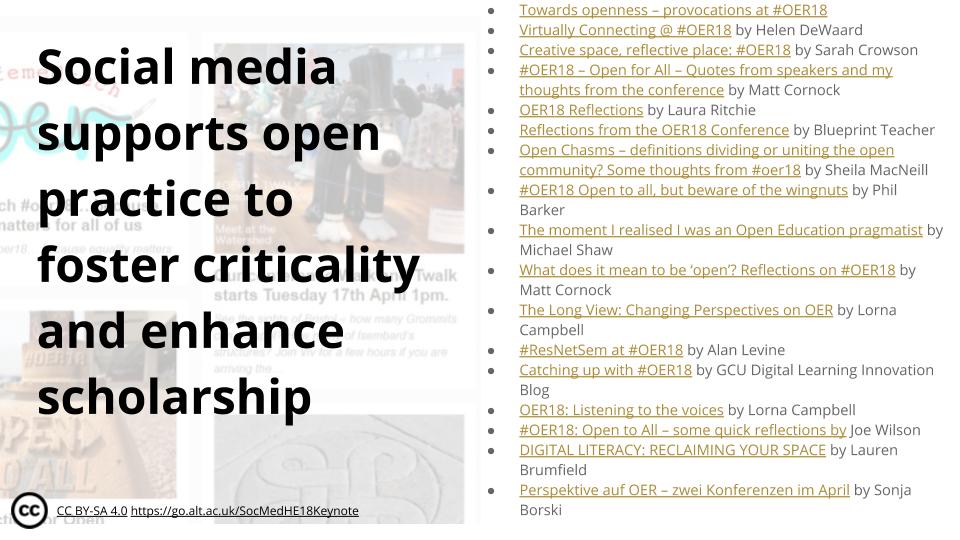
I now want to look beyond organisational boundaries to focus on individual professional practice and how social media supports open practice to foster criticality and enhance scholarship. In my experience there is no better example of this than the work that is happening around the #oer hashtags, no, conferences, and the way in which social media is used here to address some of the most difficult questions including how privileged participation in such events is, how we can find and support the voices of those we are not already hearing and how we can meet some of the global challenges that education faces through openness: access to education and equity.
It’s become somewhat of a social media tradition that the blog posts and tweets start long before an actual OER Conference, last year reaching such a large volume that there was more conversion online than anywhere else. It connected those who couldn’t attend in person (to some degree) and enabled a much richer discussion, more criticality and scholarship than before.
Slide: social media supports open practice to foster criticality and enhance scholarship
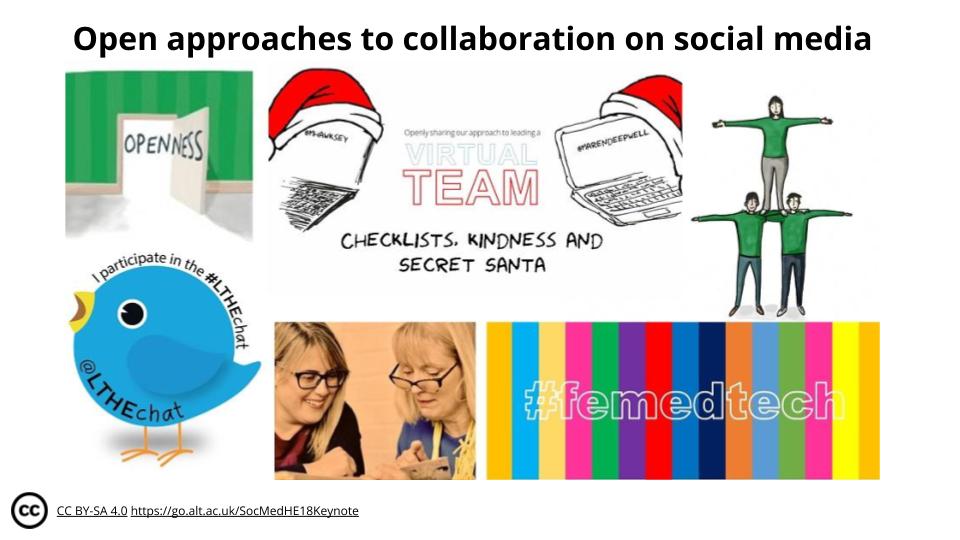
And as an open practitioner myself I am inspired, challenged, prompted to try and step up in my own work, to contribute something, to question how I could do things differently, better. And last year was very much a year of collaboration in the open for me, with many projects taking place on social media, including twitter chats and many blog posts.
Slide: open approaches to collaboration on social media
I wanted to progress leadership as an open practice – which, incidentally, is one of the sections in my CMALT portfolio and something for which I get a lot of feedback and input on social media. But the collaboration which has prompted me to reflect the most on the pros and cons of open practice on social media is my work with Martin Hawksey on leading ALT through its transition to becoming a distributed organisation and establishing a new working culture as a virtual staff team. Our monthly series of posts has been at the heart of all my work last year, touching on everything from people management and well being at work to the technical challenges of remote working and the nuances of working in the open. Writing these posts whilst everything is actually happening, rather than sharing output from work that is in the past, felt far more scary than similar kinds of work I had done before. There is much of what I do day to day that I hadn’t managed to make part of my open practice before this collaboration – leadership, management… these are not the most straight forward topics to share (especially when you are everyone’s ‘boss’). There are a lot of pros for me in this kind of approach, but also some downsides: sharing work in this way puts you in a vulnerable position, for example if someone personally attacks you, if you are not performing well, when you make mistakes or when things go wrong. Social media can be a scary place when you are not sharing success. It’s always personal and there’s a limit to how well you can protect yourself once you are out there, in the open. But on the other hand, I want to be open about how to lead, how I work. I want to show that things do go wrong, that mistakes happen and how to work through them. It’s important to share questions and doubts. It’s part of my ethos, my approach to leading a team, to leading an organisation, and I want my presence on social media to reflect that. When I first became a CEO I found it really difficult to find role models on social media (and indeed in real life) and alongside all the people who have inspired me along the way, I want to try and help others find the right way of building their professional identity.
Slide: #femedtech – Using social media to promote greater equality
And on that point, thinking about identity, we arrive at the third and final hashtag and the last part of my talk: #femedtech. The challenge here is using social media for social good. And in terms of equality, and equality in Learning Technology in particular, we still have a long way to go. Equality is for everyone, it’s in everyone’s interest and it’s everyone’s look out. Femedtech is a growing network and I am a volunteer and supporter, giving my time and voice to help promote a cause I believe in.
It’s only one example of how we can use social media to engage and empower in education and to make use of the digital, critical and technical skills we have to take some ownership of how we grow, support and chart the development of our network. And that is an important point to consider, because it is the skills and knowledge that we have that enable us to do that – the fact that we know quite a bit about social media, technical infrastructure and how data is generated and used. It’s our skills that enable and empower us to use the tools and platforms to enable and empower others – hopefully leading to greater equality along the way!
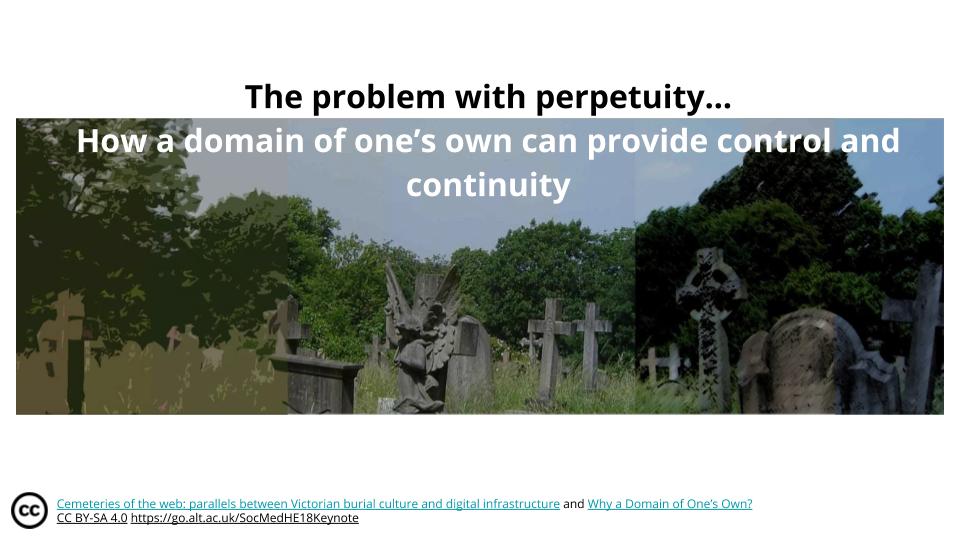
Slide: The problem with perpetuity… how a domain of one’s own can provide control and continuity
With that, we are not just going against the grain of the traditional power relationships that govern education and by extension Learning Technology. We are also going against what social media and online platforms in general wish us to do. They want our data, our attention, our engagement and in return they promise us much.
Now, I should pause here briefly, because the relationship between Victorian burial culture and digital infrastructure may not be immediately obvious, and I suggest if you are interested to read my blog post on the subject – but suffice to say that I have a PhD in cemeteries and with that comes a frame of reference that I find is very applicable indeed to thinking about our relationship with technology.
One commonality between Victorian burial culture and digital infrastructure, for example, is that a lot of digital infrastructure gives a promise of permanency in order to secure our engagement and content and Victorian entrepreneurs created urban cemeteries with the same promise. In the digital realm and in particular on social media your posts, pictures or updates remain in place while their are valuable to the platform, but can disappear or become inaccessible with little or no notice. The newly created burial space in Victorian cities would similarly be described as a place for eternity, not just safeguarding bodily remains, but securing status and remembrance for future generations. And like its digital counterpart, cemeteries, too, could disappear for building projects or urban development with gravestones stacked unceremoniously against a wall or used as paving material.
A domain of one’s own (alongside the aforementioned skills and knowledge) is key in my mind to a more empowered relationship to technology and social media. Post on your own domain, repost everywhere else – and when everywhere else stops their service, you still have your posts on your own domain. I am really inspired by the work Jim Groom has been doing in this area and I suggest you read his post on a related project.
The kind of relationship that I envisage us to have with technology and social media has a lot to contend with: we have questions about who controls the dominant discourse and how to foster diverse voices inside filter bubbles, we have a lot to work out around privacy and the right to be forgotten, the ownership of data and data literacy and the future of social media.
Slide: Social media needs us.
I hope that brings us to a point where we can explore these questions further, putting the emphasis not on the technology, but on human agency:
How can we use social media to enhance our professional practice? How can we use social media to support openness in education? How can we use social media for social good?
A big thank you to all whom I work with, who I have been inspired by and in particular the participants and organisers of the #SocMedHE18 conference for listening.
Snapshots 2018: ALT Scotland, Glasgow; Blended Learning Symposium, Hong Kong Polytechnic; ILTA Annual Conference, Carlow, Ireland; CMALT Ceremony, Hong Kong; ALT Northern Ireland, Belfast; SEDA Annual Conference, Birmingham; OER18 Open Education Conference, Bristol, ALT’s Annual Conference & Awards Evening, Manchester, UK. Thank you to everyone’s who made my year.
Against a backdrop of much political, social and environmental upheaval I have spent the past year working hard for all things Learning Technology – always on a mission to make better sense of how we relate to technology as we learn, teach and live. Learning Technology is so interesting and challenging because the work we do is happening at the intersection of education and work, constantly negotiating our relationship with technology as a society, as human beings. It brings into focus some of the biggest questions that we face in this age, questions about the role of machines in our world, artificial intelligence, about how knowledge is produced and ultimately the forces that shape our lives.
Day to day the reality of supporting lecturers with a VLE or teaching adult learners how to get online is a little more prosaic than that, but if there is anything we have learnt this year it is that the legal, ethical and moral dimensions of Learning Technology are becoming ever more important. From the role of lecture capture in labour disputes to implementing GDPR and to safeguarding well-being online there is no shortage of examples that Learning Technology has indeed come of age and that we have to face these important questions in a manner that is not only practical, but equitable and fair for generations to come. And although this year has certainly brought with it much to be dismayed about, in Learning Technology there has been a new cause for hope as our work to create a more nuanced, a more critical and reflective discourse has gained momentum. No longer do we focus primarily on advocating for technology as a solution but on a more holistic approach that acknowledges the importance of people, of learners and teachers in every learning context.
So here is my year in Learning Technology in ten highlights for you to share, make use of and be inspired by:
My favourite part of this handbook (read the review) is that is has a section on evaluating what you are doing and reflecting on it. It’s useful for many beyond Further Education and it’s written by someone who really knows their stuff – Daniel Scott. If you haven’t come across it yet, put it on your reading list for 2019.
Beyond advocacy for change: developing critical & open approaches in Learning Technology #LTHEchat #altc
Extract from the LTHE Twitter chat
This twitter chat, which Martin Hawksey and I worked on together, brings together many of the themes from this year around the role of Learning Technology, how our work is changing and how we can take a more critical, open approach. You can explore the chat itself on Wakelet or read up on the follow up blog post.
Policy Making in Action – A Senior CMALT portfolio by Melissa Highton
Melissa Highton‘s approach to achieving Senior CMALT was particularly inspiring as Melissa describes how she “delivered a session at AltC 2018 exploring the interplay between technology and teaching, and learning technologists and academic colleagues. In it I talked about the importance of working alongside colleagues from different backgrounds and I used a ‘learning from critical incidents’ framework for my reflection.”
The topic of Melissa’s work was “experience of writing, and consulting on, an institution-wide opt-out policy for lecture recording” and the context that “work with technology for teaching and learning… comes into contention during a strike” as was discussed in these blog posts [written during] during the strike can be found here.
When I grow up I want to be a Learning Technologist by Clint Lalonde
Skip to 22.28 min in for Clint‘s talk or even better sit back and watch all of them compered by the inimitable Tom Farrelly.
How and why should Learning Technologists engage with start-ups? A collaborative guide…
Working with industry in Learning Technology is not always easy and one of the collaborations I led this year was to write a guide for Learning Technologists about how to work with start-ups. At the outset of the project, we wanted to find out what makes a successful collaboration between Learning Technology professionals and start-ups, what barriers may get in the way and what experiences we can learn from. We also asked the question why this is important and how it might be useful to the wider community, both individuals and organisations. You can now access the guide http://bit.ly/altcstartupguide and read the related blog post.
25 years of EdTech by Martin Weller
In Learning Technology we have the history, evidence, research to shape a more critical perspective and there are an increasing number of voices that articulate how things are changing. Martin Weller’s inspiring series on ‘25 years of Ed Tech’ is a great example of this (and definitely worth reading if you haven’t come across it yet). Martin emphasises the need for taking a critical approach to our thinking in Learning Technology, to examine the (commercial) interest that influence its development, ‘for example, while learning analytics have gained a good deal of positive coverage regarding their ability to aid learners and educators, others have questioned their role in learner agency and monitoring and their ethics.’
A personal, feminist and critical retrospective of Learning (and) Technology, 1994-2018
…”Our session is based primarily on two perspectives.The first perspective is rooted in our analysis of the past 24 years of ALT’s Annual Conference — as represented in published websites for later conferences, and for earlier conferences, references to the conference in ALT’s Journal (now Research in Learning Technology). The second perspective is our own personal histories that both exist beyond that narrative and intersect with it. Our initial analysis of the conference has identified Open/Active Learning and Community/Communities of Practice as themes that have persisted over several conferences and many years. We will summarise the themes and trajectories, highlighting how these ideas have been represented within ALT’s Annual Conference, how they have evolved, which perspectives have persisted and which have become irrelevant or have fallen out of favour. In addition, we acknowledge that the personal is political. Our respective critical approaches to this work reflect our own varied histories within and beyond HE, IT, and learning technology.”… by Frances Bell and Catherine Cronin.
#CMALT #altc Twitter chat
CMALT Core Principles visualised by Bryan Mathers
This year has seen a lot of work on professional recognition and cpd for Learning Technologists and this twitter chat at ALT’s Online Winter Conference formed part of a broader effort of consultation and development to forge two new accreditation pathways. With input from over a hundred Members, work has progressed so that Associate and Senior CMALT are launching in February 2019 – exciting times ahead.
Openness in education: a call to action for policy makers
Article on Wonke
Together with Lorna Campbell I wrote this article on Wonkhe, which explains how 2018 was a “particularly important [year] for Higher Education as 2017 marked the anniversary of several groundbreaking initiatives that laid the foundations for what we now recognise as the open education movement. 2017 saw the 15th anniversary of the Budapest Open Access Initiative, and the release of the first Creative Commons licence, the 10th anniversary of the Cape Town Declaration, the 5th anniversary of the UNESCO Paris OER Declaration, and it was also the year that the new UNESCO OER Action Plan was launched.” Read more.
And finally…. in my own words: who shapes the future of Learning Technology?
This year I have a handy way of letting my work do the talking because much of what I am most interested in and many of the things that I feel are important came together in my keynote talk. This was a very special keynote to me and I was grateful to the Trustees of ALT to invite me to speak at ALT’s 25th Annual Conference. This post shares the slides and some of my notes for the talk and you can also watch a recording from the conference here . Thanks to James Clay for this video sketch note of the talk.
Keynote: Maren Deepwell – Beyond advocacy: Who shapes the future of Learning Technology?