Tag: #altc

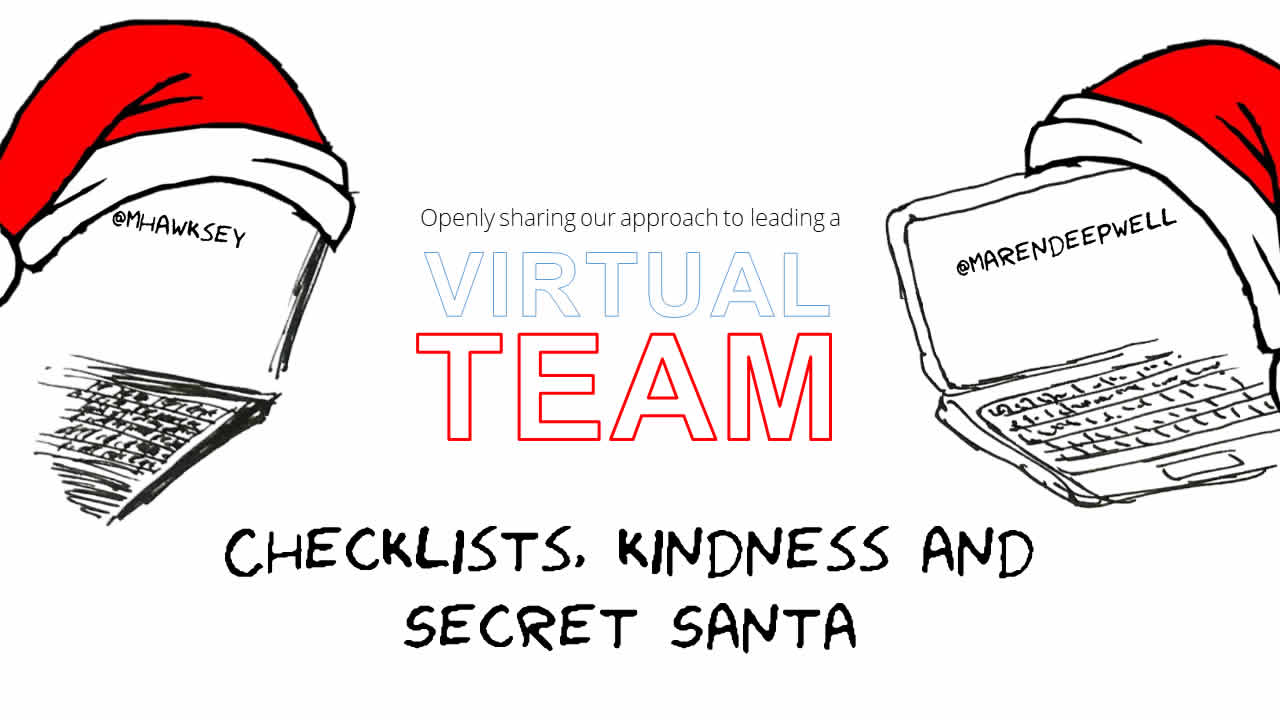
  • Virtual Teams: Checklists, kindness and Secret Santa – nudge, nudge, wink, wink, say no more

    This post continues the series on openly sharing our approach to leading a virtual team – a joint project with Martin Hawksey (cross-posted here) for which we write a monthly blog post.

    November

    This month we discuss checklists, how each of our staff invented their own scale to rate their week and treating others with kindness.

    Maren: I’ve been thinking about how to make time for both urgent and important things, and at the same time to reserve enough space for impromptu collaboration. This article on using G Suite to improve team performance via intermittent interaction for example argues that agile communication and collaboration is more effective than regularly scheduled interactions – but it’s much harder to do well in my experience. Following on from last month’s post in which we discussed trello and jamboard one of the things we have since implemented are some new checklists, for areas like payroll, GDPR and tech maintenance that cover regular, important tasks for the team, but aren’t related to urgent deadlines. I’m a big fan of checklists (and their history in aviation and healthcare in particular) and find them very effective in a team like ours and in particular for things that we don’t work on every day. We complete the checklist individually but we have a prompt at team meetings and then review the results together, which gives us space to raise questions. For me, another upside is that I spent less time on something that’s routine, if important, freeing me up for other things. As a recent development in our approach to leading the team, what are your thoughts on this?

    Martin: An aspect of checklists, particularly if they are shared, I hadn’t really considered until recently was how they can be used to ‘nudge’ team members. Nudge theory was something I first heard about many years ago talking to a contractor who worked with the UK Government, in part supporting the British Cabinet Office Behavioural Insights Team, also known as the “Nudge Unit”. It was only recently at the Scottish ELESIG that I first heard it being referenced in a learning and teaching context. This also got me thinking about nudges in distributed teams. I’ve no experience in behavioural science and I should also say I can see the dangers of going down a ‘nudge management’ route, but I can also see the value in exploring some aspects of ‘nudges’. An interesting paper I came across was Nudge management: applying behavioural science to increase knowledge worker productivity (Ebert and Freibichler, 2017). This paper highlights a number of nudge tactics and it’s interesting to see that things like quarterly reporting of goals/milestones is something we already do. I can also see parallels with some of the examples reported and the G Suite article and models of collaboration you mentioned earlier. It is unlikely we will get a Google style micro kitchen and I always wonder if there is more we can do to create opportunities for the informal exploration of ideas. Back to checklists I see one advantage of using these is it becomes easier for us to see who has and hasn’t completed activities … nudge, nudge, wink, wink say no more.

    Maren: I don’t like the term nudge management much, but it’s a very useful idea and so is the article once I got past the terminology. One benefit of using approaches like this in a small team rather than in a huge corporation like Google is being able to take an agile, informal approach to reiterating checklists: for example when a colleague added something new to their own checklist this week, we identified this as a gap and added it to the template for everyone. Two minutes work resulted in an immediate improvement. Similarly, being able to see an overview of everyone completing a monthly GDPR checklist makes the process more transparent and shows that everyone is participating. It improves communication in a very time effective way. Being a small team we can sometimes take a more playful approach as this week’s team meeting demonstrated. We often incorporate a check-in into team meetings, where we quickly and informally share how we are doing and how busy we are. That started as rating your week out of 10 (10 = the busiest) and has gradually turned into everyone rating their week on their own scale, be that a colour or phrase or similar metaphor. With a small team, that works because it still fulfills the purpose of the exercise: taking a step back and checking in with yourself, sharing that with everyone without being competitive and giving us a better sense of how everyone is doing. How individuals choose to rate their week, what scale they apply, also tells you a lot: it reflects their personality or mood, how they integrate with the team, how much of a sense they have of how they’re doing… it helps to fill the gaps formal reporting or catch ups can’t. We have established such a strong foundation in the team meetings process that we can now have more freedom to ‘personalise’ parts of it, like the check-ins. The way I see it, the better the structures we as a team have are and the more we trust them, the more freedom we have. I’m really interested in the relationship between those structures and the agility they can bring. Does that make sense to you?

    Martin: Being able to express ourselves is a good thing, I’ve never considered if it was more or less important for distributed teams. I think it certainly helps when there is work pressure on and the degree of informality perhaps provides a foundation in creating a culture for the ‘informal exploration of ideas’. I can also see the benefit of moving to a more abstract and personal scale. I think one issue with a 1 to 10 scale is it can potentially become a little divisive, particularly within a virtual team context. For example, Bob says he’s a 9, Margaret thinks ‘how is Bob a 9!?’, in part because in a distributed setting it’s hard to see how hard Bob is working. Equally John might feel like a 6, but at the same time feels guilty that Bob is a 9. With everyone using their personal scale it becomes less quantifiable and more of a personal reflection which is less open to judgement. Using scales hopefully also creates opportunities for the ‘humble brag’. I know this month you’ve shared a post on the  ‘Virtual no Distant’ blog on sharing success. In this post it highlights, perhaps on questionable research, the increased importance of sharing when things go well. As someone who usually has to be reminded to share my achievements I can see the benefits of this approach. In particular, where I see this fitting in is you might be ‘code red’, but that because the thing you were working on has been a huge success, the downside being it’s created more work. How do you feel about the ‘humble brag’?       

    Maren: Hmmmm. I’ve written posts like How to share credit and praise yourself… reflecting on the value of (deserved) recognition and Don’t think you are brilliant? Think again… – so I have given this quite a lot of thought. Alongside terms like ‘imposter’ or ‘lurking’ I have ambivalent feelings about ‘humble bragging’ (i.e. to make an ostensibly modest or self-deprecating statement with the actual intention of drawing attention to something of which one is proud). On the one hand, modesty and humility are good qualities to have. On the other hand, it’s essential to learn how to assess one’s professional achievements and articulate them. Too often, particularly in our cultural context, professionals are unable to do that effectively (and incidentally this is something I come up against frequently as a CMALT assessor). I find that sometimes ‘humble bragging’ is less a reflection of personal modesty and more to do with not really reflecting on progress, or not being able to understand one’s role within a team, one’s contribution and why it is important. Not being able to say ‘I did this…’ or ‘It’s my responsibility to…’ can make it much harder for others to understand what the other person’s role is and to respond accordingly. That’s why a few years ago we introduced 360 degree feedback for everyone as part of our annual appraisal process. It’s a regular opportunity to practice giving and receiving feedback, both good and bad. That said, any form of sharing the highs (and lows) of our work is important and welcome, ‘humble brag’ included! I’m generally very communicative at work and I’m confident enough to share both success and failure. I try to be honest about things that go wrong because I want to show that it does happen and how to deal with it. But I appreciate that this is much harder for some and at times maybe a ‘humble brag’ is the best strategy, maybe the only way to communicate. Our job, leading a team, is to listen and acknowledge that achievement no matter how loudly or quietly it may be voiced. For me, it’s also about treating others with kindness (which is also why I am mentioning our postal Secret Santa, sending a little kindness to each other each December).

    Martin: As tempting as it is to put ‘Secret Santa’ under the lens of ‘nudge management’ perhaps we should end here and show dear reader some of our own kindness and wish you all a wonderful holiday season and we look forward to sharing more of ALT’s journey in becoming a virtual team in 2019.

    Other things we’ve been reading:

  • Virtual Team outtakes: using voice recognition for reflection

    Since we started this monthly blog series openly sharing our approach to leading a virtual team,  Martin and I have often talked about how useful the process of writing the monthly posts in itself has become: it makes us make time to focus on things we may not otherwise dedicate as much time to, it prompts a joint process of reflection and improves communication.

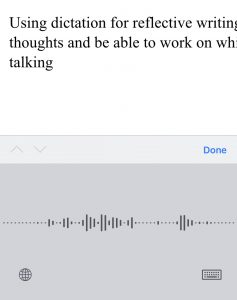
    I’ve often written about how important reflection is to my professional practice, and I use different tools for different types of reflection: this public blog, a private blog, some drawing/making activities, walks and conversations and I value each one for different reasons. But recently I have found that I have struggled to write down/type everything I have on my mind, and so I have started to use the dictation tool on my phone – with interesting results.

    Mobile instead of laptop: First, using dictation allows me to use my phone rather than a laptop to write my reflective posts. I much prefer that, particularly at weekends or in the evenings as it makes it feel less like work. Although the interface for one of the blogging platforms I use isn’t optimised for mobile, I still find this way of producing a reflective post much more convenient and comfortable.

    I talk faster than I can type: and thus, I now add a lot more than I did before. The posts are longer and more spontaneous because instead of carefully constructing sentences, I speak my mind more. It’s a different tone and takes less time than typing the same amount of narrative would have done.

    Less self-editing: although most of what I use dictation for ends up in a blog which I don’t share with anyone else, I find the process of talking about my day or week is far more frank now than when I was typing. Not something I had expected, but it is an interesting by-product of this way of working.

    More like a conversation: one of the real benefits of writing collaboratively is that it is more like a conversation. But not everything I reflect on lends itself to being shared and I find talking to my blog rather than writing in it is much closer to the kind of dynamic that I might get from having a conversation or telling someone about things on my mind. I say more things that I may not have expected, realise that things are important or have bothered me more than I would have done when I was typing the words. I have hundreds of posts to compare from the past few years and the tone of the voice posts is very different.

    Saying it out loud: for me, reflective blogging has always felt quite similar to writing a journal and over the decades I have written many journals in different formats. But sometimes being good at writing things down can make it harder to talk about something, to say it out loud. Dictation like this can really help you practice articulating your thoughts to someone else as well as to yourself. It also improves self realisation in my case. The other day I felt angry about something and when I said it out loud I realised how angry I really was. It helped me better reflect because it helped me understand more fully how I felt – to pause and realise, that is how things are in my mind. The feelings dissipated quickly, but the realisation stayed with me.

    Some pitfalls: dictation does require privacy. At least in my case there would be no point doing this if I felt someone else might be listening. Also, the voice recognition in iOS, which is what I am using, is pretty good – but it’s not perfect. It’s worth reading along or reading through the text afterwards as there can be some funny mistakes to correct. It takes only a few minutes, but still effort.

    It’s actually recording a podcast episode earlier this year that made me try voice recognition for reflective blogging and I am curious to see how future editions of the joint series may develop as we revisit that format. For now, I am going to keep experimenting in my own practice.

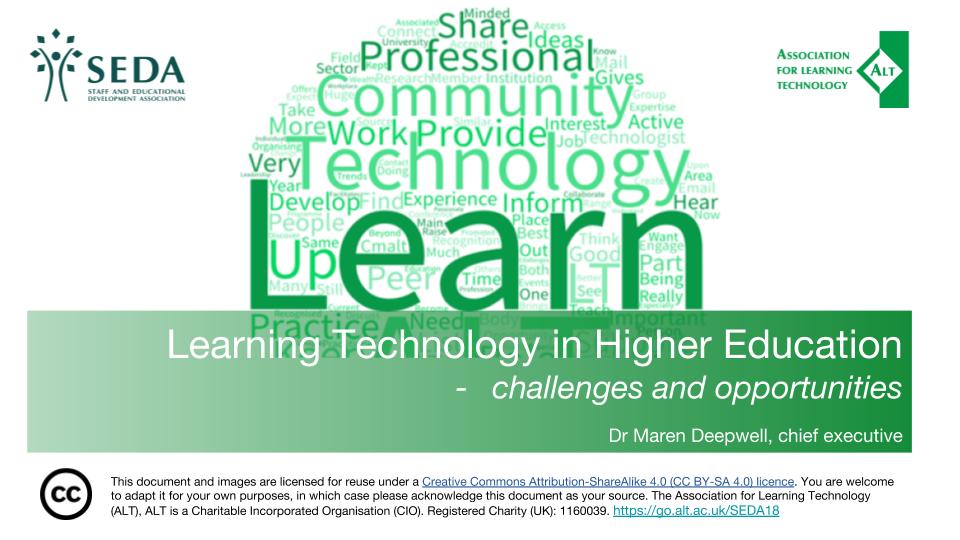
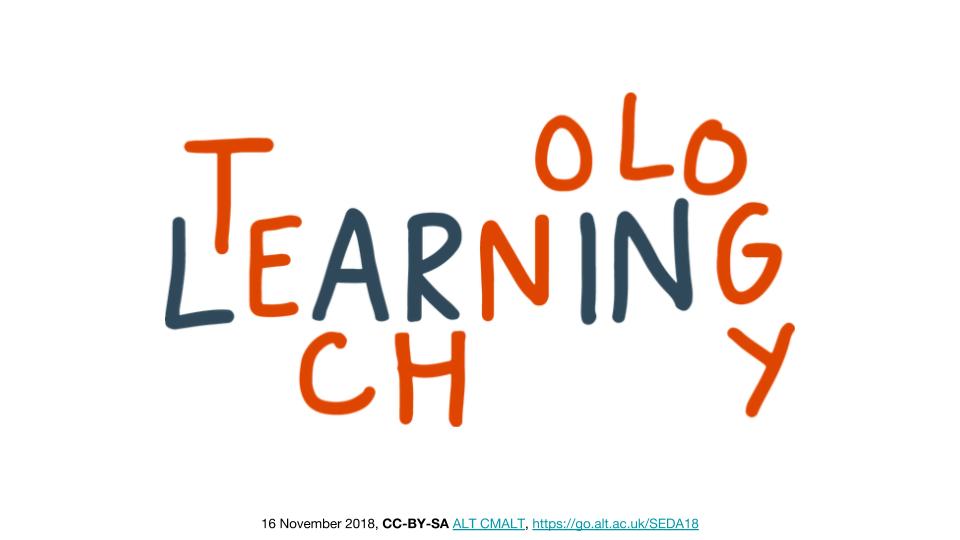
  • ‘Learning Technology in Higher Education – challenges and opportunities’ – SEDA Conference keynote

    I was delighted to be invited to speak at this year’s SEDA conference. It’s a special honour this year, as both SEDA and ALT are celebrating their 25th anniversary and my talk followed inspiring keynotes by Pauline Kneale, Pro Vice-Chancellor, Teaching and Learning, from Plymouth University and also Julie Hall, Professor of Higher Education and Deputy Vice Chancellor, Solent University Southampton as part of the conference programme.

    Here is the abstract of my talk:

    This talk will address the major themes of the conference – ‘meeting challenges’ and ‘supporting staff’ – from the perspective of learning technology, exploring recent developments in this area and discussing their relevance and implications for educational development and for the work of educational developers. For example, my review of initiatives and key developments from the work of the Association for Learning Technology (ALT) will include exploration of our new pathways to professional recognition and accreditation and discuss how these are mapped to other frameworks, including the UKPSF, QTL and Jisc’ Digital Capabilities. There are significant strategic challenges facing the sector and this talk will critically reflect on how we are solving these, sharing examples of research and practice from the ALT community and relating these to the  larger questions they pose in relation to ethics, student welfare and the future of technology in education. 

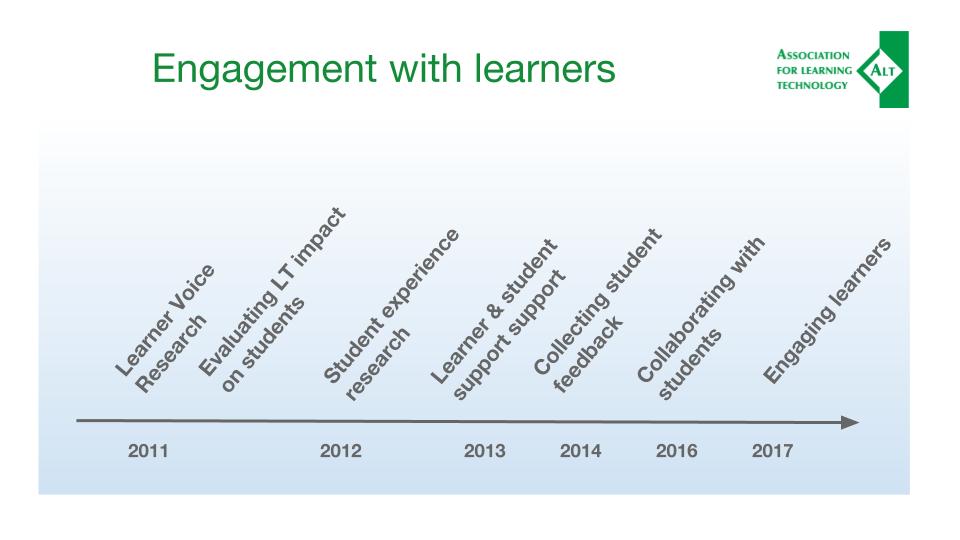
    As well as looking at some of the challenges, my talk explored how we meet them and how things are changing, specially in relation to how we engage students – and how that has changed professional practice.

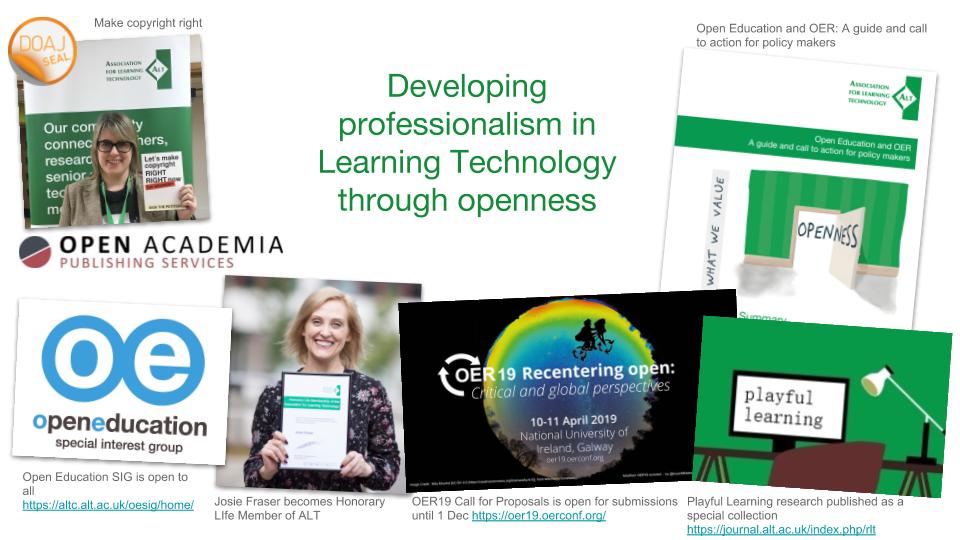
    One of the other areas I explored is how we are developing professionalism in Learning Technology through openness, using examples from across the ALT community, from the Open Education Special Interest Group, to the Open Access research journal and the forthcoming OER19 Conference.

    You can access all the slides and references from m talk here https://go.alt.ac.uk/SEDA18. 

  • Preview: SEDA Conference keynote ‘Learning Technology in Higher Education – challenges and opportunities’

    I am really looking forward to speaking at this year’s SEDA conference and I wanted to share a preview of my talk ahead of the event. It’s a special honour to be invited to speak this year, as both SEDA and ALT are celebrating their 25th anniversary and I look forward to hearing Pauline Kneale, Pro Vice-Chancellor, Teaching and Learning, from Plymouth University and also Julie Hall, Professor of Higher Education and Deputy Vice Chancellor, Solent University Southampton as part of the conference programme.

    Here is the abstract of my talk:

    This talk will address the major themes of the conference – ‘meeting challenges’ and ‘supporting staff’ – from the perspective of learning technology, exploring recent developments in this area and discussing their relevance and implications for educational development and for the work of educational developers. For example, my review of initiatives and key developments from the work of the Association for Learning Technology (ALT) will include exploration of our new pathways to professional recognition and accreditation and discuss how these are mapped to other frameworks, including the UKPSF, QTL and Jisc’ Digital Capabilities. There are significant strategic challenges facing the sector and this talk will critically reflect on how we are solving these, sharing examples of research and practice from the ALT community and relating these to the  larger questions they pose in relation to ethics, student welfare and the future of technology in education. 

    As well as looking at some of the challenges, my talk is going to explore how we meet them and how things are changing, specially in relation to how we engage students – and how that has changed professional practice.

    One of the other areas I will explore is how we are developing professionalism in Learning Technology through openness, using examples from across the ALT community, from the Open Education Special Interest Group, to the Open Access research journal and the forthcoming OER19 Conference.

  • Virtual Team outtakes: Smartwatch & homeworking

    In our most recent post on leading a virtual team Martin and I talked about the upsides of remote working and many of the comments we received highlighted ways in which people find balance between the demands of home and family life and work. That got me thinking about what makes a real difference to me day to day and took me back to contributing to David Hopkins’ Edtech Rations book, in which we shared what the most important things are, those you don’t leave home without. But when you don’t really leave home to work, what is it that makes the difference when you work from home?

    Martin mentioned wearables in the post and that prompted me to think about how I use my smartwatch when I work from home. I do have concerns about the way the watch can track so much of my activity and I have switched off some more advanced/sharing functionality because of it, but there are certain things it can do that I find really helpful:

    Alarm clock: When charging and put on its side, the watch is a great alarm clock and I use it both at home and when I travel. It’s motion sensitive so the display only comes on when needed, which I like. It shows you the time your alarm is set for and it starts to get brighter as that time approaches, helping you to wake up. All of that could easily be accomplished with a regular alarm clock of course, but I like that I can make use of the watch when I am not wearing it and travel with it without having to carry along another bulky item of technology. It also means that I can leave my phone out of reach but I can still check the time. 

    Move reminder: another aspect of the watch I really like is that you can opt in to it reminding you to move if you have sat still 50 min of the hour. Whilst I have other reminders to move, like wanting a cup of tea, or the phone ringing or a delivery arriving, this function really helps me on days when I have a lot of work to get through. It reminds me to take a break from staring at the screens as well. On a long journey it’s not always possible to take a break, but I find long train journeys much more comfortable when I move about a little regularly. With enough awareness and self discipline there is no reason why one shouldn’t naturally take breaks regularly, but I don’t always have that when I get lost in a complicated piece of work.

    Phone system: our phone system puts calls through on my computer as well as my mobile phone during work hours (I have chosen for it to do that, it’s not required). However, I am not always at my desk and I don’t always want to carry around my mobile phone either. So glancing at my watch when the phone rings gives me the chance to check whether it’s a work call or a personal call. I can answer the call on the watch, but I rarely do.

    Planning time to go running: there is one other way in which I use the watch during the week, particularly in the colder months when it gets dark early and is cold in the mornings. I set the watch to display the temperature and the time the sun sets, helping me decide when to best find time to go for a run. I don’t run every day, but for my work life balance to work I want to be heading outside once or twice during the week, and I find it frustrating to forget, finish work and realise it’s nearly dark. So having a way to remind myself of what time the sun will set (provided that it is shining to begin with) is a useful way of planning the end of my working day and I have the flexibility to finish an hour early to catch the last bit of daylight.

  • Senior CMALT: Open Access research & promoting equality in Learning Technology

    Part of my professional development for this year was to take part in the pilot schemes for new pathways to CMALT, ALT’s accreditation scheme for Learning Technology professionals. I acted as an assessor for the Associate CMALT pathway and updated and submitted my own portfolio, which was originally accredited in February 2016, for assessment for the pathway for Senior CMALT. Now that the pilot has been concluded, and I have been awarded Senior CMALT alongside colleagues who also took part in the pilot,  I am updated the openly shared version of my portfolio here as well as on the official CMALT portfolio register. 

    In contrast to others, I did not choose to create a new portfolio in order to take part in the pilot, primarily because it is due to be updated in February 2019. Instead, I have added additional sections to my portfolio as follows (the other sections remain unchanged as they are already in line with the requirements of this pathway):

    • Specialist option(s): second specialist option added, Open Access research publishing in Learning Technology
    • Advanced area: new advanced area added, Promoting equality in Learning Technology

    As this is a pilot of the scheme, it remains to be seen what the finalised guidance for this new pathway will say, but my portfolio will help provide a baseline of examples for future candidates.

    For the first new section, I drew on an area of my work that I had previously not included in my portfolio:

    I have led and worked on a number of Open Access projects supporting research in Learning Technology including establishing the ALT Open Access Repository in 2009 (the wALTer Project), overseeing the transition to Open Access for ALT’s journal Research in Learning Technology (for which I contributed to the report on “The Transition to… Open Access”) and in 2017 the second and third transition of this journal from its Open Access publisher, Co-Action, to be sold to Taylor & Francis and subsequently taking independent ownership of the journal, which is now published by ALT in partnership with Open Academia. Since 2012 I have had responsibility for the journal, working together with its Editors and Editorial Board. In 2018 I led the establishment of a new strategic working group of the journal. The new group will help steer the development of the journal with representatives from other scholarly bodies including ascilite, ILTA and the OLC alongside our Editors. The group is chaired by Prof Neil Morris, who also chairs the Editorial Board.

    Over the past 18 months I have negotiated the contracts for both transitions, first from Co-Action to Taylor & Francis and then from Taylor & Francis to ALT in partnership with Open Academia. I have project managed both transitions, supporting Trustees in their decision making as well as the Editorial Team. During this time ALT has had to suspend operations of the journal for several months and I regularly communicated with Members and other stakeholders during this time (including a transition announcement, publisher news, re-launch update and thank you). As part of my work with the working group, I have researched current practice for Open Access journals around journal impact factors and alternatives to these, including altmetrics, h index and Eigenfactor, some of which I have shared in blog posts and at the ILTA Annual Conference, EdTech2018, at IT Carlow, Ireland, in June 2018.  Under my leadership, the journal has adopted Open Access best practice and has recently been awarded the DOAJ seal and has also resumed steady operations and is now publishing regularly including a recent themed collection on Playful Learning.

    The other new section I have added is the advanced area of practice, and for this I chose to focus on how my practice contributes to promoting equality in Learning Technology. This is something I have written about before and also presented as part of my keynote at ALT’s Annual Conference in September 2018.

    From this section, I’d like to share the reflective element in particular – relating how my work addresses the core principles of the CMALT framework:

    Reflection

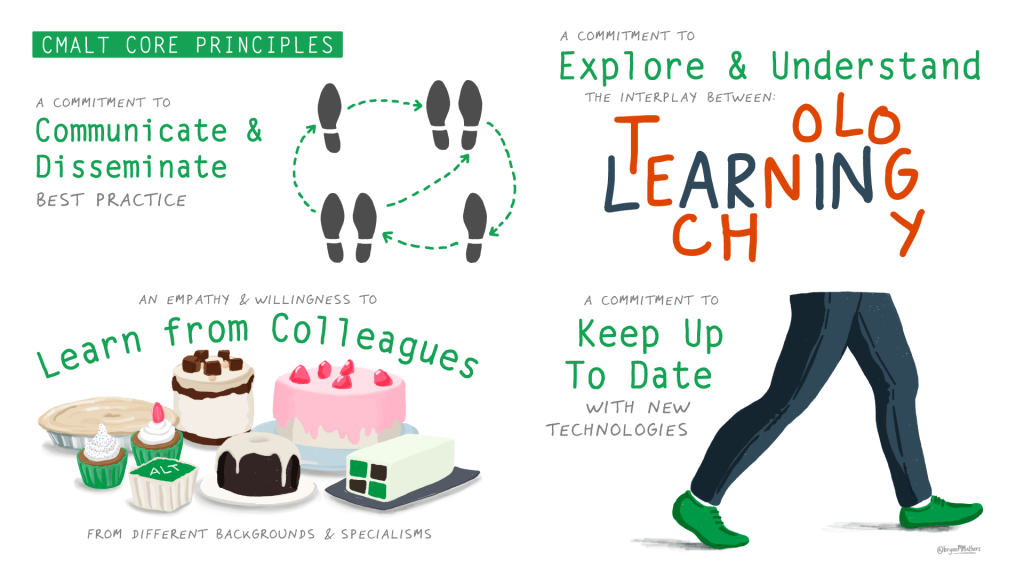
    I have not only chosen this advanced area because I think it is really important to the success of my practice, but because in my view it has a particular relevance to Learning Technology professionals. Reflecting on the core principles of CMALT, here is how my area of advanced practice, promoting equality, relates to them:

    • A commitment to exploring and understanding the interplay between technology and learning: Learning Technologists are often at the centre of negotiating an organisation’s, or a group’s, relationship to technology, for example students relationship to a social network or staff engagement with a cpd course. We are able to inform the perspective other, less expert, users have of how technology is used, understand how it affects our lives and our identities. How the data or content we create affects our work. At best, Learning Technologists empower staff and students in their relationship with technology, help them gain a more critical, reflective and thus effective long term engagement with the tools and platforms they use – and hopefully shape or create in future. It is a big responsibility and a big opportunity at the same time. If our practice, my practice, is shaped by values that prompt us, me, to promote equality, create greater equity and so forth, then we can make a real difference.
    • A commitment to keep up to date with new technologies: for me an important aspect of keeping up to date with new technologies is to understand their context: how they are financed and by whom, who has developed or tested them, or what kind of data sets informed their working, whom are they aimed at and what do they promise? What is their business model and how is it sustained? One piece of work I did this year is to collaborate with startups on a guide about how Learning Technologists can work together with start ups and through that project I had many useful conversations with CEOs of edtech startups. They were all young, white males and invariably the conversation about organisational culture reflected the pressure of moving at the speed they needed to whilst trying to have a more diverse team being in conflict with each other. It was an interesting first hand experience of how keeping up to date with technology and the constant need to catch up and adapt does not foster a culture that promotes equality. It is also an example of how our perception to need to keep pace with innovation, to move ahead, is used an an excuse, either consciously or subconsciously, not to diversify.
    • An empathy with and willingness to learn from colleagues from different backgrounds and specialisms: This is the core principles which most closely relates to promoting equality. In my own team I have led to establishing a strong practice of weekly meetings that include a show & tell element for example, enabling everyone in the team to ask questions, share ideas or show each other new tips or tricks from spreadsheet shortcuts to new tools we could use. Together as a team we take part in online cpd courses such as 23Things or a GDPR course on Futurelearn and I value the opportunity to learn alongside my colleagues, gain a sense of their perspective and understanding and to reflect this in my own.   
    • A commitment to communicate and disseminate effective practice: Lending your voice to raising issues around equality is not a task for women, but for everyone and I am grateful to have many male colleagues who play an important part in this. But I don’t think you need to explicitly reference equality at all to effectively promote it. Simply taking a balanced view in whom you reference, whom you include in your perspective, can have a most powerful effect. For me, the OER Conferences are a good example of how to promote equality in Learning Technology, how to amplify the voices of those less often heard.

    There is a lot more I hope to achieve when it comes to promoting equality in Learning Technology. I leverage what I have to make a difference and I do my best to take every opportunity I can to do so, but whilst I have a growing network of inspiring allies to work with, there is a multitude of indifference who will ask “So what?”.

    For many, equality is something that doesn’t have anything to do with them. It’s not something they want me or people like me to go on about. It’s not a an issue because…”women can participate if they want”, because “no one is stopping them”, because “I haven’t experienced discrimination so it doesn’t exist”, etc. etc. Insert any number of cliches!

    CMALT is a peer-based accreditation framework that retains its value because there is a continuous cycle of developing our understanding of what it means to be a Learning Technologist and what we understand to be good or best practice through being assessors and updating our portfolios. I think promoting equality is a big part of what makes me a good Learning Technologist and I hope that this new section of my portfolio demonstrates that.

    If you would like to have a look at the full version of the portfolio I submitted for the pilot, you can access the Google doc version and the evidence folder.