OER19 is nearly upon us and as part of the organising team the next two week will be really busy for me. I am really excited about the event this year and so while there’s still time, I want to share my thoughts in this preview post.
I’ve also been reading Invisible Women by Caroline Criado Perez (it’s an excellent read) and one of the points I took away from the book was how women’s rights and gender equality more broadly are treated as a minority interest, something that is never at the top of the list of priorities for government or industry even though we have evidence that shows why it should be. Instead it’s treated as a ‘nice to have’. This is far more eloquently expressed in the book, but my own day to day experience reflects this attitude very clearly: every time I speak about the issue somewhere there are those who roll their eyes or those who nod along patiently waiting until the talk turns back to things that really interest them, things that really matter as if they’re thinking ‘who cares about the gender data gap when there’s an AI revolution to profit from’.
Now, openness I find provokes a very similar response, and is equally demoted to the bottom of the list of things to do, because it also seems like a ‘nice to have’. To those who don’t know better openness is the domain of the dreamers, the prerogative of the privileged, a idealistic idea that doesn’t fit into the education industry of today other than as window dressing, as a veneer to enhance current business models.
In both cases short-sightedness, self interest and lack of imagination present real barriers for meaningful progress – but that isn’t to say that there is none. Fortunately for all, those committed to driving forward the open agenda are succeeding in winning many arguments, changing policy, winning funding and developing viable business models all across the world. This year’s conference programme is filled with examples (https://oer19.oerconf.org/programme/) from a broad spectrum of practice, research and policy making. From institutional case studies and national reports to individuals collaborating on open projects the programme includes sessions that set out to tackle the difficult questions and dilemmas that will come to define the future of openness.
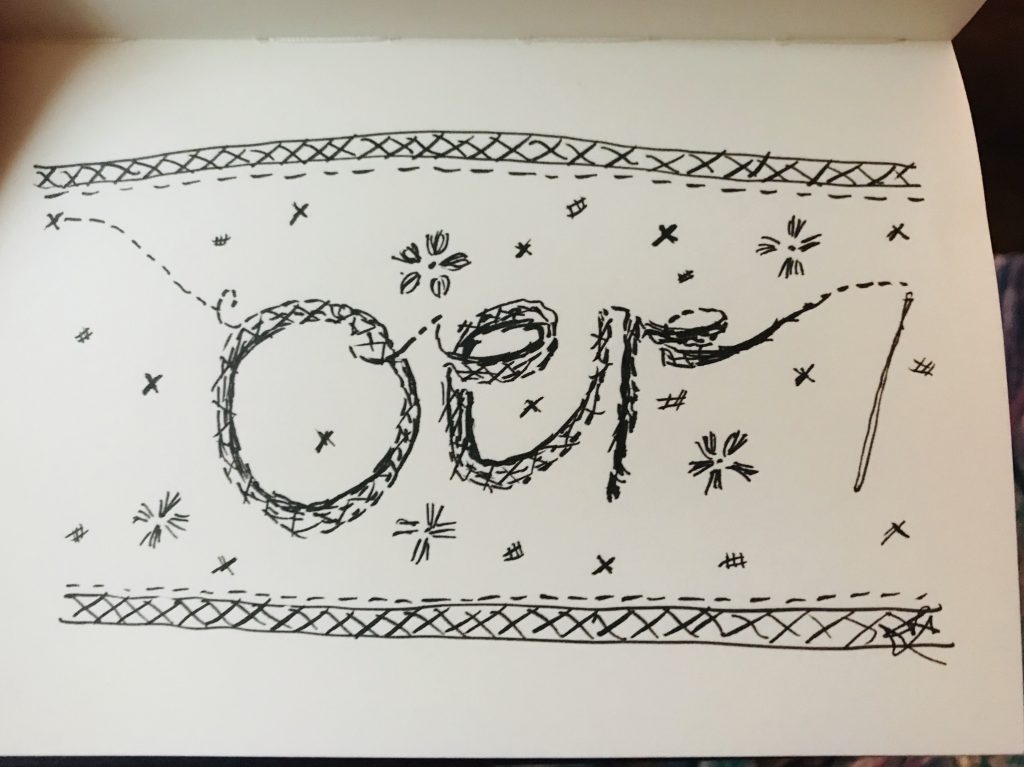
Openness is many things to many people and the vision that the conference co-chairs have brought to the event has really inspired me and helped me reach a new understanding of the challenges we face by including more diverse voices and perspectives and also by ensuring that openness has been stitched into the fabric of OER19.
In turn, that has inspired the work that ALT does to support this conference in the run up to the event such as tweaking our systems to encourage more sharing, the Board of Trustees funding more scholarship places for students than ever before, contributing to global events during Open Education Week led by the Open Education Special Interest Group, and post-OER19 to the Creative Commons Global Summit.
Openness is a very practical core value for ALT as an organisation but it’s also become a more practical and fundamental aspect of my own thinking and practice in particular on open leadership and also contributing to the oer19 open space for femedtech has been inspiring.
Thanks to everyone involved, everyone who puts time and effort and resources into making OER19 happen, I feel like actually getting to go to the event in Galway is just the finishing flourish. OER19 has been a living, breathing, inspiring part of my professional practice for over a year already. But when I watched the sun rise over Galway Bay nearly a year ago, I didn’t realise how rich, how thought provoking and nourishing a journey working on this event would be. I’m grateful that I have been able to contribute, and I look forward to playing my part in making it happen and to build on what will be shared at OER19 to continue to promote openness and support those involved in the coming year, weaving a stronger thread of openness into the fabric of things.
This week I spoke at a keynote seminar on realising the potential of technology in Higher Education and it was a valuable opportunity to share the work of ALT and its Membership. Whilst ALT is growing and the number of Members has more than tripled over the past 10 years, I always include some key points at the start, including our definition of Learning Technology and Learning Technologist and our shared values that inform ALT’s strategic aims. It’s useful for anyone who hasn’t heard about us before, but it also helps situate the perspective I speak from: representing 3,500 individuals and organisations from across sectors and a broad range of professional and learning contexts. It’s key to convey that there is a huge spectrum of practice, research and policy making in Learning Technology when it comes to infrastructure and adopting new technologies and also when it comes to pedagogy, practice and research. This may seem like an obvious point to make, but I find that many discussions about ‘the future’ or policies for technology in education often make the assumption that those involved are all in the same boat or starting from a blank slate, when in reality the fast pace of innovation leaves behind a messy trail of upgrades, legacy systems, gaps and transitions that make interoperability standards such a key issue.
It’s important to at least acknowledge the messy underbelly of the shiny, efficient future that many edtech narratives have been promising for decades. From my perspective there is great strength in really understanding the dynamics in Learning Technology over time as we can’t master what we don’t understand. So in my 10 minute keynote, I focused on some of the messy aspects of Learning Technology and some of the critical questions that we have been asking, sharing examples from ALT’s Annual Survey and the work that our Members have been leading for the past year, to demonstrate how all across the UK the future of Learning Technology is being negotiated. Specifically, I spoke about:
Defining our relationship to Learning Technology
Working with industry to tackling the challenges of scaling up use of Learning Technology
Professionalism in Learning Technology
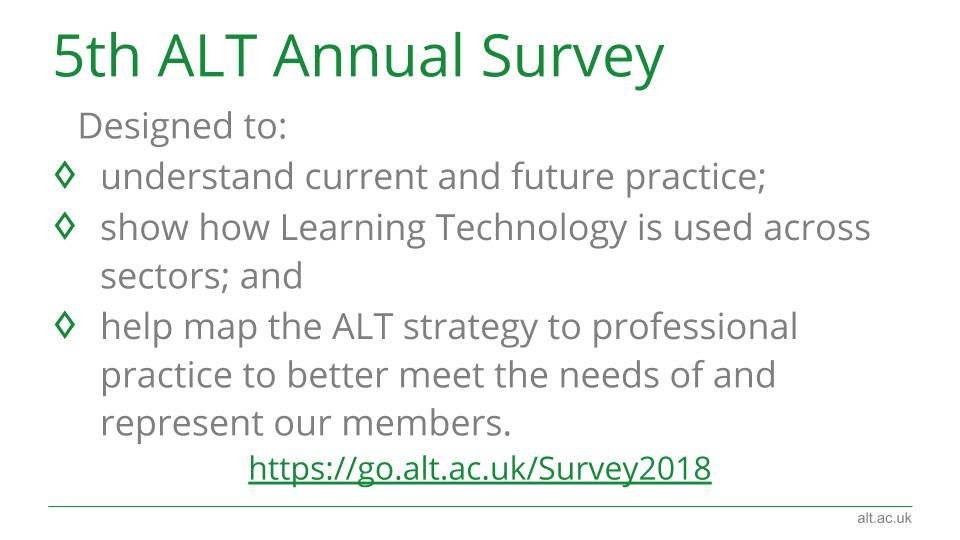
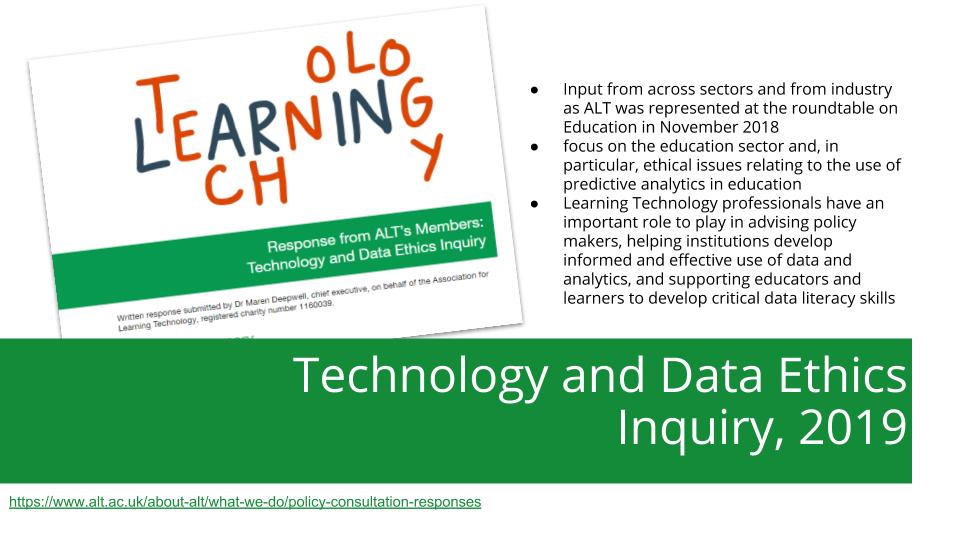
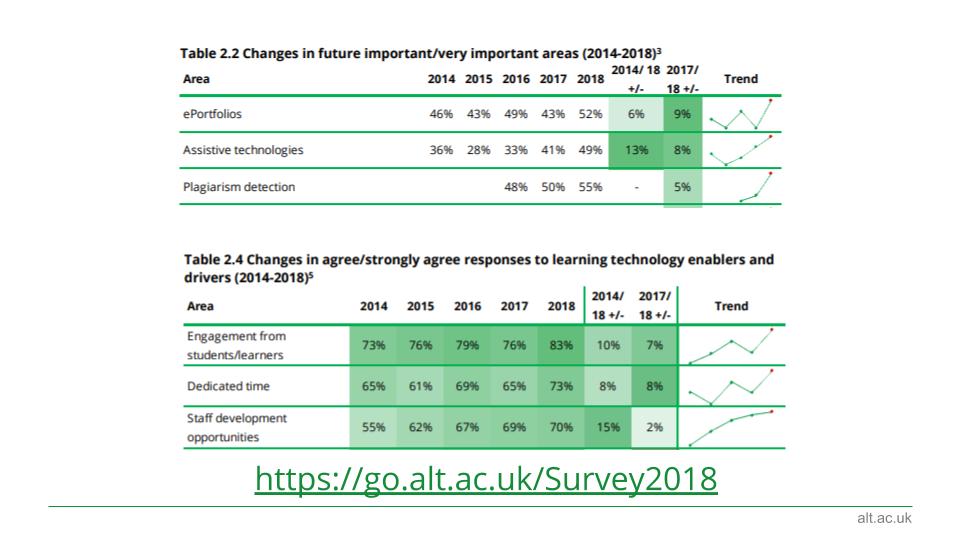
Drawing on the results from the survey ( https://go.alt.ac.uk/Survey2018 ) I first looked at the dual emphasis on learner engagement (which was been identified as the key driver for the use of Learning Technology over the past five years) and the crucial role of staff supporting each other (time, knowledge sharing, support, cpd) as the other main enabler. More professional roles in education now have a Learning Technology component, including more senior and leadership roles, so it is not surprising that staff time, development and recognition continues to grow as a critical factor. One example I shared is ALT’s input for the inquiry into Technology and Data Ethics, which highlighted that Learning Technology professionals have an important role to play in advising policy makers, helping institutions develop informed and effective use of data and analytics, and supporting educators and learners to develop critical data literacy skills.
In the second part of my talk, I focused on ‘Working with industry: Tackling the challenges of scaling up use of Learning Technology’ and shared some recent work of how ALT has facilitated Members from across sectors including industry working together and sharing knowledge to tackle some of the most challenging issues identified as important areas of change in the Annual Survey. Those include for example accessibility, relating to the new legislation on accessibility for VLEs, a community-sourced guide for Learning Technologists working with edtech start ups and in relation to tools for lecture capture and learning analytics in particular, compliance with GDPR. One of the strengths of an independent professional body like ALT is that we can act as a central exchange for information from different vendors, providers and users, creating an opportunity for institutions to collaborate on joint priorities and then providing a consistent reference point for the resources that are created for all to refer back to.
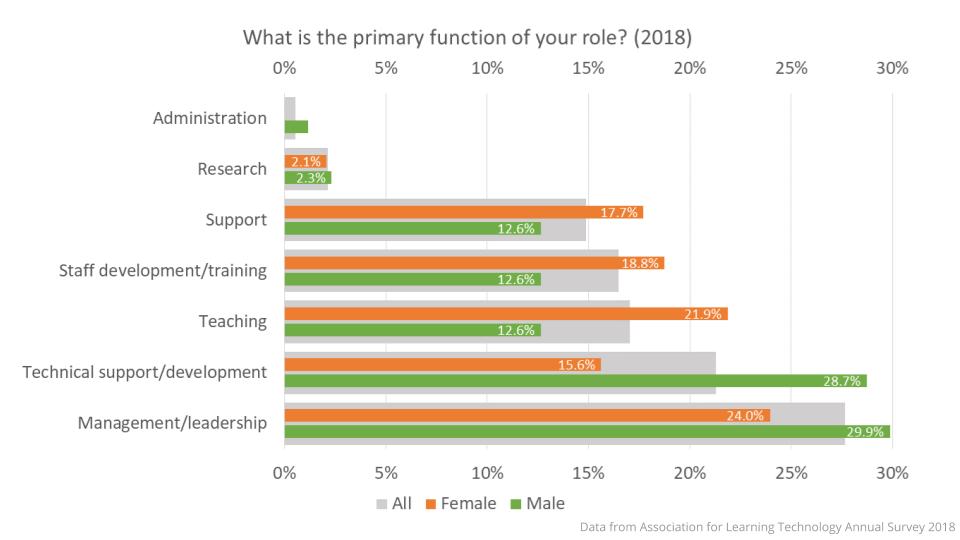
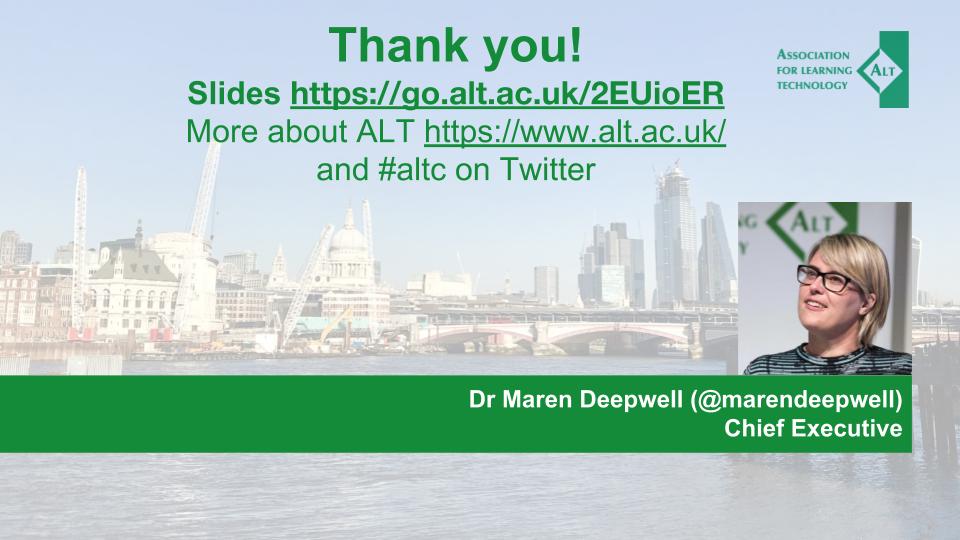
In the last part of my talk I focused on professionalisation in Learning Technology and the crucial role of staff. Referencing the 2018 Horizon Report, which identified the future role of educators as a ‘wicked’ challenge (“complex to even define, much less address”) I shared insights from the trends in role development from the Annual Survey, this time adding a separate analysis by gender. This new analysis forms an important part of ALT’s effort to close the gender data gap in Learning Technology. We recognise promoting equality as a priority for a professional body not a minority interest.
This post provides only a brief summary, but you can access the full slide deck with links to all references https://go.alt.ac.uk/2FFvk33 .
It’s my second time to volunteer as a guest curator for the @femedtech Twitter account and in the past year, since my last time as a curator, much has changed.
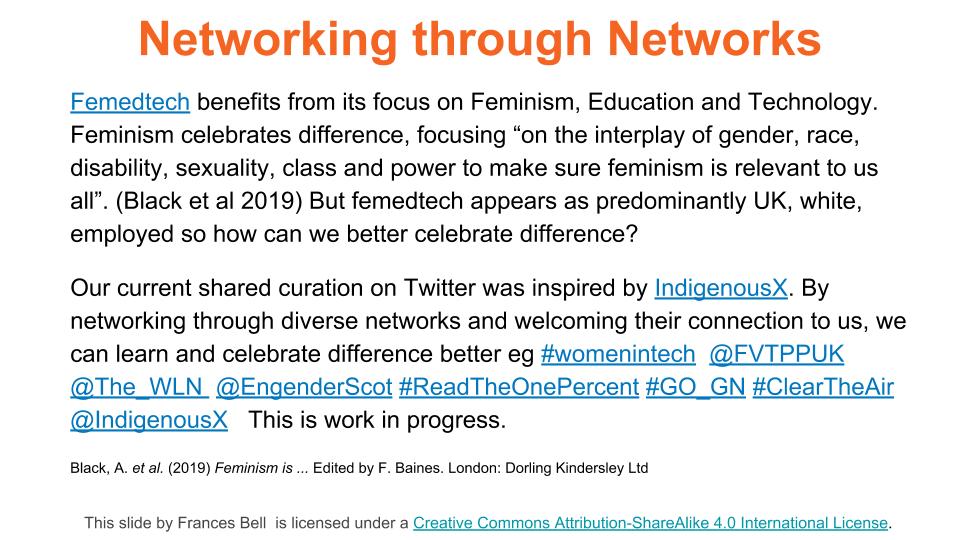
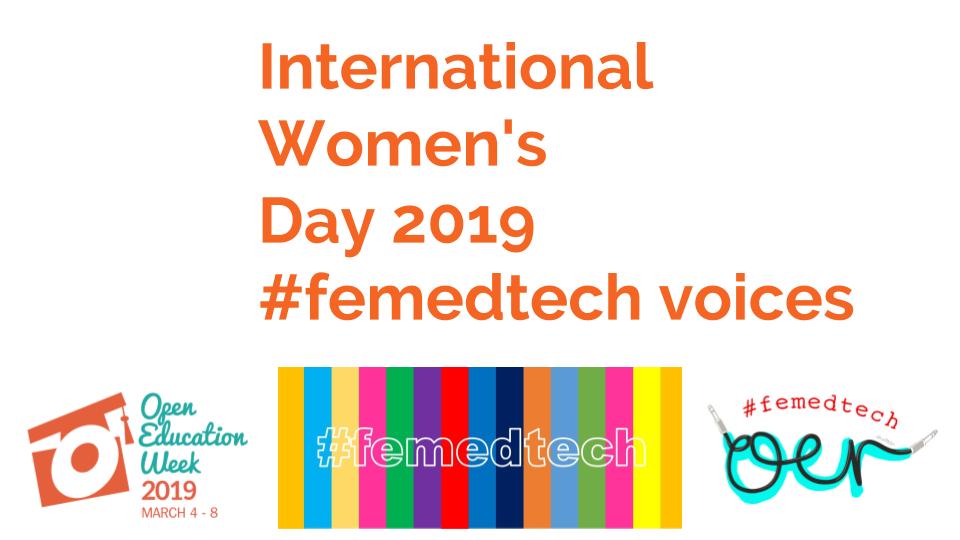
In 2018, I followed Helen Beetham, being only the second person to try out how to be a guest curator. At the time, the account had 122 followers, had tweeted about the same number of tweets and we were just in the process of writing some guidance for the activity, making it up as we went along and learning from the wonderful examples of networks around us. Frances Bell contributed the slide below to the community-sourced slides for International Women’s Day 2019.
So what is it like to be a guest curator now, that the following is ten times bigger and the network is growing rapidly, organising activities around events and interests?
I start each day by checking in with the account, checking first on the notifications and new followers. Following back those who are new and welcoming them is one of the key things I try to do each day. It’s fascinating to see who follows the account and often I come across individuals and accounts I also want to connect with in my personal capacity.
Then I look for new tweets that have been tagged with the hashtag #femedtech and like or retweet those. This can open up quite a few new rabbit holes down which my time disappears as I find a new book, artist or research that I want to learn more about. In contract to my own Twitter world, there is a much more varied and unexpected range of things being posted. Here are some examples from recent days:
You can see, there is a really varied range of things being posted, so I strongly recommend you follow the account yourself and join in.
Then, each day, I try and find and contribute something new, something from my own network or frame of reference, and which I can share to enrich the conversation or open it up to include new accounts. So this week I posted:
Looking for a creative challenge every day? Follow @ds106dc and the posts that happen each and every day
And I also work to communicate from what the network does in my day job, for example this week I had the opportunity to speak at the 13th Research and Innovation in Distance Education, and eLearning (RIDE) annual conference and I included a section on promoting equality in my talk, specifically focused on new analysis my colleague Martin Hawksey did of ALT’s Annual Survey focused on comparing gender perspectives, and his related post makes for interesting reading.
Being a guest curator for the #femedtech network really opens up new perspectives for me, it helps me get into the mindset of being a volunteer (and my day job relies heavily on the goodwill of volunteers, so that is particularly helpful for me) and it’s a powerful reminder that whilst we are making a lot of progress, there is always so much more to do to create a more equal and equitable society.
And on that note I’d like to mention a last opportunity to make your voice heard, to join in the conversation, which is a new open space for femedtech created in the run up to the OER19 conference. You can read all about it here and consider the following questions:
How do we balance privacy, openness and personal ethics?
How do we mediate our place in the open community, aspects of which might conflict with our personal ethics?
Is openness an act of conformance and / or defiance? And are there performative aspects to openness?
Do we feel pressured to be more open than we are comfortable with, or do our boundaries constrain us?
How do we manage sustainable spaces for exploring challenging issues around open?
People-powered innovation: overcoming challenges together
It’s a pleasure to talk to an audience with a long history of addressing the challenges of scaling up technology used for teaching, learning and assessment, familiar with what it takes to engage all learners and staff at scale and passionate about the potential that innovation has for distance education. I am particularly grateful for the warm welcome from Dr Mary Stiasny, Pro Vice-Chancellor (International) at the University of London and Professor Alan Tait, CDE Fellow and Professor Emeritus of Distance Education and DEvelopment at the Open University.
It’s particularly interesting to contribute to an event where the understanding of who learners are is more diverse, more nuanced than in a traditional undergraduate only context and where there is also a focus on understanding the the changing role of the distance learning practitioner. I chose the title for my talk because one of the key points I want to make is that change and innovation are people-powered, that it is human agency and drive that sets the pace of technological developments in education and beyond. It is easy to feel at times that we are at the mercy of technology, that it is the machines and technological progress that drive us forward and that we are constantly playing catch up. But we do have power to shape our paths, for institutions and individuals alike, and encourage each other to make use of it. To work together, across some of the traditional boundaries that can contain our practice in silos. With that in mind, here is an overview of what this talk covers in four parts:
Critical context and the challenges technological innovation presents
Insights into professional practice and trends in Learning Technology
Professional recognition and accreditation fit for a fast moving landscape
Promoting equality and working together to enhance the student experience
Part 1: Critical context and the challenges technological innovation presents
First, I’d like to briefly set out some of the critical context and look at examples of how what’s new in Learning Technology, what kinds of technologies we are currently seeing come into learning and teaching and what’s new on the horizon. It’s the interplay between learning and technology, how they effect each other to change our understanding and our practice, that is of particular interest.
The interplay between learning and technology
One of the areas of high priority identified across sectors is measuring learning, an interest in assessment and in a wide range of methods to quantify, track and chart all aspects of the learner experience. There is always a promise that with enough data and dashboards we can gain insights, leverage the power of learning analytics to understand more about how what we do impacts on progress, skills development and learning outcomes. It is up to us to develop our own capabilities in order to be able to understand fully how the more complex systems we use work, what determines when a ‘red flag’ goes up and how we should interpret and act on the information we gain in this manner. One of the last points I make in this part of the talk picks up on a section of the 2018 Horizon Report, which describes rethinking the role of educators not as a solvable or even a difficult challenge, but a wicked one, as ‘complex to define, much less address’. This is why I think the work that my organisation, the Association for Learning Technology, does is so important. We have been leading professionalisation in this context for over 25 years, charting the changing role of professionals across sectors, and these insights is what I will draw on in the next part:
Part 2: Insights into professional practice and trends in Learning Technology
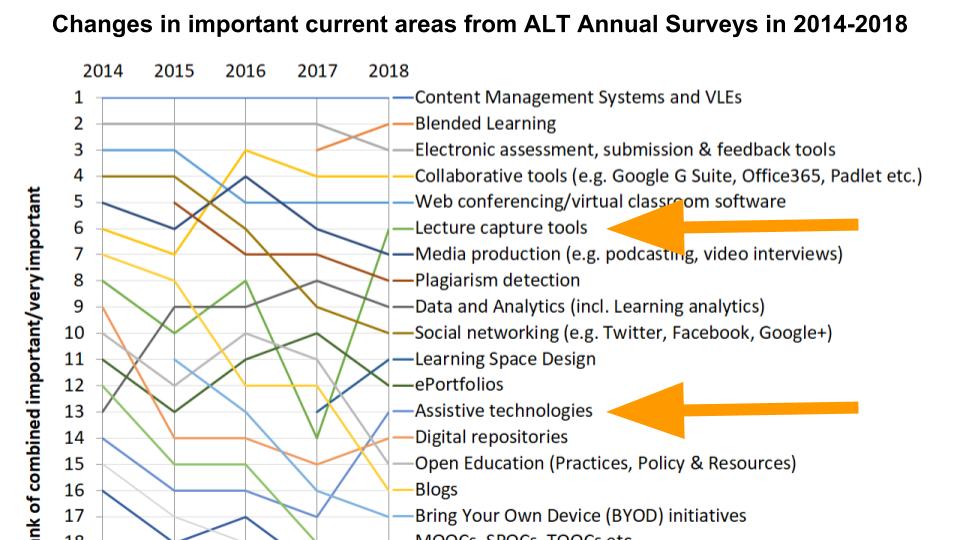
The main question I want to ask here, is how do we chart the changes in professional practice and what insights do we have. A good place to start to find answers is ALT’s Annual Survey, which in its current form has just been run for the 5th year. The survey is designed to enable us to understand current and future practice, show how Learning Technology is used across sectors and help map the ALT strategy to professional practice to better meet the needs of and represent our members. You can access the full report and all data openly, see https://go.alt.ac.uk/Survey2018 .
Changes in important current areas from ALT Annual Surveys in 2014-2018
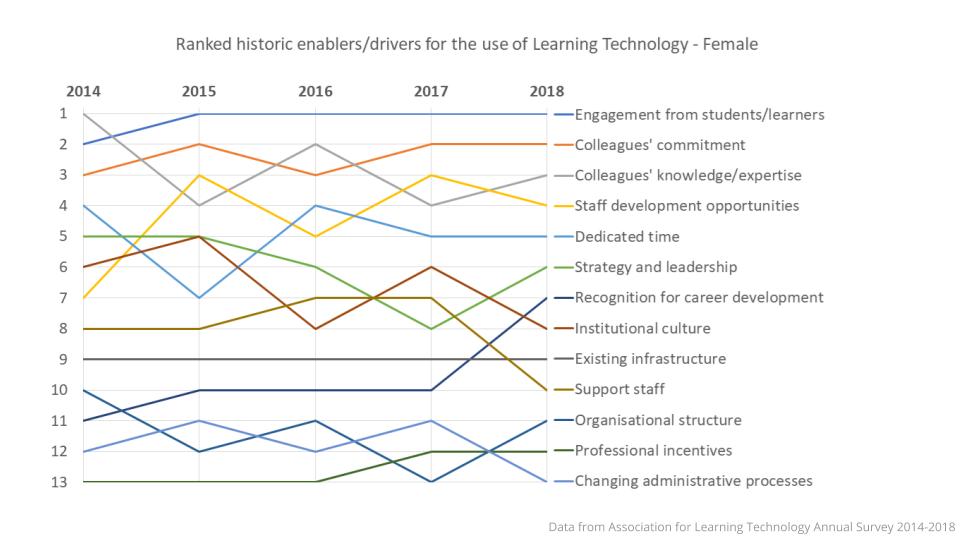
Over a period of 5 years, the survey shows how for example different areas in Learning Technology become more or less important. And one of the areas I have picked up for today specifically is Learning Technology related to assessment and also the student experience. Learner engagement has consistently been the most important enabler for the use of Learning Technology in all surveys over the past 5 years and underlines how central that is to what we do, how important people are to driving innovation and changing practice. We have that in common, no matter how different the institutions we work for, the projects we are involved with or the technologies we manage may be.
So from setting out the context of current developments in Learning Technology and the changing face of professional practice, I now want to come to talk about professional recognition and accreditation fit for a fast moving landscape.
Part 3: Professional recognition and accreditation fit for a fast moving landscape
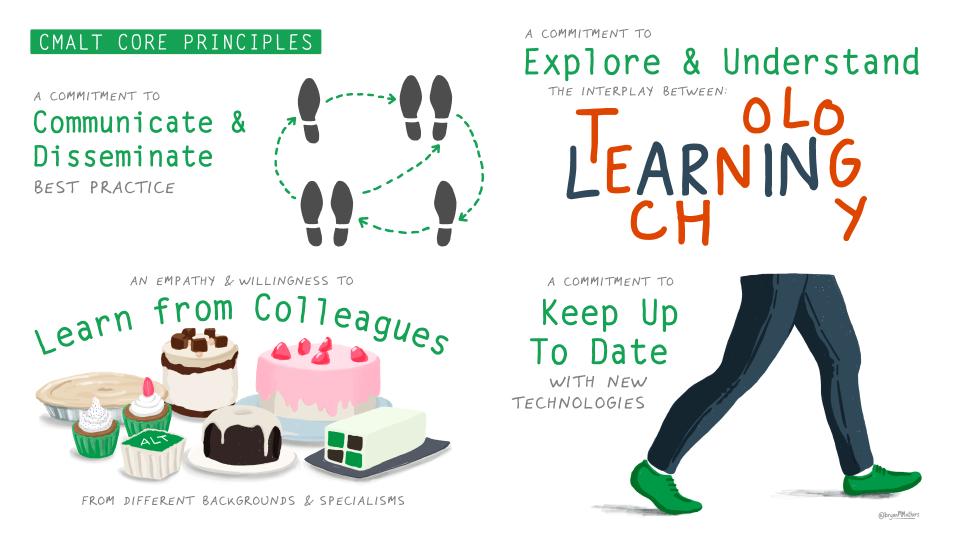
Established for over 10 years, the CMALT accreditation framework is the example I will focus on in this section. CMALT is a peer-based accreditation framework for all Learning Technology professionals and from the outset one of the key challenges it had to address was how to provide robust and high value professional accreditation in a context where practice changes rapidly and in which our definition of what ‘best practice’ looks like develops very quickly. One of the ways in which we solved this challenge was to set out, and to regularly revisit, shared principles that everyone, regardless of role, could relate to:
CMALT Core Principles
ALT’s definition of Learning Technologists is this:
You don’t have to be called a Learning Technologist to be one.
We define Learning Technology as the broad range of communication, information and related technologies that can be used to support learning, teaching and assessment.
Learning Technologists are people who are actively involved in understanding, managing, researching, supporting or enabling learning with the use of Learning Technology.
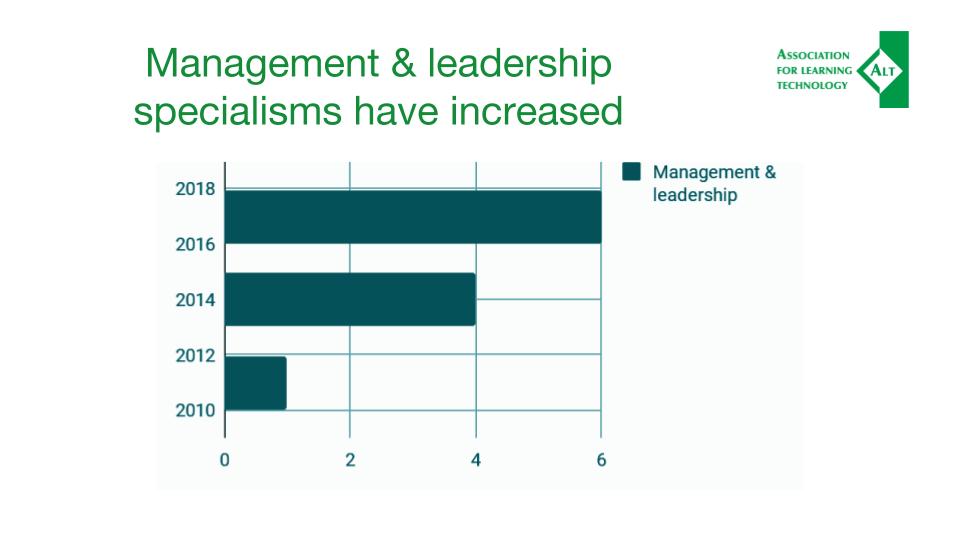
Delving deeper into what that means for professional recognition, I share examples of over a hundred different specialisms individuals have demonstrated their capability in since the scheme was launched, and specifically how specialist areas have developed in relation to engagement with learners and also how innovation has shaped the development of new specialisms. One of the areas of change that has really gained momentum is management and leadership and in particularly in the last few years we have seen increasingly senior roles, decision making roles, requiring a Learning Technology component or even focus. That is why we have piloted a new pathway for accreditation, Senior CMALT, which is due to launch in the coming months and from which I want to share some early findings.
CMALT for senior/advanced/research professionals
The new pathways continue to build an accreditation framework that empowers professionals to critically reflect on their practice and use of technology for teaching, learning and assessment. It provides robust, scalable recognition mapped to other national frameworks including the UKPSF, Jisc’s Digital Capability framework and Blended Learning Essentials. I took part in the pilot of the new senior pathway last year, and for my portfolio I chose to focus on an advanced area of practice about promoting equality in Learning Technology.
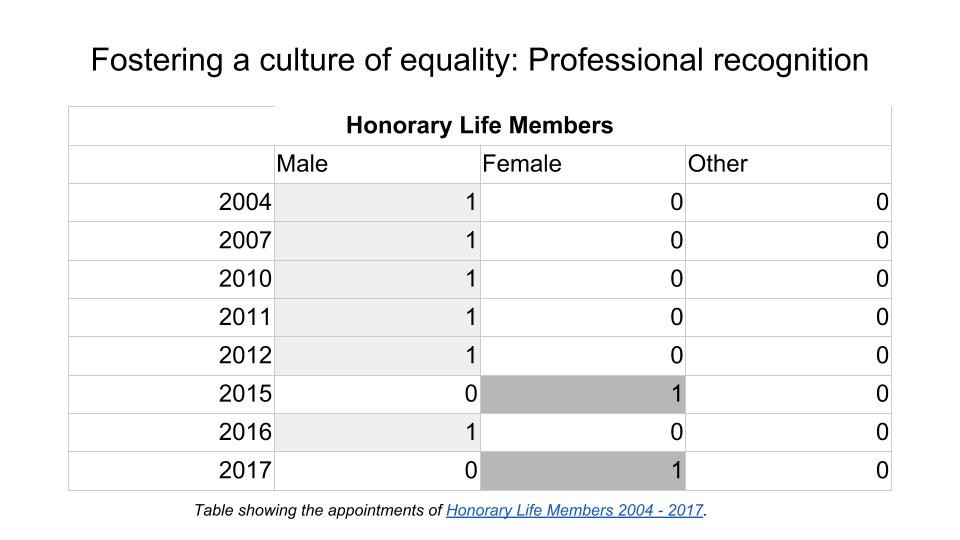
Fostering a culture of equality: Professional recognition
Some of the examples I share from my own portfolio include this, how the recognition of Honorary Life Members has changed over the past 15 years: focusing on gender balance since I become chief executive of ALT in 2012.
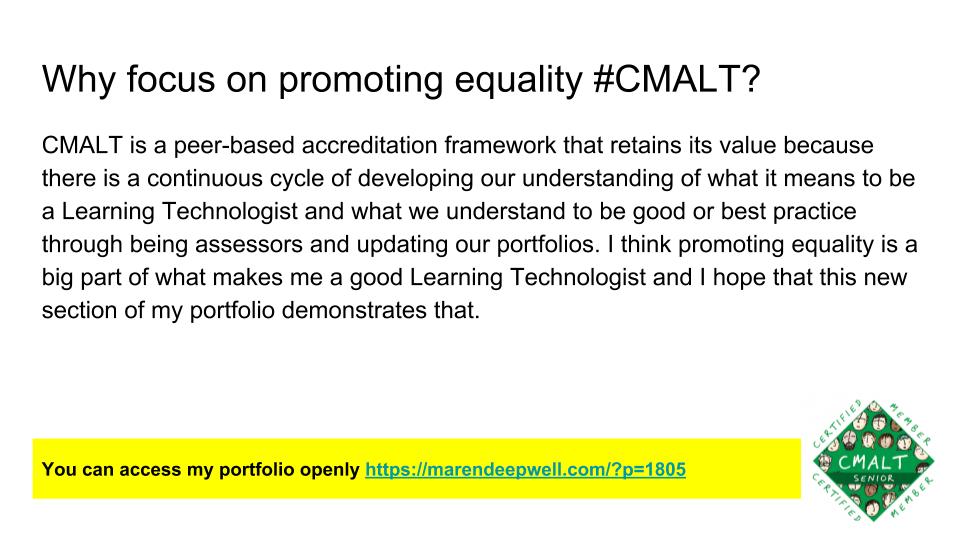
You can access my portfolio openly https://marendeepwell.com/?p=1805. Take a look for yourself and see how I approached the new pathway. And that brings me to the last part of my talk, which is about unpacking some of the challenges we are still facing when we work together and in particular the issue of gender equality in Learning Technology.
Part 4: Promoting equality and working together to enhance the student experience
I chose to focus on this aspect for working together partly because gender inequality is rife in the tech sector as a whole and even shapes how new technologies are developed, the data sets that AIs are trained on and the vision of the future that we see presented to us with technology. It’s also a continuous issue in this country and many others across the globe, even if we hear again and again that greater equality and more diverse workforces perform more effectively and deliver many benefits for organisations. Much of this part of my talk builds on the analysis my colleague Martin Hawksey did of ALT’s Annual Survey, and I encourage you to read his related post. This was written for an event on International Women’s Day at the University of the Highlands and Islands and presents new insights into professional practice from a gendered perspective.
ALT Annual Survey 2018
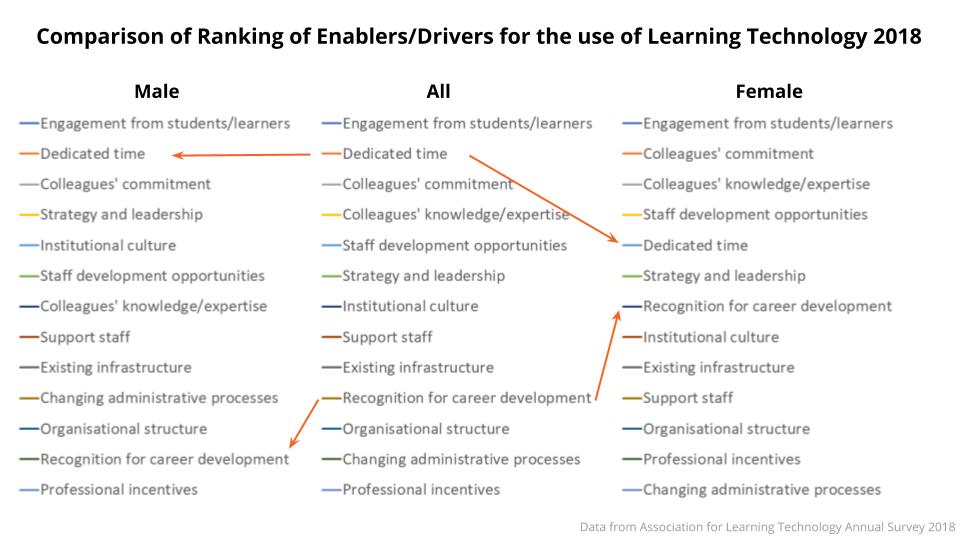
It’s interesting to see how the responses differ, particularly as we have a nearly even gender balance across all 5 years of data. So both in terms of what the areas of importance are in Learning Technology and also the enablers and drivers for the use of Learning Technology. This is the first time we have analysed the data from the survey in this way and it’s opening up new perspectives for our understanding of gender equality in our community.
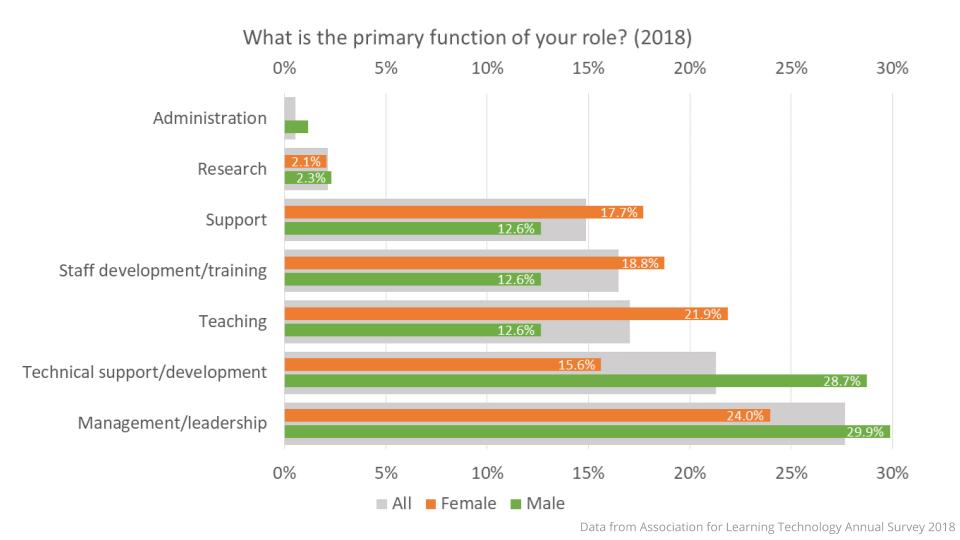
Coming back to one of the key themes of the conference, re-examining the role of long-distance educators, I would like to draw you attention to the part of the survey that charts the development of professional roles amongst respondents.
As a women in a senior leadership role in Learning Technology I am reminded every day that we still have a long way to go when it coa mes to gender equality, and the broader challenge of addressing the structural inequalities in our institutions, in national policies and also, in an ever more connected world, on a global scale. I feel this has particular relevance for distance education as at the heart of our endeavour is to provide greater access to education for all, to create greater equity for all learners and how we can use technology, in an informed and reflective way, to help us achieve those aims together with a focus on learners and staff leading innovation.
Thank you for reading and if you’d like to see the full keynote you can access the CC-licenced slide desk here https://go.alt.ac.uk/2EUioER and join the conversation #RIDE2019 on Twitter.
Today for International Women’s Day Martin Hawksey and I joined an inspiring day organised by the University of the Highlands and Islands Women’s Network. We contributed a joint keynote on promoting equality in a distributed organisation.
— University of the Highlands and Islands (@ThinkUHI) March 8, 2019
The keynote focused on sharing our perspectives on promoting equality on three levels: promoting equality as a challenge for Learning Technology professionals, promoting equality as key value in our organisational culture and promoting equality as a personal commitment.
You can access the full slides deck, including crowd-sourced slides from the generous #femedtech community https://go.alt.ac.uk/IWD19altc and all slides are openly licenced.
Martin’s part of the talk focused on a new analysis of survey data from ALT’s Annual Survey, that highlighted some very interesting differences in how male and female professionals views differ and he’s written a blog post that includes all the graphs and links to the full data set.
For my part, I want to add some reflections of my own on key parts of what we spoke about:
First, building on the perspective that Martin explored through the survey results, I shared parts of my professional development portfolio which has been accredited through ALT, making me a Senior CMALT Holder:
We heard much today about how important professional recognition and career progression is to fighting structural and organisational inequalities and in this context I felt there was an added significance to recognising different forms of promoting equality as not only a valid, but essential role of leaders at all levels, not ‘just’ specialist staff. One of the speakers today, Dr Susan Engstrand, reflected on how even small matters like keeping meetings running to time and chairing in a manner that encourages participation from everyone can make a significant difference and promote a positive culture change. It was inspiring to hear so many different voices, students included, from such a diverse university population as the communities that the University of the Highlands and Islands serves and the closing slides of our keynote added more voices from the #femedtech network to today’s discourse:
Especially as this year International Women’s Day happens during Open Education Week, it’s been a pleasure to receive contribution for this crowd-sourced slide deck, enabling volunteers within the network to help share ideas, perspectives, inspiration and practical resources. Thank you to everyone who has already contributed – and more contributions are always welcome.
As an extension of the monthly series of blog posts about leading a virtual organisation this keynote built on a recent post and podcast, focused on Martin’s and my own experiences. And so I felt it was appropriate and important that the talk followed a similar conversational format, giving our audience the opportunity to join into reflecting on our different points of view, contrasting experiences and also the similarities. It reminded me powerfully that meaningful progress can only be made if we don’t have the conversation about equality ‘just’ amongst women, or indeed any discourse about inequality of any other kind. It’s not a ‘women’s problem’ or an issue that only concerns those of us who identify as female. It’s an issue for everyone to be concerned with. In some contexts, we may make an economic argument, that mixed teams are more effective. In others there are legal, social and political realities to be confronted. But on a daily basis, there is also the difference we can each make, affecting change on a small scale, within our personal sphere of influence, as part of our families, our communities, our institutions, our networks. Thank you to everyone at the UHI International Women’s Day event for so many examples of enthusiastic, passionate and compassionate people doing just that. Every day.
I really appreciate following the work of Alice Keeler (@alicekeeler) on Twitter. I learn something new from her every week and find the tips and ideas being shared extremely accessible and easy to use. So when I saw this tweet recenlyt, proclaiming “I WANT my tech tools to become OBSOLETE” I sat back and paused – because I was just in the process of spending a few hours making one of the tools I use at work obsolete and it felt like a good point to remind myself why that is a good thing.
When we wrote about cpd and digital well being for our series on leading virtual teams, Martin Hawksey and I talked about how important it is to revisit our relationship with technology as personal habits change and professional practice develops. And I mentioned some of the more frustrating aspects of constant iteration, of ‘agile’ approaches to developing software and hardware. What we didn’t get around to talking about is what Alice’s post picks up on, the opportunity to start from scratch, with a blank slate, to improve, to re-imagine – rather than to simply edit or update. Alice’s post reminded me that it’s sometimes good when platforms or tools change because we are then forced to take a fresh look at what we are doing and why. But some processes that I work on are so fundamental, so much part of the fabric of my working world, that there’s rarely an external prompt to start from scratch.
The structures that shape workflows, processes, thinking… usually they are either complex and technologically challenging, in which case I need others to actually do the re-imagining with and for me, or they are very simple and tend to disappear into the foundation. This second category is rarely rocked by obsolescence. As tools go, spreadsheets and documents, in one form or another, don’t often change dramatically enough to really make you take a fresh look at things. So this time I am going to not focus on the ‘how’ but the ‘why’. What do I need this to do? Why is it being produced? Why is it being read? Why is it important to know? Or is it?
It’s a good thing to do, to take a fresh look at something and consider how it could do better. How it could be more efficient. Or more engaging. More transparent. More impactful. How it could be cheaper or more expensive. How it could be more fun, more enjoyable, more rewarding. And whether you need it in the first place. Does it still serve a purpose?
I am not a great fan of doing things because they have been done before. Or of doing things in a certain way simply because that’s how it was done before. That’s not a good enough reason. I always want to know why. Why, why, WHY???
There are some problems with this approach: you don’t have the comfort of accepting things as they are (and that is not to be underestimated), you can waste time and effort on something that is not worth it, you need to make sure you don’t change things for the sake of it and it’s a lot more work to constantly trying to improve everything than to simply repeat it.
There are much bigger upsides (for me): it’s not boring. You develop judgement. You can achieve more (I think). It’s fun learning new things all the time. You get to re-invent the structures that determine the shape of your work.
When I was a research student, I worked part-time in my department’s archive. A small collection of materials that students could borrow from a room filled with book cases and filing cabinets. I worked there for two years and left a new cataloguing system, the first complete catalogue, a new lending process and loans up by 100% when I left. A few hours a week sitting in a small, boring office where activity was not at all incentivised presented an opportunity for me to reinvent things from the ground up. Given time, space and a particular problem, I had enough freedom to… make things change. It never occurred to me to ask for permission.
And that’s why I liked that post from Alice and her thinking about changes in tools and platforms as opportunities to ask ‘why’? Any catalyst that get’s us to ask that question, to reflect on our work and our aims and the underlying systems, the assumptions is to be welcomed. Not ‘just’ for teachers, but for each of us.
If you have missed it, go back and read the most recent post on leading a virtual team.