Usually at this time of year I start to blog about what’s coming up at ALT’s Annual Conference in September. For over ten years this event has shaped my working life, setting the rhythm of when things go from busy to frantic. It’s not ‘just a conference’, but also a focus point around which engagement in activities that happen at other times of the year is planned (find our more).
When ALT’s Board of Trustees took the difficult decision to not hold an Annual Conference until 2021, I felt that as an organisation we made the best decision. We put the well-being of everyone involved first as it was very clear that we couldn’t manage the risks involved in holding a large international event with over 500 people in London this autumn. Or indeed at the start of what is looking to be a very demanding academic year for everyone in Learning Technology.
Yet the need to share knowledge, to learn from each others practice and research is more urgent now as Learning Technology has moved centre stage. Hence we are organising a virtual Summer Summit over 2 days, 26-27 August 2020 – and I am getting really excited about what’s in store.
From the crisis drop ins, weekly webinars and Members’ feedback in recent months we have picked up topics which are most urgent such as virtual labs, digital inclusion, well being and scaling up blended and fully online provision and for each of these and more there will be practical, parallel sessions running throughout the programme.
We have put an issue that concerns us all at the heart of the summit, and are fortunate that Angela Saini will be joining the summit for a special Q&A session #BlackLivesMatter.
Building on the recent success of #GastaGoesGlobal, a special ‘Crisis & Care’ Gasta session features doctoral researchers from the Global OER Graduate Network (GO-GN) and will be chaired in the best #altc GASTA tradition by Dr Tom Farrelly, Institute of Technology, Tralee (ITT).
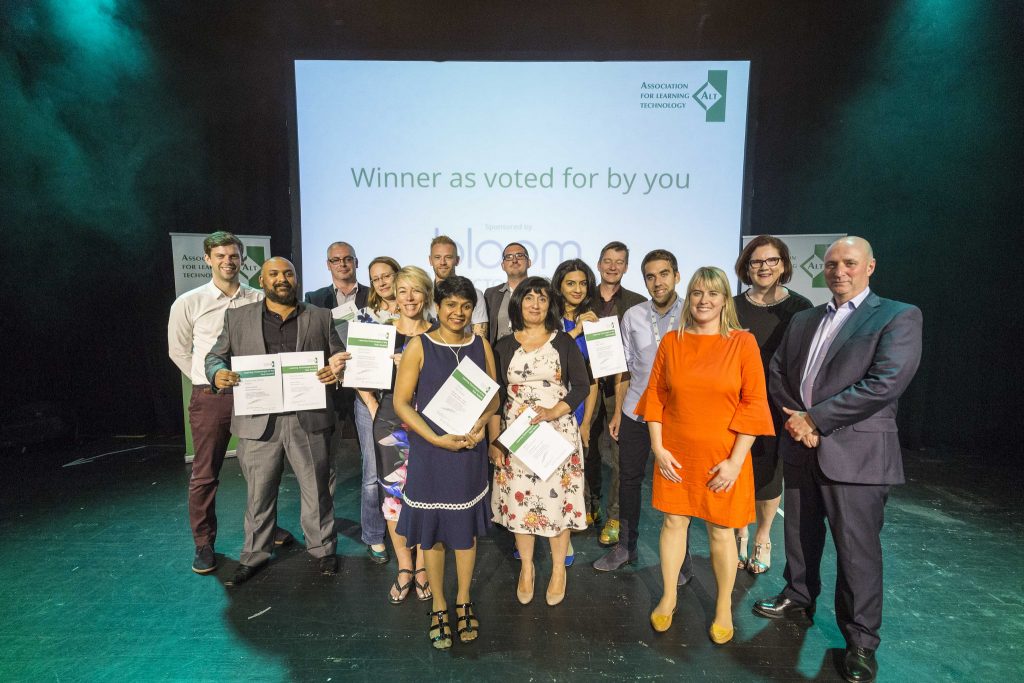
Alongside a wonderful line up of featured speakers, we have also been thinking hard about how to translate some of what makes our events special into a new online format. We want to not look at a grid of faces for two days running, so asynchronous sessions are in the programme, too, as well as a quiz, radio and… karaOERke…! There may even be a 2020 #altc community portrait 🙂
Registration for the Summit is open and tickets are £49 and free scholarship places are available. Register to get access to live sessions, recordings and resources and join us for what is promising to be a very special two days this August #altcSummit.
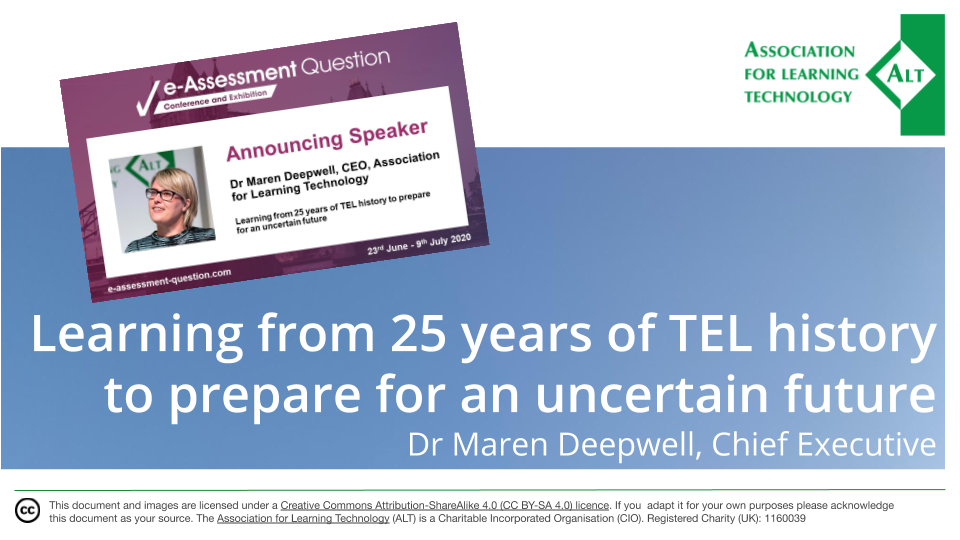
I am glad to be able to contribute this opening keynote (slides) to what has been a conference long in the making. Originally this conference was to take place in late April – but this being the year it has been, the organisers have worked very hard to create a virtual event.
The eAssessment Association is a fellow professional body, and like ALT, plays an important role in support a community of professionals who are under a lot of pressure just now to deliver at a scale and within a scope that exceeds much of what we have been used to.
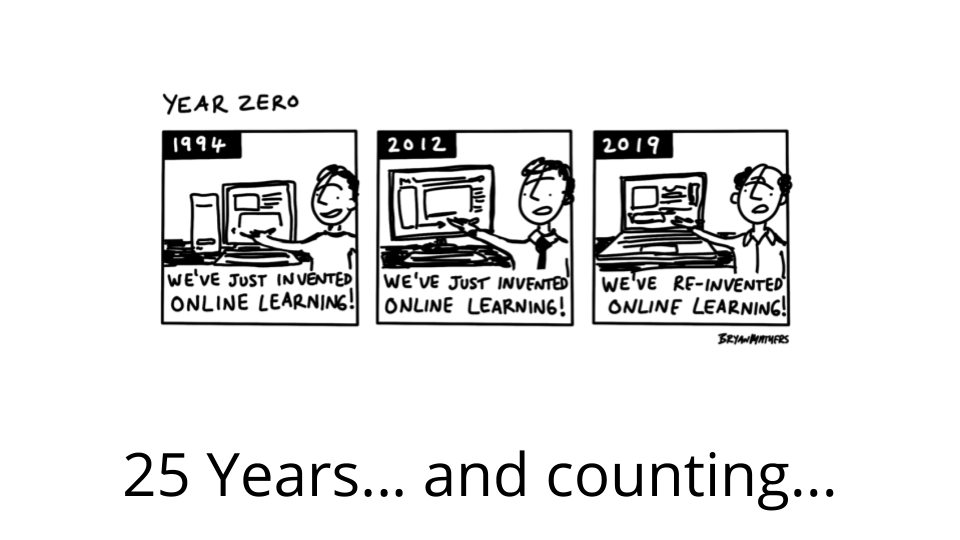
And that is important to remember and reflect on as we consider what we can learn from 25 years of history in Learning Technology to meet the challenges of an uncertain future.
I have organised and participated in many virtual events of all shapes and sizes, and I find that being online and watching video for hours is extremely tiring. We have all had many weeks of highly stressful and exhausting days, both at work and at home. So I invite you to sit back and listen. The slides from this talk including links to all the references I mention are openly accessible and there is nothing to do now for the next 25 minutes except to enjoy the start of what I am sure will be a wonderful conference.
Specifically, this talk will focus on sharing practical insights and expertise in relation to three key questions:
how to build staff capacity to use technology for learning, teaching and assessment effectively online and at scale;
how to make use of best practice frameworks and open education practices;
how to tackle equity and inclusion in online education.
Before we jump right in however, let me tell you a bit about who I am and the community of thousands of Members from the UK and beyond whom I represent.
The Association for Learning Technology (ALT) is the leading professional body for Learning Technology in the UK.
We define Learning Technology as the broad range of communication, information and related technologies that are used to support learning, teaching and assessment.
The pervasiveness of learning technology means that many working in education will be involved with it in some form, so therefore we embrace the diverse range of roles, titles and terminology in Learning Technology across sectors.
Until recently, I had no idea what a ‘Learning Technology’ emergency might be. But after months of crisis support, organising webinars, collating resources and sharing whatever support we can, I have a very clear idea of how big a challenge we are facing when it comes to scaling up learning, teaching and assessment with technology.
In the rush to pivot, pirouette or simply rush to virtual ways of doing things, it felt like a whole new audience was discovering questions that many of us were already familiar with. From being a ‘nice to have’ using technology effectively suddenly became a must have for everyone overnight. It’s not surprising that in the early days of the pandemic and the lock down it felt like we had no idea how to meet these enormous challenges. But even though this global crisis is often described as ‘unprecedented’ we do have in fact decades of research and successful practice, partnerships with industry and knowledge sharing networks across the globe. As an Association we celebrated our 25th anniversary nearly two years ago and the expertise and experience we have as a community certainly shows us what steps we might take into an uncertain future.
It is important for us to learn from the history of education technology, to explore what we know works and what doesn’t – and importantly to gain a sense of perspective that the current crisis makes is extremely hard to retain.
As staff leading organisations to the start of a new term amidst a lot of uncertainty, taking a longer view can help us gain a better understanding of when technology can help and what it can’t do. Looking back, as well as ahead, also prompts us to reflect on our relationship with technology, and how it mediates the way we work with each other and the way we relate to students.
Assessment has always been key to using technology in education. It’s an expression of what we value, what we can measure… and what goes left unsaid. Right here, right now, you trust me to present this keynote talk to you and I trust you to participate. There are many, many things going on where we are, family members coming into the room, pets, too, there is probably windows with work emails, windows with social media feeds, windows with personal shopping, windows with… anything else that currently demands your attention. Trust is part of the virtual undertaking just as it forms an important part of how we behave towards each other in person.
People, not technology, are what makes online learning work – and there is no magic button to solve all the messy, human ‘problems’ that are part of every virtual learning experience. People, staff and students, are always at the heart of our work.
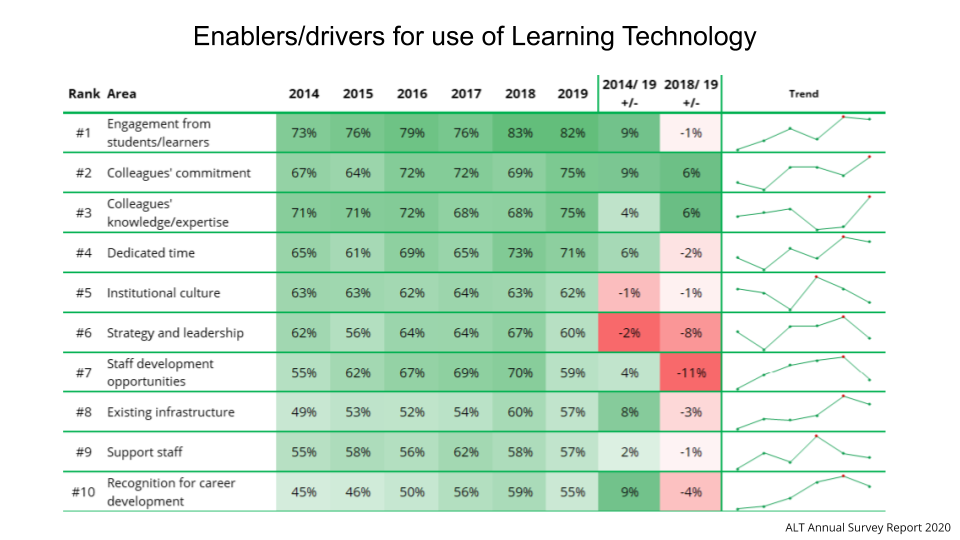
For several years now, ALT’s Annual Survey has provided valuable insight into current practice in Learning Technology and how technology is used across sectors
When we look at what the key enables and drivers for use of Learning Technology are, the top results are always student and staff engagement, commitment, knowledge and time. Scaling up design and delivery online is going to require increasing capacity. Professional bodies like ALT can help by providing access to expertise for recruitment, openly sharing research and best practice and facilitating knowledge exchange between organisations across sectors and with industry.
Recent estimates shared by Professor Tony Bates showed that institutions in the US and Canada are preparing for an increase in staff supporting Learning Technology by 15-25%. ALT’s Annual Survey 2020 highlights priorities for learning, teaching and assessment that point towards an increase for Learning Technology across the board. Of particular note in the survey is the recorded increasing importance of web conferencing/virtual classroom software and collaborative tools suggesting that the sector was already building capacity in these areas prior to COVID-19.
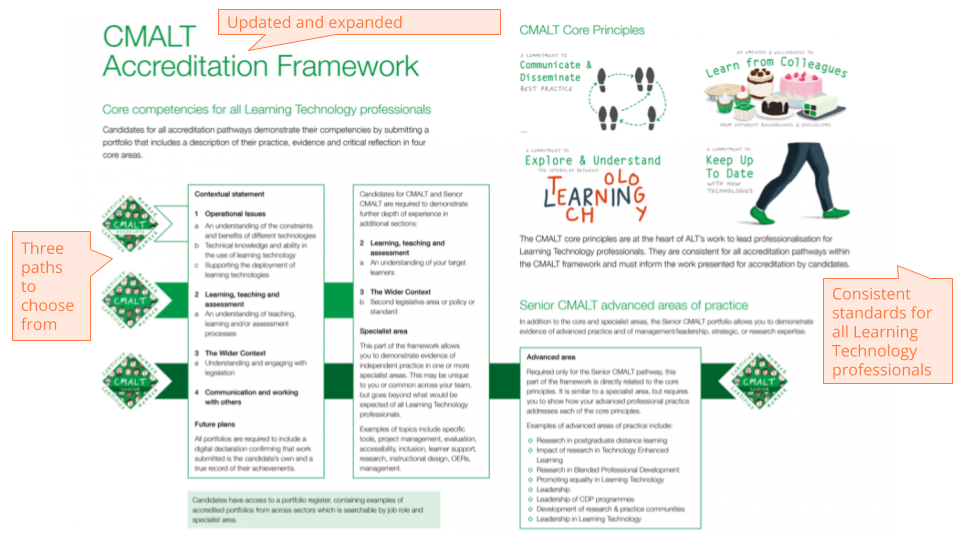
One of the ways we have recently contributed to building professional capacity is to expand ALT’s framework of professional practice and capabilities to reflect the increasingly wide range of roles that have a Learning Technology component. The number of roles which require Learning Technology is only set to increase in the coming years, making it ever more important to set out not just operational standards, but also recognise the wider context of Learning Technology policy, theory and history as fundamental to its ethical, equitable and fair use.
The analysis of current and future trends also helps establish key areas in which to grow capacity, such as virtual learning environments, particularly in the light of the expanded accessibility legislation; virtual classroom and web conferencing tools, which are now in high demand and also collaborative tools as well as with e-assessment. E-Assessment has continued to be a to priority over the past six years, including online submission & feedback tools.
Yet as the technology has become more sophisticated and more widely adopted, so have concerns regarding their ethical and inclusive use. Learning Technology as a whole, and technology for assessment in particular, has brought wide ranging concerns and questions to the forefront of professional practice.
We have to act now, to tackle inequality and discrimination in all its forms, particularly as we look beyond the crisis. We already know that certain groups and communities are more affected by the pandemic and that working and learning at home brings with it a plethora of issues around access to infrastructure, devices and space. Beyond practical considerations, we must consider how complex technologies and algorithms function and how their inherent biases impact on staff and students alike particularly when it comes to assessment.
ALT has long supported open education in all its forms. In the recent crisis in particular, we have been able to support our Members and the wider community more effectively through open approaches, fostering knowledge sharing and transparency. We encourage professionals and organisations to adopt open licences for course materials, research and other content. Two areas in which this has been of particular importance are policy advocacy for ethical approaches to using data in education, copyright for online learning and sharing best practice around accessibility:
Weekly webinars organised by Members of ALT started on Friday 20th March in response to queries largely from those in higher education related to copyright and online learning following the outbreak of the COVID-19 pandemic and the shift to online learning. The webinars are free to all and aimed at those interested in talking about copyright challenges at the current time and how we can address them. The organisers have published a page full of resources and the original blog post that led to starting this series on Copyright, Fair Dealing and Online Teaching in a time of Crisis.
I feel it is important to focus on these aspects of using technology as well as more operational questions as these issues are only becoming more urgent as we move more and more students online. Our professional practice has to find ways of tackling (structural) inequalities and help identify the blind spots in our perspectives.
Last summer when our Annual Conference took place in Edinburgh, I was very inspired by a wonderful keynote given by Jesse Stommel. I’d encourage you to watch the entire talk, Critical Pedagogy, Civil Disobedience and Edtech. For this talk, I’d like to include one particular quote, which encourages us to undertake a ‘critical examination of our technologies, what they afford, who they exclude, how they’re monetized, and what pedagogies they have already baked in. But it requires we also begin with a consideration of what we value, the kinds of relationships we want to develop with our students, why we gather together in places like universities and how humans learn.
Now, a year ago, this already seemed like an urgent priority, but in light of what has happened this year, it seems even more poignant. As we plan for an uncertain future, trusting in students and trusting in staff, rather than implementing more sophisticated ways of tracking, analysing and watching each other seems like a good place to start. And that is the thought that I hope you will carry with you over the next days and week as you participate in this conference and as you go on to plan for a new, unprecedented, academic year.
This is a conversational blog post (cross-posted here) between Martin Hawksey (@mhawksey) and Maren Deepwell (@marendeepwell).
We are using this approach to create some space to think together in ‘unprecedented times’. It’s open leadership in practice and in pandemic times. For regular readers this is a slight departure from our regular ‘Virtual Teams’ posts (you can read those on our Virtual Teams summary page) taking a broader view of work whilst midst global pandemic.
In this month’s post we share some of the things that have helped us get through the current global situation. As part of this we touch upon some of our senses and stimulants we use in our working lives including caffeine and candles. We also share how music has helped us to make connections and support our wellbeing. We invite you to read and think along and please share your reflections as a result of this month’s post and if you like you can tune in to the ds106 Radio slot with Maren, Tannis Morgan and Anne-Marie Scott at 7pm (BST) on Sundays at ds106rad.io/listen/.
All the best to you and yours. We hope you are safe and we are grateful that we are, too.
May…
Martin: Over the years I’ve worked in a number of different offices from a room perched up high in a shipyard that gently rocked when the overhead crane moved, to converted school classrooms, large open plan spaces and until I worked from home I never had an office to myself. Looking back at some of the co-spaces I worked in, it’s interesting how the practicalities of the space influenced the office dynamic and also the role of music played in how we worked and interacted. In the shipyard I was working as a CAD operator, part of a small team producing technical drawings. We were all very young with no senior management in the same room and just left to get on with it. One of the areas of tension was what music was played on the CD player. There were only a couple of albums and after The Seahorse was played for the umteenth time in one day each time a little louder I was ready to break (I once hid the remote control with the volume down button stuck on in all the paper drawings for some peace and quiet… this did not go down well). In the converted school classroom the job was very administrative, production focused and we were mixed in age and backgrounds but often we would listen to BBC 6music. If anyone had their own Seahorses moment they never let on and having a mixture of music and a DJ to listen to often create conversation points which helped get through some of the repetitive monotony of the job. And then there are spaces like the big open plan office where if you were going to listen to music headphones were obligatory. This often led to moments when our little desk cluster would all individually have our heads down, bopping away focused on our work in our own little space. The influence of music in the workplace to aid factory production and placate the workforce is well documented, but it was only recently whilst out running I realised just how much music had a physical effect on my performance. When that banging track kicked in, my body was so ready to kick on through those last 3 miles of a 13 mile run. Music also has helped me get through some deep lows. Whilst many criticise bands like Radiohead and Elbow as producing ‘depressing’ tracks, when I’m low myself this is exactly the music I listen to given the uplifting effect it has on the chemicals whooshing around my brain. Has music played a role in your work?
Maren: Music has definitely played a role in my working life… particularly when I was working in a cafe at Ray’s Jazz at Foyles Bookshop in London. I bought many albums in that job, as I was fortunate to work alongside folk who had an encyclopedic knowledge and I discovered a lot of music that year. When I worked in a university setting, a lot of my work was based around teaching or student support, so there wasn’t a lot of scope for listening to music and in my early years at ALT, when we still had a physical office, music wasn’t often part of the daily routine – although we had music hours when we each got to make a request. In recent years, since I started working from home full-time, I find I listen to music most when I travel. I have a lot of meetings each day, so the few quiet hours I can carve out each week are precious for concentration and I don’t listen to music when I have that time. I do listen to music to wind down at the end of a day, or when I am out running, or on the train or plane. That said, I find the right scent really helps my working environment. I have a scented candle next to my desk and I like having a familiar smell that I associate with work. I also have plants in my work space, and as much natural light as possible. One work environment factor that I have recently thought a lot about is the number of different screens I use. Since I moved house during the pandemic, I don’t currently have my largest monitor to work on – but even when I do, I don’t use a lot of different screens. I know you do! I prefer to have one screen for meetings and one screen to work on, but I rarely flip between screens. I don’t check social media during the day unless I am participating at an online event or managing an announcement and I prefer to work on one document at a time. I guess overall, I value a calm workspace when I can create it.
Martin: Like you I’m in between house moves so it means I don’t have my usual office setup. Whilst a pandemic lockdown situation wasn’t foreseen I had taken a number of pieces of equipment with me but my screen space has been reduced to two 13” displays. Overall it feels like I’ve adapted but something I’m aware of is with smaller screens there is a risk of eyestrain. Given most of our systems are cloud based with web interfaces it means I’ve made more use of zooming/scaling, I am however looking forward to surrounding myself again with larger displays.
I’ve never considered sense of smell and how it can be used to support your working environment. Thinking about other senses and stimulations coffee has become a bigger part of my life. Historically I’m a tea drinker and for the last couple of years have drunk caffeine free Rooibos tea, but over the last 4 months coffee has increasingly featured, now usually starting the day with a cup of joe. I’ll also turn to caffeine and some banging tunes when I have some data processing tasks to get through. When I’ve worked in offices in the past there have been various provisions provided from bring your own to employers supplying refreshments, the best was one employer who kept a fridge stocked with various refreshments (mostly caffeine based … as HR news reports in writing about the benefits of providing workplace coffee machines as a stimulant caffeine can boost productivity)
Writing this exchange during mental health week has also been useful to listen to some of the advice and support that has been shared. On Wednesday 20 May on Lauren Laverne BBC 6Music show fellow DJ Nemone, who is also a practicing psychotherapist, highlighted some of the research around the benefits of music including how it can be used to help manage stress levels as well as ‘music being a way of communicating, a conversation between people, the making and listens results in increased feeling of connection’. You can listen to Nemone speak about this in the show recording which is available until 18 June 2020 at the 1:11:17 timestamp. I know that in your spare time you’ve also been involved in a weekly radio show on ds106 Radio and you might want to talk more about that?
Maren: yes, that’s true! I have been joining some friends on the crisis radio airwaves. For the last couple of months, we have been playing tunes and sending hugs on Sundays, and more recently also requests from listeners. I have blogged about that, writing about kindness, mental health and radio full of rainbows. My particular favourites include soul soundtrack songs and old singles from The Cure. Listening to the radio, often manned by colleagues in different parts of the world whom I know is a great way of keeping connected in this time of isolation. Even though for many of us the more local measures are gradually being relaxed, my professional life has changed completely from travelling every week and going abroad several times a year to basically no travel at all in the foreseeable future. So it’s especially important for me to keep connected to people whom I might have otherwise met up with at an event or a meeting. And of course, there is the music as well. One recent show featured requests from listeners and closed with a beautiful song called “Weeping” requested by Laura Czerniewicz which resonated with many. If you’d like to listen for yourself to the whole playlist you can find it here.
We are using this approach to create some space to think together in ‘unprecedented times’. It’s open leadership in practice and in pandemic times. For regular readers this is a slight departure from our regular ‘Virtual Teams’ posts (you can read those on our Virtual Teams summary page) taking a broader view of work whilst midst global pandemic.
We invite you to read and think along and send all the best to you and yours. We hope you are safe and we are grateful that we are, too.
April…
Maren: Hello from month two of lockdown here in the UK. I initially started writing this post on 23 March, but since then so much has happened that I stopped and now, a month later, I’ve started this conversation again. I’ve been reading so much about the current crisis: at first there were emergency announcements and lockdown measures, then lots of support and help for coping, then about the ‘new normal’ and now we’ve arrived at predictions for the future. It is both incredibly busy and extremely boring. I am not sure how I feel about the idea of ‘business as usual’. I can understand the desire for a sense of normality and keeping to a routine, but no one can really function normally just now, so I am starting to think about what measures we can take to lead our team through the coming months.. ideas I have had include… building in a planned 20% reduction in overall productivity (to give us as a team more flexibility around care commitments etc); supporting setting priorities for each week and creating a clearer overview for us as a team (kind of like what you would do for a project, ie treat the crisis as a project) and to try and set aside small pockets of time for thinking about things, rather than just doing stuff. What do you think of these ideas?
Martin: There are days right now where I certainly feel less productive and reading this thread shared by one of our team members on the inability to focus as the result of the extra stress from the current situation definitely helped. I’ve also found some of the small adjustments to the way we operate have also been really beneficial. For example, as part of our usual weekly team meeting swapping our usually CPD focused ‘show and tell’, to a ‘show and mental wellbeing’ where we all shared something that was helping us cope with the current situation. I found it particularly uplifting and helpful to see the creativity from the team, but also get a sense that others are also impacted by our current life less normal. In terms of ideas I fear the danger of setting weekly priorities is that “SUDDENLY [you] DON’T GIVE AF about future-based goals, projects, or dreams like you used to?” and the stress of missing goals might end up snowballing. At this time I feel the best we can do is continue to be understanding and responsive to team member needs. Having extra time off over Easter is one example of how ALT has responded to support staff and I think it worth keeping in mind that additional ‘mental wellbeing’ might be required, but I see this need reducing as we all find a new normal. If not already it might be worth spending a little time in the team to share where we are at as a team and if there are any ways something in ALT’s control could be done to make the situation better? Perhaps this last one is covered by your last idea about setting time aside?
Maren: I agree that sharing the well-being ideas are really good. It’s great to hear all these ideas and we shared quite a few laughs as well. Also, our HR advisor, Jo, also checks in with everyone every two weeks. Two weeks is a long time just now, so a lot can change in how we are feeling or coping. It’s challenging to share how we all are as a team, because some of the things that are happening to everyone are very personal. I am trying to figure out the balance between work being an escape, a bit of “normality” for us all and work being a source of social interaction and support. These two things are not necessarily mutually exclusive, but they can sit uneasily alongside each other when for example one person wants to try and have a ‘normal day’ and someone else feels like sharing their pandemic news. On a practical note, I found revising our plan for 2020 really helpful. Focusing on specific tasks rather than an overall uncertain picture has helped focus my mind a bit more. So spreadsheets to the rescue?
Martin: Funny that you mention spreadsheets as they have been something I’ve turned to for my own wellbeing. On Twitter I was asked mental health #Threefor3 in which I included ‘coding’ as one of the things I do. Whilst I do a bit of coding for the day job I’ve also been using it as an escape, nothing like a bit of computational thinking for a distraction and relaxation … well for me anyway. I’ve published a number of these recent projects on my blog, which includes some of the Google Sheets tips we use at ALT for managing our events (evidence that like you trying to find a balance between work as an escape). Something else I’ve been reading and thinking about recently is the demands of video call and video conferencing. It started with this post from Anna Page with her reflections from #OER20. As part of this she mentions that “It can be cognitively demanding keeping an eye on the chat as well as listening to what the presenter is saying and looking at their slides”. This was something I hadn’t considered before but can see where Anna is coming from. More recently I’ve been reading a piece on Engadget on ‘Why is video conferencing so exhausting?’, which highlights factors like “non-verbal overload” and “constant gaze” as reasons video calls can be more tiring than meeting face-to-face. As someone who does lots of online meetings back-to-back is this something you can relate to?
Maren: Definitely. I am not a fan of back to back video meetings and I find there are alternatives:
having a phone call (often more personal),
meeting around a document,
or screen sharing something that everyone can focus on instead of video,
or having an audio call maybe with video briefly at the start to wave hello.
If… nothing helps and you do have to have back to back meetings, as I often do, then what works for me is
to have them standing up (I currently have a standing desk only),
to keep each one to half an hour or less,
to take regular breaks between meetings,
and to check in with everyone participating at the start.
Being one of many faces in a grid of video camera pictures is not a helpful way to visualise what having a productive meeting looks like. We don’t all just stare at each other in person. So having a visual focus other than those individual feeds, like an agenda document or a shared screen is key to getting things done for me. I’ve been enjoying reading the different perspectives on whether to use a virtual backdrop in video calls in an education context, like in a teaching context or at a conference, and I am in two minds about it. Whilst I prefer seeing people in their context, I appreciate that many are not in environments they are comfortable sharing widely or wish to protect their privacy. What is your view on video backdrops?
Martin: Having something else to focus on like a doc is a great tip! Video backdrops is an interesting topic. I was at a webinar last week which was being presented by someone I knew, but never met in person. When they presented I thought they were in a rather luxurious private library and my thoughts were how grand it looked (and also how did they afford it!), then when the background started to glitch the game was up. I can see why people prefer to hide their actual backgrounds, particularly when given many have become enforced homeworkers and perhaps have had to squeeze into a space they wouldn’t usually want to share. I can see why people would also want to use enhancement filters, the nature of video call solutions means you generally end up having at the very least a thumbnail of yourself staring back at you, which to me can feel like there is a mirror in front of you most of the day. Awkward for those, especially those thrown into remote working, to adjust to constantly seeing yourself (I actually embrace this and often focus on looking at myself rather than others in the meeting. Not sure if this is how my head tries to get around ‘constant gaze’ of others or if I’m just a huge egomaniac 😉
Maren: It’s been really useful for me to start a conversational blogging project in this new context. I am grateful for the prompt to do some thinking and critically reflect on my practice. I find in these busy times space to do any of that is precious and limited, so it’s useful to start thinking together again. But it is also a vulnerable position to be in, radically open if you like. Let’s hope our readers take encouragement from this, fellowship in face of a crisis. Till the next time 🙂
I work with volunteers on a day to day basis and with a small, dedicated team of people. Saying thank you and showing appreciation is something that is important to me personally and professionally, both on an individual basis and in my capacity as a leader and on behalf of my organisation.
Saying thank you and expressing how much value the contribution of an individual or a group of people has is really hard to do online, where you can’t really hear the applause, feel the hugs or even shake hands. It’s one instance when emoji really don’t convey anything near the meaning that they should.
Also, there is a lot that you can’t really convey online when it comes to physical tokens of thanks.
For example, sending someone a small gift or a sticker only works with some people, whilst others might find the token disappointing.
Also, saying thank you online can’t be done as easily by a group of people – there is less scope for spontaneity or personal contributions…
BUT
All that will have to change, because I have many people to thank and it will all have to happen online.
So I am going to get my thinking cap on and ask for advice and input.
Maren Deepwell, Laura Czerniewicz, Helen Beetham
Celebrating the Learning Technologist of the Year Awards 2017
Josie Fraser receives her Honorary Life Membership of ALT (with Martin Weller and myself)
It’s been a few tough weeks and there is more of this ahead. The longer it lasts, the more I read about how we are all finding this harder than expected. Fellow CEO David Hughes recently wrote on Coronavirus: ‘This is more difficult than I expected’ in the TES and the post resonated with me and many others.
As a CEO, I am in a fortunate position in this crisis. I am not new in my role and I know my organisation well. I have a wonderful, inspiring Chair and active Board to work with who contribute their expertise and support me. I have a team of amazing colleagues, each of whom is working very hard, sharing tips on how to keep sane and we all support one other.
But leadership is still often a lonely gig and like the generous CEOs and leaders of other organisations I talk to are finding, it is particularly tough when you are facing uncertainty at a scale none of us have before.
Frankly, I don’t think I know enough to fully understand how brilliant some of Martin’s more technical achievements really are – but I do see the results and they speak for themselves. He is a card carrying genius 😉
Like many reluctant leaders, Martin doesn’t push himself to the front and often shies away from the limelight. Even when he wins awards and receives accolades from his fans in edtech, dev circles, senior staff and keynote speakers everywhere, he receives their praise with self-effacing modesty.
That he doesn’t choose to take centre stage very often in public however, doesn’t mean that he isn’t an effective leader. His vision, his drive and energy are often what keeps us going. He finds solutions. He solves problems. He supports others and leads by example.
When I told Martin that we will have to change our business model, plans and budgets in response to the current crisis, that we are facing completely new challenges ahead, his response was “… oh, I may have a good idea… I’ll just get started then…”.
Being able to dig down into such resources of creativity and ideas is priceless at times like this.
When I first started running and I had no idea how to keep going and cover long distances, Martin’s advice was simple, but effective: “slow down, but don’t stop. Just keep going.” A year later I completed my first Half Marathon.
Martin has a combination of attributes that few people have: talent, skills, vision and heart. He is loyal and always tells me before I am about to make a wrong call. I can trust his judgement and he trusts mine.
Together we make an effective leadership team with a track record of successes stretching back many years. It’s a partnership that has helped both of us to thrive in our work. We have weathered many a crisis together and celebrated the best of times, too.
So, Martin, this is from me to you.
Thank you for being all round amazing and the best collaborator I could wish for. This Sunday evening from 7pm (BST), on #ds106radio, I am going to play Knights of Cydonia in appreciation and play it LOUD. If you, like me, are a fan #4life of Martin Hawksey, I invite you to tune in.