Category: staff development

  • CMALT CPD Log: tracking professional development using Google Apps

    Since gaining my CMALT accreditation in February, I have been struck by how much of a difference it has made to me (and I am not just saying that because I work for its awarding body…). As well as providing useful evidence for my work day to day, it’s made me take a more focused and considered approach to my Learning Technology work. Part of it is developing a habit to reflect, about learning to pause and take stock before moving on to the next thing. I’ve also started being a peer assessor for other candidate’s portfolios and that has been an interesting process in itself, making me feel more connected with other professionals working in the same discipline.

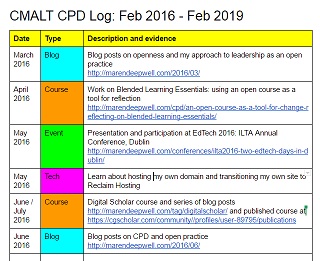
    As the portfolio has to be updated every 3 years (as explained here) I’ve been considering how I am going to track my own activities. Three years is a long time and I think I would dread having to compile everything in 2019. So, like other CMALT Holders before me, I have tried to devise an approach to help me keep everything in one place and link easily into my portfolio that I built using Google Apps for Education.
    CMALT_Log

    Main aims: keep a running log of CPD activities, make it as easy as possible to log these, keep the format linked to my portfolio so that I can transfer content at the review stage and keep evidence.

    First steps: I set up a Google sheet and a form initially, but found that I didn’t like it because typing longer text into each cell didn’t work for me and the form felt too impersonal. I wanted to give myself the flexibility to add reflection and expand the format whenever I want. So I started a new Google doc instead, with a table, free text sections and an appendix section with guidance from the ALT website. I also set up a folder for additional evidence to be stored.

    Collect evidence or risk loosing it: it became quickly apparent that a lot of evidence I was logging is contained in my blog. As I now host that on my own domain (thanks, Reclaim Hosting 🙂 I feel that this works even in the long term. However one course I participated in this summer has published my work only behind a log in. So I took screenshots of the key information and stored them in the folder in case I loose access in the long run. Certainly the process of logging the evidence was the reason why I did this – otherwise I don’t think I would have.

    Where’s my CPD heading? As well as aiding reflection and encouraging me to keep my work properly backed up colour-coding different categories of CPD (e.g. events, blog, course… etc) made it very clear what I have been focusing on and areas in which I could do more.

    Tags, categories, images… couldn’t I do all of this in a more elegant way? I am sure I could. There are apps out there that would certainly make it look and feel a lot more glossy. If you have found a way that works for you, I’d love to see how it works. For me, sticking with the same format as my portfolio works for now.

  • My last week as a #DigitalScholar?

    PeerTomorrow is the last live session of the Digital Scholar course. In this post I will share my experience of week 4 and look back briefly at the course overall. So, last week was all about the peer review process and reviewing each others’ course outlines. At the end of the week, we each received the feedback provided by our peers and mine was definitely useful. Some comments were very factual, pointing out a typo or missing information, while others made me think about how a particular section of my proposal could be re-framed or re-ordered to make it clearer. What I found particularly useful:

    I know what I am talking about, but will my audience… : I think that is a key benefit from being part of a course with such a diverse group of participants. At least one of my reviewers was completely unfamiliar with what the course I was proposing was about and their comments made me want to improve my outline to make it easier to understand.

    Where, what, when… : I have a tendency to repeat things when I write and using 100 words where 20 will do. Some of the feedback prompted me to be more strict about where information was included and where it could be omitted. The Scholar interface and the course rubric also helped with that.

    No one knows who you are… : I rarely get blind feedback on work that I produce and as I have a senior position it can be hard for others to give me critical feedback. Even if you try and take a very collaborative approach, those kind of barriers make a difference. So I appreciated my “blind” feedback in particular because it was rather blunt.

    Is this the end of my #DigitalScholar journey?
    While this week is the last week of the course I am not sure I am ready to leave things behind. I am looking forward to tomorrow’s live learning moment, a meet up which has established itself quickly in my weekly routine as something I look forward to. I’ve also made some good connections with other participants and I hope they will continue to develop beyond the course end date. In terms of the work I did during the course, developing the course outline has been a really interesting undertaking. I think I have a good idea for how to develop it further in a work context, applying some of the ideas to my day job – and I also have come to realise that I have some other ideas, the bread crumb style course I mentioned in a previous post, that I might explore in my own time. Both have helped inspire me to engage directly  with open course design and delivery for the first time since my work on the ocTEL course finished.

    If you would like to read more, you can find all my previous posts about the course: starting with the first one looking ahead at the course, followed by the week 1 post about meeting the community and joining in, then my post for week 2 which focused on my process of designing the course outline and imaging another and also my post for week 3, which was about the peer review process.

  • An open course as a tool for change: reflecting on Blended Learning Essentials

    One project I am currently involved in is a course on FutureLearn called Blended Learning Essentials.  In this short blog post I want to think about how this course, or others like it, can be used as tools for change.

    A bit about the course
    UntitledThis is an open course about using blended learning for vocational education and it runs for a total of 8 weeks in two parts. The first part covers the ‘essentials’ and the second focuses on ’embedding’ blended learning. Content and in particular the videos are created in collaboration with teachers/learners in vocational education contexts and shaped by current practice. If you’d like to see what it’s like for yourself, parts of the course are accessible without signing up: Going beyond reflection to data https://goo.gl/cwGRtQ, collaborative learning to improve learner support https://goo.gl/LwnCnA, sharing and re-using teaching ideas https://goo.gl/gHdsp9 and managing a culture change https://goo.gl/j7q17q.

    Change for learners and teachers
    One of the aims of the course is to provide an entry point to using learning technology effectively regardless of what participants already know or feel confident about. While that is a big ask it also highlights the fact that there is a big disparity in the relevant competencies across the sector. At one end there are enthusiastic individuals or institutions whose learners are benefiting from technology-enhanced innovation and at the other end of the spectrum are those who don’t know where to start. Learners may or may not have access to devices and networks, but once they do, they need to gain skills that will be useful for them in what they do next and teachers need to be able to support them in that. So one way in which a course like Blended Learning Essentials can become a tool for affecting change is to provide a path to building competencies and confidence for those who deliver learning. It could be incorporated into existing internal provision, to enhance what a provider or group can offer internally – or it can act as a way to start scaling up CPD.  Similar to another course I worked on in the past, the Open Course in Technology Enhanced Learning (ocTEL) it can provide flexible chunks of CPD depending on what the participant is most interested in.

    Decision makers who manage change
    While learners and those who deliver learning can make use of the course, I think that those in decision making roles also have something to gain. To begin with they can participate themselves, online and at their own pace, to refresh or supplement their own skills and knowledge. Particularly if you don’t get much time to have hands on experience with learning technology, the course can help bridge the gap. The case studies and discussion forums meanwhile can be used as a frame of reference for establishing where a particular organisation is in terms of making intelligent use of learning technology, what common barriers are or how to solve problems. Particularly the second part of the course (the last 3 weeks) are relevant in this context. Given that the course is free to attend and most of its resources openly licenced, it can be an efficient tool for up-skilling and provide paths to accreditation (accreditation is the part of the course that I have worked on most, so I am going to point to further information and in particular its mapping to CMALT for those who are interested).

    Some limitations
    I think this course can be a useful tool for affecting or managing change, from introducing blended learning, to scaling up provision or enhancing it. But there are also some limitations:
    It’s online: this is a free ONLINE course about blended learning. It requires you to get online, supports you to develop the skills to engage with it and while you can certainly participate with a group of colleagues and support each other face to face, being able and willing to learn online is a key requirement. If this is a major barrier for you or your institution the course could be a useful way to build your capabilities in this area;
    Accessibility: actually, in my experience the FutureLearn platform excels at making courses accessible and if you are in doubt it’s definitely worth exploring the “how to learn” resources they provide or make an enquiry;
    It’s not advanced enough: as the course is aimed at those who don’t already have advanced skills it can seem too basic for some. The discussion forums and social media conversation may be more interesting to those who find some of the content too basic or it might be a useful tool for supporting colleagues;
    So what?: One of the most interesting aspects of the course for me as to see how strong a driver learners’ future success is for getting individuals and providers do more or better blended learning. As everyday life and work require more skills for using technology it becomes more urgent that we use it effectively for learning, teaching and assessment. Other drivers for using blended learning might be providing more flexible provision, broadening access, scaling up or enhancing delivery, improving feedback & assessment…

    Things I’m thinking about next
    Working on this course has made me reflect on the conversation about open courses, what they can be used for, what they achieve in terms of creating communities, scaling up provision and supporting professional development.
    This course is a first in more ways than one, it’s the first course on this particular platform for the vocational education sector, to my knowledge it’s the first open course in this context that has attracted over 20k participants and it’s the first time we have seem a large scale response to the policy agenda in UK that is supported by some many organisations.
    It’s a tool we can make use of to affect change and we can probably use every bit of help we can get in achieving effective use of learning technology across the sectors.

  • Sharing my approach to leadership as an open practice

    photo 2It’s been nearly a year since I wrote my first post on leadership as an open practice, inspired by the 2015 OER conference. So in this post I want to reflect on how my experiment is going, what progress I have made and what’s next.

    Where it all began…
    In April last year, I wrote : “I’d like to try and adopt open practice in my role and connect with others who do the same. Like teachers, researchers or developers who share their practice and resources openly, I’ll try to follow their example. To make my work, which is mostly about leadership, governance and management in Learning Technology, an open practice.”

    Putting the experiment to the test
    Since then, I took part in the #rhizo15 course/community and the #blimage challenge, I have shared a number of conference presentations and blog posts about CPD, policy and current issues. I have been building and sharing my CMALT portfolio (specialist area: leadership as an open practice) and reflected on different aspects of open practice.  This blog has become a really helpful tool for engaging with different aspects of the work I do, share my thoughts and reflect openly. It’s certainly prompted me to do more thinking in the open and has resulted in many conversations and comments that have been helpful and stimulating (thank you!). It’s also motivated me to engage with others’ blogs and outlets, reading and commenting or contributing in turn. Sharing the template for how I built my CMALT portfolio with Google Apps is another example of this approach in action. My original aim was to share, connect and engage more openly and I think that aspect of my open practice has definitely developed.

    Difficult aspects of leadership as an open practice
    Although it has been hugely rewarding, leadership as an open practice has also been quite challenging. While I have certainly started to find more like-minded professionals in similar roles there have been many more false leads, e.g. blogs that are more marketing than sharing, open-sounding practice that leads to pay-walls and a definite reluctance to connect beyond networking for fear of loosing some sense of being ahead, of having the edge over others in leadership roles. At times when political or economic turmoil threatens funding or jobs open practice seems to become a lot more difficult and far less popular for people in similar roles to mine.

    It has also been difficult at times to manage different aspects of my practice when my ‘day job’ as a CEO comes into contact with other work I do. When I contribute to a discussion or a twitter chat I try and make it clear whether I am representing the organisation I work for or whether I am participating in a less formal capacity, but it’s not always easy to make these distinctions. On the other hand there are real advantages to having the chance to get involved with research or practice in a more hands on way and it helps me be better at the work I do as a CEO.

    With managing different identities also comes being a woman and a leader in Learning Technology and this is probably where my experiment has delivered the most rewarding examples and connections. Through a wealth of media I have become more familiar with the work other women do to drive forward technology in learning and teaching, from writers and IT Directors to CEOs and teachers both younger or more experienced than me. While in my  experiences day to day there is still a long way to go to achieve equality for women decision makers in government, industry or funding bodies my growing network makes me feel hopeful.

    Take away’s
    So, one year on, what are my take away’s from this experiment in leadership as an open practice? Here goes:

    1. Will I continue? Yes! It’s been such a rewarding experience, stimulating and challenging that I will definitely keep going;
    2. What’s the best bit? The freedom that an open approach help me establish, the prompts to follow whatever I was curious about and the generous feedback from peers;
    3. What’s the worst bit? For me at times lack of peers in comparable job roles who are interested in open practice;
    4. What’s next? On a practical front, more #rhizo16 this year, some opportunities to speak at events or contribute to other projects, making more of an effort to communicate and connect with others… and hopefully to become better at leadership as an open practice.

    Your thoughts?
    Over the past year I have had many comments/conversations prompted by blog posts or tweets and it’s been extremely helpful. So if you have any comments or feedback on my approach to leadership as an open practice or your own experience, share it below or tweet me @marendeepwell.

  • Looking back at delivering an online conference

    As part of finishing my #CMALT portfolio I have been working on completing a section on communication. The example I am using is leading a small team in delivering an online conference, in this case ALT’s first wholly online winter conference in December last year.

    Some of the things I have been reflecting on re communication are:

    • delivering live events when you are not all in the same place and using online communication methods to help bridge the gaps;
    • how online events compare with face to face events when it comes to communication and leading the delivery team;
    • how to communicate when, yes, the network you and participants depend on goes down the day before the event…;
    • using group communication as a way to manage and problem solve.

    I will share what I have come up with and my reflections as part of my CMALT portfolio in due course. Sharing one example already, you can watch Martin Hawksey and me welcoming participants to day 1 of the conference in the video below:

  • Peer based accreditation for agile professionalisation in Learning Technology

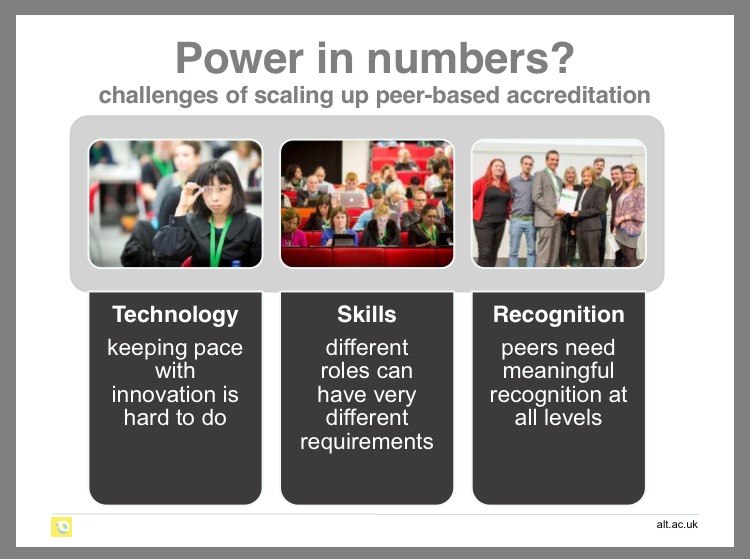
    Snapshots from my presentation as part of a panel at OEB15, 3 December 2015 in Berlin. You can also download the entire presentation (CC-BY) OEB15_MarenDeepwell_2015 (1).

    FullSizeRender (5) FullSizeRender (4) FullSizeRender (3) FullSizeRender (2) FullSizeRender (1) FullSizeRender