I have been trying out new online courses, starting with a Futurelearn course ‘Understanding the General Data Protection Regulation‘ which many colleagues are also taking part in. I am a Data Controller and responsible for my organisation’s compliance with the GDPR framework when it comes into force, and this course forms part of our way to becoming compliant.
I have been taking part in the course mostly by reading and absorbing the material rather than discussing/exchanging ideas with other participants – I have plenty of debate around these issues in other contexts.
The course is clearly structured, easy to follow and has plenty of references and articles to follow up on specific issues further. I found the video component of the course, which is usually more engaging for me, less interesting in this case. I found I prefer to read the more detailed articles and lists.
After one more week of GDPR, I am really looking forward to starting a completely different kind of course, the upcoming ‘Engagement in a Time of Polarization‘ run on edX led by Delia Deckard and Bonnie Stewart. The course is described as follows:
How can we work together in a society where our communications channels have become so polarized? Can we engage in active, effective collaboration in a media ecosystem designed to make money from driving us apart?
This two-week course convenes a conversation on participatory engagement models, and on building understanding and relationships even within the very real limits of contemporary social media. The course will enact the same participatory ideas it explores, and will feature input from leading voices in media literacies, disinformation, and polarization. Participants can engage on their own time and in real time, and if they wish, can build towards action in their local communities.
The focus of this course closely relates to some of the work I do day to day, in particular around enabling engagement in online communities at scale, supporting effective open, online governance and reflecting on the skills required to participate.
It’s also a topic I am interested in for my own practice, and I am looking forward to learning more about how debate gets polarized and how we interact online.
This is part 2 of my look back at my year in Learning Technology in 2017 (read part 1).
The rise of the robots and the power of shared values
Another story that has shaped my work this year is the ‘rise of the robots’ with headlines once again prophesying a future where every job is under threat and where, in education in particular, robots will soon replace teachers and lecturers all together. From gleefully pronouncing the ‘uberfication’ of education to examining the potential efficiencies that can be gained by an automated system for delivering learning and accreditation, this past year has had it all. And many eloquent writers and researchers have dedicated their efforts to examining what is actually happening and what impact it may have.
In my previous post I wrote about how we can make use of the ubiquity of ‘digital’ to raise awareness of Learning Technology and the work we do. I argued for the need to define clearly what we mean when we talk about all things ‘digital’. When it comes to talking about intelligent or learning machines (or indeed teaching machines), language is even more important.
When we talk about robots coming to take our jobs what we are really talking about is human agency, human decision making to replace human workers with machines. Just because we may be able to make machines that are ever more sophisticated doesn’t necessarily mean that the ‘rise of the robots’ is inevitable. Those in power have choice. We have choice.
By talking about machines like human beings we transfer to them a sense of being similar to our own. We talk about how they learn, how they feel or what they need. As an Anthropologist I specialised in the study of Material and Visual Culture, more specifically the relationship we have as human beings to objects, and so I have a particular interest in this area. I know that our sense of who and what we are is shaped by how we perceive the world, our senses, and that even understanding another person’s view of the world can be a challenge, particularly if they have a different cultural background.
Thus, when I listen to conference presentations or vendor pitches evangelising about the next generation of caring machines, of robots who have empathy, who will provide care for our elderly or teach our children, it makes me pause.
It makes me pause because I think it’s important that we acknowledge our agency in the evolution of machines. It makes me pause because being human is more different from being a machine than the way we talk about it seems to imply.
Our relation with technology
Much of what I work on builds on decades years of research exploring how technology can be used effectively for learning, teaching and assessment. Learning Technology, by definition, advocates the use of technology in education even if it does so critically. Every part of our lives, and increasingly the lives of the majority of the human population, is permeated by digital technologies and our education and training systems reflect this.
In my last post I argued what we need to focus on is how we can best use technology to achieve our aims for learning, teaching and assessment. The next step is to consider what values we share that define our aims and what part, if any, machines play in that.
Over a year ago, when ALT set out to create a new strategy, we started on a journey that has given me a new insight into the power of values. My previous experience of setting out strategic aims was that usually one or two individuals end up writing such documents and few people ever read them. Instead we ended up on a journey through a collaborative, consultative process that resulted in articulating strong strategic aims and shared values that better communicate what we do, why and how. It was an empowering experience for everyone involved that has had significant impact not only for our organisation, but far beyond as I have openly shared not just the end result but also the process that got us there with other organisations including UCISA and the YMCA and at events like OER17, ILTA’s annual conference and Mozfest.
From supporting the campaign for right copyright to finding a new Open Access publishing arrangements for ALT’s journal, Research in Learning Technology, joining the Creative Commons Open Education platform, much of what I do day to day is all about putting our values into practice and advocating for what we care about as a community. I make sure that the values we have inform our aims and use that as a basis for operational decisions.
From values to action
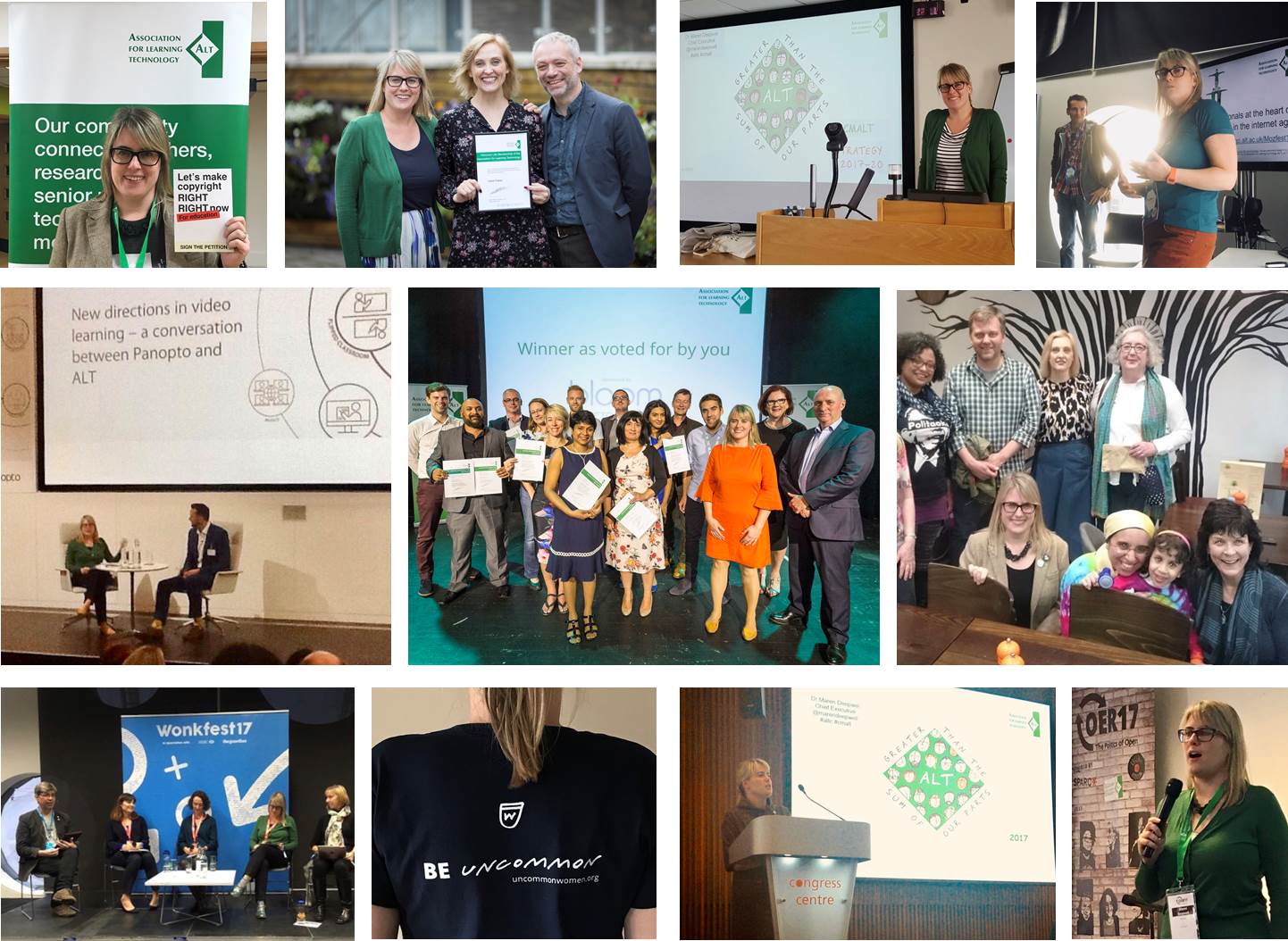
One of the highlights of my year, ALT’s Annual Conference, provides an international stage on which you can see the power of the values we share in practice. Not only in the academic programme, but in the way the event is organised and how participants engage with it. For example, open elections in which every Member of ALT can vote each year result in three new Trustees joining ALT’s Central Executive and we welcome them at the AGM that is open to all to attend and live streamed. Like the strategy, ALT’s Annual Report is written by Members for Members and gives a clear account of finances, governance and achievements. Making the effort to issue open calls for getting involved in various activities, from conferences to publications, and ensuring there is regular turnover and transparency helps engage hundreds of professionals each year. It also ensures power and decision making is distributed throughout the community and that is really important to me.
Elizabeth Charles as a newly election Trustees of ALT
As well as good governance, I help recognise and celebrate the achievements of outstanding peers within our community, through for example supporting the Honorary Life Membership and the international Learning Technologist of the Year Awards. Members from across sectors and with different areas of expertise make up the selection panels I support and we actively promote diversity throughout the process. Each year winners reflect the the range of achievements in Learning Technology and showcase the impact of the work of individuals and teams from our community around the globe. It’s inspiring to see what can be achieved often against all the odds.
Josie Fraser receives her Honorary Life Membership of ALT (with Martin Weller and myself)Celebrating the Learning Technologist of the Year Awards 2017
Whilst the Annual Conference may be the biggest stage on which we recognise professional achievements, there’s much happening throughout the year that recognises and rewards Learning Technologists, like the recent CMALT celebration I took part in (cake and all).
Newly minted CMALT Holders at the University of Edinburgh (image with kind permission from Susan Greig)
Whether in person or online, what’s important about these kinds of celebrations is that they give expression to the value placed in professional practice, in valuing people. And what individuals do to play a part in this does matter. It makes a difference to colleagues, staff, managers. How we work together, how we support each other, how we talk about, relate to and use technology matters. As a Learning Technologist in a leadership position I leverage my position to purposefully set an example that reflect my values.
Taking personal responsibility to put values into action makes change happen. And that applies to the decisions we take about our relationship to robots, to machines, just the same. Coming back to the the rise of the robots, it’s not inevitable that much of what we currently do will be done by machines in the future. I argued for the difference individuals can make to achieving equality through openness in Learning Technology when I spoke at ILTA’s Annual Conference in June. Now, I hope that just as the fight for equality continues, our efforts to form an equitable relationship with machines and technology (in education) will provide a balancing weight to technological determinism.
I take a collegiate, collaborative approach to leadership and my work in general. This is particularly true of some of the examples I mention in this post. I am fortunate to have so many people to work, think and make things with. As you’re reading this you are likely to be one of those people, and I’d like to say thank you. You made all the difference to this year for me.
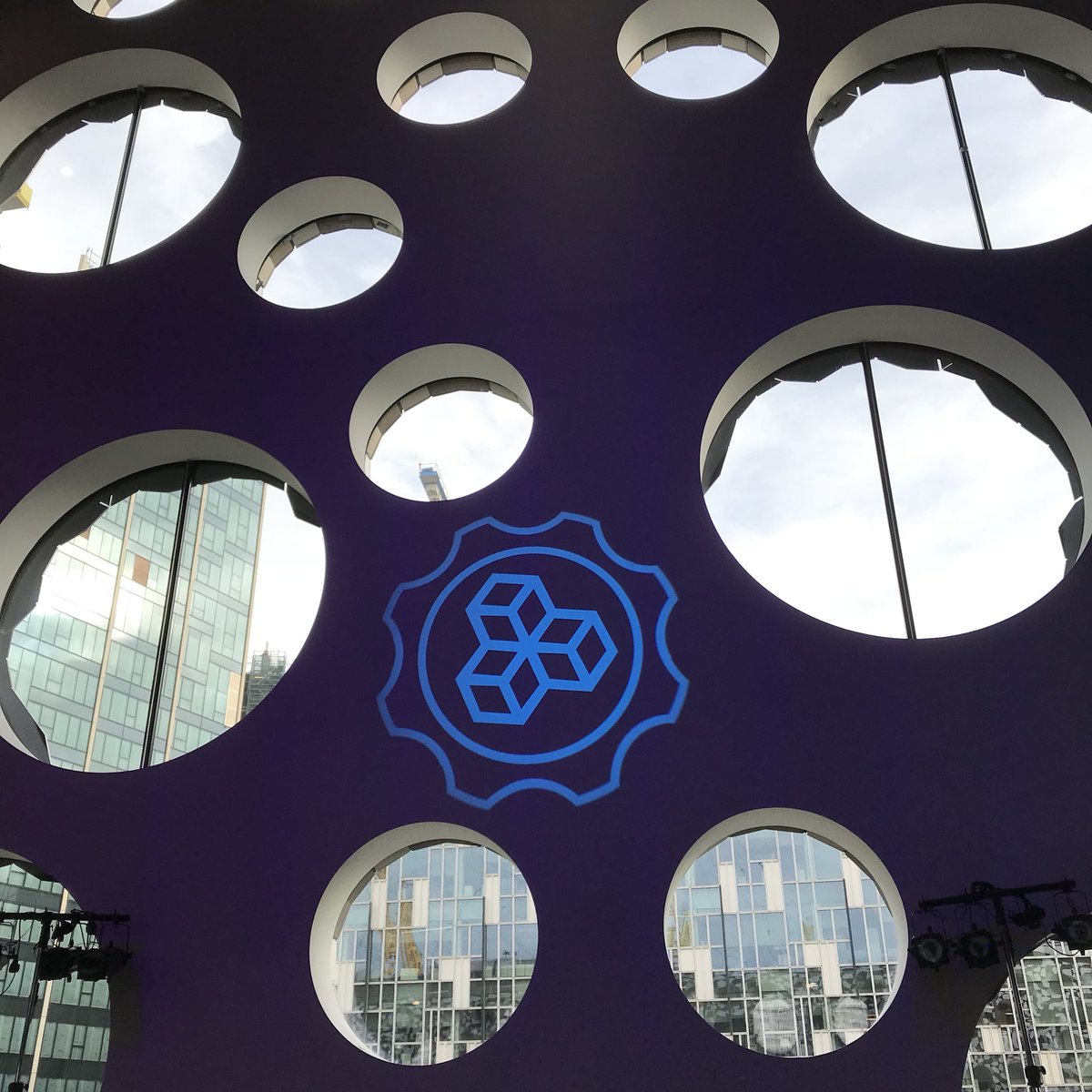
Some time ago I wrote a blog post about how ALT contributes to this year’s Mozfest together with my colleague Martin Hawksey. It was the first time for us to take our work to this event – one of the biggest of its kind anywhere in the world. Mozfest brings together a unique and diverse community from across the world and everyone gathers at Ravensbourne College in London over a weekend packed with all kinds of sessions, activist talks, making and discovering.
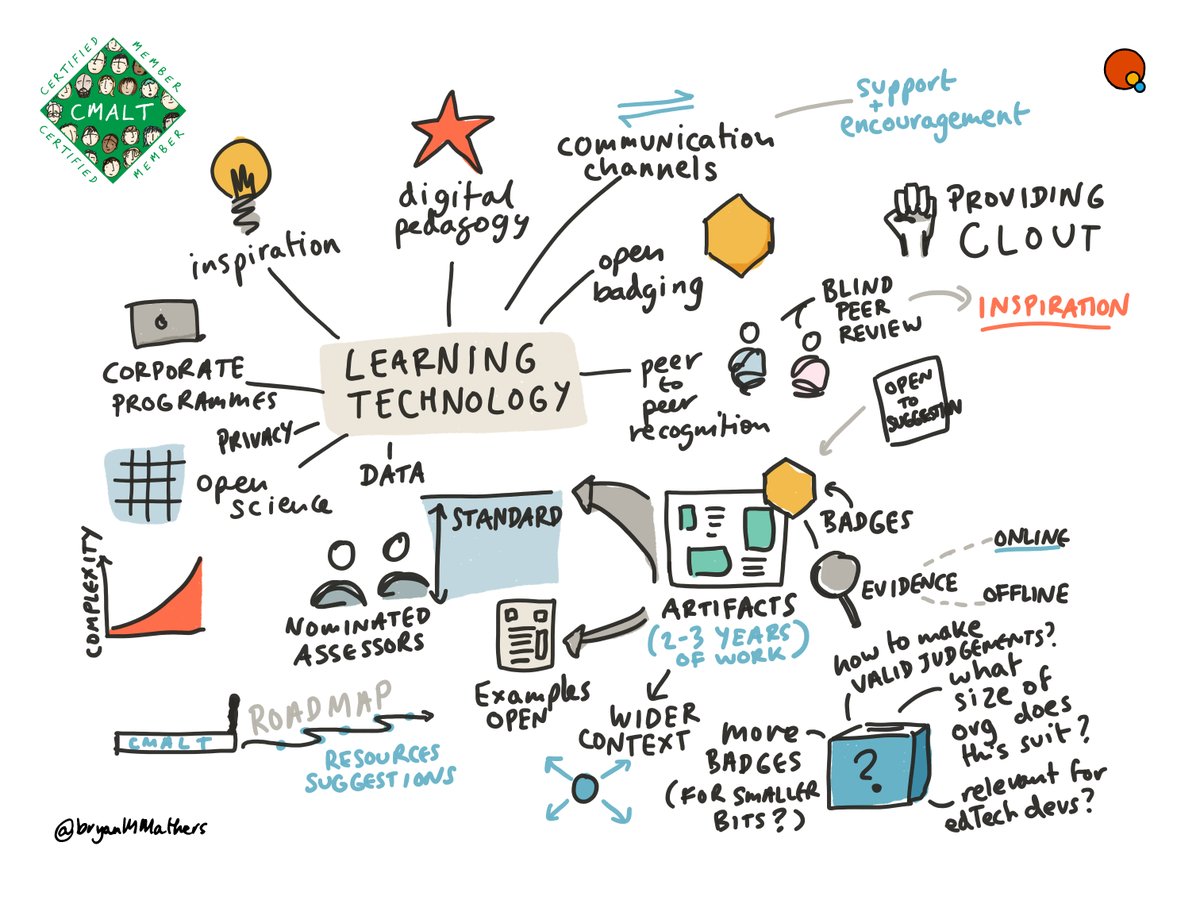
If you are keen to find out what we talked about at Mozfest when we were joined by Bryan Mathers who contributed his Visual Thinkery to the workshop, have a look at our slides & links at http://go.alt.ac.uk/Mozfest17 which also include Bryan’s capture of participants’ contributions:
Slides from our Mozfest workshopContributions captured by @BryanMMathers
For me, my own first experience at Mozfest, which I thoroughly enjoyed, can best be summed up in these photos. It was an amazing experience – a big thank you to everyone involved in making it happen!
VConnecting with Josie Fraser, Martin Hawksey & coThe BEST badgesNot a view out of the window our workshop participants were prepared for…I wanted to go to this sessionOne of my favourite discoveries #Mozfest
This week I am looking forward to giving a short talk at the EdTech 2017 Conference, the annual conference organised by the Irish Learning Technology Association (ILTA). This year’s theme is TEL in an Age of Supercomplexity: Challenges, Opportunities and Strategies.
The event has what looks like a great programme. My own focus is on exploring how openness can be a tool for Learning Technology professionals to promote equality. I am going to look at three specific examples of this, starting with work that’s happening close to home in the ALT Member Community and in particular our local Member Groups – illustrating this with the visual thinkery created for ALT by Bryan Mathers. The other two examples I want to talk about are the emerging FemEdTech network and the voices still echoing from the OER17 conference. I’ve shared my slides below and I look forward to the conversations and feedback in response to my contribution – and a special thanks to Catherine Cronin who has already provided me with some very helpful comments!
Below is the full transcript of my talk:
Thank you for giving me the opportunity to share with you how individuals are taking action to promote equality in Learning Technology, equality in our profession and across sectors – equality for individuals and within institutions.
Equality. We are facing a big challenge. Looking around this room everyone among us has witnessed inequality in some form. On a global scale policy and strategy are necessary to address some of the most fundamental challenges that stand in the way of greater equality for all – but what I’d like to explore is how taking action on a personal basis, taking action as part of our professional practice, can make a difference. Make a difference through openness – openness as in for example sharing OERs, using open licencing, through open governance and open practice at all levels.
The first example is the work of ALT’s Member Groups, and also Special Interest Groups who share their practice and collaborate openly, all across the UK and beyond. Aligned to ALT’s aims the Learning Technology professionals who are active in these groups share the values we have set out as a community and sharing their experiences, both failures and success. These groups, by being inclusive and community-led, have contributed to making our membership more diverse and their work continues to contribute to strengthen equality in our profession.
Now, the emerging femedtech network is a new initiative that is led by Learning Technology professionals who are taking personal action to promote equality and to do so through open practice, conversations and events. It’s an important effort to create a safe space that is also open and inclusive. We want to celebrate and extend the opportunities offered by education in/and/with technology – to women, and to all people who might otherwise be disadvantaged or excluded. If you haven’t already, I urge you to look at the work that this network is beginning to undertake.
My last example are the voices still echo-ing from the OER17 conference convened earlier this year by Josie Fraser and Alek Tarkowski. Josie, Alek and the organising committee made a concerted effort this year to create a more diverse, inclusive programme with a distinctive all female keynote line up and a programme that inspired a lot of critical reflection and conversation long after the event – and indeed that conversation is still going on. Catherine Cronin, who was part of the closing plenary at the conference, later reflected that the themes of criticality, equality and social justice were at the heart of OER17. It was a powerful example of many individuals taking action together – through openness – and making a difference.
Days like today give us that opportunity, to reflect on how we, as individuals, as a professional community, can take action to achieve greater equality through openness, to harness technology to do so – and then to go and make a difference.
At a recent session with a group of Learning Technology professionals we discussed how to best compile a portfolio for CPD and accreditation such as for the CMALT scheme. One of the options we discussed was to join forces either as a group within an institution or with peers elsewhere. In many instances that involves meeting up for writing sessions, progressing through the process at the same pace and sharing work in progress. There are a lot of advantages to this, but what if you don’t have that option? I wrote my own portfolio pretty much in isolation until it was very close to completion (full disclosure: it did take me three attempts over a 5 year period to actually complete it, so my approach is not necessarily the one to follow. On the other hand, I’ve learnt from the mistakes I made). So this post contains a brief overview of how to compile a CMALT portfolio as a solo undertaking.
Step 1: I started with the structure, copying the heading structure that’s required into a blank Google doc. At the start is the contextual statement, the future plans section is last and in between are all the required Core Areas as well as a placeholder for the Specialist Area.
Step 2: I then looked at the structure and tried to write down 1-2 examples of work I had done in each section. I added no details at this stage, just enough information for me to be able to identify what I meant. It was very quickly apparent that I had a lot of examples in some sections, none in others. So I moved some around which could fit into other sections. Once I had covered all Core Areas it was easier to decide what to pick for my specialist option, basically something I hadn’t already covered.
Step 3:Once I had the structure and at least 1 example in each area, I started with the section I thought would be easiest (1b in my case) and added a description and some evidence. Once I had those, I added the reflection at the end. That’s what I did for each section in turn. Some took longer, usually because evidence was time consuming to collect or reflection felt harder. Because I already had a scaffold (i.e. the heading structure and at least 1 example for each section), working on the portfolio moved ahead at a much better pace. In previous attempts I hadn’t planned ahead and found the blank pages ahead daunting each time I moved on to a new section.
Step 4:Once all the required and the specialist areas were complete, I took a step back and started writing my contextual statement and the future plans section. That was a lot easier with the rest of the portfolio in place because the examples I used shaped what I wrote. Also, having reflected on my work made thinking about the future much more straight forward.
Optional step 5:Because I wrote my portfolio in isolation, without peers or feedback or someone to compare it with, I felt some feedback would be useful before I submitted it. I sent it to a few people and they came back with useful comments which were incorporated. I also shared it with colleagues who were directly mentioned.
Hearing about the sharing and support that groups or peers provide sounds like a great way to undertake CPD. In my case, writing my portfolio was mainly confined to odd anti-social hours and I needed to progress at my own pace. If, like me, you are on your CPD or #CMALT journey in a solo capacity, I hope this post is helpful and good luck!