Category: Conferences

  • Professionalisation and accreditation in Learning Technology #digifest18

    Professionalisation and accreditation in Learning Technology #digifest18

    Together with colleagues we are talking about professionalisation and accreditation in Learning Technology today. You can access all slides and links to resources from our talk at http://go.alt.ac.uk/altcDigifest .

  • Technology Enhanced Learning #IGHETech18

    Technology Enhanced Learning #IGHETech18

    I was invited to participate in an interesting event this week, “Embracing Technology Enhanced Learning”. Lots of very useful resources were shared on Twitter, so I’d encourage you to browse #IGHETech18 to pick up great resources.

    One of the highlights of the day for me was seeing and listen to colleagues whom I work with for ALT, but whom I don’t often get to see on a stage talking about what they do best!

    And both Sheila and Peter as well as Chrissi Nerantzi gave great talks that have really inspired me to follow up on a number of new initiatives.

    We also joined into a brief periscope session as part of this week’s BYOD4L: AN OPEN LEARNING EVENT FOR STUDENTS & TEACHERS, check https://byod4learning.wordpress.com/ for full details and to catch up on what’s been happening.

    The day really inspired me, but it has also left me with some questions: first, it’s reminded me of how unevenly we, as individuals and institutions, take up Learning Technology. There’s a general sense of scaling up, but it feels that there is always a wide distribution across a rather steep curve of adoption – from those who are reluctantly facing change to those who embrace new processes, tools and ways of thinking and empower each other in the process. That is why, I think, we return to talking about the potential, rather than the reality of technology for learning, teaching or assessment. How can we move on?

    Also, Peter really struck a chord with me when he emphasised how the one concern that brings everyone together is for students and the desire to improve things for them. I agree with that and my experience working in any sector proves that time and time again. But how can we actually put that concern first when we are faced with ever more complex technologies? How can we ensure that we can understand, interrogate and shape machine-led processes sufficiently to put students’ benefits first?

    Last, I was left with considering how we can increase the impact of all the work we are doing? There is such a wealth of experience, resources and insight that everything we are already doing seems insufficient to really leveraging its impact fully.

  • Coming up #oeb17: Re-articulating what we value – a new vision for Learning Technology professionals

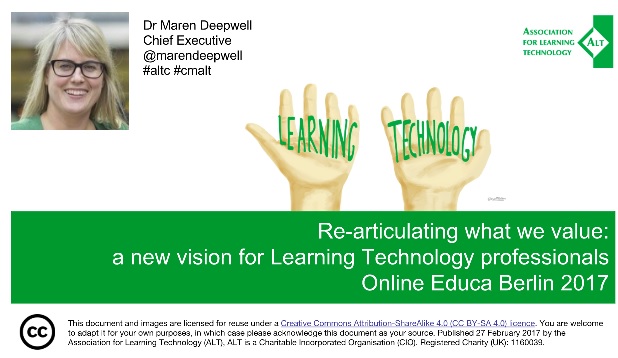
    Coming up #oeb17: Re-articulating what we value – a new vision for Learning Technology professionals

    I am looking forward to a panel discussion at Online Educa Berlin 2017 this week, as part of the Business EDUCA: Learning L&D Needs session. The session is about:

    Creating learning solutions which enable workforce development is no easy feat. And becoming an effective instructional designer will often require a degree, courses and field experience. This session will discuss the skills practitioners need for the L&D department of the future, as well as how we can learn the profession and remain relevant to our organisations.

    You can view the full programme of the conference and more information about the session here.

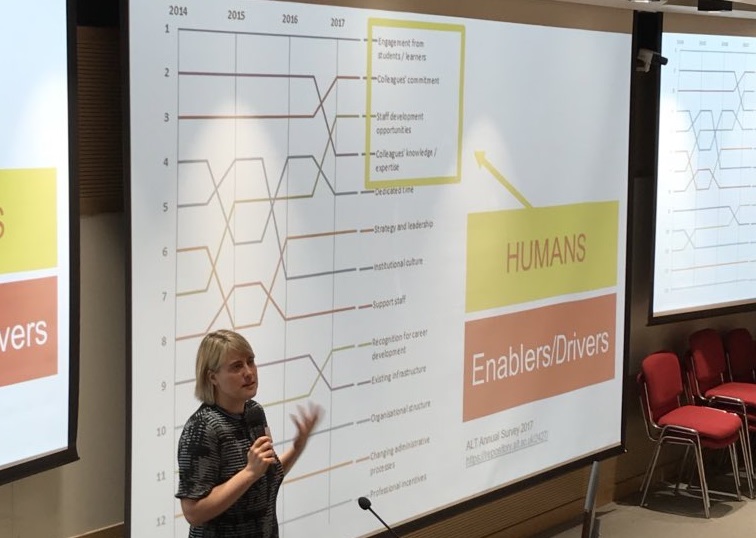
    My contribution is focused on professionalisation of Learning Technology in the UK informed by results from ALT’s Annual Survey and the development of the CMALT accreditation framework (slides).

  • Talking about #FELTAG: keynote on workforce development in Learning Technology

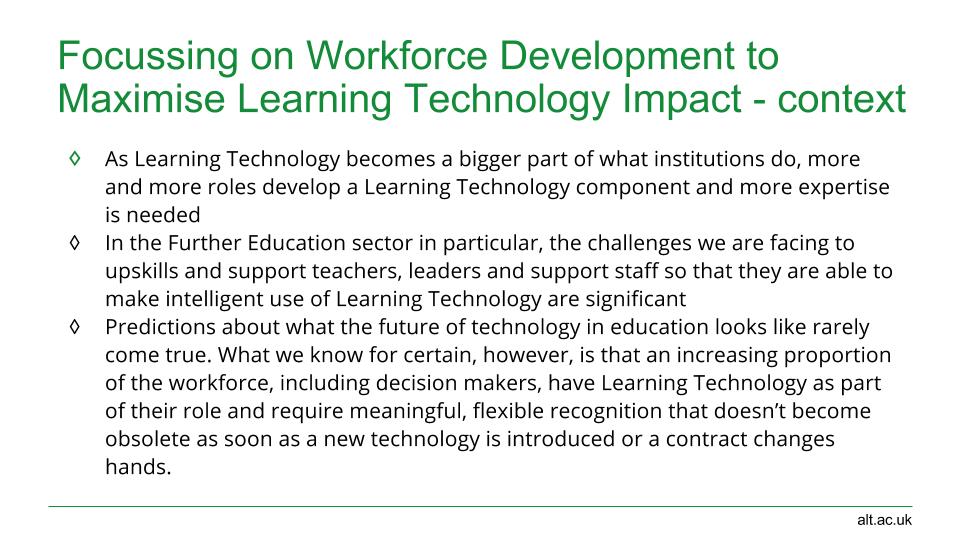
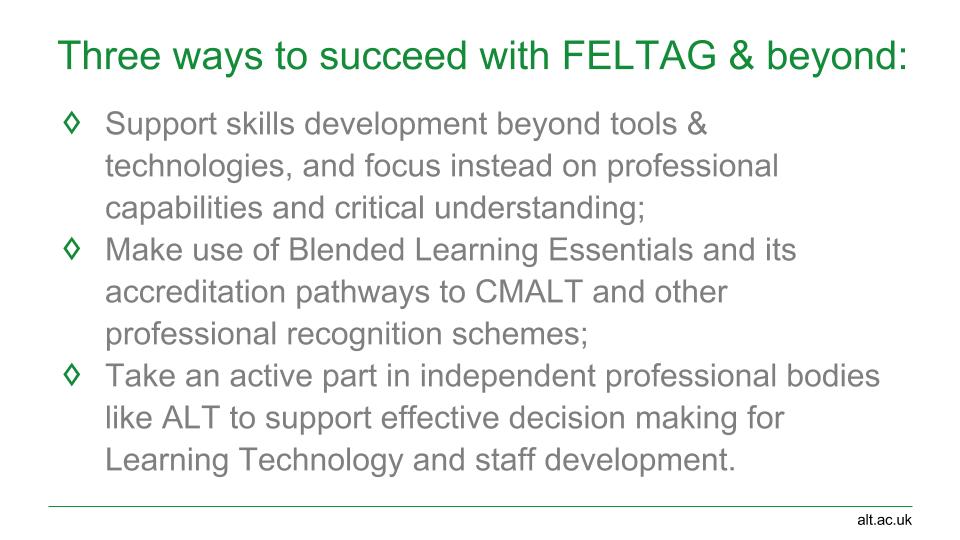
    This week I am contributing to a conference called FELTAG 2017: Embracing Digital Technology in Further Education and I am pleased to have been invited to give a short keynote as part of the programme. My talk (slides) will focus on workforce development to maximise Learning Technology impact in three ways: first, I set out what questions we need to ask about skills and capabilities, second, I explore how and open online course can support workforce development and third I showcase how ALT’s accreditation scheme, CMALT, can help increase intelligent use of Learning Technology.

    This sets out the context for the talk and draws on other things I have recently written, first for FE News in an article about Digital Skills development in the workforce , and then also on the Efficiency Exchange in a post called Accreditation fit for a (digital) purpose?

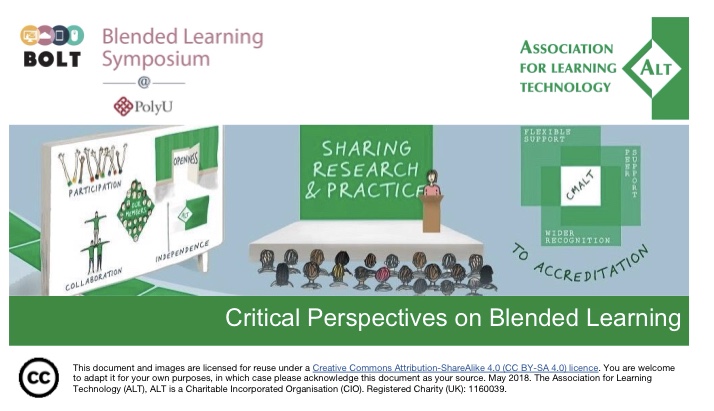
    ALT Strategy Aim 3 (visual thinkery)

    The ALT strategy places a form emphasis on professional development and recognition for different roles in Learning Technology and the broad range of professionals who need different levels of skills and capabilities is something I am particularly interested in. CMALT, ALT’s accreditation framework is one of the topics I will be exploring in my talk.

    One of the projects I am involved in via ALT is the development of the Blended Learning Essentials courses, led by Prof Diana Laurillard and Prof Neil Morris. These open online courses run on the FutureLearn platform and the next one to launch has a focus on developing digital skills.  It’s a useful example of how such initiatives can support individual and institutional CPD across the sector.


    As I was part of the original Ministerial FELTAG Group and a contributor to the recommendations made in 2014 the opportunity to speak about what’s happened since and how much progress we have made is welcome. However, while I can see much positive change, there are also mounting challenges not just in relation to Learning Technology, but the FE system more generally.

    Using technology for learning, teaching and assessment continues to be of increasing importance and its potential grows  each year. Yet technology by itself is no answer to some of the larger, structural challenges facing learners, teachers and providers and those continue to mount. So whilst I am looking forward to being part of a conference that encourage participants to embrace Digital Technology in FE and look forward to contributing, I think it is the people, the teachers and trainers, that we really need to focus on.

  • Making it happen… leading a community conference

    Making it happen… leading a community conference

    It’s the weekend before the biggest face to face event that the organisation I lead runs each year. It’s our Annual Conference and between an inbox that doesn’t sleep, aching feet and a planning spreadsheet with a row for every detail my excitement is mounting. This is the week of the year when both online and in person our community comes together.

    My job as CEO, at least on paper, is to carry the responsibility. To manage risk, to keep oversight, to make decisions and provide leadership. But alongside this, after nearly a decade of Annual Conferences, I have also developed my particular approach to leading the way through this busiest and buzziest of weeks in my calendar. This year again I have tried to improve what I do, so in this post I want to share with you some of what I do to get ready #altc:

    Everyone has a voice, so listen: one of the most valuable aspects of the conference for me is to hear all the different voices from across sectors, different institutions and professional practice. Whether it’s an apprentice just starting out in Learning Technology whom I sit next to during dinner or an Awards winner from a prestigious institution, I try to listen.  It’s critical discussion of current issues that I am most interested in – finding out how we are approaching some of the difficult questions around ethics, consent, equity, skills or policy.

    Only 400-500 people can participate in person, so this year I have worked directly with supporters to open up the conversation further, for example via podcasts, radio broadcasts, virtual participation, articles and tweet chats in which speakers, organisers and participants can all get involved openly.

    Make time to enjoy meeting people: the most common way in which my conference conversations start is by someone saying “I know you must be busy”… or “I know you don’t have time…” – and sometimes that is true. If there is a problem I need to deal with, then you will have to excuse me. But that’s not usually the case and I try to make myself as visibly available as I can and meet as many people as I can, both in person and virtually (and you can always tweet @marendeepwell and say hello). I serve the Association and its growing membership of over 2500 individuals as well as the interests for the wider community we work with. I am here to meet you, find out how your first presentation went, what product you are pitching or what research you are looking for. During most breaks you will find me at ALT’s stand so look out for me and say hello. On the last day of the conference you can also meet me virtually via VConnecting.

    Conferences are not about perfect: together with a regular army of volunteers, Co-Chairs, Trustees and a small team of colleagues I get to host hundreds of people next week and we have worked for 18 months to try make everyone have the best possible experience – but conferences are not about perfect and more likely than not I will be the recipient of any grumbles or complaints so that we can deal with them and improve. There’s always small things that can go wrong and so I try and pick a handful of things for each day I really focus on and if they go right, then the day is a success. I use the same approach when I attend an event as a participant, and it works well for me. Meet 2-3 specific people, get to a few particular sessions, ask a question – have some fun… and you have had a good day. I have read many of the blog posts others write about preparing their presentations, planning their programmes and getting ready to network, share and connect. If you are contributing, good luck to you and I hope it is a rewarding experience.

    ‘C’ stands for Community: for me, our conference is all about community, a community of shared values. Yes, there is a rigorous peer review process, an emphasis on research and academic knowledge sharing, networking and showcasing innovation. But with 24 years of leading professionalisation in Learning Technology behind us we also get to influence and shape our part of education. We help set the tone, we colour the future, we point the way to what Learning Technology is through research, practice and policy – but also through how we put the values we share into practice. Values of openness, independence, collaboration, participation and, at the heart of it all, the Members of our Association.

    Earlier this year when we launched our new strategy, Bryan Mathers helped us articulate these values afresh through visual thinkery, and for me the conference is the biggest opportunity I have to put those values into practice. So while you may not see me wearing actual ALT trainers (although I may have some of those…), I will be doing my best to walk on the path that our vision set out. And I am really, really looking forward to it.

    P.S. If you’d like to read what I have written about in the run up to the conference, including recent articles on skills development, accreditation and professionalisation, see my previous post.

  • Politics v personhood: #iltaedtech17 conversations

    Politics v personhood: #iltaedtech17 conversations

    This week’s  EdTech 2017 Conference, the annual conference organised by the Irish Learning Technology Association (ILTA) had the theme: TEL in an Age of Supercomplexity: Challenges, Opportunities and Strategies. Some very interesting conversations have come out of the event, and you can explore the conversation on Twitter #iltaedtech17 or explore the hashtag and archive on TAGSExplorer as well as ILTA’s webpages for the programme and live streaming links with videos to follow shortly.

    Last year at the event Audrey Watters gave a keynote talk called ‘The Rough Beasts of Education Technology‘ and at the time Audrey was looking at a future before the Brexit referendum or the Trump administration. One of the themes from Audrey’s talk last year that continued to resonate with me when listening to this year’s speakers was the role of machines in the future of education. Whether it’s AI, AR, VR or machine learning, one of the dominant narratives is one of inevitability, of machines taking the place of human beings, of technology dominating how we meet the challenges of our age. At the same time, there were many sessions I attended that a a focus on up-skilling and supporting staff in the deployment of Learning Technology, with the aim of building competence, confident and leadership.

    Reflecting on the keynotes and breakout sessions I find myself exploring the tension between the politics of globalised, technological capitalism on the one hand and how our sense of being a person is defined by how we learn and teach on the other.

    I heard of many examples of technology being used to scale up provision of teaching and assessment, to deliver content in more personalised, flexible ways, to collect and analyse data and make use of it to increase retention or enhance outcomes. The use of technology in this context is a response to solving the challenges presented by the labour market, the political climate, the shareholder – and reflects a transactional relationship between the learner and the institution that accredits the outcome. There is a sense of inevitability, of technological determinism, that points to a future in which we as human beings only find a use in education for ‘what we are good at’ or rather for what machines are not yet deemed good enough, like providing guidance or critical dialogue.

    At the other end of the spectrum where a range of sessions that were focused on putting Learning Technology in the hands of the teachers and learners in more creative, empowered ways – to enhance not replace human learning and teaching. These highlighted how difficult it is to keep up with innovation and use of technology, how big a challenge it is to address ethical implications or build critical approaches while keeping pace with an ever changing technology landscape. And there were many, many examples of Learning Technology at its best: broadening access, supporting learning, transforming teaching and connecting people. One of these was awarded the Jennifer Burke Award at the conference for the #coolPE project, ‘focused on preparing pre-service teachers for the inclusive classroom in a digital era’. It showcased powerful examples of using Learning Technology to address issues like body image, bullying and confidence.

    My own short talk at the conference was about how openness in professional practice in Learning Technology can promote equality. Before the conference I did a lot of reading about efforts to promote equality in different contexts, such as gender equality, pay equality, marriage equality and so forth. After the conference I thought more about how our rights are affected by the decisions of those who control the technology that increasingly shapes our understanding of who we are. These kinds of questions have been explored by writers far more eloquent that what I can write here, but it is important that events like this enable us to reflect as part of a community and continue the conversation.