Tag: #virtualteams

  • Virtual Teams Book – Monthly News, January 2022

    Virtual Teams Book – Monthly News, January 2022

    Writing Retreat ahead

    At the end of last year I completed the first draft of the book and I am really pleased that despite everything that was going on last year, I managed to reach that important milestone. Along the way I made some changes to the structure of the book and now that the draft is complete, I can also see overarching themes emerging.

    My plan was to continue editing the draft chapters over the holidays, but when I finally reached the end of the working year and having had my booster jab, I decided to take a complete break instead. It was much needed and I am glad to have had some proper time off.

    My plan is to still fit in some editing this month before heading on a week long writing retreat at the end of January.

    Talks and events

    This month I am speaking at fewer events as many of the planned conferences have been moved to later in the year. In many ways this is a blessing as it gives me more time to focus on writing. At the end of December I looked back at the talks and articles I published in 2021 – and that were more than I expected.

    One key focus for 2022 is going to be continuing work on the Framework for Ethical Learning Technology and I am looking forward to taking part in the THE Digital Universities Week and Ahead by Bett to share process and new developments.

    Join our monthly radio meet up on DS106radio talking about the journey from learning online to working in distributed teams on Tuesday, 11th January 2022 at 19:30 GMT on DS106 Radio – chat with me or submit song requests #DS106radio.

    Coaching update

    I have had excellent coaching on my journey to becoming a CEO. My own experience has given me an understanding of how powerful the right coach can be and how valuable for developing your approach to being a leader.

    In order to become an accredited coach, an ICF Associate Certified Coach, I am taking part in Katie Linder’s Higher Ed Coach Training. I’ll be blogging every month sharing my experiences and how this relates to leading virtual teams.

    Writing buddy update

    Posey celebrated her 1st birthday this month, so she gets featured 🙂

  • VIRTUAL TEAMS BOOK: … EXTRACT FROM The Introduction

    VIRTUAL TEAMS BOOK: … EXTRACT FROM The Introduction

    Progress since the last post

    Since my last post, I have been working on the Introduction to the book and that has been very helpful. It’s prompted me to write an overview of how all the chapters hang together and it’s help me get a clearer sense of the overall structure.

    Apart from the conclusion, I have now drafted all chapters. I have decided to incorporate what was going to be a chapter on addressing inequality and inequity in remote work into each chapter as those questions came up again and again.

    So now that I have a clearer sense of the shape of the book, I want to make a plan for revising and improving the drafts that I have completed so far, building up to a week long writing retreat in late January.

    Remote working radio:

    It’s time to start what will hopefully turn into a monthly radio meet up on DS106radio talking about the journey from learning online to working in distributed teams. The first one of these will happen today:

    • Date: Wednesday, 1st December 2021
    • Time: 19:30 GMT
    • Where: DS106 Radio
    • Hashtag: Chat with me or submit song requests #DS106radio

    See you on the airwaves.

    Chapter: Introduction

    Below is an extract from the draft introduction chapter:

    In 2017 I embarked on a journey of organisational transformation as the CEO of an independent charity, as we took our organisation from a traditional, office-based model of operations to a fully virtual, distributed team. In comparison to many businesses who were forced to adopt home-working in response to the global pandemic, we made the transition for strategic reasons over the period of a year. Instead of sending staff home with a laptop one day and starting home-working the next, we went through formal consultation periods and implemented the transition gradually, providing support and training at every stage. As a result we made a very successful transition and started to focus on how to evolve our approach to working as a virtual team beyond practical considerations from the outset. 

    When I set out to create a new vision for what working for our virtual organisation would be like I came across a lot of practical advice about infrastructure and business processes and I also read a lot of management books that seemed intent on helping leaders and managers to translate traditional power structures from the office to the virtual workplace with a strong emphasis on productivity, cost-savings and employee surveillance. None of what I came across helped to answer my questions. 

    What I was looking for was authentic insight into what it’s like to manage people remotely and to lead an organisation from home, and to do it well. And by doing it well I mean not only meeting budget targets and KPIs but to balance business needs with employee happiness and wellbeing. I was looking to find creative and fun ways to work with people you may never meet in person and to build meaningful working relationships.  I was looking for ethical ways to work online that respect employee privacy and build trust between the organisation and its staff. In short, I was looking for the opposite of the ‘office-deficit’ model. 

    This is why I wrote this book. It’s the book I wish I had when I was setting out on my journey to lead a virtual team. I hope it will provide a source of inspiration and a prompt for reflection to my readers and will be of practical help with managing hybrid, blended and fully distributed teams and organisations.

    If you’d like to keep in touch with book progress:

    • Subscribe to my newsletter;
    • Join today’s monthly radio meet up on DS106radio;
    • If you’d like to invite me to speak or write, get in touch with me directly.
  • Virtual Teams Book: Setting out as a Virtual Team… extract from Chapter 1

    Virtual Teams Book: Setting out as a Virtual Team… extract from Chapter 1

    Progress since the last post

    Since my last post, I have been working on Chapter 1 which is all about setting out as a Virtual Team. It’s been very rewarding to work on this chapter as it include a first hand account of the key milestones I experienced leading a team from the office to working remotely and I enjoyed re-reading some of the posts one month, six months and a year into the process. It was useful to reflect on how much the reality a few years later meets with the expectations I had at the beginning and what has changed.

    Next, I will be working on Chapter 5, which will explore equity and equality for virtual teams. I have left writing this chapter till last, particular because it requires the most research and also because I wanted to be able to reflect on issues that arise in the other chapters. Now that Chapters 1-4 are complete, I have my key issues to address in this chapter ready.

    I have completed drafts for four of the six chapters now, and I am on track to complete my draft of the whole book before the end of the year.

    As planned, I will be sharing extracts from work in progress (read this month’s extract below) and invite you to read along, reflect and share your thoughts.

    • Subscribe to my newsletter;
    • Look out for details of the virtual drop in sessions starting in November;
    • If you’d like to invite me to speak or write, get in touch with me directly.

    Chapter overview: Setting out as a Virtual Team

    This chapter is divided into two parts. The first part covers practical considerations for setting up virtual teams, including how to involve staff in the process, recruitment and selection for virtual teams and practical considerations such as choosing the right tools and platforms for the job, GDPR compliance and up-skilling staff.  

    The second part of the chapter contains a first hand account of an organisational transformation process I led to give practical examples of what can happen during a journey from office-based to blended or fully virtual team. 

    Draft Chapter extract

    Below is an extract from the first part of the chapter, focused on recruitment and selection.

    Distributed organisations offer a different value proposition to staff. Whilst there are downsides, too, the advantages of working from home and the flexibility that brings with it are significant: 

    Not everyone’s commute is that brutal, but companies and organizations can enable a more diverse and healthier workforce if they allow people to work remotely, at least some of the time.

    For instance, consider how difficult it is for a blind person, or someone who is confined to a wheelchair, to commute into an office every day by taking a bus for an hour each way. The commute itself is stressful and exhausting. Will that individual also be able to give their best to the work if they are already tired from just the commute?

    Or consider parents of young children who need to remain within a 10-minute drive to their children’s schools in case of emergency. If remote work is allowed, you gain access to a whole other talent pool of potentially highly-skilled employees. 

    https://www.informationweek.com/team-building-and-staffing/create-an-all-star-tech-team-welcome-remote-workers

    Once you have made the jump and offer flexible or fully home-working, recruitment needs to reflect that and enable you to find the best candidates in the larger number of applicants. Here are some practical examples of how to adjust the selection process for remote working: 

    Set out expectations clearly

    Ensure that role descriptions and adverts set out clearly that you offer in terms of flexible/home-working. Be as specific as you can about what you provide (e.g. equipment, financial support etc) and what prospective staff will need to have in place (such as a dedicated work space). If you have policies that are specific to home-working, refer to these and spell out precisely what your expectations are. Particularly in the post-pandemic workplace many people’s experiences of home-working may have been during a time of crisis, and won’t necessarily reflect what a ‘normal’ approach looks like long term. Include details such as ‘we expect all staff to be in the office on Wednesdays for a team meeting’ or ‘our normal working hours are between 9.00am and 5.00pm’ to help prospective candidates get a sense of how flexible your approach is. 

    Review your internal processes

    It can be difficult to find comprehensive guidance for recruitment processes that happen online and in most contexts your existing policies and training should continue to apply. That said, it is important to review what everyone participating in the recruitment process needs to be able to do in order to fully participate: if panel members struggle with the meeting software or reviewers don’t understand how your online score sheet works, then the recruitment process is going to suffer. It may seem like an obvious point to make, but even experienced managers need time to gain confidence undertaking fully online recruitment. Ideally, test your process by role playing / user testing all elements beforehand, so that you can put yourself into the shoes of a candidate and gain a sense of what their experience will be. 

    If your organisation uses a particular tool or platform for all meetings try to use the same platform during the recruitment process. Similarly, try to use as many of your familiar workflows when designing the practical elements of the interview. It the absence of a physical environment the candidates will get a much better sense of the organisation if the interviews happen on the same platform that they will be using day to day. In a sense, it’s the virtual equivalent of seeing your office or visiting campus. 

    Include remote-working questions

    It can be very helpful to include questions specifically about home working in the interview. It can help you learn more about each candidate and establish a rapport about some of the challenges you can encounter. For example you could ask something like: ‘Have you had any experience working from home previously?’ and ‘Can you expand on the main challenges you’ve encountered and/or perceive?’. 

    You might be surprised how considered responses to such questions can be, highlighting issues like isolation and maintaining boundaries between work and personal life. 

    It can also help establish whether candidates have experience working remotely in a solo capacity, e.g. running their own business or working as a consultant, and working remotely as part of a distributed team. Whilst there are many transferable experiences there are some important differences, such as the volume of communication required, having to be available for team members and meetings more frequently and having a shared sense of starting/ending a day. Often individuals who have worked remotely only in a solo capacity underestimate the extent to which this makes a difference and the interview can help establish a common understanding of what the organisational working culture is day to day. 

    Homeworking long term

    If you are offering home working full-time or some days of the week on a permanent basis, it is worth reflecting how this can impact on staff as things change either in the workplace or at home. For example, the tools you use as an organisation may change significantly over a period of five years and require constant upskilling. Virtual working often relies on tools that are frequently updated, impacting on workflows and requiring changes to procedures. Whilst this is true of everyone in the workplace to different degrees, the impact of such changes can be felt more keenly as a home-worker, for example if you start you week by logging in and suddenly your usual Monday morning catch up meeting won’t let you join or if you can’t reach work in domestic emergency because of software updates. Being reliant on tools and platforms that are updated according to Silicon Valley release schedules can cause havoc for even the most techy of staff and requires everyone to be adaptable to a larger degree than a traditional office setting where support can be provided at your desk or in your building. 

    Committing to working from home long-term can seem an easy decision initially, but can become challenging during periods of change at home, such as a house move, changes in family life or relationships as well as physical and mental health. What seemed a good fit initially may turn out to be a nightmare a year on. Any and all information that you can provide for candidates to help them reflect on the realities of working remotely in the long term is valuable and increases the chances of finding the best candidate. 

    Virtual Interviews

    In many cases the interview is the deciding factor in the recruitment process and if you are recruiting for a virtual team you will hopefully have experience in organising meetings online. For virtual interviews, preparing ahead of time is key. Common pitfalls include using a platform that is only available to individuals within your organisation, failing to ensure your interview is fully accessible and lack of appropriate support for panel members. Plan in time for the candidate to set up and test things before the formal interview starts and allow time for things to go wrong. First impressions in virtual interviews happen both ways and candidates have likely prepared very carefully so it is worth being very explicit with everyone taking part in the recruitment process how to represent themselves and the organisation. 

    As with the other elements of the recruitment process, established HR guidance will apply, but in addition, ask yourself what went wrong in bad meetings and interviews you have attended. Everyone has experiences of chairs not seeing their hand up, technical difficulties not being resolved, cameras being switched off when they should have been on and so forth. Even for experienced staff, checklists can be really helpful for virtual interviews and ensure that candidates have a better and fairer experience. 

    If you find yourself interviewing someone in a suit, sitting in front of a perfect office backdrop and never breaking eye contact whilst giving you textbook answers and at the other end you are hoping to have an informal conversation from your kitchen table with your cat walking across the screen then you are experiencing a class virtual interview fail. Interviewing online robs you and the candidate of many common assumptions about what’s expected and how to behave, so be as explicit as you can both in the way you communicate and what information you provide ahead of time. For example, if formal workwear is commonly worn in your organisation, make candidates aware of that. Similarly, if it is not usual for staff to use digital backgrounds and if it is acceptable to see each other’s (family) life in the background, you can make that clear as well. Consider carefully how you can eliminate as many factors that could distract you from the purpose of the interview as possible. You don’t want to focus on someone’s unusual virtual backdrop or their unexpectedly formal attire instead of the key questions around the job. 

    Experienced managers pick up a lot of clues when meeting candidates in person and that can help you take action to calm nerves and make candidates feel welcome. Online, the clues are still there, but it can be a lot harder to get beyond someone feeling nervous once you have had a technology fail or sound drops. Chairs should be prepared to start the interview in a manner that helps settle everyone and also pause proceedings if unexpected difficulties occur. In a later chapter we will specifically explore equality and equity in the context of working remotely and these considerations are particularly important in the context of recruitment starting with the connectivity and equipment required to apply to the tools and software required to take part in the interview process. A tool or platform that the organisation has a licence for and which is thus easily available to all staff may not be accessible to prospective candidates for example. 

    The tension between technology and human beings becomes apparent in other chapters of this book and in this section I have intentionally focused on recruitment processes that are conducted largely by human beings using technology as tools for recruitment instead of recruitment undertaken by machines. I have chosen to do so as this book is focused on knowledge workers and professionals who work in education contexts and automated selection processes are not predominant as yet, at least in my experience. 

    No doubt certain types of recruitment are becoming ever more determined by automated processes and artificial intelligence, and scenario based virtual interviews and skills texts can provide a useful addition to recruitment processes. Someone who comes across brilliantly in a prepared written application, virtual test or on email may not be able to communicate well in real time or on screen. So if the role you are recruiting for relies on communication and collaboration in a virtual team, it’s important to put human interaction at the centre of the selection process and ensure that the candidate you are appointing has the required skills for the role. 

    The set up for home-working is a huge factor in the long term physical and mental health of your workforce and it can feel much more outside of your control than an office would. 

    If appropriate you can include this kind of guidance in the information for prospective staff as well as in annual/regular processes for all staff. Ensure that it is a compulsory part of everyone’s practice to review and document their workstation and that you have a way to monitor this and address any issues that arise. 

    Many new or temporary home-workers start out working with their laptop on the sofa or at the kitchen table and then report back and neck pain or wrist problems. 

    The set up of the workspace should be an important part of the induction process and not left to chance as it’s your opportunity to get things right from the outset and avoid problems and illness further down the line. 

  • June & July ’21: A break, a book and back to running

    I was on a long awaited break at the end of June and I missed out blogging about what I did in June… and so you get double the monthly blogging goodness in one post 🙂

    First up… CEO updates

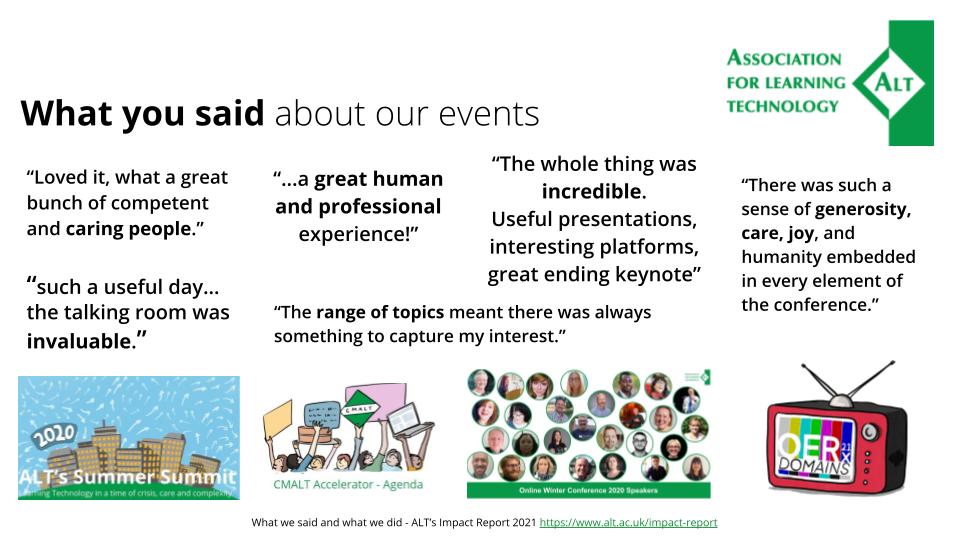
    Things were BUSY for me as a CEO in June, as I wrote in my report to Members of ALT. Not only did we hold our AGM, announced new Trustee appointments and a Board meeting all in the same week, but we also launched our Impact Report, which I am really proud of:

    A page from the ALT Impact Report 2021

    That was my week of the year to hit all the big annual milestones and I am glad to say that the feedback was excellent. After the year we and everyone in Learning Technology has had, it means a lot to me that I have contributed to turning things around for us. We are once again on an upward trajectory, and as an independent charity we have weathered the crisis, for now at least. That is a great achievement as a CEO and for my whole team.

    We also shared the consultation response to the draft ethical framework we are developing and this is a project very close to my heart. We conducted an open consultation from 7 May – 9 June 2021 and received 165 responses – thank you! The consultation asked for feedback and input about different elements of the framework:

    • Ethical principles for professional practice in Learning Technology
    • Putting principles into action – reflective practice, practical tools and a checklist

    Work is now underway to create the resources which will launch in September. Speaking of September…

    There is also a very exciting (and online first) ALT Annual Conference on the horizon…! Even after running a whopping 157 online events in the past year with over 5,000 participants in total, we prepare for the Annual Conference somewhat differently. It’s our biggest event, our flagship conference, with a lot of history, and meaning for our community.

    The kind of value we want to provide goes well beyond sharing solutions and disseminating findings. To me, and to many others, ALT’s Annual Conference is ‘not just another (online) conference’ but it is an opportunity to make plans, to connect to colleagues and to energise and mobilise your networks for the year ahead. That kind of energy and inspiration is much needed and precious. Here is a blog post sharing what I’m hoping for for #altc #altc21.

    Personal update, birthday and my break 🙂

    And now… books!

    I absolutely LOVED reading Where you are is not Who you are by Ursula Burns (thank you, Catherine, for the recommendation). It’s an awe inspiring and awesome read and really made me think about being a CEO in a new way. It was fantastic to read about the reflections of someone who has had a successful career as a principled leader.

    Image

    Another great read from this past month has been Girl, Woman, Other by Bernadine Evaristo. And all the while, I was listening to DS106 Radio of course, and took part in the 24 hour marathong that Jim Groom organised to celebrated it’s 10 year 6 month (106) anniversary. You can read my love letter to emergency broadcasting here.

    And… I have finally managed to reclaim my morning runs.

    But. Most excitingly I have started to finally write the Leading a Virtual Teams Book and I am now two chapters into what I hope will be a year long writing project. And of course, you can read along:

    This month, I am writing Chapter 3: Leading a virtual team:

    Is leading a virtual team very different from leading a team that is geographically co-located? This chapter explores what the reality of leading a virtual team is like for managers and leaders, reflecting on the ups and downs of leadership and sharing ideas for how to find your own virtual leadership style.

    Exciting times and hopefully some useful output for everyone who finds themselves leading a virtual team.

    Quick links

    • Key insights for 2021 – a presentation for Russel Group Universities IT Directors (RUGIT), 14 July 2021;
    • Developing ethical approaches to learning technology, a Fair Comment article, Common Wealth of Learning, July 2021; 
    • Learning And Teaching Reimagined: Understanding The Response To COVID-19 And Exploring The Future Of Digital Learning And Teaching @ The Future of Blended Learning in Higher Education 2021, keynote, 17 June 2021;
    • Pedagogy and Practice when Teaching Online, webinar, 10 June 2021;
    • Open Apereo 21 #ALT & #Apereo Screenside Chat: ‘Ethics & Learning Technology. Perspectives from the Pandemic’. With @bellaabramsIT, @drchuck, @14prinsp, @MarenDeepwell & @iandolphin24 – 8 June 2021;
  • Leading a virtual team: blended is BEST

    Leading a virtual team: blended is BEST

    We’ve previously written about how important a blended approach is to leading a virtual team (in this post from 2019 about delivering in person events as a virtual team and in this podcast) but the past year has changed that conversation on a global scale.

    What’s best?

    Getting ‘back to the office’?

    Staying with working from home?

    Who decides and what should we base this decision on?

    Having led my team from being office based to working from home with in person elements to working entirely from home for 12+ months with no in person contact, I’ve had a lot of experience with the different options.

    This article, which I discovered thanks to Matt Lingard, explores a lot of interesting options that organisations are now thinking through when designing their approach in (what’s hopefully one day to be) a post-pandemic workplace:

    After months of working remotely, we have all learned that most tasks are accomplished and most meetings go just fine without the office.

    But that, the authors warn, doesn’t mean companies should suddenly abandon their workplaces. Going to the office, they argue, has never been just about work. And technology won’t make socializing less dependent on direct interpersonal contact anytime soon. In this article they describe the important social functions of an office: It’s where people build trust through personal interaction, learn the nuances of their job, and build and maintain organizational culture. And it’s through random in-person encounters between people from different functions and cultures that many of the most innovative business ideas are born. The authors conclude by showing how design, technology, and management practices can be used to make tomorrow’s offices more effective as social, learning, and innovation spaces.

    https://hbr.org/2021/03/designing-the-hybrid-office

    We need a ‘Social anchor’

    One function of in person contact that is explored in the article is that of social interaction (outside of formal meetings) to foster relationships, social bonds and cooperation – the ‘office as a social anchor’. In person interaction, it argues, helps built commitment and support for each other and the organisation. One of the examples cited is the ‘The WELL (Whole Earth ’Lectronic Link), which started in 1985, is one of the oldest virtual communities in existence’. 35 years later, we have A LOT MORE technology and connectivity to help us establish and grow our virtual teams and communities – but what many of the teams and organisations who only moved online in 2020 don’t have, are the shared experiences of meeting up, sharing life events, supporting each other longer term.

    Even in our team, having worked mostly remotely for 3-4 years now, sharing those events over time, has had a big impact already. It takes times for enough birthdays, weddings, births and so forth to happen in order to share them and for that shared experience to strengthen team and organisational culture and belonging.

    Sharing ‘how things are done’

    In my experience the onboarding or induction process, is one of the biggest challenges of leading a virtual team and I agree with the authors who write:

    Classically, this on-the-job learning takes place through apprenticeship. New employees learn the correct and proper way to behave—“how things are done around here”—from directly observing those around them, especially their mentors.

    Technology can certainly be used to facilitate this sort of learning, but without question an office makes the process a lot easier.

    We are currently in the midst of one such induction process, and we have developed a number of approaches to help us provide as many opportunities as possible for the kind of learning that’s described in the article. For example:

    • As a team, we each spend time working synchronously with a new member of staff, enabling them to observe how we use tools and systems and explore what we do day to day;
    • We provide a comprehensive induction checklist, with links to processes and procedures, which we work through together;
    • We start the induction process before the first day, to ensure that a new colleague knows what to expect and how to prepare, including undertaking a home-working review and assessment;
    • I provide a lot of the induction focusing on the ‘why’ and bigger picture context of what we do, rather than the ‘how’.

    Creating the collaborative spark

    Without exception, what I hear the most about working form home as well as virtual conferences, is that everyone missed those watercooler moments and hallway chats above all else. The authors identify these types of interaction potential for ‘unstructured collaboration’. This, without exception, takes THE most time, effort and imagination to make happen, and initially I spent A LOT of my management time experimenting with different approaches to make this happen in my team, including setting up a ‘watercooler chat’, having unstructured ‘show & tell’ elements in weekly team meetings and so forth.

    Over the past year, I’ve come to the conclusion that all of these efforts contribute something, but by far the most effective is to lead by example. Even as a senior leader, you have to make the effort to have open conversations, exploring ideas and questions, sharing thinking in progress, so that you create not only space but also time for the kind of unstructured collaboration you want to happen.

    It’s a skill that a few of the senior leaders I work with cultivate – and you can see the difference immediately. The result is less presentation, more collaboration – fewer meetings where no one speaks up and everyone has their cameras turned off and more hangouts in which everyone contributes and ideas spark.

    You can learn to cultivate that kind of approach to leading virtual teams, and it takes a high level of focus on your own skills in communicating and collaborating online. You need to put yourself intentionally in a position in which you would naturally be in an office – sitting at your desk with work in progress, staring out of the window whilst thinking about a difficult problem.

    Blended is best.

    I have started planning to see my team in person again. The first of our joint away days may still be 6+ months away, but we are preparing for increasing the in person element of our ‘blend’ again after a long period of not meeting up. Both social and work interaction is planned for 2022 and that thought in itself provides welcome structure and motivation through these months of continued pandemic life. In the interim, we have puppy pics, snack boxes, t-shirts, feedback by post and… online karaoke and radio to keep that blended spirit alive.

  • Virtual Teams: moving parts

    Welcome to this month’s post (cross-posted here) in which we, that is Martin Hawksey (@mhawksey) and Maren Deepwell (@marendeepwell), openly share our approach to leading a virtual team. If this is your first time visiting this post series or you’d like to review previous posts go to our Virtual Teams summary page.

    This month we start our third year as a virtual team and we talk about the ups and downs of moving house as home workers, how to give yourself a break during times of upheaval and supporting each other.

    February

    Maren: I have been looking back at the first post in our series. Although it’s two years ago, that moment of closing our physical office door for the last time and starting the next morning as a virtual team is still palpable. At the time, creating stability, a sense of security and permanence seemed like a formidable challenge. Every aspect of our operation was in flux, new systems everywhere we looked. Tasks like receiving post or signing an invoice became things that required an extraordinary amount of time and thought. Two years on and nearly half of our staff team are planning to move house over the next year. Instead of work being in flux and ever changing, the ability to take our work with us, to remain part of a virtual team regardless of location, provides security. It’s interesting to reflect on how things have changed. We have supported quite a few colleagues through home working house moves and this year it’s our turn. What are your thoughts? 

    Martin: When I started working for ALT over 6 years ago the ability to work from home was an essential requirement as relocating to our then base of operations in Oxford was simply not an option. Six years on the ability to relocate without having to give up my job is another big win, although admittedly our move this time is just 10 minutes away. When looking for a new home accommodating my workspace was one of the criteria, but another was what sort of internet connectivity was available. I’m actually looking forward to setting up a new office, a chance to design my new space. Transition is also a consideration. Unfortunately we aren’t able to move straight into our new home so I’ve got a period without my own space. This is going to be a bit of a journey into the unknown, particularly in terms of connectivity. We’ll be staying in Airbnb’s so hopefully hosts have made sure they’ve got good wifi to keep guests happy and I’ve got a VPN for a secure connection. Should connectivity still be an issue I’ve got access to three different PAYG mobile networks. Over the years I’ve also accumulated a couple of portable external displays so I’m not anticipating issues, but these things can sometimes be hard to predict just as it was two years ago when we changed operations. What are your thoughts on moving?

    Maren: Moving house is not something I read about in charity management handbooks! Like so many other aspects of leading people it wasn’t discussed much or at all. When you don’t have the option of working from different locations a house move often means finding a new job as well. So it’s a huge plus to be able to keep the job when you have to relocate. Since we became a virtual team more than half of us have moved and the disruption has ranged from serious and prolonged to very minimal. Moving is a big, stressful life event and has a long tail of practical consequences. Like moving offices or rather moving out of an office it takes a lot of planning and doing and that takes headspace and time. All of which causes a certain amount of distraction from work. For some work acts as a welcome break from the stress of moving as it presents more predictable problems to solve. For others productivity slows when they lose their habitual set up and environment. Although we live in a culture where working from home is becoming more normal, most parts of life aren’t really set up for it. ‘People’ just assume you ‘go to work’ and moving processes are not designed to prioritise continuity for home workers. We have taken steps to support staff during periods of transition such as providing a mobile WiFi hub (which is passed to whoever needs it), putting our flexible work policy to good use to accommodate moving dates etc and so forth. In terms of work I think house moves function in a similar way to holidays. It’s a deadline that can focus the mind and it forces you to take a step back from your usual perspective. It’s also incredibly stressful, uncomfortable and discombobulating and the only way I can deal with it is just to sit with those feelings and accept that ‘chaos’ is upon me. It reminds me, very forcefully, that every professional, no matter how successful, is a human being first and foremost. We all deserve some kindness and compassion from our colleagues and ourselves, we deserve to give ourselves a break. 

    Martin: I don’t know if it was prompted but it feels like the ALT team are giving me some extra care and consideration, which is quite remarkable given how caring they are already. It’s small things like pre-empting questions with “I know you are busy but could you help me with…”. In terms of disruption we now have a possible entry date for our next property which isn’t until the end of May. Whilst this length of time isn’t ideal it’s nice to have a date and it doesn’t feel like forever. In terms of planning and trying to prevent disruption a particular problem, perhaps unique to virtual teams, is the extra preparation for the equipment I store for ALT used at our face-to-face events. As I manage the livestreaming this includes AV equipment, lots of cables and magic boxes, as well as various other bits and pieces we use as part of our events. The removers we’ve employed are very nice but I don’t think I’ll be thanked if I have to ask for something accidentally put into storage. Another potential disruption looming at the time of writing is Coronavirus (COVID-19). As a distributed team we benefit from not having to send employees home should someone contract COVID-19, or spend time disinfecting workspaces. This is not to say we can ignore the risks associated with the wider impact that could happen such as the UK Government imposing travel restrictions, or members of our team becoming unwell … all part of being human. For me it’s a reminder of the benefits of small things like our Monday morning watercooler chat. As we aren’t co-located I find this is the perfect chance to see how someone is feeling.

    Maren: yes, at a time when we do a risk assessment a day those touch points to check how everyone is are key. Processes and procedures are always important when an unexpected crisis hits and I suppose we have had ample opportunities to stress test ours. Virtual working makes it even more crucial to communicate regularly and effectively and it’s actually helpful, I find, not to be able to rely on being co-located but to be forced to communicate expressly. It’s an example of how working remotely promotes better practice by default. The year ahead looks like it may prompt more organisations to adopt flexible working practices and in many ways using technology to manage a crisis really worries me. Our blog series highlights so many aspects in which you need time and resources to support a transition like this effectively no matter how good the technology is: it’s never going to be seamless. I feel there is a real danger to erode support structures, labour rights and established norms that should not be disrupted. So I am glad that our way of working as a distributes team was not formed at a time of crisis, but a planned transition in which employees were consulted and supported. We chose this path. I hope what we learnt so far continues to be useful to others who are now rushing to find solutions. We certainly work in interesting times just now!