Category: CoachingResources

  • Reflecting on different modes of working

    As part of my work on the Leading Virtual Teams book, I have been careful to define what is meant by terms describing different ways of working. It’s taken me a while to bring the various terms together, and to reflect on their meaning not just now, but also before the advent of digital technologies and more widely available, reliable, high speed internet connections.

    In my childhood days for example, selling Tupperware from your garage was a popular way for women to work from home alongside bringing up children, for example, and that didn’t involve Zoom calls or being online at all.

    Similarly, there are many industries in which distributed working (i.e. across a number of different geographical locations) or working remotely (away from a central location such as a campus or corporate HQ) has been commonplace well before we had the capacity to take much of our “office” with us in the form of a laptop or even mobile device.
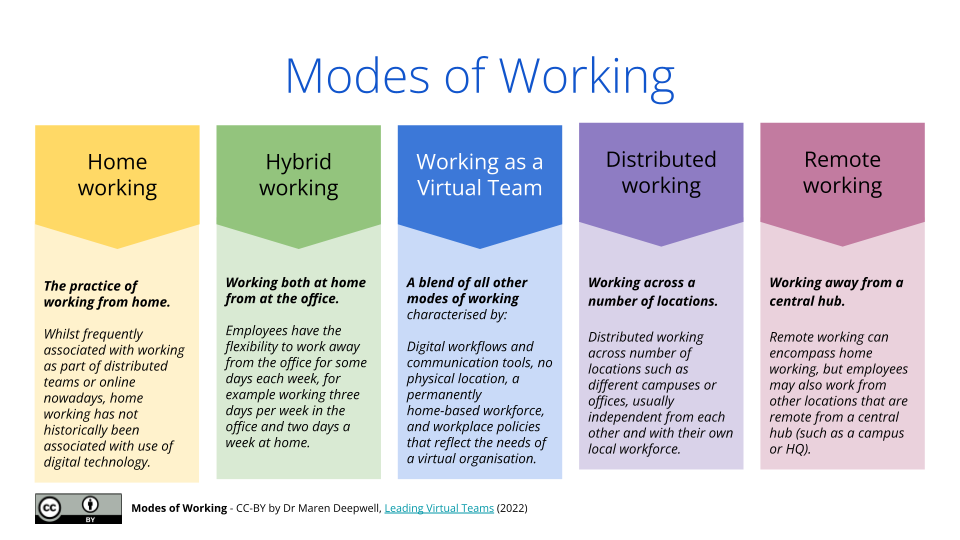
    Graphic showing an overview of different Modes of Working - CC-BY by Dr Maren Deepwell, Leading Virtual Teams (2022)

Home working: The practice of working from home.

Whilst frequently associated with working as part of distributed teams or online nowadays, home working has not historically been associated with use of digital technology. 

Hybrid working: Working both at home from at the office. 

Employees have the flexibility to work away from the office for some days each week, for example working three days per week in the office and two days a week at home. 

Working as a Virtual Team: A blend of all other modes of working characterised by:

Digital workflows and communication tools, no physical location, a permanently home-based workforce, and workplace policies that reflect the needs of a virtual organisation. 

Distributed working: Working across a number of locations. 

Distributed working across number of locations such as different campuses or offices, usually independent from each other and with their own local workforce.

Remote working: Working away from a central hub. 

Remote working can encompass home working, but employees may also work from other locations that are remote from a central hub (such as a campus or HQ).
    Graphic showing an overview of different Modes of Working – CC-BY by Dr Maren Deepwell, Leading Virtual Teams (2022)

    One of the key themes of the work I have been doing is reflecting on how the way we work impacts on us. More specifically, I am interested in how different modes of working impact on particular aspects of our lives such as physical and mental health, work/life balance or a sense of connectedness.

    Inspired by my coach training, in which our coach trainer recently asked us to practice with a coaching tool called Wheel of Life, I have adapted this coaching tool to explore different ways of working such as working from home, hybrid working,
    distributed or remote working and working in virtual teams and reflect on how the way you work impacts on you and your life.

    Here is one example focused on hybrid working:

    Example of a wheel adapted to reflect on hybrid working

    Each wheel contains eight sections, including one which is blank for you to add your own category. I have been experimenting with what categories to include based on the research I have undertaken, and the mix of what’s included changes for different modes of working.

    For hybrid working, you could reflect on and score:

    • Home working environment
    • Work/life balance
    • Physical and mental health
    • Care and family responsibilities
    • Socialising with colleagues
    • Commute
    • Office or campus work environment
    • and… a category of your choice

    Here is another example that I have completed for working as a virtual team:

    Example of a wheel with scores adapted to reflect on working in a virtual team

    In this example, I have added a lower score for “Virtual socialising with colleagues” and high scores for areas like “work/life balance” and “home working environment”.

    Try out this resource

    You can download this resource and use it or adapt it to better suit your particular needs.

    If you have any feedback or comments, I would love to hear from you. Contact me.
  • Coach in training

    Coach in training

    In January I officially started my coach training in order to become an accredited coach, an ICF Associate Certified Coach, via Katie Linder’s Higher Ed Coach Training. Having completed the first part of the course, I am about to start the next one, which will focus on coaching fundamentals in a deeper way.

    The notebook pictured above is my celebration, a gift to myself for taking this next step along the path to getting formally credentialed.

    The coach training includes formal assessment, and it’s been a while since I last had to write an assessed essay or undertake an exam! I found the experience really positive however, and appreciated that we had a number of assessment options to choose from.

    One of the options I didn’t pick was to develop new coaching tools, and whilst I didn’t do it for the assessment, it has inspired me to start designing some new tools to try out and share with my fellow coaches.

    Coaching practice

    What’s most rewarding for me about coach training is working with clients. I really enjoy working together to reflect, set new goals and find out what the next step might be. Some of the tools I have been working with include writing a personal mission or vision statement (in one sentence), which is harder than it sounds.

    I tried it out for myself, and it prompted interesting reflections for me. If you’d like to have a go yourself, start with your goal and values and try to express these in one sentence.

    Curious about coaching?

    I currently offer prop-bono coaching and discounts for paying clients as part of completing my coach training. All coaching with me includes:

    • Exploratory conversation
    • Coaching plan
    • Six 1-hour coaching sessions (online)
    • Coaching resources

    If you are interested in coaching, get in touch to arrange a free 30 min conversation to find out if coaching with me is a good fit for you.

    1-to-1 Coaching package: £210 for six sessions (normal price £420)

  • Walking into a coaching mindset

    In January I officially started my coach training in order to become an accredited coach, an ICF Associate Certified Coach, via Katie Linder’s Higher Ed Coach Training.

    We are now in Week 7 of the course and I am thoroughly enjoying it. I have learnt a lot in the first few weeks of the training, met some amazing people and started to develop a whole range of skills. It’s been a very motivating part of my practice and I find myself looking forward to each Saturday night’s session.

    Whilst the training is very comprehensive, the hours required fit well around my existing commitments, and I have been listening to readings on walks in the evening and at weekends.

    Along the way, I have set up a summary page about the work I am doing, and as my first pro-bono clients start coming on board, I have started to share coaching information and resources .

    Adopting a new mindset

    One of the things I have found the most interesting so far, is adopting a new mindset – a mindset that is focused very much on whomever I am working with. It’s fascinating to focus on not knowing the answers, but to be curious about what we might discover together.

    Curiosity is something I value highly and it’s an element of coaching that I find suits me very well. I like asking questions, and I always try to keep an open mind about what might be at the end of a thought process or a conversation, and the coach training helps me develop a new way of doing that.

    Initially I was expecting it to be challenging not to give advice or offer answers because that is often what my work requires of me day to day. But I haven’t found it to be a problem at all, quite the reverse. Focusing on my clients priorities has helped me adopt a new, a coaching mindset.

    Walking and coaching (literally)

    One idea I have had that is inspired by my previous experiences of walking line management meetings is to offer established clients I work with sessions that enable us to walk and talk. Here is what I have in mind:

    Walk with your coach

    Sometimes a video call is not the best environment to get us thinking, so for established clients I offer coaching sessions whilst we walk. Usually, this would be coaching via a phone call, but if you are based locally, we could also meet in person. Walking coaching sessions are particularly suited to think together about difficult situations or to reflect on a particular problem or idea.

  • Coaching with me… unpacked

    If you are curious to learn more about coaching with me and why I work as a coach and what motivates me, this post is for you.

    Why do I work as a coach?

    I have had excellent coaching on my journey to becoming a CEO and in the decade since. Coaching has helped me through difficult periods of transition and to make big decisions under pressure. My personal experience has given me an understanding of how powerful coaching can be and how valuable it is for developing all aspects of my professional practice and values. 

    How does this fit with being a CEO?

    Being a CEO and leading the Association for Learning Technology is a very rewarding role, which takes up a lot of my focus day to day. Over time, I have learnt that I am more effective in my role if it’s not my only priority. I like to keep learning and keep some hands on practice alongside my executive role. So for most of the past ten years, I have worked as on a free-lance basis alongside my role as a CEO, devoting a day a week to other projects, including writing my book on managing virtual teams.

    I do some coaching with organisations and teams as part of my work for ALT, specifically supporting digital transformation and strategic development. Training to become a certified coach has given me the opportunity to offer some 1-to-1 coaching alongside my day job.

    Who do I work with?

    My approach is specifically designed for professionals working in education and learning technology, with a focus on leadership and career development, managing change and creative problem solving.

    I coach early and mid career professionals who are looking to develop in their career as well as established managers seeking to move into an executive position. I am focused on helping clients develop value-led, ethical and open leadership practice.

    Is this the right fit for you?

    Coaching can bring many benefits, but it isn’t the right fit for everyone or every situation. Coaching might be a good fit if you are:

    • Looking for space to focus on an important decision or period of change.
    • Feeling stuck and struggle with productivity or specific tasks.
    • Ready to plan for the next stage in your career.
    • Looking for something to think (or draw) with to solve problems.

    Coaching offers a range of tools, resources and strategies in a creative, safe space that is focused on your needs.

    Creativity built in

    With a background in art and design, I build creativity into all aspects of my coaching practice. We might use sketch notes, visual conversations and other creative approaches as part of coaching sessions, and to help tackle any problems you bring to the session.

    What is a coaching session like?

    I offer 1-to-1 coaching for individuals, usually for six online sessions. Coaching sessions are 60 minutes long and include:

    • Setting an agenda together, defining what the session will focus on and session objectives
    • Using powerful questions, activities and resources
    • Checking in on session objectives and making a plan for next steps

    2022: Discounted and Pro Bono coaching offer

    I currently offer discounts for paying clients as part of completing my coach training.

    1-to-1 Coaching: each six sessions £210 (normal price £420)

    • Exploratory conversation
    • Coaching plan
    • Six 1-hour coaching sessions (online)
    • Coaching resources

    If you are interested in coaching, get in touch to arrange a 30 min exploratory conversation.

    For professionals who are not supported by their employer and for whom cost is a barrier to coaching, I also offer pro bono coaching sessions. If you are interested in finding out more, please contact me.

  • Coaching: Getting started

    Coaching: Getting started

    This week I am officially started my coaching certificate and I am looking forward to getting involved in the course. In order to become an accredited coach, an ICF Associate Certified Coach, I am taking part in Katie Linder’s Higher Ed Coach Training.

    After two years of very little formal CPD that didn’t have to do with charity crisis management, I am delighted to have this opportunity to learn and develop in an area of my leadership practice that I have long been passionate about: mentoring and coaching.

    A few years ago I co-authorised a series of blog posts on mentoring with my amazing former mentor Margaret Bennett, and since I have continued to develop in this area. How I feel it’s time to formalise my skills and gain more insight into coaching.

    My focus

    There are two areas I am particularly interested in: leadership and executive coaching, which is growing in particular in Higher Education, and organisational development coaching, which is focused on helping organisations with cultural change and strategic transformation.

    In my role as CEO I frequently advise and work with organisations who are seeking to develop their use of educational technology, develop and recognise staff in this area and to create a vision for their digital futures. Enhancing my skills to coach individuals and organisations through these times will add an important new skillset to the experience and expertise I have gained over the past ten years.

    Continuing to develop in an executive role

    This year is my tenth year as CEO and over the past ten years I have learnt a lot in my role. The past two years in particular have been challenging for everyone and leading my organisation through these troubled times has pushed me to develop new strategies and approaches fit for times of crisis.

    I think this year is a good moment to shift the momentum and to start to actively plan for and respond to what I see on the horizon instead of reacting to what is happening in the moment.

    Supporting women into leadership roles

    Over the past few years I have actively supported other women who are looking to advance in their careers and develop their professional practice. As part of my coaching practice I will continue to offer support women moving into management and leadership roles.

    One of the aspects of my coaching practice I will be developing this year is to offer individual and group coaching sessions, and I will be sharing further details of this later in the year.

    Professional recognition

    It’s important to recognise professional skills and expertise, and a big part of why I am spending my free time each week taking part in the course is to learn about and gain a new professional accreditation and also include it in my CMALT portfolio. I want to learn about the ethical standards and formal tools of the coaching profession alongside gaining practical knowledge about supporting the individual and organisations I work with.